

What do you think?

Days Like These: A witty, entertaining and touching alternative guide to the year in 366 poems
A brilliant way to brighten each day. In this playful, innovative collection, Brian Bilston writes a poem to accompany every day of the year.
Each poem is inspired by a significant – often curious – event associated with that from Open an Umbrella Indoors Day to the day on which New York banned public flirting; from the launch of the Rubik’s Cube to the first appearance of the phrase, ‘the best thing since sliced bread’.
Perfect for reading aloud and sharing with friends, Days Like An alternative guide to the year in 366 poems will take the blues out of Monday, flatten the Wednesday hump, and amplify that Friday feeling.
Each poem is inspired by a significant – often curious – event associated with that from Open an Umbrella Indoors Day to the day on which New York banned public flirting; from the launch of the Rubik’s Cube to the first appearance of the phrase, ‘the best thing since sliced bread’.
Perfect for reading aloud and sharing with friends, Days Like An alternative guide to the year in 366 poems will take the blues out of Monday, flatten the Wednesday hump, and amplify that Friday feeling.
521 pages, Kindle Edition
First published October 13, 2022
About the author
Brian Bilston
19 books168 followersBrian Bilston is a poet whose work has been shared widely on social media over the last few years. He has been described as the 'unofficial Poet Laureate of Twitter'.
Ratings & Reviews
Friends & Following
Create a free account to discover what your friends think of this book!
Community Reviews
Displaying 1 - 30 of 81 reviews

paused
November 10, 2022A poem a day for a year, written to fit something related to the day, whether historic, strange, or silly, as explained in a paragraph before each one.
Rolling review over the 366 days I read it.
The book starts on 1 January, but was published late October, and I'm starting on 9 November 2022, when I went to an event where Bilston read many of his poems and talked a little about himself. He did it with dry humour, as he mostly read humorous poems. However, the book includes at least one of his more political ones, which I reviewed a few months earlier: Refugees, HERE.
You can probably find the text of most of these by Googling the title and Bilston's name: he has profiles on Facebook, Twitter, Instagram, and probably elsewhere.
Bilston's poems are often fun, but I think he's at his best when he adds some snark or political satire (rare in this collection) or comes up with odd rhymes and wordplay.
12 November, King Canute died. “Not Reigning but Drowning” is a parody of Stevie Smith's famous verse.
13 November, World Kindness Day. “Kindness” imagines a pandemic of infectious kindness, in contrast to the one we were in the thick of when he wrote it. “It’s hard to argue against that - except to say that it is possible to be kind on all the other days, too.”
16 November, Dostoevsky died. In “Unfinished Poem”, he's facing a firing squad, and quick/slow thinking are key.
19 November, International Men's Day (also World Toilet Day). “Bear Wrestling” is a humorous fantasy against toxic masculinity.
21 November, World Philosophy Day. An excuse for “Nihilism Means Nothing to Me”, a poem of puns of philosophers' names. “I plato win but always lose. / Please come back. Exhume my heatre.” I thought of Monty Python's Philosophers' Song, which starts, “Immanuel Kant was a real piss-ant who was very rarely stable. / Heidegger, Heidegger was a boozy beggar who could think you under the table.” See here.
26 November, The Sex Pistols released “Anarchy in the UK”. The poem is the total opposite: “Accountancy in the UK”. Another Monty Python connection.
27 November, Shakespeare's wedding anniversary. A possible clerical error in the paperwork inspired Marriage Vows for the Uncommitted. It starts, “I pledge my undying love to you, / Insofar as it's possible to guarantee anything these days.”
28 November, Enid Blyton died. “The Final Famous Five Books” tells a story by successive titles: .
29 November, anniversary of Mary Whitehouse's clean up TV campaign. “On Profanity” makes you expect one, but delivers an innocuous word instead: “You fill our children's minds with muck / yet still you do not give a fig.”.
That was a good run. The first dozen days of December are less notable.
13 December, Samuel Johnson died. Hence “An Attempt to Write an Abecedarian Poem in Praise of the Dictionary”. Of course, it's the end that's tricky: “You'd get the better of me / Zooner or later”.
15 December, Emperor Nero born. Roman history in verse, “Julio-Claudian Clerihews”. For example, “Augustus Caesar, / a formidable geezer, / stamped out civil wars and riots. / He loved a bit of pax and quiet.”.
19 December, “A Christmas Carol” published. See my review HERE and “Tense Christmas”.

27 December, TV chef, Fannie Craddock, died. “Recipe for Midwinter Happiness”, culminating in “One good book* / * or one good lover if book not available.”
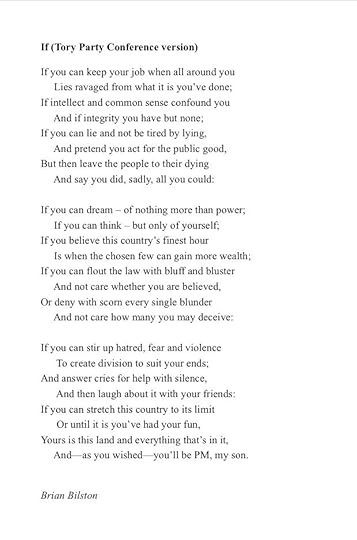
30 December, Rudyard Kipling born. Politics! “If (Conservative Party Version)”.
10 January, world’s first underground railway opened. It was the Metropolitan Line, but “Love Notes from the Underground” comprises puns using stations on many different Tube lines. “Hainault, I wasn’t Holborn yesterday / and I know you like Stanmore than me / but don’t let our futures be Edgeware, or leave me Barking up the wrong tree. / It’s true, I may not be a Richmond / but you can Bank on me.”
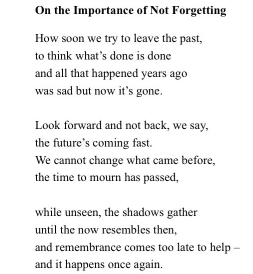
27 January, Holocaust Remembrance Day. In three short stanzas, “On the Importance of Not Forgetting” demonstrates the need to look forward as well as back.
24 February, Wilhelm Grimm born. A humorous folkloric treat, “A Few Take Home Points from Grimm’s Fairy Tales” gives life advice to avoid the fates of familiar characters. “Avoid, where possible, all houses situated in dark forests, / particularly ones owned by bears or witches / or those constructed predominantly from gingerbread.
11 March, Douglas Adams born. “To My Crinkly Slobberfrock” is meant to be worse than Vogon love poetry, but the opening reminded me more of Jabberwocky: “What swang humburgle drips from thee, / More frujious than the vimhorn tree. Then it got amusingly yucky. “Thy dropsy dewflaps splotter me, / And fruggle me with globjuice.
13 March, Open an Umbrella Indoors Day. “Consequences” dares you to defy superstition.

Bilston didn't necessarily write the poems on the days, but for them. Flicking through, I saw the poem for 18 April was written the day after the storming of the Capitol in DC on 6 January 2021.
Rolling review over the 366 days I read it.
The book starts on 1 January, but was published late October, and I'm starting on 9 November 2022, when I went to an event where Bilston read many of his poems and talked a little about himself. He did it with dry humour, as he mostly read humorous poems. However, the book includes at least one of his more political ones, which I reviewed a few months earlier: Refugees, HERE.
You can probably find the text of most of these by Googling the title and Bilston's name: he has profiles on Facebook, Twitter, Instagram, and probably elsewhere.
Bilston's poems are often fun, but I think he's at his best when he adds some snark or political satire (rare in this collection) or comes up with odd rhymes and wordplay.
12 November, King Canute died. “Not Reigning but Drowning” is a parody of Stevie Smith's famous verse.
13 November, World Kindness Day. “Kindness” imagines a pandemic of infectious kindness, in contrast to the one we were in the thick of when he wrote it. “It’s hard to argue against that - except to say that it is possible to be kind on all the other days, too.”
16 November, Dostoevsky died. In “Unfinished Poem”, he's facing a firing squad, and quick/slow thinking are key.
19 November, International Men's Day (also World Toilet Day). “Bear Wrestling” is a humorous fantasy against toxic masculinity.
21 November, World Philosophy Day. An excuse for “Nihilism Means Nothing to Me”, a poem of puns of philosophers' names. “I plato win but always lose. / Please come back. Exhume my heatre.” I thought of Monty Python's Philosophers' Song, which starts, “Immanuel Kant was a real piss-ant who was very rarely stable. / Heidegger, Heidegger was a boozy beggar who could think you under the table.” See here.
26 November, The Sex Pistols released “Anarchy in the UK”. The poem is the total opposite: “Accountancy in the UK”. Another Monty Python connection.
27 November, Shakespeare's wedding anniversary. A possible clerical error in the paperwork inspired Marriage Vows for the Uncommitted. It starts, “I pledge my undying love to you, / Insofar as it's possible to guarantee anything these days.”
28 November, Enid Blyton died. “The Final Famous Five Books” tells a story by successive titles: .
29 November, anniversary of Mary Whitehouse's clean up TV campaign. “On Profanity” makes you expect one, but delivers an innocuous word instead: “You fill our children's minds with muck / yet still you do not give a fig.”.
That was a good run. The first dozen days of December are less notable.
13 December, Samuel Johnson died. Hence “An Attempt to Write an Abecedarian Poem in Praise of the Dictionary”. Of course, it's the end that's tricky: “You'd get the better of me / Zooner or later”.
15 December, Emperor Nero born. Roman history in verse, “Julio-Claudian Clerihews”. For example, “Augustus Caesar, / a formidable geezer, / stamped out civil wars and riots. / He loved a bit of pax and quiet.”.
19 December, “A Christmas Carol” published. See my review HERE and “Tense Christmas”.
27 December, TV chef, Fannie Craddock, died. “Recipe for Midwinter Happiness”, culminating in “One good book* / * or one good lover if book not available.”
30 December, Rudyard Kipling born. Politics! “If (Conservative Party Version)”.
10 January, world’s first underground railway opened. It was the Metropolitan Line, but “Love Notes from the Underground” comprises puns using stations on many different Tube lines. “Hainault, I wasn’t Holborn yesterday / and I know you like Stanmore than me / but don’t let our futures be Edgeware, or leave me Barking up the wrong tree. / It’s true, I may not be a Richmond / but you can Bank on me.”
27 January, Holocaust Remembrance Day. In three short stanzas, “On the Importance of Not Forgetting” demonstrates the need to look forward as well as back.
24 February, Wilhelm Grimm born. A humorous folkloric treat, “A Few Take Home Points from Grimm’s Fairy Tales” gives life advice to avoid the fates of familiar characters. “Avoid, where possible, all houses situated in dark forests, / particularly ones owned by bears or witches / or those constructed predominantly from gingerbread.
11 March, Douglas Adams born. “To My Crinkly Slobberfrock” is meant to be worse than Vogon love poetry, but the opening reminded me more of Jabberwocky: “What swang humburgle drips from thee, / More frujious than the vimhorn tree. Then it got amusingly yucky. “Thy dropsy dewflaps splotter me, / And fruggle me with globjuice.
13 March, Open an Umbrella Indoors Day. “Consequences” dares you to defy superstition.
Bilston didn't necessarily write the poems on the days, but for them. Flicking through, I saw the poem for 18 April was written the day after the storming of the Capitol in DC on 6 January 2021.
October 15, 2022
When a poet publishes a wrist-wrecker, it’s usually a Collected Poems. This volume, weighing in at 516 pages, represents only Brian Bilston’s third collection of poems for adults, closely following his second, published only last year.
Since then he has set himself the task of writing a poem a day for each day of the year. This is more flexible than it sounds - poems about the Ides of March, Halloween and Remembrance Day jostle next to poems about historical events both big and small - the Boston Tea Party, the birth of King Canute (title: ‘Not Reigning but Drowning’), the release of Abbey Road, and the day the first loaf of sliced bread was sold.
Bilston has been called the Poet Laureate of twitter, where his poems initially appear. Few contemporary poets can match his audience - over 300,000 followers. This social-media fed career has allowed Bilston to slip under the ‘Keep Orf’ sign erected around the London poetry world. Whether this has been a wholly good thing is a poser. Suffice to say it has worked for Bilston. His first collection was crowdfunded via Unbound and met its target in only three days. I imagine a lot of the discussion around Bilston’s work centres on his unique position vis a vis his audience. Some poems were inspired by topical events and, he claims, were written and published the same day. This risks obsolescence in the pursuit of freshness and is probably held against him in some quarters. Critics prefer poets to be as costive as Philip Larkin, who published a wire-thin collection roughly once a decade.
Does more mean worse? I think it’s fair to say the collection is uneven - much like the days of the year. For every public holiday there are a dozen drizzly Thursdays. Some are short and feel more dutiful than inspired. The most successful poems all spring from inner compulsion. His favourite themes are the awfulness of Tory politicians, the unexpected perspective, and moral responsibility. ‘Independence Day’ is his secret manifesto with its call to ‘form the independent republic of myself’ free from inept governments, influencers, pedants and queue-jumpers. He likes the overlooked and the snubbed. ‘The Clown Next Door’ sets out to redeem the image of its subject from horror films. ‘Love My Tinder’ is a forlorn love letter from the dating app itself; ‘The Iceberg Cometh’ is the mea culpa of the Titanic’s killer told directly to the audience.
I wonder if Bilston’s background - born in Birmingham in the 70s, a lifelong Birmingham City Fan - gives him an edge in the field of overlooked perspectives. He knows what a KPI is, and the baffling waste that is office work at first-hand. More published poets should have a biography like his. Bilston has a voice: educated but not pedantic, fast but not glib, unfussy yet concerned, and interested in everything that comes his way.
Puncturing pomp is another of his abiding concerns. ‘If (Conservative Party Version)’ is THE great pandemic poem, wittily inverting Kipling as it eviscerates government incompetence. ‘It’s Baking in Here’ gets its charge from sending up the smugness and platitudes consecrated in The Great British Bake Off. Bilston moves from the macro to the micro with envying skill, and without shedding his quotability.
In many ways this book feels like the end of an artistic period. My crystal ball is faulty, but my guess is from here on Bilston’s collections will grow thinner, more personal, and more powerful. To date, ‘Refugees’ is still his signature piece. My hunch is this gifted poet’s best is still ahead of him. When he slows down and steers closer to his inner coordinates, he may well become unstoppable.
Since then he has set himself the task of writing a poem a day for each day of the year. This is more flexible than it sounds - poems about the Ides of March, Halloween and Remembrance Day jostle next to poems about historical events both big and small - the Boston Tea Party, the birth of King Canute (title: ‘Not Reigning but Drowning’), the release of Abbey Road, and the day the first loaf of sliced bread was sold.
Bilston has been called the Poet Laureate of twitter, where his poems initially appear. Few contemporary poets can match his audience - over 300,000 followers. This social-media fed career has allowed Bilston to slip under the ‘Keep Orf’ sign erected around the London poetry world. Whether this has been a wholly good thing is a poser. Suffice to say it has worked for Bilston. His first collection was crowdfunded via Unbound and met its target in only three days. I imagine a lot of the discussion around Bilston’s work centres on his unique position vis a vis his audience. Some poems were inspired by topical events and, he claims, were written and published the same day. This risks obsolescence in the pursuit of freshness and is probably held against him in some quarters. Critics prefer poets to be as costive as Philip Larkin, who published a wire-thin collection roughly once a decade.
Does more mean worse? I think it’s fair to say the collection is uneven - much like the days of the year. For every public holiday there are a dozen drizzly Thursdays. Some are short and feel more dutiful than inspired. The most successful poems all spring from inner compulsion. His favourite themes are the awfulness of Tory politicians, the unexpected perspective, and moral responsibility. ‘Independence Day’ is his secret manifesto with its call to ‘form the independent republic of myself’ free from inept governments, influencers, pedants and queue-jumpers. He likes the overlooked and the snubbed. ‘The Clown Next Door’ sets out to redeem the image of its subject from horror films. ‘Love My Tinder’ is a forlorn love letter from the dating app itself; ‘The Iceberg Cometh’ is the mea culpa of the Titanic’s killer told directly to the audience.
I wonder if Bilston’s background - born in Birmingham in the 70s, a lifelong Birmingham City Fan - gives him an edge in the field of overlooked perspectives. He knows what a KPI is, and the baffling waste that is office work at first-hand. More published poets should have a biography like his. Bilston has a voice: educated but not pedantic, fast but not glib, unfussy yet concerned, and interested in everything that comes his way.
Puncturing pomp is another of his abiding concerns. ‘If (Conservative Party Version)’ is THE great pandemic poem, wittily inverting Kipling as it eviscerates government incompetence. ‘It’s Baking in Here’ gets its charge from sending up the smugness and platitudes consecrated in The Great British Bake Off. Bilston moves from the macro to the micro with envying skill, and without shedding his quotability.
In many ways this book feels like the end of an artistic period. My crystal ball is faulty, but my guess is from here on Bilston’s collections will grow thinner, more personal, and more powerful. To date, ‘Refugees’ is still his signature piece. My hunch is this gifted poet’s best is still ahead of him. When he slows down and steers closer to his inner coordinates, he may well become unstoppable.

November 24, 2022
I like Brian Bilston. He really does have a poem for all occasions. However I did struggle with a full year's worth in one go.
This collection seems to be designed to be read across any contemporary year, presumably day by day. There are poems here that are very much about COVID and Conservative government which I suspect will date it in years to come, but Days Like These still caters to all poetic tastes including cheeky couplets, familiar forms, reinterpreted song lyrics and personal free verse. While I didn't enjoy every poem he shares in this collection, I did appreciate Bilston's consistent sense of humour and eye for wordplay.
My main sticking point is that, in the later months, he uses a lot of poems I recognised from You Caught the Last Bus Home and social media. While I imagine writing 366 print-ready poems in one year isn't entirely realistic, I couldn't help but feel cheated. Also I noticed patterns in Bilston's style which irked me, such as two poems shaped like trees that involve scattered words. Such literary tricks are more effective when used once.
However, peering into Bilston's writing life like this also reminded me of how adaptable his style is and where his true passions lie. His poems about wildlife and extinction consistently moved me and his literary satire appealed to my bookish nature.
Days Like These is a triumph that I felt could be more triumphant but that is quite forgivable. I recommend it to fans of Bilston's verse and those who would like to read an amusing and/or thought-provoking poem every day of the coming year.
Notable Poems
• Queueing for an Ice Cream (6th June) – a fine example of Bilston’s autobiographical efforts, focusing on his grandad’s D-Day memories.
• A Song Heard Backwards (14th August) – a descriptive reverse history of how music reached the masses and still moves the individual.
• Remember, Remember (4th November) – Bilston at his silliest whilst also craftily pointing out the recurring patterns of nursery rhymes.
This collection seems to be designed to be read across any contemporary year, presumably day by day. There are poems here that are very much about COVID and Conservative government which I suspect will date it in years to come, but Days Like These still caters to all poetic tastes including cheeky couplets, familiar forms, reinterpreted song lyrics and personal free verse. While I didn't enjoy every poem he shares in this collection, I did appreciate Bilston's consistent sense of humour and eye for wordplay.
My main sticking point is that, in the later months, he uses a lot of poems I recognised from You Caught the Last Bus Home and social media. While I imagine writing 366 print-ready poems in one year isn't entirely realistic, I couldn't help but feel cheated. Also I noticed patterns in Bilston's style which irked me, such as two poems shaped like trees that involve scattered words. Such literary tricks are more effective when used once.
However, peering into Bilston's writing life like this also reminded me of how adaptable his style is and where his true passions lie. His poems about wildlife and extinction consistently moved me and his literary satire appealed to my bookish nature.
Days Like These is a triumph that I felt could be more triumphant but that is quite forgivable. I recommend it to fans of Bilston's verse and those who would like to read an amusing and/or thought-provoking poem every day of the coming year.
Notable Poems
• Queueing for an Ice Cream (6th June) – a fine example of Bilston’s autobiographical efforts, focusing on his grandad’s D-Day memories.
• A Song Heard Backwards (14th August) – a descriptive reverse history of how music reached the masses and still moves the individual.
• Remember, Remember (4th November) – Bilston at his silliest whilst also craftily pointing out the recurring patterns of nursery rhymes.

January 1, 2025
No complaints. I read it over the full year and it’s delightful.

October 21, 2023
Brilliantly written poems with satisfying wordplay, each relating to a day in history, or a day such as National Relaxation Day (15th August). I went to see Brian Bilston in Chorley Little Theatre and bought the book which he kindly signed for me on my birthday page. The poem is called Nominative Determinism and is about Ivan the Terrible and how he might have turned out differently had he been called something less inflammatory. He signed it to Deb the not so Terrible, which pleased me no end, though I did catch Covid, quite possibly from him.

May 15, 2024
'Days Like These: An Alternative Guide to the Year in 366 Poems' (2022) - is a collection of poems by the 'unofficial poet laureate of Twitter' Brian Bilston.
As the title would suggest, there's a poem for every day of the year, along with accompanying text regarding an interesting fact of relevance to that particular day.
This is the first Bilston that I've read and it's a lovely collection of poems, often funny, clever, pertinent, intelligently delivered and occasionally moving.
I'm presuming that the premise of this collection is that it is read one poem per day throughout the year, however I read them all within a week and very satisfying it was too.
As the title would suggest, there's a poem for every day of the year, along with accompanying text regarding an interesting fact of relevance to that particular day.
This is the first Bilston that I've read and it's a lovely collection of poems, often funny, clever, pertinent, intelligently delivered and occasionally moving.
I'm presuming that the premise of this collection is that it is read one poem per day throughout the year, however I read them all within a week and very satisfying it was too.

June 6, 2025
If there were a Nobel prize for puns, there'd be no point applying because Brian Bilston (not his 'spoonery' namesake Bill Bryson) has already got it and he's running like a bandit.
These poems bend and flex language and derive meaning out of almost nothing. One poem describes a man listening to a blotch of mold on his bedroom wall...but he stopped because it was only talking rot.
These poems bend and flex language and derive meaning out of almost nothing. One poem describes a man listening to a blotch of mold on his bedroom wall...but he stopped because it was only talking rot.

July 13, 2024
3.5 stars
An eclectic mix of poems - some good, some bad - worth a look. A boom you can dip in and out of. You can either read a poem a day and finish the book in a year; or you can read multiple poems each day for a quicker read.
An eclectic mix of poems - some good, some bad - worth a look. A boom you can dip in and out of. You can either read a poem a day and finish the book in a year; or you can read multiple poems each day for a quicker read.

December 31, 2023
Starting each day with a Brian Bilston poem has been an absolute joy. I'm really going to miss them! Highly recommend this collection.

December 31, 2024
Fabulous!
April 20, 2025
I tip my hat to Bilston: writing 366 poems, one a day for a leap year, is some feat. (Keats wrote (or published) only 54 in his lifetime, as a comparison.) Each poem addresses a certain theme or topic-of-the-day, as laid out by Bilston in short preambles. As you might imagine across such a large number of poems, while the majority are good reads, there are inevitably some which don't work as well as others, and some which are no more than snippets or couplets. Bilston is at his best when he injects some humour in to his poems, less so when he tackles more sensitive or serious topics. Who am I to complain, though? I thought about writing this review as a poem, in a tribute to Bilston, but was just overwhelmed and didn't know where to start - so it's not easy, and his poems achieved a high success rate for this reader. Overall, this book is an admirable achievement and an entertaining, never-boring read, probably a 3.5 out of 5 for me.

December 31, 2024
A joyous collection of poems, one per day, recognising various anniversaries, both serious and trivial. Some definitely feel like padding, perhaps unsurprisingly. But the collection as a whole is wonderful.

December 31, 2025
A wonderful collection of poems from the serious to the silly, from thought provoking to hilariously funny and all mixed with history for each day.
March 4, 2026
Such a fun book to read once a day. Lots of laugh out loud moments and lots of clever reflections from Brian who appears to be an all round good egg

July 28, 2026
I bought this for one poem - Refugees. What I got was a poem a day for the entire year. Most of these poems are brief, there is whimsy and playfulness as well as the occasional burst of sarcasm or anger.
All in all a good read. Recommended.
All in all a good read. Recommended.

December 31, 2024
52 Book Club Reading Mini-Challenge- Prompt: Time Loop
3.5/5*
3.5/5*

December 31, 2024
I have thoroughly enjoyed reading a poem a day, or catching up with a few on days I missed. I can’t believe 2024 is at and end, but here’s to 2025 and I’m on the look out for a similar daily read!
March 18, 2025
A wonderful collection of poetry from Brian Bilston (aka the Banksy of Poetry) comprising a poem for each day of the year that marks an event associated with that day. The poems vary in style and length but each one is a delight as is the introduction to each day's subject. A useful resource and all I could want from a collection of poetry.

January 1, 2025
A lovely and often funny companion to have throughout the year.

September 21, 2024
Brian Bilston has been described as “the poet laureate of Twitter”, a distinction which perhaps loses some of its shine when you remember what happened to Twitter. But in any case, I always saw more of his stuff being shared by people on Facebook.
Days Like These is a collection of Bilston’s poetry in which there’s a poem for every single day of the year, with Bilston doing his best to tie his poems into those days. Sometimes it’s something as arbitrary as National Hot Chocolate Day (I’m making that up but I bet it exists). Other times, it’s the more obvious stuff, such as poems that are themed around Easter or the changing of the seasons.
Alongside the poetry, Bilston also provides a short introduction to each poem that helps to place it into context and give you a clearer idea of the circumstances in which it was written. That’s important, because we have to remember that the majority of these poems were written with social media publication in mind. They were literally tailored towards the days they were published on.
Of course, the nature of this book also means that there are different ways you can approach it. You could read one poem a day, savouring the book for a whole year, or you could do what I did and read it over a couple of days, a hundred poems or so at a time.
It’s actually quite a substantial tome for a poetry book, and I think that adds to its appeal. I’m used to poetry collections that you can read through in an hour or so, and so it was a joy to pick up something I could get properly stuck into.
I’ve previously read Bilston’s You Took the Last Bus Home, and I’d have to say that I enjoyed that a little more than this one. Nevertheless, I’m pleased to have picked up both of them and I plan to read more of Bilston’s work when I get a chance. There’s also the fact that because he’s so prolific on social media, you can check out plenty of his work for free.
That’s pretty much all I have to say about this one, which causes me something of a problem because I need to hit 540 words to satisfy my rule of making sure that my reviews have the same number of words as the books have pages.
Still, suffice to say that I was pretty happy with this one and that I’d definitely recommend picking it up if you get a chance, especially if you can find a cheap copy in a charity shop like I did. Brian Bilston is the closest thing we have to a poet for the masses in today’s day and age, and while I don’t necessarily always like his work, that’s inevitable with poetry.
For me, Bilston has something around a 70% success rate, which actually puts him somewhere in my top ten poets or so. And if nothing else, that statistic shows just how hard to please I can be when it comes to reading poetry.
Days Like These is a collection of Bilston’s poetry in which there’s a poem for every single day of the year, with Bilston doing his best to tie his poems into those days. Sometimes it’s something as arbitrary as National Hot Chocolate Day (I’m making that up but I bet it exists). Other times, it’s the more obvious stuff, such as poems that are themed around Easter or the changing of the seasons.
Alongside the poetry, Bilston also provides a short introduction to each poem that helps to place it into context and give you a clearer idea of the circumstances in which it was written. That’s important, because we have to remember that the majority of these poems were written with social media publication in mind. They were literally tailored towards the days they were published on.
Of course, the nature of this book also means that there are different ways you can approach it. You could read one poem a day, savouring the book for a whole year, or you could do what I did and read it over a couple of days, a hundred poems or so at a time.
It’s actually quite a substantial tome for a poetry book, and I think that adds to its appeal. I’m used to poetry collections that you can read through in an hour or so, and so it was a joy to pick up something I could get properly stuck into.
I’ve previously read Bilston’s You Took the Last Bus Home, and I’d have to say that I enjoyed that a little more than this one. Nevertheless, I’m pleased to have picked up both of them and I plan to read more of Bilston’s work when I get a chance. There’s also the fact that because he’s so prolific on social media, you can check out plenty of his work for free.
That’s pretty much all I have to say about this one, which causes me something of a problem because I need to hit 540 words to satisfy my rule of making sure that my reviews have the same number of words as the books have pages.
Still, suffice to say that I was pretty happy with this one and that I’d definitely recommend picking it up if you get a chance, especially if you can find a cheap copy in a charity shop like I did. Brian Bilston is the closest thing we have to a poet for the masses in today’s day and age, and while I don’t necessarily always like his work, that’s inevitable with poetry.
For me, Bilston has something around a 70% success rate, which actually puts him somewhere in my top ten poets or so. And if nothing else, that statistic shows just how hard to please I can be when it comes to reading poetry.

March 4, 2024
Last year I was given a copy of Days Like These by Brian Bilston for my birthday and I have now completed the book! I have enjoyed my daily reading of the poems which have been entertaining, funny, moving and poignant depending on the theme of the day.
Each day has a different focus from well known days such as Burns Night, Valentine’s Day, Hallowe’en and Christmas to lesser known days such as Random Acts of Kindness Day on 17th February or National Relaxation Day which occurs on 15th August. There is sometimes a focus on historical events such as 6th May, the day when the Channel Tunnel opened in 1994, or 6th August which marks the day that the US dropped an atomic bomb on Hiroshima. Sometimes famous people are commemorated such as on 8th May which is David Attenborough’s birthday or 17th June, the day that Charles Macintosh patented the waterproof cloth then used to make rain-macs. Author Bill Bryson’s birthday on 8th December is marked with an amusing poem about how his name is quite similar to Brian Bilston’s and has occasionally caused confusion! And this year of course, it was appropriate to read the poem for 29th February called An Extra Day filled with all kinds of things you might do with your extra day!
In case you are wondering, my birthday (5th March) is the day that Dutch painter Jan van der Heyden was born in 1637. As well as being an artist he was also a draughtsman, a printmaker, an engineer and an inventor. Among the things he invented was the firehose. He wrote a firefighting manual and re-organised the Dutch fire-brigade. A multi-talented person for sure! So the poem for today is called Uncharted Waters and is about putting out fires.
I thoroughly enjoyed reading my way through the year one poem at a time. If you are someone who thinks they might want to read a bit more poetry but aren’t really sure where to start, then I’d highly recommend this very readable and entertaining collection.
Each day has a different focus from well known days such as Burns Night, Valentine’s Day, Hallowe’en and Christmas to lesser known days such as Random Acts of Kindness Day on 17th February or National Relaxation Day which occurs on 15th August. There is sometimes a focus on historical events such as 6th May, the day when the Channel Tunnel opened in 1994, or 6th August which marks the day that the US dropped an atomic bomb on Hiroshima. Sometimes famous people are commemorated such as on 8th May which is David Attenborough’s birthday or 17th June, the day that Charles Macintosh patented the waterproof cloth then used to make rain-macs. Author Bill Bryson’s birthday on 8th December is marked with an amusing poem about how his name is quite similar to Brian Bilston’s and has occasionally caused confusion! And this year of course, it was appropriate to read the poem for 29th February called An Extra Day filled with all kinds of things you might do with your extra day!
In case you are wondering, my birthday (5th March) is the day that Dutch painter Jan van der Heyden was born in 1637. As well as being an artist he was also a draughtsman, a printmaker, an engineer and an inventor. Among the things he invented was the firehose. He wrote a firefighting manual and re-organised the Dutch fire-brigade. A multi-talented person for sure! So the poem for today is called Uncharted Waters and is about putting out fires.
I thoroughly enjoyed reading my way through the year one poem at a time. If you are someone who thinks they might want to read a bit more poetry but aren’t really sure where to start, then I’d highly recommend this very readable and entertaining collection.

December 31, 2025
I love Brian Bilston's poems very much. This is one of the only poetry collections that actually had me laughing out loud. It was great that he also gave a bit of information before each of his poems. Below I'm going to show all of my favorite poems throughout the year. There are a lot of them. Such a wonderful collection that I know I will pick up in years to come. I highly recommend this book!
Favorite Poems:
~ January 14th- "Ch-Ch-Ch-Changes"
~ January 31st- "Mnemonic"
~ February 1st- "A-Ant: An Analysis"
~ February 2nd- "Groundhog Day"
~ February 16th- "Tutankhamun"
~ February 24th- "A Few Take Home Points from Grimm's Fairy Tales"
~ February 25th- "Flippin' Eck"
~ February 28th- "Selected Entries from Bilston's Dictionary of Non-Existent Words"
~ March 10th- "It's Time to Complete Your Census Questionnaire"
~ March 11th- "To My Crinkly Slobberfrock"
~ March 21st- "Selected Early Writings of the Poets"
~ April 2nd- "The Very Angry Caterpillar"
~ April 9th- "Departure Day"
~ April 17th- "2020: A Year in Haiku"
~ April 23rd- "The Very Condensed Shakespeare"
~ April 24th- "The Fall of Troy"
~ May 4th- "Love Duet for Wookie and Droid"
~ May 19th- "Mnemonic to aid understanding of the role of Anne Boleyn in Succession Crisis of Henry VIII"
~ June 6th- "Queueing for an Ice Cream"
~ July 17th- Funeral Blues Emoji rendering
~ August 10th- "He Wishes for the Millennium Falcon Lego Set"
~ September 18th- "Imaginary Rock God Blues"
~ September 21st- "You're Getting to be a Hobbit with Me"
~ September 22nd- "The Problem of Writing Poems in the Shape of Deciduous Trees"
~ October 3rd- "Poetry Festival: Advice for Residents"
~ October 4th- "animals"
~ October 5th- "Teachers"
~ October 8th- "Don't Go Breaking My Hearts"
~ October 17th- "Love Excels"
~ October 24th- "I Still Survive"
~ November 23rd- "Word Crunching"
~ December 19th- "Tense Christmas"
~ December 21st- "Mope About (4)
Favorite Poems:
~ January 14th- "Ch-Ch-Ch-Changes"
~ January 31st- "Mnemonic"
~ February 1st- "A-Ant: An Analysis"
~ February 2nd- "Groundhog Day"
~ February 16th- "Tutankhamun"
~ February 24th- "A Few Take Home Points from Grimm's Fairy Tales"
~ February 25th- "Flippin' Eck"
~ February 28th- "Selected Entries from Bilston's Dictionary of Non-Existent Words"
~ March 10th- "It's Time to Complete Your Census Questionnaire"
~ March 11th- "To My Crinkly Slobberfrock"
~ March 21st- "Selected Early Writings of the Poets"
~ April 2nd- "The Very Angry Caterpillar"
~ April 9th- "Departure Day"
~ April 17th- "2020: A Year in Haiku"
~ April 23rd- "The Very Condensed Shakespeare"
~ April 24th- "The Fall of Troy"
~ May 4th- "Love Duet for Wookie and Droid"
~ May 19th- "Mnemonic to aid understanding of the role of Anne Boleyn in Succession Crisis of Henry VIII"
~ June 6th- "Queueing for an Ice Cream"
~ July 17th- Funeral Blues Emoji rendering
~ August 10th- "He Wishes for the Millennium Falcon Lego Set"
~ September 18th- "Imaginary Rock God Blues"
~ September 21st- "You're Getting to be a Hobbit with Me"
~ September 22nd- "The Problem of Writing Poems in the Shape of Deciduous Trees"
~ October 3rd- "Poetry Festival: Advice for Residents"
~ October 4th- "animals"
~ October 5th- "Teachers"
~ October 8th- "Don't Go Breaking My Hearts"
~ October 17th- "Love Excels"
~ October 24th- "I Still Survive"
~ November 23rd- "Word Crunching"
~ December 19th- "Tense Christmas"
~ December 21st- "Mope About (4)

November 2, 2023
Witty, original and never-endingly varied.
I promised myself when I got my (signed at an event!!) copy, I'd read one a day over the year. And I'm mostly keeping to that, but thought I could still give my thoughts on it a few months early.
(edit: several months later - I've finished and the following all still applies!)
Well Brian. I'm still as wildly jealous of your talent as ever, in awe of your ability to gracefully move between styles so varied, to play with form as well as words. And I'm entertained every single morning with both the poems and the stories behind them.
The author has taken as his inspiration one significant event for every day of the year and crafted a poem around it, also given interesting and amusing details about the date in question.
So I managed to laugh myself a little silly on Groundhog Day (February 2nd). A little lump in the throat on Michael Bond's birthday with Paddington in sight. Got tongue-twisted on Thesaurus Day (18th January), made my bloke snort with The Final Famous Five Books on Enid Blyton's deathday. And felt a bit Churchill-y narrating for him Kipling's unwritten version of If with Boris in mind. And that's just from 4 months of reading. (Edit - 12 months and I'm even more jealous of your talent and ready for the next book of poems)
Genius. Relevant. Bl**dy good.
I promised myself when I got my (signed at an event!!) copy, I'd read one a day over the year. And I'm mostly keeping to that, but thought I could still give my thoughts on it a few months early.
(edit: several months later - I've finished and the following all still applies!)
Well Brian. I'm still as wildly jealous of your talent as ever, in awe of your ability to gracefully move between styles so varied, to play with form as well as words. And I'm entertained every single morning with both the poems and the stories behind them.
The author has taken as his inspiration one significant event for every day of the year and crafted a poem around it, also given interesting and amusing details about the date in question.
So I managed to laugh myself a little silly on Groundhog Day (February 2nd). A little lump in the throat on Michael Bond's birthday with Paddington in sight. Got tongue-twisted on Thesaurus Day (18th January), made my bloke snort with The Final Famous Five Books on Enid Blyton's deathday. And felt a bit Churchill-y narrating for him Kipling's unwritten version of If with Boris in mind. And that's just from 4 months of reading. (Edit - 12 months and I'm even more jealous of your talent and ready for the next book of poems)
Genius. Relevant. Bl**dy good.

April 8, 2025
After seeing Brian Bilston's poems on facebook, I got 2 of his books. The first one I reviewed a while ago. This one was a bigger volume, but no better for it.
The book is structured as a kind of diary, with each day being notable for something, be it a birthday of someone famous, a historical date or a day put aside for something. Each day's poem is preceeded by some information to introduce said poem. The tidbits are sometimes quite interesting. For instance, I never knew Agatha Christie was a pioneer of surfing (I know! Look it up).
Sadly, for me (and I seem to be in the minority), the poems themselves often seem forced, and some of them are just twaddle. Many are clever, but not entertaining, funny or thought provoking, and some are obviously rattled off because he had nothing else to say.
I was very disappointed. It gets 2 stars because some of the anecdotes are amusing and every 20-or-so poems there is one which raises a slight smile or makes you think.
I've come to the conclusion that if you stay on facebook and follow Bilston then you won't see much better of his stuff.
The book is structured as a kind of diary, with each day being notable for something, be it a birthday of someone famous, a historical date or a day put aside for something. Each day's poem is preceeded by some information to introduce said poem. The tidbits are sometimes quite interesting. For instance, I never knew Agatha Christie was a pioneer of surfing (I know! Look it up).
Sadly, for me (and I seem to be in the minority), the poems themselves often seem forced, and some of them are just twaddle. Many are clever, but not entertaining, funny or thought provoking, and some are obviously rattled off because he had nothing else to say.
I was very disappointed. It gets 2 stars because some of the anecdotes are amusing and every 20-or-so poems there is one which raises a slight smile or makes you think.
I've come to the conclusion that if you stay on facebook and follow Bilston then you won't see much better of his stuff.
June 10, 2025
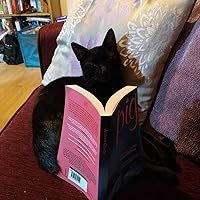
This review has been brought to you by my cat, Ruben AKA 'Smelly Cat'.
'My member of staff chuckled and cried her way through this chunk of a book (not as chunky as me in my winter fur coat though).
I barely got a stroke out of her at bedtime because she was as engrossed in this book as me watching my next catch of the day out of the bedroom window. She didn't even notice me drink from her glass of water on her bedside cabinet. Mmm.
Apparently, there's a fact for each day of the year and then a poem about the fact. There's even one on MY birthday (15 September, presents appreciated). The facts are as entertainingly written as the poem, according to her. So the other member of staff, that steals my sleep spot, might learn something other than football and fast cars. Meow!
She said she's even met the author. He's very nice and likes cats too. Yawn.
Now she's finished reading it, I find it a splendid perch to sit on while waiting for treats. Yess.'
PS from the owner of Smelly Cat: you don't have to own a cat to like this book.
'My member of staff chuckled and cried her way through this chunk of a book (not as chunky as me in my winter fur coat though).
I barely got a stroke out of her at bedtime because she was as engrossed in this book as me watching my next catch of the day out of the bedroom window. She didn't even notice me drink from her glass of water on her bedside cabinet. Mmm.
Apparently, there's a fact for each day of the year and then a poem about the fact. There's even one on MY birthday (15 September, presents appreciated). The facts are as entertainingly written as the poem, according to her. So the other member of staff, that steals my sleep spot, might learn something other than football and fast cars. Meow!
She said she's even met the author. He's very nice and likes cats too. Yawn.
Now she's finished reading it, I find it a splendid perch to sit on while waiting for treats. Yess.'
PS from the owner of Smelly Cat: you don't have to own a cat to like this book.

September 11, 2025
As you'd expect, a book that's very very mixed in quality. From the excellent (such as the last two in the collection: Kipling's 'If' done to apply to the Conservative Party, and on New Year's Eve 'This was the year that was NOT the year'). But far too often the poems are simply prose broken down into uneven lines - with no attempt at being poetic - or have nothing really to do with the day in question.
I started the book trying to read one poem a day on the day it related to - but quickly I dropped behind, so I then tried to get ahead, by reading a week's worth in one go, but eventually I decided to read on to the end.
So, okay, but very variable.
I started the book trying to read one poem a day on the day it related to - but quickly I dropped behind, so I then tried to get ahead, by reading a week's worth in one go, but eventually I decided to read on to the end.
So, okay, but very variable.
December 31, 2023
I was introduced to this poet thanks to social media ( yes a power of good for once- what debateable ? Just read some of Brian's poems on the state of the world ). Yes he is Brian to me as I have spent every day of 2023 with him.
As with any collection, some poems make you happy, some make you perplexed, some make you LOL and some make you uncomfortable , as they should.
A poem for a day with a fact for that date, some which leach into the poem.
I bought this for my nephew, and his father has nicked it already !!
As with any collection, some poems make you happy, some make you perplexed, some make you LOL and some make you uncomfortable , as they should.
A poem for a day with a fact for that date, some which leach into the poem.
I bought this for my nephew, and his father has nicked it already !!

December 31, 2024
Yes, a book that took me an entire year to read. But this was on purpose. A poem a day for an entire year, and yes that includes Feb 29th.
Each day has a new poem, either based on something that happened that day, or on a random thought of the day. So for my birthday, a poem on Mnemonics, on my wedding anniversary a poem on the founding of the BBC.
It can go from the humorous, to the political, to the heart-breaking. I'll miss doing this every day, unless of course I start from the beginning again.
Each day has a new poem, either based on something that happened that day, or on a random thought of the day. So for my birthday, a poem on Mnemonics, on my wedding anniversary a poem on the founding of the BBC.
It can go from the humorous, to the political, to the heart-breaking. I'll miss doing this every day, unless of course I start from the beginning again.
November 1, 2025
I like poems that are easy to read and you can tell what the writer is trying to say. These fit that nicely. He also seems to have good morals, which is not a must for poems, but it means you can read it without feeling guilty. I will look out for his other books in future.
I found some of them better than others and they can start to feel a bit samey if you read too many in one go. That is my fault for reading the book wrongly though, because it is supposed to be one per day during the year, not for binge-reading.
I found some of them better than others and they can start to feel a bit samey if you read too many in one go. That is my fault for reading the book wrongly though, because it is supposed to be one per day during the year, not for binge-reading.

Read
October 1, 2026I do love Bilston's stuff... funny and clever without being pretentious, and luke a box of chicolates, I couldn't limit myself to just one per day, so I started after the year began, and have finished well before its end. However, this collection is more variable in quality than his shorter collections, probably with the pressure of having to fill each and every day of the year. A heavier reliance on puns than normal and some seemed shoe-horned in to face the day, but there are still a number I suspect I will be quoting for years to come.
Displaying 1 - 30 of 81 reviews