Hans Ludwig Cohn Jaffe was born as the son of Jewish parents. He married Elly Jaffe Freem on August 16, 1947 in Lucerne. After his graduation at the Goethe-Gymnasium in January 1933 moved Hans Jaffe in connection with the seizure of power by Adolf Hitler in Germany, to Amsterdam. Here he studied art history and after his bachelor's degree assistant Johan Quirijn of Regteren Altena, curator at the Municipal Museum of Amsterdam. In 1936 his first catalog was created, titled Two centuries of British Art. After completing his studies in 1938 he started his journalistic career at The Green Amsterdam. Jaffe also taught several years of art history at the Art School in New Amsterdam, a school that worked according to the methods of the German Bauhaus. From 1940 to 1942 Jaffe did resistance work. In 1942 he fled to England via France and Switzerland. In 1945 he was commissioned to identify. Dutch art From 1947 to 1961, Jaffe attached to the Stedelijk Museum Amsterdam, first as curator and later as Deputy Director. After obtaining his PhD in 1956 on De Stijl in 1958 he was a private tutor at the University Of Amsterdam. From 1963 to 1976 he was director of the Jewish Historical Museum in Amsterdam.
This coffee table book authored by 20th century art expert Hans Ludwig Cohn Jaffé provides readers with a complete survey and overview of the life and times and artistic development of Dutch artist Piet Mondrian (1872-1944). Included also is Jaffé's detailed commentary on nearly forty individual Mondrian paintings, beginning with a self-portrait, landscapes, trees, windmills and ending with the artist’s signature abstracts, each painting reproduced in color and on its own page.
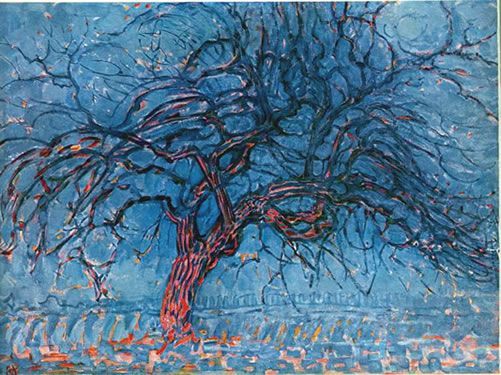
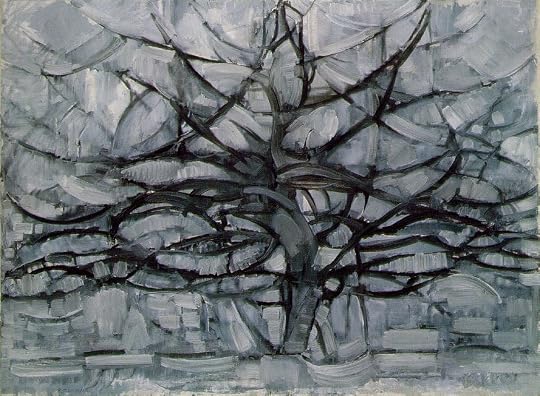
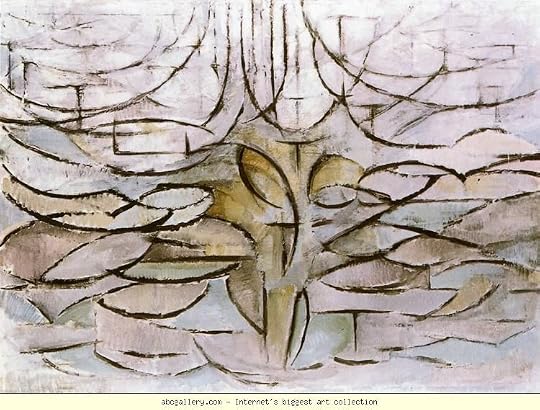
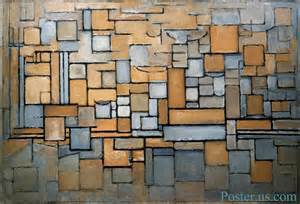
For a sampling of the tone of the author’s presentation, below are several direct quotes along with my brief comments. I’ve also included 4 pics as a visual taste of how Jaffee charts Piet Mondrian’s painterly evolution.
“Mondrian never deviated or compromised, not even for his bread and butter, for he regarded his work, his quest for harmony, as a task he had to fulfill.”
When I read of the artist’s rather austere life, I envision his day-to-day living as an extension of his austere abstract art.
"Searching for a “true vision of reality” and finally finding it, filled Mondrian’s whole life. And the search was always conducted by means of painting."
Mondrian was not compelled to write artistic manifestos or poetry, essays or fiction, nor was he inspired to try his hand in the other arts, things like music or theater. For Mondrian, his artistic vision was his life and painting was the exclusive means of expressing his vision.
“The vision that Mondrian formulates in his writing, and that he embodies magnificently in his paintings, is in fact related to Plato’s doctrine of ideas. His entire evolution as a painter aimed at visually interpreting general laws that underlie every phenomenon and that are to the wealth of natural forms as a theme is to its variations.”
Even as a youngster, before I read anything relating to Mondrian or abstract art, I sensed this boiling down of the natural world into something purer and more mathematical whenever I happen to see one of his paintings. And during my college years, I recall hearing someone say Mondrian was attempting to paint the square root of a rainbow.
"Contemplation of the universal, and hence penetration into the core of reality, is the meaning that Mondrian gives his art. As Mondrian himself stated, “If it is one’s intention to manifest what things have in common and not what makes them differ, this is not a drawback, but a necessity. For the particular, which leads us away from the principle, is abolished by this procedure; the common factor remains.”
Said like a true Platonist.
"Mondrian showed painting a new function, and in his own painting he made a new function of art, the new world view, visible to the beholder."
I don’t know about you but I will never walk the streets of a city again without thinking of a number of his abstracts, especially Broadway Boogie-Woogie.
And speaking of Plato, I will conclude with a quote from the Greek philosopher's dialogue ‘Philebus’: “I will try to speak of the beauty of shapes, and I do not mean, as most people would think, the shapes of living figures, or their imitations in paintings; I mean straight lines and curves and the shapes made from them, flat or solid by the lathe, ruler and square, if you see what I mean.”
Super interesting to see the progression from more classic painting to shapes and primary colors. Maybe I don't get it but I preferred his earlier work, though his last two pieces I really loved. The author was a bit insufferable in his descriptions, so I ended up scanning them briefly towards the end
This book includes a brief but complete biography of Mondrian as well as numerous photographs of his works. In the first half of the book focuses on his life and includes many black and white photographs of his associates and locations as well as photographs of his early works. The second half of the book includes large colored photographs of his significant works including a discussion of each.
This might be a different book than the one I had but it's the same author and the only one with a cover picture. I've been to the Gemeente Museum in Den Haag and they have one whole section of the place dedicated to Piet Mondriaan. Worth a visit for sure.