Jump to ratings and reviews
Rate this book

Ramayana Unravelled: Lesser Known Facets of Rishi Vālmiki’s Epic

Rate this book
No epic has moved the consciousness of millions like the Ramayana. The appeal of the story of Rama is such that it has inspired the imagination of countless storytellers over the centuries, across the length and breadth of the subcontinent. From Jain poets to Bhavabhuti, from Kamban to Goswami Tulsidas, many have retold the Ramayana in their own language, infusing their own unique flavour.
Though the story of Rama is much loved and well-known, questions prevail. Ramayana Unravelled attempts to address some key concerns: How did his childhood and youth shape Rama? Why did Rama agree to go on vanvas - was it only to obey his father or was there more to it? How was the relationship of Rama and Seeta? Is the Ramayana inherently misogynist, considering the characterisation of Seeta, Shurpanakha, Kaikeyi and Tara? What led to the downfall of Ravan?
Ami Ganatra takes the reader through the events of the Ramayana, resolving conundrums and underlining the reasons the epic continues to be cherished to this day.

236 pages, Paperback

Published July 28, 2022

188 people are currently reading
1130 people want to read

About the author

Ami Ganatra

6 books143 followers
Management professional with ~15+ years consulting and business management experience across sectors, capabilities and geographies having worked across four continents in various capacities viz. Asia, Europe, South and North America. Currently, working with organizations in the social impact space.

Beyond work, she blogs on travel, Yoga, Shashtra and other things on https://dharmorakshtirakshitah.wordpr...

Ratings & Reviews

What do you think?
Rate this book

Friends & Following

Create a free account to discover what your friends think of this book!

Community Reviews

5 stars
379 (55%)
4 stars
206 (29%)
3 stars
88 (12%)
2 stars
10 (1%)
1 star
4 (<1%)
Displaying 1 - 30 of 96 reviews
Profile Image for mahesh.
270 reviews25 followers
November 23, 2022
Generally, I don't like reading any books multiple times. But when it's about lord Rama, I can read it again and again till my last breath.
if you have read Valmiki Ramayana or listened to the stories of Rama from your grandparents, you will realize there is nothing new in this book. However how can you get bored by reading about Lord Rama.so Read it again and breathe the fresh air of this great land where rama walked from ayodhya to Sri Lanka.Feel the bliss of gentleness of rama in every walk of your life.
Jai shree Rama!!
Profile Image for Ujjwala Singhania.
221 reviews69 followers
October 23, 2023
Ramayana Unravelled by Ami Gantara ji is my first book by the author. This book talks about the key players, their characters and the choices made by them at critical moments which shaped our Itihaas. The author has deconstructed the reasons and the implications of those choices.
Reading the initial chapters, I was a little underwhelmed. I was hoping for something awe-inspiring but since most of the stories narrated in the book were known to me, there seemed nothing new for me. But what kept me going was the easy narration broken down in small chapters and the lucid words in which the author has put forth her reasonings based on her understanding of the Mahakavya. And what won me at end is her way of handling the very contentious events of the Itihaas with simple no-nonsense yet profound words.
This book is a very good addition for YA and for readers who want to venture into new genres after their stint with Indic-fictions.
Profile Image for Madhulika Liddle.
Author 22 books547 followers
September 11, 2022
Across South-East Asia, in every country except Vietnam, it is celebrated in dance drama and ballad, in art and craft. It has been written about and discussed by personalities as eminent as C Rajagopalachari and RK Narayan. Akbar had it translated into Persian, the manuscript completed in 1584 CE. It has been hotly debated, its nuances and its characters, its plot elements and its poetry dissected, for many centuries. Millions, both in India and outside it, can quote freely from it.

The Ramayana, the story of Rama: loved, respected, venerated. And when an epic is of such epic proportions, it is hardly surprising that there will always be something more to be said about it, as Ami Ganatra sets out to do in her Ramayana Unravelled: Lesser-Known Facets of Rishi Valmiki’s Epic.

At the very start of the book, Ganatra explains the very ‘varied’ nature of the Ramayana as most people know it: how there are supposedly some three hundred versions of it, besides the many retellings that abound. She goes on to emphasize the pre-eminence of the version composed by Rishi Valmiki, and then devotes the book to examining this, Valmiki’s Ramayana, from different aspects and angles. After an introduction to the Ramayana, Ganatra presents a brief summary of the epic, before going on to the bulk of her book, which she divides into three parts.

The first part, Context and Settings, explains how Valmiki came to compose the Ramayana. Beyond this, Ganatra explains the bloodlines of some of the main characters in the epic: the lineages of Rama, Seeta, Ravana and the vanaras are discussed here, along with rudimentary family trees to illustrate them. With reference to the settings, Ganatra describes some of the main spaces that form the setting for the Ramayana: Ayodhya, Kishkindha, and Lanka.

The second part of the book, Personalities, Events and Eventualities, is its biggest section, covering over 250 pages. Ganatra begins by discussing some of the important yet (relatively speaking) peripheral figures of the epic, such as Vishwamitra and Ahalya. She then delves into the main characters, from Dasharatha to Kaikeyi, to Seeta, Sugreeva, Hanuman, Ravana, Vibhishan—and, of course, Laxman and finally Rama. This section ends with a brief discussion of Rama Rajya, and what it meant.

To explain the character of each of these personalities, Ganatra dives deep into the Ramayana, providing a detailed insight into incidents and dialogues that help define the individual in question. She quotes extensively from Valmiki’s epic, providing a translation as well as (at times) some of the original Sanskrit text, written in Devnagari. This is where a more nuanced understanding of characters, their motivations and their considerations, comes through, especially as Ganatra is able to provide back stories or alternate insights that reveal character traits.

For instance, there is the much-discussed episode of Seeta, in the aftermath of the battle and the death of Ravana, stepping into the fire (agni) to prove to Rama her chastity and fidelity. To explain the context, Ganatra provides some interesting background on why and how Agni came to be regarded as the paramount witness—and how that tradition carries through to this day. In the same episode, she dwells on the motivations of both Rama and Seeta in this context, and is able to provide a plausible rationale for each of them behaving the way they did, as well as how it highlights their relationship.

Similarly, when it comes to explaining Rama’s willingness to abide by what was an obviously unfair decision by Dasharath, Ganatra uses a section from the Shrimad Bhagavad Geeta to illustrate her point. Using Krishna’s explanation of what governs the success or the failure of an enterprise, Ganatra shows how and why Rama would have reacted the way he did.

The third and final part, also the shortest section of the book, is the Epilogue, in which Ganatra discusses a couple of somewhat tangential (but pertinent) episodes that have a bearing on the understanding and interpretation of the Ramayana.

All said and done, this is a competently crafted, annotated (and abridged) version of the Ramayana. Ganatra provides interesting insights into the epic, its characters and its relation to other Hindu scriptures, including the Vedas and the Mahabharat. True, the book does not provide path-breaking insights too different from what most people with an interest in the epic would already know or be able to surmise. True, too, that Ramayana Unravelled could have benefited from some more thorough editing. But, on the whole, it’s a readable, insightful book for anyone who only has a basic knowledge of the Ramayana and would like to know more.

(From my review for The New Indian Express: https://www.newindianexpress.com/life...)
163 reviews10 followers
April 29, 2024
Itihasas embody the values and virtues of our illustrious past and have a wide acclaim across various sections of the society. Ramayana is a topic of immense interest, specially in the current times due to certain events in the history of Bharatha. This book provides a different way of understanding Rsi Valmiki’s Epic through the perspectives of few of its central characters.

The format of the book is about understanding the main story of Ramayana through some of the central characters. This is a very interesting approach to the epic where the reader learns about the epics in a gradual manner where new information augments the previously discussed points i.e. incremental approach which builds the overall picture in a much more detailed and clear fashion.

One of the standout features of this book are the interesting anecdotes from other epics like Skanda Purana, Mahabharatha, Arthashastra etc. This provides a comprehensive view to the reader which is really beneficial.

Some of the slokas at the conclusion of a chapter are chosen with exquisite care and beautifully augments the narration. A case in point is the shloka at the culmination of the chapter “The Divine Inspiration”. The chapter on Bloodlines is very detailed and explained very well through the illustrations. Similarly, the section on “Arya Unarya” is excellent and very informative. The tidbit on Venkatesha Suprabhatham is expected to invoke some surprise in the readers when the source is revealed in the book. The section on various types of Shulkas like Virya Shulka, Rajya Shulka, Dhana Shulka etc is very well explained and highly informative.

Vasishta and Vishwamitra’s stories are intertwined and how one is the catalyst to the other’s transformation is very wonderfully captured. The authors observations from certain events in the epic and their ramifications on modern life is quite interesting and very informative. The summary towards the conclusion of the chapter “Kinship in Kishkinda” along with Sugriva’s atlas is top-notch.

Chapter 13 named “The Difficulty of Being Good” explains the perspectives of Vibhishana. Personally, I can understand the rationale for the title. However, the puritan in me finds this difficult as the name is also of a famous book by Gurucharan Das which provides a very interesting take on Mahabharatha. I wish the chapter was named slightly differently.


The book is mainly based on the CE and Valmiki Ramayana from Gita Press. This is truly commendable considering the multiple retellings, specially the local ones with their own anecdotes. Considering the Gita Press version as a reference, there are some specific points which I personally felt were generalised and specific details are missing from the book.

Point 1:

In the Summary Storyline, author has mentioned that Dasharatha had 3 wives, but no progeny. It is important to note that the Kausalya, Kaikeyi and Sumitra were the main queens, but Dasaratha had 350 wives. In Ayodhya Kanda, Sarga 34, we find the reference to the same

अर्ध सप्त शताः ताः तु प्रमदाः ताम्र लोचनाः |
कौसल्याम् परिवार्य अथ शनैः जग्मुर् धृत व्रताः || २-३४-१३

Encircling Kausalya, three hundred fifty women, steadfast in their vow(of devotion to their husband), with their eyes reddened, went there slowly.

Point 2:

In the chapter named “A Twist of Fate”, the author doesn’t elaborate on Lakshmana’s reactions on observing Bharatha’s army. In the subsequent chapter called “Soumitri”, again, this aspect is not touched upon. Lakshmana’s anger about the wrongs done to Sri Rama is legendary. His first response as captured in Ayodhya Kanda, Sarga 96 is quite explicit.

यन् निमित्तम् भवान् राज्याच् च्युतो राघव शाश्वतीम् |
सम्प्राप्तो अयम् अरिर् वीर भरतो वध्य एव मे || २-९६-२२

O, Rama the warrior! By the reason of whom you were deprived of an eternal kingdom, such Bharata as a foe who is coming here, deserves to be slain by me."

Overall Summary:

This book is definitely very good and highly recommended for young minds as well as those starting with a more analytical study of the epic. For those familiar with the Samskruta / Valmiki Ramayan version, this book provides interesting anecdotes from other epics. Definitely Recommended Book.

On a related note, for those interested in much more deeper analysis of Ramayana, I highly recommend “Lectures on the Ramayana” by Rt. Hon. V. S. Srinivasa Sastri.

Profile Image for Vaishali Sekar Rama.
77 reviews9 followers
February 2, 2023
Ramayana Unravelled : Lesser-Known Facets of Rishi Valmiki's epic written by Ami Ganatra was such an incredible read. Being a Ramayana enthusiast, I thoroughly enjoyed reading the wonderful book. This book is truly a gift from Lord Rama himself.

The book has touched upon various unknown aspects in the life of Lord Rama. It is highly recommended for everyone who loves our Puraanas and Ithihaasas.

For several decades, as humans with limited perception, people have questioned/misunderstood various actions of Lord Ram. The book answers all the questions and makes the readers understand the significance behind the actions of Lord Rama. No action of Lord Rama was against Dharma. Beautifully narrated. I would definitely read the book over and over again and enjoy the beautiful journey all over again.
Profile Image for Divya Sharma.
1 review9 followers
January 8, 2023
This is just a mare repeating of Ramayan in a summarized way . There is no new thing to learn from it . I was very excited to read this book listening from author at pod cast but she failed to add any new perspective to Ramayana. Just a simple plain manner of repeating the same Valmiki Ramayan .
4 reviews1 follower
February 9, 2024
The author has done a fabulous job of gathering information and facts based on the Valmiki Ramayana. She emphasizes the pre-eminence of the version composed by Rishi Valmiki, and then devotes the book to examining Valmiki’s Ramayana from different aspects. She also explains the importance of Dharma and Itihasa in one's life.

We all must have read most of the stories written in this book. However, this book gives us an overall idea of the incidents, their relevance in the characters' lives, and how the incidents were meant to happen (destined). The author beautifully captures the emotions - love, grief, sorrow, joy - expressed by the characters. She has even depicted their thought process and their reasoning behind every decision they made.

The only part which I thought could have been improved was the repetition of a few incidents through the book. Else it was a great read. A must read for youngsters who want to know our roots and our Itihasa.
Profile Image for Raghav Sharma.
165 reviews1 follower
March 19, 2023
Subtle differences between Ramayana and its popular derivatives like Raamcharitamaanas have been explained well in this book. The story of Rama, a man who is the epitome of morality, always gives me the courage to value morality more than anything else. May Lord Rama always guide my conscience and bring me back to the path of Dharama whenever I am led astray.
Profile Image for Pritha.
10 reviews10 followers
July 2, 2024
There are so many incidents which we have heard of but are not mentioned in Rishi Valmiki's Ramayan. This book is very well researched and sheds light on such scenarios. Kudos to the author- Amiji for presenting the itihasa in a simplified manner yet with meticulous attention to detail.
Profile Image for Daffodil .
19 reviews
September 25, 2025
Ami Ganatra does an excellent job of peeling back the layers of popular myth to show us the Ramayana as told by Rishi Valmiki. This book isn't a simple retelling; it's an insightful analysis that gives context to the epic's most complex and often misunderstood moments.

I especially enjoyed the exploration of the characters—Sita is presented as a strong, assertive woman, and the complex political and financial systems of ancient Ayodhya are clearly "unraveled." Ganatra provides well-researched, logical explanations for actions like Rama's exile and his later difficult choices, urging readers to view them through the lens of ancient Dharma and a king's duty, not just modern sentiment.

If you love the Ramayana but want to understand the "why" behind the well-known events, this is a must-read. It’s a smart, direct, and thought-provoking read!
Profile Image for Saloni (earnestlyeccentric).
790 reviews41 followers
June 18, 2025
An exploration of the Ramayana, including disproving several popular additions to the story that weren't written in the original.

Spoilers ahead.

I always chalked off the Ramayana as being less interesting than the Mahabharata. I thought Rama was too perfect, and that the other characters (aside from Hanuman) were quite bland. I also didn't like the ending where Rama sent Seeta away because there was still doubt amongst his people regarding her chastity. They went to all that effort of building a bridge to Lanka, and defeating Ravana, only for the two of them not to be together at the end! So, I was pleasantly surprised, upon reading Ganatra's book, that there was a lot of nuance to the Ramayana story which I hadn't appreciated. 

I took a few notes as I read on things I found interesting. I'll go through them in order.

It was interesting to see that Kumbhakarna may have suffered from hypothalamic obesity or potentially even Klein–Levin syndrome. Ganatra didn't go into much detail with either one, but I wonder if he had something like diabetes insipidus? Or Cushing's? And Klein-Levin syndrome really only explains his sleeping for 6 months of the year. 

I found Ahalya's story amusing, primarily because of Indra having goat testicles. I didn't know he had goat testicles! Ahalya was the wife of Rishi Gautama. Lord Indra took the rishi's form and slept with Ahalya (who knew it was Indra), so Rishi Gautama cursed both of them. Ahalya would have to do a lot of penance until Rama arrived in the ashram. Indra, meanwhile, was cursed to be impotent and so needed to get new testicles.

The Ashwamedha Yajna, a ritual where a horse is set free to wander (and the person who sets the horse free has to fight all the kingdoms the horse enters [unless the other kingdoms accept their rule without a war]), reminded me a lot of that Greek story where Aeneas (I think?) has to follow a horse after the Trojan War and establish a new city there. I wonder how many more rituals different civilisations had in common way back in the past. 

In the Bhagavad Gita, Krishna states five factors that determine whether something will be a success or a failure: 1) the doer, 2) the instruments used, 3) place, time and approach, 4) different activities/processes the doer has undertaken, and 5) destiny. You might absolutely nail all four of those things but if it's not in your destiny, then it won't happen. It's kind of reassuring to know that there are variables that you can control, but also one important variable out of your control. So if you've done everything to the best of your ability, and you leave the rest up to God, then you can definitely say that it wasn't in your destiny. Rama tells Lakshmana that his exile was in his destiny. There was no other way to explain why Kaikeyi had acted so out of character. It would have been futile for Rama to resist his fate.

Rishi Valmiki states four qualities that are important for success in life: 1) strong willpower, 2) vision/wisdom to see long-term consequences, 3) intellect for objective reasoning, and 4) skill/capability in implementation. This, taken together with what was in the Bhagavad Gita, is a pretty effective blueprint for how to live life. Something that really stayed with me was this: if you get super attached to objects (obsession), you have an intense desire to own it. This causes anger if you're unable to own it, which then leads to delusions. If you are deluded, your memory can't be relied upon, and so you've lost your intellect. All that leads to a downfall of a person.

There was a lot of information on what made a good government--which makes sense because Rama was meant to be the epitome of a good ruler and person. It's annoying that there are clear guidelines on how to accomplish all this yet corruption runs rampant, and good leaders are scarce. Some of the principles mentioned included: ensuring there were enough wealth creation opportunities for its citizens (so jobs, I guess?), having a balance between rights, regulations, freedom and punishment, living in harmony with nature, and focusing on all parts of society (not exploiting or being biased towards one). Rama was an excellent leader because he was in control of his senses. "Good governance depends on control of the senses and mind (of the leader)." 

Finally, the ending of the Ramayana. I was upset that Seeta and Rama didn't live together even after being reunited with Lava and Kusha present. I didn't understand why Rama needed her to prove her chastity AGAIN (especially after the God Agni said that she hadn't done anything like that). And Seeta, to preserve her honour, chooses to be swallowed up by the Earth as proof of her virtue. It's just so tragic! Even though Rama was a perfect everything, he couldn't be the perfect husband to Seeta after everything.

Overall, I really enjoyed this book. I'm so used to seeing characters like Sugreeva and Hanuman being depicted as monkeys, but it's possible that it wasn't Hanuman's tail that was set on fire in Lanka, but his genitals (big yikes). I wish there had been a bit more discussion on that aspect of the story and whether those depictions were true. (Also, I wish I could see the bridge that was built to Lanka. It sounds like a feat of engineering.)
Profile Image for Shubhank Singh Chouhan.
16 reviews
November 23, 2022
Must read!!!
The book breaks so many misconceptions we have about our Ramayan. It also tells how real characters are so different from what is shown on television. Great effort by the writer!!💯💯
Profile Image for Preetam Chatterjee.
6,833 reviews366 followers
January 21, 2024
Societies are demarcated by the heroes they look up to. Therefore, heroes cannot be and should not be outside critical investigation. As society progresses, heroes have to be put through an acute contemplation to scrutinize their significance.

This also helps society redefine and recalibrate its value systems.

But let the critical enquiry happen with honest inquisitiveness to learn and progress rather than out of an urge to discharge.

Not for the sake of Rāma — his romance has subsisted the scrutiny of thousands of years — but to expand our own frontiers of discernment and put the right archetypes in place for ourselves and our society.

This book has been divided into three sections, each containing numerous chapters.

The first section is entitled ‘CONTEXT AND SETTINGS’. It contains three chapters in all:

1) The Divine Inspiration
2) Bloodlines
3) Cities and City Life in the Rāmāyana

The second section is entitled ‘PERSONALITIES, EVENTS AND EVENTUALITIES’. It contains thirteen chapters in all:

4) Vishvāmitra’s Quest
5) The Making of Vishvāmitra
6) Ahalyā
7) The Descent of Gangā
8) A Twist of Fate
9) Sahadharmachārini
10) Kinship in Kishkindhā
11) Vāyuputra
12) The Trap of Lust
13) The Difficulty of Being Good
14) Soumitri
15) Rāmo Vigrahavān Dharma
16) Rāma’s Rājya

The concluding section, entitled ‘EPILOGUE’ contains three chapters:

17) A Short Note on the Approach to Understanding Itihāsa
18) Shambuka Vadha
19) Forsaken

The author of this book points out at the didacticism of the Ramayana through a sequence of questions. The fundamental questions he asks, the answers to which he seeks during the course of the nineteen chapters are as follows:

a) Was Lakshmana an angry young man as he is thought to be usually, or is there more depth to his character?

b) How was the relationship between Rāma and Seetā?

c) Was Seetā a deplorable, burdened woman or an emphatic woman with a mind of her own?

d) What led to the defeat of Rāvana? Did he refrain from forcing himself on Seetā because he cared for her consent? Did he abduct Seetā to avenge his sister?

e) How was the Nala Setu built? Was it a miracle of floating stones as it is thought to be or was it an engineering marvel?

f) What is the real story of Ahalyā? Was she really a stone—what is her story in the Rāmāyana?

g) Is the Rāmāyana inherently misogynist or quite the opposite, considering the characters of Seetā, Shurpanakhā, Kaikeyi, Tārā?

h) Why does Krishna say in the Srimad Bhagavad Geetā that ‘among the warriors, I am Rāma’?

i) What lessons from his growing-up years shaped Rāma’s values as a king?

j) Why did Rāma agree to go to vanvās—was it only to obey his father or was there more to it?

Beyond the key events of Rāma’s life, there is so much to learn from the Rāmāyana—Vishvāmitra’s penance, Hanumāna’s wit, Seetā’s grit, Lakshmana’s unfailing support, Vibhishana’s sense of right, Shurpanakhā’s deceit, Rāvana’s call for his own downfall and much more .

This book, more than anything, shows us that in Rishi Vālmiki’s Rāmāyana, Rāma is unquestionably of divine birth, an avatār of Vishnu himself, but his personality is more human, undergoing the full range of human emotions including desolation, dissatisfaction and annoyance.

What makes Rāma superior is his mental strength, lucidity of thought, strength of character, suppleness in the face of challenges and, most important, his understanding of dharma and swadharma.

While he feels all emotions and profoundly so, his decision-making is not sullied by personal emotions, biases or short-term gratifications, even when experiencing great misery.

Give it a try.

Siyāvar Rāmchandra ki jai!
3 reviews
October 4, 2024
I recently finished reading Ami Ganatra’s Ramayana Unraveled, and it exceeded my expectations, surpassing even her previous work Mahabharata Unraveled. The structure is tighter, and the language more sophisticated, which made the reading experience far more enjoyable. It almost feels like a more mature work, and perhaps even a result of collaboration or her evolution as a writer.

One point that Ganatra emphasized multiple times throughout the book was how Rama consistently maintained his composure. There’s a recurring observation that no one could ever read his emotions from his face. However, in one rare instance, we see Rama’s vulnerability when he’s with Lakshmana. When faced with the devastating decision to go on vanvaas (exile), Rama breaks down in front of his brother, something that Ganatra highlights as an unusual occurrence. This closeness between Rama and Lakshmana is deeply moving and adds a new dimension to Rama’s character, especially since we often associate him with his love for Sita and his emotive moments with her. But here, the bond between the two brothers is portrayed with such depth, showing that Rama could be vulnerable and emotional in front of Lakshmana as well.

Ganatra also sheds light on the relationships between Rama and Hanuman, and between Rama and Vibhishana. The bond with Hanuman, one of loyalty and reverence, is a classic dynamic that’s often touched upon, but Ganatra delves into the nuances that make this bond stand out. On the other hand, Rama’s relationship with Vibhishana is more complex, especially considering Vibhishana's connection to Ravana. This familial split—between Ravana and Vibhishana—provides a moral and ethical contrast that Ganatra carefully unpacks, showing how loyalty to dharma (righteousness) supersedes family ties in Vibhishana’s decision to support Rama.

A particularly insightful aspect of the book is how Ganatra breaks many myths surrounding the Ramayana, especially those that are often peddled in modern interpretations. She refutes popular misconceptions, presenting a more nuanced and faithful retelling of the epic, grounded in tradition but enriched with fresh analysis. These debunked myths help clarify the intentions and actions of key characters, painting them in a more authentic light, rather than through the lens of later cultural and political agendas.

Overall, I’d rate Ramayana Unraveled 4.5 out of 5 stars. It’s a compelling read that stands out not only for its structure and writing but also for the deep insights it offers into the relationships and complexities of the characters. Ganatra’s ability to balance a faithful retelling with modern interpretations makes it a valuable addition to any reader’s collection of Indian mythology.
2 reviews
April 6, 2023
When it comes to Epic , its always Mahabharat that is the preferred one , given the twist and turn , the all so charismatic Shri Krishna who would not shy away to break the rules for the ultimate goal and all other character with a grey undertone, that is no one is completely right or wrong making Mahabharat more relatable and thrilling to read in todays context too.

So I have never felt like taking up Ramayana given its relatively straight storyline, felt that I wont be able to hold on reading the book.
However was totally wronged when I received Ami Ganatra Ramayana that has changed my view towards the epic, right from the crisply explained preface for why she chose to write the book and her insight for the same, it just hooks the reader through out.

I have read her blogs in FB , and for the very reason I was all the more eager to pick up this one, and as it has to be It’s an absolute gripping read.

She is an IIM Ahmedabad alumni and really Kudos to her for taking up this magnus work of reading the epic right from the Valmiki version to various others , learning Sanskrit and taking the onus to understand and bust the popular myths head on.
She is also certified in Yoga and what she has achieved by authoring such a book only someone with Yogic mind could do I believe .

The beauty of the book is with her comprehensive understanding of the epic, she has not biased it to any one version but has chosen multiple references and other versions of Ramayan too to build readers understanding wherever relevant and required.

She has tried to counter most of the mainstream narrative peddled to malign the epic especially the most controversial Uttarakand,has been included too with appropriate anecdotes and examples connecting the dots.

I also love the fact, that she has kept it very simple without unnecessary complications to put her point making it very reader friendly, mainly for teenagers who are the ones who will holding the baton of this civilization.

There is lot to learn from the book when it comes to contextual decision making and thought process. It also reflects her problem solving mindset and with that she has done great justice to the narration.

Overall an excellent read and by far the best version of the epic, I have read. I have already put a word in my inner circles and request all to please read , circulate and gift to the younger lot. That’s the minimum we should do for our civilization and get the right perspective about our own history.
Profile Image for Kaustubh Dudhane.
650 reviews48 followers
July 10, 2025
"More often it is through sorrow that the path of life is illuminated."

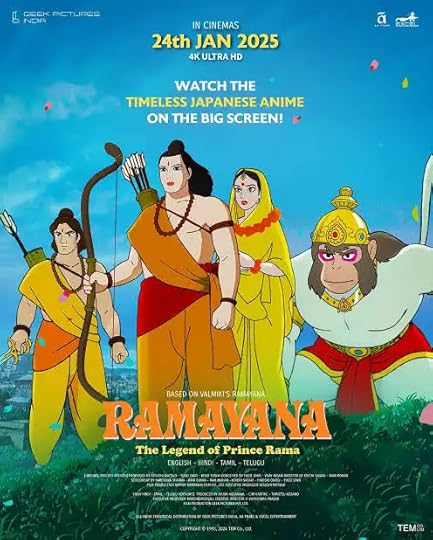
I have started reading it when Yugo Sako's Ramayana was getting re-released in the theatres.


However, it took me almost five months to finish it. We will come to that later. I have been a huge fan of Ramayan right from the Ramanand Sagar's mega TV series, the above anime on Cartoon Network and multiple retellings from my Aaji. Fortunately, I wasn't scarred with Adipurush. When I was pitched that there are a lot of hidden stories within Ramayan, I was super-excited and bought this book. And I have mixed feelings.

There are a lot of interesting snippets and facts from Valmiki's Ramayan. Modern retelling have also included some variations which had seeped from the other 300 versions of Ramayan. I had enjoyed those clarifications regarding the variations. However, I have liked the way those trivia which were presented at the right moment.
"For maintaining social systems, honouring promises and contractual agreements is important. For a system to sustain, there must be certain non-negotiables that every stakeholder in the system must sincerely adhere to; in that truth, accountability and trust are necessary."

A-matter-of-fact retelling: Almost all the Itihāsa is told as a matter of fact. I felt that the writing style was a bit dry for my taste. Additionally, some of the events were repeated again and again. Hence, I kept on moving away from the book. In fact, I was almost contemplating DNFing it.

I believe it is a good retelling for someone who hasn't read or viewed or listened to Ramayan earlier as a good starting point. Yes, editing could have been better. But I wonder how relevant my statement will be when the first timers will watch Namit Malhotra's Ramayana.


6 reviews
January 24, 2023
We have heard and read Ramayana right from our childhood times from multiple story books, serials and in the form of stories told by our elders..

Then why read another book of Ramayana?

This book is way different from what we read during our childhood days..

Off course the itihaas of Ram doesn't change..

The book impresses us at multiple points

The author through her immense sanskrit knowledge has attempted to not only translate, read Valmiki Ramayana ( original one) but also interpret, analyse and justify the behaviour ,actions and incidents in Ramayana..

There are so many lesser known facts in Ramayana which we were never aware of like the lineage and ancestors of Ram, Ancestors of Ravana, The making of Vishwamitra, ashta Siddhi of hanumaan, How Hanuman and angada did search  of Sita, The character of Raavana, Life saving herbs which saved lakshmana, The starting of vanvaas of Ram where he stayed , how they travelled…all the minute details are accurately elaborated by the author.. 

The author also summarises important people in ramayana…Why did Rama agree to go to vanvaas, What was Rama like? What lessons he got in Raaj Dharma from Rishi Vishwamitra?  Why dint Sita come with hanuman back  when hanuman came to search for her? What was the role of Lakshman in Rama's life, …the author has well portrayed and described their actions and behaviour during that time.

The book depicts well the reason why we have to study our itihaas and dharma shastras.. Our itihaas has given us so many lessons which we fail to see and use it in our day to day practice..Dharma Sankat are a reality of life..And like Rama and Krishna who had to deal with ethical dilemmas, even we face tough times to resolve our Sankat due to sub optimal alternative solutions.. Definitely Ramayana teaches us life lessons,virtue, gratitude,non jealousy, strong character,love, sacrifice, determination, fortitude, Dharma..

There are lot of quotes and sentences which we come across while reading which teach us so many things….

A must read for all of us who want to reread itihaas of our ancestors and know all the facts which we were never aware of..

      Jai Siya Ram 
25 reviews
June 25, 2023
There is no other book that binds us all , there is no Indian that has not tried to put the virtue or behaviour of Shri Ram in his or her life. The Ramayana is the Itihasa of our ancestors. It is the book of grit,determination,love,sacrifice,fortitude , moral courage etc. The author succintly points that everyone wants to be like Ram but when time comes to take decision, it is very very difficult to take that kind of path that was taken by Shri Ram. The author very beautifully brings out the various emotions that are being played out in the Ramayana, whether it is brotherly relationship between Shri Ram, Sugreeva,Lakshman and Hanuman , the pain and suffering endured by both Shri Ram and Mata Sita on account of their seperation and longing for unification again. Some episodes such as killing of Shambuka by Ram to install natural order as well as forsaking Sita in order to heed to the voice of the citizens and establish accountability of those who are governing. These are very tough decisions that may seem to be wrong but when analysed as has been done by the author, it is very difficult to judge them solely on emotional value, there was no one more precious to Shri Ram then Sita, forsaking her in order to uphold Raj Dharma is the epitome of Kingship displayed. That decision when seen from the perspective of a loving husband seems rude and harsh but when it comes to Dharma, only Maryada Purushottam Shri Ram can take such a decision to instill confidence among the governed. Ramayana is a life lesson on ethical dilemmas faced by each one of us on a daily basis what this Itihas on our ancestor conveys is the path that we can take to uphold Dharma. The author has brought out many important events and rendition of the same is done very lucidly. The book is simply unputdownable and tells us many facets of Ramayana generally not so easily accessible. The language used is simple,beautiful and elegant, words are carefully chosen to convey most accurate meaning as is written in the epic by Adikavi Valmiki. I recommend this book for everyone who want to get a glimpse of what is Dharma, and what all sacrifices it entails to uphold that Dharma.
This entire review has been hidden because of spoilers.
Profile Image for Parth Agrawal.
129 reviews19 followers
September 22, 2025
Hey everyone. I hope all of you must be doing well. I came across this author through a podcast and I was very impressed by her take on various issues related to Ramayana. It goaded me to buy her book and give it a whirl. However, in the aftermath of completing this, I feel that her podcasts were better than her book. There are definitely instances when she has gone on to set the nuanced narrative right which was the need of the hour but I suppose it is difficult to sound new and innovative on this topic when so much has already been written and spoken about it. However, following are the aspects which I really loved:

1) Ravana's original name was Dashagreeva. There is an incident in which he attacks Kuber in Kailash and takes his Pushpak Viman. He reaches a point in the Viman beyond which, Nandi, the gatekeeper restricts its movement saying that this is Shiva's resting place. Dashagreeva gets angry and tries to uproot Mount Kailash. Shiva uses his toe to crush him below the mountain and in fear and desperation, he screams and prays for Shiva. Shiva eventually gets satisfied with his penance and gives him the name Ravana (Rav means scream)

2) I wasn't aware of the fact that Vali was so strong that when Ravana challenged him to a duel, Vali defeated Ravana comprehensively. After this incident Ravana had befriended Vali

3) There is a beautiful explanation written about destiny. Shrimad Bhagvat Geeta has been referred for this matter. According to Sri Krishna, there are 5 elements which determine success or failure of an undertaking. They are "the doer", "the instrument being used", "place, time and approach", "different activities and processes undertaken", "destiny". Sri Krishna says that destiny is definitely a factor but it is only one of the factors. The rest 4 factors are within our control and only when all the 4 elements are performed with the best of our abilities, we can attribute the result to destiny

People interested in understanding certain nuances to better understand the epic and our itihasa can definitely pick up her book, however, I would suggest that listening to her podcasts may turn out to be more enlightening. Happy reading to all
Profile Image for Preity.
77 reviews1 follower
March 31, 2025
I don't know if it's because of the ideologies of Rama or the remembrance of my Baba’s lessons, that I tend to pick again and again this story to read by different authors in different forms.
This book is another exemplary representation of Ramayana by another renowned author. Every book has its own delegation to recite this great epic in its own rendition, and this piece is quite different from all that I had read till now.
The unknown and unheard that I had read in Sita Ramayana by Devdutt Pattnaik was intriguing and factful, but when I was comparing the facts of Rishi Valmiki’s epic, I couldn’t find anything new. But the only thing that kept me glued to read was the categorization of context, settings, personalities, events and eventualities. Author has mentioned each and every aspect with thorough research and then articulated in a way to untangle every phase of the epic. Be it personality of the character in Ramayana, occurrence of events, governance of Ram Rajya, or motive behind many of Rama’s questionable actions, Ganatra has tried her best to convince the audience of her writing style.
So, there’s no harm in re-reading the epic. After all, we all love to listen/read the stories which have a deep impact from our childhood.
Profile Image for Saranya Raghavan.
191 reviews17 followers
April 7, 2023
👉The Crux:-

🔸 Ramayana Unravelled is an amazing read by Ami Ganatra. This read reveals some unknown facts about Ramayana. The cover page itself reveals the fact that this is a marvellous book.

🔸It starts with a brief introduction and summary of the epic Ramayana. Then the author gives us some context and its explanation and settings about it.

👉My two cents:-

🔸The language is simple and the narration is just perfect. The author has explained beautifully about everything which gives us crystal clear ideas. This seems like a very big read but once you start reading it you will get immersed and it turns out to be a page-turner. I loved her style of storytelling which didn't spoil and kept the essence of Valmiki's Ramayana.

🔹I am a big fan of the ancient epic Mahabharata but this time I am taking up Ramayana instead as I want to know more about this epic started reading and trust me this is a perfect read for everyone who wants to know more about the epic and its contexts. So why are you waiting? go grab your copy of this masterpiece. Hope to grab my favourite Mahabharata (Unravelled) soon from the same author.
2 reviews6 followers
March 24, 2023
A very well researched work by Ami Ganatra that took into consideration popular stories that are built around Ram and Seeta's story and many other side stories, and clarified these in light of Valmiki Ramayana.
Only Ramayana by Rishi Valmiki can be considered History as he was documenting his own times, all other versions of Ramayana, the most popular being Ram Charit Manas, Krittivasi Ramayana and Kadamb Ramayana, may have taken some creative liberty with the original tale to suit their times.
The author is very particular about pointing out that the female characters in Valmiki Ramayana are not the supressed, demure ladies, they are intelligent strong human beings capable of taking their own decisions and bearing the result of it too, whether it is Seeta, Ahalya or Shurpanakha.
The side notes explaining terms like Veeryashulka, Arya Unarya and others are quite convenient for a layman reader.
Overall it is interesting to understand a well known tale from analytical point of view that the author so painstakingly has provided.
Profile Image for Manish Shaw.
13 reviews
October 12, 2023
Since Ramayana teaches Dharma (the rights & responsibilities) no doubt everyone must read it. As far as I understand, history was not perfect at all, there were imperfections all around. The society was not equal for both genders. However, the unequal acts were justified in the name of the welfare of the society. Vices like lust and polygamy were the central themes.

Moreover, the book debunks many popular myths regarding Ramayana such as Lakshman Rekha and Rama's name on the stone to construct the bridge. There is no mention of Lakshman Rekha in Valmiki Ramayana and the stones were floating because they were tied up with wood (based on modern-day Archimedes' principles).

Lastly, the book describes each and every story very naturally and debunks the myths around it. Moreover, it shows the love of Rama and Seeta throughout the book but the story of their separation is very painful and silent. Both understood each other's problems and responsibilities very well but never complained, hence taking pain for the sake of each other's dharma.
Profile Image for Shivani Kedia.
68 reviews
January 18, 2024
Highlights :

"purushārthas of dharma, artha, kāma and moksha— the building blocks of Sanātana Dharma— which are the key to living a worthwhile and fruitful life."

"When one is on the path of dharma, help comes from unforeseen and unexpected sources. What we need is humility, some patience and detachment to accept both joy and sorrow that life brings, while continuing to do what we must. More often it is through sorrow that the path of life is illuminated. We need to trust life to bring to us what we need to remain steadfast on the path of dharma to realise the goal of our life."


"Bhagavad Geetā, Krishna explains five factors that determine the success or failure of an undertaking. These are: 1. कर्ता—the doer 2. करणम्—the instruments being used 3. अधिष्ठानम्—place, time and approach 4. चेष्टा— different activities and processes undertaken 5. दैवम्—destiny"

"Three vices are said to destroy a person— stealing other men’s wealth, eyeing other men’s wives and being excessively suspicious of one’s well-wishers."
113 reviews13 followers
February 17, 2024
If you are reading this with an intention to read Ramayan.. this is not the place.
This book is made to understand the nuances of Ramayan, understand why Ram was and is Ram, why the love story of Ram and Seeta is still unparalleled.. I am a fan of the author, so I could be biased, but the way this book clarified a few things for me, other renditions of Ramayan couldn’t.
Rishi Valmiki was an amazing poet and more, to imagine the beauty of his work by just seeing a few couplets in the book and by just reading the translation at some places is just outstanding. The way Ram and his character is defined, the way Sita’s role as a wife - sahadharmacharini is elaborated; it’s exquisite.
These epics are sometimes considered stories by people, and some believe in them as history- whatever be the case, the point is to learn from them. You understand how a Ram Rajya is established; and it clearly shows how the leaders of today think and operate vs how they should. It’s a beautiful and very easy writing, and at the same time has depth.
Profile Image for Lahama Kar.
2 reviews
March 3, 2025
Good point:
The best part about this book is that the author doesn't impose her perceptions and ways of understanding into the narratives. She presents few facets of this epic just as it is in the original source, the Valmiki Ramayana. She reads it, and translates it to us. Yes, she discusses a bit about the controversial stance about how Rama is perceived, may be judged, in our modern age society ; what led him to do what he did, but she never justifies him. She just states that it's easy to criticise Rama, but not easy to be Rama. There are a few lesser known facts which is brought to light in this book and how over the years the storyline has spun out into different versions and interpretations. The Ramayana we read as children presented Rama as the Lord, the Divine. Rama is human, more of an ideal righteous human, in the epic written by rishi Valmiki himself.

Not so good point:
I found quite a few parts of the book repetitive. I understand the author's point of view of providing a thorough understanding of the characters and occurrings, but repetition of same story and words sometimes dampen the flow of reading I feel.
Apart from this, all in all a good read!
249 reviews4 followers
May 17, 2023
This is an excellent book to read only if knowledge of Ramayan is known beforehand. Like her first book Mahabharata Unravelled, the author busts some popular myths and gives some lesser-known insights. Like Lakshman Rekha, Anyone attacking Vali from the front will lose half of his skills; Urmila sleeping double to compensate for Lakshman's sleep is a myth not mentioned in the original text. Similarly, the original story of Raavana, from his naming to his lineage, has been good additions, reasons for Raavana looking for consent from sita and the various curses put on him. The story of Vedvati and similarly many other anecdotes are added and makes it a good and exciting read.
Though the author has tried to distance herself from the debate of Uttar Kaand and its authenticity; therefore, by being a bystander, she cannot add much to the epilogue, and the third part lacks any significant additions.
Profile Image for sneha.
7 reviews
January 15, 2024
I could never get enough of the Ramayana ever since I was a child, this itihasa has come to me in many forms over the years (various retelling and interpretations) and Ganatara’s Ramayana Unraveled is a beautifully clear explanation of the original Valmiki text that I’ve never experienced. Her literal explanations of the Ramayana as it was written are perfectly balanced with a storytelling tone that keeps you drawn to the last page. There’s probably nothing extremely revelatory if you know the general gist of Ramayana but there is also a beautiful level of detail that just refreshed the Ramayana in a new light for me. I would recommend this book to anyone regardless of how familiar you are with the Ramayana.

Side note - I fell in love with Ami Ganatara when I saw her on The Ranveer Show - her energy is so radiant and she is so clearly passionate about Hindu itihasa, which really shone through in this book. Mahabharata Unraveled is next on my list.
65 reviews2 followers
September 18, 2022
This is the second book by Ami & this one also amazed me with some really good information & clearing mis-conceptions by the TV serial version.

I had a got a feeler of the book after listening to het talk on the Vaad YouTube channel with Arihant

Here are the few of the points that really are noteworthy
- Nice simple narration
- The detailing in the story of Vishvamitra
- The nuances in the story of Ahalya was really unravelling
- The bond of love between Rama & Seeta was really well handled
- The story of hoe Ravana got his name is one thing was really unravelled
- The Ravana’s lust is generally not talked about but again very well handled here
- The importance & knowing about Lakshmana was enriching
- And lastly, a couple of stories from Uttara kanda were explained very well.
Note : The video on YouTube channel called Project Shivoham on Uttara Kanda is a must watch.
Displaying 1 - 30 of 96 reviews

Can't find what you're looking for?

Get help and learn more about the design.