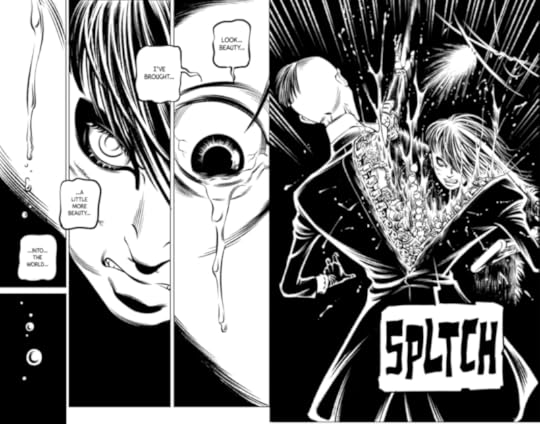
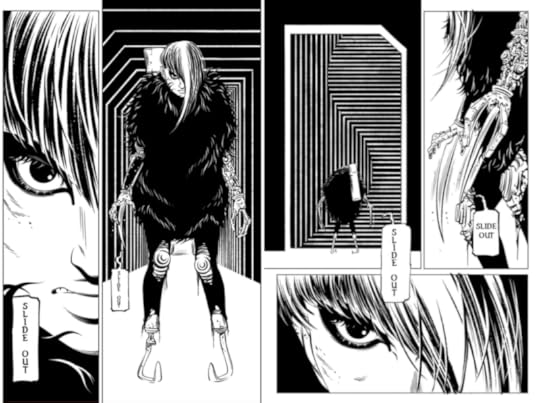
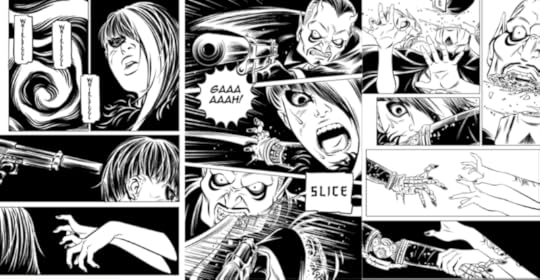
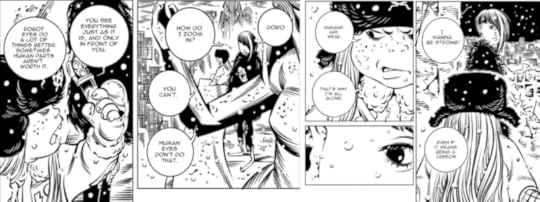
Im dritten Band hat die Protagonistin Hyaku fast alle ihre Organe wieder erlangt und macht nun den mechanischen Träger ihres Herzens zu ihrem nächsten Ziel. Während sie ihren Rachefeldzug gegen die Cyborgs fortsetzt, die ihr ihre Körperteile geraubt haben, entwickelt sich die Geschichte zu einem komplexeren Konflikt.
4.5/5 stars. Review for the entire series: Search and Destroy is incredibly fun, fast-paced, and satisfying to read. I had no prior experience with or much knowledge about Dororo, so I can't speak for how repetitive this adaptation/reimaginging might be for Tezuka readers. However, given the present-day contextualization and Kaneko's afterword, I really liked how he made this story his own while re-fitting Dororo's themes for a cyberpunk setting. The characters are compelling, the plot is engaging, and the writing is some of the best I've seen in a current manga serialization. I can't wait to read more Kaneko--and Tezuka!
Osamu Tezuka's Dororo has been in my part of my life since I was a teenager playing the adaptation Blood Will Tell on the PS2. Having since read the original manga, seen at least one or two anime adaptations, and read now a couple manga re-tellings, Kaneko's brief afterward in this volume sums it up perfectly: stay furious. Let rage against injustice be your drive, fuel for your art. Inner peace is great and all, but with all the monstrous cruelty in the world, rage is not only healthy but sometimes truly necessary to stay alive
Each of these volumes I read with a sleeping babe in arms over a single reading session (or maybe two). The art is really terrific and the story was a cool twist on a classic revenge tale. My foray into manga over the last year continues to pay dividends. Would recommend to sci-fi fans who don’t mind a touch of Kill Bill in their story.
What excites me most about this book is the insane art and the fact that after 55 years, Dororo finally has a conclusion (even if it wasn't what Tezuka may have imagined). I'm not quite sure I understood everything in the end, and it may not be a perfect landing, but we got there.
Ovu priču možete interpretirati i doživeti na više načina. Neću se time baviti. Samo ću pomenuti neke od aktera ovih stranica:
Hyaku - devojka kojoj su po rođenu hirurški odstranjeni delovi tela (i to njih 48) i koja pokušava da ih vrati kako bi se osetila "celom". Na početku mange podseća na kiborga, da bi do kraja pomalo poprimila obrise ljudskog bića.
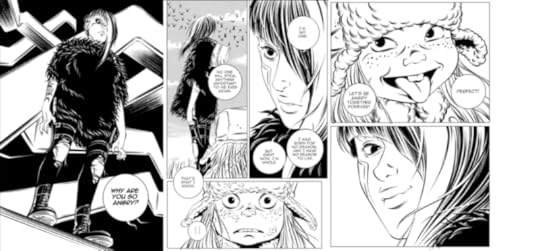
Doro - na oko devojčica, ali ipak dečak, da bi se ispostavilo da može biti i jedno i drugo. Za razliku od Hyaku koja želi natrag svoje ljudske delove, Doro želi da svoje ljudske delove zameni mehaničkim kako bi bio brži, bolji, ubitačniji, jednom rečju - napredniji.
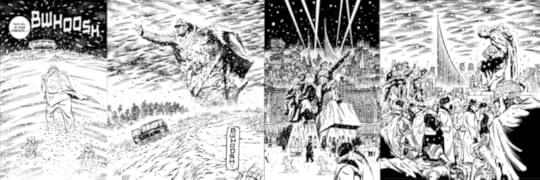
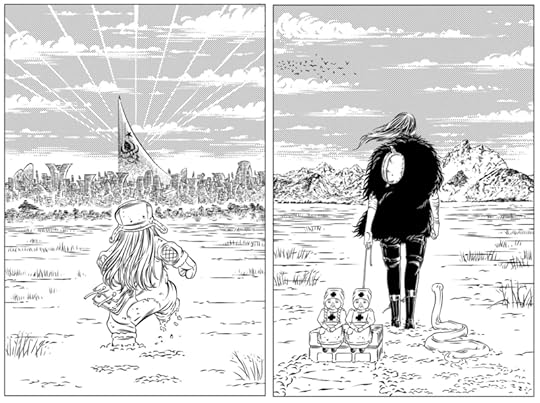
komunistička/brutalistička arhitektura - izbija skoro sa svake druge strane. Na prvim stranama ćete odmah prepoznati Buzludžu, pa potom i spomenik ispred Muzeja kosmonautike u Moskvi, pa onda spomenike iz Treptover parka iz Berlina, Majku Otadžbinu iz Volgograda, Branioce iz Stare Zagore itd. Njihova impozantnost umnogome doprinosi atmosferi u mangi. Osetićete se brutalno mrvišnim, nebitnim i nevidljivim.
bes - najčešće jedina stvar koja vas održava u tom surovom okruženju među robotima i ljudima koji se po surovosti i (ne)empatiji od robota gotovo ne razlikuju. Pored pohlepe i besa, malo šta je ostalo u ljudima, čak i među krvnim srodnicima.
Creechs (roboti) bi da budu prihvaćeni međ' ljudima, da okuse, vide, osete isto što i oni, dok bi ljudi da iskoriste robote za ostvarenje svojih ciljeva. Pojedinci i jedne i druge vrste žele prevlast po svaku cenu, dok im većina "naroda" grca u bedi, blatu, rupama... sa tek ponekim snom o slobodi.
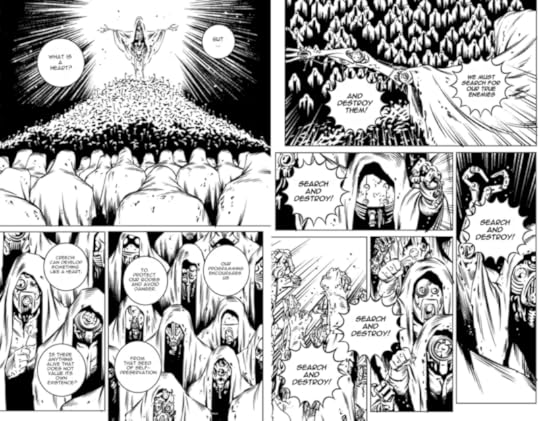
From an atmosphere, art, and intensity standpoint, Atsushi Kaneko's "Search and Destroy Vol. 3" is a masterwork. Intricately illustrated, with fine lines and dense splashes of black, it creates a futuristic dystopia reminiscent of Katsuhiro Otomo or William Gibson.
Our Japanese setting sees humans and robots alike struggling in the aftermath of a brutal war. The robots, or kreaches, as they're called here, were created to do some of the dirtiest fighting, but they've largely been abandoned after the armistice, forced to toil in mines or torn apart on the streets by human mobs looking for scraps.
A few kreach are looking to rebel against this state of affairs; others are scheming for a buck or doing goon work for wealthy benefactors. But our protagonist, Hyaku, is lashing out just as the title suggests. She's hunting well-connected kreach to steal back the body parts they harvested from her when she was a baby, part of a one-of-a-kind payment for their service in the war.
It's a gonzo premise (based on an earlier manga by Osamu Tezuka), but Kaneko generally makes it work. Hyaku is fierce, almost feral, and her anger fuels her as she seeks a cruel, but righteous, vengeance. She's mirrored in her actions by the kreach looking to free themselves from servitude, but a lot of bodies get caught in the crossfire.
The series is intense and well crafted, but Hyaku is such an indomitable force that it robs the story of some of its stakes. She sucks up bullets and stab wounds, even as her robot body parts are replaced by real ones, and the story loses a bit of its tension every time. Hyaku will win, it seems, because she's wronged and just "wants it more," but her arc would be more meaningful if it were earned or meaningfully threatened.
Still, "Search and Destroy" is a powerful creative work. It's dark and it bellows, making for a rewarding read.
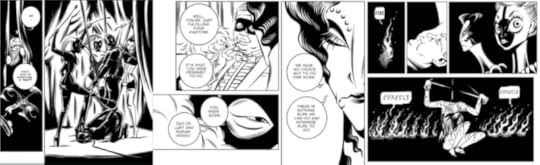
The final volume for Search and Destroy. I wish there was more because i liked this series and it felt rushed a bit in vol.2-3. Hyaku fights her way to the mayor, who surprise, she knows. Doro takes up half of this story and to be honest, it was just OK. Too much crammed into vol.3 left me wishing either leave out the Doro story or develop it more. The Doro story sort of came out of nowhere and while it does parallel Hyaku's story I just didnt need it getting ramped up during the climax really. It diminished the impact I felt toward Hyaku getting her revenge. The fight Kyaku had against the kretch business partner was even left totally out, all you see is his body. Look I loved this series especially for the art but maybe 4 volumes. I loved connecting the last bits with the doctor and her father, it was brutal. Volume 1 still stands out as the best and I wish the momentum stayed. Still worth reading just for the art, it is phenomenal.
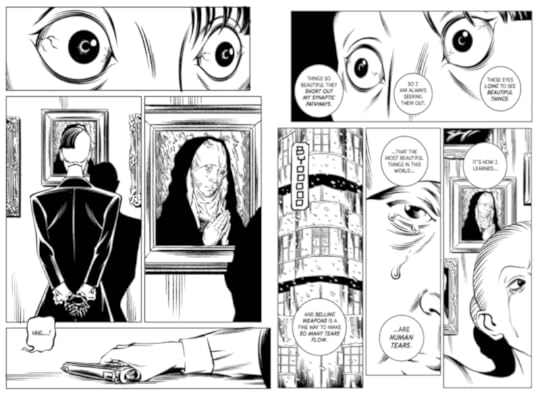
This is a futuristic retelling of Osamu Tezuka’s Dororo (1967) that plays like a brutal blend of Blade Runner and John Wick. The stark black-and-white art, reminiscent of Frank Miller with touches of Jack Kirby, feels more Western than traditional manga. Kaneko’s fluid, frenetic layouts use minimal dialogue, relying heavily on Phil Christie’s striking sound-effect lettering to drive the story. Set in a violent cyberpunk dystopia, the book explores the trade-offs between human and mechanical bodies through Hyaku, a protagonist slowly reclaiming her humanity at a steep cost. Kaneko has successfully taken his anger at real-world anxieties and translated it into a story that reflects our times. This third and final volume resolves Hyaku’s quest but leaves the door open for more tales set in this universe. Fantagraphics’ design is excellent, and the inventive panel layouts make this far better read in print than as an e-book.
Une série pleine de rage, contre l'oppression, le capitalisme, le sexisme; et de ce fait, avoir une heroïne dépossédée de son corps dans une société patriarcale qui verse dans le totalitarisme est une excellente idée (dans le contexte d'une réecriture de Dororo, d'Osamu Tezuka, ou le protagoniste était un homme), l'univers cyberpunk est aussi extrêmement pertinent pour évoquer un état d'inégalités sociales extrêmes et d'une révolution imminente. Les décors empruntent à l'imagerie sovietique voir parfois Nord-coréenne, dans un climat sibérien, le tout servi par un trait absolument irréprochable, et achèvent une ambiance topissime, et participent encore à moderniser les thèmes que Tezuka évoquait en 1967, et à en apporter de nouveaux, dans une défense des opprimés qu'il n'aurait certainement pas renié.
As a huge fan of Dororo, I can happily say that this series is a wonderful rewriting of it for modern times. I really like the way that this series explored identity, our relationships with technology, and most importantly, the power of rage and anger to help us keep going in times when things are hard (like nowadays). This volume is a cathartic and intense read that offers up a powerful finish to the series. The way in which the lives of Doro and Hyakku cross and drive each other forward amid their pain is a surprisingly uplifting side to what is a very dark story. I'd highly recommend this to anyone who loves a gritty sci-fi or revenge story.
This entire review has been hidden because of spoilers.
Chef d’oeuvre de Kaneko. Mes attentes étaient très élevées suite aux deux premiers tomes et je n’ai pas été déçu. L’actualité de ce récit de Tezuka est déconcertante. Kaneko dépeint de main de maître l’absurdité de la guerre, de l’exploitation des masses, des inégalités qui l’accompagne, et de l’enrageante impuissance qui s’ensuit.
A spectacular and fittingly bittersweet climax to Hyaku’s journey to reclaim her missing pieces, with Doro stealing the spotlight for an extended period to reveal their own backstory. I’m glad to see this wrap up so satisfyingly, but I’m sad to know this is the end of Kaneko’s visual exploration of this gorgeously realized cyberpunk world.
"Die Wut as Tezukas Manga lebt in mir weiter und verleiht mir heute den Mut, meine Werke uu zeichnen. Wenn mein Manga die Kräfte besäße, jemandem da draußen die Einsamkeit zu nehmen und die Wut am Leben zu erhalten, dann könnte ich nicht glücklicher sein."
This entire review has been hidden because of spoilers.
A fitting conclusion to the trilogy. The best part is how nicely the backstories of Hyaku and Doro come together. The author has channeled his anger into the deeply unequal dystopian world and paid tribute to the master Osamu Tezuka's Dororo.
Holy shit, I shouldn't have slept on this series for as long as I did. I kept checking out the first volume but not actually picking it up until it was already due. This whole thing was so good!!!
The final part of the series, this story answers questions asked by the previous volumes. I would have liked to see more of the world this story is set in but enjoyed the series as a whole.
This last volume isn't quite as good as the first two. Lost the thread a bit of this woman out for revenge and to retrieve the body parts that had been stolen from her. All the ancillary stuff going on felt unnecessary and detracted from the rest.
It's cool. It's just not my thing. A little too edgy and angry for me. But that's just me. Your mileage may vary.
Search and Destroy Review
4/5 stars
This will be a spoiler free review. Onto the review!
I wanted to read this manga because it’s a cyberpunk retelling of the Osamu Tezuka manga Dororo. And it was interesting. I’m not sure this is really my sort of thing, but it was fascinating.
So the original story of Dororo is that this horrible man made pacts with demons in exchange for power, and as a trade they make it so his firstborn son is born missing a lot of body parts. A war surgeon offers to graft him “new” limbs from the bodies of kids who have died in the war. Once this kid becomes an adult, he wants his original body back, so he tries to track down all the demons to get back his original body parts. Note: Dororo is not the name of the guy tracking down the demons, it’s the name of the kid who follows him around.
I’ve wanted to read some Tezuka for a while now, but instead I keep reading modern reinterpretations of his works. This is something I need to remedy at some point. I’ve got a few of his series on my list of things to get around to, Unico, Astro Boy, Dororo, and Princess Knight to name a few. But I’m sure once I go down the Tezuka rabbit hole, I’ll find a lot more I want to read.
Search and Destroy is sort of the original Dororo story, but obviously in a very different world. In this world, some people have given up their original human bodies in order to become androids/robots, but there are still people within that group who covet real human parts in order to experience sensations, such as taste. If I’m remembering right (it’s been a while since I read the first volume where this was explained) this was to make humans more durable, and able to live longer. Of course, only the rich could afford this. Poor people still have human bodies, and are often exploited for the rich.
The main character had been experimented on, and now her body parts are scattered amongst various people who are rich enough to afford one real human body part. She ends up travelling around with a kid named Dororo looking for the people with her body parts, similar to the original manga. I’m sure that I’m missing out on some of the small details that carry over from the original, since I haven’t read it yet.
I really liked the way this interpreted the general plot, and the way it modernized it. There were a lot of interesting modern political parallels. I can’t say if these are true to the original, because I haven’t yet read the original. But either way, it worked really well in this. I almost want to reread this, so I can see how all the plot threads are organized between the three volumes. I read them pretty spread apart, so it’s hard for me to really remember exactly what happened in which volume.
Something that surprised me in a good way about this was its art style. It’s very similar to the art styles in the underground Garo manga magazine from the 60s-80s. I’ve been wanting to read some manga from Garo for a while now, because I found a guy on youtube who loves Garo and it honestly looks really cool. I’ve found some lists of Garo artists, and many of their works have been collected into anthologies that are available to read in English on mangadex. Plus, there are a lot of untranslated original Garo magazines on the internet archive if I really want to see what the magazines themselves looked like.
Once I’ve read both the original Dororo and some Garo series, I want to come back to this and see if my feelings change about it. As of right now, I liked it, but I didn’t love it. So take my 4/5 rating with a grain of salt until I have educated myself. I’m just struggling a bit with it because I don’t know enough of the source material and inspiration well enough to really have much of an opinion yet.
Honestly, the juxtaposition of old and new in this manga was the most fascinating thing to me. It’s the classic Dororo, but cyberpunk. It’s got a very modern, updated underground manga art style. I’ve honestly never seen another manga like this before, so I’m having a hard time classifying it.
I do recommend this, especially if you’re a Tezuka fan or like Dororo. And I’m glad that reading this has helped me figure out a type of manga I haven’t yet read from yet but really want to.