Jump to ratings and reviews
Rate this book

An Immigrant's Love Letter to the West

Rate this book
For all the West's failings - terrible food, cold weather, and questionable politicians with funny hair to name a few - it has its upsides. Konstantin would know. Growing up in the Soviet Union, he experienced first-hand the horrors of a socialist paradise gone wrong, having lived in extreme poverty with little access to even the most basic of necessities. It wasn't until he moved to the UK that Kisin found himself thriving in an open and tolerant society, receiving countless opportunities he would never have had otherwise.

Funny, provocative and unswervingly perceptive, An Immigrant's Love letter to the West interrogates the developing sense of self-loathing the Western sphere has adopted and offers an alternative perspective. Exploring race politics, free speech, immigration and more, Kisin argues that wrongdoing and guilt need not pervade how we feel about the West - and Britain - today, and that despite all its ups and downs, it remains one of the best places to live in the world.

After all, if an immigrant can't publicly profess their appreciation for this country, who can?

208 pages, Kindle Edition

First published July 14, 2022

Loading...
Loading...

About the author

Konstantin Kisin

1 book115 followers

Ratings & Reviews

What do you think?
Rate this book

Friends & Following

Create a free account to discover what your friends think of this book!

Community Reviews

5 stars
1,072 (49%)
4 stars
701 (32%)
3 stars
301 (13%)
2 stars
73 (3%)
1 star
39 (1%)
Displaying 1 - 30 of 217 reviews
Profile Image for Sian.
31 reviews4 followers
July 27, 2022
Listened on Audible. Not what I expected at all; I thought this was going to be tales of life in the final days of the USSR. My mistake! Instead it was the author’s views on life in the West. His political views are not very similar to mine, however, I found myself interested in what he had to say. I even found myself agreeing with quite a lot of his book (I definitely also disagreed with some parts). On the whole I enjoyed this. It was refreshing to hear another viewpoint and I also think it’s good to listen to them. It’s good to have your own worldview challenged from time to time.
Profile Image for David Steele.
565 reviews40 followers
July 14, 2022
No doubt you'll already be aware of whether or not you are going to agree with much of this book. As a long term subscriber/ supporter of the Triggernometry podcast, I can't claim to be an unbiased reviewer - especially since I had the book on pre-order for weeks. Enough to say that I'm a big enough fanboy that you should feel quite comfortable dismissing my five star review, as long as you're equally willing to ignore the 1 star review from the person who reviewed the book three weeks before it came out.
The launch of this book coincided with my summer holiday, so I took a sunny day out to listen to the audio of this and was entertained and informed. Next, I'm going to take my time with the Kindle version. What I'd like to do now is discuss whether this book is for you by comparing it to a couple of others that are already on the market.
Interesting that this book was reviewed by Douglas Murray for the Sunday Times, because it treads a very similar path to The War on the West. However, this book has a far more conciliatory and moderate tone. Whereas Douglas set out to take a wrecking ball to the worst hypocracies of the educated left, KK shies away from the bombastic approach, querying, questioning and providing intelligent counter arguments that might actually have a chance of changing minds through reasoned argument, rather than smashing down the walls.
That said, it's not a dry read. While neither adhering to the dogma of the left or the right, KK is careful to point out the lazy assumptions, historical ignorance and false assumptions that many influencers assume we should all accept as gospel. It goes to some length to explain why the modern left's groupthink is a threat to the Anglosphere without making the reader put hours of work in to get the point. For this reason I'd say that, for progressive readers, it's as informative as Despised: Why the Modern Left Loathes the Working Class, but it won't go out of its way to piss you off while you're reading it.
A common problem I find with the likes of Ben Shapiro and Bret Weinstein Naomi Klein and many political authors is that their books (at least the ones I've read) completely ignore anything outside of America. I'd suggest a similar note of caution for American readers who might not have read anything aimed at an international audience. This book has a very Anglo-centric slant, but at least American writers, politicians, thinkers and institutions are referenced throughout. In balance, this is only to be expected, because KK is writing about his experiences as an immigrant in Britain.
In summary - I was always going to love this book, but I'd recommend it to anyone who is more interested in a light read that provides a respectful and reasoned argument than a rant.
Profile Image for Cav.
920 reviews226 followers
August 26, 2022
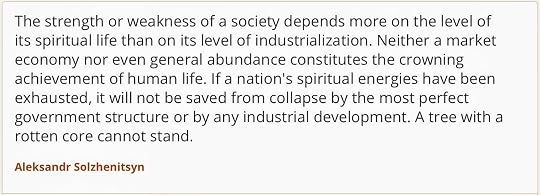
"The strength or weakness of a society depends more on the level of its spiritual life than on its level of industrialisation. Neither a market economy nor even general abundance constitutes the crowning achievement of human life. If a nation’s spiritual energies have been exhausted, it will not be saved from collapse by the most perfect government structure or by any industrial development. A tree with a rotten core cannot stand."
~Aleksandr Solzhenitsyn

An Immigrant's Love Letter to the West was an excellent short read. The author drops the quote above by the famous Russian Gulag prisoner, author, and dissident at the start of the book.
The art on the cover of the book is a throwback to Russian Communist propaganda posters. The book's title could also possibly be a throwback to famous KGB defector Yuri Bezmenov's 1984 book: Love Letter to America, which was penned under the pseudonym of Tomas Schuman.
I have loosely followed the author online for a few years, through his TRIGGERnometry Podcast. I generally enjoy their content, so I decided to give this one a read.

Author Konstantin Kisin is a Russian-British comedian and political commentator. Kisin regularly writes for a number of publications including Quillette, The Spectator, The Daily Telegraph and Standpoint on issues relating to tech censorship, woke culture, comedy and so-called "culture war" topics.

Konstantin Kisin:
Konstantin-Kisin-SITE-1536x864


Kisin gets the writing here off on a good foot, with a very well-written preface. He talks about the recent increase in societal polarization, and the invasion of Russia by Germany in WW2 (Operation Barbarossa). He also tells the reader a bit about his early life in Russia, where he was warned to not repeat in public what was talked about in his household.

He then moves on to cover the famous story of the Russian boy Pavlik Morozov, who turned his father in to the authorities and was the subject of a massive propaganda campaign by the Russian government.
Kisin also touches on the term "useful idiot," which was reportedly coined by Vladimir Lenin, and is roughly defined as: "a term for a person perceived as propagandizing for a cause without fully comprehending the cause's goals, and who is cynically used by the cause's leaders." He cites American socialist politician Bernie Sander's 3 properties and ~$200k salary to further this point. This talk then dovetails nicely into socialism and its philosophical underpinnings, which were provided by Karl Marx and Fredrick Engels.

Kisin has an excellent writing style that should have no trouble holding the reader's attention. The book has great flow. Kisin peppers his writing here with many humorous asides. This can be tough to do in a book, and I feel that he effectively pulled it off here. The audiobook version I have was also read by the author, which is a nice touch I always appreciate.

He lays out this quote early on, which states his reason for writing this book in the first place:
"I can still remember the day I arrived in the UK with a wonderful sense of promise and expectation. Twenty-five years on, that feeling of freedom has never gone away. Nor has my adopted country ever disappointed me.
Despite all the ups and downs, it has always been wonderful to me. That’s why I’ve written this love letter to Western civilisation.
In short, Britain – and the West in general – saved me from a terrible fate. Now, as people seek to destroy it, I want to save it in return."

The author also makes sure to tell the reader that this book will not be a partisan piece, however:
"I should make extremely clear at this point that I have no interest whatsoever in the false dichotomy of Right v. Left. Some of the things in this book will map neatly into the left-wing worldview, and others into socalled ‘right-wing talking points’, but I have no interest in being in either of these tribes. If there is one thing my Soviet childhood taught me, it’s that subscribing to someone else’s ideology will always inevitably mean having to suspend your own judgement about right and wrong to appease your tribe. I refuse to do so."

And cautions against the dangers of seeking a utopian society:
"...Therefore, instead of wasting time trying to create a perfection which can’t be achieved, the best we can do is deal with reality as we find it – and not as we wish it to be. And, in order to do this successfully, we must bear the cruel lessons of history in mind at every step. If we don’t, we’re doomed to repeat the worst mistakes of our forefathers. And, for all we know, we might even make a bigger hash of it all."

So, how did we get here? Partially due to the failure of our education system, which tells young, impressionable minds what to think, and not how to think. Kisin writes:
"In their book The Coddling of the American Mind Jonathan Haidt and Greg Lukianoff detail the extraordinary transformation of higher education in Western countries in recent decades. In the early 1990s, the left-to-right ratio of university professors was about two to one. Today, it is ten to one and, in many social science departments, the ratio frequently approaches and exceeds 100 to one.
This means that our education system has become a progressive monoculture in which young people are increasingly taught the ‘correct’ thing to think, as opposed to being taught how to think. Rather than equipping the next generation of students with the tools they need to analyse facts and reach their own conclusions, our universities now indoctrinate young people into a particular worldview..."

The scope of the writing here is quite broad, and many different issues are touched on. Kisin draws parallels between the Bolsheviks and modern-day western society. He also speaks to the cyclicality of civilizations, and the Russian Gulags:
"Historians estimate that 10 per cent of the total gulag prison population was killed each year..."

Some more of what is covered here includes:
• Slavery around the globe; a brief history. The inherent problems with reparations.
• Free speech – and why it matters. Recent encroachments into free speech.
• How language is used to conceal the truth; the Marxist roots of political correctness.
• Why we need journalists, not activists.
• The c-word (capitalism); the historical failings of socialist societies. Venezuela's socialist disaster. The "good" and "bad" of capitalism.
• The other c-word (comedy). The censorship of comedy ruining the art. Jesters have been around forever.
• An immigrant’s view on immigration. The racism of "diversity" policies. The myth of Britain historically being a "nation of immigrants."
• Ten ways to destroy the West; the destructive effects of far-left progressive ideology on society. Cultural relativism.
• How useful idiots handed Stalin the nuclear bomb.

This quote ties a nice knot in the writing, and could be underscored for its importance:
"On almost every issue that we claim to care about in the West, there is nowhere in the developing world that comes close to what we have. Think of any major country outside Western Europe and North America: China, Russia, Brazil, India and even Japan. Is there a single sane person who thinks ethnic minorities are treated better there than in the West? Are these countries safer? Are the people of China free to speak their mind? Is there less racism in Brazil? Less discrimination or violence in India? Do the Japanese welcome foreigners with open arms? Japan has a wonderfully rich culture, but in 2017 there were 19,628 asylum applications. Only twenty were approved. That’s the sort of ratio your favourite ‘white supremacist’ bogeyman couldn’t have dreamed of!"
************************

As mentioned at the start of this review; this was a great short book. Unfortunately, most of the material covered here will read like borderline satire to those unfamiliar with the current political climate and culture war. For that reason, books like this serve as important counterbalances to societies' pathological groupthink, and should be on the required reading list of anyone who is young and impressionable...
5 stars, and a spot on my "favorites" shelf.
Profile Image for Paul Bryant.
2,476 reviews13.6k followers
September 12, 2026
The purpose of this book is to describe and diagnose the malaise afflicting Western society and to offer solutions.

- Konstantin Kisin

That’s bold.

It’s certainly true that if I watch a political debate online or on ye olde television everyone is eagerly telling me that Britain is going to the dogs, that it’s already gone to the dogs, that the dogs have rejected Britain as not worth their attention, what a second division country we have become and soon to be relegated from the second division too. Seven prime ministers in ten years! It gets tiresome.

So Konstantin Kisin is here to tell us here in the UK (and by extension the rest of the west) : you don’t realise how good you’ve got it here. He’s here to moan about all the moaning. He feels he has the perspective required to be able to do this as he was born in Moscow in 1982 and came to Britain at the age of 11, speaking about three words of English.

He runs a podcast I like called Triggernometry, a good place to hear some rattling debates about the rackety topics of the day with some interesting people. He likes to say I’m not left, I’m not right, but his mission in life is to push fairly strongly against what he considers to be a whole raft of modern orthodoxies, every one of which you could say was leftist, so after a few chapters of this book, you get the feeling that if it walks like a duck and quacks like a duck it’s a right-winger.

So, he says that British and other Western societies are in the process of forgetting what has made them great, meaning fundamental liberal values, you know, free speech, tolerance, etc. According to him, many babies are being thrown out with the bathwater. He wades, either fearlessly or foolhardily, into the midst of many difficult issues. Here’s an example. Chapter three is entitled

Stop feeling guilty about race, whiteness and slavery

And the gist of it is that non-white people enslaved each other and white people enslaved other white people and this happened throughout history and is still happening in many places. To concentrate on white people’s egregious enslavement of non white people is to be highly selective at best. I’m putting this delicately. Konstantin does not put things delicately.

You know I like a good bout of iconoclasm, but after a while it seemed that he thinks if anyone is promoting socialist ideas in any shape or form they are unwittingly trying to recreate the USSR . He would agrees that no one in their right mind wants that but if you lefties get your hands on government that’s what we’ll get, since every socialist country ever failed miserably (insert list of 22 countries that tried and failed) and with all its dreadful faults capitalism has given you your smartphones and your kindles and your sachertorte and your baklava and your winter break at the Icehotel in Jukkasjavi so get real.

I exaggerate for comedic effect, as does KK, a lot.

This book is not for everybody. The people it is for wouldn’t ever read it. In many ways I think he wrecks a lot of his own arguments, but then I also think that nobody is up for a reasonable debate about all this difficult stuff. Reasonableness is obsolete.
Profile Image for Thia.
83 reviews3 followers
July 14, 2022
So personal and touching! I just loved this book. You so rarely hear expressions of unqualified gratitude for anything these days. It’s not political in that it’s neither right nor left, but it is a powerful critique of communism and a hopeful appeal to enlist it’s enemies to “testify” before it’s too late. Everyone should give it a listen whatever your political affiliation. This Russian immigrant’s story was beautifully told, deeply personal, and the audiobook was read by the author himself.

My favorite excerpt:
“Before the millennium arrived people in Russia had even stopped having children because there was so much instability. By 1999 the total population fell by about 3/4 of a million, which is a lot. Rates of suicide and murder were also increasing. Access to medicine was poor. I watched all this unfold on the news from my new adopted home. I also kept in touch with old school friends who’d tell me of the disturbing world they were living in. And, crucially, how lucky I was to have been air-lifted out and delivered into a place of peace and prosperity, a country where I could thrive and be equal. And, although I missed my family, I knew they were right. I can still remember the day I arrived in the UK with a wonderful sense of promise and expectation. Twenty-five years on that feeling of freedom has never gone away. Nor has my adopted country ever disappointed me. Despite all the ups and downs, it has always been wonderful to me. That’s why I’ve written this love letter to Western civilization. In short, Britain and the West in general saved me from a terrible fate. Now, as people seek to destroy it, I want to save it in return.”
Profile Image for Martin Mele.
38 reviews1 follower
November 23, 2023
Pure disappointment.
Who ever says:

‘So Bernie is a hypocrite because he is not a poor person by himself. Engels nor Marx had no right to become socialists because they had not been raised by the street.’

or

“tRuSt mE i LiVEd in USSR uP to mY aGE of 12 sO i KnoW tHe BesT”

Has none of my attention.
Profile Image for Negin.
841 reviews146 followers
September 7, 2024
Fabulous read. He’s insightful, sharp, and, best of all, has a great sense of humor.


Here are some of my favorite quotes.

The Best of Times
“According to global poverty estimates published by the World Bank, 94 per cent of people lived in extreme poverty during 1820. By 2015, that number had slumped down to a life-affirming 9.6 per cent, despite the global population increasing by a whopping two billion. In that time, hunger, poverty, illiteracy and child mortality all reduced massively. The main reason? Free-market capitalism, which allowed people to accrue wealth through hard work and entrepreneurialism, while also benefiting from the fact that tax rates are generally lower than those under a socialist regime.”

Capitalism
“Capitalism has more benefits than negatives. And, despite its defects, it’s something we should embrace and value. After all, in his best-selling book Love for Imperfect Things, Zen Buddhist teacher Haemin Sunim proves that things don’t need to be faultless in order for them to be good or adored. They can be cherished and retain their inherent value in spite of their failings …”

Cultural Ghettos
“My local doctor’s surgery offers leaflets and brochures in dozens of languages. Don’t bother learning English if you live in England – we’ll spend millions of pounds translating for you. This creates cultural ghettos, in which people live in a parallel environment that supplants the original Western set-up. The more cultural ghettos, the more fragmented a country becomes – and the less dominant the Western values. Once this starts to create chaos, division and disharmony, woke liberals can weaponise this to dismantle Western ‘authoritarianism’ and ‘level up’.”

Europe is Lost
“The Vatican’s former Cardinal Robert Sarah, a black immigrant who moved to Italy from Guinea in West Africa, is one such person who expressed his fears for the West’s future. ‘Europe has lost the sense of its origins. It has lost its roots. And, like a tree without roots, it will die. There are many signs. No more natality [a birth rate big enough to sustain the current population profile] … you are still invaded by other cultures who will progressively dominate you by their number and change your culture, your convictions, your morality.’”

Free Speech
“We also know, from experience and research, that in all the countries in the world today where free speech protections are meagre, there’s intense oppression of minority groups. The correlation is clear.’ He speaks the truth. Eritrea, North Korea, Iran and Turkmenistan all lack freedom of speech and unfettered expression of thought. The same is true of China. None of these are cutting-edge places of liberal values. All of them have issues with all the societal groups that the West rushes to protect, whether that’s gays, trans people or women. Meanwhile, over in Saudi Arabia, speech is somewhat free – until a person speaks ill of Islam, then it’s deemed as blasphemy, which is punishable by death. Not exactly progressive.”

Hollywood Hypocrites
“Film-maker Michael Moore, who has a huge audience of impressionable people, once claimed ‘Socialism means everybody has a seat at the table and everyone gets a piece of the pie’ – although if Michael Moore is at the table, I doubt anyone else is getting any pie. He also said that, ‘Capitalism is evil, and you cannot regulate evil.’ This is pretty rich coming from somebody who’s never lived in a socialist state and has, in fact, amassed huge wealth via Western prosperity and opportunity. As of 2014, Moore had an estimated personal fortune of US$50 million and owned nine luxurious properties, including a multi-million-dollar apartment in Manhattan, plus a 10,000-square-foot mansion in Michigan. Socialism in action. Actress Susan Sarandon is another example. She also has an estimated wealth of US$50 million, yet famously said: ‘Democratic socialism is your kid’s public school.’ If that’s true, why is she part of an industry that’s predicated on capitalism? Proof if ever it was needed that actors should stick to speaking words other, smarter people have written for them.”

Illegal Immigration
“‘We simply cannot allow people to pour into our country undetected, undocumented, unchecked.’ ‘Illegal immigration is wrong, plain and simple.’ ‘I helped push funding to build a barrier to try to prevent illegal immigrants from coming in.’ I know, I know! Quoting this sort of outrageous xenophobia is in bad taste. It’s the sort of nasty, divisive rhetoric that only the Trumps and Farages of this world would engage in – and for a first-generation immigrant like me to quote these obviously ‘racist’ people is an added layer of disgusting. You might be surprised to learn that the first quote is from Barack Obama, the second from Democrat Senate Leader Chuck Schumer and the third is Hillary Clinton, all speaking a few years ago. See, until very, very recently the idea of allowing people to come into your country illegally was universally regarded as absurd, self-sabotaging and entirely at odds with the very idea of the nation state. Indeed, when BLM and Antifa radicals, who advocate for open borders, seized a six-block area of Seattle, Washington to create the Capitol Hill Autonomous Zone, knows as CHAZ, guess what was one of the very first things they did? They built a wall and had entry checkpoints manned by armed guards. Everyone, literally EVERYONE – including pink-haired Antifa morons – understands why a country needs borders.”

Marx
“Born in 1818, Marx was part of a wealthy Prussian family. His father was a high-ranking lawyer who later paid for him to attend the University of Berlin when practically nobody but the absolute upper echelons of society got an education, never mind a degree. There, in the cultural capital of Europe, he studied law and philosophy and, in his spare time, became a member of the Young Hegelians, which was almost a precursor to Oxford University’s decadent Bullingdon Club. After graduation, he became a journalist when most people couldn’t even afford to buy newspapers, and in 1842 became the editor of the left-wing broadsheet Rheinische Zeitung. Not exactly slumming it, right? If Marx was alive today he’d be one of those tedious Guardian journos who lives in Hackney, dabbles in veganism and prances around in a Che Guevara onesie. His buddy, Friedrich Engels, didn’t come from the streets either. On the contrary: his father owned a lucrative textile factory in the industrial metropolis of Barmen, Germany, and he was also a partner in the Ermen & Engels cotton plant of Greater Manchester’s Oldham and Salford, which meant the family were loaded and, better still, they got their riches by employing poor people in awful conditions. Even after Engels made a living by promoting the overthrow of the oppressive capitalist system, he still enjoyed financial aid from his father. What a total hypocrite!”

Move Towards Androgyny
“Camille Paglia, the American transgender professor and writer, has argued that our current transgender trend and the blurring of gender lines is indicative of societal ruin. ‘Historically, the move towards androgyny typically happens in the late stages of culture,’ she said at the Battle of Ideas Festival in London in 2016. ‘The people who live in these eras, whether it’s the Hellenistic period, the Roman Empire, the mauve decade of Oscar Wilde, or the Weimar Republic in Germany, the people feel that they are very sophisticated and cosmopolitan, but from the perspective of historical distance you can see that this is a culture that no longer believes in itself. Then, what you invariably get, are people who are convinced of the power of heroic masculinity on the edges [of the culture], whether they’re the Vandals or the Huns or the barbarians of ISIS, you see them begin to mass on the outsides of the culture, and that’s what we have right now.’”

Open Borders
“As fellow immigrant Jason D. Hill wrote in The Hill, the motivation behind open borders isn’t one of humanity, but of raising hell. ‘The push for open borders is part of a globalist agenda, which is a way for the radical left to normalise the idea that Western sovereignty and territorial rights are imperialistic and non-inclusive,’ he wrote. ‘They have suffused our language with terms such as “global wealth”, “national wealth”, “unfair income disparity”, to disarm American citizens from protecting what is rightfully theirs. The notion of open borders is another stealth move to socialist America.’”

Rejection of the West
“The rejection of Western exceptionalism is usually one of the first red flags for a successful society. Instead of being proud of what has been achieved through centuries of knowledge, effort and sacrifice, which has led to everything we have now – running water, electricity, the car, the aeroplane, medicine, democracy, etc. – some people prefer to chip away at its legacy. Gaslit to within an inch of their lives, they embody what economist Thomas Sowell described when he explained what ‘multiculturalism’ boils down to: ‘You can praise any culture in the world except Western culture – and you cannot blame any culture in the world except Western culture.’
Like a bacterial infection, this mindset then expands and targets other organisms, such as Christianity, which underpins the very foundation of our moral codes, the English language, and capitalism (which has liberated more people from poverty than anything else, yet is portrayed as wholly exploitative and evil). Even art, which long focused on a search for morality, has been degraded into something vapid, vain and meaningless. Author Anne Glyn-Jones, who spent nearly a decade studying the decline of civilisations, was so appalled by art’s decline that she said, ‘It may become so degenerate that future generations will be completely uninterested in it.’
Blimey. How did we go from the Enlightenment to this?”

The Roots of Political Correctness
“Do you know where ‘political correctness’ comes from? I’ll give you a hint: all roads lead to Moscow.
Political correctness has nothing to do with ensuring sensitivity to the feelings of others, or protecting vulnerable groups, as you are now being told. In fact, the term first appeared in Marxist–Leninist vocabulary following the Russian Revolution and was used to describe adherence to the policies and principles of the Communist Party. YES – THAT’S WHERE IT COMES FROM.”

Slavery
“A 2018 report suggests that India is home to the largest number of slaves globally, with 8 million people of all ages, followed by China (3.86 million), Pakistan (3.19 million), North Korea (2.64 million), Nigeria (1.39 million), Iran (1.29 million), Indonesia (1.22 million), Democratic Republic of the Congo (1 million), Russia (794,000) and the Philippines (784,000). In case you hadn’t noticed, none of these places is big on white privilege.”

“The politically incorrect truth is that in every corner of the world, from the earliest human societies up until the present day, slavery has been a universal, abominable phenomenon. It has been conducted by people of every race against every other race, as well as their own. Yet, whenever we talk about slavery in the West, we inevitably think of the transatlantic slave trade in which millions of Africans were transported to the colonies against their will. The horrors of this deadly journey and the brutality, humiliation and barbarism of their subsequent existence are undisputed. Even I, an adopted Brit whose ancestors had no involvement in buying, selling and exploiting innocent people, feel a measure of shame. But it’s only one part of the bigger backstory. The trans-Saharan slave trade, in which Muslim traders sold sub-Saharan Africans into North Africa and the Middle East, was far worse. According to Orlando Patterson, a black Jamaican-American sociologist whose many books include Slavery and Social Death, these traders took more slaves out of Africa than the Europeans. He also says that the mortality rate for this trade was worse and that it only declined ‘toward the end of the nineteenth century under direct pressure by European colonial powers’.
We shouldn’t be surprised by this. Slavery had been prevalent in Africa for centuries before the arrival of the European traders. Let me repeat that: slavery had been prevalent in Africa for centuries before the arrival of the European traders. None of this excuses or justifies British, American, Spanish, Portuguese or any other slavery, but it proves that the phenomenon is not unique to Europe or the West. And, contrary to popular belief, it wasn’t all about white supremacy. Not by a long shot. During the Barbary slave trade, for example, Christian fishermen and coastal dwellers of seventeenth-century Europe lived in constant fear of being kidnapped by Muslim pirates and sold into slavery in North Africa. Admiralty records for the first half of the 1600s show that no fewer than 466 vessels between 1609 and 1616 were plundered for human cargo. A further twenty-seven ships were raided near Plymouth alone in 1625. Countless white people suffered this fate over the course of several hundred years, with even the likes of Samuel Pepys commenting in his diary, ‘… to the Fleece tavern to drink and there we spent till 4 a-clock telling stories of Algier and the manner of the life of Slaves there; and truly, Captain Mootham and Mr Dawes (who have been both slaves there) did make me full acquainted with their condition there. As, how they eat nothing but bread and water … How they are beat upon the soles of the feet and bellies at the Liberty of their Padron. How they are all night called into their master’s Bagnard, and there they lie.’”

“… even the word ‘slave’ predates the transatlantic slave trade. It comes from the Slavic people who were incessantly raided and taken into bondage (not the fun kind) many centuries before Africans were bought and sold and transported to the United States from the sixteenth to the nineteenth centuries.”


Words
“… much has been made in recent years of the need to ensure ‘diversity’. If you take the old-fashioned approach of consulting a dictionary, you might conclude that the point of making a place, organisation or society more ‘diverse’ would be to implement variety across the board, covering everything from age to political allegiance. However, this is not the case in reality. As a rule, the more outward ‘diversity’ an institution has, the more political uniformity there usually is among the people within it. This is because those calling for ‘diversity’ don’t really want dissimilarity or opposing views. They just want certain groups to be promoted over others, and straight, white men taken down a peg. Never the other way around. That’s why female-dominated industries, such as medicine, primary school teaching or veterinary science, in which there’s almost no male presence, rarely face calls to hire more men. Or why the National Basketball Association (NBA) is never expected to hire Jews, Asians and Filipinos. A Jewish basketball player would be a wonderful thing for the NBA – a victory for diversity (plus he could help his teammates with their legal troubles and financial investments). Hand in hand with this new linguistic spin on diversity comes ‘inclusion’, which is another word that has been bastardised in recent years. Spaces, we are told, must now be made more inclusive in order for them to be healthy. However, on entering such a space, you’ll soon discover that some people are more included than others. In fact, those responsible for setting up particularly ‘inclusive’ spaces frequently ask certain people to leave in order to ensure ‘safety’.”

“Safety, you see, also has a new meaning based primarily around not having to be confronted with different opinions and beliefs (as opposed to physical threat, which is the sole ‘safety’ issue everyone cared about until five minutes ago). The word ‘gender’ is another dreadful example.
Once upon a time, when things were sane, ‘gender’ was simply a synonym for ‘sex’ – as in male or female. You were either one gender or another. Now, without any consultation with the British public, it has been repackaged and rebranded by academics and gender activists as a word that means something totally different.”

“The phrase ‘undocumented immigrant’ is another case in point. This too is the work of ‘liberals’. For many years everybody on both sides of the political fence was fine using the term ‘illegal alien’ because it was an accurate description of somebody in America without the relevant legal permissions. Obama said it! Bill Clinton said it! John F. Kennedy said it!”
Profile Image for Kinga.
436 reviews12 followers
January 31, 2023
Less of a love letter and more of a nostalgic whinge about the state of the West currently. I am slightly familiar with Konstantin Kisin’s TRIGGERnometry, but I found this book lacking in substance and in form. He is very grateful for the life he has had in the UK, but he does spend a lot of time complaining about the direction the country is taking. I found a lot of his claims unsubstantiated: the leftist liberal media (really? Have you seen the Daily Mail or the Daily Telegraph), remainers forming 75 percent of all panel shows on the BBC (proof, please), Texas and Florida doing much better than New York during the COVID crisis (both states have higher death rates of COVID, despite the fact that their population densities are not necessarily as high as New York’s). He takes a pop at WHO doing science things such as changing advice once more evidence is available. He bemoans the loss of “edgy” comics and signs the praises of Joan River’s quite deplorable joke about Heidi Klum looking hot. But it’s ok, because Kisin is Jewish. Maybe other Jewish people didn’t find the joke as funny, but that would probably make them “woke”.

I come from a similar background to Konstantin, having grown up under Communism. It's not a state of being which I desire to return to, and I think Kisin's insistence that much of the liberal west does, is forced and unsubstantiated. There are fringes of leftist extremists in the West, just like there are fringes of extremist rightists. The economic differences between those on gig economy and those on six or seven-digit salaries keeps growing and inequality increases, this is hardly evidence for a society headed for a Marxist paradise.

Free speech is Kisin’s great rallying cry seemingly forgetting that, in the age of algorithm-driven social media, free speech is sometimes an excuse to be abusive towards others. He alleges that all liberal voices want to force communism upon the West for which he has no actual proof. He accuses most teachers in0 the UK of being Communists. As someone who’s worked in education in the UK for well over 15 years, I find this to be one of the most absurd claims.

Kisin’s approach to things is novel and his YouTube channel certainly makes for great discussions and thought-provoking discourse. In this book, I found the content a bit fluffy and without sound proof.
Profile Image for Nigel.
247 reviews
September 21, 2024
He’s a post secondary grad. He lived in authoritarian governments and lived in many countries and says lived experience, saying you know as much as we think the West is bad or is failing. It’s still better than a lot of places.

On a you tube clips he goes on to say in a dialogue with a radio host which draws a person into reading his book 📕

Human diversity….
I think could be best explained with this quote.


Why do you think it’s so difficult to publicly advocate for problems of men and boys?

Because victimhood doesn’t work For Men as it does for women we don’t feel sorry for men rightfully so …

Biological men are disposable the way women are not for obvious reasons men women in tribalism ten women go to war you’re screwed, ten men go to war one comes back you can regrow and tribalism replenish

So that we don’t feel sorry for men in the same way and not advocating to feel sorry for men because I don’t think that’s a solution to men’s problem. Solution for men’s problems is a solution to be better.

How do you mean?

How do you mean, you know what I mean your entire life is made induced into being a better version of yourself emotionally psychiatry, psychology, financially mentally you’re obsessed with performance you’re obsessed with being better you’re obsessed to being more happier, more fulfilled, and all of these things, it’s a pursuit in your own happiness

-Konstantin Kisen
Profile Image for Петър Стойков.
Author 2 books333 followers
November 2, 2023
Разбира се, абсолютно всичко, което казва Константин Кисин е вярно. Сравненията, които прави на съвременните "културни войни" и "събуденото" ляво в западния свят с комунистите в Руската империя и СССР са съвсем точни и навременни. Самият той е добър оратор и доста забавен на живо.

И също така разбира се, в книгата си не казва нищо ново, никой от "другата страна" няма да седне да я прочете, да се удари по челото и да каже "Ебаси, ама то ние сме били като лошите болшевики, колко съм грешал досега!". Хората от едната страна на тая културна война знаят нещата, които той разказва, а на хората от другата страна не им пука за тях. Просто поредната anti-woke книга.
Profile Image for Najada Zylyftari.
48 reviews16 followers
October 23, 2024
The book was amazing, and it had so many valid points that people should be reminded of. However, I want to say that if the book had used a more professional (but simple) approach instead of adding phrases like 'whatever that means' or 'sure, I would know' on every page, it would honestly be a 5-star. If it had presented all those facts and arguments in a different way, it would have been such a great and important book for a reality check for everyone.

I was going to give this 3 stars, but I'm giving it 4 just because I laughed so much at the last chapter. It was very funny and very sad at the same time...
9 reviews1 follower
May 9, 2024
Full of simple claims, tokenstic examples and illogical fallacies which make it difficult to keep up with the ‘arguments’ made in each chapter.
If you were looking for an academic insight into the pros of the West, look again. The author makes little effort to actually promote the West but rather relies on his brief experience in the Soviet Union, routinely tokenising his ‘immigrant’ card to make weak points and jibes. What was most disappointing was the constant rhetoric of ‘well it could be worse! Look at these other countries…’, it could also be a lot better!
The author consistently makes assertions and predictions throughout, rarely supporting himself with evidence in any form which comes across as a Twitter feud more than anything. Fails to go into depth about foreign policy, imperialism or economic strategy when talking about either side, which makes for an easy but whiney read.
This book certainly panders towards daily mail readers and those who lack critical thinking skills, read at your own risk!
Profile Image for Jennifer Maloney.
Author 1 book45 followers
August 9, 2022
This was a relatively quick and fascinating look at Western culture through the eyes of a Russian Jewish immigrant to the UK. He has a unique perspective on our culture that we’d be wise to listen to! Plus he’s a comedian, so is able to get his points across in a way that’s funny and easy to digest.

Other than the last 40 pages (which I found off-putting - these parts were meant to be sarcastic, but didn’t come through well in written format), I found this book both fascinating and horrifying as the author laid out just how fast we’re sliding in the toxic, authoritarian, communistic culture that ruined his homeland and killed millions of people. Honestly I think everyone in the Western world should read this book. His warning is a real eye-opener!

CW: copious amounts of swearing
Profile Image for RomantasyQueenUK.
496 reviews16 followers
January 27, 2026
Thought provoking. Opinion challenging. Often uncomfortable truths. A few iffy jokes. A few funny jokes. Very likely a different opinion.
A book for the open minded and the anti cancel culture society members.
You can agree and disagree with opinions in this book, that is ok, several things can be true at once, even if they contradict each other.
Profile Image for Kailea.
177 reviews3 followers
October 23, 2023
This book is a very easy read and there were certain things that I learned, but it lacked a certain something. I can't quite figure out what that something is. Perhaps it lacked depth, (it definitely lacked sources!) or a more consistent tone. It is written by a comedian, so one could expect it to be satire, but it's not fully that. It waffles between seriousness, satire, and sarcasm. There are some funny lines, and I get his point, but he often dismisses issues without really getting into the meat of them. I suppose that's not the purpose of his book, but then what is? It's definitely not a love letter, though he does love and appreciate what western culture has given him.
Profile Image for Dan.
205 reviews7 followers
January 10, 2026
"...has stars on the cover"

“We have forgotten that the prosperity, safety, life expectancy, stability and freedoms we enjoy did not just fall out of the sky. They were built, over centuries, on philosophical and moral foundations that have withstood the test of time. They were defended over and over again by our ancestors who bled to defend them. They were refined in the crucible of fierce political and ideological debates.”

Short, sharp, and necessary. Kisin makes a clear-eyed case for Western capitalism, not as a utopia, but as the least-bad system we’ve got. Having lived under socialism, he cuts through the theory and reminds us what markets actually provide: choice, dignity, mobility, and the freedom to fail and try again.
The West is flawed, messy, and inconsistent-but it works, and it works better than the alternatives. This reads less like ideology and more like a warning from someone who’s seen what happens when those freedoms disappear.
Not a super long read, but I would've enjoyed it if it were twice as long.
Profile Image for K M Laume.
163 reviews3 followers
Read
August 2, 2022
Been following KK’s work for some years now, so know many of his political thoughts already. I found reading about his family and growing up in the Soviet really interesting and I wish there was actually more of that (perhaps next book?). My grandfather was a prisoner in a Nazi labour camp so I found the stories of his grandparents in labour camps and comments on slavery interesting. It’s important to read and learn these stories that are often left out of mainstream narratives. He backs up many of his claims with data, mentioning the one piece of data I always try to tell people about - that more people died in the Soviet at a more rapid pace during WWII (≈20mil) than from the Nazi WWII efforts (≈6mil), both of course horrific.
The book mostly flowed nicely, though the chapter on comedy seemed to come out of nowhere and take the book elsewhere - felt it could’ve been more passing comment within the rest of book or saved for another book (though I appreciate his enthusiasm to fit everything in his first book!)
Though KK claims to have wanted to write a book that anyone can read and to convince all sorts of people regardless of political leaning, I still think the way he writes often drifts into snarky stabs at activists and people on the ‘far left’ especially the final chapter where he uses sarcasm to give advice on how to ‘destroy the west’. Though I get why he wants to express in this way (and he does this a lot in his podcast too) I never feel it’s a very productive way of growing the discussion - rather it triggers defensiveness and closes down conversations between all but ‘the choir’.
One last thing - I felt a few of the examples/references he used weren’t explained enough (by in-text or footnote) and could’ve done with some explanation for those that aren’t on twitter following all the stories that he follows - eg. JK Rowling pile-on was mentioned - the story of which I know already, yet many won’t and more info would’ve been good. Sometimes it felt a bit name-drop-y for no reason, like the Ru Paul reference… a bit odd to me and I couldn’t work out why it was there.
But all and all, I’m proud of KK for writing and releasing his first book and to great success. I’d definitely recommend a read at least for the Soviet stories alone!
Profile Image for Nunyah Biznuss.
494 reviews41 followers
September 23, 2022
I love Triggernometry, so I was really looking forward to reading Konstantin's book.

This is a thoughtful outsider's look in at the current state of play in Western culture and what's going wrong. Konstantin nails it. He's from Russia, the grandson of people who lived/were born in Gulags. He has lived under communism, and now in the UK. He can compare systems with lived experience - unlike the screaming hordes on Twitter who haven't even been outside their own US state, let alone lived in another country and needed to learn a new language & culture.

Of particular note is the chapter on journalists now being activists - this is SO bloody true and really needs honest people to pull them up.

Many people in my social groups will screech that Konstantin is a right wing shill, but this is just untrue. Read the book and see for yourself.
Profile Image for Taiba Alhumaidhi.
51 reviews5 followers
September 28, 2024
I was excited to read this book after I saw the author in a podcast, his insights were refreshing and so very true and so I thought his book would be the same. Unfortunately, there is a lot of glorification of “the west” and cherry picked negative details of the Middle East and Asia. I strongly suggest the author do some research before plugging in content without studying the cultures or even implying that they don’t work based on his point of view.
Profile Image for rebecca.
120 reviews1 follower
December 23, 2022
DNF’d on kindle at about 8%. i really enjoy reading books about the Soviet Bloc etc from the perspective of people who lived during them, however i found the constant put down of “woke” culture and the transphobic comments in the beginning of the book incredibly off putting. i’m all for being challenged politically but this read like a downtrodden man’s monologue about cancel culture
Profile Image for Maureen.
55 reviews
August 3, 2022
This is an excellent book everyone should read and take note of the content and concerns it highlights. We need to cherish our freedoms and stop all the hysterical wokery that is destroying the west. We are better than that.
Profile Image for Sam.
332 reviews24 followers
September 24, 2024
If I had to level one criticism against this book, it would be that the statements “more men than women died during Covid” and “women make better leaders in a crisis” aren’t actually mutually exclusive. They do not contradict.
Profile Image for James Anson.
24 reviews2 followers
August 28, 2022
British people complaining about their lot, including elected politicians, has become as much of a ritual as a good cup of tea. It is not until some reach the point where they romanticise a life outside of a Western democracy that it compels a few, such as Konstantin Kisin, to set a few things straight. Kisin is one arm of the successful podcast Triggernometry, a stand up comedian and a one time citizen of 1980s Soviet communism. Having left Russia to attend a boarding school in the U.K., Kisin is as much grateful to the British way of life as he is nonplussed by its creeping ingratitude.

His boarding school experience might even be apparent from the occasional finger-wagging tone of the book, that sometimes slips into more sweary frustration. What is Kisin so angry about in his 'love' letter? Too many Westerners do not know how lucky they are to be living in the West. It gets worse: some believe that socialism, in whatever derivation, might actually be preferential to Western democracy, and these ideologues are really Kisin's primary target audience. Unfortunately the 'left', as Kisin often calls them, probably won't read it, and I dare say that the book will preach to the converted more often than not. For those who nod in agreement, Kisin will still entertain with his frequent stand-up, style quips and one-liners.

Kisin will have his work cut out convincing the new left that Britain is not institutionally racist or that gender has a biological foundation. In addition, the publication of his book will inevitably result in derision for the 'cancel culture' concern - after all, quite patently, Kisin has not been silenced. Meanwhile the vast majority of people whose employment is dependent on having the 'right' (but not politically right) kind of views will lower their reading eyes to the floor and hope that identity politics eats itself sooner rather than later.

Perhaps audible gives a different experience, but when read by Kisin, An Immigrant's Love Letter to the West, is blessed with irony and wit, together with some sharply reasoned arguments. This is not so much a romantic love letter, but the kind of love you offer a post cardiac relative: this is how you need to do be different for your own good. If Kisin is anything to go by, his formative brush with communism has arguably liberated him to value democratic values more than his peers who grew up with an abundance of choice, freedom and safety. Learning through experience facilitates perspective, and that's one thing that the Western upbringing fails to teach.
Profile Image for Aditya Patil.
69 reviews15 followers
February 26, 2024
"The collapse of the USSR ended one threat, but another rises in the East. If you really want to destroy the West, let your soppy utopian notions get the better of you...So, there you have it. Ten efficient and impossible-to-refute ways to destroy all that's good and prosperous about Western society.

What we'll replace it with, I have absolutely no idea - and I'm guessing you don't either, but it can only be better than freedom, democracy and prosperity.

Right, comrades?"
180 reviews
August 9, 2023
I have mixed feelings on this. It started off well, with valid insights into the development and sanctity of bastions of Western society such as free speech. However, it turned into a not very well delivered sarcastic tirade against...well, against I'm not entirely sure what, but certainly against anyone who thinks differently to the author. I appreciated the prescient warnings against communism, but a lot of this would probably land better with Daily Mail readers. That said, it provides useful insight into that mindset and I appreciate getting a better understanding of some different viewpoints to my own.
Profile Image for Alan Tomkins.
390 reviews106 followers
July 7, 2025
Nothing new here, but Kisin does effectively elucidate the left’s threat to democracy, liberty, and culture in the UK and Western civilization while defending the unique qualities of the West that make it (for now) the best place to live in the world. He does so with humor and insight, and from the perspective of an immigrant from the old USSR who knows what the leftist alternative to our society is really like.
Displaying 1 - 30 of 217 reviews