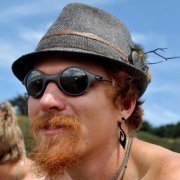
Don Henry Ford, Jr., is an unapologetic outlaw. For seven years he made his living smuggling marijuana across the U.S.-Mexico border in the Big Bend region of Texas. His business partners were some of the era's biggest narcotraficantes like Pablo Acosta and Amado Carrillo Fuentes. After Ford was arrested and imprisoned, he escaped and lived for a year in rural Mexico, raising a bumper crop of weed and hiding out from the federales , before his recapture and return to the penitentiary. Contrabando is the extraordinary, unabashed memoir of a rebel -- a warrior on the other side of the War on Drugs who lived to tell the tale. But more than a riveting and remarkable true crime confession, Contrabando is an ode to the beauty of the dry, dusty West Texas plains and the lonely hills of Mexico -- and a tribute to Ford's friends, protectors, and fellow outlaws who stood by him during the dangerous smuggling years.
True story (and I got to meet the author!) that is being adapted into a screenplay (can't wait!). Vivid tale about life on the road as a drug smuggler that keeps the highways hot on trails into Mexico through the Big Bend region. Don Ford isn't necessarily from a hard life, but more so finds an easy life in a hard industry. Don has a love affair with the land that he traverses and does a good job of describing what his world is like from his perspective. Good times and bad.
Bought this book at a store in Terlingua (Big Bend), having discovered that the right book can make a vacation seem to last another week.
This book did the trick, being loaded with sites all over not only Big Bend but places I know all over West Texas and even Mexico, from Lubbock to Fort Worth to Houston to Balmorhea to Pecos to Fort Stockton to even the jail in Piedras Negras (walls I have actually been behind, visiting the incarcerated). And of course, so many scenes happen in the national park, especially around Santa Elena Canyon--which I researched but could not see thanks to the park being closed due to a single resident testing positive for Covid-19. Stupid pandemic. Anyway, I enjoyed the book.
The author is cynical about his subject. I believe another review called him "unapologetic." He is defensive, admitting he broke the law, but arguing at the same time that the law is wrong. He further attributes blame to Americans in general, to the rich, the successful, the hardworking. In other words, those of us who played by the rules, earned a college degree or more (and paid for it), are to blame for the plight of those less fortunate. We don't care, we are selfish, and we ignore nature's beauty in our capitalist pursuit of money and power.
Obviously, I disagree. (Why else was I in Big Bend? Why do I raise my kids on a farm? Why is my life all books and art and nature and teaching students from all over the world?)
And it goes without saying that all of us hardworking members of the public are using drugs every day too. It's our fault people like Ford are forced to pack 100 pounds of pot into their cars and drive through the Rio Grande under cover of darkness.
Again, I disagree. I have never used drugs. Not even once--though I saw and smelled pot nearly every day of high school. And there are millions like me. Ford admits as much when he says that one pot user can spot another--to do so, he must also be able to spot the majority that is NOT using.
Ford spent seven years breaking the law. Why? Because it was the quickest way to get rich. Farming was cash-poor. So hey, I'll be a drug smuggler.
I'm not judging him, merely pointing out the hypocrisy of his arguments, particularly those in the Afterword. It seems he spent seven years breaking the law, then fifteen in prison--adding up to 22 years telling himself what he did was okay, the laws are wrong, it's all someone else's fault, and man, I'm really sorry--that my attempts to get rich quick have forever wounded my wife and children. He is sorry about that, but finds it easy to rationalize away his crimes and failures. And again--the real losers are the masses out there doing their best every day, because apparently Americans--collectively the most generous people on earth--are too stingy. Not like all those kind-hearted drug dealers out there.
Sorry. I got carried away--most of what I've written applies only to the Afterword and an odd line here and there in the book. But of course, I finished with the Afterword, so that part is still ringing in my ears. Clearly this review is unfairly weighted by Ford's politics, a subject of only minor importance in the book. This is not a book about politics, or a dissertation on the evils of the War on Drugs. It is an adventure tale, with a pinch of the author's opinions thrown in for seasoning.
Incidentally, some of the best writing in this book was about food, of all things. Ford knows all about farming, irrigation, and deserts, and his writing explains those issues well. But Ford also knows a great deal about "the old ways" of cooking, by peasants, over open flames and wood-fired hearths. He explains how to prepare tortillas and beans with the vigor and detail of a book by a world-class chef. And his writing about steaks and barbecue and the various cuts of meat is equally educational. It is also savory--even the descriptions of tortillas and refried beans made me impossibly hungry.
This is a well-written book. Ford is no poet, no English major. He is not John Steinbeck or Ernest Hemingway, living a bruising, manly life and somehow becoming a better writer because of it. But Ford's prose is straightforward with beautiful moments sprinkled here and there. It is a good read, the sort of Narco story that rings true and does not feel sensationalized like TV shows on the topic. The book strikes me as an honest telling and I am glad I read it.
I certainly wish him well. His reformation, his leaving not only a life of crime but turning his back on his own pot-smoking habit, is an amazing story and one this book does not tell. Perhaps he should write that story next.
great book. I'm not particularly a criminality related books reader. But my passion for the city of Miami often sends me into that category. and being vaccinated to cocaine stories, i decided to dig a bit the weed smuggling world, to see how things were there the book is incredibly rich. but not detailled where it becomes boring. it's very detailled, but details one wouldn't expect for such type of book. for example great attention is given to the people he meets along his contrabando life. and this is one of the things that i noticed early in the book. the persons he meets aren't just names, it's people he shared something with. that he considers important. for example the mexican guy Beto. that guy was basically a mexican cow boy who used to bring him food when he was wanted. He describes Beto physically, but also how he rode horses, how he cooked. when he meets Beto again several years later, again he describes him physically. And this goes for almost all the people he interacted with. people for that guy aren't just pawns on a chessmate, they're people he shared with. And which are precious books with tons of details can be boring. But that book is the opposite. he describes how he crossed that ford, what he ate. what he cooked. how to cultivate an agricultural parcel, how to repair an old truck with few it's really a modern cow-boy, or outlaw story. with a big difference compared to Jesse James though. DHF never made any deal carrying a fire arm. it's a kind of soft criminal. outlaw, and also very human at the same time. at the beginning he wasn't a criminal. i let you discover it. But he was a farmer, and an hard worker. and a big rain, or a storm, i don't recall it, put him in difficulty, and he decided to deal majihuana
I read for the travel, and the humanity, and i got served, and copiously served
The dark side of a region of Texas most often romanticized. A good testimony to the waste and heart ache of a life of crime. An interesting tidbit on page 237.
A true tale of a West Texas farmer turned drug runner. All the things about a life on the run,no one to trust, no place to hide, money won and lost. Lots of lessons learned the hard way. Makes you wonder if your neighbor is a drug runner and you don't know it.