

What do you think?

Call Me Lucky
A candid self-portrait of one of the most gifted of all American entertainers
Bing Crosby once said, when asked to explain his success, "Every man who sees one of my movies or who listens to my records or who hears me on the radio, believes firmly that he sings as well as I do, especially when he is in the bathroom shower." And it's not surprising that his classic autobiography, Call Me Lucky , is written in the casual, confident tone of a man singing in the shower. In these pages, Bing tells us how he developed his unique style to produce an unequaled string of hit jazz and pop records, and shares stories about music, horses, golf, movies, and contemporaries--Bob Hope, Bix Beiderbecke, Louis Armstrong, to name just a few. Writing at the apex of his fame, Crosby looks back on a rich and absorbing life--and a phenomenal career--and says with Bingian modesty, hey, Call Me Lucky.
" Call Me Lucky remains one of the most enchanting of all show business memoirs. It not only chronicles, with reasonable accuracy, the life of a central figure in the popular culture of this century, but reproduces the merry, occasionally guileful tone Bing Crosby perfected on radio and in movies. This is Crosby the way he wanted to be known to his adoring public and in all likelihood to himself."--Gary Giddins
Bing Crosby once said, when asked to explain his success, "Every man who sees one of my movies or who listens to my records or who hears me on the radio, believes firmly that he sings as well as I do, especially when he is in the bathroom shower." And it's not surprising that his classic autobiography, Call Me Lucky , is written in the casual, confident tone of a man singing in the shower. In these pages, Bing tells us how he developed his unique style to produce an unequaled string of hit jazz and pop records, and shares stories about music, horses, golf, movies, and contemporaries--Bob Hope, Bix Beiderbecke, Louis Armstrong, to name just a few. Writing at the apex of his fame, Crosby looks back on a rich and absorbing life--and a phenomenal career--and says with Bingian modesty, hey, Call Me Lucky.
" Call Me Lucky remains one of the most enchanting of all show business memoirs. It not only chronicles, with reasonable accuracy, the life of a central figure in the popular culture of this century, but reproduces the merry, occasionally guileful tone Bing Crosby perfected on radio and in movies. This is Crosby the way he wanted to be known to his adoring public and in all likelihood to himself."--Gary Giddins
360 pages, Paperback
First published April 1, 1993
About the author
Bing Crosby
133 books8 followersHarry Lillis "Bing" Crosby was a popular American singer and actor whose career stretched over more than half a century from 1926 until his death. Crosby was the best-selling recording artist until well into the rock era, with over half a billion records in circulation.
One of the first multimedia stars, from 1934 to 1954 Bing Crosby held a nearly unrivaled command of record sales, radio ratings and motion picture grosses. Widely recognized as one of the most popular musical acts in history, Crosby is also credited as being the major inspiration for most of the male singers of the era that followed him, including Perry Como, Frank Sinatra, and Dean Martin. Yank magazine recognized Crosby as the person who had done the most for American G.I. morale during World War II and, during his peak years, around 1948, polls declared him the "most admired man alive," ahead of Jackie Robinson and Pope Pius XII. Also during 1948, the Music Digest estimated that Crosby recordings filled more than half of the 80,000 weekly hours allocated to recorded radio music.
Crosby exerted an important influence on the development of the postwar recording industry. In 1947, he invested $50,000 in the Ampex company, which developed North America's first commercial reel-to-reel tape recorder, and Crosby became the first performer to pre-record his radio shows and master his commercial recordings on magnetic tape. He gave one of the first Ampex Model 200 recorders to his friend, musician Les Paul, which led directly to Paul's invention of multitrack recording. Along with Frank Sinatra, he was one of the principal backers behind the famous United Western Recorders studio complex in Los Angeles.
Through the aegis of recording, Crosby developed the techniques of constructing his broadcast radio programs with the same directorial tools and craftsmanship (editing, retaking, rehearsal, time shifting) that occurred in a theatrical motion picture production. This feat directly led the way to applying the same techniques to creating all radio broadcast programming as well as later television programming. The quality of the recorded programs gave them commercial value for re-broadcast. This led the way to the syndicated market for all short feature media such as TV series episodes.
In 1962, Crosby was the first person to be recognized with the Grammy Global Achievement Award. He won an Academy Award for Best Actor for his role as Father Chuck O'Malley in the 1944 motion picture Going My Way. Crosby is one of the few people to have three stars on the Hollywood Walk of Fame.
One of the first multimedia stars, from 1934 to 1954 Bing Crosby held a nearly unrivaled command of record sales, radio ratings and motion picture grosses. Widely recognized as one of the most popular musical acts in history, Crosby is also credited as being the major inspiration for most of the male singers of the era that followed him, including Perry Como, Frank Sinatra, and Dean Martin. Yank magazine recognized Crosby as the person who had done the most for American G.I. morale during World War II and, during his peak years, around 1948, polls declared him the "most admired man alive," ahead of Jackie Robinson and Pope Pius XII. Also during 1948, the Music Digest estimated that Crosby recordings filled more than half of the 80,000 weekly hours allocated to recorded radio music.
Crosby exerted an important influence on the development of the postwar recording industry. In 1947, he invested $50,000 in the Ampex company, which developed North America's first commercial reel-to-reel tape recorder, and Crosby became the first performer to pre-record his radio shows and master his commercial recordings on magnetic tape. He gave one of the first Ampex Model 200 recorders to his friend, musician Les Paul, which led directly to Paul's invention of multitrack recording. Along with Frank Sinatra, he was one of the principal backers behind the famous United Western Recorders studio complex in Los Angeles.
Through the aegis of recording, Crosby developed the techniques of constructing his broadcast radio programs with the same directorial tools and craftsmanship (editing, retaking, rehearsal, time shifting) that occurred in a theatrical motion picture production. This feat directly led the way to applying the same techniques to creating all radio broadcast programming as well as later television programming. The quality of the recorded programs gave them commercial value for re-broadcast. This led the way to the syndicated market for all short feature media such as TV series episodes.
In 1962, Crosby was the first person to be recognized with the Grammy Global Achievement Award. He won an Academy Award for Best Actor for his role as Father Chuck O'Malley in the 1944 motion picture Going My Way. Crosby is one of the few people to have three stars on the Hollywood Walk of Fame.
Ratings & Reviews
Friends & Following
Create a free account to discover what your friends think of this book!
Community Reviews
Displaying 1 - 13 of 13 reviews

August 27, 2014
I read Bing's biography after reading an autobiography that was just a load of cobbled together quotes and meanness. It's no secret that Bing has long been painted as a 'tough' man and parent but the autobiography was all hearsay and unpleasant...and it worried me that the artist I so enjoy could be that awful.
However, the biography painted a different picture altogether and one that was entirely believable. Bing didn't make himself out to be all sweetness and light but seemed to be very much a product of the times. A no nonsense type of guy who lead an extraordinary life and attained extraordinary levels of success, from such humble beginnings. He seemed to be a man of his word and loyal to those who deserved his loyalty but did not suffer fools at all and was adept at keeping everyone at arm's length. Bing definitely had a way with words and in this book used them to great effect creating an entertaining barrier between the reader and himself by providing us with so many wonderful anecdotes about his friends and all of the nonsense they got up to over the years, subtly diverting attention from himself so you think you are learning all about him...and you are, from a distance.
However, the biography painted a different picture altogether and one that was entirely believable. Bing didn't make himself out to be all sweetness and light but seemed to be very much a product of the times. A no nonsense type of guy who lead an extraordinary life and attained extraordinary levels of success, from such humble beginnings. He seemed to be a man of his word and loyal to those who deserved his loyalty but did not suffer fools at all and was adept at keeping everyone at arm's length. Bing definitely had a way with words and in this book used them to great effect creating an entertaining barrier between the reader and himself by providing us with so many wonderful anecdotes about his friends and all of the nonsense they got up to over the years, subtly diverting attention from himself so you think you are learning all about him...and you are, from a distance.
April 15, 2010
I love this book. Bing Crosby is the man- hilarious, intelligent and humble. I will most likely read this book again soon, skipping the lenthly middle section where he reflects on golf.

December 6, 2025
Four solid stars, though that's subjective. It probably deserves 3.5 objectively.
I'm a little biased because Bing Crosby is probably my favorite singer ever. I still listen to his radio shows from the 1930s-40s every week on Sirius, and it's always a joy. You can really see how much things have changed since then as far as comedy and class go. You didn't have to be vulgar to be funny back then. In fact, such wasn't allowed on the air. Personally, I think being funny and clean simultaneously takes more talent, and I have more respect for anyone who can pull that off. Bing did it with flair. I also like him because we seem to share the same vocal range, and I can sing along with Bing without straining my pipes. Make no mistake, I don't sound anything like him and will occasionally venture off-key, but it's nice to do that without hurting anything in myself, though a listener's ears might get injured.
Once in a blue moon someone comes along with an incomparable natural talent in a particular field, and that's what Bing brought to singing in the early 20th century. It's easy to hear when he's singing with others because they can't touch him no matter how great they may be. If you listen closely it sounds like they're trying, but Bing just belts it out effortlessly with unmatched grace and ease. Take the "Style" scene from Robin and the 7 Hoods with Frank Sinatra and Dean Martin. Bing lacks visual appeal, and his dancing leaves much to be desired, but when his dulcet tones cut in at the end, he blows the others out of the water. I'm not arguing that he sounds better to everybody; that's a matter of opinion. I'm just saying his mellifluous timbre exhibited a natural elegance one can't get from training no matter how hard he tries. Fred Astaire did this with dancing, and Bing even said "when you're in a picture with Astaire, you've got rocks in your head if you do much dancing. He's so quick-footed and so light that it's impossible not to look like a hay-digger compared with him." There may be other dancers out there you prefer (Gene Kelly was a hell of a hoofer with an athleticism almost impossible to match), but none of them made it look as easy as Fred did. Michael Jackson had that skill too. I remember when he showed up NSYNC at the 2001 MTV VMAs, not that he was trying to. What's worse is that MJ was having an off night, danced for only 25 seconds, didn't even want to be there, and he still mops up the floor with them with his natural talent. All I'm saying is you can always tell when there's a swan among the ducks.
But I'm straying too far afield. This book was written in 1953 just after Bing's career had hit its apex. Several things happened then and his star began to wane. His first wife died. Radio, a medium in which he was king, was starting to decline in favor of television. (After all, video killed the radio star.) Rock and roll was in its gestation period, and while Bing was proficient in multiple styles, he never made that transition. I expect he found it too silly with songs asking who put the bomp in the bomp, bomp-bomp, bomp-bomp instead of more sensible questions like who threw the overalls in Mrs. Murphy's chowder? But this all worked out in Bing's favor. All he ever wanted to do for the first fifty years of his life was sing; the movies, radio shows, money, horse racing, golf, being involved in multiple business ventures, owning part of the Pittsburgh Pirates, and all the rest was just gravy. He'd have been just fine eking out a living crooning to whoever would listen as long as it paid the bills. By 1953, he was ready to call it a day if that's what the fates had in store for him, but the world wasn't done with him yet. He stayed busy in multiple entertainment projects until his death in 1977, but his real heyday was from the 30s to early 50s. He seems like the kind of guy who could adapt to whatever life threw at him and be content; the essence of easygoing; able to wear the world like a loose garment. I personally find that more admirable than any success he attained.
This doesn't mean he was perfect, of course. Multiple sources say he was distant and aloof in his private life. He doesn't make such an admission in this, but he does say that he probably could've done better as a parent even though he did the best he knew how. His oldest son Gary supposedly raked him over the coals in his own book Going My Own Way, but I haven't read it myself. Depending on whom you ask, either Gary exaggerated Bing's abuses, or those who accused him of doing so exaggerated how bad Gary made Bing look. The only way to be sure is to read Gary's book yourself (which I don't plan to do due to lack of interest). Regardless, it's generally accepted that Gary's take, while based in fact, should be taken with a grain of salt. The other brothers disagreed to varying degrees, one of them vehemently. It also looks like the book is more about Gary's struggle with alcohol and life than it is about Big Bad Beating Bing; Bing's contribution with a belt was just a part of Gary's story. And it's also possible Gary figured turnabout was fair play. Bing briefly discusses problems he was having with Gary in college at the end of Call Me Lucky when he was talking about how he could've done better as a parent and wasn't sure what to do next, and they don't leave Gary in a positive light.
But enough about that. Reading this was a delight. I could hear Bing's voice perfectly since it emulated his speaking style which was top-notch. When he came along, elocution was still taught in schools, and he apparently took it to heart. I always figured he just had great writers for all his movies, but it turns out he ad-libbed a lot, and many of the witty gems you hear in his movies and radio shows were all him. He loved words as a kid and young adult, and he always had a thesaurus with him that he would peruse as a hobby which explains much of his unique phrasing. The ad-libbing also happened in his music. In fact, the "lay that thing down before it goes off and hurts somebody" line in Pistol Packin' Mama was spit out on the spot.
He and Bob Hope drove the directors crazy while making their on-the-road movies.
This shows that Bing enjoyed what he did, but it was the work that brought him joy and not the finished product. He almost never watched his own movies or listened to his own songs if he could help it because he'd find himself picking his performance apart. One of his sons later said he'd never met anybody so disinterested in his own work.
His self-deprecating sense of humor and modesty is all over this book. Of White Christmas, which has sold 50 million copies and is still the best selling single of all time by 17 million copies (not counting digital sales which is a whole different ballgame), he said "a jackdaw with a cleft palate could have sung it successfully." He was trying to say how it was a great song and Irving Berlin deserved the credit, but Bing frequently downplayed his role in making something a hit.
This was laid out in a haphazard way. It started with a few anecdotes, then went chronologically, then topically, but oddly enough, it works. I enjoyed it because it was filled with fun stories about the people he met and worked with, and they were similar to the stories I like to tell about my friends and family, not to mention myself. The longest chapter in the book by far was the one about golf which was Bing's greatest passion aside from singing, and it may have even outstripped that the last couple decades of his life. Hell, the man died on a golf course. He had just won an 18 hole match, and his last words were "That was a great game of golf, fellas. Let's go have a Coca-Cola." (Looks like he was doing sponsor spots right up until the very end.) Then he stepped off the green and into the afterlife.
The golf chapter made me hip to the fact that Bing wasn't always wrapped too tight.
I didn't try again until I got to college, but matters didn't improve. During my six or seven-year stint, I got 18 on a par three more than once, and one of those times I followed up the score massacre with a tee shot off that very green with my putter which sent the ball through a line of trees. The sound of squealing tires came back because apparently there was a road on the other side. I missed the ball on multiple tee shots, and occasionally the driver flew out of my hand on the back swing and sent my friends scrambling for cover.
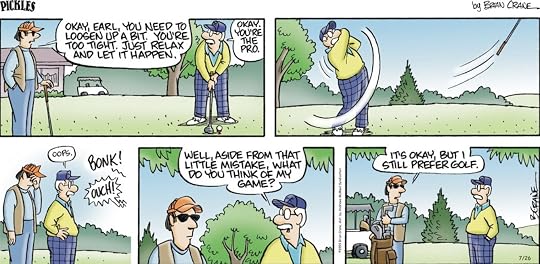
I know that's the follow-through, but whatever. It's still pretty bad when you have to holler "fore" for a flying club.
I was better at sending divots down the fairway with an iron than anything else, and any body of water in or near my path would be well fed before I made it to the hole. In fact, I always brought extra balls and would throw one directly into the lake or pond when I got to it and say, "Oh Lake God, please accept this sacrifice to satiate your hunger for my balls. Sanctus dominus deus ex machina e pluribus unum ut prosim kyrie eleison down the fairway I must travel. Amen." Sometimes this appeased him, sometimes not. If the latter, I simply took a drop on the other side instead of sending four or five consecutively into the drink which is also a feat I accomplished more than once. I've gotten a ball stuck in a tree and also the club that put it there when I threw it in an attempt to get the ball back, and my pitching wedge bore permanent scars from the parking lot tarmac because my buddies that day were quite adamant that we must always play the ball where it lies.
My temper tantrums back then were legendary during the course of a normal day, but a game of golf elevated them to mythological status, so tell me once again, Bing, old buddy, old pal, how golf is a relaxing game which brings out the best in people. I'm more in line with Mark Twain's take on the matter which states that golf ain't nothing but a good walk spoiled. I still believe that in spite of the many fond memories I have, but those are more about the fun times with friends; laughing, hooping, and hollering to the point that the course superintendent found it necessary to follow us from afar. We'd calm down for a bit but resume our antics as soon as he departed. We only did that shit on the redneck courses which is really all I ever played because my friends were too ashamed to bring me along to the better ones, partly because I played like crap, but mostly because I could be a bit of a nut when I got bored, and I was usually tired of the game by the seventh or eighth hole and looking for ways to make it more interesting. That was fine with me, though, because while shoes were required at all courses, shirts were optional at these podunk dog tracks. This lax stance on clothing came in handy on warm days and allowed me to multitask and work on my tan as I cursed my way through nine or eighteen holes.
Hmph. Looks like Bing ain't the only one who can get the on-and-ons about golf.
I'm a little biased because Bing Crosby is probably my favorite singer ever. I still listen to his radio shows from the 1930s-40s every week on Sirius, and it's always a joy. You can really see how much things have changed since then as far as comedy and class go. You didn't have to be vulgar to be funny back then. In fact, such wasn't allowed on the air. Personally, I think being funny and clean simultaneously takes more talent, and I have more respect for anyone who can pull that off. Bing did it with flair. I also like him because we seem to share the same vocal range, and I can sing along with Bing without straining my pipes. Make no mistake, I don't sound anything like him and will occasionally venture off-key, but it's nice to do that without hurting anything in myself, though a listener's ears might get injured.
Once in a blue moon someone comes along with an incomparable natural talent in a particular field, and that's what Bing brought to singing in the early 20th century. It's easy to hear when he's singing with others because they can't touch him no matter how great they may be. If you listen closely it sounds like they're trying, but Bing just belts it out effortlessly with unmatched grace and ease. Take the "Style" scene from Robin and the 7 Hoods with Frank Sinatra and Dean Martin. Bing lacks visual appeal, and his dancing leaves much to be desired, but when his dulcet tones cut in at the end, he blows the others out of the water. I'm not arguing that he sounds better to everybody; that's a matter of opinion. I'm just saying his mellifluous timbre exhibited a natural elegance one can't get from training no matter how hard he tries. Fred Astaire did this with dancing, and Bing even said "when you're in a picture with Astaire, you've got rocks in your head if you do much dancing. He's so quick-footed and so light that it's impossible not to look like a hay-digger compared with him." There may be other dancers out there you prefer (Gene Kelly was a hell of a hoofer with an athleticism almost impossible to match), but none of them made it look as easy as Fred did. Michael Jackson had that skill too. I remember when he showed up NSYNC at the 2001 MTV VMAs, not that he was trying to. What's worse is that MJ was having an off night, danced for only 25 seconds, didn't even want to be there, and he still mops up the floor with them with his natural talent. All I'm saying is you can always tell when there's a swan among the ducks.
But I'm straying too far afield. This book was written in 1953 just after Bing's career had hit its apex. Several things happened then and his star began to wane. His first wife died. Radio, a medium in which he was king, was starting to decline in favor of television. (After all, video killed the radio star.) Rock and roll was in its gestation period, and while Bing was proficient in multiple styles, he never made that transition. I expect he found it too silly with songs asking who put the bomp in the bomp, bomp-bomp, bomp-bomp instead of more sensible questions like who threw the overalls in Mrs. Murphy's chowder? But this all worked out in Bing's favor. All he ever wanted to do for the first fifty years of his life was sing; the movies, radio shows, money, horse racing, golf, being involved in multiple business ventures, owning part of the Pittsburgh Pirates, and all the rest was just gravy. He'd have been just fine eking out a living crooning to whoever would listen as long as it paid the bills. By 1953, he was ready to call it a day if that's what the fates had in store for him, but the world wasn't done with him yet. He stayed busy in multiple entertainment projects until his death in 1977, but his real heyday was from the 30s to early 50s. He seems like the kind of guy who could adapt to whatever life threw at him and be content; the essence of easygoing; able to wear the world like a loose garment. I personally find that more admirable than any success he attained.
This doesn't mean he was perfect, of course. Multiple sources say he was distant and aloof in his private life. He doesn't make such an admission in this, but he does say that he probably could've done better as a parent even though he did the best he knew how. His oldest son Gary supposedly raked him over the coals in his own book Going My Own Way, but I haven't read it myself. Depending on whom you ask, either Gary exaggerated Bing's abuses, or those who accused him of doing so exaggerated how bad Gary made Bing look. The only way to be sure is to read Gary's book yourself (which I don't plan to do due to lack of interest). Regardless, it's generally accepted that Gary's take, while based in fact, should be taken with a grain of salt. The other brothers disagreed to varying degrees, one of them vehemently. It also looks like the book is more about Gary's struggle with alcohol and life than it is about Big Bad Beating Bing; Bing's contribution with a belt was just a part of Gary's story. And it's also possible Gary figured turnabout was fair play. Bing briefly discusses problems he was having with Gary in college at the end of Call Me Lucky when he was talking about how he could've done better as a parent and wasn't sure what to do next, and they don't leave Gary in a positive light.
But enough about that. Reading this was a delight. I could hear Bing's voice perfectly since it emulated his speaking style which was top-notch. When he came along, elocution was still taught in schools, and he apparently took it to heart. I always figured he just had great writers for all his movies, but it turns out he ad-libbed a lot, and many of the witty gems you hear in his movies and radio shows were all him. He loved words as a kid and young adult, and he always had a thesaurus with him that he would peruse as a hobby which explains much of his unique phrasing. The ad-libbing also happened in his music. In fact, the "lay that thing down before it goes off and hurts somebody" line in Pistol Packin' Mama was spit out on the spot.
He and Bob Hope drove the directors crazy while making their on-the-road movies.
Our first road picture baffled its director, Victor Schertzinger... He was used to directing his pictures in leisurely fashion. His awakening was rude. For a couple of days when Hope and I tore free-wheeling into a scene, ad-libbing and violating all of the accepted rules of movie-making, Schertzinger stole bewildered looks at his script, then leafed rapidly through it, searching for the lines we were saying. When he couldn't find them he'd be ready to flag us down and to say reprovingly, "Perhaps we'd better do it the way it's written, gentlemen," but then he'd notice that the crew was laughing at our antics. He was smart enough to see that if we evoked that kind of merriment from a hard-boiled gang who'd seen so many pictures they were blase about them, it might be good to let us do it our way.After that, they were given the barest sketch of what was supposed to happen, and they pretty much made up all the dialogue along the way. Both men were quick-witted, and their back and forth banter, all unscripted, usually came out as comedy gold when they were together on their radio shows.
This shows that Bing enjoyed what he did, but it was the work that brought him joy and not the finished product. He almost never watched his own movies or listened to his own songs if he could help it because he'd find himself picking his performance apart. One of his sons later said he'd never met anybody so disinterested in his own work.
His self-deprecating sense of humor and modesty is all over this book. Of White Christmas, which has sold 50 million copies and is still the best selling single of all time by 17 million copies (not counting digital sales which is a whole different ballgame), he said "a jackdaw with a cleft palate could have sung it successfully." He was trying to say how it was a great song and Irving Berlin deserved the credit, but Bing frequently downplayed his role in making something a hit.
This was laid out in a haphazard way. It started with a few anecdotes, then went chronologically, then topically, but oddly enough, it works. I enjoyed it because it was filled with fun stories about the people he met and worked with, and they were similar to the stories I like to tell about my friends and family, not to mention myself. The longest chapter in the book by far was the one about golf which was Bing's greatest passion aside from singing, and it may have even outstripped that the last couple decades of his life. Hell, the man died on a golf course. He had just won an 18 hole match, and his last words were "That was a great game of golf, fellas. Let's go have a Coca-Cola." (Looks like he was doing sponsor spots right up until the very end.) Then he stepped off the green and into the afterlife.
The golf chapter made me hip to the fact that Bing wasn't always wrapped too tight.
I've been told that I'm relaxed and casual. If I am, I owe a lot of it to golf. Golf has provided relaxation which has kept my batteries recharged when I put too heavy a load on them. It doesn't matter what my professional or personal problems are, when I step onto that first tee I get a sense of release and escape. When I concentrate for three to three and a half hours on trying to play a good game, the studio, my radio hour, and the fact that the latest oil well in which I've invested is spouting water are unimportant...Bing obviously never played with me. I haven't played in over 20 years, and to be honest, I didn't really "play" then either. What I did on the course could never be considered "playing golf," and I've only myself to blame for my continual frustration over it, for I was given the clearest of signs that it was not the pastime for me when I defied the laws of physics at my very first game when I was 12 years old. My dad, a couple friends, their dad, and I hit the links. Since I was brand spanking new at this, my friends' dad, who spent more time on a golf course than he did at home and was quite good at the sport, gave me a few pointers, and I was determined to do my instructor proud. I teed off, the ball flew straight up, knocked me in the forehead right between the eyes, then ricocheted just out of the tee box giving me my first of many couple-yard hits, and my golfing career was off to a roaring stop. Daddy said he'd never seen anything like that happen before but knew that if anybody could perform such a miracle, it would be me. Friends' dad said he had never even heard of anything like that happening before and wouldn't have believed it possible if he hadn't just witnessed the marvel with his own eyes.
In my opinion, competition on the links has removed more carbon knocks and emotional burrs from human minds than all of the psychiatrists' couches. I'm a fanatic on the subject, but golf is a game which not only brings out the best in individuals but those who play it are ready and willing to channel it into paths which contribute to the public weal.
I didn't try again until I got to college, but matters didn't improve. During my six or seven-year stint, I got 18 on a par three more than once, and one of those times I followed up the score massacre with a tee shot off that very green with my putter which sent the ball through a line of trees. The sound of squealing tires came back because apparently there was a road on the other side. I missed the ball on multiple tee shots, and occasionally the driver flew out of my hand on the back swing and sent my friends scrambling for cover.
I know that's the follow-through, but whatever. It's still pretty bad when you have to holler "fore" for a flying club.
I was better at sending divots down the fairway with an iron than anything else, and any body of water in or near my path would be well fed before I made it to the hole. In fact, I always brought extra balls and would throw one directly into the lake or pond when I got to it and say, "Oh Lake God, please accept this sacrifice to satiate your hunger for my balls. Sanctus dominus deus ex machina e pluribus unum ut prosim kyrie eleison down the fairway I must travel. Amen." Sometimes this appeased him, sometimes not. If the latter, I simply took a drop on the other side instead of sending four or five consecutively into the drink which is also a feat I accomplished more than once. I've gotten a ball stuck in a tree and also the club that put it there when I threw it in an attempt to get the ball back, and my pitching wedge bore permanent scars from the parking lot tarmac because my buddies that day were quite adamant that we must always play the ball where it lies.
My temper tantrums back then were legendary during the course of a normal day, but a game of golf elevated them to mythological status, so tell me once again, Bing, old buddy, old pal, how golf is a relaxing game which brings out the best in people. I'm more in line with Mark Twain's take on the matter which states that golf ain't nothing but a good walk spoiled. I still believe that in spite of the many fond memories I have, but those are more about the fun times with friends; laughing, hooping, and hollering to the point that the course superintendent found it necessary to follow us from afar. We'd calm down for a bit but resume our antics as soon as he departed. We only did that shit on the redneck courses which is really all I ever played because my friends were too ashamed to bring me along to the better ones, partly because I played like crap, but mostly because I could be a bit of a nut when I got bored, and I was usually tired of the game by the seventh or eighth hole and looking for ways to make it more interesting. That was fine with me, though, because while shoes were required at all courses, shirts were optional at these podunk dog tracks. This lax stance on clothing came in handy on warm days and allowed me to multitask and work on my tan as I cursed my way through nine or eighteen holes.
Hmph. Looks like Bing ain't the only one who can get the on-and-ons about golf.

April 5, 2018
I downloaded this and read it when I had a few minutes and was without my physical book and was caught up on other things on my phone. This book was good and entertaining. Though I've known of Bing all my life and have seen maybe one or two of his movies in my lifetime, I did not Google him prior to finishing the book. I did not expect the ending of the book. Later I Googled and saw his kids are also gone. So sad. I guess that's to be expected when you read something from 1954, but still...

September 17, 2015
5 stars. I started the book this morning and finished it this evening *cheers* :) exactly what I was hoping it would be. Illuminating, refreshing, most definitely witty. The life and career of one of my all time favourite singers in his own words.
December 15, 2023
good voice man

February 1, 2018
Call Me Lucky was an autobiography by Bing Crosby that gave a deeply personal view into the life of the famous crooner. This was unlike other biographies on Crosby in that it did not simply relate each and every movie he was in. Instead, Crosby talked openly about himself, his family, and his friends - things he believed were essential to understand his life.I was surprised to learn that he was a law student, but soon realized that his heart wasn't in the legal field.
Instead, his passion for singing lead him to develop a style that labeled him as a "crooner" and landed him parts in various singing groups. I enjoyed his tales from his early career, where managers and theater owners didn't appreciate his jokes, ad libbing, or singing style. His voice finally earned him some recognition that lead to him singing in several movies. Then he naturally progressed to having roles in the movies, and then starring in films.
It seemed that even Crosby was surprised when he was offered his famous role as Father O'Malley in Going My Way. He was even more stunned when he won the Oscar for his performance. Other roles seemed to fit him and his personality much better. The Road movies with Bob Hope are my favorite Crosby films, and I love the constant ribbing the men do back and forth throughout the films. I wanted a little more information about Crosby's relationship with Hope and their experiences on set, but I guess for that, I'll have to read someone else's biography on Crosby.
Crosby was a total jokester and loved playing pranks on those around him. So much of the book was him retelling funny tales and pranks he played. Some of these were a bit difficult to understand given the more than fifty years that have passed since the book was written. Its sort of like trying to understand the line that causes Ford's Theater to erupt into laughter the night President Lincoln was shot. Good luck.
I liked this book for the personal view it gave of Crosby's life, and I appreciated that it told his own story. I consider this a must read for Crosby fans.
Instead, his passion for singing lead him to develop a style that labeled him as a "crooner" and landed him parts in various singing groups. I enjoyed his tales from his early career, where managers and theater owners didn't appreciate his jokes, ad libbing, or singing style. His voice finally earned him some recognition that lead to him singing in several movies. Then he naturally progressed to having roles in the movies, and then starring in films.
It seemed that even Crosby was surprised when he was offered his famous role as Father O'Malley in Going My Way. He was even more stunned when he won the Oscar for his performance. Other roles seemed to fit him and his personality much better. The Road movies with Bob Hope are my favorite Crosby films, and I love the constant ribbing the men do back and forth throughout the films. I wanted a little more information about Crosby's relationship with Hope and their experiences on set, but I guess for that, I'll have to read someone else's biography on Crosby.
Crosby was a total jokester and loved playing pranks on those around him. So much of the book was him retelling funny tales and pranks he played. Some of these were a bit difficult to understand given the more than fifty years that have passed since the book was written. Its sort of like trying to understand the line that causes Ford's Theater to erupt into laughter the night President Lincoln was shot. Good luck.
I liked this book for the personal view it gave of Crosby's life, and I appreciated that it told his own story. I consider this a must read for Crosby fans.

July 20, 2026
What a darling!
I love Bing!
He's a cutie. He had so much fun singing, dancing, and performing - as a former theater kid, it really warmed my heart he had so much fun with it!
As a teenager, he and his buddies stole some cinnamon rolls, ate them until they were full, then threw the rest of the cinnamon rolls off a bridge onto the tops of cars!... including an undercover cop car. He was thrown in Juvenile Detention.
"Keep him there overnight," my mother said firmly. "It'll do him good."
HA! Darn right it will! He never did THAT again!
You know his super famous rendition of "Silent Night"? He didn't feel comfortable making money off a "Bible song" so he donated all his royalties - MILLIONS of dollars - to Orphanages in China!
"The widely publicized Hope-Crosby feud was not a planned vendetta. It was a thing we fell into."
Bing Crosby and Bob Hope both risked their lives on the front lines of World War 2 - singing and doing comedy routines to keep morale up - risking their lives to rebuild our traumatized soldiers' will to live.
They loved our troops.
They loved each other. And they insulted each other all day to make our soldiers laugh!
Cuties!
Be aware: page 331 he uses words that were correct at the time he used them, but are now outdated.
"I recall some outstanding things in show business, things which made lasting impressions on me. These things excited me at the time and i still haven't forgotten them. I recall going to see a show called Calico Days, in 1928 in Chicago. It had an all-Negro cast. A tall, handsome Negress walked out in "one." Her face was wreathed in a warm, ingratiating smile. Her eyes sparkled as she sang, "Dinah." Her name: Ethel Waters."
Bing Crosby clearly respects and admires African Americans. He used words that were respectful at the time he wrote them.
I love Bing!
He's a cutie. He had so much fun singing, dancing, and performing - as a former theater kid, it really warmed my heart he had so much fun with it!
As a teenager, he and his buddies stole some cinnamon rolls, ate them until they were full, then threw the rest of the cinnamon rolls off a bridge onto the tops of cars!... including an undercover cop car. He was thrown in Juvenile Detention.
"Keep him there overnight," my mother said firmly. "It'll do him good."
HA! Darn right it will! He never did THAT again!
You know his super famous rendition of "Silent Night"? He didn't feel comfortable making money off a "Bible song" so he donated all his royalties - MILLIONS of dollars - to Orphanages in China!
"The widely publicized Hope-Crosby feud was not a planned vendetta. It was a thing we fell into."
Bing Crosby and Bob Hope both risked their lives on the front lines of World War 2 - singing and doing comedy routines to keep morale up - risking their lives to rebuild our traumatized soldiers' will to live.
They loved our troops.
They loved each other. And they insulted each other all day to make our soldiers laugh!
Cuties!
Be aware: page 331 he uses words that were correct at the time he used them, but are now outdated.
"I recall some outstanding things in show business, things which made lasting impressions on me. These things excited me at the time and i still haven't forgotten them. I recall going to see a show called Calico Days, in 1928 in Chicago. It had an all-Negro cast. A tall, handsome Negress walked out in "one." Her face was wreathed in a warm, ingratiating smile. Her eyes sparkled as she sang, "Dinah." Her name: Ethel Waters."
Bing Crosby clearly respects and admires African Americans. He used words that were respectful at the time he wrote them.
April 2, 2019
I found this in hardback on a free shelf at Starbucks! I have had an interest in Bing ever since I saw and re-saw a dozen times his films Holiday Inn and Going My Way.
That aside I was primed for a great read and boy I was not disappointed. The stories told by him were so upfront and personal I though he was in the room with me. After reading his son Gary Crosby's book I was of course dismayed to see the stories of severe discipline Bing could dish out but to give you my personal insight.... belt whippings were all to common in my own childhood home. So I can't get so unnerved about that issue with Bing. Clearly the home and business persona were different as it was with my parents and myself back in the day.
But I digress. Back to the book itself. I found I really knew Bing so much better after reading it. Unlike so many autobiographies of musicians read today I felt I really knew Bing better. Written more than a half century ago it still came off fresh to me. If you like Bing and can find this book, do so.
Sadly I returned my free book back to the shelf at Starbucks. A week later it was not there.
That aside I was primed for a great read and boy I was not disappointed. The stories told by him were so upfront and personal I though he was in the room with me. After reading his son Gary Crosby's book I was of course dismayed to see the stories of severe discipline Bing could dish out but to give you my personal insight.... belt whippings were all to common in my own childhood home. So I can't get so unnerved about that issue with Bing. Clearly the home and business persona were different as it was with my parents and myself back in the day.
But I digress. Back to the book itself. I found I really knew Bing so much better after reading it. Unlike so many autobiographies of musicians read today I felt I really knew Bing better. Written more than a half century ago it still came off fresh to me. If you like Bing and can find this book, do so.
Sadly I returned my free book back to the shelf at Starbucks. A week later it was not there.

February 5, 2019
Call Me Lucky, Bing Crosby's Own Story. Bing wrote an autobiography? What an awesome discovery. His droll story telling is full of anecdotes about his buddies and his family. Its like having him over for dinner. Loved it.

November 14, 2025
One LESS on the paperback TBR shelf.📚

October 22, 2015
I read the 1950s edition of Bing's autobiography. It covers his life from birth to just after his first wife Dixie Lee died, he is entertaining throughout the book. His friendly rivalry with Bob Hope and his friendship with the likes of Paul Whiteman and Louis Armstrong are given with his usual humour. I would like to read the more up to date version which would undoubtedly have his rivalry with Frank Sinatra.
October 16, 2016
Great book
Displaying 1 - 13 of 13 reviews