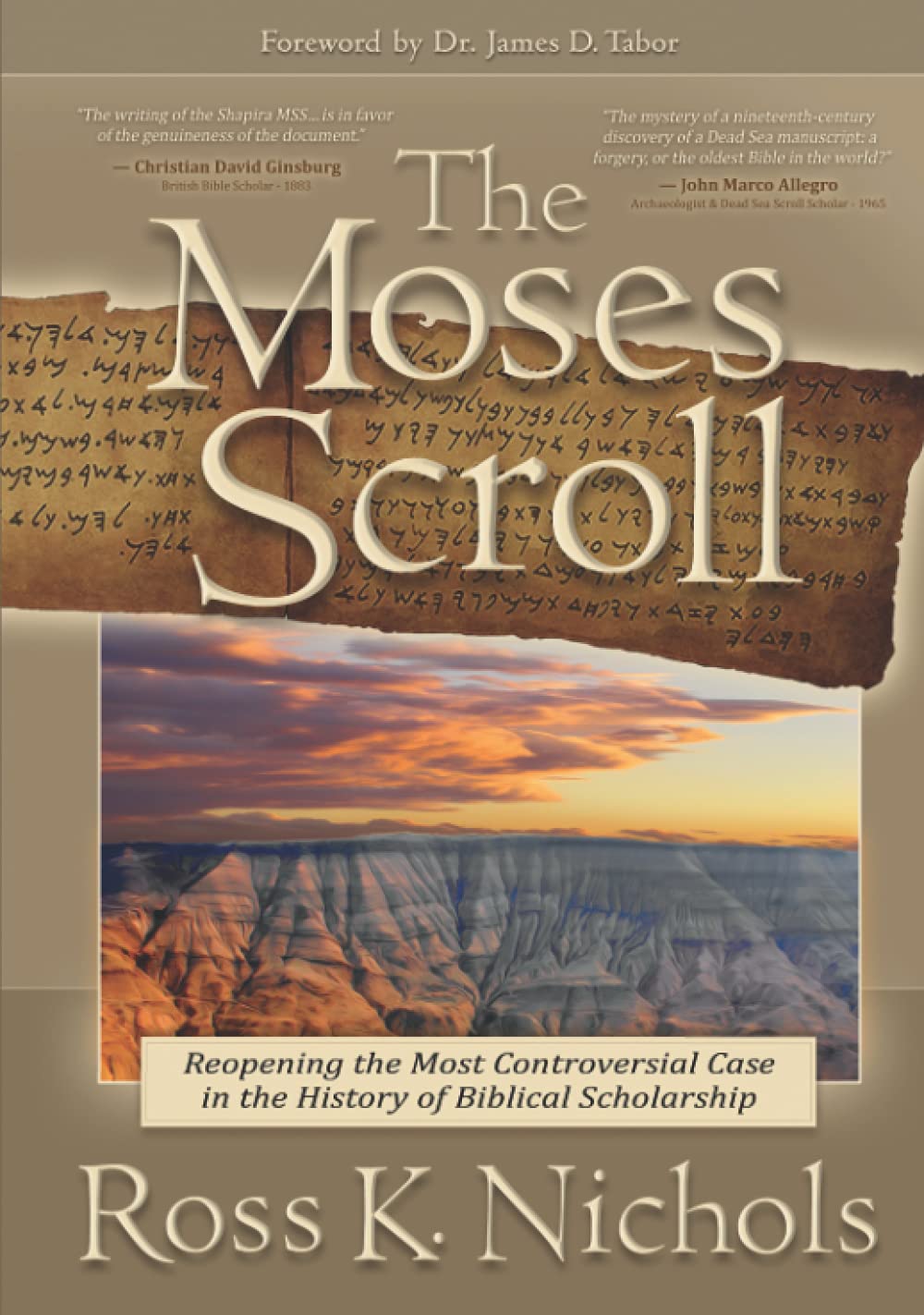
In 1883, Jerusalem antiquities dealer Moses Wilhelm Shapira presented a set of sixteen blackened leather strips written in ancient Hebrew script. The text resembled the Book of Deuteronomy, yet with striking differences. It was said to have been discovered around 1865 in a cave east of the Dead Sea, still bearing traces of linen and a black pitch-like coating—details now familiar from the Dead Sea Scrolls.
The manuscript’s narrative moved from Horeb to the plains of Moab, containing a distinctive version of the Ten Words (Commandments)—including one unknown in any other ancient witness—followed by blessings and curses that correspond directly to them, but none of Deuteronomy’s later law code (chapters 12–26).
Dismissed as a forgery and forgotten after Shapira’s death, the case has reemerged since the discovery of the Dead Sea Scrolls, leading scholars to ask Were the critics wrong?
In The Moses Scroll, Ross K. Nichols retraces the manuscript’s 19th-century journey from Jerusalem to Leipzig, Berlin, and London, and then reconstructs the lost text itself, presenting the complete English translation, commentary, and Hebrew reconstruction based on contemporary transcriptions made by those who examined the original strips.
Praised by scholars and reviewers
“A sea change in Shapira studies… a thrill to read—part detective saga and mystery—but solid historical documentation.” — James D. Tabor
“No one in the late 19th century could have faked such a complex work… Nichols is now a leading authority on Shapira’s discovery.” — James H. Charlesworth
“A fascinating account of the dramatic story that unfolded in 1883… calls for a re-examination of the case.” — Matthieu Richelle, Semitica
“Semi-academic, semi-theological… asks, ‘What did Moses write?’” — Jonathan Klawans, Dead Sea Discoveries
The Moses Scroll invites readers to reopen the most controversial case in the history of biblical scholarship—and decide for themselves.
Ross K. Nichols is an independent biblical researcher, author, and educator. He has published three books through Horeb Press: The Moses Scroll (2021), Fragments of a Leather Manuscript Containing Moses’ Last Words to the Children of Israel (2021), and These Are the Words: Essential Biblical Hebrew Vocabularies (2022). You can find his books on Amazon, Barnes & Noble, and other booksellers.
Nichols has traveled extensively to Israel and Jordan over the past decade, leading tours and conducting biblical research. His primary research interests include the Hebrew Bible, emphasizing the Pentateuch, the Dead Sea Scrolls, and nineteenth-century explorations and discoveries in the Levant. He has participated in archaeological excavations in Jerusalem and Biblical Tamar south of the Dead Sea and expeditions to identify the locations mentioned in the wilderness itineraries, including the quest for Biblical Horeb/Sinai.
Nichols is a Vice President and an ordained minister of the Hebrew Faith for United Israel World Union, an educational, non-profit organization founded in 1944. Videos of his weekly classes in Biblical studies are live-streamed to a growing global audience on Facebook, Twitter, and YouTube. Audio archives of his biblical teachings are available on Amazon Music/Audible, Apple Podcasts, iHeart Radio, Pandora, Spotify, Stitcher, TuneIn, and most major podcast directories. Search for United Israel by Ross K. Nichols and subscribe.
HOT! The Shapira affair is back in the world news! Immerse yourself in one of the most controversial historical-biblical mysteries of all time. Follow Moses Shapira, 19th century book seller and antiquarian as he attempts to have his amazing find validated. Fifteen leather strips, found in a cave near the Dead Sea by Bedouins, covered in a black asphalt like substance, once wrapped in cloth, with paleo-Hebrew writing. Once deciphered, they are found to contain two copies of the Book of Deuteronomy (sound familiar). In his quest to authenticate the strips, Shapira travels from Jerusalem to Berlin, to London and meets with the preeminent scholars of the day. Sounds like Indiana Jones? Except this is not Fiction! Meticulously researched, with extensive footnotes but written for the historical fiction nut like me. Fantastical find (1st Dead Sea Scroll?) or fraud? And where are they today? Join 21st century scholars as they once again debate the issue.
Read this book for a beautifully written human story and exceptionally accessible work of scholarship! The pathos and mystery surrounding antiquities dealer Moses Shapira and his controversial manuscript made it hard to put the book down. Tight editing and content organization move the reader through a multitude of characters and details of scholarship without losing the book's narrative appeal. The manuscript is named "The Moses Scroll," not after the dealer Moses Shapira, but after the historic Moses to whom authorship is ascribed in the opening line: "These are the words that Moses spoke." The text of the Moses Scroll, presented at the back of the book in Hebrew and in English, is recognizable from the Book of Deuteronomy 1-11 and 27-31. Readers will learn why these sections of Deuteronomy are distinct from the rest of the Pentateuch. Discovery of the Moses Scroll preceded discovery of the Dead Sea Scrolls by more than seven decades. In 1878 the scholars examining the scroll had no reference points with which to authenticate this unique artifact. They did not believe leather scrolls could survive thousands of years in a cave above the Dead Sea. No one was willing to risk their professional reputation; it was a much safer application of their expertise to find reasons why the Moses Scroll was a fraud. Seventy years later, their analysis would have a much different context. Unfortunately, by the time the Dead Sea Scrolls were discovered, the Moses Scroll had been lost. All that remains are scholars' notes and drawings. The text of the Moses Scroll is provided at the back of the book in Hebrew and in English. Also at the back of the book is one of the most interesting features of the book for me, the Ten Words or Ten Commandments harmonized with the blessings and cursings of Mount Gerizim and Mount Ebal. I find this harmony highly compelling! The Moses Scroll version of the Ten Commandments is numbered differently than versions in Exodus and Deuteronomy and includes an "11th commandment" (the tenth in the Moses Scroll): "You shall not hate your brother in your heart." For scholars the book is thoroughly annotated. What I miss is AN INDEX! Especially for a book of this detail, an index is so important! Otherwise how can one retrieve this or that piece of information recalled from the book but needing clarification or documentation? This is my only criticism of this otherwise impressive and compelling work.
The Moses Scroll by Ross K. Nichols is part detective mystery, part theological thriller—and completely fascinating. Nichols revisits the long-dismissed Shapira Scrolls, making a compelling case that this ancient version of Deuteronomy deserves a fresh look with modern eyes and tools.
What impressed me most was the balance Nichols struck between faith and scholarship. He doesn't push an agenda — he asks provocative questions and invites the reader to wrestle with the implications. The material is deep, covering biblical archaeology and textual criticism, yet he presents it in a way that's accessible even to non-specialists.
The differences between the scroll's version of the Ten Words and the canonical text are particularly striking and raise important questions about how sacred texts develop over time. The parallels he draws to the initial skepticism surrounding the Dead Sea Scrolls are thought-provoking.
Whether you leave convinced or still skeptical, you will walk away with a deeper appreciation for the complexities behind the texts we often take for granted. Highly recommended for anyone interested in the Hebrew Bible, biblical archaeology, or the origins of sacred texts.
The implications of this text are absolutely massive. It would seriously change how we understand the origins of biblical law and give some major weight to traditions preserved by the Essenes, Ebionites, and Nazarenes, as well as the warning in Jeremiah 8:8 about scribes corrupting the law. The biggest implication being that Moses never commanded animal sacrifice, meaning a big part of the traditional biblical narrative could have been added or altered later. Ross does a good job laying out the history of the scroll, the reasons it was labeled a forgery, and why the discovery of the Dead Sea Scrolls make the whole case worth revisiting
This is a scholarly work that reads like a novel. I was on edge throughout the read to know what the scrolls said. Nichols does not disappoint. He not only details the differences between the Moses scrolls and later versions of Deuteronomy, he actually includes a line by line Hebrew script. If you are serious Bible student this book is a must have.
This book is essential reading for all who seek the way as to how the book of Deuteronomy was compiled. The Scroll of Moses was the original Torah Moses, a Covenant made between God and Moses some 3500 years ago and faithfully transmitted by Levites priests over the Biblical period. Barry Page
Very well researched. I’ve known the author for numerous years & remain grateful for his time while showing me around Israel for a couple of weeks back in November 2022.