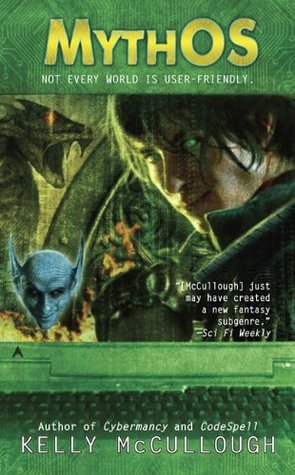
Computer savvy sorcerer Ravirn learns that not every world is user friendly in this WebMage novel from Kelly McCullough.
In the 21st century, magic has advanced with the times and gone digital. Ravirn—umpteenth great-grandson of one of the three Fates—is a talented sorcerer, a computer hacker extraordinaire, and in the process of becoming a minor demi-god. His best friend and familiar is both a goblin and a laptop, changing shape from one to the other as needed.
While repairing Necessity (the badly-broken sentient computer that runs the multiverse), Ravirn is thrown into a very different place, a parallel world where the Greek gods are only myths. This strange realm is ruled by the Norse pantheon of gods—Odin, Thor, and other fun-loving brutes—and their magic uses a completely different operating system. A system that Ravirn will have to hack if he ever wants to get out of Asgard alive…
Kelly McCullough was raised and educated by free-range hippies. Later he received a degree in theater and worked in improv. That combination was the perfect preparation for his current career as author and cat herder. He lives and writes in the Midwest with his physics-professor wife, Laura. He enjoys hiking and biking and his role as self-heating cat furniture. He is the author of the WebMage and Fallen Blade series.
I just really liked this book. My comments say a lot:
"I've been wanting a refresher in Norse mythology, fun!" "This series is a great intersection of sci-fi/cyberpunk and fantasy. Fans of both should try it." "I just like books that make me think or learn a little without making it a chore. Fun." "Can Loki ever really be the good guy? Ravirn is, and he's kind of the equivalent."
It's a smart, action-packed adventure with great characters, a fascinating premise and creative use of history and literature. The basic concept of fate vs. chaos continues to be intriguing. The conflict between Odin and Loki exemplifies this and really made me think a little. It does have quite a cliffhanger ending, something I've seen a few complaints about. I didn't find it unusually abrupt for a series. It was clear throughout the book that eventually Ravirn would have to go back to his MythOS, but I'm glad that further adventures in this setting are in store for us as well. It left me eager for the next book, as intended, especially because it's unclear where Melchior is at the very end. It doesn't actually say that Ravirn picked Melchior up. I'm worried!
This was okay but [kind of unsurprisingly] I just found it hard to get into. Part of that is definitely on me since I haven't read any of the other books in the series so I'm sure part of my inability to connect with the main character was not knowing his backstory, but also he just seemed to be a pretty standard Male Urban Fantasy Protagonist so I'm not sure if I would have felt differently with more background anyway.
I basically just read this because it featured the Norse gods and Loki in particular so my biggest complaint is that Loki wasn't in it enough to make that worthwhile, but I get that it wasn't technically a book about him. His scenes were definitely fun though and I felt like he was presented in a way where he was mischievous but not downright evil [aka how Loki *should* be].
The techno-magic premise was also pretty interesting but seems incredibly dated even for the time period, definitely feels like something I would have thought came out a decade before it actually did. Still, if you like mythology [the rest of the series takes place with the Greek pantheon] or pretty standard urban fantasy books then you might want to give this a try.
I'll start this review by saying that I did enjoy this book, just as I have enjoyed the other books in this series. I like the relatively unique magic system (though I wish it was explored a little more thoroughly), I am interested in the fates of the characters, and I think that there is definitely potential in this series.
However, all that being said, there are some glaring problems with this book.
The first is the lack of descriptions.
This novel finds the protagonist as well as a few other characters actually travelling to another reality... or a differing MythOS. In this new reality, it is the Norse pantheon rather than the Greek pantheon that rule over creation. This concept is instantly intriguing but never felt fully realised. What differences are there between the two realities? Where exactly in the world are these stories taking place? What does each new location look, sound and smell like? I struggled to find the answers to any of these questions which made the whole novel feel as though it was taking place in some kind of featureless void.
My other main issue is that this novel felt like it relied a bit too heavily on telling rather than showing. The events have a feeling of the narrator reading off a list, lacking the emotional depth needed to get me really invested in the story. Because of this, the action felt like it lacked the necessary stakes to create real tension, moments of loss didn't evoke a similar emotion in me, and overall the novel felt a little flat.
Again, the premise is interesting enough to keep me reading, but unfortunately, I can't quite overlook these issues to rate the book higher.
There are other issues just as there are other strengths, but these are the issues that I felt worth mentioning.
If you have read this series before and enjoyed what you read, then I can recommend this book to you as it is very much in the same vein as what has come before. If you have not read this series then I can still recommend going back to the beginning and giving this series a try. They aren't long books and they're easy reading if nothing else, so it is definitely worth a try even if you don't end up liking them.
MythOS is the fourth and penultimate book in the WebMage series written by Kelly McCullough. It centers on a hacker and junior at university who just happens to be a sorcerer and the grandson of Lachesis – one of the three Fates of Greco-Roman mythology.
Ravirn is a computer hacker who can get into just about anything in the world ruled by Greek gods, Fates, and Furies. However, his Greek familiars don't rule everything, as he finds out when he is very unwillingly transported into a strange new MythOS dominated by Norse gods, and Greek beings are no more than fairy tales.
Just like back home, there is a power struggle, this one between Odin, the highest of gods who sacrificed his eye to know everything, and Loki, who believes he must fight to stop Odin’s prophecy coming true. Both sides immediately perceive Ravirn as a potential threat and ally, but he has no desire to be a pawn or dead, for that matter, so he has to act.
MythOS is written rather well. McCullough has blended cyberpunk, Norse mythology, and techno-magic rather well in this fast-paced action. McCullough fills his book with distinctive, likable characters, as they go through another cyberpunk thriller that questions the themes of fate and omniscience.
All in all, MythOS is written rather well and is a wonderful continuation to what would hopefully be a wonderful series, which I plan to continue in the very near future.
These. books have been enjoyable but not great. This book takes the expected trip to another mythos with all the expected confusion about each side thinking there's only one pantheon that's real.
This book starts with a mystery that's never really resolved, just danced around. The mystery is kept alive, not so much by growing it as ignoring it. The characters go from set piece to set piece without any attempt to resolve/investigate/understand. Constantly on the go because the god players in this verse are always out to get them for something. An endless list of people chasing them for an endless list of reasons, it seems.
I may go back and try the next book at some point as it's setup to be a direct follow up to this but, not for a while.
The technical IT allusions were what made this series worth reading for me. I could hear echoes of Steve Jobs on page 56 : "let your imagination of what a device should be define your specs instead of letting the limitations of current designs straightjacket you... Never build for the engineers; always build for the end user.
This is book 4 in a series of 5, and they just keep getting better. Picture of you will, a Greek mythos that includes cyberpunk and a very clever hacker who gets suddenly shoved into a Norse mythos. It's hard to explain, but SO much fun to read. Can't wait to read book 5, but at the same time don't want the fun to end!
In the twenty-first century, magic has gone digital. Ravirn is a talented sorcerer, a computer hacker, and umpteenth great-grandson of one of three Fates, who don't like him much and the feeling is rightfully returned by Ravirn. Ravirn has had to deal with some difficult in the not so distant past and then to seriously complicate things, he and his best friend, who is a goblin and a laptop, Necessity, who is the sentient computer that runs everything, is broken and Ravirn has to fix it.
But that's kind of hard to do when he's thrown in a totally different place: a parallel world called Asgard where there's no Greek Gods, and it's run by the Norse-pantheon. At least he's not by himself, he's got his best friend, Melchoir, and sometime lover, one of the furies born to protect Necessity, Tisiphone. This Norse-run world is run on magical system that's completely different from what they're used to. And let's not forget that the people in this world are not so welcoming, in fact some of them are down-right hostile!
To return to their home universe, Ravirn and his allies are going to have to try to hack into this strange magic-operated system, and also tried not to get killed by the big players who call Asgard home.
MythOS is the first book by Mr. McCullough I've read and the fourth following Ravirn and his adventures. I really liked how the Greek gods, and mostly the Norse gods, features in the story. It's a very creative addition and it's what originally made me want to read this book. While I found myself a little bored at the technical description parts, because while McCullough is very thorough explaining how the magical computerized system works, it sometimes felt a little overwhelming to me. However, that certainly didn't subtract from me enjoying the book.
Ravirn's got this dry sense of humor that comes out at what seems the worse times and those light-hearted moments balanced nicely with the most sort of suspense atmosphere. He's being through a lot and that seems to only made him more determined to survive this strange world he suddenly founds himself in. While I haven't read the previous books, there was enough back story for me to nicely be able to follow the story and understand what was happening. I thought Tisiphone was great, her one purpose in life is to protect Necessity and now that she can't do that, she doesn't let that deter her from helping Ravirn found a way home. While she's dealt a huge shock that changes her entire life, she also manages to deal with it. She's strong but then again, she is a Fury so that's not very surprising. Melchoir, the goblin/laptop, is the perfect sidekick. He's definitely needed and adds funny comments when the situation really doesn't call for it.
This is the fourth book in the Ravirn series, and like the others, a very enjoyable read. Ravirn is attempting to fix Necessity, the computer who runs the multiverse, and find his dear friend, the webtroll Ahllan, when a glitch suddenly throws him into a different pantheoverse, one ruled by the Norse gods. Unlike Ravirn's home reality, this pantheoverse is a universe, rather than a multiverse, which means there's only one possible outcome for any particular event. This is particularly troubling, as the world's end, the great battle of Ragnarok, has been foretold by fate, and the gods Odin and Loki have drawn up sides. And with Ravirn an unknown entity, completely unseen by Odin's omniscient eye, he could be the perfect pawn in the battle between the gods. If he were only content to let himself be used. . .
The shift from the Greek to the Norse mythos, I'll admit, threw me for a bit of a loop. I really missed some of the characters from the Greek multiverse, especially Cerberus and Eris, though Ravirn was accompanied by Melchior, as always, and his sometime girlfriend, the fury Tisiphone. However, there are fun new characters from the Norse myth, including the Midgard Serpent and Laginn, the Hand of Tyr, and Loki is always fun. I am considerably more familiar with Greek mythology than Norse, so I'll admit I was a little disappointed to be (temporarily, it appears) to leave the former for the latter. However, the Ragnarok story line allows McCullough to return to one of the original themes of the series---the conflict between fate and free will---a welcome development which allows Ravirn to further explore his newly chaotic nature. It was also fun to read the analogies between the Greek and Norse mythology: for example, Ravirn, who is also Raven, is further dubbed Intuition or Impulse, as one of the three ravens of Odin.
This series has always been one designed to appeal to both the myth lover and the technophile, and I'll admit that the technospeak did overwhelm me at times here, though maybe I was just distracted. Then again, maybe wrapping my head around the technology was easier in the books where I was NOT wracking my brain tryiing to remember what Norse mythology I knew; trying to understand two different unfamiliar worlds and lingo might have overwhelmed me a bit. Whatever the case, the technospeak has not previously been an issue for this technophobe, and wasn't a big one here. If you do understand computers, you will probably appreciate that aspect of the series even more!
Ravirn honestly can’t catch a break. While repairing Necessity – the world’s supercomputer – he’s thrown into a parallel world. One where Greek gods don’t exist – and the Norse pantheon does. Now his cybermagic doesn’t work, he’s got new enemies to deal with, and he’s running out of time to fix Necessity before it’s too late. Small spoilers head.
Weirdest ending ever. It was a little too fast and abrupt and left so many questions unanswered. Like…when and why did Tisiphone decide she needed to stay in the Norse MythOS? I know she’d enjoyed some parts of it but her will to go home seemed higher up on the list than kicking back and enjoying herself.
There were some things that confused me about this book. The shrinking spells at the beginning when they met up with Ahllan after getting shipped off to the Norse MythOS (which is not explained, how or why) really got me because that whole scene was very rushed and a little off. And of course, quantum descriptions and code still confuses me since I’m not exactly the computer type.
But everything else…man, I wish I had McCullough’s brain. His blending of magic, Greek myths, and technology is just so amazing. I love Ravirn’s “I’m not a hero” personality and that he just does things out of whim without thinking about the consequences.
All the Norse big guys are out to play in this. I loved the fight scenes with Laginn and Tyr and Heimdall. I also love love love Fenrir. And on the Greek side of things, I like that Tisiphone is finally showing truer, more forgiving, more HUMAN character traits and that her decision to stay in the Norse pantheon gives her a weakness in that tough shell. Sad to see a character go, though glad she’s somewhat still part of the Norse world in her own way.
A shiny four for the usual awesome world building, hilarious dialogue, and great characters.
Weirdest ending ever. It was a little too fast and abrupt and left so many questions unanswered. Like...when did Tisiphone decide she needed to stay in the Norse MythOS? I know she'd enjoyed some parts of it but her will to go home seemed higher up on the list than kicking back and enjoying herself.
There were some things that confused me about this book. The shrinking spells at the beginning when they met up with Ahllan after getting shipped off to the Norse MythOS (which is not explained, how or why) really got me because that whole scene was very rushed and a little off. And of course, quantum descriptions and code still confuses me since I'm not exactly the computer type.
But everything else...man, I wish I had McCullough's brain. His blending of magic, Greek myths, and technology is just so amazing. I love Ravirn's "I'm not a hero" personality and that he just does things out of whim without thinking about the consequences.
I loved the fight scenes with Laginn and Tyr and Heimdall. I like that Tisiphone is finally showing truer, more forgiving, more HUMAN character traits and that her decision to stay in the Norse pantheon gives her a weakness in that tough shell.
Sad to see a certain character go, though glad she's somewhat still part of the Norse world in her own way. Eager to see what's to come in the (final?) next installment of the WebMage series.
This was a fun read, sufficiently fast-paced to keep me engaged without being a whiplash-inducing rollercoaster. If you've enjoyed the others in the series, you should enjoy this as well. It's probably my second favorite in the series.
Overall the writing is pretty good. The plot is logical. The details and descriptions are clear, yet don't bog the story down. The initial setup for this adventure was a little clunky, and the end screams "sequel heading your way" more than the previous books in the series. The prior books' summaries seemed a bit longer than need be, though I understand the industry requirement for these.
The world is a nice refreshing change. Seeing characters we've come to know, very out of their familiar surroundings was nicely done, and the world was well fleshed out. The magic takes an interesting twist, though there are some things that weren't sufficiently explained. I expect to see wrap-up of some of these things in the next book. McCullough does a nice job with the gods, who may (or may not) look and act human, but very definitely are NOT.
"MythOS" is book 4 of the WebMage series. I loved it. The story is maturing and goes off in a different direction as Raviern tries to fix the Norse gods' mythological universe.
The story: Raviern and his girlfriend, the Fury Tisiphone, are sent into another universe where the Norse gods run things. If you thought the Greek pantheon was messed up, wait until you get a load of Odin, Loki and the rest.
Any problems with this book? All problems with previous books apply to this one. There is cursing, but reasonable for hackers. There is sex involved but it is not described in any detail. There is violence, and the action is quick and exciting which is a plus.
All in all a good read. It has an exciting ending. It winds up the major problems while leaving a big opening for the sequel, "Spellcrash" which I believe is the last book in the series.
I really love the Webmage series. I really like the combination of magic, hacking, networking, and mythology. This is a great addition to the set. Ravirn and friends find themselves in a universe dominated by the Norse gods, as opposed to the Greek-dominated universe they came from. I'm a long-time fan of Thor, so I was all set to cheering on Thor, Odin, and booing Loki and his lot. This book did the unimagineable and had me siding with Loki to win Ragnarok. I really like the characterizations of the Fenris Wolf, Hati the Wolf, and Jormungandr the Midgard Serpent. The last ~50 pages had a bunch of surprises, and some very moving moments.
If I could, I'd give different sections a different number of stars. The first half I'd give 3.5 or 4 stars. The second half, definitely gets 5. I'm averaging it out to 4.
This fourth book in the series of the cyber magical world was a dud. It had streaks of really great reading, but I fell asleep while reading it - twice!
Other than that, its an enjoyable read, as we watch Ravirn attempting to fix the computer who runs the multivers, Necessity, who also just happens to be the mother of Ravirn's new love, the fiery FATE Tisisphone.
Ravirn only has to save his webtroll friend/mother substitute Ahllan, he also has to find an alternate ending for Ragnarok (yes, he switched pantheons), while avoiding the enmity of the Norse gods and enjoying the attentions of the aforementioned Fury.
Some of it seemed hacky and even hokey, but it was a good read - just one I won't repeat.
And just as the Raven is coming into his own and taking ownership for some of the consequences of his actions in the previous books he gets kicked to an alternate/parallel dimension with the Norse pantheon in control, rather than Greek, and with an alternate type of Chaos power. Again Raven and Mel are facing off against Fate, but this time indirectly, while at the same time attempting to get themselves and their friends home in one piece. Boy-loses-Girl, Boy-fights-Fate. The main plot to this point is mirrored in minor in this book, giving a good overview of the idea of the multiverse in general.
Mixing up the myth arcs at play in a digitally magic world, Ravirn not only falls afoul of the Norse pantheon, but gets to explore what a relationship with a fury is like when she takes a break from her responsibilities. This book leaves little time for breathing, moving from one crisis to another in an effort to solve the pending doom of Necessity. One thing becomes more and more apparent as we follow Ravirn's story, that his self awareness and maturity grows. He evolves from a college student with little sense of responsibility to someone thinking of the benefit to the greater pantheoverse, albeit with the quirky twist of chaos.
I think this may be my favorite installment of the Webmage series. Ravirn and Company get tossed into a different universe... one ruled by the pantheon of Norse gods rather than Greek ones. Learning how to deal with the new rules and lore and politics of an unfamiliar MythOS, along with some seriously high stakes and touching moments, make the book a lot of fun to read. I also really enjoy this representation of Loki and his children as they try to thwart the fate that Ragnarok decrees they will have. Two Tricksters in one universe? Now there's a recipe for disaster. Only one more book to go!
. So. From the Greek parthenon to the Norse. A lovely trip. "More of the same" but not in a bad way. I feel like my reviews if books 3+ in a series can be summed up usually as "if you're still reading, you'll still like it". Mostly. Some series stand out as a downward spiral towards "sucking".
Not this one though, and the visit with Norse mythology was interesting. MimirSoft was highly amusing as well.
Seriously this series is wild, I love the fact that Kelly McCullough combines science fiction with fantasy, technology with greek and NOW norse lore. It is interesting and never ever dull, its a fast read that I love and can't wait to see more of.
I was debating on my rating and thought twice, since this book really hit a whole new level I am giving it a five. But warning it leaves you hanging and wanting more at the end.
Didn't like this one quite as much as the earlier ones. In this book, Ravirn is somehow sent into an alternate reality where the Greek gods are myths and the Norse gods hold sway. Mostly, it gets a three star because I didn't like the ending.
It's a good read, but I think I just prefer the books where Ravirn is in his own universe. Now I'm wondering where McCullough will go from here.
It took me forever to finish this book, which is unfortunate because I like this series. Don't think this book was as good as the last one, but I did enjoy it, even if I didn't much like the ending. Don't get me wrong, it was good, but I liked the one before it better. I still plan on picking up the next book, though because I can't wait to find out what happens next.
Even if I'm not a huge fan of Norse mythology, that didn't particularly affect my love of this particular volume. That, and now, on re-reading, can see how much this sets up the fifth and final volume, I remain in love.
Another good installment in the series. This one takes quite a left turn into another mythology (Kelly coined the term Pantheoverse), and it's ripe for chaos. The ending left a bit to be desired, as even though Raven "won", he ends up losing quite a bit. He just can't seem to catch a break, and it's getting repetitive.
And I have to wait a year to find out what happens next!!!!! Probably requires a higher level of computer geekdom to reakky enjoy than the first in this series, which is fun for me but a pity for some others, but I love the series and the concept - greek myth meets cyberpunk
After the events of the 3rd book in the series I wasn't sure how things would progress for our Raven, and I was happily surprised with how things panned out.
A good job of juggling two different mythologies while still maintaining the computing metaphor---as well as the plot and characterizations. An engaging book in a very fun series, from a truly inventive writer.
Bk. 4 of series. Ravirn, Melchior (his webgoblin familiar) and the fury Tisiphone get gated to the Norse world with a different magical system, where the meet Loki, Odin, Thor and other Norse gods. Fascinating series, interesting new world view. Recommended.
Same issue as the previous book. It's fast paced, there is a lot of stuff going on but not a lot of it is explained in detail. It makes for a fast read but it leaves the reader with a lot of questions. Hopefully story threads will be resolved in the final volume. Onwards!