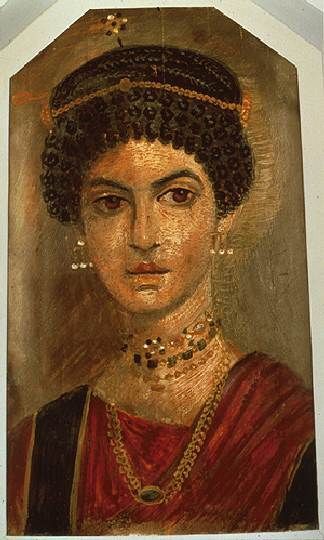
A daughter of privilege in the most powerful empire the world has ever known, Claudia has a unique and disturbing "gift": her dreams have an uncanny way of coming true. As a rebellious child seated beside the tyrannical Roman Emperor Tiberius, she first spies the powerful gladiator who will ultimately be her one true passion. Yet it is the ambitious magistrate Pontius Pilate who intrigues the impressionable young woman she becomes, and Claudia finds her way into his arms by means of a mysterious ancient magic. Pilate is her grand destiny, leading her to Judaea and plunging her into a seething cauldron of open rebellion. But following her friend Miriam of Magdala's confession of her ecstatic love for a charismatic religious radical, Claudia begins to experience terrifying visions—horrific premonitions of war, injustice, untold devastation and damnation . . . and the crucifixion of a divine martyr whom she must do everything in her power to save.
Рим не е чест сюжетен избор. В англоезичния свят пък такъв избор често се преплита с новия Завет и се наблюдава пълно отплесване към религията. Тук обаче фокусът върху античния свят е стабилен и е водещ.
Клавдия е римлянката от добро семейство, която все пак иска за себе си нещо повече - лично щастие, свободата да се изразява. Мечтите и като че ли са на път да се сбъднат, докато не осъзнава, че действителността около нея просто е била крита от нея с цел “закрила” и слепотата и я прави лесна жертва в много ситуации. Тя извървява пътя си към мъдростта, и заплаща цената за нея.
Не обичам аналогии между писатели, защото винаги са неточни, но в случая има нещо, което го имаше и у Кейт Куин, докато все още беше на вълна “Рим”. Т.е. има си лиричността и драмата, но си е тежичко дамско четиво.
Okay, if this woman did so much historical research why does she get the small things wrong? Stuff like the old chestnut about "thumbs down" meaning to kill the losing gladiator, when modern scholars are pretty sure it's the opposite? She even gets the way Roman names were used wrong--she uses "Procula" as if it were a last name!
Pious Christians will recoil at her Mary Magdalene as Jesus's wife bit, but what bothers me more is the way she picks and choses her history and invents bits to fit her plot. And Claudia herself is not a consistent character--one moment she is a determined young woman, the next a fluttering ninny.
I have to say, that I really enjoyed this book. I was thinking about its connection(s) to the Book of Longings, by Sue Monk Kidd, who wrote about a fictionalized version of the wife of Jesus. Obviously this one connects as it is the wife of Pontius Pilate. Jesus is quite the minor character in this tale, but I know little of what happened at that time in history and I was curious. Also, brief mention of Salome, from the Court of King Herod, and that was the book I DNF'd just before starting this one, set at the exact same time. (The King's Shadow by Angela Hunt. I LOVE Angela Hunt, but perhaps I jsut couldn't get into the mood for this one.).
This book has been on my TBR since I joined Goodreads in 2016, and in fact it sat at spot #2. It was actually written in 2006 and was the authors debut novel. Why has it stayed on my TBR so long? That's easy. It's because I am a sucker for female heroines who have the Sight. Who have prophetic dreams and prophecies. That is my favorite trope. The ones where the women can see but are unable to stop history from happening in front of them. They often have a true love that they are bound to, sometimes outside of their current circumstance. Such is the way for our heroine Claudia, who is Pilate's Wife - and yet has a special connection to the Gladiator Holton.
Claudia is a follower of Isis, and in fact that is the source believed to have gifted her gifts. It is because of these gifts that she is both elevated and used. The gifts made her a target as well as highly coveted. Naturally, as our heroines are, she is bold and little fearless, following her heart and her sight over custom.
I figured this book would fit the catgory of Ancient Heroes and Monsters, and I was trying to decide, not really knowing what role Pontius Pilate would play in the death of Jesus. Monster I wondered? Ancient was a no-brainer. Would Jesus be the hero, and Pilate the monster? But I have to say, that none of this played out until the end of the book, where I had quite an understanding of Pilate before this point. Honestly, he was just a man. And one trying to make hard choices. He loved his wife, and he loved Rome, and he suffered too as a result of corrupt rulers who abuse power. When given the choice to spare one person a year, as his new post of running Judea, he chose Jesus to spare. But the pressure from Caiphates (sp?) and others, was so great, that he was overruled. I wouldn't call him a monster by any stretch. Just a complicated man in difficult times. I still may count it for the challenge point though. Because aren't heroes and monsters sometimes mixed anyway, depending on your viewpoint? Aren't they often to always just complicated and nuanced?
Great Book - and I appreciate that its an oldie that no one is talking about. I like that its gotten some attention recently on my Goodreads Feed. You never know the exact right book for someone at just the right time.
I didn’t get to this book when I picked it up at the beach in May, so I saved it for a fun read after my statistics exam. I love historical fiction about ancient Rome, and this book lived up to my expectations. The book follows the life and tragedies of Claudia, the wife of Pontius Pilate. Claudia travels with her family and then with her husband all across the Roman empire, and I appreciated May’s detailed descriptions of Antioch, Alexandria, Rome, and Jerusalem among other locales. Most of the book centers on Claudia and her (almost always) devastating experiences of the political intrigues of Roman imperial life. If you loved the HBO series Rome, you will enjoy this book. But be warned, just like the HBO series, this book does not hold back when it comes to the brutal entertainment choices and sexual preferences of Romans at the time. Jesus, Mary, and Mary Magdalene don’t appear as characters until towards the end of the book. Even though it’s fiction, I found it refreshing to be reminded how Judaism as well as Jesus and his followers (among other ‘zealots’) might have been perceived by the Romans at the time. Though no Pulitzer Prize winner, overall, Pilate’s Wife was an entertaining, fast-paced read with great historical drama.
Dit is een boek dat vlot las. Het gaat over Claudia, de vrouw van Pilatus. Hoewel het historisch niet accuraat is (de vrouw van Pilatus wordt in de Bijbel maar 1 keer vermeld, zonder haar naam), is de schrijfster er in geslaagd een boeiend verhaal te vertellen. Er komt toch wel wat Romeinse geschiedenis in voor, geromantiseerd natuurlijk, en ook de cultus van Isis speelt een belangrijke rol in het leven van Claudia. De politieke intriges van die tijd in het Romeinse Rijk worden ook aangestipt, vooral voor zover die betrekking hebben op het leven van Claudia en Pilatus. Als je dit boek puur als een roman leest, is het voor mij zeer goede lectuur.
The Gospels and this Novel have little in common. Some of characters, for the most part, have different names; but Jesus is the same. In this novel Jesus is married to Miriam of Magdala.
Claudia, Pilate's wife, is historical enough; she did have dreams about the outcome of Jesus. And Claudia, did indeed, warn Pilate not to involve himself with "that holy man."
Claudia, also had a love affair with Holtan, a gladiator. Eventually, due to Holtan's success in the arena, bought his freedom.
Pilate's Wife was an interesting read; and it certainly puts a different spin on how Christians would remember Scripture.
She appears in just a single verse of the Bible, but it's a riveting inflection point, a moment that dares us to imagine that events might go either way: Jesus stands before Pontius Pilate. The leaders of the Temple have accused him of treason and want him crucified, but Pilate is wavering. Then the Gospel of Matthew adds this tantalizing detail: "When he was set down on the judgment seat, his wife sent unto him, saying, Have thou nothing to do with that just man: for I have suffered many things this day in a dream because of him."
The psychic wife of a Roman governor tries to stop the crucifixion of Jesus? Sounds like a plot that would make Dan Brown fall to his knees and cry "Hallelujah!" It's the inspiration for biographer Antoinette May's first novel. She's fleshed out a few scraps of Coptic legend to create a breathy romance about Pilate's wife. May imagines her as a young woman named Claudia, whose father serves a powerful commander of the Roman army. She's also a distant member of the emperor's family, which during this period -- the reign of Tiberius and his fiendish mother -- is more of a death sentence than an honor.
"First, let it be said that I did not attend his crucifixion," Pilate's wife begins. "If you are seeking insight into that tragic affair, you will not hear it from me." This is like sitting down with a survivor of the Titanic who announces that she has nothing to say about the sinking, and for hundreds of pages it appears that May, in fact, won't get to the Big Moment.
In a voice that swings from melodrama to self-pity, Claudia begins with her life as a military brat. This is about as rich as material gets: the world's superpower crushing all who resist, gladiators fighting to the death, young Caligula showing signs of lascivious madness, the emperor's mother snuffing out contenders for the throne. But May seems strangely unwilling to let us enter this raw, ancient world. Despite Claudia's bird's-eye view, we often learn of deadly battles via notes sent from the front line. Where we want bacchanalia, we get Victorian exclamations of shock: " 'Oh!' I gasped, my cheeks flaming as I stared at his naked body." And the book's chronic lack of irony makes Claudia's heavy-handed feminist insights particularly grating. Watching 800 slaves rowing her boat, for instance, she says, "I saw similarities between their lot and my own. No overseer lashed my shoulders, but was I any less a slave?" Well, Claudia, you might try asking one of them before he's whipped to death. Much of this has the earnestness of a school-approved YA novel: "Oh, little sister, what will they do to me?"
Release the lions, I say.
Still, the faithful read on, encouraged by the sighting of an ambitious officer named Pilate -- "sleek and handsome like a young leopard." Although he's looking for a woman with a large dowry, Claudia snags him with a magic serum. "The potion had worked beyond my wildest dreams," she says, and maybe circa 27 A.D. she was the first person to use these clichés. "We were a golden couple. What could ever change that?" In fact, their marriage is quickly wracked with jealousies and betrayals on both sides. In search of solace, she becomes a follower of the Egyptian goddess Isis, which inspires some exciting scenes but also too many New Age howlers such as: "Isis is for everyone. . . . We are all part of each other like leaves in some giant tree." In any case, neither Claudia's feminism nor her spirituality keeps her from jeopardizing her life by panting after a hunky gladiator because he's "so, so . . . masculine ."
If the bulk of this Roman romance is merely overwrought, its long-delayed climax is surprisingly offensive. Many scholars suggest that the exculpatory portrayal of Pilate in the New Testament arose from the early Christians' desire to curry favor with Rome and distinguish themselves from other Jewish groups. And so the Gospels show us Pilate, the representative of Rome, reluctant to condemn Jesus, convinced of the man's innocence, disgusted with the Jews' hatred, determined to wash his hands of the whole dirty business. All leading up to that horrible verse in Matthew when the Jews yell, "His blood be on us, and on our children."
Throughout the novel, May presents a wildly unorthodox version of Jesus's life: Her Jesus studies in the temple of Isis; he marries a rich prostitute in an ecumenical wedding that blends Egyptian and Jewish traditions; he's given a sleeping potion to fake his death on the cross. Of course, such inventions are all within the novelist's right -- as someone once wryly asked, "What is truth?" But when it comes to Jesus's trial, May suddenly gets religion and hews to the few blood-soaked Gospel verses that have served as the bedrock of Christian anti-Semitism for 2,000 years. Again and again, May exonerates Pilate to remove any doubt about who murdered the son of God. "Clearly, Pilate was the one reasoning mind against a rabid mob," Claudia tells us -- despite the fact that she's estranged from him and sleeping with another man.
Long before Mel Gibson clarified his attitudes about Jews during that infamous traffic incident, he noted that the apparently anti-Semitic statements in his "Passion of Christ" were merely lifted verbatim from the Bible texts. But May takes such license with those texts throughout most of her story that she has forfeited even that specious defense of her conclusion. And so we're left to wonder why a writer would want to resurrect this deadly old prejudice.
I thoroughly enjoyed the history in this book--it pieced together some religious events for me that were previously vague. I think this book is about 80% historically accurate--the story created around it is a little weak, but interesting nonetheless.
Claudia, the main character, is the daughter of Roman Empire royalty. She posesses the gift of "sight." Claudia's visions range from vividly detailed and informative to almost nonexistent, and the changing level of detail in places and characters give Claudia's world a similar sense of contrast between great detail and sketchy unreality.
I found Pilate's Wife to be enjoyable, but not exceptional. However, as an exploration of women's lives and roles in the first century Roman Empire, it was quite fascinating.
Last month I did a reading at a library in Sonora , CA and Antoinette May was the reader who preceded me. I was impressed by the number of years she spent researching Roman history and culture. I am interested in knowing about the cultural context in which Christ began his ministry and this seemed to fill the bill.
May uses restraint in her descriptions of Goddess worship, weaving it through a storyline rich in political and family history. Christ appears toward the end of the story as just another diety on the menu, one with a promising albeit perplexing message. As troubling as that might be to Christians, keep in mind that the story is written from the point of view of a high born Roman woman surrounded by treachery who finds solace in Isis. The challenge for me was the literary license, a historical fiction author’s right, that had Jesus’ mother Mary and follower (and wife, by this account) Mary Magdalene dabbling on the fringes of Goddess worship.
May has sympathy for all her characters except history’s most corrupt. The story is engaging but it left me shaking my head over the portrayal of Christ dallying with a new wife shortly before He goes to the cross. May has examined all the myths surrounding Christ’s birth and death and picked the ones that work best for storytelling. They don’t necessarily square with the Biblical account. I did find the account of Jewish religious and political life interesting, particularly the commentary on the Zealots.
While I admire the author's extensive research in compiling this novel, I must admit that the distorting of Bibical incidents and facts are baffling.
Firstly, when we talk of the Roman Empire, we talk of family names as well as their heros. It is crystal clear that Claudia is the granddaughter of Augustus Ceasar. Why little mention of him.?
Secondly, Claudia is a weird character. Her descriptions and development just simply kill my desire for reading. Then there is her passion for Pilate. It sounds like a fake love, hearing from priests and soothsayers that Claudia is the only one he loves but did he profess it?
Jesus studying at the Temple of Isis is just a crap! Romans running after Egyptian dieties is a serious offense, Oh Calamity!!!
Thirdly, the wedding at Canna is not about Mary Magdalene and Jesus.
Claudia is the daughter of Tata, Germanicus’ top lieutenant. Agrippina, Germanicus’ wife, is a second, if not always the warmest, mother to her. We see the events of the times through the eyes of this youngster as she comes of age, beginning the tale when she is an early teen. Characters here will be familiar to anyone versed in the I, Claudius saga. I was fortunate in having recently seen the entire series again. Claudia is no ordinary teen girl, however. She has a gift. She sees things. She lacks the ability to control her power, finding that she is more of a receptacle for it than a master of it. We see Alexandria, Rome, Antioch, get a taste of some of the variety of religious belief within the Roman Empire. Claudia finds herself much taken with Isis, an Egyptian deity. She also finds herself much taken with the dashing young Pilate, a handsome, rising star in the military. Despite her lack of familial wealth or blood kinships with the ruling class, she manages to win Pilate, with the help of a potion or two. Life is not so simple, though. When Germanicus is done in, the standing of any associated with him is at risk. We follow Claudia’s life through the travails of political upheaval in Rome, and feel for her as she finds that life with Pilate is not what she hoped. This was a very engaging novel, with a well drawn protagonist, and significant payload about the mores and places of that era. Highly recommended
So in the Bible, there is one (unnamed) mention of Pilate's wife. PW (as I will now refer to her) was later named Claudia by someone in 1619--so yeah 1600 years later, get a name.
So Antoinette May decides that Claudia was from the Claudia house (family of Julius Caesar EDITED: Actually, although his fam is often referred to as the Julio-Claudio family, Claudia would have been only related to Tiberius, the son of Livia by her first marriage, not to Julius's family) and pretty much makes up a huge twisted and chaotic story about her, Isis, and Pilate, and Tiberius and Nero.
You know what would have helped her, reading ANY book about Roman culture. Pick one. ANY ONE.
ETA: For one thing, daughters didn't get really their own names. They were just given the feminine of their family's name with an ordinal of some sort. Sometimes a nickname. That's why you have a plethora of Julias and Agrippinas.
There's so many omigod historical inaccuracies in this book that it honestly makes your head ache. Then the plot is just dumb. Really dumb. And wow.
PW becomes an acolyte for Isis, a Roman socialite, a mistress of a gladiator, oh and stand in for Ariadne during a seriously whacked out Dionysus mystery that only existed for salacious details.
It's just a bad book. Really really bad.
Turns out the author writes books on clairvoyants before writing her first novel. I hope she saw this review coming.
I thought this book was interesting historical fiction up until the last 15%. The life in the Roman Empire part was good. However, once she gets into Jesus showing up it borders upon ridiculous, if not blasphemous...the wedding at Cana was supposedly his marriage to Mary Magdalene, who was a courtesan; supposedly Jesus was drugged during the crucifixion and that's why he rose from the dead three days later?! Ridiculous.
This entire review has been hidden because of spoilers.
I was enjoying this book (historical fiction about Rome) until it got to the part where the main character Claudia meets Jesus in the Temple of Isis. The author had Jesus saying that his mother worshiped Isis. I just can't believe that of all people his mother Mary would do that. Thus ended my reading of this book. And probably a good thing as I have read on other accounts that it leans toward blasphemous at the end of the book.
Claudia Procula (or Procles) was the wife of Pontius Pilate and accompanied him to Judea during his prefecture there (from 26 to 36 CE). Little verifiable fact is known about Pilate's wife and, despite this, May has created a vibrant novel which succeeds in bring Claudia to life.
Pilate's wife is mentioned in the Gospel of Matthew 27:19: “When he was set down on the judgment seat, his wife sent unto him, saying, Have though nothing to do with that just man: for I have suffered many things this day in a dream because of him.” Throughout the novel, May presents a wildly unorthodox version of Jesus's life: Her Jesus studies in the Temple of Isis; he marries a rich prostitute in an ecumenical wedding that blends Egyptian and Jewish traditions; he's given a sleeping potion to fake his death on the cross. Of course, such inventions are all within the novelist's right but will definitely not sit well with those of Catholic and/or Christian faiths.
This novel is set during the reign of the Emperor Tiberius, and the history provides the frame for the fiction. The story of Claudia provides some insight into the lives of women of privilege as it does also of the intrigue and cruelty of Rome. Claudia herself is depicted as an interesting and at times a fickle character capable of kindness but also of short-sighted impulsive actions. Though blessed with the ability to see the future, Claudia never manages to prevent the tragedies she foresees. May is at her best when unencumbered by literary or historical precedent; Claudia's sister, the unwilling Vestal Virgin Marcella, for example, is better realized than the shallowly rendered Caligula, and descriptions of Antioch and Caesarea are more compelling than those of well-known locations like Pompeii.
Claudia’s marriage to Pilate, her infatuation with a gladiator, her brushes with Empress Livia (mother of Tiberius) all make for interesting reading. While I was not always sympathetic to Claudia, I was fascinated by her life as depicted in this novel.
This novel was a quick and easy read, but had flaws that bothered me throughout the novel. This novel tells the story of Claudia, the wife of Pontius Pilate. If you're hoping for new insight into Pilate's connection to Jesus then you're not really going to get it here. Jesus appears a couple of times briefly in the book and a couple of events in his life are alluded to, including obviously the crucifixion, but mostly the events are revolving around Roman life and politics as it tells the story of how Claudia marries Pilate and their life together.
Claudia is obviously a flawed character from the start. She basically wants her way no matter what. The first instance of this is her joining the priesthood of Isis despite the wishes of her father because she is drawn to the priesthood's beliefs. I was okay at this point. Then she in quick succession demands from Isis's mystic man a love spell to make Pilate fall in love with her, another love spell that's stronger when he starts to stray, then a child, then to help hide her from her husband. She's so spoiled and annoying that it's really hard to sympathize with her husband that is unfaithful to her. Then she eventually begins an affair of her own and thinks nothing of the pain she could bring to her husband in return. I read the whole book because I wanted to see how the author tied in Jesus, which was clever and fairly well done, but I could not stand Claudia and she ruined the novel for me.
This entire review has been hidden because of spoilers.
I found this story to be very good. This follows the life of Claudia, first as a young girl, and finally as the wife of Pontius Pilate. Ms. May gives such dynamic description that it drops the reader right into that time period. I enjoyed reading about the lives of Romans, Egyptians, their gods, and how Jesus came to be in front of Pilate. In this book, Claudia struggles with what she believes in, and finally becomes a follower of Isis. She has visions that seem to foretell the future. She does not understand the vision she keeps having of a young man about to die with a crown of thorns on his head. It seems like a very scary time to be living in Rome, where any trivial matter not to the emperor Tiberius' liking will result in a death. I don't know if the history is accurate, but nonetheless, was an interesting time period to read about. This is historical fiction, and not a biography, so I won't get upset about anything that was written inaccurately.
I'm not sure how I felt about this novel. On the one hand I enjoyed it and the other hand (as far as historical fact go) I thought it a pile of s**t. Not very much is known about Pilate's wife except for the reference in the Gospel of Matthew 27:19: “When he was set down on the judgement seat, his wife sent unto him, saying, Have thou nothing to do with that just man: for I have suffered many things this day in a dream because of him.”. The author has re-imagined a history of Claudia and Pontius Pilate. She tells the story of Claudia from the time she is a young girl who has prophetic dreams, her fascination with the cult of Isis, marriage to Pilate and his subsequent posting to Judea. Christians would be horrified at the author marrying Miriam (Mary Magdalene) and Jesus. On the whole a good piece of entertainment and an easy read but certainly no historical value.
Another perspective on the life and times when Jesus lived.
This was riveting! A most pleasant surprise!
Thoroughly researched, nicely written and filled with details of ordinary life, this debut novel sets up the historical, political and cultural factors surrounding the Jesus story. Vivid and shocking, the story feels new in this retelling. Claudia (who becomes Pilate's wife) meets a young Jesus at a temple to Isis in Egypt and encounters him again much later as he enters Jerusalem in triumph. Claudia appears as a guest at the wedding in Cana - which is interpreted in great detail and expands the account from my Bible in a most intriguing way!
I teach middle-schoolers in Sunday school and this novel really expanded the biblical details that provide set-up of the scenario that led to the birth of Christianity. I plan to use it as a reference when I am preparing lessons.
Lovely and heart-breaking. You can feel the joy, sorrow, fear, desperation as if you were the one living the story. The author uses known facts as point of departure and then unfolds a narrative which is fictional but which makes a lot of sense because it presents decisions and actions you and I might have taken and done in similar situations. I loved the plot, the narrative style, and the diction. Excellent read!
Interesting details and viewpoints. This book would be fun as a Bible study, or at least a book club to discuss and find out what others think about it. Enjoyed this thought provoking read.
An exploration of Pilate's wife and the role of women in Ancient Rome seems like an interesting and engaging story.
However, with Antoinette May it is not. May starts if her story strong, introducing us to our main character Claudia, a Roman patrician upon whom the gods have bestowed the ability to foresee the future.
We follow Claudia throughout her life in the Roman Empire, a journey which shows us how women both with and without power cope with Roman society. Ultimately leading to Claudia's failed attempt to save Christ from the Crucifixion.
The entire journey however, feels largely superficial. Set into the backdrop of a love triangle that does not appear until almost the second half of the book, most of Claudia's actions and experiences seem to have very little impact on the world around her.
Adding on to that, much of the book feels like a collage of unrelated experiences tied to a weak story in which characters fall in and out of love for almost no reason.
While the characters we meet are all very interesting in and of themselves, May barely delves any deeper than the surface of these side characters. Characters like Livia and Miriam, both powerful women who in many ways embody the spirit of independence that Claudia craves seem like cardboard cutouts of themselves, only used to move the plot along.
Claudia herself is also a seemingly flat character, rushing along from event to event, reacting in the same basic way, never gaining insight from her experiences, satisfactorily achieving her goals, or changing anything through her visions.
Perhaps this is what May wanted us to learn from her novel: Roman women, trapped in an oppressive society, could do little to exercise power, and for all their rushing around were unable to accomplish anything at all, neither through their own abilities nor through the intervention of gods.
Is it right to play with history to such an extent? Specially when religious sentiments are involved. Be it Christian or Jew or pagan. Why do people bring the good name of Jesus in all this crap. God or not,he was a great healer and reformer. What has one to prove by marrying him off... As if making him a mortal will lessen his worth... Whatever!! Claudia procula is known in testaments for her visions of jesus but for the book, main character herself is so inconsistent. Not a single incident in her life has significance later. She can't understand why her sister pines for boys... And herself does that later. Says never to have a baby.... Goes into depression for not having one. Shows unlimited passion for goddess Isis... Forgets her completely later. She has visions so frequently in the beginning.... Not a single one later. The list is endless. Then there are so many unanswered questions.. Why did she so fell in love with holtan ( great sex? ).... Why did she stop meditating for Isis ( after going to such lengths for initiation)... Why didn't emperor eliminate her like the rest... Why Agrippina and her daughters were not sent on exile sooner.... Why didn't she avenge her family's death.... Why was Caligula preferred by empress... Again endless list. As if this was not enough, Jesus Christ and Mary Magdalene in all this. Dan brown says they were companions and Mary a princess. She says Mary a pariah of family after brutal rape for no fault of hers and wife of Jesus. Whom to believe? What about Pontus Pilate? A social climber who jumps his loyalty from germanicus to emperor's right hand, yet turns a true servant of Rome in later life... Even stops his infidelities and starts truly loving his wife, forgives her dalliance.... Yet she loves holtan who has done nothing remarkable apart from winning gladiator games. The book is more bad than good. Two stars for going through roman era.... Since those times were worth reading for, however fictional!!
I give this book 5 stars for creativity. Of all of the fictional account involving Jesus I’ve ever read this one probably incorporates more of the Roman religious practices than any of them. Since to incorporate those practices when you realize that Claudia, Pilates why would have been raised in that tradition. It was a little disconcerting for me to see so much incorporation of Isys into the book but it makes sense from their cultural perspective. Sometimes what I see in this book is reference to things that we would take for granted in our cultural experience such as touching of the shoulder with when expressing affection and such things. And sometimes linguist dick expressions such as “Isis knows“ instead of saying God knows. We would say God knows. I wonder if there was such an expression in the Roman world even with other deities. Just something that stood out to me. And I cockroach words such as “murmured” and instances where someone took it there hands into her hands. That’s kind of a western gesture I think. It was a good read. Sometimes though you just need to read these kinds of books as they say with a grain of salt. But it is obvious that someone did a lot of work on this. Nice job without over emphasizing things that could get much more attention like six scenes and such. They were gracefully handled and while I don’t agree with the theory that Jesus married Mary magna Lane it was handled in such a way that there were no children produced which leads to other things handled by other authors. I have read many different versions of the wedding where Jesus turned water into wine. They are fictional account since we don’t know what really happened. This one was interesting. It wasn’t described but it was eluded to and it was kind of sad and away. But that’s my subjective opinion. I suppose reviews are subjective opinions.
I feel like the main character, Claudia, went from a strong personality to a weak one, then spent the rest of the novel fluctuating back and forth.
She started out independent, found self-sufficiency through her devotion to Isis ... then promptly became a weak-minded ignoramus. For a person with her seeming devotion, and who believes in and possesses Sight, I can't figure out why she would ignore every warning the temple "priest" spelled out for her in no uncertain terms. I felt like she deserved what she got after that.
Also, the author seemed to take every legendary character from tales of Rome and try to fit them into this book (she must have just read Roman Women too), which seemed to interfere with the story's realism.
Finally: who knew they had strap-ons in ancient Rome? Gotta watch out for those priestesses, man.
I really don't recommend this book unless you have unlimited time for reading. It is an ok book, but JUST an ok book and there are so many better books out there.
I don't like the main character, Claudia. She is headstrong and willful, and while she started out as honorable and brave, by the end of the story she is just self-centered, doing whatever she wants no matter who she may hurt, and not learning from her, or others, mistakes.
Also, the book crosses the line from historical fiction, which is based in fact, even though there is quite a bit of embellishment, to fantasy. Not much is apparently known about the real Claudia, so the author took great liberty with her imagination. One of Claudia's best friends is Miriam (Mary Magdalene) and Claudia attends the wedding of Miriam to Jesus. Miriam spends the night of the crucifix in Claudia's quarters in Pilate's palace. It just felt more like 'name dropping' than good fiction.
This entire review has been hidden because of spoilers.
Full disclosure: I read this mostly because I got it confused with another book with a similar pretense recommended to me by a friend.
So Antoinette May tried to write a novel on Claudia Pilate based on various vague legends and one sentence in the bible. Not an easy task, and for the most part she did a good job. The first few parts and her literary style were great, but then you get to the part everyone is waiting for and, OH MY WORD, so many left turns. It gets weird. Very weird at that point.
I hate spoilers, so I won't put any. (I don't care that there's a cut-away. My disdain for them goes so much deeper than that) I will say, though, that it would be possible for a reasonable person to get offended at some of the twists in this book.
Definitely a book for fans of historical FICTION as opposed to HISTORICAL fiction.
It's not surprising that this is the author's first novel. The plot, as well as the writing, is quite trite. The story itself is somewhat slow-moving and is far too long. One would expect a book referencing Pilate to have mostly to do with the crucifixion of Jesus, but that seminal event takes place only at the very end, almost as an afterthought. I really didn't like the bit where Mary Magdalene becomes Jesus's wife, as there is no evidence that he was ever married. It's a shame; this book could have been a very interesting look at the Roman era at the time of Christ.