

What do you think?

Justice #1 of 3
Justice, Volume 1
When a conspiracy of villains finds a way to defeat the Justice League, while looking like heroes to the public, the JLA reserve members must come up with a way to turn the tide against the villains.
160 pages, Paperback
First published January 1, 2006
About the author
Alex Ross
1,381 books508 followersLibrarian Note: There is more than one author in the GoodReads database with this name. See this thread for more information.
Ratings & Reviews
Friends & Following
Create a free account to discover what your friends think of this book!
Community Reviews
Displaying 1 - 30 of 145 reviews

July 31, 2012
So this is the sort of thing that will be like, A) totally irrelevant to most people, B) a head-nodder for some, and C) a head-shaker for the rest, but like, I'm never really gotten the Justice League.
I get Batman, you know, because I love Batman, and so I figure that if people can love other superheroes the way I love Batman, then sure, it makes sense for people to be big fans of Superman flying around having Superman adventures and Wonder Woman having Wonder Woman adventures and all the rest, in their own micro-universes, each with their own flavor and tone and fan bases. All that makes sense.
But the Justice League, instead of feeling like a celebration of all things superheroic by having a giant team-up book, has always seemed to me like a dilution of what was good about each character. Basically Batman comes in and is a Debbie Downer but everyone respects him because he sells more books, and Superman grapples with his power and Wonder Woman wants to fight and complains about mortal men and shit. I mean like, we are dealing with characters that are easy to one-dimensionalize in the first place, you know? And then you put them all in the same room and everyone needs to have a line of dialogue and somehow have that dialogue reflect their character or whatever and it all gets a little, you know, sad, and overblown, and kind of every bad stereotype about superhero comics plays out in horrible, exacting detail.
So yeah, I've never gotten the Justice League, but I really like Alex Ross' art, and Alex Ross loves him some Justice League, mmmm boy. So I finally decided to buy JUSTICE, the big-overblown-Alex-Ross-Justice-League-Book (or series, as it were -- I picked up the three-volume paperback set) just because during my most recent journey to the comic book store it kind of looked, well, sort of awesome.
And here's the thing. I am really dumb.
A while back I reviewed All Star Superman, and the basic gist was that the book’s significance lies in its ability to channel the pure exuberance that results when the apeshit insanity of superhero comics meets the open-minded incredulity of childhood, transforming the silly hamfistedness of pulp into something goofy and joyful, the kind of imaginative lunacy that I think any adult writer (or reader, even) is always trying to add to his or her bag of tricks. It is in this way, this tapped vein of manic creative energy, that I think comics have the potential for a sort of Secret Knowledge separate (and yet completely tied to) the cognitive associations that happen when language and visuals mix on the page, or whatever other high-falutin’ way you like to spin it when explaining to your high-falutin’ friends why you genuinely think comics are cool (as opposed to when you think comics are cool just because the NY Times or the Huffington Post has told you to think so.)
And like, way to make a totally salient point and then miss the friggin’ boat completely when a book like JUSTICE comes along.
The point of a team-up storyline like Justice League is not that it’s subtle, or nuanced. It’s more like when you broke out all the toys in your toybox as a kid and spread them out on the living room floor and created a multi-generational epic spanning time and space, ending only when Mr. T and Jem rode on Teddy Ruxpin’s back into the sunset. And if you’re a little sick of all the wide-eyed childhood references, then substitute your favorite adult preoccupation because seriously? We all still spread out all our toys sometimes.
And I guess, well, a book like JUSTICE is really the kind of thing that sends this home. It’s a relatively random conglomeration of heroes and villains in a free-for-all that’s really not random at all -- it’s beautifully orchestrated chaos, with a perfect spotlight on each costume, each monster, each skirmish. It’s a gorgeous piece of work, and there’s not a word I could write that would expand its audience past the devoted masses that have already snapped it up.
But the thing is, see, that I am not writing this for them. I am writing this because I have figured out something for me, something that I want to give to you. I don't care about helping them celebrate the things they already like, for reasons they wouldn't care about anyway. I care about convincing you that these cartoons and ideas you think are silly are, in fact, not -- that the corners in which you push the very funnypages that helped popularize the medium you only cursorily enjoy can, in fact, clue you into something great, if you'll let them.
But hell! Even I almost missed this one. There's no way I can count on anyone else to pick it up because of my claptrap.
And that, as I have said before (and will no doubt say again), is a damned shame.
I get Batman, you know, because I love Batman, and so I figure that if people can love other superheroes the way I love Batman, then sure, it makes sense for people to be big fans of Superman flying around having Superman adventures and Wonder Woman having Wonder Woman adventures and all the rest, in their own micro-universes, each with their own flavor and tone and fan bases. All that makes sense.
But the Justice League, instead of feeling like a celebration of all things superheroic by having a giant team-up book, has always seemed to me like a dilution of what was good about each character. Basically Batman comes in and is a Debbie Downer but everyone respects him because he sells more books, and Superman grapples with his power and Wonder Woman wants to fight and complains about mortal men and shit. I mean like, we are dealing with characters that are easy to one-dimensionalize in the first place, you know? And then you put them all in the same room and everyone needs to have a line of dialogue and somehow have that dialogue reflect their character or whatever and it all gets a little, you know, sad, and overblown, and kind of every bad stereotype about superhero comics plays out in horrible, exacting detail.
So yeah, I've never gotten the Justice League, but I really like Alex Ross' art, and Alex Ross loves him some Justice League, mmmm boy. So I finally decided to buy JUSTICE, the big-overblown-Alex-Ross-Justice-League-Book (or series, as it were -- I picked up the three-volume paperback set) just because during my most recent journey to the comic book store it kind of looked, well, sort of awesome.
And here's the thing. I am really dumb.
A while back I reviewed All Star Superman, and the basic gist was that the book’s significance lies in its ability to channel the pure exuberance that results when the apeshit insanity of superhero comics meets the open-minded incredulity of childhood, transforming the silly hamfistedness of pulp into something goofy and joyful, the kind of imaginative lunacy that I think any adult writer (or reader, even) is always trying to add to his or her bag of tricks. It is in this way, this tapped vein of manic creative energy, that I think comics have the potential for a sort of Secret Knowledge separate (and yet completely tied to) the cognitive associations that happen when language and visuals mix on the page, or whatever other high-falutin’ way you like to spin it when explaining to your high-falutin’ friends why you genuinely think comics are cool (as opposed to when you think comics are cool just because the NY Times or the Huffington Post has told you to think so.)
And like, way to make a totally salient point and then miss the friggin’ boat completely when a book like JUSTICE comes along.
The point of a team-up storyline like Justice League is not that it’s subtle, or nuanced. It’s more like when you broke out all the toys in your toybox as a kid and spread them out on the living room floor and created a multi-generational epic spanning time and space, ending only when Mr. T and Jem rode on Teddy Ruxpin’s back into the sunset. And if you’re a little sick of all the wide-eyed childhood references, then substitute your favorite adult preoccupation because seriously? We all still spread out all our toys sometimes.
And I guess, well, a book like JUSTICE is really the kind of thing that sends this home. It’s a relatively random conglomeration of heroes and villains in a free-for-all that’s really not random at all -- it’s beautifully orchestrated chaos, with a perfect spotlight on each costume, each monster, each skirmish. It’s a gorgeous piece of work, and there’s not a word I could write that would expand its audience past the devoted masses that have already snapped it up.
But the thing is, see, that I am not writing this for them. I am writing this because I have figured out something for me, something that I want to give to you. I don't care about helping them celebrate the things they already like, for reasons they wouldn't care about anyway. I care about convincing you that these cartoons and ideas you think are silly are, in fact, not -- that the corners in which you push the very funnypages that helped popularize the medium you only cursorily enjoy can, in fact, clue you into something great, if you'll let them.
But hell! Even I almost missed this one. There's no way I can count on anyone else to pick it up because of my claptrap.
And that, as I have said before (and will no doubt say again), is a damned shame.

May 11, 2022
This is one of those runs which I don't think would be rated quite so highly if it was drawn by anyone else other than Alex Ross. So much of the book is carried by the stunning visuals that the actual weaknesses of the plot seem to get forgotten. Despite the action, it feels incredibly slow, especially for a story that focuses on so many different characters. You'd think they would get to the point a little quicker when each member of the JL needs time to shine, but it ends up feeling a lot like a Batman and Superman show featuring the rest of the League. However, it's absolutely worth a read as it contains some absolutely quality scenes, plus, you get to see Superman fighting in glasses.
October 20, 2025
Excellent combination of great writing and great artwork. This is the perfect expression of the beloved Justice League of my childhood, evocative of the silver age but not antiquated. Surprising combination of accessibility and nuance. Nostalgic and compelling.
October 12, 2018
JUSTICE! What a generic title. I'm not even a fan of Alex Ross (Gasp! I know!) So I was expecting very little but instead got a whole lot.
So it starts off with easily one of the best first issues in a series (least for me) I read for DC in awhile. It's all the heroes trying to save people but all failing miserably. The world is going up in flames, like everything is being destroyed, and you see every major hero trying their best and dying. The saddest being Flash who believes he saved people but obviously not and even Aquaman's "Don't go into the water. You'll burn to death" after seeing his people and animals fried in the water. It's horrific yet sets the tone right away. Then the following two large issues in here discuss who's narrating and giving the super villains their time to shine as they one by one pick off the heroes and either kidnap them or take them out of the picture. Justice league no more.
Good: The first issue is damn good and gets you sucked in right away. To see heroes fail is both sad and interesting. The following issues give a good story and interesting outlook on it all. Alex Ross, as I mentioned before, isn't one of my favorites but the destruction scenes are amazing and really set the tone well.
Bad: Some pacing issues, one with Aquaman, gives is a slower pace than needed. I get the build up but the slowness could have moved it faster a little.
Overall, this was fantastic. Feeling very similar to Kingdom Come or Injustice, this is a darker look on our world. One worth checking out. A 4 out of 5.
So it starts off with easily one of the best first issues in a series (least for me) I read for DC in awhile. It's all the heroes trying to save people but all failing miserably. The world is going up in flames, like everything is being destroyed, and you see every major hero trying their best and dying. The saddest being Flash who believes he saved people but obviously not and even Aquaman's "Don't go into the water. You'll burn to death" after seeing his people and animals fried in the water. It's horrific yet sets the tone right away. Then the following two large issues in here discuss who's narrating and giving the super villains their time to shine as they one by one pick off the heroes and either kidnap them or take them out of the picture. Justice league no more.
Good: The first issue is damn good and gets you sucked in right away. To see heroes fail is both sad and interesting. The following issues give a good story and interesting outlook on it all. Alex Ross, as I mentioned before, isn't one of my favorites but the destruction scenes are amazing and really set the tone well.
Bad: Some pacing issues, one with Aquaman, gives is a slower pace than needed. I get the build up but the slowness could have moved it faster a little.
Overall, this was fantastic. Feeling very similar to Kingdom Come or Injustice, this is a darker look on our world. One worth checking out. A 4 out of 5.

April 9, 2020
Four and a half stars
Excellent stuff, kriptonite in the vein.
Excellent stuff, kriptonite in the vein.

July 17, 2019
I randomly decided to buy this from Half Price books yesterday because it was hardcover, in great condition and I love Alex Ross' artwork.
I was surprised to find that I really enjoyed it! It was a plot that could have easily had that annoying "this will end EVERYTHING" tone that most event comics have. The kind that don't always age well when you're very much aware that nothing changed much after the arc ended. With this plot, it made sense how the heroes were defeated, the pacing was well done and I thought it had the right amount of weight to it. I really loved Ross' artwork, as well!
I wanted a bit more from the Diana of it all. After all, she's the only one who's backstory isn't really told here. I don't exactly know why that is? Short of men usually forgetting to include the female Justice League members. After all, Dinah is only here to be seen in bed with Ollie and later in the kitchen when she's grabbing a snack.
Aside from that, I really enjoyed it.
I was surprised to find that I really enjoyed it! It was a plot that could have easily had that annoying "this will end EVERYTHING" tone that most event comics have. The kind that don't always age well when you're very much aware that nothing changed much after the arc ended. With this plot, it made sense how the heroes were defeated, the pacing was well done and I thought it had the right amount of weight to it. I really loved Ross' artwork, as well!
I wanted a bit more from the Diana of it all. After all, she's the only one who's backstory isn't really told here. I don't exactly know why that is? Short of men usually forgetting to include the female Justice League members. After all, Dinah is only here to be seen in bed with Ollie and later in the kitchen when she's grabbing a snack.
Aside from that, I really enjoyed it.

August 28, 2011
Loved it! Loved. It.
The story is great, but Alex Ross' artwork really takes everything up a notch for me. It's stunning!
On to Volume two...
The story is great, but Alex Ross' artwork really takes everything up a notch for me. It's stunning!
On to Volume two...

January 6, 2021
Love the artwork of Alex Ross and have always wanted to read this. Was finally able to get a copy of this at a used bookstore a few weeks back.

April 9, 2012
If all the world's supervillains, or even most, were to band together, the heroes would be in trouble. And that's exactly what happens in Justice. Inspired by a dream of superheroes being powerless to save earth from catastrophe, and lead by Brainiac and Lex Luthor, the villains systematically target the heroes one by one, while at the same time using their abilities to benefit humanity. Poison Ivy makes the desert bloom, for example. Of course, they're up to something.
Luthor himself raises an interesting question here. Why don't the heroes do something to truly save the world, feed the hungry, cure the sick? And it's a good question, except... Well, let's be honest here. What can Superman do to cure AIDs? How can Wonder Woman feed the hungry? Sure, scientists like Ray Palmer could do some very helpful research... But how does Luthor know that he isn't, or that he's even a scientist capable of it? Not that I expected a flawless argument from someone who isn't even arguing in good faith to begin with...
The art is, of course, stunning. It's Alex Ross, painting over pencils by Doug Braithwaite. As extras in the back show, Ross was given some truly fantastic and detailed pencils to work with. The result is truly beautiful.
Luthor himself raises an interesting question here. Why don't the heroes do something to truly save the world, feed the hungry, cure the sick? And it's a good question, except... Well, let's be honest here. What can Superman do to cure AIDs? How can Wonder Woman feed the hungry? Sure, scientists like Ray Palmer could do some very helpful research... But how does Luthor know that he isn't, or that he's even a scientist capable of it? Not that I expected a flawless argument from someone who isn't even arguing in good faith to begin with...
The art is, of course, stunning. It's Alex Ross, painting over pencils by Doug Braithwaite. As extras in the back show, Ross was given some truly fantastic and detailed pencils to work with. The result is truly beautiful.

December 6, 2017
+1 star for the artwork alone!
Great story. Amazing artwork. Worth the re-read!
Some minor problems I've had here and there with the story, and mainly with the whole chit-chat that could be done in, say, 1 panel and not 5-6, but overall it's definitely a great JLA story!
Great story. Amazing artwork. Worth the re-read!
Some minor problems I've had here and there with the story, and mainly with the whole chit-chat that could be done in, say, 1 panel and not 5-6, but overall it's definitely a great JLA story!

October 2, 2016
Book Info: This collection contains
Justice
issues #1-4.
ABSOLUTE RATING: {2.5/5 stars} (Rounded Down)
STANDARDIZED RATING: <2/5 stars>
"Survival. Perhaps that is all I can hope for at this point. Our potential was stunted when earth became the battlefield for the rest of the cosmos... when the so-called Justice League of America banded together because they were unwilling to allow us to bleed and suffer and learn how to defend ourselves... when Earth and humanity became but suburbs to the conflicts of a galaxy. And we realized we were no longer alone."
– (Lex Luthor?)
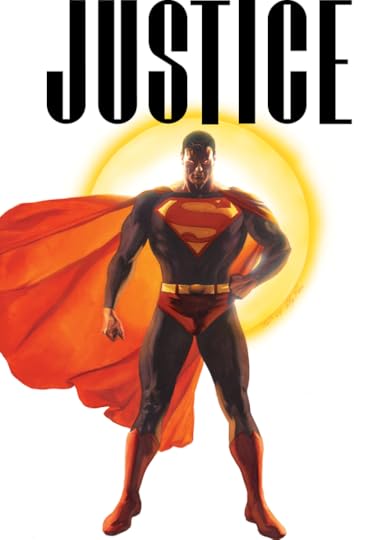
When several of Earth's most notorious villains are plagued by terrible nightmares of the Justice League's failure to avert Armageddon, they conclude that the fate of humanity rests in their hands. United to carry out Lex Luthor's mysterious master plan, Black Manta, Cheetah, the Riddler, and others set in motion a sequence of outwardly unrelated events which will ultimately ensure humanity's survival. First on their agenda is the violent abduction of Aquaman from Atlantis, followed by the digital theft of the JLA's identities from Batcave's database. Meanwhile, an anonymous benefactor has been performing medical miracles on the infirm – including the healing of paralyzed individuals who never expected to walk again. Captain Cold and Poison Ivy perform similarly grand and altruistic feats. So the world is now left to wonder: what is the meaning behind all these occurrences, and could it be that the bad guys truly have the people's best interests at heart this time around?
After reading this first volume, I've come to suspect that the story is probably more satisfying when all three volumes are read together as one. There's quite a lot going on here, and only at the end of the very last issue does it seem like Krueger's done enough plot setup to actually start telling his story. But of course, by then it's much too late. I guess a plan of this scope must necessarily require many components, but having to sit through a series of scene changes – none of which lasted long enough to be independently interesting – was far from the most fun I've ever had reading a comic book. Honestly, I'm not really the biggest fan of those stories which prolong the unchallenged and inevitable execution of the villain's plot to destroy the heroes. In most cases, it's much more enjoyable to just skip ahead to the part where the fallen heroes fight to restore goodness in the world.
And I'm starting to see that there's an art to crafting mystery in a story so that it doesn't bore or frustrate readers; the sheer quantity of unknown elements at play in a plot isn't necessarily a concern, but the trick is providing just enough explanations, hints, or diversions to give the reader the illusion that they might have a handle on what's going on. In this way, the writer can encourage the imagination to run wild, and avoid creating a plot that's too cluttered and overwhelming. Like I said before, the final quarter of this volume is the first time it feels like we're about to get some measurable clarification, but it ends before it can deliver, and I walked away with far too many unanswered questions. It felt like I was given too few pieces of the puzzle to try and work it out, and Krueger didn't divulge enough to entice further reading.
The strongest two issues of the collection for me had to be the heavily-monologued first and last chapters. The theme of superhero intervention fostering human weakness and complacency isn't quite such a revolutionary one, but it was expressed well enough by Luthor to distract me away from issue #1's unaffecting dream sequence and the hollow violence of issue #4. The issues comprising the middle half of the book were largely devoted to dull Batman vs the Riddler and Martian Manhunter vs Grodd showdowns. As Batman himself kept reminding me, he had "the means, the skill, and the method" over Riddler, and I'm much too used to "the-customary-broken-jaw"-and-trip-back-to-Arkham routine to think for a minute it could end up any other way. The Manhunter vs Grodd issue was even more one-sided, and Krueger seemed content relying only on the MM's pyrophobia to generate suspense. Beyond all that though, at least I could enjoy unfunny, unclever, and non-threatening two-part Joker cameo, as well as the prolonged, redundant, and unexciting Brainiac human experimentation scenes.
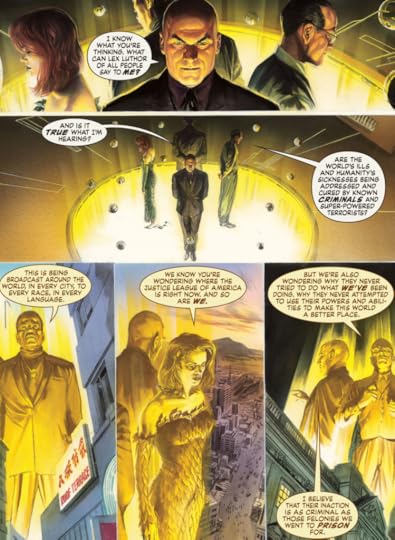
[I wish I could say my interest was piqued at this point, but I felt this moment should have occurred *at least* an issue ago, and these philosophical concerns weren't satisfactorily addressed in this book.]

[Watching Superman get mercilessly beat-up by Solomon Grundy and Bizarro – who are both later joined by Metallo and Parasite – doesn't much demonstrate the cleverness of the villain's plot, so I wasn't much impressed. And this is only one of several uninteresting moments I was forced to watch the heroes being blatantly outclassed by their enemies.]
But a big positive about this book – and one I would've never expected to find – is actually Ross' artwork. I know a lot of people love the guy, but I generally see his style as a bit too staged, proper, and precise to capture the excitement we're supposed to find in comic books. But unlike Marvels , I think what worked out better here was that the writer gave him a chance to drown the book in beautiful landscapes, hectic battles, and epic character poses. In other words, he was free to do what he did best as often as he could get away with, and didn't have to draw nearly as many bland and lifeless panels of normal people doing mundane things. And the 11 years since he's drawn Marvels may have also given him the chance to add some more vibrancy to his coloring.

[This shot is nothing short of masterful, and helped to give me a newfound respect for Ross' talents.]
At the end of the day, this was a short volume, and I'm glad I was able to read this quick and (relatively) painlessly enough to review it and say I at least gave it a fair shot. Without the need for as much exposition going forward, I do get the feeling the next two volumes ought to be a little better, but only by a half-star at the most, so I guess I'll never know for certain. Justice Vol. 1 is an unmemorable, disjointed, and overly-compressed book, and it doesn't look like comic fans would be missing very much by steering clear of it altogether.
Postscript:
Perhaps the most uncertainty I had concerning this story stemmed from my not fully understanding Luthor's involvement. I think I maybe get how the witless, B-list supervillains are scared enough to get behind anyone who says they've got a plan to save the world, but why the hell would Luthor be convinced their bad dreams would eventually come true? He's hugely intelligent, and by no means a superstitious man, but I saw no efforts on his part to scientifically investigate the source of their nightmares. To me, this whole thing screams of psychic manipulation by another unknown villain, and I doubt Luthor would want to so blindly play into his/her plans. Is he himself the mastermind behind the dreams, or is he just intentionally playing dumb and taking advantage of an opportunity to amass a superpowered army? While I suppose either scenario is plausible, Krueger doesn't appear to write the story with an appreciation (or even an acknowledgement) of this inconsistency, so I can't automatically assume he's given it much thought.
Oh, and maybe I should have mentioned this earlier, but wouldn't it make more sense just to work together with the JLA to ward off whatever unknown force threatens the planet? The villains could always wait and stab the good guys in the back *afterwards*, couldn't they? Compared to a global takeover, I would think basic survival would be the more pressing motivator, but hey – everyone's different, right?
ABSOLUTE RATING: {2.5/5 stars} (Rounded Down)
STANDARDIZED RATING: <2/5 stars>
"Survival. Perhaps that is all I can hope for at this point. Our potential was stunted when earth became the battlefield for the rest of the cosmos... when the so-called Justice League of America banded together because they were unwilling to allow us to bleed and suffer and learn how to defend ourselves... when Earth and humanity became but suburbs to the conflicts of a galaxy. And we realized we were no longer alone."
– (Lex Luthor?)
When several of Earth's most notorious villains are plagued by terrible nightmares of the Justice League's failure to avert Armageddon, they conclude that the fate of humanity rests in their hands. United to carry out Lex Luthor's mysterious master plan, Black Manta, Cheetah, the Riddler, and others set in motion a sequence of outwardly unrelated events which will ultimately ensure humanity's survival. First on their agenda is the violent abduction of Aquaman from Atlantis, followed by the digital theft of the JLA's identities from Batcave's database. Meanwhile, an anonymous benefactor has been performing medical miracles on the infirm – including the healing of paralyzed individuals who never expected to walk again. Captain Cold and Poison Ivy perform similarly grand and altruistic feats. So the world is now left to wonder: what is the meaning behind all these occurrences, and could it be that the bad guys truly have the people's best interests at heart this time around?
After reading this first volume, I've come to suspect that the story is probably more satisfying when all three volumes are read together as one. There's quite a lot going on here, and only at the end of the very last issue does it seem like Krueger's done enough plot setup to actually start telling his story. But of course, by then it's much too late. I guess a plan of this scope must necessarily require many components, but having to sit through a series of scene changes – none of which lasted long enough to be independently interesting – was far from the most fun I've ever had reading a comic book. Honestly, I'm not really the biggest fan of those stories which prolong the unchallenged and inevitable execution of the villain's plot to destroy the heroes. In most cases, it's much more enjoyable to just skip ahead to the part where the fallen heroes fight to restore goodness in the world.
And I'm starting to see that there's an art to crafting mystery in a story so that it doesn't bore or frustrate readers; the sheer quantity of unknown elements at play in a plot isn't necessarily a concern, but the trick is providing just enough explanations, hints, or diversions to give the reader the illusion that they might have a handle on what's going on. In this way, the writer can encourage the imagination to run wild, and avoid creating a plot that's too cluttered and overwhelming. Like I said before, the final quarter of this volume is the first time it feels like we're about to get some measurable clarification, but it ends before it can deliver, and I walked away with far too many unanswered questions. It felt like I was given too few pieces of the puzzle to try and work it out, and Krueger didn't divulge enough to entice further reading.
The strongest two issues of the collection for me had to be the heavily-monologued first and last chapters. The theme of superhero intervention fostering human weakness and complacency isn't quite such a revolutionary one, but it was expressed well enough by Luthor to distract me away from issue #1's unaffecting dream sequence and the hollow violence of issue #4. The issues comprising the middle half of the book were largely devoted to dull Batman vs the Riddler and Martian Manhunter vs Grodd showdowns. As Batman himself kept reminding me, he had "the means, the skill, and the method" over Riddler, and I'm much too used to "the-customary-broken-jaw"-and-trip-back-to-Arkham routine to think for a minute it could end up any other way. The Manhunter vs Grodd issue was even more one-sided, and Krueger seemed content relying only on the MM's pyrophobia to generate suspense. Beyond all that though, at least I could enjoy unfunny, unclever, and non-threatening two-part Joker cameo, as well as the prolonged, redundant, and unexciting Brainiac human experimentation scenes.
[I wish I could say my interest was piqued at this point, but I felt this moment should have occurred *at least* an issue ago, and these philosophical concerns weren't satisfactorily addressed in this book.]
[Watching Superman get mercilessly beat-up by Solomon Grundy and Bizarro – who are both later joined by Metallo and Parasite – doesn't much demonstrate the cleverness of the villain's plot, so I wasn't much impressed. And this is only one of several uninteresting moments I was forced to watch the heroes being blatantly outclassed by their enemies.]
But a big positive about this book – and one I would've never expected to find – is actually Ross' artwork. I know a lot of people love the guy, but I generally see his style as a bit too staged, proper, and precise to capture the excitement we're supposed to find in comic books. But unlike Marvels , I think what worked out better here was that the writer gave him a chance to drown the book in beautiful landscapes, hectic battles, and epic character poses. In other words, he was free to do what he did best as often as he could get away with, and didn't have to draw nearly as many bland and lifeless panels of normal people doing mundane things. And the 11 years since he's drawn Marvels may have also given him the chance to add some more vibrancy to his coloring.
[This shot is nothing short of masterful, and helped to give me a newfound respect for Ross' talents.]
At the end of the day, this was a short volume, and I'm glad I was able to read this quick and (relatively) painlessly enough to review it and say I at least gave it a fair shot. Without the need for as much exposition going forward, I do get the feeling the next two volumes ought to be a little better, but only by a half-star at the most, so I guess I'll never know for certain. Justice Vol. 1 is an unmemorable, disjointed, and overly-compressed book, and it doesn't look like comic fans would be missing very much by steering clear of it altogether.
Postscript:
Perhaps the most uncertainty I had concerning this story stemmed from my not fully understanding Luthor's involvement. I think I maybe get how the witless, B-list supervillains are scared enough to get behind anyone who says they've got a plan to save the world, but why the hell would Luthor be convinced their bad dreams would eventually come true? He's hugely intelligent, and by no means a superstitious man, but I saw no efforts on his part to scientifically investigate the source of their nightmares. To me, this whole thing screams of psychic manipulation by another unknown villain, and I doubt Luthor would want to so blindly play into his/her plans. Is he himself the mastermind behind the dreams, or is he just intentionally playing dumb and taking advantage of an opportunity to amass a superpowered army? While I suppose either scenario is plausible, Krueger doesn't appear to write the story with an appreciation (or even an acknowledgement) of this inconsistency, so I can't automatically assume he's given it much thought.
Oh, and maybe I should have mentioned this earlier, but wouldn't it make more sense just to work together with the JLA to ward off whatever unknown force threatens the planet? The villains could always wait and stab the good guys in the back *afterwards*, couldn't they? Compared to a global takeover, I would think basic survival would be the more pressing motivator, but hey – everyone's different, right?

July 26, 2022
Justice is a must read for anyone from casual comic book readers to lifetime DC comics fans. With an epic story that seems to encompass every major hero or villain in the DC universe, Krueger's writing is perfectly in touch with the essence of DC. With the breathtaking, hyper-realistic paintings by Alex Ross, readers will spend just as much time appreciating the images as the story. I know it took me hours to read, finding myself taking ample time to look at all the details in the pictures. A wonderful stand-alone story with memorable moments and amazing action. If you could only read one Justice League story, this is the one you should read.
- Reviewed by Nate G.
- Reviewed by Nate G.

July 17, 2019
Gorgeous artwork props up the “tear it all down” story. Like all superhero stories, this is rising action in the arc of heroes’ fall and heroes’ rise, but it’s a major downer slow burn.

November 9, 2025
Not to literally just repeat myself, but my god. The art in this is stunning.

November 28, 2007
"When you write an antagonist, you always write him, in his mind, as the protagonist. That means, every villain of a story, to be a good villain, must believe himself to be the hero. Not the villain at all."
In his foreward in this book, Jim Kreuger speaks about how he writes a villain and what he has learned about writing effective villains. This really caught my attention because this is what I have always believed when I read a book that features a pronounced antagonist. I really can't stand to read books where the villain "raise[s:] his head from his pillow that morning to consider what "evil" he might do that day." People in my reading groups and anyone who reads my reviews know that I hate Evil for Evil's sakes villains. I want to villain to be someone who really thinks what he is doing, from his perspective, is right. Yes, what he is doing is...,well,...evil. But he doesn't think so and he has a real motive of why he's doing it.
In this very well done and provocative first volume, Kreuger does just that. He takes some very well known DC universe villains, (Lex Luthor, Riddler, Black Manta etc.) as has them banding together to solve Earth's woes. Their reasoning is that the Justice League heroes (Superman, Wonderwoman, Batman, Aquaman etc.) haven't really made the world a better place with all their super powers. They haven't cured diseases, they haven't eradicated poverty etc. And in fact their presence has made man lazy. Their ability to save men from dangers hasn't allowed man to grow and reach for the stars themselves. And actually, this is pretty darned sound reasoning. Really, what have they done except fight each other and other supervillains? So Lex and co. actually go about doing all that stuff. And it is pretty darned awesome.
Of course the painful part is seeing the heroes number among the fallen now. Knowing that the villains are carrying out a carefully constructed and well orchestrated plan to remove the heroes for good, is kinda awful to read and see. And it is a plan that looks like it just might work.
Of course this is just the first volume. There are, I believe, four or five total. This means that eventually the heroes will possibly come out of top again. Because, frankly, no matter how well drawn or reasonable a group of supervillains are, they are, at heart, villains. Somebody is going to do something that will make their fragile alliance collapse. But that is for a later installment possibly.
For now, this volume really works for me.
And let me take a minute to talk about Alex Ross. I FLOVE his art. If his art were human I'd have it's babies. It is beautiful, almost living. I try to buy any books he illustrates because his art just speaks to me. I have the giant posters of Wonder Woman, Superman, Batman and Captain Marvel that he did as a limited edition. And I love the character he puts in their faces. Especially Wonderwowan. She isn't just a pretty woman in satin tights. She looks like an Amazonian Warrior who just happens to be gorgeous. They all look like they've been fighting a lot and seen a lot.
Reccommend!
In his foreward in this book, Jim Kreuger speaks about how he writes a villain and what he has learned about writing effective villains. This really caught my attention because this is what I have always believed when I read a book that features a pronounced antagonist. I really can't stand to read books where the villain "raise[s:] his head from his pillow that morning to consider what "evil" he might do that day." People in my reading groups and anyone who reads my reviews know that I hate Evil for Evil's sakes villains. I want to villain to be someone who really thinks what he is doing, from his perspective, is right. Yes, what he is doing is...,well,...evil. But he doesn't think so and he has a real motive of why he's doing it.
In this very well done and provocative first volume, Kreuger does just that. He takes some very well known DC universe villains, (Lex Luthor, Riddler, Black Manta etc.) as has them banding together to solve Earth's woes. Their reasoning is that the Justice League heroes (Superman, Wonderwoman, Batman, Aquaman etc.) haven't really made the world a better place with all their super powers. They haven't cured diseases, they haven't eradicated poverty etc. And in fact their presence has made man lazy. Their ability to save men from dangers hasn't allowed man to grow and reach for the stars themselves. And actually, this is pretty darned sound reasoning. Really, what have they done except fight each other and other supervillains? So Lex and co. actually go about doing all that stuff. And it is pretty darned awesome.
Of course the painful part is seeing the heroes number among the fallen now. Knowing that the villains are carrying out a carefully constructed and well orchestrated plan to remove the heroes for good, is kinda awful to read and see. And it is a plan that looks like it just might work.
Of course this is just the first volume. There are, I believe, four or five total. This means that eventually the heroes will possibly come out of top again. Because, frankly, no matter how well drawn or reasonable a group of supervillains are, they are, at heart, villains. Somebody is going to do something that will make their fragile alliance collapse. But that is for a later installment possibly.
For now, this volume really works for me.
And let me take a minute to talk about Alex Ross. I FLOVE his art. If his art were human I'd have it's babies. It is beautiful, almost living. I try to buy any books he illustrates because his art just speaks to me. I have the giant posters of Wonder Woman, Superman, Batman and Captain Marvel that he did as a limited edition. And I love the character he puts in their faces. Especially Wonderwowan. She isn't just a pretty woman in satin tights. She looks like an Amazonian Warrior who just happens to be gorgeous. They all look like they've been fighting a lot and seen a lot.
Reccommend!

December 23, 2022
Holy camoly. The art is GORGEOUS.
Apparently loads of folks are familiar the beautiful art of Alex Ross, but this was my first experience with it. I could have looked at this all day. I kept interrupting my reading to show my husband some of the stunning images because I couldn't keep it to myself.
The story is...just starting. It was a slow build up and a lot of characters but not a ton of story just yet. I'll definitely be continuing on to the next volume to see where this goes.
Side note on one thing I personally appreciated:
I know a fair amount of DC characters but am not a DC expert by any stretch of the imagination - hence why I'm trying to read more and learn. Sometimes it feels impossible to know where to start because some of these characters have been around for 80+ years. This can lead to a lot of confusion when you start a series because it may not be (and likely is not) starting from the character's very beginning. Even though this had a lot of characters (including some I didn't know), it was rarely confusing because there were little backstory snippets at the beginning, throughout, and at the end. I appreciated this as a bit of a novice, and I don't think it would have been too annoying for a seasoned DC'er to read either.
^That said, anyone who has advice on where to start on some of these, I'd love to hear that advice!
4 Stars
Apparently loads of folks are familiar the beautiful art of Alex Ross, but this was my first experience with it. I could have looked at this all day. I kept interrupting my reading to show my husband some of the stunning images because I couldn't keep it to myself.
The story is...just starting. It was a slow build up and a lot of characters but not a ton of story just yet. I'll definitely be continuing on to the next volume to see where this goes.
Side note on one thing I personally appreciated:
I know a fair amount of DC characters but am not a DC expert by any stretch of the imagination - hence why I'm trying to read more and learn. Sometimes it feels impossible to know where to start because some of these characters have been around for 80+ years. This can lead to a lot of confusion when you start a series because it may not be (and likely is not) starting from the character's very beginning. Even though this had a lot of characters (including some I didn't know), it was rarely confusing because there were little backstory snippets at the beginning, throughout, and at the end. I appreciated this as a bit of a novice, and I don't think it would have been too annoying for a seasoned DC'er to read either.
^That said, anyone who has advice on where to start on some of these, I'd love to hear that advice!
4 Stars

May 2, 2021
Alright, alright, you got my attention! First off, really enjoyed how realistic this art is. The story is like, wtf is going on, but definitely in a good way. I’m curious to see where it goes. Some of these characters are new to me and I have to suspend my belief on some, but that’s just comics.
Volume two, here we come!
Volume two, here we come!

May 4, 2021
Great first volume. Amazing art style, compelling storyline, looking forward to see where vol.2 goes.

December 1, 2025
Beautiful art but has so much going on with so many characters it becomes difficult to follow and feels weirdly paced the whole time.

November 10, 2008
I'm glad I got this out from the library, because I'd have been pretty annoyed if I'd paid for this utterly uninspiring and unmemorable piece of work.
What is it about DC and Marvel that they simply CANNOT publish a memorable or well-written comic or miniseries unless one of a very small number of writers is part of the project? At this point, if it's not by Alan Moore or Neil Gaiman, my expectations are virtually nil.
I read the whole series - volumes 1, 2, and 3. What was it about? The bad guys (primarily Lex Luthor and Brainiac) get together and screw over the good guys (the usual cast: Batman, Superman, Wonder Woman, and the rest of the Justice League of America).
Look, the art is the usual brightly-colored eye candy. And the characters are the same old classic characters who can be magic in the hands of a decent writer, but are leaden and uninteresting in the hands of the usual DC gang of incompetents.
Worst of all, the whole damned thing was confusing. Was it just that the original comic book miniseries assumed that the readers were all desperate fanboys who were reading everything that DC produced, and so left half the plot out of this series because it was all covered elsewhere? I doubt it. All I know is that for much of the novel I didn't know what was going on. And worse, I didn't CARE.
Confusing, poorly written, uninspired. I read it two or three days ago, and the ONLY memory I have from it is Wonder Woman looking like a zombie because she was poisoned and was therefore turning back into earth. I didn't know she was made from earth to begin with - I'm pretty sure that's just something the writers added for this particular series - but from three all three volumes that's the ONLY thing I remember. And it's not really WORTH remembering.
And I have a good memory, mind you!
Sad. Just sad. I don't understand why DC won't or can't get decent writers. Someone should smack them with a clue-by-four.
What is it about DC and Marvel that they simply CANNOT publish a memorable or well-written comic or miniseries unless one of a very small number of writers is part of the project? At this point, if it's not by Alan Moore or Neil Gaiman, my expectations are virtually nil.
I read the whole series - volumes 1, 2, and 3. What was it about? The bad guys (primarily Lex Luthor and Brainiac) get together and screw over the good guys (the usual cast: Batman, Superman, Wonder Woman, and the rest of the Justice League of America).
Look, the art is the usual brightly-colored eye candy. And the characters are the same old classic characters who can be magic in the hands of a decent writer, but are leaden and uninteresting in the hands of the usual DC gang of incompetents.
Worst of all, the whole damned thing was confusing. Was it just that the original comic book miniseries assumed that the readers were all desperate fanboys who were reading everything that DC produced, and so left half the plot out of this series because it was all covered elsewhere? I doubt it. All I know is that for much of the novel I didn't know what was going on. And worse, I didn't CARE.
Confusing, poorly written, uninspired. I read it two or three days ago, and the ONLY memory I have from it is Wonder Woman looking like a zombie because she was poisoned and was therefore turning back into earth. I didn't know she was made from earth to begin with - I'm pretty sure that's just something the writers added for this particular series - but from three all three volumes that's the ONLY thing I remember. And it's not really WORTH remembering.
And I have a good memory, mind you!
Sad. Just sad. I don't understand why DC won't or can't get decent writers. Someone should smack them with a clue-by-four.
February 23, 2011
Alex Ross, Jim Krueger, and Doug Braithwaite do the seemingly impossible and told the Super Friends' first ever legitimately cool story.
Can't really say how without spoiling it, so I'll just talk about the pictures.
In Justice, Ross paints over Braithwaite's pencils but many of the characters (especially their faces) look like pure Ross. This has me curious about the original pencils: did Braithwaite draw the characters while aping Ross's style, or did Ross disregard Braithwaite's faces and do his own thing?
One of my favorite things about Ross's portrayal of superheroes is how he DOESN'T over-emphasize their physiques; too many artists show every single line, muscle, and vein improbably showing through their clothing with more clarity than you'd see on half-naked bodybuilders flexing while covered in baby oil. (Not that I watch half-naked bodybuilders flexing while covered in baby oil or anything. Ahem.) Braithwaite puts more emphasis on these details than Ross normally does on his own, but he doesn't go overboard, and the end result still works fine.
The only weakness I see in the art is with the depiction of shape-shifting. It might just be me, those scenes were never clear, whether it was Martian Manhunter, Clayface, or even Giganta when she changes size.
But really, that's the ONLY problem I had with all the Justice books. The story is really well put together and has some nice twists, and the art is beautiful, featuring some great character designs.
I don't want to write too much about Krueger's contribution for fear of giving anything away, but it's a hell of a story and anyone who liked (or still likes) the Super Friends will likely LOVE Justice.
Can't really say how without spoiling it, so I'll just talk about the pictures.
In Justice, Ross paints over Braithwaite's pencils but many of the characters (especially their faces) look like pure Ross. This has me curious about the original pencils: did Braithwaite draw the characters while aping Ross's style, or did Ross disregard Braithwaite's faces and do his own thing?
One of my favorite things about Ross's portrayal of superheroes is how he DOESN'T over-emphasize their physiques; too many artists show every single line, muscle, and vein improbably showing through their clothing with more clarity than you'd see on half-naked bodybuilders flexing while covered in baby oil. (Not that I watch half-naked bodybuilders flexing while covered in baby oil or anything. Ahem.) Braithwaite puts more emphasis on these details than Ross normally does on his own, but he doesn't go overboard, and the end result still works fine.
The only weakness I see in the art is with the depiction of shape-shifting. It might just be me, those scenes were never clear, whether it was Martian Manhunter, Clayface, or even Giganta when she changes size.
But really, that's the ONLY problem I had with all the Justice books. The story is really well put together and has some nice twists, and the art is beautiful, featuring some great character designs.
I don't want to write too much about Krueger's contribution for fear of giving anything away, but it's a hell of a story and anyone who liked (or still likes) the Super Friends will likely LOVE Justice.

March 18, 2016
Alex Ross's work is catnip to me (even when he's painting over another artist's pencils), so I am predisposed to like this. This volume is largely set-up for the mysteries that will play out over the next two volumes, but it still manages to shoehorn in a ton of dynamic hero shots, some interesting character work and dialogue, and a very nice treatment of the trope of "Lex as protector of humanity's drive for excellence." This book also checks in on a ton of different Justice Leaguers and their foes, some of them more central than others. You get the sense that the writer and artists just love these characters, and want to showcase them as much as possible.
There are also some interesting moments where characters appear to be aware of the breaking of the rules inherent to the tropes of their own stories (e.g., that insurmountable odds are the set up for a heroic reversal, that the hero always wins, etc.). Are they recognizing some metatextual hints of their own status as fictional characters? Maybe not, but it hints at an interesting interplay with breaking the fourth wall. A fun read so far and I'm looking forward to seeing where this one goes.
There are also some interesting moments where characters appear to be aware of the breaking of the rules inherent to the tropes of their own stories (e.g., that insurmountable odds are the set up for a heroic reversal, that the hero always wins, etc.). Are they recognizing some metatextual hints of their own status as fictional characters? Maybe not, but it hints at an interesting interplay with breaking the fourth wall. A fun read so far and I'm looking forward to seeing where this one goes.

September 15, 2009
Justice: Volume 1 takes everything we knew about in the DC comic world and turns it on its head. The Intro note from the author is intriguing and well written, and poses a few great points, most importantly that a well-written villain is acting "right" in his own mind, while a hero is acting "right" in his own mind.
That said, Justice begins with a thought-provoking mindset. The premise of the series is that the world's Super Villains decide to join together and do good in the world, kind of like the Justice League of America, but for bad guys. They accomplish more for the better of Man than the JLA ever did.
Without revealing much, I really enjoyed this installment of the series. The artwork is beautiful and the story is intriguing. If you're a fan of the members of the JLA (Superman, Batman, Wonder Woman, Flash, etc.) then this is a story arc you'll not want to miss.
That said, Justice begins with a thought-provoking mindset. The premise of the series is that the world's Super Villains decide to join together and do good in the world, kind of like the Justice League of America, but for bad guys. They accomplish more for the better of Man than the JLA ever did.
Without revealing much, I really enjoyed this installment of the series. The artwork is beautiful and the story is intriguing. If you're a fan of the members of the JLA (Superman, Batman, Wonder Woman, Flash, etc.) then this is a story arc you'll not want to miss.

July 5, 2015
A superhero story in twelve issues, or three volumes. About the Justice League.
It helps to know the characters, I dare say. There are lots of them, both heroes and villains. It opens with a common nightmare plaguing all the supervillains, to draw them in: the superheroes failing to rescue Earth from destruction. And then showing their plots, capturing Aquaman, raiding Wayne Industries to use its computers, making the desert bloom, healing crippled people so they can walk -- which, as you can guess, leads into their plot. . . .
It involves a child who's not supposed to talk to strangers, the speed of Mercury, blue kryptonite, someone trying to smother a patient in the hospital, hostages, Wonder Woman's lasso, the Riddler's habit of telling the truth, subterfuge, and a lot more.
It helps to know the characters, I dare say. There are lots of them, both heroes and villains. It opens with a common nightmare plaguing all the supervillains, to draw them in: the superheroes failing to rescue Earth from destruction. And then showing their plots, capturing Aquaman, raiding Wayne Industries to use its computers, making the desert bloom, healing crippled people so they can walk -- which, as you can guess, leads into their plot. . . .
It involves a child who's not supposed to talk to strangers, the speed of Mercury, blue kryptonite, someone trying to smother a patient in the hospital, hostages, Wonder Woman's lasso, the Riddler's habit of telling the truth, subterfuge, and a lot more.

March 15, 2021
(This review is a collective for all three volumes of Justice)
This comic was both so interesting and so amazing :D
Whilst I carry the general opinion that I prefer Alex Ross' artworks to be on covers or promotional material as opposed to materials (as they are so detailed filled and therefore I find it hard to see what's quickly happening) but I felt in this series, the artwork truly shined!
The storyline was so gripping from point one and even though it required some default understanding of the basic ideas and morals of each of these superheroes and their respective villains, the fact it didn't need to explain much from the start gave the story a chance to propel itself forward quite swiftly!
The mystery and wickedness of this series is interesting! It kept me turning the page over and over and as such it drew me into this massive universe of lore!
This comic was both so interesting and so amazing :D
Whilst I carry the general opinion that I prefer Alex Ross' artworks to be on covers or promotional material as opposed to materials (as they are so detailed filled and therefore I find it hard to see what's quickly happening) but I felt in this series, the artwork truly shined!
The storyline was so gripping from point one and even though it required some default understanding of the basic ideas and morals of each of these superheroes and their respective villains, the fact it didn't need to explain much from the start gave the story a chance to propel itself forward quite swiftly!
The mystery and wickedness of this series is interesting! It kept me turning the page over and over and as such it drew me into this massive universe of lore!

August 24, 2008
Awesome writing, awesome handling of the characters, and, as always, the life-like art of Alex Ross seems to bring more life to them than a lot of the current movies. When Ross handles the DC Universe, particularly the icons(Superman, Batman, Wonder Woman, even the villians), I am often reminded of old Greek Mythology and how fascinating those stories and characters have always been. Could our comic book heroes be the same to us as the stories of Zues and Hercules were in ancient times? Hmm. Modern Mythology. At least, it's appearant in his work that Ross feels that way, giving him an approach to these characters that others seem to miss when handling them. This is part 1 of 3, it's a fascinating story so far, can't wait to read the rest.

December 24, 2011
The villains of the DC Universe have been having nightmares about the end of the world and how the heroes can't stop it. So they band together for two purposes, 1) to save mankind by performing acts of good and 2) stop the apocalypse by stopping all the heroes.
In this first volume we see hero after hero fall to the onslaught of villains. It is a bit depressing watching the icons of my childhood fall so easily to the onslaught of the badguys. If it had been this easy, wouldn't it have happened before? Still there is enough here to make me want to read the next instalment.
In this first volume we see hero after hero fall to the onslaught of villains. It is a bit depressing watching the icons of my childhood fall so easily to the onslaught of the badguys. If it had been this easy, wouldn't it have happened before? Still there is enough here to make me want to read the next instalment.

January 7, 2009
This novel changed my views on Superheroes.
...imagine if the Supervillains are the cops and the authority, to help people in need.
...and imagine if the Superheroes are the terrorists and murderers, it's crazy I know.
*Spoiler*
...and to actually witness the death of Superman, using ones imagination, really is unbearable to continue on.
****
...a must for fans of DC Comics.
...imagine if the Supervillains are the cops and the authority, to help people in need.
...and imagine if the Superheroes are the terrorists and murderers, it's crazy I know.
*Spoiler*
...and to actually witness the death of Superman, using ones imagination, really is unbearable to continue on.
****
...a must for fans of DC Comics.
March 2, 2016
The heroes don't fare too well in this first volume. If you like to see heroes get beat up, then this is for you. I'm not a big fan of it. The art is nice, though.

April 14, 2023
It begins with a vision of total destruction. The superheroes of Earth are powerless to prevent some calamity and they can only attempt, scattered as they are, to do a little bit of good here and there and many of them cannot even manage this much. In a more straightforward story it would be the heroes who have these dreams, the plot flowing forth from this being how they can prevent the catastrophe.
Justice brings this twist: It is the villains visited with such visions, and from this they sense an opportunity to try a different way to achieve their goals. The villains of the world suddenly get way into philanthropy, using their powers and gadgets to such ends as to bring water and plant life to the deserts, or smaller-scale things like saving people from burning buildings. The Justice League is preoccupied, and scattered: One of their own, Aquaman, has gone missing early in the story, and they sense a rat but don't know where it is or what its aim. The Riddler almost pulls one over on Batman, or so Batman thinks, with a plan to hack into Bruce Wayne's computer system to discover superhero identities. Someone really should have thought to try that before.
Naturally, the volume builds towards the ultimate bad guy, Lex Luthor, delivering some kind of "hack the entire planet" monologue about how there's still all of this suffering and poverty in the world and what have the Justice League ever done about that? The reader knows that this is a bunch of bullshit - especially because even in their grand monologue the villains can't bring themselves to apologize for anything they've ever done before - because the reader has seen plenty of real life figures come along who act like populists even as they seek to build a world that shields their immense wealth from any scrutiny or accountability and expands the power they can exercise that wealth. But the reader also knows that there are tens of millions of people just in America alone who will buy into the bullshit and convince themselves that the orange guy is not the biggest swamp creature of all as long as he's directing his nastiness at people they don't like. So it's not hard to think that this might resonate.
The heroes find themselves unable to offer an immediate response to the grand monologue, for which they are taunted within it, since the plan has sprung, the secret identities were acquired, and villains who are not the public face of the operation have been able to go around and trap or apparently even seriously hurt the heroes in their separate domains. Seems bad!
This collected volume ends after four issues on that wicked cliffhanger of frantic panels of isolated heroes unable to escape these villainous traps. I do wonder about how the pacing might have seemed when this was merely monthly releases, but since I only read collected editions far after the fact, it's no problem to me. It's certainly a thought-provoking beginning, one that caught my attention even with only a very hazy knowledge of DC heroes and villains beyond the A-listers, and I'm interested curious to see where things go from here.
Justice brings this twist: It is the villains visited with such visions, and from this they sense an opportunity to try a different way to achieve their goals. The villains of the world suddenly get way into philanthropy, using their powers and gadgets to such ends as to bring water and plant life to the deserts, or smaller-scale things like saving people from burning buildings. The Justice League is preoccupied, and scattered: One of their own, Aquaman, has gone missing early in the story, and they sense a rat but don't know where it is or what its aim. The Riddler almost pulls one over on Batman, or so Batman thinks, with a plan to hack into Bruce Wayne's computer system to discover superhero identities. Someone really should have thought to try that before.
Naturally, the volume builds towards the ultimate bad guy, Lex Luthor, delivering some kind of "hack the entire planet" monologue about how there's still all of this suffering and poverty in the world and what have the Justice League ever done about that? The reader knows that this is a bunch of bullshit - especially because even in their grand monologue the villains can't bring themselves to apologize for anything they've ever done before - because the reader has seen plenty of real life figures come along who act like populists even as they seek to build a world that shields their immense wealth from any scrutiny or accountability and expands the power they can exercise that wealth. But the reader also knows that there are tens of millions of people just in America alone who will buy into the bullshit and convince themselves that the orange guy is not the biggest swamp creature of all as long as he's directing his nastiness at people they don't like. So it's not hard to think that this might resonate.
The heroes find themselves unable to offer an immediate response to the grand monologue, for which they are taunted within it, since the plan has sprung, the secret identities were acquired, and villains who are not the public face of the operation have been able to go around and trap or apparently even seriously hurt the heroes in their separate domains. Seems bad!
This collected volume ends after four issues on that wicked cliffhanger of frantic panels of isolated heroes unable to escape these villainous traps. I do wonder about how the pacing might have seemed when this was merely monthly releases, but since I only read collected editions far after the fact, it's no problem to me. It's certainly a thought-provoking beginning, one that caught my attention even with only a very hazy knowledge of DC heroes and villains beyond the A-listers, and I'm interested curious to see where things go from here.
Displaying 1 - 30 of 145 reviews