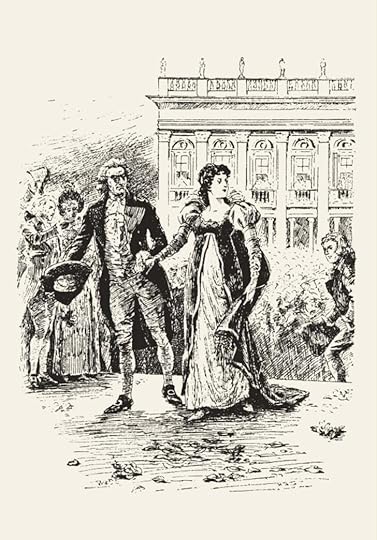
My story of Corinne begins with my college experience of Literary Women, by Ellen Moers, and her dedication of an entire section to DeStael's book, entitled Performing Heroinism: The Myth of Corinne. I've finally, through the miracle of online publishing, been able to see for myself that which was so rigorously discussed in her book.
As a researcher, Moers found Madame DeStael's early-19th-century book to be an essential contribution to the history of western Europe's early female authors. She cites its direct influence over Eliot, Barrett, Chopin, and even American author Beecher, etc; and presents its protagonist as THE archetype of the performing heroine (a female celebrity of talent), influencing many 19th century novels, including: Consuelo,The Song of The Lark, Aurora Leigh, even Uncle Tom's Cabin. Women authors of the time, Moers asserts, found an intriguing and kindred spirit in the character of Corinne - with her overwhelming "need to please, to captivate, to impress", and thus "enchant and subjugate the world".
(As a matter of fact, I'm wondering right now if the precocious and pathetic Maggie, from The Mill on The Floss, was not an Eliot extrapolation - twisted and turned in upon itself - of the character of Corinne, as a woman of genius, if she had grown, only to wither, in the social mores of Britain rather than spending her formative years in her native country of Italy; or if she had actually acted on her impulse to return to live in the country of her father.)
All of Moers' observations come in spite of her own feelings about Corinne, or Italy; she personally finds the book to be overwhelmingly silly and melodramatic and struggles to take it seriously.
So I came to Corinne with a certain amount of prejudice, after spending 25 years with an author who staunchly asserts its surface ridiculousness. I was a bit surprised, then, to have my eyes opened through my own experience with the book. I found it to be, actually, in truth, surprisingly close to the heart. In love. In duty. In thought and in action. In the artistic impulse.
Is the setup forced? Yeah. Is the dialogue unnatural? Yeah, sometimes. Corinne's continuous rambling discourse to Oswald about everything Italian, national history to national psychology to national politics, becomes wearing after a while - even though I understand this setup is to reinforce the concept of "naturalness" and "darkness" of Corinne and Italy, in opposition to the stifling social atmosphere of Britain at the same time. De Stael is not the only author, we know, to have gone to that well, in contrasting rainy, monotone England as-a-whole, to the sun-drenched, colorful Italy as-a-whole. It also shows off the depth of knowledge that DeStael must have had about both countries (she was incredibly educated, especially for a woman of her time).
The story, in the end, was especially unsettling for me, in how much of the Corinne/Oswald tragedy resulted from mis-communication... from things not said (or said WAY too late); from motivations misunderstood and never clarified through explanation.
This is the greatest preventable tragedy of all, in my own personal book of observation and experience. So these kinds of stories affect me the most.
Corinne, ultimately, was that kind of story. And De Stael nailed it perfectly, despite the melodrama and the staging, and despite the lapse of 200 years between her writing the story and my reading it.