

What do you think?

A Woman's Place: 1910-1975
A history of women's lives in the twentieth century, very readably written by a novelist. Preface by Yvonne Roberts.
339 pages, Paperback
First published January 1, 1975
About the author
Ruth Adam
20 books12 followersRuth Augusta King was the daughter of a vicar in a Nottinghamshire mining village. After school in Yorkshire, she taught for five years, before marrying the journalist Kenneth Adam and moving with him first to Manchester and then to London. She travelled a great deal, pursuing her wide-ranging interests in education and social policy. Four children were born between 1937 and 1947, by which time the Adams had moved to a large house outside London to live communally with other families. During the war Ruth Adam worked, like many other writers of her generation, in the Ministry of Information; meanwhile her husband joined the BBC, where he later became Director of Television. Ruth Adam wrote twelve novels between 1937 and 1961, all of them concerned with social issues; she also co-authored, with Kitty Muggeridge, a biography of Beatrice Webb. A Woman's Place, a history of women's lives in the twentieth century, appeared in 1975.
Ratings & Reviews
Friends & Following
Create a free account to discover what your friends think of this book!
Community Reviews
Displaying 1 - 28 of 28 reviews

July 20, 2025
This was a really interesting overview of women's place in Britain from the end of the Victorian era to the 1970s. Adam traces the progression of women's rights-- two steps forward, one step back for the most part --and demonstrates how pivotal moments of the 20th Century transformed women's lives.
I know the history quite well, yet I still enjoyed seeing it laid out in such an accessible and chronological format. Unsurprisingly, Adam highlights the two World Wars and access to contraception and abortion as significant turning points.
A more surprising takeaway was her somewhat critical view of Florence Nightingale-- or, to be precise, Nightingale’s philosophy of moral duty and self-sacrifice. Adam argues that this idea had a detrimental effect on the (mostly female) profession for over a century, effectively "brainwashing" nurses into thinking they should put up with long hours, low pay and poor working conditions.
This notion-- that women should willingly take on care roles for little or no compensation out of innate moral duty and a naturally nurturing temperament-- plagues women to this day.
Another interesting, and depressing, theme is the extent to which men (and sometimes other women) have gone to justify paying women less for doing the same work. Adam presents this as an almost comically ludicrous performance of constantly shifting goalposts.
While Adam's tone is measured and never polemical, there’s an undercurrent of frustration and anger to her writing that makes the book feel urgent and compelling, even fifty years after its publication. She is angry about the treatment of working class women, angry at men like Asquith, and especially angry at the way women are not only constantly being told how they should behave and what they should desire, but also how this is always changing to fit society's needs. A woman's "natural" role seems to be whatever society, and men, need from her.
I know the history quite well, yet I still enjoyed seeing it laid out in such an accessible and chronological format. Unsurprisingly, Adam highlights the two World Wars and access to contraception and abortion as significant turning points.
A more surprising takeaway was her somewhat critical view of Florence Nightingale-- or, to be precise, Nightingale’s philosophy of moral duty and self-sacrifice. Adam argues that this idea had a detrimental effect on the (mostly female) profession for over a century, effectively "brainwashing" nurses into thinking they should put up with long hours, low pay and poor working conditions.
This notion-- that women should willingly take on care roles for little or no compensation out of innate moral duty and a naturally nurturing temperament-- plagues women to this day.
Another interesting, and depressing, theme is the extent to which men (and sometimes other women) have gone to justify paying women less for doing the same work. Adam presents this as an almost comically ludicrous performance of constantly shifting goalposts.
While Adam's tone is measured and never polemical, there’s an undercurrent of frustration and anger to her writing that makes the book feel urgent and compelling, even fifty years after its publication. She is angry about the treatment of working class women, angry at men like Asquith, and especially angry at the way women are not only constantly being told how they should behave and what they should desire, but also how this is always changing to fit society's needs. A woman's "natural" role seems to be whatever society, and men, need from her.
‘A woman born at the turn of the century could have lived through two periods when it was her moral duty to devote herself, obsessively, to her children; three when it was her duty to society to neglect them; two when it was right to be seductively "feminine”; and three when it was a pressing social obligation to be the reverse.; three separate periods in which she was a bad wife, mother and citizen for wanting to go out and earn her own living, and three others when she was an even worse wife, mother and citizen for not being eager to do so.’

May 9, 2018
This book takes a look at women’s place in British society from the suffragette days of the 1910s to 1975 when the Equal Pay Act requiring equal pay for equal work came into force. The writer stopped there (the book was first published in 1975) and didn’t consider how much more there was to do—which with hindsight was a lot. But I do just about remember this happening in 1975 and how groundbreaking it was felt to be at the time, so I can understand her not wanting to complain at that point.
As well as looking at women’s employment opportunities, the book considers the changing attitudes to marriage and sex, with developments in contraception, adoption, abortion, and divorce, and the impact these had on women. All of these of course are viewed with 1970s eyes.
She also makes clear what we perhaps forget today - the reason why women teachers, for example, had until then been paid less than men for exactly the same work: because married women traditionally didn't work, so a man's wage had to be enough to support a wife and family, while most working women only had to support themselves. It was when married women began working (and the divorce rate went up) that pressure started for this to change.
It’s a book for the general reader that doesn’t go deeply into any topic, but I enjoyed it and there were some new perspectives for me.
As well as looking at women’s employment opportunities, the book considers the changing attitudes to marriage and sex, with developments in contraception, adoption, abortion, and divorce, and the impact these had on women. All of these of course are viewed with 1970s eyes.
She also makes clear what we perhaps forget today - the reason why women teachers, for example, had until then been paid less than men for exactly the same work: because married women traditionally didn't work, so a man's wage had to be enough to support a wife and family, while most working women only had to support themselves. It was when married women began working (and the divorce rate went up) that pressure started for this to change.
It’s a book for the general reader that doesn’t go deeply into any topic, but I enjoyed it and there were some new perspectives for me.

August 15, 2019
I read Ruth Adams’ 1975 history of women in Britain (mainly, women in England) through two lenses.
In the first, it was as a feminist social history written for general audiences. To a large degree, it succeeds – remembering, of course, that it was written 45 years ago (I’m writing this in 2019), so it is inflected with perspectives of the day. She writes from a broadly socialist-feminist angle, so there is good attention to paid work and class (given the limitation of sources and the paucity of other feminist history at the time). There is also quite good attention to questions political representation – the suffrage campaign and subsequent election of women to Parliament – as well as wider cultural questions and social change. She also has a good handle on various of the key political matters – access to divorce; changing health, housing, education and social welfare issues; management by the state and major institutions, including trade unions, of women’s labour market involvement during both World Wars. To a large degree she outlines the broad understanding that we have (through a perspective that is sensitive to class as well as gender) of the shape of the first ¾ of the 20th century.
There are, however, major omissions that even with the paucity of research could have been alluded to, most notably ‘race’. There is no sense at all that British women were anything other than White British – yet by 1975 there had been 25 years or so of post-war Commonwealth migration, especially from the Caribbean and South Asia, but also there were the particular issues faced by Irish women on both sides of the Irish Sea; yet there is no mention of issues of race and ethnicity. There are some allusions to sexuality as ‘an issue’, especially in the context of changes in women’s working and living arrangements – although here the sources and paucity of research is more important, and there are references.
Which bring me to the second lens: reading this as an historical source/text, which highlights both the state of the play in our grasp in the mid-1970s of women’s history as very much a margin subject. Deidre Beddoe, in the 1983 book Studying Women’s History spends the first chapter explaining why we should study women’s history anyway – and for many years much of the discussion turned on how and why it was a meaningful subject. When Adam was writing, I presume in 1973/4, the subject area was barely touched upon: although not a gender or women’s history, Thompson’s Making of the English Working Class, which helped redefine this kind of social history from below was only 10 years old, and History Workshop Journal as the among first academic journals to take feminist women’s history seriously only launched in 1973. Adam, then, gives us a clear and sharp insight into the state of the discipline in the mid-1970s – and in doing so tells us much about what we didn’t know.
There are aspects of the text that are likely to unsettle contemporary readers. She sneers in places at aspects of 2nd wave feminism, especially in its emphasis on reproductive rights (which I suspect is an element of a particular strand of socialist feminism attention to class), and repeatedly refers to ‘girls’, likely to unsettle many at the time let alone now. These, however, might also be read through the historical source lens: it does pose questions about the debates of the era as much as what we knew, and in this sense given the contemporaneousness of many of the debates (the tone changes markedly in the final chapter where she traces the period 1970-75) enhances the sense of this being source material.
Taking account of all of this, the book remains an engaging read: in clearly being targeted at a general readership Adam’s style takes us in and carries us along. It remains a fine way into the history of (white) English women in the 20th century, tracing the main trajectories of the era. She is alert to class, even if the sources mean she has better narrative and evidence about middle and upper class women, and makes a compelling case for the power of patriarchy.
The book is part of a lovely project by Perspehone Books to reprint classic works of feminist literature and analysis. It is beautifully presented and elegantly bound – making it an aesthete’s delight as much as an engaging historical foray.
In the first, it was as a feminist social history written for general audiences. To a large degree, it succeeds – remembering, of course, that it was written 45 years ago (I’m writing this in 2019), so it is inflected with perspectives of the day. She writes from a broadly socialist-feminist angle, so there is good attention to paid work and class (given the limitation of sources and the paucity of other feminist history at the time). There is also quite good attention to questions political representation – the suffrage campaign and subsequent election of women to Parliament – as well as wider cultural questions and social change. She also has a good handle on various of the key political matters – access to divorce; changing health, housing, education and social welfare issues; management by the state and major institutions, including trade unions, of women’s labour market involvement during both World Wars. To a large degree she outlines the broad understanding that we have (through a perspective that is sensitive to class as well as gender) of the shape of the first ¾ of the 20th century.
There are, however, major omissions that even with the paucity of research could have been alluded to, most notably ‘race’. There is no sense at all that British women were anything other than White British – yet by 1975 there had been 25 years or so of post-war Commonwealth migration, especially from the Caribbean and South Asia, but also there were the particular issues faced by Irish women on both sides of the Irish Sea; yet there is no mention of issues of race and ethnicity. There are some allusions to sexuality as ‘an issue’, especially in the context of changes in women’s working and living arrangements – although here the sources and paucity of research is more important, and there are references.
Which bring me to the second lens: reading this as an historical source/text, which highlights both the state of the play in our grasp in the mid-1970s of women’s history as very much a margin subject. Deidre Beddoe, in the 1983 book Studying Women’s History spends the first chapter explaining why we should study women’s history anyway – and for many years much of the discussion turned on how and why it was a meaningful subject. When Adam was writing, I presume in 1973/4, the subject area was barely touched upon: although not a gender or women’s history, Thompson’s Making of the English Working Class, which helped redefine this kind of social history from below was only 10 years old, and History Workshop Journal as the among first academic journals to take feminist women’s history seriously only launched in 1973. Adam, then, gives us a clear and sharp insight into the state of the discipline in the mid-1970s – and in doing so tells us much about what we didn’t know.
There are aspects of the text that are likely to unsettle contemporary readers. She sneers in places at aspects of 2nd wave feminism, especially in its emphasis on reproductive rights (which I suspect is an element of a particular strand of socialist feminism attention to class), and repeatedly refers to ‘girls’, likely to unsettle many at the time let alone now. These, however, might also be read through the historical source lens: it does pose questions about the debates of the era as much as what we knew, and in this sense given the contemporaneousness of many of the debates (the tone changes markedly in the final chapter where she traces the period 1970-75) enhances the sense of this being source material.
Taking account of all of this, the book remains an engaging read: in clearly being targeted at a general readership Adam’s style takes us in and carries us along. It remains a fine way into the history of (white) English women in the 20th century, tracing the main trajectories of the era. She is alert to class, even if the sources mean she has better narrative and evidence about middle and upper class women, and makes a compelling case for the power of patriarchy.
The book is part of a lovely project by Perspehone Books to reprint classic works of feminist literature and analysis. It is beautifully presented and elegantly bound – making it an aesthete’s delight as much as an engaging historical foray.

July 25, 2020
Adam's history of women's emapncipation in the UK (but largely just England) is straightforward and very readable. It starts in the lead-up to the first world war where young boys are being removed from their mothers care (read: influence) to not become too soft and are moulded into the perfect war-fodder. Adam's notes these women are 'superfluous' to the nation, and it certainly seems that way. Enter the Suffragette movement: the Pankhursts and Fawcett. I don't know a lot about this period of time, but I was impressed (?) & stunned at the boldness and perseverance of the women in such an unforgiving society. The violence shown by the police and government is eerily familiar to that of today's attacks on peaceful protestors in the US.
The next chapter has the men led off, like triumphant vikings drunk on the glory of war, while the women are suddenly told it is their patriotic duty to step up and take over the welding, the post office, the armory and leave their children at home so they can run the country.
So begins the 20th century, a strange time in which women are repeatedly told to step up or get back in the kitchen, sometimes by each other. Adam's closing statement sums this up brilliantly:
Some of the book has aged a little strangely, particularly in regards to the way sexuality is described (lesbians are just lonely spinsters who didn't find the right man, really?) and the more subtle nuances of gender but given it is 50 years old at this point these are forgivable slip-ups. I'd be so interested in seeing this refreshed to cover '75-20.
This is not academic text, and it does drag a little sometimes. However, given its condensed form it can be seen as a springboard to launch a more in-depth study or, as it is framed here by Persephone Books, as a reference to put into context the literature written by women during that period.
3.5 stars rounded up.
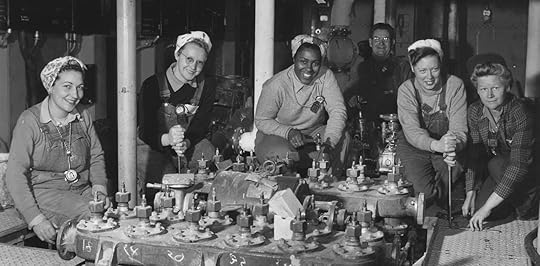
Women in engineering and technician positions during WWII.
The next chapter has the men led off, like triumphant vikings drunk on the glory of war, while the women are suddenly told it is their patriotic duty to step up and take over the welding, the post office, the armory and leave their children at home so they can run the country.
So begins the 20th century, a strange time in which women are repeatedly told to step up or get back in the kitchen, sometimes by each other. Adam's closing statement sums this up brilliantly:
A woman born at the turn of the century could have livd through two periods when it was her moral duty to devote herself, obsessively, to her children; three when it was her to duty to society to neglect them; two when it was right to be seductively 'feminine' and three when it was a pressing social obligation to be the reverse; three separate periods in which she was a bad wife, mother, and citizen for wanting to go out and earn her own living, and three others when she was an even worse wife, mother, and citizen for not being eager to do so.
Some of the book has aged a little strangely, particularly in regards to the way sexuality is described (lesbians are just lonely spinsters who didn't find the right man, really?) and the more subtle nuances of gender but given it is 50 years old at this point these are forgivable slip-ups. I'd be so interested in seeing this refreshed to cover '75-20.
This is not academic text, and it does drag a little sometimes. However, given its condensed form it can be seen as a springboard to launch a more in-depth study or, as it is framed here by Persephone Books, as a reference to put into context the literature written by women during that period.
3.5 stars rounded up.
Women in engineering and technician positions during WWII.

November 6, 2019
They say that the past is a foreign country... you can certainly feel that with this book.
Ruth Adam's work is really interesting and engaging. Although the book focuses predominantly on white British women, you do get a cross-section of class and social expectations and how these have evolved. Adams examines the changes in education and working conditions as well as attitudes towards sex, marriage and divorce. She even includes (very briefly) a section on lesbianism and refers to Radclyffe Hall.
You can feel that it was very much written in the 1970s, somewhat prematurely announcing that the "sex war is over" which, from 2019, seems more than naïve. Also some of the attitudes are dated (unbelievably there is a tone of scorn when referring to shell-shocked men returning from the first world war, using words like "limp" and "weak" which are very out of kilter with 21st century attitudes to mental health) but I think these are things that make the book even more interesting.
The Afterword written by Yvonne Roberts also feels like a snapshot into the past. Written in 2000 at the height of Tony Blair's government, in a pre-9/11 world, Roberts briefly looks at all the steps made since 1975, and how much still there is left to do. She ponders on the changes in child care, paternity leave, and comparable models in Europe. She rightly asserts that women of colour, and queer women should also have their place examined in women's history. I think a book including the last 20 years would be fascinating.
Ruth Adam's work is really interesting and engaging. Although the book focuses predominantly on white British women, you do get a cross-section of class and social expectations and how these have evolved. Adams examines the changes in education and working conditions as well as attitudes towards sex, marriage and divorce. She even includes (very briefly) a section on lesbianism and refers to Radclyffe Hall.
You can feel that it was very much written in the 1970s, somewhat prematurely announcing that the "sex war is over" which, from 2019, seems more than naïve. Also some of the attitudes are dated (unbelievably there is a tone of scorn when referring to shell-shocked men returning from the first world war, using words like "limp" and "weak" which are very out of kilter with 21st century attitudes to mental health) but I think these are things that make the book even more interesting.
The Afterword written by Yvonne Roberts also feels like a snapshot into the past. Written in 2000 at the height of Tony Blair's government, in a pre-9/11 world, Roberts briefly looks at all the steps made since 1975, and how much still there is left to do. She ponders on the changes in child care, paternity leave, and comparable models in Europe. She rightly asserts that women of colour, and queer women should also have their place examined in women's history. I think a book including the last 20 years would be fascinating.

April 15, 2018
An erudite but very readable history of women's place in British society through most of the 20th century. Written in the 1970s, some of the author's views feel dated now, though it is fascinating to see the first half of the century through the lens of the second half.
The author considers the varied impacts of societal and cultural expectations, government policies, changes to the law, the financial and conflict state of the country and artistic and literary influences on women's status throughout the century.
If only it could be extended to the millenium...
The author considers the varied impacts of societal and cultural expectations, government policies, changes to the law, the financial and conflict state of the country and artistic and literary influences on women's status throughout the century.
If only it could be extended to the millenium...

December 12, 2022
Very interesting look at the changing position of women in British society from 1910-1970. It covers changes in law, education, work, attitudes etc for women of all classes. Some of the women mentioned in the book are still well known today, others less so. Very enjoyable.

January 23, 2016
A Woman's Place provides an interesting overview of the position of women in society throughout the twentieth century, and documents the shifts of gender expectations; every decade, it seems, brings with it a new - or regurgitated - concept of womanhood and femininity, suitable to society at that point.
The book is certainly interesting, and is written with a certain fierceness that is both a boon and slightly problematic. On the one hand, it's tone makes it easy to read and not dry at all, as it is very engaging. On the other hand, it also gives the book a more subjective vibe than perhaps could be wished for, given that it is non-fiction and not meant as a manifesto, but a neutral overview.
As is often the case, the book severly lacks discourse on queer and ethnic identities for women throughout the twentieth century - it is a fault I often maken myself, but especially when one attempts an informative book like this, the two topics cannot be absented. Pity, because it would have been interesting to see these positions next to the "standard" views on femininity.
Recommended for those who would like to know a little more about the lives of their grandmothers and mothers, and the many different images of femininity conveyed in the last century. It definitely made me want to sit down with my mother, a bottle of wine, and have a conversation about how she has felt all of these shifts and expectations in her life.
The book is certainly interesting, and is written with a certain fierceness that is both a boon and slightly problematic. On the one hand, it's tone makes it easy to read and not dry at all, as it is very engaging. On the other hand, it also gives the book a more subjective vibe than perhaps could be wished for, given that it is non-fiction and not meant as a manifesto, but a neutral overview.
As is often the case, the book severly lacks discourse on queer and ethnic identities for women throughout the twentieth century - it is a fault I often maken myself, but especially when one attempts an informative book like this, the two topics cannot be absented. Pity, because it would have been interesting to see these positions next to the "standard" views on femininity.
Recommended for those who would like to know a little more about the lives of their grandmothers and mothers, and the many different images of femininity conveyed in the last century. It definitely made me want to sit down with my mother, a bottle of wine, and have a conversation about how she has felt all of these shifts and expectations in her life.

December 29, 2014
Very readable and impossible to put down. Ruth Adams explores the different stages of the feminist movement and women's rights between the years of 1910 and 1975 (along with an afterword from Yvonne Roberts that briefly takes us up to the year 2000). She talks about what economic, political and social factors contribute to the changes in the "woman's place" and highlights the cyclical nature of it all.
I found this book incredibly enjoyable and very interesting indeed. Not only is it informative in a historical context, but it sheds a lot of insight into the inequalities faced by modern women (for example, the forever existing pay gap) and how they came to be, looking at the origins of the arguments used to maintain the current state of affairs.
I very much recommend this book to anyone interested in the evolution of women's rights and definitely to anyone who has ever said they aren't a feminist or thinks that we no longer need feminism. One read of this book and you will understand why our mothers, grandmothers and great grandmothers fought, what they fought for, and why we still need to keep fighting (hint: if you recognise any of the attitudes from previous decades in our present day- and you will- you'll see why we still need feminism).
I found this book incredibly enjoyable and very interesting indeed. Not only is it informative in a historical context, but it sheds a lot of insight into the inequalities faced by modern women (for example, the forever existing pay gap) and how they came to be, looking at the origins of the arguments used to maintain the current state of affairs.
I very much recommend this book to anyone interested in the evolution of women's rights and definitely to anyone who has ever said they aren't a feminist or thinks that we no longer need feminism. One read of this book and you will understand why our mothers, grandmothers and great grandmothers fought, what they fought for, and why we still need to keep fighting (hint: if you recognise any of the attitudes from previous decades in our present day- and you will- you'll see why we still need feminism).

August 17, 2014
That was superb - extremely readable and to the point. I feel like this book accomplishes twice as much as perhaps four books put together. Ruth Adam writes with a clarity and honesty that's astonishing, even when tackling very recent (at the time of publication) changes. It's an excellent, riveting account of the status and place of women as related to family and work and it's essential reading for everyone. Two things that I found bothered me were the way she talked about disabled children (verging on eugenism) and lesbians (no outright homophobia but you do feel she's not very comfortable with the topic). An excellent account and the conclusion - which reminds us that women are always criticized for not adhering to expected patterns were they conformity to the feminine ideal or the rejection of it - is still relevant today.
June 28, 2021
An interesting overview of women's rights in the UK, ending in 1975 (when it was first published). It's wide-ranging, including employment rights, suffrage, attitudes to work and marriage, divorce, contraception, fashion - though mainly from a middle-class perspective, and an entirely white one. There's not really any deep examination of anything but it rattles along and there are lots of interesting quotes from the time. It's a little dated in places but it's always salutary to be reminded of the various ways in which women were so firmly second-class citizens. It's also a pleasure to read the Persephone edition - I wish all books were as well presented and bound as this.

November 1, 2011
I learned a lot about World Wars women, which for some reason I found interesting. Maybe it was because I had female relatives who lived through them. The book is British and therefore focused on England, but it was kind of fascinating watching the social and economic fortunes of the people swirl here and there and into things so weird and different it must have been very jarring to live through it.

March 4, 2019
Excellent overview of the evolution of women's rights in Britain, and the still-unresolved complexities that have hampered equal pay, equal access to/consideration for jobs, balancing family/work, etc. and the effect of the welfare state on these issues as well. Adam is an excellent writer, I found the layout helpful and very readable, this never collapsed under the weight of the many issues she was covering. Definitely recommend.

September 1, 2019
A great primer to the role of women during the first three-quarters of the twentieth century. Considering it’s length and scope, it is not surprising that it can be a little superficial at times, but there is a wealth of further reading material on specific decades and issues - this is a mere taster. I did not always agree with all the conclusions that Ruth Adams came to - there were a couple of moments that felt dated - but overall, a great read.

March 29, 2010
This book is incredibly informative and interesting. If you are looking for anything transformational, don't read it, but if you are looking to understand an era and find highly interesting facts to spark your own exploration, definitely read it.

September 19, 2014
While this book could do with some more issues addressed - queer and trans women and women of colour are almost entirely missing - this is a very good commentary on the progress of gender equality over the twentieth century. It also contains some awful ableism.

March 27, 2018
Super interesting read, and I’d love to read a version covering 1975-now! My only qualm is it’s a little too focused on the middle classes and not so much the working class, but as a broad overview it’s very informative and a great read to reflect on how far we as a gender have come.
January 29, 2023
An enlightening description of the changes in the lives of women and the attitudes towards them over a period of 65 years. This covered the two world wars and the institutional changes that were imposed upon their lives during and after these events.

June 3, 2017
dated, but interesting nonetheless.

April 24, 2018
A compact study of women's issues in UK only. Read this with Rowbotham's books will be great help to compare to the US side of the similar issues.

December 27, 2019
If you have an interest in women’s equality in Britain between 1910-1975, this book may be of interest. Kind of a helicopter view of all that happened for women.

June 2, 2020
Interesting.

June 5, 2021
I enjoyed most of this but thought the author’s view of 60s and early 70s lacked perspective and became judgmental.

April 9, 2023
I very much liked her novel ‘I’m Not Complaining’ (4.5 stars) and liked her memoir ‘(A House in the Country’, 3.5 stars). I learned a good deal in this book...it was a history of British women between the time period of 1910-1975 that includes time periods before, during, and after two world wars and then the ‘60s and early ‘70s.
I found the early part of the book the most interesting (between 1910-1939). One thing that sticks in my brain was pre-WWI and during and shortly after WWI there were far fewer men than women in England, and so there were a number of unmarried women in that time period. They were referred to as spinsters and old maids and I felt so sorry for them. Society or their families did not look kindly on them. And if they worked, they typically had to work until late in their lives because there was no social safety net to support them.
And then the number of babies that women bore (not peculiar to England for sure) and the high odds that a mother would bury at least one of her children. Yikes.
I wrote down this blurb from the book...it just made me realize what a cushy life. It’s about a woman who was employed in a factory during World War I. “...she worked from 7 a.m. to 8:30 p.m. and on Sundays from 8 to 5; ... she spent two hours daily travelling to and from work and was supporting an invalid husband and six children under twelve, but ... she felt better because with her wages they all could have as much as they wanted to eat every day.” Wow...
After a while I was overwhelmed with facts...it wasn’t Ruth Adam’s fault. I thought she did a pretty good job in explaining British women’s social history from 1910-1975.
Reviews:
• https://librofulltime.wordpress.com/2...
• from a Goodreads reviewer: https://www.goodreads.com/review/show...
Note:
• In this book, Ruth Adam did mention a novel that I have and want to read — ‘The Well of Loneliness’ by Radclyffe Hall (about lesbianism) published in 1928 and banned for a period of time from the reading public until 1959 in Great Britain! A male literary critic (literary editor of The Sunday Express) wrote, “I would rather give a healthy boy or girl a vial of prussic acid than this novel.” 😧 😮 😲
I found the early part of the book the most interesting (between 1910-1939). One thing that sticks in my brain was pre-WWI and during and shortly after WWI there were far fewer men than women in England, and so there were a number of unmarried women in that time period. They were referred to as spinsters and old maids and I felt so sorry for them. Society or their families did not look kindly on them. And if they worked, they typically had to work until late in their lives because there was no social safety net to support them.
And then the number of babies that women bore (not peculiar to England for sure) and the high odds that a mother would bury at least one of her children. Yikes.
I wrote down this blurb from the book...it just made me realize what a cushy life. It’s about a woman who was employed in a factory during World War I. “...she worked from 7 a.m. to 8:30 p.m. and on Sundays from 8 to 5; ... she spent two hours daily travelling to and from work and was supporting an invalid husband and six children under twelve, but ... she felt better because with her wages they all could have as much as they wanted to eat every day.” Wow...
After a while I was overwhelmed with facts...it wasn’t Ruth Adam’s fault. I thought she did a pretty good job in explaining British women’s social history from 1910-1975.
Reviews:
• https://librofulltime.wordpress.com/2...
• from a Goodreads reviewer: https://www.goodreads.com/review/show...
Note:
• In this book, Ruth Adam did mention a novel that I have and want to read — ‘The Well of Loneliness’ by Radclyffe Hall (about lesbianism) published in 1928 and banned for a period of time from the reading public until 1959 in Great Britain! A male literary critic (literary editor of The Sunday Express) wrote, “I would rather give a healthy boy or girl a vial of prussic acid than this novel.” 😧 😮 😲

June 23, 2024
Yes, there's lots of statistics and numbers here but if you read a lot of 20th c fiction, especially by women and esp between the two world wars, you'll find this pretty illuminating. Its written for the general reader and it definitely comes from a feminist/progressive perspective; Adams has a sense of humor as well. Oddly, the sections from the 1970s seemed the most dated of all.
I'm keen to read Adams' fiction.
Another winner from Persephone Press.
I'm keen to read Adams' fiction.
Another winner from Persephone Press.

July 13, 2009
Only half-way through but excellent. Now I need to see if there is such a concise book that looks at American women's history in the same way.

July 12, 2016
I would have found this far more compelling if I had little knowledge of the topic; consequently, I do not feel as though I learnt much at all.
Displaying 1 - 28 of 28 reviews