Jump to ratings and reviews
Rate this book

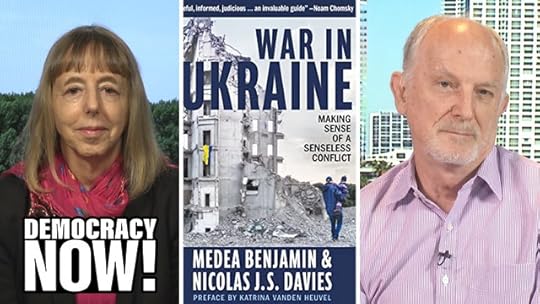
War in Ukraine

Rate this book
Now extensively revised and updated, here is a concise, accessible, and highly informative primer on a conflict that persists in roiling the global balance of power.

This expanded new edition of a widely praised book brings the story of the war in Ukraine up to 2025, as Donald Trump’s return to office sparked a renewed push for negotiations. Trump’s 2024 campaign hinged on the claim that the war would never have started under his watch—topped by a promise to end it in twenty-four hours. His new defense secretary, Pete Hegseth, signaled a shift from Biden-era policy, calling a return to Ukraine’s pre-2014 borders unrealistic and telling NATO, “The bloodshed must stop. And this war must end.” The authors ask: have we reached a true turning point—or just more great-power posturing?

Skillfully bringing together the historical record and current analysis, Benjamin and Davies look at the events leading up to the conflict, survey the different parties involved, and weigh up the continuing risks of escalation and opportunities for peace. For anyone who wants to get beneath the heavily propagandized media coverage to an understanding of a war with consequences that could prove cataclysmic, reading this book will be an urgent necessity.

144 pages, Paperback

First published January 1, 2022

24 people are currently reading
252 people want to read

About the author

Medea Benjamin

24 books93 followers
Benjamin grew up in Long Island, New York, a self-described "nice Jewish girl." During her freshman year at Tufts University, she renamed herself after the Greek mythological character Medea. She received master's degrees in public health from Columbia University and in economics from The New School.

Benjamin worked for 10 years as an economist and nutritionist in Latin America and Africa for the United Nations Food and Agriculture Organization, the World Health Organization, the Swedish International Development Agency, and the Institute for Food and Development Policy. She spent four years in Cuba, and has authored three books on the country.

In 1988 with Kevin Danaher, her husband, and Kirsten Moller, Benjamin co-founded the San Francisco-based Global Exchange, which advocates fair trade alternatives to what she describes as corporate globalization. She is a co-founder of the left-wing feminist anti-war group Code Pink: Women for Peace, which advocated an end to the Iraq War, the prevention of future wars, and social justice. Benjamin has also been involved with the left-wing anti-war organization United for Peace and Justice.

Ratings & Reviews

What do you think?
Rate this book

Friends & Following

Create a free account to discover what your friends think of this book!

Community Reviews

5 stars
89 (39%)
4 stars
66 (29%)
3 stars
35 (15%)
2 stars
14 (6%)
1 star
19 (8%)
Displaying 1 - 30 of 56 reviews
Profile Image for Julian Worker.
Author 44 books451 followers
April 8, 2023
I'm not a big fan of this book.

Firstly, there's no index which for a book that's packed with facts is a small tragedy and makes me even less likely to keep it on my bookshelves.

Basically, this book indicates that this conflict could have been avoided if NATO's foreign policy had been different and they'd taken into account Russia's fear about NATO expansion?! This is a very limited conclusion.

Before this Russian invasion of an independent country, I would have said NATO no longer had a role in the world. But Vladimir Putin has proved me wrong, because he's gone and invaded a country that borders on NATO members and united NATO like never before (since the end of the previous Cold War).

Of course there's a vast amount of hypocrisy in the West because the USA and NATO have invaded countries (Iraq, Afghanistan) and done more or less what Russia is doing now and yet the world's response was vastly different - so yes definite hypocrisy and double standards from the West and the mainstream western media. I understand and agree with this.

However, I think there's more to this invasion than Russia invading Ukraine to stop it joining NATO. To me Putin wanted to suppress the fledgling democracy (more so than exists in Russia anyway) that was starting in Kyiv. He presumed that with the withdrawal of US Forces from Afghanistan that the USA was no longer trying to be the world's sheriff.

The book argues for negotiations but surely an invasion like this can't be rewarded with an increase in occupied territory for Russia? Invasions can't be rewarded in this way. If Russia obtains an increased amount of former Ukrainian territory, Putin will invade another independent country in the near future, perhaps one or more of The Baltic countries?
Profile Image for Randall Wallace.
665 reviews654 followers
December 29, 2022
Biden just sent more money to help the Ukraine proxy war with weapons and aid than he allocated to solve all of climate change. “Once more, America favors military presence over diplomacy.” The Biden administration equates diplomacy, negotiation, and compromise with appeasement and capitulation. Bullies, on and off the playground, don’t negotiate. “It has been reported that Secretary of State Antony Blinken has not spoken to his Russian counterpart since the beginning of the war.” No time or money for peace but tons of time and money for weaponry designed only to kill or destroy. Sounds funny coming from a self-proclaimed “Christian” nation.

“Russia’s invasion was illegal on many counts.” It violated the UN Charter, and the Kellogg-Briand Pact. “But it was not by any means ‘unprovoked’, as US officials repeatedly claimed.” In response to the invasion, “Ukraine responded by declaring martial law and a general mobilization of all men between the ages of 18 and 60, preventing them from leaving Ukraine with their families. It banned 11 opposition political parties though not Svoboda or other extreme right-wing parties, and (like Russia) it shut down all independent TV channels to enforce a ‘unified information policy’ via state media.” By June 2022, the death toll was 10,000 Ukrainians, versus 4,238 Russians.

During WWII, Ukrainian nationalist militias fought on the German side, and took part in the mass killing of Jews and ethnic cleansing of Poles from Western Ukraine. Crimea’s 1991 referendum vote was 94% for independence from Ukraine.

The end of the Soviet Union had given us not the long-expected peace dividend, but instead a power dividend. No commies to fight anymore? Who cares? We simply put Yugoslavia, Iraq, Somalia, Lebanon, Palestine, Libya, Syria, and Yemen in our sniper crosshairs and every one of those countries soon saw many delightful US violations of the UN Charter.

Try and find any mainstream reporting on the US neoliberal “shock therapy” applied intentionally to the balls of Russia in the 90’s. US shock therapy in Ukraine led to “65% drop reduction in real GDP” and “just as in Russia, it also spawned a corrupt class of oligarchs who amassed their wealth by scooping up state-owned assets.” That clearly US led action also led to a seven year drop in Russian male life expectancy. Pretend you are helping another while intentionally hurting them – how noble. Putin inherits what the US did to Russia, “by the end of his second term as president in 2008, his government had cut the poverty rate from 30% to 15%, restoring Russia’s GDP to its 1990 level.

Ukraine’s 2014 US supported Coup and Maidan Protests: the Massacre was committed by Right wing elements and not the Yanukovych government as mainstream media said. Bullets that killed did not match police weapons, shooting began before police arrived, “pro-Maidan neo-fascist elements played a leading role in shooting demonstrators.” Ukraine’s own Prosecutor General said that many of the Maidan 2014 protestors were shot with hunting rifles, not police weapons. After the Coup, Ukrainians didn’t uniformly kneel before the new government; “only 51.2% agreed that the post-coup government was in fact the legitimate government of the Ukraine”. Western Media would never cover this ambivalence over the 2014 new pro-western government.

Minsk II Agreement: Minsk II was the roadmap (from February 2015 to 2021) for stopping the civil war killings post-Coup. If Ukraine had merely followed what it had committed to at Minsk II, there would not have been a Russian Invasion. But Ukraine committed political and diplomatic failure. “Ukraine’s government failed to follow through on the constitutional changes to which it committed in Minsk.” Medea says, Kviv had a lack of will in following Minsk thanks to pressure from its extreme right. And during this time that Ukraine’s economy was hitting the US and EU-led neoliberal crapper, 60% of Ukraine’s universities closed, the health care system and 342 state-owned enterprises were privatized and 20% reduction is public sector employment. In 2016, the EU head said it would take Ukraine “another 20 to 25 years to join the EU.” By 2016, the Western backed Ukraine government belonged not to the Ukrainian people, but to “Western capital and to partnerships between local oligarchs and Western ones with even deeper pockets.” George Soros, who knows a good fire sale when he sees one, rushed into Ukraine with a billion dollars to invest and in 2015 collected the Order of Liberty and major ass kiss from Ukraine’s president. At the time, the US was more interested in blaming Russia for all Ukraine’s problems than trying to resolve issues with Russia or at least, call off their own US paid neo-liberal attack dogs.

US liberals like to pretend that Ukraine has no Nazi-loving far right (saying it is only Russian propaganda) meanwhile Ukrainians remember that Zelensky himself did a comedy routine where “he said he’d really like to read Mein Kampf, but couldn’t get a copy because it was sold out in Ukraine.” Ukrainians also remember Zelensky saying “we will continue in the direction of the Minsk talks” which, if he had done so, it’s doubtful Russia would have invaded. At a Paris meeting in 2019, Zelensky told France and Germany he was still following Minsk II. But “with no support for his peace initiatives from the United States, Zelensky abandoned his efforts”. “He was soon referring to the Donbas leaders as ‘terrorists’ and refusing to talk to them.” The late Russia expert Stephen Cohen called this Zelensky’s lost opportunity.

Well before the Russian invasion, Zelensky and Company stopped talking about a Ukrainian civil war and began claiming Ukraine was fighting a war against Russia. Such weak leadership led to Zelensky’s popularity to plummet to 17% where it stayed for two years until the invasion, then came his western media fueled comeback. In 2019, the Rand Corporation came out with a report commissioned by the US Army titled “Overextending and Unbalancing Russia”; you’d have to be an idiot not to understand what US goals were with that report. Keep provoking Russia until it does something stupid, and that event can used by the West against Russia. To make the message clearer, the Biden administration also gave Ukraine another $275 million in military aid in 2021 (before the invasion), bringing total US military aid to $2.5 billion since 2014 when the US led coup removed Ukraine’s democratically elected leader to the sound of crickets in the West.

Before the invasion, ‘the US and NATO summarily dismissed Russia’s proposals.” The US moved nuclear weapons closer to Russia giving it then only 15 minutes to respond whether to launch a counter-strike. Provoking Russia has been so popular, I’m surprised Milton Bradley hasn’t made a board game about it.

“Once wars go on longer than a year, they more often than not last more than ten years.” Mariupol in Ukraine is the main base of the neo-Nazi Azov Regiment. Page 88-89 includes a long -assed list of all the kinds of US weapons sent to Ukraine. Raytheon alone got a $340 million order for Stingers and then Raytheon and Lockheed Martin sent thousands of Javelin anti-tank missiles, a real bargain at $176,000 each. Zero money for peace negotiations, but on Amazon.com you can buy ‘Zelensky Green’ T-shirts, sales of which no doubt go to keep Ukraine from considering all peace negotiations, Ukrainian labor from organizing under Draft Law #5371, and a free Ukrainian press from returning. Funny how all concern for two decades of the US killing (far more people than Putin has) in ten countries disappeared when Putin invaded. Don’t look over here, look over there! Russia’s war becomes a genocide to all liberals who stubbornly refuse to read the actual dictionary definition of genocide.

Genocide accusers won’t tell you how William Arkin wrote a Newsweek article how Putin’s bombers could easily devastate Ukraine and why Putin doesn’t. DIA officers told Arkin they saw no evidence that Putin was targeting civilians. Despite this, not a single democrat (even faux-progressives Bernie Sanders and AOC) voted against the massive Ukraine aid bill. I can picture Bernie going, “$135 million a day being spent risking nuclear war by intentionally keeping an ugly US proxy war from reaching any peaceful settlement? Count me in!” Even the NYT knows better and has said that victory for Ukraine “is not a realistic goal.”

NATO expansion and aggressive behavior “was one of the root causes of the conflict.” Western media wants everyone to think expanding NATO has never posed a threat to Russia, even though in 1997, fifty of the top US foreign policy experts, including war criminal Kissinger, “urged President Clinton to stop NATO expansion eastward”. Always delightful NATO then brought us the chaos and misery of Serbia, Afghanistan and Libya. Clinton’s own deputy secretary of state Strobe Talbott, said, “Many Russians see NATO as a vestige of the Cold War, inherently directed against their country. They point out that they have disbanded the Warsaw Pact and ask why the West should not do the same.” Instead of disbanding, NATO went from 12 to 30 members, even though clear promises were made to the Russians that NATO would never expand Eastward. To those liberals who say that boldly broken verbal assurances by the US which were never put in writing shouldn’t be a provocation to Russia, I ask: When your past romantic partners historically had affairs behind your back, after clear multiple verbal assurances of loyalty to only you, did you say, “Silly me, if I didn’t get that clear verbal promise in writing, then it’s my mistake, I don’t deserve to feel slighted at all”?

There is a 1990 State Department Memorandum that clearly warns against granting NATO membership to Eastern-European states saying, “If the US did organize an anti-Soviet coalition on its border such a coalition would be perceived very negatively by the Soviets.” But then President Clinton foolishly expands NATO Eastward because “he wanted a strong foreign policy platform in the midterm elections that the Republicans could not criticize” and because he didn’t want to lose the Polish vote in the Midwest. Madeleine Albright knew the Russian public “were strongly opposed to NATO enlargement. And so, in 1998, Poland (Russia-hating troll Anne Applebaum’s home), the Czech Republic and Hungary all joined NATO making sure Russia was deprived of its own Monroe (safe buffer) Doctrine that the US got to have for centuries. Biden’s CIA director now, William J. Burns, was back in Moscow in 1995, where he responded then that this NATO enlargement was “needlessly provocative.” One of the biggest names in foreign policy, George Kennan, warned that this NATO expansion was the beginning of a new Cold War. Ask yourself: Against whom was this expansion intended? It doesn’t take much of a brain to see that every Eastern European country that joins NATO is both a threat to Russia and takes the US only closer to Nuclear War. The US is playing a game of Global Chicken, if the world survives, Hasbro will probably release it at Toys “R” Us in a deluxe End of World edition.

NATO as you can see, has gone (just like Trump) from defensive to offensive. NATO launched a war against Serbia (including Kosovo) without UN approval. NATO’s bombing of Serbia caused ethnic cleansing. Is Putin today acting like NATO in 1999? Or more like the US in Iraq? Or more like the US in Vietnam? Under Obama, Ukrainian soldiers were trained by the US which by itself undermined the Minsk II agreement. Trump called NATO “obsolete” and “an anachronism”. Funny how occasionally a Trump comment will sound to the Left of Democratic Party.

NATO Propaganda: A 2020 NATO document called both China and Russia “authoritarian” and that “their aggressive and coercive behavior” was a threat to “Euro-Atlantic security”. The balls of pretending saying that in an official document that couldn’t provoke China and Russia. Since the US (not Russia & China) has been world’s top candidate for aggressive and coercive behavior for decades now, NATO’s comments seem a shallow deflection. In 2020, China (not the US) became the EU’s top trading partner and Russia was EU’s largest oil and gas supplier. Imagine Mainstream media telling you any of that. In a European poll, “only 17% of Europeans wanted closer relations with the United States.” All that changed with Russia’s invasion which “gave NATO a new lease on life.”

Post-invasion, you were divided into two groups on the Ukraine/Polish border: one white and one non-white. Whites quickly boarded buses and trains, while people of color enjoyed being out in the cold. “Ukraine proved that, if you have the right (white) skin color, you’ll get sympathetic coverage from the Western media.”

Regarding the “Putin is Hitler committing genocide” rant: “Senior US Defense Intelligence Agency officers estimated that the first 24 days of Russia’s Bombing was less destructive than the first day of US bombing in Iraq in 2003.” “From 2001 to 2021, the US and its allies dropped a total of more than 337,000 bombs and missiles on nine different countries. That’s an average of 46 per day for twenty years.” That guy Putin sure has a lot of catching up to do!

Media Censoring: Why does Western Media call for Russia be held accountable for war crimes but never the US, or Israel, or Saudi Arabia? Instead, Western Media gives us false flag stories like Iraqis ripping babies out of incubators in a Kuwaiti hospital or Russians this year busy raping babies and children (the lie of which was exposed in Newsweek May 31, 2022). After the Russian invasion, the RT TV channel was shut down which removed six-year archive of Chris Hedges TV shows even though “at that time, Hedges never produced a single show on Russia. Facebook and Instagram forbid all posts that incite violence, but a propaganda exception was made if you call for Putin’s death, or any of his soldiers. “NBC news reported that Russian restaurants across the US were vandalized and threatened.” “Even cats became the victims, as the International Cat federation would not allow felines with Russian owners enter the competition.” Netflix stopped production of “Anna Karenina” even though everyone knows Tolstoy was a major pacifist. Imagine if you couldn’t read Mark Twain after the US boldly invaded the last 50 countries it has invaded? Or never reading Charles Dickens or Shakespeare after British Empire clearly killed millions. Jingoistic logic. No doubt gourmands were telling others than Russian dressing is now to be called Tak-Yur-Time Dressing and people contemplating suicide by gun are told that Russian Roulette must now be called Ukrainian Roulette.

The US loves hurting Russia, and thus has kept Russia from selling lots of energy post-invasion; yet basic economics shows the invasion increased energy prices and yes Russia is selling less but now earning more. Historically, Operation Backfire, the favored mission of our US military, is now complete. In the US, instead of obvious negotiations with Russia, we get higher prices for energy and food. And so, Operation Counter-Productive is also a raging success. By keeping basic diplomacy and common sense at bay, the US can enjoy fertilizer prices that are 100 to 500% more expensive than pre-invasion. So, even Operation Shoot Yourself in the Foot is going swimmingly. Many countries voted against the Russian invasion, yet you should know the remaining countries that voted instead to abstain represent the MAJORITY of the world’s population.

Final Silliness: Today we fight Russia, knowing Tomorrow it’s China: Secretary of State Antony Blinken said in May 2022, “we will remain focused on the most serious long-term challenge to the international order. And that is posed by the People’s Republic of China.” Hey Tony, way to ensure China is driven into the arms of Russia! What a boon for your Operation Counter-Productive! Terrific book by Medea Benjamin. I’ve reviewed 14 good books on Ukraine and Russia this year alone, and I’d say if you read only one book on this subject this year, this is the one to read. Kudos.
Profile Image for Carlos Ferrero Martín.
38 reviews1 follower
March 18, 2023
"Yes, Russia’s aggression was reckless and, ultimately, indefensible. But—"

The rest of the book is dispensable.
5 reviews
November 22, 2022
Hatchet job written to cash in on the war in Ukraine. Some incredibly important arguments are covered, but so often in a one sided, poorly researched way that muddles cause and effect. Described as a primer, written in two months - it shows. Rubbish references, this is left wing news articles linked in a long essay. We can and should be doing better than this.
Profile Image for Reid tries to read.
153 reviews85 followers
December 3, 2023
The thesis of this book is a common one amongst the Western left: post-Cold War NATO expansion and aggression were the precipitating factors leading to the Russian invasion of Ukraine. However, this book presents this case better than any other that I’ve read.

The original NATO charter stated that an attack against one NATO member was an attack against all. America used this as a tool to deter the USSR during the Cold War, who in turn deterred NATO through its own Warsaw Pact. These ostensibly defense alliances prevented NATO from intervening when the USSR sent in the tanks to Czechoslovakia and Hungary. Once the USSR collapsed, however, NATO became increasingly expansionist and aggressive. It had always been a tool for America to subordinate Europe, since under NATO American commanders/officers were the de facto leaders of the alliance, and to integrate Europe into the American sphere of influence. Soon after the USSR began dismantling itself as the cold war wound down, NATO began swallowing up Warsaw Pact members and expanding its reach around the globe, rather than disbanding like the Warsaw Pact did. This tool of imperialism, which had ostensibly been created to “counter Soviet aggression”, soon inducted nations such as Australia, Mongolia, Japan, and Columbia into its alliance. It also began bringing in nations touching Russia’s borders, like Poland and Romania, despite objects from western fan-favorites Mikhail Gorbachev and Boris Yeltsin. Despite the fact that, in 1991, James Baker infamously promised Gorbachev that NATO would not move “one inch” towards Russia, behind closed western doors plans to do the opposite were being schemed. NATO soon inducted East Germany into its sphere, and then under the Clinton administration NATO grew rapidly. Clinton wanted to have a strong foreign policy platform to deter Republicans from portraying him as a weak liberal. Under his administration NATO also functioned as a way to prevent France and Germany from developing the EU in Europe’s own imperialist bloc outside of America’s control. In 1996 Clinton made promises to Poland to indict it into NATO despite the loud displeasure of Yeltsin and the Russian oligarchy. Clinton feared that failing to follow through on this promise would cost him crucial Polish-American votes in the Midwest he believed he needed for re-election. Hungary and the Czech Republic would soon be inducted as well.

NATO’s aggression grew in proportion with its size. With the Cold War over the organization needed some sort of justification for its existence in order to secure continued funding from member nations. In 1992, NATO members agreed to enforce a blockade against Yugoslavia, its first act of aggression against a nation who did not attack NATO. It then followed this up by enforcing a no-fly zone in Bosnia, which resulted in America shooting down dozens of planes. Between 1994-1995 NATO launched dozens of air strikes into Bosnia, and from 1995-2004 NATO employed a permanent force of “peacekeepers” in a nation which, like Yugoslavia, had not threatened or attacked any NATO members. In 1999 NATO launched a war in Yugoslavia without the approval of the UN. Much like Russia’s invasion of Ukraine, this NATO invasion and bombing was completely illegal under international law. The NATO mission, which was to create and independent Kosovo, was achieved by bombing thousands of Serbian civilians into submission. Kosovo was then to be run by a war criminal who was eventually tried in The Hague. Destruction of civilian infrastructure during their bombing created a humanitarian conflict crisis, which is ironic considering the fact NATO was reporting to be easing a humanitarian crisis with this bombing. A UN chairman claimed that the bombing didn’t just fail to stop an ethnic cleansing, contrary to NATO’s claims, but in fact was one of the causes of the cleansing.

The war on terror became an excuse to further ramp up NATO’s imperialist campaigns, first with the occupations of Afghanistan and Iraq. Then, in 2011, NATO undertook an unsanctioned, unadvised, and totally illegal regime change operation in Libya to overthrow Gaddafi. NATO members invaded Libya, dropped bombs, coordinated the Gaddafi assassination, then supported the coup regime thereafter. This devolved Libyan society into a decade of anarchy, rule by warlords, destruction of daily livelihoods, and the emergence of open slave markets. It was this monstrous force, one which Russia saw as an existential threat, that began knocking on Ukraine’s door. In 2002 the president of Ukraine signed an action plan which committed Ukraine to joining NATO; in 2005 the president of Ukraine was invited to a NATO summit; and in 2008 George W Bush attempted to offer Ukraine and Georgia a set of concrete steps that, if taken, would ensure their induction into NATO. Other NATO members as well as high ranking U.S. intelligence officials rejected this overture, knowing how much it would exacerbate tensions with Russia. As a compromise, Georgia and Ukraine were promised NATO membership at unspecified dates under unspecified terms, essentially stringing them along. Even still, Ukraine’s steadfast dedication to joining NATO remained constant up until the Russian invasion, and even then after. In 2017 the Ukrainian parliament passed legislation stating that joining NATO was a “key strategic objective”, and in 2019 a similar amendment was written into Ukraine’s constitution. By 2020, NATO had designated Ukraine as 1 of 6 “enhanced opportunity partners”, which designated the nation as a close ally of the military alliance.

Crimea had been part of historical Russia since the 1700s. In 1954 Khrushchev made Crimea an administrative part of Ukraine. In 1990 Ukraine voted for independence from Russia as the USSR began collapsing, taking Crimea with it. The next year more than 90% of Crimeans voted for independence from Ukraine, but its parliament eventually decided to join Ukraine against the preferences of most of the population. This issue would become important in 2014. Until then, Ukraine would suffer through the 1990s like most of the Eastern bloc in the wake of shock therapy: poverty rose, life expectancy fell, and elite oligarchs began hoarding wealth. In 2004 two oligarchs with opposed interests ran for presidential election, putting Ukraine in the crossfire between the Atlantic-imperialist bloc and Russia. Viktor Yushchenko was favored by the West, while Viktor Yanukovych was Russia’s preferred candidate. Yanukovych was declared the winner in a run-off election after winning most of the Russian-speaking votes in the east and south, while Yushchenko was supported mainly by the Ukrainian west and northern areas of the country. However, the entirety of both campaigns were fraught with corruption. Backed by the OSCE (Organization for Security and Cooperation in Europe) and the Anglo-bloc, Yushchenko contested the election results and urged his supporters to take to the streets, while the EU and United States refused to acknowledge Yanukovych as the official leader of Ukraine. This became the Orange Revolution, named after Yushchenko’s campaign colors, and it led to the Ukrainian Parliament throwing out the election results, leading to Yushchenko narrowly winning the rematch (52% to 44%). His administration would be plagued by corruption charges which sapped his popularity. In 2010 Yanukovych won the presidential election behind a campaign promising to heal the divisions in Ukraine, join the EU, and remain neutral from both Russia and the West.

In 2013 Yanukovych refused to sign an agreement with the EU that would have liberalized Ukrainian markets in exchange for only limited access for Ukraine into European markets. In November of 2013, thousands of Ukrainians set up a protest in Maidan square which became known as the ‘Euromaidan’, named after the protestors’ main goal of forcing Ukraine into joining the EU. This was a broad movement, but as the police began violently cracking down on protestors the far right began having a greater influence on it. Neo-Nazis from the Right Sector provided the shock troops to violently fight with police in the streets. Then, on February 20th 2014, the far right staged a false flag sniper attack where they shot and murdered protestors in an attempt to pin the blame on the police. Yet during the attack 3 police officers themselves were shot and killed. By this point opposition leaders had very much lost any control they had over the Right Sector. Eventually the far right raided both the presidential palace and parliament building and, under the watchful eyes of armed neo-Nazis, made members of parliament oust Yanukovych from power.

After this coup Crimea held a referendum, which the vast majority of its populace voted in, on whether or not to leave the Ukraine; Crimeans voted overwhelmingly in favor of succession and joining Russia. Half of the Ukrainian military in Crimea also defected to Russia, forcing Ukraine to allow this succession to take place rather peacefully. Across Ukraine the population was more often than not ambivalent about the coup. At best, only around half of Ukrainians supported the post-coup government according to popular polls taken. On April 7th, 2014, anti-coup militants in Donetsk seized a government building and announced there would be a referendum to decide whether Donetsk would stay in Ukraine or succeed into its own autonomous region. Soon after a similar event occurred in Luhansk. In both cases voters heavily favored succession. Terrorism by the far right was used throughout the country to put down other anti-coup protests. For example, in Odessa on March 4th, anti-euromaidan protestors were burned to death by members of the right sector. Soon these neo-Nazis would make up the bulk of pro-Ukrainian forces fighting in the Donbass, the region where Donetsk and Luhansk had seceded. The Donbass succession had been broadly supported by many Ukrainians, Russian speakers in both Ukraine and Russia, and the Russian government. The region had been part of Ukraine’s industrial heartland, so the coup government (and their U.S. backers) viewed it as an essential territory for Ukraine to control. Yet the coup government found recruitment to fight in this civil war extremely difficult. With Nazis being the most ardent supporters of the fighting, the coup government began formalizing the induction of far right militant groups into the military. This is how the Azov battalion became a flag bearer for right wingers across the globe. In 2015 the Minsk and Minsk II agreements were supposed to put an end to the conflict by enacting a bilateral military ceasefire. The Ukrainian government, however, continuously undermined the ceasefire. Although the United States put on a public face that ostensibly supported the Minsk agreements, in reality the Obama administration supplied $75 million worth of “defensive” equipment to Ukraine, while also providing 300 military trainers to train soldiers in the Donbass region; this was all after the agreement was signed. Then, under Trump, Ukraine was given offensive American weapons for the first time. This included sending and training the neo-Nazi Azov battalion on how to use American grenade launchers.

At the same time, the new government also accepted a $40 billion bailout by the IMF. This bailout forced them to privatize large swaths of the public sector, as well as cut public sector jobs and spending. Public sector salaries and pensions were cut, and the overall number of public sector employees was reduced by 20%. 42 state owned enterprises were also privatized. Education also bore a large brunt of these cuts, and 60% of Ukraine’s universities were closed as part of the bailout. Between 2012 and 2016, Ukraine GDP fell by 25%.

In 2019 Volodymyr Zelenskyy won the Ukrainian presidential election behind a campaign platform which emphasized a crackdown on corruption, allowing autonomy for the Donbass region, and Zelenskyy’s position as an outsider to Ukrainian politics. In October of the same year Zelenskyy signed an agreement with Russia to pull heavy weapons out of the Donbass, guarantee autonomy to the Donetsk People’s Republic (DPR) and Luhansk People’s Republic (LPR), and allow for them to undergo new elections. However, Far right troops and the Azov regiment refused to withdraw. Even after Zelenskyy ordered them to leave on live television, they responded by setting up roadblocks to prevent soldiers from leaving. They then recruited far right militants from abroad to bolster their ranks. At the same time, 10,000 far rightists marched in Kiev to voice their support for continuing the civil war. Feeling boxed in by the opposition of both the far right and the United States to his decision, Zelenskyy tucked tail and conceded. He began soon after referring to fighters in the autonomous regions as “terrorists”. His approval rating subsequently dropped to below 17%, where it hung for around 2 years and was only improved by the Russian invasion. Meanwhile, the United States army began building up a NATO training base in Western Ukraine staffed by American, British, Canadian and other NATO military members; NATO began bolstering the Ukrainian Navy so that it could contest Russia in the black sea; and CIA agents admitted to helping train Ukrainian soldiers in sniping, assassinations, and sabotage.

Joe Biden’s ascendancy to the presidency further inflamed U.S.-Russian relations. After Biden was elected he promoted Victoria Nuland into a senior position in the State Department. This was a direct slap in the face to Russia, as Nuland had been caught red handed, thanks to Russian hackers leaking a phone call of hers, in having a key role in the 2014 EuroMaidan coup. This phone call even showed Nuland helping hand pick the leadership of the coup government from Yanukovych’s opposition well before he was ousted. Later, Defense Secretary Lloyd Austin directly stated that the US’ goal was to “weaken Russia”. On March 24, 2021 Zelenskyy said it was now Ukrainian policy to recover Crimea, and Biden responded by sending him more military equipment. Russia responded by moving more troops into Crimea on the border with the Donbass. Then, on April 5th, the Russian defense minister pleaded for America to use their influence in Ukraine to force Ukrainians to adhere to the Minsk agreement. Instead, in June, NATO and Ukraine conducted a joint exercise in the black sea that consisted of dozens of warships and fighter planes entering into Russian naval territory. Russia even claimed to have fired warning shots and dropped bombs in the sea to ward off a UK warship; the UK denied this incident occurred. Next, on the 15th of September in 2021, 15 NATO nations took part in a joint military exercise in Eastern Ukraine. Despite all of this NATO refused to give Zelenskyy any concrete agreement as to when and how Ukraine could join NATO, even as Zelenskyy repeatedly requested to do so. This was the essence of what would become the policy of “fighting Russia to the last Ukrainian'': NATO would rather train Ukraine’s forces and have Ukrainians fight and die in an American-backed proxy war than have NATO be forced to come to their aid and send their own soldiers in the event of a Russian-Ukrainian war.

A month after the September exercise, OSCE observers in the Donbass began reporting multiple instances of Ukrainians breaking the ceasefire. This even included using a Turkish drone (Turkey is a NATO member) to drone strike Russian soldiers. Afterwards NATO expelled 8 Russian officers who were liaisons to NATO, claiming they were engaging in espionage. Biden, in October, sent Nuland to Russia for discussions with the Russian government on the deteriorating situation. This was quite obviously a very provocative action considering the Russian view on Nuland. In fact, Nuland had to ask permission to be able to enter the country because she was still under sanctions from the Russian government. This visit went so poorly that, afterwards, Russia ended 30 years of liaisons with NATO and expelled all NATO offices from Russia. Still, Russia was willing to play ball and open up negotiations, which it did in December when it proposed drafts for two mutual security treaties: 1 treaty between Russia and the U.S. and 1 treaty between Russia and NATO. These were not ultimatums; they were drafts that were opened to edits, negotiations, and compromises with the goal of addressing some of Russia’s fears about current western policies/provocations. The United States and NATO responded by entirely dismissing both proposals and refusing to negotiate on them further. This meant they rejected any discussions on curtailing NATO expansion, sending arms to Ukraine, and positioning nuclear-capable weapons near Russia’s border.

By 2022 Russia had seemingly exhausted any compromises with the American/NATO bloc. The Minsk agreements continued to be undermined; Zelenskyy continued to solely refer to those in the DPR and LPR as “terrorists” and refused to talk to them; and the United States continued to assert that Ukraine had sovereignty over the Donbass and Crimea, ignoring that Ukrainian sovereignty over these regions could only come through warfare and continuing bloodshed. In the 4 days before the Russian invasion of Ukraine, the 600+ OSCE ceasefire monitors in Ukraine documented massive escalations in ceasefire violations, totaling nearly 6,000 violations and 4,000 artillery explosions; almost all of these occurred within LPR and DPR territory. America and the UK attempted to portray these as “false flag” attacks. On February 24, 2022 Russia invaded Ukraine. By July over 5 million Ukrainians had been turned into refugees.
Profile Image for Dmitry.
1,275 reviews99 followers
December 23, 2023
(The English review is placed beneath the Russian one)

Как доброго лица не прозевать,
Как честных угадать наверняка мне? —
Все научились маски надевать,
Чтоб не разбить своё лицо о камни.

Я в тайну масок всё-таки проник, —
Уверен я, что мой анализ точен:
Что маски равнодушья у иных —
Защита от плевков и от пощёчин.


Авторы книги заявляют, что они хотят предложить читателю «альтернативную версию» случившегося в Украине с 2014, так как «прозападная версия» военного конфликта между Россией и Украиной уже всем известна. Несмотря на то, что первое, что мне пришло в голову, когда я услышал обещание авторов предложить читателям «альтернативную версию», это фраза Дональда Трампа про «альтернативные факты», я всё же рассчитывал получить пусть и иную, но непредвзятую точку зрения. Я действительно думал, что авторы предложат пусть не прозападную версию, но и не кальку с Первого канала российского телевидения. Конечно, такой топорной российской пропаганды в книге нет, и присутствуют даже вполне рациональные доводы, однако в целом, книга не объективна. Авторы выискивают недостатки украинской стороны, в то же самое время ничего не говорят о пророссийской стороне. Перед тем как привести примеры из книги, я хочу отметить, что книга является очень коротким обзором событий в Украине с 2014 по 2022.

Итак, авторы начинают с известного в 2014 году события в Украине – Евромайдана. Во время этого события действительно происходили вещи, за которые стоит критиковать украинское правительство и если бы авторы были не предвзятыми, книге можно было поставить хотя бы 2 звезды, но, увы, авторы открыто заняли одну из сторон конфликта в этом противостоянии. К примеру, когда авторы описывают те кровавые события на Майдане, они, среди прочего, пишут, что многие жертвы стали результатом не действий Беркута, а результатом самих протестующих и членов партии «Свобода», Правого Сектора и пр. Где-то я это уже слышал, что украинцы сами себя убивают.…От кого я это уже слышал? Хорошо, я могу допустить, что такое имело место, хотя об этом я слышу впервые, поэтому это утверждение очень неоднозначное. Далее автор пишет, как радикалы оказывали сопротивление Беркуту, как оппозиция договаривалась с Януковичем и как люди на Майдане не приняли компромисс. В принципе, это можно расценить как возможный вариант развития событий, если бы не одно обстоятельство. Авторы книги прямо это не говорят, но другого вывода, исходя из написанного, сделать нельзя. Я хочу сказать, что согласно книге, большая часть ответственности за случившиеся на Майдане лежит не на президенте Януковиче и его правительстве, а на радикалах из Правого Сектора, партии Свобода и пр. Вот только это брехня! Просто посмотрите, как европейские правительства решают проблему радикальных демонстрантов, т.е. ситуаций, когда мирные протесты перерастают в беспорядки. Не нужно обладать большими знаниями об истории Европы, чтобы знать тот факт, что кровавые стычки демонстрантов с полицией бывали и в США и в Европе, но только власти не посылали на демонстрантов снайперов и автоматчиков, как это сделал Янукович. Вот этого авторы не написали, но именно это является ключевым для понимания вины Януковича. Да, на Майдане были радикалы, но это задача власти не допустить гибели людей, ибо это у власти есть водомёты, резиновые пули и дубинки и огромное количество силовиков. Вина Януковича в том, что он допустил смерть 100 людей, т.е. что при его правлении по участникам Майдана начали стрелять. Вот это оправдать никак нельзя, даже если заявить что участники Майдана кидались камнями и коктейлями Молотова. Всё это происходило и в благополучной Европе и США, но вот только ни в США, ни в Европе полиция не стреляет в граждан из снайперских винтовок. Да и в целом, почему авторы не пишут, что мирные демонстрации вообще не нужно разгонять? Зачем вообще Янукович стал разгонять людей на Майдане?

Далее Одесса, 2 мая 2014 года. Я думаю, все знают, что там погибло несколько десятков участников анти-майдана. Авторы преподносят эту версию, как пример того, что участники Майдана были воинственно настроены и были, типа как, угрозой всем остальным русскоговорящим жителям Украины. Однако они не упоминают один важный факт. Участники анти-майдана были не просто «обычные граждане». Участники анти-майдана были, во-первых, вооружены и стреляли в своих соперников, а во-вторых, участников анти-майдана защищала полиция. Я это отчётливо помню, ибо следил за событиями в тот день. Но авторы об этом ничего не говорят. Для них, это были якобы безоружные участники анти-майдана, которых заживо сожгли военизированные группировки, приехавшие из Киева.

Далее, референдум в Крыму в 2014. Возможно, я пропустил, но в книге ничего не говорится про вооружённых людей, т.е. про «маленьких зелёных человечков» которые следили за тем, чтобы жители Крыма проголосовали правильно. Сей факт авторы тоже не упоминают. Авторы, говоря про то, что США финансировали украинских проевропейски настроенных политиков, но почему-то не говорят про финансирование со стороны России украинских пророссийски настроенных политиков, т.е. что Россия поддерживала Януковича и его партию.

Вообще, авторы чуть ли не приходят к выводу, что США и НАТО, тренировав украинскую армию, поставляя им вооружение, создали ситуацию, когда Украина начинала представлять всё большую и большую военную угрозу для России. Прямо авторы об этом не говорят и возможно они имеют в виду, что Украина, таким образом, готовилась вернуть территории силой, однако у меня возникло именно такое представление. В любом случаи, это не может служить оправданием начала военного вторжения, даже если кто-то думал, что усиление украинской армии в будущем может вылиться в нечто опасное. Нужно обладать больной фантазией, чтобы считать, что Украина могла бы когда-нибудь напасть на Россию или на тот же оккупированный Донбасс (Россия бы явно заметила передвижения украинских войск и поэтому сразу бы направила туда армию, но даже это теоретическое построение является полной фантастикой).

��ороче говоря, это очень слабая попытка оправдать действия России, т.е. что типа Россию якобы спровоцировали. Главный виновник, по мнению авторов – США и НАТО, которые и спланировали это всё, начиная с Майдана в 2014. Возможно, на Первом канале российского телевидения такая версия пользовалась бы успехом, но у меня это вызывает полное неприятие. Если хотите прочитать действительно альтернативную историю конфликта между Россией и Украиной, то я советую книги «Democracy, Populism, and Neoliberalism in Ukraine: On the Fringes of the Virtual and the Real» и «War, Peace, and Populist Discourse in Ukraine».

The authors of the book state that they want to offer the reader an "alternative version" of what happened in Ukraine since 2014, as the "pro-Western version" of the military conflict between Russia and Ukraine is already known to everyone. Despite the fact that the first thing that came to my mind when I heard the authors' promise to offer readers an "alternative version" was Donald Trump's phrase about "alternative facts," I still expected to get a different but unbiased point of view. I really thought that the authors would offer not a pro-Western version but also not a copy (point of view) of the Russian TV Channel One. Of course, there is no such open Russian propaganda in the book, and there are even quite rational arguments, but, in general, the book is not objective. The authors look for the shortcomings of the Ukrainian side while at the same time saying nothing about the pro-Russian side. Before giving examples from the book, I would like to note that the book is a very short review of events in Ukraine from 2014 to 2022.

So, the authors start with a well-known event in Ukraine in 2014 - Euromaidan. Things did happen during this event that is worth criticizing the Ukrainian government for, and if the authors were not biased, the book could have been given at least 2 stars, but alas, the authors openly took one side of the conflict in this confrontation. For example, when the authors describe those bloody events on Maidan, they write, among other things, that many victims were not the result of Berkut's actions but the result of the protesters themselves and members of the Svoboda party, Right Sector, etc. Somewhere I've heard this before, that Ukrainians kill themselves....From whom have I heard this before? Okay, I can concede that this may have happened, although this is the first time I've heard of it, so it's a very controversial statement. The author goes on to write how the radicals resisted the Berkut, how the opposition negotiated with Yanukovych, and how the people on the Maidan did not accept the compromise. In principle, this can be regarded as a possible scenario if it were not for one thing. The authors of the book do not say this explicitly, but one cannot draw any other conclusion from what is written. I mean, according to the book, most of the responsibility for what happened in Maidan lies not with President Yanukovych and his government, but with radicals from Right Sector, Svoboda Party, etc. Except this is bullshit! Just look at how European governments deal with the problem of radical demonstrators, i.e., situations where peaceful protests turn into riots. You don't need a great knowledge of European history to know that bloody clashes between demonstrators and police have happened in the U.S. and Europe, but the authorities didn't send snipers and machine gunners on the demonstrators, as Yanukovych did. This is what the authors did not write, but it is the key to understanding Yanukovych's guilt. Yes, there were radicals on Maidan, but it is the task of the authorities to prevent people from dying because it is the authorities who have water cannons, rubber bullets and batons, and a huge number of law enforcers. Yanukovych's guilt is that he permitted the deaths of 100 people, i.e., under his rule, the Maidan participants began to be shot at. This cannot be justified in any way, even if we say that Maidan participants threw stones and Molotov cocktails. All this happened in prosperous Europe and the USA, but neither in the USA nor in Europe did the police shoot citizens with sniper rifles. And in general, why don't the authors write that peaceful demonstrations don't need to be dispersed at all? Why did Yanukovych start to disperse people on Maidan in the first place?

Next is Odessa, May 2, 2014. I think everyone knows that several dozen anti-Maidan participants were killed there. The authors present this version as an example of the fact that the Maidan participants were militant and were, as it were, a threat to all other Russian-speaking residents of Ukraine. However, they do not mention one important fact. The anti-Maidan participants were not just "ordinary citizens". The anti-Maidan participants were, first, armed and shot at their opponents, and second, the police protected the anti-Maidan participants. I remember it clearly because I followed the events of that day. But the authors do not say anything about it. For them, it was the supposedly unarmed anti-Maidan participants who were burned alive by paramilitary groups that came from Kyiv.

Next, the referendum in Crimea in 2014. Perhaps I missed it, but the book says nothing about armed men, i.e., "little green men" who made sure that the residents of Crimea voted correctly. The authors do not mention this fact either. The authors say that the U.S. financed Ukrainian pro-European politicians, but, for some reason, they do not say anything about Russia financing Ukrainian pro-Russian politicians, i.e., that Russia supported Yanukovych and his party.

In general, the authors almost come to the conclusion that the U.S. and NATO, by training the Ukrainian army and supplying them with weapons, created a situation where Ukraine began to pose a greater and greater military threat to Russia. The authors don't say this directly, and perhaps they mean that Ukraine was thus preparing to regain territory by force, but that's the impression I got. In any case, this cannot be an excuse for launching a military invasion, even if one thought that the strengthening of the Ukrainian army could lead to something dangerous in the future. One would have to have a sick fantasy to think that Ukraine could ever attack Russia or the occupied Donbas (Russia would obviously notice the movements of Ukrainian troops and, therefore, immediately send an army there, but even this theoretical construct is a complete fantasy).

In short, it is a very weak attempt to justify Russia's actions, i.e., that Russia was allegedly provoked. The main culprit, according to the authors, is the United States and NATO, which planned it all, starting with Maidan in 2014. Perhaps on Channel One of Russian television, such a version would be a success, but I have a complete aversion to it. If you want to read a truly alternative history of the conflict between Russia and Ukraine, I recommend the books «Democracy, Populism, and Neoliberalism in Ukraine: On the Fringes of the Virtual and the Real» and «War, Peace, and Populist Discourse in Ukraine».
2 reviews
January 8, 2023
Russian propaganda from the far left. Anti-Ukraine drivel which supports the Russian genocide against Ukrainian people.
Profile Image for Oleksandr .
304 reviews9 followers
May 6, 2024
Best pieces of Russian propaganda translated.
If seriously, big lack of Ukrainian view on what happened, but Russian pieces are highlighted. Also there is no research.
All claims against Russia are alleged, but nothing else.
The book denies Ukraine right to be a subject and shows it a pawn in a game between Russia and USA.

On page 17 and 18 there is a very short history of relations between Russia and Ukraine. It is important for authors to mention that after World War one armies of different countries fought in Ukraine, but have no mention of many ways Russian empire and Soviet Union tried to destroy Ukrainian national identity by prohibition of Ukrainian language and purges of Ukrainian writers and scientists.(as typical Russian propaganda does)

Part 1 starts with mentioning 4 of 6 armed conflicts that happened after dissolving USSR and until 2013. It doesn't mention Chechnya and Transnistria because it makes Russia be active participant in 5 out of 6 conflicts.
In mentions Crimea, but tells nothing about it history except the popular point in Russian propaganda that it was given to Ukraine by Khrushchev. It does not mention deportation ofTatars during World War 2 and that Crimea was a popular place for Soviet Army officers to retire. The fact that Tatars were coming back 88-92 and had no rights initially might explain results of referendums that are mentioned.
Then the book calls Yanukovych political godfather of the eastern oligarchs. This is incorrect - while Yanukovych was representative of Donetsk oligarchs connected with mafia, he was not representing oligarchs of different large cities in the east of Ukraine(such as Kharkiv or Dnipro). Then the boom says that Yushchenko campaigned with the promise to send to prison looters, however the promise was about the Donetsk mafia and not about some olgarchs-looters.
The book mentioned that the country was divided during the election but does not mention anything about Manafort and Russian political experts who actually made it and based Yanukovych president campaign on it.
The Orange revolution is explained from the point of view of Russian propaganda - Yanukovych was winning, but Yushchenko challenged the results with help of OSCE, EU and USA. Russia said that results were correct. But since people come out to streets, the Supreme Court ordered another round of voting. It is not clear why, the main goal of authors to show the conflict between West and Russia. Hundreds of video proofs that there were multiple falsifications are ignored.
Later, Yanukovych is described as corrupt as his predecessors, however it makes Yushchenko look worse, since Yanukovych was obviously much more corrupt.
The rise of Svoboda to power is not explained. But it would be worth mentioning that Yanukovych sent to prison his greatest opponents and it was suspected that he helped Svoboda to keep them as a scarecrow for the future election. At his point, the authors start repeating Russian propaganda about importance of UPA and their connection to Nazi
The Euromaidan timeline is broken and incorrect. The book says that December 1 10,000 people setup new base and joined by 10,000 nationalists from Western Ukraine, after that people went marching on streets of Kyiv and were attacked by riot police, nationalists started to throw rocks at police, then 400,000-800,000 went on march.
Actually, in the morning of December 1 there were marches in all large cities in Ukraine and the largest one was in Kyiv which actually had 400k to 800k people. The fight with the riot police happened after the march.
Also, the book doesn't mention constant protests that happened on Maidan before.
The authors repeat Russian news that there were only 25000 people after on Maidan, even though there are plenty of videos that contradict this number.
The next important point for the authors is smashing the statue of Lenin on December 8. The authors lie that it was replaces with the flag of UPA, while there were Red and Black flag with the participants, people put Ukrainian flag. It is easy to verify by checking the photos of that day.
Then the authirs lie that opposition leaders didn't meet with Yanukovych on December 16.
The book does not says anything about police brutality, kidnapping people by riot police and hired criminals that attacked Maidan and were covered by police.
They mention 4 killed people on Maidan, but from context it seems like it was provoced by Right Sector and they were shot when attacking the police. However, one of the victims was found in forest after being kidnapped by police. Other people were shot with live rounds.
The authors wrote almost two pages about Nuland (mimicking Russian propaganda and setting her importance in organising protest).
While in the preface the authors say - we will find out if there was a coup(as Russian propaganda explains their action), when describing murders - they start calling Maidan - coup.
They mention two reports that people on Maidan were shot by "pro-Maidan neo-fascist". However, the second report is based on the first one. And the first one is based on explaining ballistics for 2 murders and some words by riot police representative. However, it ignores ballistics for majority of murders.
Later, the authors frame Right Sector again. The book claims that Right Sector occupied parliament building and forced opposition MPs to "confirm" Yanukovych resignation. However, this did not happened and majority of parliament votes to stop Yanukovych presidency when they found out he ran away.
The authors ignore pro-Maidan protests on the east. They completely ignore Crimea occupation by Russian army without identification. They completely ignore that Crimea parliament was actually occupied by Russian Army when local authorities were voting to organise referendum. They say that USA and EU condemned referendum as illegal and found result "implausible". They don't try to find if the referendum results are made up, since they know from the very beginning that EU and USA hate Russia.
They also completely ignore murders of pro-Maidan people in Donetsk, Russian intelligence service agents who helped organise uprisings in Donetsk and Lugansk. They completely trust made-up numbers for referendums in Donetsk and Lugansk where was no capacity to organise referendum and no data from government to calculate actual attendance.
Then they stop on Russian propaganda favourite topic - Odesa tragedy. They just repeat word-to-word what propaganda points about the clash and fire in Trade Union House without checking independent investigations.
They completely skip the war and focus only on attendance of Azov which they call neo-nazi. They also say that neo-nazi from the whole world join Azov.
They are not interested in Russian neo-nazi, in Russian Army participation in the war (MH17, Buryat tankists, 76 air assault division).
The next chapter is describes that US army instructors can destabilize situation in Ukraine. I mean since they ignore actual Russian troops, financial support by Russian intelligence service it is easy to say.
I started skipping pages because there were only handpicked facts.
In small chapter about Zelenskyy, the authirs focus one of his comedy shows where he joked that Obama was real president of Ukraine and that he wanted to read Mein Kampf, but couldn't get a copy since it was sold out.
This show was a mockery of Russian television, however the authors lie that these were digs at the Ukraine political culture.
There was a strong quote of Right Sector leader where he said that Ukraine does not belong to Zelenskyy and he will be hanged if he tried to give away Ukrainian land for peace because "state belongs to the warriors who have died for it". I was curious because it sounds very radical and very Russian-propaganda style. The part of the quotation was cut, either by authors or by Aaron Mate in his substack(which they quote too heavily). The actual quote goes "to people who protect country - volunteers, business people, family of died soldiers, activists, journalists and the warriors". But they have a goal to blame Right Sector and neo-nazi.
The chapter about the actual invasion again contains hand-picked facts. The authors ignored that Russia put army forces on border with Ukraine in early March 2021 and made it look that Russia put army after Zelenskyy issued a decree about policy of Ukraine according to Crimea.
They mention security treaties that Russia suggested to USA and NATO but didn't provide any details since the treaty required USA to out forces away from any place that Russia could chose and some more Russian demands.
They say Russia is bad, but all the wars are bad and Russia is not different from USA. Also, there aren't that many civilian victims. And even not that many destroyed buildings in Kyiv. (As for example Kharkiv or Mariupol, they don't care).
Then the second half of the book starts. First goes chapter about NATO. Authors repeat Russian talking points that Russia got scared of NATO expansion and attacked Ukraine(which helps them achieve what?). Of course, they can't skip Kosovo and Iraq. And explain that for Putin idea that country with ties to Russia (that declared independence) can (do something on their own and) join NATO was anathema.
The next chapter is called "Information warfare". It says that Ukrainian refugees are eelcomed because they white, war is described better that war in Syria (where government does not guarantee safety for journalists). Also, that half of the population in the world doesn't care about punishing Russia nd invite them everywhere. It goes about censorship in Ukraine and how people were protesting against the war in the beginning in Russia.
The next chapter is about sanctions, how Russian culture is great and must-have (and Ukrainian is not important). That sanctions against culture and people are bad. That sanctions against Russia affect Europe, Africa and Asia negatively.
Then a chapter how Russia scares everyone with nuclear weapon and West should stop provoking (and stop helping Ukraine).

The answer for who is responsible for the war is: poor stupid russians who were easily provoked, evil genius Biden with his team and Soros(who is mentioned in the book for some reason).

I hope the authors got well paid for the hard-picking of the facts and translation of Russian propaganda.
Profile Image for Cav.
907 reviews205 followers
July 14, 2023
"War is a tragedy, a crime and a defeat..."

War in Ukraine was an excellent examination (for the most part) into the modern-day war that has become a complete SNAFU; but not without a few flaws. More below. The book begins with the quote above.

Co-author Medea Benjamin is an American political activist who was the co-founder of Code Pink. Co-author Nicolas J. S. Davies is an independent journalist and a researcher with Code Pink.

Medea Benjamin & Nicolas Davies:
maxresdefault

The book opens with a good preface and intro; that set the pace for the rest of the writing to follow.
Russia's war against Ukraine is a very polarizing topic, no matter where you sit on the political spectrum. Personally speaking, I am against almost all war on principle. I have done enough reading about historical warfare that the last thing I want is to wage unnecessary wars.

I realize that it's not really possible to review this book properly without inserting your own personal politics. Many people support this war. Many do not. This book makes the case for the absolute horror that the war actually is on the ground, and outlines the extreme danger of it escalating from a regional conflict, into a full-blown nuclear war, that will pose an existential threat to almost all life on Earth as it climbs the escalation ladder.
The book identifies both the proximate cause for the war (Russia's invasion) as well as the ultimate cause (American agitation and involvement with Ukraine).

A cursory look at some of the reviews here shows that many people seem to have a hard time with this dichotomy. Yes, Russia was wrong to initiate this war. But, the US has also played a causal role in this conflict, by arming Ukraine and attempting to bring them into a Western sphere of influence, solely for the end goal of undermining Russian power. These two things are not mutually exclusive...

The reader of this review can cut me some slack, as a lot of my commentary here reflects my personal disdain for war; in general. I love the ethos and foundational values of The United States of America, but I find much of their recent foreign policy to be abhorrent. Particularly, the Middle-Eastern wars in Afghanistan and Iraq and the resulting chaos, and the current intervention in the Ukrainian war. A decent argument can be made that American involvement in the Middle East was the worst foreign policy mistake in its history. IMHO, intervention in the Ukrainian war could be on par, or surpass those wars, in the disastrous outcome(s) that could result.

Despite its short length, the book is very informationally dense. It takes the reader on a crash course of recent history, as well as a longer historical context to current events. No easy task, considering how complex it is, and I felt that the authors did a good job with this.

The authors talk about how many Ukrainians have been displaced by the war in this quote:
"As Russian forces advanced toward Kyiv and other cities, massive numbers of women, children and the elderly began fleeing their homes, and in many cases their country. By the beginning of July 2022, an astounding 5.5 million Ukrainians were new refugees or exiles, while about 7.7 million were displaced inside Ukraine. Altogether, about 30 percent of Ukraine’s people had fled their homes..."

And despite the Western mainstream media, political class and other assorted pundits fawning over him, Volodymyr Zelensky is no champion of democratic values and freedom. They write:
"Ukraine responded to the Russian invasion by declaring martial law and a “general mobilization” of all men between the ages of 18 and 60, preventing them from leaving Ukraine with their families. It banned 11 opposition political parties (though not Svoboda or other extreme right-wing parties) and, like Russia, it shut down all independent TV channels to enforce a “unified information policy” via state media.
There were early indications that this might be a short war. Some predicted that Russia would quickly conquer Ukraine and install a pro-Russian government. That did not happen, due to the fierce resistance of Ukrainian forces.
The media portrayed this resistance as an outpouring of sheer nationalist fervor by inexperienced but passionate fighters. They usually neglected to say that, for eight years, the U.S. and NATO had been building up an experienced fighting force with classes, drills, and exercises involving at least 10,000 troops a year. NATO and its members helped get Ukrainian forces ready for a war with Russia—and had used the conflict in Donbas as a testing ground."

Before Russia invaded, the Biden administration sanctioned Russia, claiming that the sanctions would prevent the invasion. They didn't. Many Western nations then announced more punitive measures towards Russia, which as the authors describe, did nothing to deter Russia's military machine. Instead, they hurt regular Russian citizens, as well as the citizens of the countries that levied the punitive measures; in the forms of increased fuel and food costs, scarcities, and increased inflation; among others. They write:
"Before the invasion, the Biden administration framed the threat of sanctions as a tool to deter Russia from invading Ukraine. But Russia invaded anyway. In the wake of the invasion, Biden reframed the purpose of the sanctions as “inflicting pain on Russia and supporting the people of Ukraine.” But the sanctions didn’t stop the Russian tanks and shells from devastating Ukraine, and instead inflicted pain on millions of Russians, as well as millions of the most vulnerable people around the world—people who had no role in this conflict except as innocent victims..."

Although there was lots of interesting writing that was well done here, there were a few bits of super cringey, low-resolution nonsense tossed in. Chapter 5 chastises various politicians and reporters for identifying that the Ukrainian refugees were similar to other Europeans, in that they were white and Christian. They dislike that the Urkanian refugees were thought to be more culturally assimilable than Muslim refugees. I don't know why this is controversial. People that have more in common tend to live together more harmoniously. This is Social Psychology 101.

They also call the Russian-backed African communist insurgents of the 1960's post-colonial era "freedom fighters." LMAO. I almost spit my drink out. Communism is not freedom!

Finally, and perhaps most ridiculously, they repeatedly advocate for the complete abolishment of all nuclear weapons. This is ridiculous utopian fantasizing. What a naïve take...
"However this war ends, it has underlined the continuing imperative for nuclear disarmament, and no amount of residual hostility can be allowed to prevent the resumption of serious international efforts to forever ban nuclear weapons from the face of the Earth..."

***********************

Even considering the criticisms above, the book was still very well done. There was lots of interesting information that the average viewer of mainstream news is never going to hear. For this reason, this book is important.
I would have easily given it a 5 star review, but for the above nonsense, I'll take off a star.
I would still highly recommend this one to anyone reading this review.
Profile Image for sander.
35 reviews10 followers
June 18, 2023
lees dit als je context bij de oorlog en de (media)dynamieken daaromheen wilt begrijpen
Profile Image for Barbara.
129 reviews4 followers
December 3, 2022
I applaud Medea Benjamin and company for getting this much-needed book out in record time. If Americans each had this book in hand, they might read it. And if they did they would understand the complexity of the geopolitical power play that got us into the Ukraine war. They might be chastened to learn the role of the US and NATO in precipitating the conflict. They might consider the existential reality of how close this conflict has brought the world to the brink of total annihilation. They might realize this is not the World Cup us-against-the Evil Empire black and white ball game. They might take a hard look at their government and what it has wrought on a global scale and discover that it has not been what it’s said it was. And then they might join together with the rest of the ordinary people of the world and demand world peace and a ban on all nuclear weapons.

Then we’d be ready to tackle the other existential threat to life on earth - the climate crisis.
Profile Image for Claire Q.
374 reviews5 followers
January 4, 2024
While this book is very 'readable' and provides important information on the context of NATO and rightly criticizes the stark contrast of media coverage of Ukrainian refugees with non-white refugees, it cannot be called unbiased, which is how it presents itself. It is so focused on being anti-US, anti-NATO and highlighting the limited involvement of right wing groups, it nearly feels pro-Russian. For example, it says "similar accusations of atrocities against civilians and prisoners by Ukrainian troops" (pg. 132) without a citation. In all the coverage I've read, never once have I read those accusations except here. Two pages later, they imply that a post saying that the horrors and crimes committed by Russian troops in Bucha was a 'false flag' operation should not have been removed. (again, with no citation) They call the conflict in the Donbas and Crimea a "civil war", a term I have never heard used to describe that conflict in either books (for example Grey Bees (written in Russian by a Ukrainian author) and Ukraine in Histories and Stories (written by Ukrainians), Borderland (written by an American scholar) and The Gates of Europe (written by a Harvard professor)). They gloss over (and by that I mean don't mention at all) the proven fact of Russian secret troops pressuring the 'vote' in the Donbas and Crimea and act like it all happened legally, when it is internationally accepted that it did not. They do not mention Putin's references to wipe Ukraine and Ukrainians off the map, nor the historic conflict between Russia trying to invade and control Ukraine (the Tsars, the Holodmor), often implying that Putin acted out of justifiable self defense because of the actions of NATO and the US (and as if that was his only reason). They do not mention the 1994 Budapest Memorandum, when Ukraine gave up nuclear weapons with the promise that Russia would respect its territorial integrity and that the US would come to their aid if attacked. This book stops just short of stating that Ukraine needs to give up territory and negotiate to end the war, but that is certainly the implication.

I couldn't bring myself to give the book a bad rating simply because I disagreed with how it choose to portray certain aspects and because to me it felt too forgiving of Russia (if not outright pro-Russia) because I did feel like I learned something. It is important to read diverse perspectives on complex issues. But reader beware - this book will not give you a full unbiased background on the war in Ukraine, but should be part of a larger reading list.
Profile Image for boekjes van max.
51 reviews5 followers
June 5, 2023
heel verhelderend. veel geleerd wat in de pers niet centraal staat of uberhaubt niet besproken wordt. snel geschreven en daardoor soms een beetje warrig, maar zeker een nuttige primer
Profile Image for Dimitar.
100 reviews1 follower
June 12, 2024
The United States, NATO and EU are meddling in Ukraine and using it to provoke good and peaceful Russia (no mention whatsoever about the numerous times that Russia has been meddling in Ukraine); they also violate international agreements (barely anything ever mentioned about Russia's violations of international agreements); Crimea seceded from Ukraine and joined Russia after voting (no mention about Putin's green pawns without insignia on their uniforms); so-called Donbas is in a civil war against Ukraine; the east and the south are mainly Russian-speaking; Viktor Yanoukovich was just looking for a better deal for Ukraine and eventually found it in Russia; it's impossible for Ukraine to get all of its territory stolen by Russia back so it should work on a peace treaty with Russia so that thousands of lives are spared (no mention about Russia's plan in Ukraine to take over the entire country and completely wipe it out along with its language and culture, no mention about Russia's unwillingness to negotiate).

If the reader knows nothing about politics and history, they will easily conclude from this "primer" that Russia is the good and the (collective) West is evil and left the good Russians with no choice but to invade their neighbor. There are plenty of cherry-picked facts to make that point. However, there are a lot of other facts that were conveniently omitted that would otherwise expose the book and its authors as being on the wrong side of history.
Profile Image for Thomas Ray.
1,506 reviews520 followers
November 17, 2024
War in Ukraine, Medea Benjamin & Nicolas J.S. Davies, 2022, 185 pages, Dewey 947.7086

An important and eye-opening book. We learn:

Ukraine and Russia are both victims of U.S. economic brutality and militarism.

This isn't the simple good-guys-versus-bad-guys story we get from U.S. media and politicians.

Obama, Trump, and Biden administrations provoked a military response from Russia.

Clinton, Bush, Obama, and Trump dismantled treaties and safeguards that had reduced the threat of nuclear war. pp. 168, 173-175.

Had NATO not expanded eastward, Russia would not have attacked Ukraine. p. 99.

Every Eastern European country that joins NATO is a threat to Russia, increasing the risk of war. p. 106.

If the media covered the suffering caused by U.S. wars honestly, people would turn against the wars. p. 128.

Multibillion-dollar, for-profit social-media monopolies censor what we can say to each other: this is not a free society. p. 136.

U.S. military spending is 12 times that of Russia. p. 168.

Enlarging NATO is a way for the U.S. to prevent France and Germany from developing the EU into an independent economic and diplomatic power. p. 103.


History and current events:

For centuries, Kyiv, Eastern Ukraine, and Southern Ukraine, were part of the Russian Empire. p. 17.

1783 Crimea became part of Russia. p. 25.

As an army officer, Dwight D. Eisenhower cajoled U.S. industry to create a military-industrial complex, to prepare for war. [See Eisenhower's autobiographical works.]

1947 The USSR was in shambles, no threat to anyone. (See /The Unwomanly Face of War/.)

1949 NATO formed to counter (non-existent) threat from the USSR: "to keep the Russians out, the Americans in, and the Germans down." p. 99, 103.

1952 NATO invited Turkey to join, further encircling the USSR. p. 101.

1955 West Germany joined NATO, over Soviet objections. p. 101.

1955 USSR and 7 Eastern bloc socialist republics formed the Warsaw Pact, to resist the threat from NATO. p. 101.

1953 Dwight D. Eisenhower succeeded Harry Truman as U.S. president.

1954 Nikita Krushchev, who was from Ukraine, transferred Crimea administratively from the Russian SSR to the Ukrainian SSR. p. 25.

1961 President Eisenhower warned of the capture of U.S.-Government policy by the military-industrial complex. p. 14.

1961 John F. Kennedy succeeded Eisenhower as U.S. president.

1962 Cuban missile crisis. The world came very close to nuclear war. p. 101.

1989 George H.W. Bush succeeded Ronald Reagan as U.S. president.

1989 East Germany left the Warsaw Pact, to reunite with West Germany. p. 101.

1990 Ukrainian parliament voted for independence from the USSR. p. 26.

1991.01 Crimeans voted for independence from Ukraine. p. 26.

1991 USSR broke up; Warsaw Pact disbanded. pp. 25-26, 101.

1991 Crimea's parliament voted to join Ukraine, against the will of 94% of Crimeans. p. 26.

1991 to present Ukraine, and Russia, were governed by kleptocracies, feeding on the spoils of the U.S.-mandated privatization of their economies (under Bush I, Clinton, Bush II, Obama, Trump, and Biden). pp. 26, 30-31.

After the collapse of the USSR, the U.S. engaged in catastrophic wars in Yugoslavia, Afghanistan, Iraq, Somalia, Lebanon, Palestine, Libya, Syria, and Yemen (under all the above U.S. presidents). p. 15.

1993 Bill Clinton succeeded George H.W. Bush as U.S. president.

1994 Budapest Memorandum: Ukraine gave up its nuclear weapons; USSR and USA jointly guaranteed Ukraine's security. p. 38.

1994-1995 Clinton directed U.S. and NATO militaries to interfere in former Yugoslavia's civil war. NATO troops would be there until 2004. For decades afterward, Bosnia would be a dysfunctional, poverty-stricken ward of the international community. p. 107.

1996 Clinton's secretary of state, Madeleine Albright, said that 500,000 children's deaths in Iraq were "worth it" to try to get rid of Saddam Hussein (which the murderous sanctions she was defending failed to do). p. 71.

1998 Clinton expanded NATO to include former Warsaw Pact members Poland, the Czech Republic, and Hungary--breaking promises to Russia not to expand one inch to the east, and despite the fact that no one was threatening anyone else. Clinton reportedly did this in part to court Polish-American votes for Democrats in the 1998 midterms. pp. 104-105.

1999 Clinton launched an illegal war, using U.S. and NATO forces, to carve an independent Kosovo out of Serbia--pummeling Serbia with 23,000 bombs and missiles, /causing/ ethnic cleansing, destroying infrastructure, the Chinese embassy, and uncounted people. p. 108-109.

1999 Vladimir Putin was appointed prime minister of Russia. p. 16.

2000 Putin was elected president of Russia. p. 16.

1994-2005 Ukrainian president Leonid Kuchma was a kleptocrat. He ordered the kidnapping of an anticorruption journalist, who was later found murdered. p. 26.

2001 George W. Bush succeeded Bill Clinton as U.S. president.

2001 Bush started a war on Afghanistan that would last 20 years (using U.S. and NATO troops), killing hundreds of thousands, displacing millions. The U.S. and NATO would lose the war and leave, humiliated, in 2021; the Taliban would return to power. pp. 109-110.

2001-2021 The U.S. and allies dropped more than 337,000 bombs and missiles on 9 countries, an average of 46 a day for 20 years. p. 126.

Ukraine's President Kuchma committed Ukraine to joining NATO, as George W. Bush wanted, against the advice of Germany, France, and all diplomats who knew it would provoke Russia. p. 111-112.

2003 George W. Bush launched an illegal war against Iraq, lying to Americans to "justify" it. The chaos revived Al Qaeda and spawned the Islamic State. pp. 110, 131-132.

2004 Bush let 7 more eastern-European countries into NATO, including the Baltic republics that had been part of the USSR and part of the Czarist Russian Empire. p. 106.

2004 Ukrainian presidential election:
Southeastern-Ukrainian, pro-Russian but also pro-Western-Europe, former governor of the provence of Donetz, Viktor Yanukovych, allied with oligarchs, Yanukovich was Ukrainian prime minister 2002-2005, tried to join Ukraine to the E.U. Opposed NATO membership but sent Ukrainian troops to support George W. Bush's occupation of Iraq.

versus

Northwestern-Ukrainian, pro-Western-Europe, Viktor Yuschenko, Ukrainian prime minister 1999-2001, was governor of Ukraine's central bank during the U.S.-backed privatization and looting of the economy in the 1990s (Bush I and Clinton years).

Yanukovych won. The Bush II administration refused to recognize Yanukovych as the winner. The Ukrainian supreme court mandated a rematch, which U.S. favorite Yuschenko won.

Yuschenko was soon widely accused of corruption. pp. 26-28.


2006 President Yuschenko appointed his former rival, Yanukovych, as prime minister. p. 28.

2007 Munich Security Conference. Putin challenged NATO expansion. pp. 16, 106.

2009 Barack Obama succeeded George W. Bush as U.S. president.

2010 Southeastern-Ukrainian Yanukovych was elected president of Ukraine. He tried to join Ukraine to the European Union, while maintaining close ties with Russia, wanting to stay out of both NATO and Russia's CSTO. Yanukovych was as corrupt as his predecessor, or moreso. By 2013, his son ran a $500 million empire built on illegal gains. pp. 28-29.

2011 Obama administration armed and supported Al-Qaeda-linked terrorist groups to overthrow Russia's ally, Syria's President Assad, whom Russia then defended. p. 17.

2012 Neo-Nazi Svoboda (Freedom) political party won 8% of the seats in Ukraine's parliament, with 38% of the popular vote in western Ukraine. The Obama government and media downplayed or denied Svoboda's neo-Nazi nature when it overthrew the Yanukovich government in early 2014. pp. 29-30.

2013.11 The European Union offered Ukraine associate membership, demanding full EU access to Ukrainian markets in return for only limited access to EU markets. President Yanukovich said a reluctant no, to the bitter disappointment of western Ukrainians, who had pinned hopes of a better life, and of European travel opportunities, on EU membership. p. 31.

2013.12 The U.S. Government (under Obama) had so far given $5 billion to political opponents of the Ukrainian government. pp. 38-39.

2014.02 As pro-Western Ukrainians (including Fascists) protested the failures of the Ukrainian government, Obama's Assistant Secretary of State Victoria Nuland and ambassador Geoffrey Pyatt were selecting which officials they wanted in a new Ukrainian government, after the current government would be overthrown. They wanted Arseniy Yatsenyuk as prime minister. pp. 36-37. They recruited U.S. Vice President Joe Biden to help bring about the desired regime change. pp. 37-38. The Obama administration was providing lavish funding, weapons, and military training to militant opponents of Ukraine's government, violating the 1994 Budapest Memorandum and provoking Russia to consider military intervention. p. 38, 71.

2014.02.20 Right-wing militants including Svoboda and Right Sector (mostly from western Ukraine) fired into a crowd, killing at least 49 and wounding hundreds, in order to blame it on police, in a successful attempt to bring down the Ukrainian government. The rightist militias proceeded with an armed insurrection, installing themselves at the head of government. However, this amounted not to a revolution but merely to a new deal of the cards among oligarchs. The new right-wing government covered up the acts of the neo-Nazi militants that put them in power. pp. 39-43.

2014.02.27 The Kyiv parliament appointed Arseniy Yatsenyuk prime minister, as Vice President Joe Biden called for. The Russian-speaking eastern provinces called out the Kyiv events as unlawful; anti-coup protests spread in the east and south. pp. 42-43.

2014.03.16 Crimeans voted to secede from Ukraine and reintegrate with Russia, by 97% of an 81% turnout. The Obama administration and the EU condemned the referendum as illegal. The Ukrainian military withdrew from Crimea, half of it defecting to join the Russian military. In all of Ukraine, only 51.2% thought the post-coup government was legitimate. U.S. media praised the coup as a democratic revolution. p. 43-44.

2014.04 Donetsk and Luhansk, eastern provinces, voted to secede from Ukraine, by 89% and 96%. p. 44.

2014.05.02 Pro- and anti-coup demonstrations clashed in Odesa. Right-wing militants killed 42 people, hardening Russian-speakers' resentment of the coup. The Kyiv government, and the Obama administration, were silent on the massacre. p. 45.

2014 Civil war in eastern Ukraine. U.S. media falsely called it a Russian invasion, in an apparently deliberate misinformation campaign. The Ukrainian government used neo-Nazi militants, since regular army recruits were reluctant to kill their compatriots. Neo-Nazis joined from around the world. p. 20, 46-47.

2014.09.05 Minsk Accords and 2015.02.15 Minsk II Agreement lead to a cease-fire, but Ukraine's government reneged on its required constitutional changes, leading to future war. p. 20, 47-49. Ukraine's parliament reneged on granting autonomous status to Donbas. pp. 55-58.

2015.03 to 2015.04 The Obama administration sent military aid, and hundreds of military trainers, to Ukraine. p. 56.

2015 The (U.S.-controlled) International Monetary Fund demanded that Ukraine suffer yet more privatizations and public sector cuts as conditions for $40 billion in loans. The new, Obama-administration-backed Ukrainian government cut public-sector employment 20%; cut salaries and pensions; privatized the healthcare system and 342 state-owned enterprises; cut public-education funding; closed 60% of Ukraine's universities. p. 53. They did this to open Ukraine to plunder by Western capital, and to partnerships between local oligarchs and Western ones. Wall-Street billionaire George Soros said he would spend $1 billion in Ukraine's fire sale of state-owned enterprises. p. 54.

Ukraine lost nearly a quarter of its GDP between 2012 and 2016. p. 54.

2016 European Commission president said Ukraine might join the EU in 20 to 25 years. p. 53.

2016 Obama committed to $2 trillion upgrade of U.S. nuclear weapons. p. 175.

2017.01 Donald Trump succeeded Barack Obama as U.S. president, revived cold war with Russia, sent weapons and military trainers to Ukraine. pp. 59-60.

2019 Stephen F. Cohen published /War with Russia? From Putin & Ukraine to Trump & Russiagate/. p. 9. https://www.goodreads.com/book/show/4...

2019 Actor and comedian Volodymyr Zelenskyy won Ukrainian presidential election, beating oligarch Poroshenko 73% to 24%, especially in the south and east. As a comedian, Zelenskyy had lampooned the Ukrainian government's subservience to the U.S., and its friendliness to Nazis. pp. 61-63. Zelenskyy tried to abide by the peace agreements, ordering troops back from Donbas and Luhansk. Trump's administration refused to support Zelenskyy's effort to make peace; Ukrainian right-wing militias continued the occupation of Donbas and Luhansk, in lieu of the Ukrainian army. The Trump administration effectively supported neo-Nazi efforts to make war on Russia. pp. 64-65. The Zelenskyy government, and the U.S. government and media, exaggerated Russia's role in Ukraine's civil war. The U.S. built a major NATO base in Ukraine, and provided Ukraine with warships in the Black Sea. The CIA trained Ukrainians in sniping, sabotage, and assassination. p. 66. The U.S. rampup of Ukraine's military forces put Russia on notice that if it was to defend Crimea and Donbas, it must not wait too long. pp. 66-67. The Trump administration chose to:
* provide lethal aid to Ukraine
* impose deeper trade and financial sanctions on Russia
* deploy additional tactical nuclear weapons (replace 1979-era nukes with new, improved nukes starting in 2024)
* break out of the nuclear arms control regime
* deploy conventional and nuclear forces and weapons closer to Russia's borders. p. 68.


2020 China supplanted the U.S. as the EU's #1 trading partner. Russia was the EU's largest oil and gas supplier. p. 114.

2021.01 Joe Biden succeeded Donald Trump as U.S. president. Biden appointed Victoria Nuland to the #3 post at the State Department: Under Secretary for Political Affairs. Russia knew that Nuland had been deeply involved in the 2014 coup against Ukraine's Yanukovych government, which led to Russia's takeover of Crimea, a bloody civil war in Donbas, and ever-rising tensions between the U.S. and Russia. p. 71.

2021 to present News pundits and "war experts" were being paid by the U.S. weapons industry (unbeknownst to viewers). pp. 6, 9, 119.

2014 through 2021 The Obama, Trump, and Biden administrations gave Ukraine a total of $2.5 billion in military aid so far. p. 74. [This is a gift to the U.S. munitions industry, to the cost of Ukraine's, and Russia's, people.] And mark the sequel:

WAR

2022.02.24 Russia invaded Ukraine. pp. 13, 18. The Biden administration sent an orders-of-magnitude increase in weapons to Ukraine. See below: p. 60.

MAKE SURE IT STAYS WAR

2022 President Biden said, "Putin cannot remain in power." His defense secretary said, Russia must be weakened. These statements make a negotiated settlement less likely; that may have been their purpose. p. 179.

RUSSOPHOBIA

2022 Americans vandalized Russian restaurants all over the U.S. p. 147. Netflix stopped production of /Anna Karenina/. Universities stopped teaching Russian literature. p. 148.

SANCTIONS HURT US ALL

2022 Biden and his European allies imposed economic sanctions on Russia: refusing to trade. This stopped fuel from flowing to Europe, which raised fuel prices worldwide. Russia was selling less fuel, but getting more revenue from it. Russia's GDP contracted by 9% in 2022; inflation was at 20% in Russia. Gasoline and grocery prices soared in the U.S. Inflation was at 9% in the U.S. The sanctions had no effect on Russia's attack on Ukraine. They continue to harm innocent Americans, Russians, Europeans, Africans, and Asians, shutting off 40% of worldwide wheat imports, other grains, vegetable oil, and fertilizer. p. 164.

THE WAR BUSINESS

2022.04.28 President Biden wanted to weaken Russia and enrich Raytheon, Lockheed Martin, General Dynamics, and Northrop Grumman, arming and aiding Ukraine to fight Russia as America's proxy, at a cost of $47 billion as of 2022.04 (borrowed from the rich) and rapidly climbing. pp. 5-10, 89. [Notice that the U.S. is giving Ukraine more dollars worth of U.S. weapons-manufacturers' products than the IMF loaned Ukraine, after demanding that Ukraine's healthcare and other government services be privatized, the Ukrainian people be thrown out of work and suffer lower wages and higher prices.]

2022 The U.S. helped Ukraine assassinate many Russian generals, and sink the flagship of Russia's Black Sea fleet. p. 90. Biden-administration officials then bragged to the media about it. p. 95.

2022 Germany said it will spend €100 billion to upgrade its weaponry, including nuclear-armed F-35 fighter jets. p. 90. Other European countries likewise ordered U.S.-made weapons. p. 115. NATO countries planned to install battle groups and weapons in Slovakia, Hungary, Bulgaria, and Romania. p. 115. Sweden and Finland applied to join NATO. p. 115.

2022 The war has returned Europe to its status as a subservient U.S. ally. p. 180.

2022.05 U.S. Congress passed an enormous $40 billion in military aid to Ukraine: no Democrat opposed it; 11 Republican senators and 57 House Republicans voted no. p. 93. Some of that funding would continue to 2031. p. 94-95.

2022.05 Biden said the U.S. will defend Taiwan militarily, if China invades. Secretary of State Blinken called China "the most serious threat to the international order." The statements infuriated China. p. 163.

2022.07 30% of Ukrainians had fled their homes so far. p. 80.

2022 Europeans took white Ukrainian refugees into their homes; soldiers beat and inns turned away refugees of color. pp. 120-125.

2022 Ukrainian government officials fabricated stories of Russian atrocities to feed to the news media, who lapped them up and broadcast them. p. 133.

ANOTHER CASUALTY: THE FREE PRESS

2022 Western governments and media platforms shut down all critical voices. Youtube removed all 6 years of Chris Hedges' program /On Contact/--though it had never mentioned Russia. pp. 133-136. In Russia too, everything that wasn't propaganda was eliminated. p. 137.

2022.07.09 Biden's secretary of state, Anthony Blinken, had not spoken to his Russian counterpart since the start of the war. pp. 7, 10.

2022 This book published.


ERRATA

Uses the letter "l" for the numeral "1."


Profile Image for Nina.
358 reviews
February 26, 2023
With God on Our Side (excerpt)
1963 - Bob Dylan, Nobel laureate (despite his protestations)

I've learned to hate the Russians
All through my whole life
If another war comes
It's them we must fight
To hate them and fear them
To run and to hide
And accept it all bravely
With God on my side

But now we got weapons
Of chemical dust
If fire them, we're forced to
Then fire, them we must
One push of the button
And a shot the world wide
And you never ask questions
When God's on your side


As a natural-born hippie and a student of history, I tend to distrust anything and everything that US government officials of either party have to say when it comes to matters of war and peace. The motives behind US foreign policy decisions are much more likely to stem from self-interest than from altruism and the country’s frequent use of military force for dubious purposes renders any of its tedious claims to the moral high ground utterly laughable. As Martin Luther King once put it, the US government is the greatest purveyor of violence in the world today. This being the case, the reasons cited for any actions the US takes viz a viz potential challengers to its hegemonic position in the world should always be viewed with utmost suspicion.

This is especially true when the WWII analogies start flying around, as every country the US views as a threat is another Nazi Germany, its leader a Hitler, and its soldiers evil orcs to be dispatched without mercy. When Russia invaded Ukraine in February 2022, the WWII analogies arrived on cue and most of my fellow Americans seemed eager to believe the narrative we were given by government officials and the popular media, a narrative that could have been drawn from any Hollywood movie, a battle of good-hearted people versus mustache-twirling villains who must be defeated lest the world fall into darkness forevermore. There can be no negotiation with such treacherous fiends. They must be stopped by any means necessary. The fate of the universe depends upon it.

I’m afraid that, much to my chagrin, I live in the real world, which is much messier than the fantasy world of Hollywood. Humans are complex creatures and each of us has within us the capacity to do both good things and terrible things to other creatures depending on the circumstances in which we find ourselves. As Solzhenitsyn, put it, the line between good and evil passes within every human heart. “Confronted by the pit into which we are about to toss those who have done us harm, we halt, stricken dumb: it is after all only because of the way things worked out that they were the executioners and we weren't.”

This book represents an attempt to bring a more nuanced perspective to the dialogue about the Russian invasion of Ukraine. It is a short book, but it is jam-packed with information about the thorny issues at the heart of the conflict, the reasons why many people around the world are doubtful that the US involvement in the conflict is as altruistic as its leaders would have us all believe, the reasons why many people around the world believe that the US is, in fact, partly (or even mostly) responsible for the conflict, and the many ways in which the actions taken by the US and its allies (i.e., endless arms shipments) are worsening the situation rather than resolving it, with an increasing risk that the conflict could escalate to a full-scale nuclear war.

The first chapter deals with the history of Ukraine from the collapse of the Soviet Union up to the pivotal year of 2014. My main takeaway from this chapter is that, far from being a stable democracy, Ukraine has pretty much been a mess from day one. Its history from the time it broke away from the Soviet Union up to the present has been a tale of economic woe, runaway inflation, rampant corruption, political instability, and civil unrest, culminating in a US-backed coup and the outbreak of a bloody civil war in the Donbas in 2014. Another key takeaway regards the status of the disputed regions within the “legal” borders of Ukraine. It is a little known fact that, before Ukraine broke away from the Soviet Union, the people of Crimea voted overwhelmingly to break away from Ukraine. Though the Ukrainian parliament made promises that Crimea would have autonomous status within the new country’s borders, those promises were never fully met and the rights of self-determination were not always available to the predominantly Russian inhabitants of the peninsula or to the Crimean Tatars who wished to return to their ancestral homeland from which they were forcibly expelled by Stalin in the 1940s. The demographics of the Donbas region also rendered self-determination for many of its citizens difficult to obtain in a society that heavily emphasizes Ukrainian culture over that of the ethnic minorities (especially Russians) within the borders of the newly independent nation.

The second chapter discusses the Minsk accords, under which Ukraine agreed to grant autonomous status to the disputed regions in the Donbas and most of the combatants agreed to a ceasefire. Needless to say, Ukraine failed to keep its promises under these agreements, largely due to continued political and economic instability in the country, exacerbated by interference from the United States, with the Obama administration funneling millions of dollars of military aid to the Ukrainian government in the form of training and support for the Ukrainian army, which emboldened factions within Ukraine who were opposed to granting autonomy to their enemies in the Donbas. The Trump administration, which had a stated policy goal of weakening Russia and China, ramped up the level of military aid to Ukraine and reversed the previous administration’s prohibition on “lethal” military aid, supplying the Ukrainians with increasing quantities of modern weapons, providing support to the Ukrainian Navy, and building up a major NATO training base in western Ukraine.

The third chapter chronicles the escalating tensions in the run-up to the invasion in 2021-2022, during which the U.S. funneled more and more military aid to Ukraine and NATO conducted multiple joint military exercises with Ukraine, including a naval exercise in the Black Sea. U.S. officials also made repeated assurances to Ukraine that they were laying the groundwork for Ukraine’s admission into the “defensive” alliance of NATO. The Russians viewed these actions as provocative, to say the least, and responded by closing NATO’s liaison office in Moscow and issuing ever more strident warnings that the U.S. and its allies were treading precariously close to a “red line” that Russia could not allow them to cross, though they also offered proposals for mutual security treaties to address the perceived threats to their national security that the actions of the U.S. and NATO represented. These proposals were summarily rejected.

The fourth chapter explores the history of NATO, a military alliance formed in the aftermath of WWII for the explicit purpose of “containing” Soviet communism. As the first Secretary General of NATO, Baron Ismay, put it, the purpose of the alliance was to “keep the Russians out, the Americans in, and the Germans down”. When the Cold War ended and the Soviet Union disintegrated, one could be forgiven for believing that NATO’s mission had been accomplished and that the organization should be disbanded, as its counterpart, the Warsaw Pact, was disbanded. Instead, despite repeated assurances from U.S. officials to the Russians that NATO would not expand eastwards towards their borders, over the next 30 years, the alliance added 14 new member states, none of which are located on the North Atlantic and several of which share a border with Russia.

The fifth chapter covers the information war, in which the Western media took delight in providing wall-to-wall coverage demonizing the Russians and glorifying the Ukrainians, relying on the instinctual compassion Westerners have for people they perceive as being like themselves to sway them towards supporting Ukraine, a level of compassion that Westerners have rarely shown towards the victims of America’s wars of choice over the decades. As is usually the case in America’s conflicts with other nations, peace activists were shouted down and access to news sources from the other side of the conflict was cut off entirely. The Russians and Ukrainians, of course, were even more blatant in their censorship of opposing viewpoints, shutting down any media outlets that dared to criticize their governments or to disseminate what they deemed “fake news”.

The sixth chapter talks about the impact of the sanctions regime against Russia conducted by the U.S. and its allies, which, to a large extent, ended up backfiring on them, exacerbating pandemic-related inflationary pressures, particularly with respect to the price of energy, fertilizer, and food. The impact this had throughout the Global South and Asia deepened their convictions that this was a European conflict in which they felt no need to involve themselves. Americans and their European allies, who have a long and bloody history of invading other people’s territories throughout the globe, were increasingly seen as high-handed hypocritical warmongers, more interested in weakening one of their historical adversaries than in finding a way to resolve the conflict.

In the seventh chapter, the authors sound the alarm bells to warn the reader of the potential escalation of the conflict into a full-scale nuclear war. As pressure on Russia increases, the options for ending the conflict in a way that would be acceptable to the Russians become ever more limited. The premise of mutual assured destruction as a deterrent against the use of nuclear weapons is predicated on the notion that people are rational. However, it should be obvious to anyone with any insight into human nature that rationality goes straight out the window when people are backed into a corner facing what they view to be an existential threat. The Russians view the expansion of a U.S.-dominated military organization to their very borders as an existential threat.

It doesn’t take too much imagination to envision how the US would respond if a hypothetical North Pacific Treaty Organization (comprised of Russia, China, and India) invited Mexico and Canada to join their organization and sent military hardware to them to help them defend themselves against the aggressive country on their borders that happens to spend more money on its military than the rest of the world’s countries combined, has a recent history of invading other countries on false pretexts, and has shown no qualms about using nuclear weapons against civilians in previous conflicts. Why would anyone think that Russia would be willing to accept such a thing without a fight?

The book’s concluding chapter is the authors’ plea for peace, a plea that appears likely to fall on deaf ears based on everything I have seen and heard from my fellow Americans about this war. I have profound sympathy with the Ukrainian people, as do the authors of this book. They’re both hippie peaceniks like me and they state quite clearly at the outset that they feel that it was wrong for Russia to invade Ukraine. Their goal is to enhance the reader’s understanding of these events and place them within a broader context with the hopes that the more people know about why this is happening, the sooner the conflict can be brought to an end. I fear that their hopes are probably in vain.

I can’t pretend to be any kind of an expert on Ukraine, but I highly recommend the following books about some key events in Ukrainian history: Red Famine: Stalin's War on Ukraine, 1921-1933 by Anne Applebaum, Chernobyl: The History of a Nuclear Catastrophe by Serhii Plokhy, and Voices from Chernobyl: The Oral History of a Nuclear Disaster by Svetlana Alexievich.
Profile Image for Ginny.
267 reviews
September 3, 2024
War in Ukraine authored by Media Benjamin, founder of Code Pink, and Nicholas J. S. Davies, offers an historical and in-depth analysis of Ukraine and its’ struggles for independence amidst Russian and US super powers. Most importantly the authors present a thorough review of events prior to and during the Ukraine war that US mainstream media has failed to cover. For example, the long civil war in Ukraine especially between Russian and non-Russian speaking civilians is rarely presented in our news. And at one point most Ukrainians wanted to be part of Russia, but US media have never shared this information in part because the US CIA has been serendipitously working towards a leadership that would benefit US and their Western allies. Benjamin and Davies reveal how this war did not begin after a sudden Russian invasion. The initial tension began with a dispute over Crimea where people spoke Russian. But on March 2021 Zelensky announced that it was his policy that Crimea should be part of Ukraine not Russia. This policy violated a consensus reached in the Minsk agreements. Moreover Russia felt obligated to protect ethnically speaking Russian people in these regions. Eventually the United States sided with Zelensky. These authors show how multiple attempts to peacefully and diplomatically resolve this issue led to Russia’s invasion of Ukraine. The threats and expansion of NATO, according to the authors, also escalated tensions with Russia. They also argued that non-stop coverage of this war in the media galvanized Western involvement in this conflict. Nevertheless a majority of Americans disapproved of sending our troops into Ukraine. What most American don’t know is the extent of opposition to Russia’s invasion among its people. Thousands of Russians protested in the streets against these attacks. Unfortunately many Russian citizens suffered from the anti-Russian sentiments that emerged around the world. In the West the hostility affected Russian restaurants, culture, and language. Even cats owned by Russians were ostracized. Some universities banned Russian music, e.g. Tchaikovsky, and famous novelists such as Tolstoy and Dostoevsky. In sum, Medea and Davies underscore the consequences of war on vulnerable citizens and the consequences of sanctions on innocent Russian citizens. The authors chastised leaders for “Playing chess with millions of lives on the line.” They scold Western leaders for their failure to protect us while they ,for example, pressured Ukraine’s leaders not to negotiate with Putin. The threat of nuclear war increases when leaders take such aggressive stances towards each other. The authors conclude by arguing for the UN Treaty on the Prohibition of Nuclear War, which so far no country has signed. Media and Davies have written an important book that underscores how mainstream media dangerously escalate tensions by their failure to educate viewers on the historical and political context of this Ukraine war. According to these authors such an approach inevitably escalates tensions that could lead to nuclear war and oppressive outcomes for their people
Profile Image for Francesco De Chirico.
21 reviews
July 7, 2024
I agree that the Western world needs to learn more about the Ukraine conflict from a different point of view, and this book does an egregious job at this.

The only problem is that the authors are so focused on disrupting the Western narrative that they end up supporting the Russian one. Even though they condemn the invasion and explicitly state that they do not support Putin’s regime (and I believe them), the idea that you get out of this book is that Russia had no choice but to invade Ukraine after decades of Western diplomatic mistreatment and threats.

This is further complicated by the fact that this is a piece of journalism, and not an academic work. Sources are therefore not cited, and one can’t always be sure that the information provided is trustworthy.

I still gave this book 4 stars because I don’t believe it is based on lies. The West is indeed jointly responsible for what is happening in Ukraine, and this book can help Western citizens see a side of the story that they don’t see in the media. However, the reader should be aware that this is still a well constructed narrative, and that the truth lies somewhere in between.

This book is therefore an important step towards forming a more informed knowledge about the conflict, but it is not a definitive answer to all questions related to it.
2 reviews4 followers
July 25, 2024
One of the worst book I’ve read on Ukraine. The main argument of the book is that the West provoked Russia into invading Ukraine. At times it seems that the authors nearly argue that Russia is justified in their invasion. I have many complaints about this book but I’ll only list a few:

1) The crux of the problem is their reliance on non-Ukraine experts. They only site two experts on Ukraine, Ivan Katchanovski, who’s analysis of Maidan crimes is mocked by scholars, and Volodymyr Ishchenko, a member of the far-left who views all conflicts through class warfare. Why are Timothy Snyder, Serhii Plokhy, Taras Kuzio or David Marples not mentioned? They are over reliant on Stephen Cohen and Richard Sakwa who are not Ukraine specialists.

2) This book nearly brings sympathy to Russia. The narrative they paint is that the West and Ukraine provoked Russia to invade. It was Ukraine that violated Minsk I and II. Neo-Nazis are heavily influential in Ukraine. Maidan was a coup staged by the West and neo-Nazis.
Why is there no discussion of Russia violating Minsk I and II? Why is Ukraine’s “neo-Nazi” problem not compared to Russia or other parts of the world? Why did the far-right only occupy 6/424 seats in Parliament after Maidan if they are influential?

There is no mention of MH17 being shot down, the Battle of Ilovaisk, or other Russian war crimes prior to the full-scale invasion. This book is overly reliant on Russia’s narrative of events, Ukrainians are ignored.

3) My final criticism is their discussion of Russia’s war crimes. They argue that many of these are over reported and the media is giving too much coverage of this war. Their low point is defending Scott Ritter’s argument that Bucha was a Ukrainian staged event. To the authors, this is a viable alternative view. While they rant about the Western war crimes in conflicts unrelated to Ukraine, they ignore the plethora of crimes against Ukrainian speakers in the occupied regions and all over Ukraine.

My concluding thoughts, these authors are ignorant of Ukraine and its war. Their anti-West bias has clouded their judgement of foreign events and has forced them to paint Russia as the poor country that was “provoked”. They should stick to protesting wars rather than writing Kremlin propaganda pieces.
88 reviews1 follower
August 9, 2024
Appalling. Lack of context and nuance, continually missing crucial aspects of the story. In reading this, you'd think Russia was a mere observer to events.
7 reviews
September 8, 2025
Beyond Opposing Narratives: Seeking the Deeper Roots of Peace

This article is generated by AI.

In today’s polarized global discourse, the war in Ukraine is often reduced to a battle between good and evil. Yet *War in Ukraine: Making Sense of a Senseless Conflict*, co-authored by Medea Benjamin and Nicolas J. S. Davies, courageously challenges this black-and-white narrative. The book offers readers a more nuanced, multi-dimensional perspective, probing the deeper logic behind what the authors call a “senseless conflict.” For anyone who values peace and longs to understand the truth, this book is undeniably a valuable reference.

The central thesis of the book is sharp and profound: the war in Ukraine is not an isolated event but rather a “perfect storm” fueled both by Russia’s aggression and by decades of Western arrogance and policy missteps. The authors argue that we must acknowledge the dual nature of the conflict: first, Russia’s military intervention in Ukraine’s civil war; second, the broader geopolitical struggle between the U.S./NATO and Russia. This framework moves beyond the simplistic binary of “aggressor” versus “victim,” compelling us to confront the long-ignored factors that mainstream narratives overlook.

The book carefully traces the historical context leading up to the war, highlighting the 2014 Euromaidan events as a crucial turning point. Rather than portraying it simply as a democratic revolution, the authors delve into the complex political motives, the role of far-right forces, and—what they regard as—the U.S. role in supporting a coup. This moment, they argue, ignited the civil war in eastern Ukraine and paved the way for Russia’s subsequent actions.

The book also delivers a searing critique of NATO’s eastward expansion, framing it as a “policy error of historic proportions” by the West after the Cold War. Citing warnings from senior U.S. diplomats—including the current CIA director—the authors contend that NATO’s disregard of Russia’s clearly defined “red lines” was a key factor in the collapse of trust and the spiral of escalating tensions.

Further, the authors examine why the Minsk II agreement, designed to peacefully resolve the Donbas conflict, ultimately failed—not only due to obstruction from Ukrainian nationalists but also because the United States, instead of sincerely supporting a political settlement, acted as a spoiler while continuing to supply arms.

Yet the value of the book extends far beyond history and geopolitics. Ultimately, it draws our attention to the catastrophic consequences this war has brought upon humanity as a whole. As the authors emphasize, regardless of how the war ends, it should serve as a warning. *“This tragedy is not driven by ordinary Russians’ desire to conquer Ukraine, nor by any ordinary Americans’ or Europeans’ wish to return to a Cold War–divided world. It is driven by leaders who have time and again sacrificed our hopes and dreams on the altar of their wars and imperial ambitions.”* This passage starkly reveals the essence of the conflict: it is the product of political elites’ ambitions, while the costs are borne by innocent civilians and by the future of humanity itself.

At a time when the world desperately needs cooperation to combat climate change and protect life on Earth, leaders have instead chosen “to build more weapons and turn more of our homes and communities into their battlefields.” This, the authors warn, squanders humanity’s “last chance to save our climate, the creatures of this planet, and our children’s future.” The war, in its most brutal way, underscores the urgent and ongoing necessity of nuclear disarmament, reminding us that we must never allow hostility to obstruct global efforts to eliminate nuclear weapons.

In sum, *War in Ukraine: Making Sense of a Senseless Conflict* is a thought-provoking work. It does not justify acts of aggression by any side but instead offers a vital exercise in critical thinking, urging us to reconsider the long-term choices and consequences of Western policies. It reminds us that genuine peace requires not only condemning aggression but also addressing and dismantling the root causes of conflict. For readers unwilling to settle for simplistic answers, and ready to explore the complexity of this tragedy in depth, this book will prove deeply enlightening.


This entire review has been hidden because of spoilers.
Profile Image for Tom.
Author 21 books72 followers
December 24, 2022
War in Ukraine gives a comprehensive analysis of the 2022 conflict, along with its roots that originated as long ago as the late nineteen eighties and the disintegration of the Soviet Union.

It is presented as a ‘primer’ that extracts timelines of events using sources that are not restricted to the mainstream media. Of particular interest are the internal conflicts and civil war that occurred back in 2014, describing the different factions representing ethnic and political interests in Ukraine. This is particularly relevant to events in Crimea and the Donbas region.

A primer like this includes many references, and one’s willingness to accept the author’s points of view depends in large part on the authenticity of these references, together with the conclusions drawn from them.

I did check out a few of these, including NY Times links and others such as the National Security archive re. NATO expansion eastwards. The article regarding ‘What Gorbachev heard’ had to be followed through to the original source in the Ukrainian Pravda. Given that no one in the US statement has ever denied this pledge by world leaders to Gorbachev, it seemed convincing to me, but it does illustrate the fact that references often represent a chain of reporting rather than the original source.

Also checked out was the notorious Nuland-Pyatt conversation where these US players discuss possible politicians to recommend in a post-Yanukovych Ukranian govt. This, again, strongly suggests evidence of US involvement in Ukranian affairs, however you swing the context.

The veracity, tenor and accuracy of Benjamin and Davies’ references seems to check out although, as with many of these kind of links, one has to accept the possibility that they have been cherry picked. My advice would be this - research any counter claims and see if quotes and conclusions are actually denied. In the cases I’ve quoted, they are not. The US State dept. hasn’t issued any challenge over the Nuland-Pyatt conversation, for example, other than that the leak is from Russian sources (as if that in itself somehow draws doubt as to whether it is true or not.)

‘War in Ukraine’ is a cogent narrative that builds an alternative picture to the generally received ‘Putin bad/Zelensky good’ narrative. I’m aware that the authors have been accused (in an ad hominem manner) of producing a left-wing, communist piece of propaganda. To this I say, they may be of a socialist persuasion but that doesn’t mean that the arguments they present are not valid, especially when commentary on the Ukrainian situation from mainstream media relies on reports and opinions from ex-military personnel and right wing government spokespeople.

Other sections of the primer I found useful included the analysis and criticism of NATO’s involvement in European and wider global military interventions, together with a treatment of both Minsk agreements and why Minsk 2 broke down.

In conclusion, War in Ukraine is indispensable source material for challenging orthodox viewpoints and making a case for a peaceful negotiated settlement. It is also helpful for those who wouldn’t normally agree with this kind of standpoint. At least you will know the various facets of argument which are presented to advocate for a de-militarisation of the conflict.
693 reviews11 followers
December 26, 2022
War is always a bad outcome. Lives change in a moment. Civilians are uprooted and will carry the trauma all their lives. This doesn't consider the soldiers on either side who are forced to shoulder the demands of their leaders.

I grew up in a military family & understood the importance of demonstrating superior force as a way to deter conflict. War wasn't the super patriotic thing seen in movies. It was to be averted if at all possible.

Here I'm speaking of a nation state threatening the USA borders or our bases overseas, not of the failed wars from Vietnam forward.

I have been following the military side of the Ukraine war since the beginning of the year. It is as an amateur analyst, watching the various information channels out of Ukraine & Russia to better understand the war at the level of the solider. I readily admit I lacked the context of Ukraine's history & how the current government came to be after the 2014 coup. In my previous readings, I do know geography helps create the eternal worry within Russia of it being invaded. One book talked about the pivot point of the world running through the Black Sea, from Ukraine to Iran. We are seeing the outcome of more than a thousand years of history playing in front of us.

The book here was done quickly, to help educate someone like myself to see the shades of grey in this conflict. As in all conflicts, this isn't simply good vs. evil, but a multitude of competing interests. I didn't know that parts of the collation that swept into power in 2014 were driven by a Neo-Nazi group. The Azov group is this power base. It is the same regiment we read about during the battle of Mariupol. It means some of the Russian propaganda about removing Nazi's from Ukraine has a bit of truth to it.

The authors also provide a large overview of Ukraine itself, one which is made up of a lot of different groups, many of whom don't like each other, similar to the USA. The war is one way to unify the country, directing the ire towards each other to a common enemy. Once the conflict is over, be ready for a return to the divisions to rear their ugly heads.

While Russia is guilty of actually invading a neighbor, NATO didn't help to defuse the situation over the last several years. Quite the contrary. There are hints in the book, which have a ring of truth to them, that it was in the best interest of NATO to foment conflict. The Western military justifies its current spending levels & the defense contractors keep building more weapons. Ukraine is given a lot of weapons to help grind down the Russian military, but not enough to truly dominate in the war. It doesn't help that the USA leaders have said their goal it to help the Ukrainians make the Russian military impotent. It becomes difficult to negotiate peace with such rhetoric being thrown around.

The book is only a small introduction to what has led to war & its potential to spill over to engulfing the world. I know more will be written of the regional history and of the war itself in the years to come. I like OR Books in that they always challenge my thinking and this book has done just that.
Profile Image for Malcolm Pellettier.
126 reviews12 followers
December 24, 2022
The United States' foreign policy is premised upon regime change, and has been since approx 1898, if not earlier. For every one public endeavour, (Yugoslavia, Iraq, Afghanistan, Syria, Libya) there are at least 9 covert attempts.
Following the cold war, Foggy Bottom/CIA went on steroids implementing a de facto global Monroe doctrine that brooked no challengers, or red lines, like the Ukraine joining NATO and placing nuclear capable missiles 6-7 minutes from Moscow..

The US's provocations in Ukraine meant killing two birds with one stone: ie attacking a perceived weak link in the Eurasion axis, ie Russia, and reinvigorating European vassalage. China is Germany's biggest trade partner. Moreover, the Euro is becoming an alternative global reserve currency. All of that is out the window now.

China has overtaken the US in several economic metrics. It's no accident that the US is clusterfcking the entire (Sea) Road of China's Belt and Road initiative to stymie Chinese economic advancements. Yemen, myriad African uprisings, Myanmar, etc. all just happen to fall along geostrategic chokepoints for Chines oil shipments. Both China and Russia have an irritating habit of actually partnering with the global south for mutual benefit. Compare and contrast to the IMF/World Banks demands for a pound of flesh.

The thing is that Russia now completely outclasses the US in conventional weaponry, by a country mile. The US's only forte is war propaganda, of which the Russians, quite rightly, are quite contemptuous. Ukrainian, and latterly, Polish, Romanian, French, British, Canadian and US troops are being sent to the slaughter. Russia has hypersonic missiles and hypersonic air defense for weapons the US hasn't even built yet. Russia has intercontinental nuclear missiles that can hover for days. Russia's computer jamming capabilities are unmatched, as is their ability to destroy enemy satellites. Were the US stupid enough to enter the Black sea with their NAVY, it'd be shooting fish in a barrel. Same goes for ground troops and supersonic patriot missile batteries.
We're being sold a bill of goods, which is nothing new for the US. Us victory in Vietnam was only a week away for 15 years.

It's a new multipolar world. The days of the US pushing people around without consequence are entirely over. It's a new (cold) war between neoliberal rapine/inequality and good, old-fashioned industrial capitialism. This is why nonsense about Russia having a GDP the size of Texas or Spain is so misleading. So much US GDP is hyper-financialized (FIRE) paper money.

I just pray that the neocon lunatics at Foggy Bottom don't do anything desperate, ie nuclear, as they're getting their ass kicked.


93 reviews1 follower
February 5, 2023
Good basic overview of the history of the geopolitical causes of the war. While clearly describing Putin's decision to launch the war as a crime, the authors suggest that for its part, all the way up to the moment of publication in late 2022, the U.S. has been "more interested in blaming Russia for the continuing crisis than in actually resolving it."

Benjamin and Davies go one step further, setting out to convince the reader that "without NATO's expansion toward Russia's borders and its history of aggression, we doubt that Russia would have invaded Ukraine."

We'll never know if that's true, but they make a decent case. Perhaps for those who really know the history that wasn't too difficult. After all, none other than George Kennan, the voice of U.S. Cold War containment policy, said something similar back in 1999 when Poland, Hungary and the Czech Republic were incorporated into NATO. Kennan warned that NATO expansion would trigger a new Cold War: "I think the Russians will gradually react quite adversely and it will affect their policies. I think it is a tragic mistake."

Calls for diplomatic solutions are more urgent than ever. Yet the focus on providing tanks and Patriot missiles have pushed questions of diplomacy to the margins. (Ask yourself whether you've read or seen any reports about the differences between the U.S. response and those of Germany, Italy and France.)

Whether Biden's statement that the objective must be to remove Putin gave away the game or was a casual statement of opinion by the always talkative politician, who knows. But if you were Putin would you ever believe any American pleas to end the war (while sending increased armaments and trainers) were actually sincere?

Who knows. But the first step in the journey towards peace requires an engaged public that has a strong understanding of the history and geopolitical nuances.

This is Putin's war of choice. But if we choose to passively continue supporting our government's escalated involvement by proxy, it could end up being ours, too.
Profile Image for Rhuff.
390 reviews26 followers
February 7, 2023
This book, by long-active peace advocates Medea Benjamin and Nicolas J. S. Davies of Code Pink, deserves every bit of its praise in the accompanying cover and flyleaf reviews. It is indeed balanced, judicious, and comprehensive in facts as it explores the unnecessary sacrifice and brutality unleashed in Ukraine: a “winnable” regional war that could escalate into a nuclear holocaust where all lose equally.

The culpability of Putin in justifying his pre-emptive war, by appealing to Bush Jr.’s precedent; the covert US desire to wage war on Russia, economic and military, through a cutout proxy; the stupidity of the Kiev government in believing it can kick the lion’s tail while hiding behind Uncle Sammy’s pants – all are here in their fatuous transparency.

Unfortunately, this is the kind of critique that will be bodyslammed by the propaganda hacks of the mass media in the West and Ukraine. Such folk do not trade in facts, in judicious assessment of evidence, in trying to see the other point of view. Knee-jerk emotionalism, war-drumming, sensationalism, hate-mongering against the enemy and cheap sentimentality for the chosen friend are the only reportage of which they are capable. One-dimensional, simplistic, and hate-laced diatribes are well-funded; other voices must be marginalized.

Medea Benjamin’s new book joins the worthy dialogue launched by the late Professor Stephen F. Cohen, husband of Katrina vanden Huevel who wrote the introduction. Professor Cohen had long spoken against the rising cold war of the 2010s as inexorably segueing into a hot one. It’s unfortunate for us that Professor Cohen passed a year before the invasion, as his voice is needed now more than ever. But it was, perhaps, a blessing for him: not to be dragged through the mud of demonizing and misrepresentation sure to follow on Ms. Benjamin’s heels.
26 reviews1 follower
September 2, 2024
I’m struggling with this book to be honest.

I wanted a balanced and reasonable account but by page 53, if I didn’t know better, we are led to believe that Putin is a peaceful, legitimately democratically elected Head of State (no hint of any kind of electoral interference or constitutional rigging here!) whilst Ukraine is rampantly corrupt, venal and in need of a firm hand from its neighbour who really does just want to get along with everyone.

So far they’ve mentioned that Russia was wrong to invade, and then spend the next few pages trying to justify the invasion. Referenda held under dubious circumstances at the threat of violence and with no external scrutiny are presented as legitimate expressions of the will of the people with Russia acting reasonably. Even Biden as vice president in 2014 is somehow more culpable than the president of Russia

I’m happy for there to be an explanation for the Russian aggression. I want there to be one. But the childlike “Biden bad, Putin good” which is essentially what is being presented here is simply wrong and ridiculous
94 reviews
December 30, 2022
This is the most comprehensive- yet compact - piece of information on the war in Ukraine I have found in any form. This is not a “pro-Putin” book as so many misinformed Americans will be told it is. This is not a pro-western, or pro-NATO, or pro-Ukraine book. As Benjamin and Davies make clear, there are truly no “good guys” what so ever in this atrocious war, other than many innocent victims inside Ukraine. This book needs to be consumed by so many.
Displaying 1 - 30 of 56 reviews

Can't find what you're looking for?

Get help and learn more about the design.