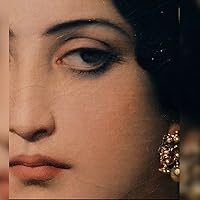
José Federico Burgos has just jumped from the wall of an elaborate castle, designed by Luis Barragán, and still alive and conscious, has been discovered by a pair of golfers; he is taken to hospital where he suffers from seizures and delirium, and sees, or thinks he sees in his dazed condition, a nun praying the rosary beside him, the golfers who rescued him, and a mural painter strangely working at night in the deserted hallways. The central story unfolds within this oneiric frame narrative. Before jumping, Burgos had been a down-and-out art copyist, restoring and reproducing old Renaissance paintings for his bourgeois clients. He was four months behind on rent, his truck had been towed, and his most recent client had forgotten to pay him. Everything looks desperate until a mysterious dealer named Horacio Romero offers him a lucrative opportunity: to produce a copy of a Belgian painting La Morisca (The Moor) attributed to Mabuse (though the painting itself lacks any signature). Burgos is reluctant—he had been involved in a forgery scheme before and wound up in jail—but out of equal parts desperation and curiosity, he finally agrees.
Horacio's fortress is built around La Morisca which resides in a vault in the center. The painting cannot be removed. Horacio's father had purchased it from the occultist Baron Sebottendorf, fallen in love with the woman depicted in it and eventually, becoming a mystic dervish, had locked himself in the room to die in rapture before it. "Real collectors are so passionate they want to live the life of the objects in their collection," Horacio explains about the objects in his possession—the monetary value is nothing compared to the spirit of the art and the owner's intense desire to commune with the object. La Morisca is often thought of in the book not as a painting but as a woman, and a dangerous one. "Do not look at that painting too long, young man, or you will sink into despair," Horacio cautions him. Despite his technical knowledge and artisanship, however, Burgos struggles to copy the painting. There aren't simply logistical obstacles (the painting cannot be transported to a studio) but metaphysical barriers. Burgos tries too precisely to mimic the brushstrokes of Mabuse. By replicating the figure of the Moor he has failed to represent the woman's spirit. "I don't know if the La Morisca I'd painted was so similar as to be different, or so different as to end up being the same," he explains in hindsight. Like Horacio's father, Burgos finds himself locked in a tower, trying to recreate the arresting image in the dark, striving to make not a lifeless wax copy but, somehow, an aesthetic resurrection of the woman herself. Burgos eventually succeeds by finding "the intimate sense that shatters external form". The copy, ironically, does not slavishly reproduce every brushstroke but captures something more ineffable. "You're no mere copyist, you're a poet!" Horacio declares. The problem, as the mural artist in the hospital explains to him, was that "you were still yourself, instead of becoming the other." The true forgery happens within—the artist must remold his inner self to the shape of the original, not simply retrace the outer figure.
And so, following this logic of iteration and doubling, one becoming the other, Burgos finds himself in the same situation all over again. History repeats, scenes copy one another, and Burgos is locked up again—just as he was before, and just as Horacio's father had been. It's a surreal novel—Burgos, with his rounds of absinthe, his cyanide- and led-mixed paints, his hospital painkillers, moves from one scene to the next in a hallucinogenic reverie. "The question is, you are you? If you are you, then you will seal the destiny of those who must be released. He who finds the door also finds the key," a woman beside a guava tree explains to him. I can see the connections to Juan Rulfo's Pedro Paramo but I was also reminded of William Gaddis' The Recognitions, another story of an art forger whose own identity becomes unfixed in a world of copies and duplicates.