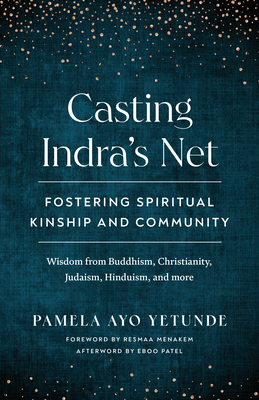
A heartfelt call for community-oriented models of well-being in our age of polarization and turmoil.
Creating compassionate communities takes more than good will—it requires a dedication to respecting cultural differences while remembering the fundamental spiritual kinship that exists between all people. Activist, counselor, and Buddhist teacher Ayo Yetunde creatively unpacks this condition through the metaphor of Indra’s Net—a universal net in which all beings reflect each other like jewels.
She offers a practice path that acknowledges our deep challenges—challenges that increasingly give rise to the temptation of group violence, which she calls mobbery—while showing exactly how we can still listen, learn, and heal together. Drawing inspiration from the Black liberation tradition and from stories from various religions, Yetunde recasts Indra’s Net as the network in which we all have the choice either to succumb to our impulses toward division and brutality or renew our civility and love for each other. The more than 20 practices in Recasting Indra’s Net include:
- Five commitments for healthy, nonviolent living - Guided contemplation to water the seeds of your spiritual potential - “Mirroring” and “twinning” other people - Tonglen (receiving and releasing) and lovingkindness meditations - Affirmations
The author is a pacifist and I am not but I do believe that stretching to take sophisticated pacifism seriously expands our humanity and makes us take seriously the toll of violence or even property destruction.
The author shares what land on me as perhaps the best metta and tonglen instruction around on pages 137 and 158.
I also appreciate that the author names and critiques Minnesota nice (p18). I also really like the frame to foster spiritual kinship and community but I didn't find the instructions for doing that as clear or practical as I'd hoped they would be.
Mostly, I liked this text. Ayo is solid and clear. I appreciated the Buddhist parts most, since that’s my approach. But I can appreciate how she bridges the approaches of other religions as well. The final parts felt like the strongest part of the book to me - calling in Buddhist leaders, invoking MLK Jr, etc.
I really appreciate this author’s perspectives on nonviolent activism and the application of this practice in religious communities. There were a couple of quirks about this book though that, for me, made it a little difficult to follow.
First of all, the author makes up several words with definitions in her book, which she obviously has the right to do if existing language isn’t sufficient for the way she wants to express herself. For a reader though, if that person is neither a sociologist nor a theologian (this book references several different religions), these new words further complicate the layers of abstraction of the language used in this book. At times, she is talking about an idea using a word she defined based on a religion I am not yet very familiar with or a social concept I am just learning about in the book, which means that for me, I have to redefine a word twice to put it into language that makes sense in my brain. Once she defines a word or concept, either made up by her or from a religion I’m less knowledgeable about, she doesn’t go back and redefine it, which is nice for concision purposes. However, when I go to pick the book back up, if I forgot a name or definition from several chapters ago, I had to flip back and find it again so I would understand what is being discussed. I think a glossary would have been really helpful for me while reading this book, and if I read it again I might make my own.
Secondly, much of this book felt anecdotal, which I wasn’t really expecting. A lot of these personal experiences are used to illustrate broader phenomena, and while I really appreciate Pamela Ayo Yetunde’s various life experiences and perspectives, sometimes applying the takeaways of small example to wider society felt like either an over generalization or naïveté, depending on the claim.
Many of the author’s claims were also supported by parables from several different religions. While I *was* expecting this part, it didn’t quite land the way I expected it to. It was very interesting to note similarities across religions, but by trying to include several different religions to illustrate a single concept, sometimes the book felt a little repetitive. I will also note that this author practices Buddhism and therefore emphasizes Buddhism over other religions, but she also seems to expect the reader to have a baseline knowledge of several religions that I didn’t necessarily have much familiarity with. Like the author, I also practice Buddhism and was raised Christian. Therefore, I worry that if I was a bit lost during some of the religious parts, anyone I recommend this book to might be even more confused or overwhelmed than I was.
Overall, I really do appreciate the mission of the book, but I think it is more accessible for interfaith leaders or other people with some sort of shared intellectual background with the author. This isn’t to say other people shouldn’t read it, they just need to be prepared to integrate several unfamiliar religious concepts and attempt to understand them in the context of a philosophical work that is making a statement on the broader social justice movement in the United States. Ultimately, I am glad I read this book through to the end and I will try to apply its teachings to my life. I wish the book was more accessible for me to share and recommend to people, but I couldn’t tell if the intended audience was supposed to be Buddhist and Interfaith leaders, or the general public.
This is a much needed book on on seeing others with compassion and as humans that all have the same value. They accurately portrayed the injustices America has done to minorities. They encourage those of different faiths to unite at our common grounds. Their view of Christianity is not accurate to The Bible or Christianity. They seemed to only have a pejorative view of Christianity and did not present Christianity as loving and including people from all ethnicities. They present led Christianity as presented by those that call themselves Christian and yet promote injustice. White people have committed numerous injustices against minorities but that doesn’t mean all of us support the wrongs people like us have done. I don’t support these wrongs.
I loved how Pamela Ayo Yetunde brought forward stories, universal truths and practices from a multitude of spiritual and social justice traditions. She shows the deep necessity of collective liberation.
Adored the beautiful and useful imagery and woven interfaith teachings. Wanted to hear more about the Vedic origin and use of India’s Net, but can seek elsewhere.