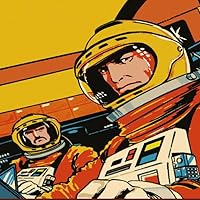
He was the two-hundred-and-forty-seventh citizen with the name Thomas Robert Hendley. His name, of course, was never used. The Organization found numbers more efficient than names. Only, TRH-247 wasn’t any other citizen. He was himself, different from anyone else, and he had to do something about it. So he quit work; smuggled himself into the forbidden pleasures of a Freeman Camp; found boredom and nonidentity there, too; committed the ultimate rebellion, using a false number; and got the ultimate punishment—banishment. He took the girl with him, for her crime was equal to his. The only problem he had to face now was—survival!
This is an interesting dystopian novel set a few hundred years in the future, after a nuclear holocaust had destroyed much of our planet. The survivors, East and West, had rebuilt their worlds but had become so similar that they eventually merged into a single conglomerate, called the Organization, which thanks to its computers, controlled practically everything. Everyone has an assigned socioeconomic level and a lifetime tax debt to be paid off to the Organization. You rise through the levels and when your tax debt is paid off you achieve the level of "Freeman". And they have their own cities, where anything goes in the pursuit of pleasure. Into this world comes TRH-247, i.e. the 247th person named Thomas Robert Hendley. Everyone also wears an ID bracelet which identifies them by number, status etc. His assigned occupation is being an architect but he is dissatisfied with life and one day skips work and meets up with a woman he had briefly encountered previously - ABC-331, whose first name was "Ann". Naturally their tryst was seen and he is taken into custody by the Morale Investigators. As part of his prescribed rehabilitation, he is given a day in a Freeman camp, so he can see for himself what the goal of becoming a Freeman means and why he should strive to attain it. So off he goes. What could go wrong??? And of course, Ann - ABC-331 - shows up (NOT as a Freewoman!).
A comparison to Orwell's "1984" would be hard press not to compare this book to. One could maybe argue this would be a Big Brother 1.0 society before they really "perfected" it. Here, the Big Brother government overlords are "The Organization". Members of the society are named in license plate format of three letters and three numbers in similar fashion to Ayn Rand's "Anthem". All members have a Tax Debt that they must work off by doing work for some unknown period of time and people are classified by how many long they have work left (so they are clearly subscribers to Modern Monetary Theory). Then you win your Freedom to become Freemen and spend the rest of your days not working in a secluded location away from the working class. Enter our hero who will not be classified by a designation but by his name and he's decided to take the day off and go after a woman not his assigned person. The Organization can't have free thinkers like that!
This is a pulp novel from 1963 so it behooves the author to pull the audience in quickly - and I liked this book by page 10. The world is introduced right away and our Winston-type character, Hendley. His rebellion is begun right off the bat and after soon being caught the banter between The Organization and Hendley shows that both are written smartly. It shows that the government doesn't have complete control over the population but they also aren't a naive ruling elite.
The second act is not as strong as the first where the punishment is to try and show Hendley what he's working for by giving him a day pass to the Freemen society. And here is where the author doesn't make his point strong enough. His point is that freedom isn't all that it's cracked up to be when The Organization is in charge and no work is present. But the hedonism and lack of value placed on life by the Freemen isnt' as forceful as it needed to be. More focus on the lack of value of life could have been more expressed (though it is somewhat). Or the focus on how the value of work done in light of freedom would have been a more excellent point. The ending hints very briefly at that type. There is no Emmanuel Goldstein manual for our hero to learn from. It's not clear how he has established his moral basis for seeing either the working side of The Organization or the Freemen side of The Organization as being wrong and immoral. There seems to be some discussion about a "before time" but there's no discussion about religion or life in the world before - except as a contrast when it comes to the working model in the current system. The second and third act slow down a bit and might not be satisfying if you're looking for a copy plot like Orwell's.
However, this is a well-written and entertaining dystopian novel. It keeps you interested and at about 150 pages is pulp at its best. I was really hoping there would be a sequel to read but sadly there was not. Charbonneau writes well and his characters are believable who think and feel and aren't supermen/women because they are the main characters. If you're looking for a 1984-like dystopian pulp novel this is a good one. Final Grade - B+
World War III happened. Enough people survived to rebuild the world, but the most amazing thing happened. Over the course of time, government and business began to be pretty much the same thing. A new system of economics developed in both East and West, one in which you are born owing taxes, and the goal is to work that off, at which point you can retire. Retirees even get to go to special retirement communities, where the only rule is "anything goes". After the final "merger" of the Eastern and Western organizations, there is only one government for all. The final "victory" has been won. No more conflicts of any kind. Of course, there's a price. Until you retire, everything is determined for you...your job, who you will marry, and so on, but the reward at the end is great. What could possibly go wrong?
Charbonneau created one of the most unusual dystopias of all time, a blend of 1984 with twisted variations on utopian concepts.
‘The Sentinel Stars’ is a Dystopian science fiction novel originally published in 1963. I love the look of these earlier Bantam books paperbacks, so when I saw it for 50¢ a few months ago, I picked it up.
The story/plot itself Isn’t very good. The characters are flat and there are serious holes In the plot. The writing is decent but where I give the book full credit is in its exploration of ideas. Like most good mid century science fiction, and especially dystopian works, this novel had me thinking..
Most impressively, I couldn’t tell of Charbonneau’s political leanings when reading this novel. It doesn’t appear to care to display a blatant message. In my experience with mid century science fiction you either get American Cold War hawks or you get a happy go lucky realization that we should love each other. The closest this novel gets may be a paleo conservative realization.
The story revolves around a man whose identity has essentially been stripped from him. He lives in an underground city in the near future where your job is assigned at birth. You have a tax debt you are given to pay off through long hours and years of work. The entirety of this city and world as he knows it is run by a major company going through a merger - the government and corporate world have all but blended. The goal of every worker they are told, is to pay off the tax debts to move into “freedom camps” outside of the major cities. In freedom camps they are told work is no longer necessary and pleasure, leisure, rest and play are all that remain.
The main character through the plot ends up visiting a “freedom camp” and begins to question everything.
What truly is “freedom”? Most people work their entire lives towards a goal of relaxation and social freedom - but how do they feel when they reach that goal(retirement)? Are we truly free under the hand of social systems, sex, corporations, government, the influence of drugs and alcohol, etc.
‘The Sentinel Stars’ is an interesting read. I can’t say I’d recommend it, but it had me thinking… I believe that is the author’s goal. 5.5/10
Story is pretty boring. Somewhat interesting premise. Post apocalypse, underground cities, people work off tax debts in hopes of reaching “Freeman” status. But it’s not a mere retirement analogue, oh no. Freemen have basic anarchy, robot butlers and *CAN* play games that can become downright deadly in their prison leisure camp. But protagonist can’t handle the freedoms. Available now on gutenberg.org.
In a post apocalyptical future, men labor their days away in order to clear their 'tax debt' and be granted absolute freedom and endless leisure. In the meantime they work to solve problems the governing computers have already answered, attended their allotted classes, participate in mandatory debates, and have sex with their assigned wives, all under the auspices of 'The Organization.'
Our protagonist, for reasons he can't quite articulate, takes issue with a recent policy decision and decides to stage a one man strike. Reprimanded, he's granted a days freedom, a rare privilege, to remind him what they're all working towards. However he soon finds that a country club full of bored anarchists isn't all it's cracked up to be, especially when some of them really don't want to be there.
Sort of a distorted reflection of 1984, where society has strived for Automated Luxury Communism, but they've mostly automated the oppression, haven't quite managed the luxury part, and the computers running the show are pretty keen on you still turning up to work.
As written it falls into the cracks between too short and too long. The book spends far too much time following our protagonists daytime drinking, and not nearly enough time exploring things teased at in the latter parts of the novel, the 3rd act being a 20 page sprint to the finish. Not particularly long at ~150 pages, it could probably have either been cut down to a novella proper, or given another 100 pages to fully flesh out the rest of the world and the machinations of the organization.
The time is 2200. The world is very regimented. East and West have merged, there is peace, and has been for a long time. Everyone is assigned a job, they have to work off their tax debt after all, whatever they qualify for, they are assigned partners for which they get an hour a week in the Public Intercourse Booth, and the goal is to pay off that tax debt.
They then become Freemen and go to the camps set up for them, there to live a carefree life of leisure for the rest of their days.
That's what Thomas Robert Hendley wants. In this future world,he is TRB-247, reduced to a number, the two hundred forty seventh Thomas Robert Hendley, for computer control. The little ID bracelet affixed around his wrist has that designation.
TRH-247 becomes dissatisfied one day and blows off work, not a smart thing to do. It will only add to his tax debt. He meets a woman and spends the day with her, returns home to arrest and a talking to by a grandfatherly type who sends him to Freecamp for a twenty-four hour visit to realize what he's jeopardizing.
There, he learns, first, that things aren't as nice as one would believe,and, second, that there are people willing to do almost anything to switch places with him.