Jump to ratings and reviews
Rate this book

Gallipoli

Rate this book
On 25 April 1915, Allied forces landed on the Gallipoli Peninsula in present-day Turkey to secure the sea route between Britain and France in the west and Russia in the east. After eight months of terrible fighting, they would fail.

Turkey regards the victory to this day as a defining moment in its history, a heroic last stand in the defence of the nation's Ottoman Empire. But, counter-intuitively, it would signify something perhaps even greater for the defeated Australians and New Zealanders involved: the birth of their countries' sense of nationhood.

Now approaching its centenary, the Gallipoli campaign, commemorated each year on Anzac Day, reverberates with importance as the origin and symbol of Australian and New Zealand identity. As such, the facts of the battle – which was minor against the scale of the First World War and cost less than a sixth of the Australian deaths on the Western Front – are often forgotten or obscured. Peter FitzSimons, with his trademark vibrancy and expert melding of writing and research, recreates the disaster as experienced by those who endured it or perished in the attempt.

Audiobook

First published October 29, 2014

106 people are currently reading
882 people want to read

About the author

Peter FitzSimons

85 books479 followers
Peter FitzSimons is one of Australia’s most prominent and successful media and publishing identities. His busy professional life involves co-hosting the breakfast program on Sydney's Radio 2UE, writing weekly columns for the Sydney Morning Herald and Sun Herald newspapers, appearing on Foxtel's Back Page television show and, when time permits, authoring best-selling books. A correspondent for London's Daily Telegraph as well, he is also in high demand as a guest speaker and presenter

Ratings & Reviews

What do you think?
Rate this book

Friends & Following

Create a free account to discover what your friends think of this book!

Community Reviews

5 stars
371 (47%)
4 stars
292 (37%)
3 stars
93 (11%)
2 stars
16 (2%)
1 star
10 (1%)
Displaying 1 - 30 of 76 reviews
Profile Image for Amanda - Mrs B's Book Reviews.
2,231 reviews332 followers
April 25, 2017
The story and the history of Gallipoli is one that needs to be continually told again and again, to educate the younger generations of the bravery of their forefathers but to also keep the spirit of the Anzac alive. Peter Fitzsimons, an author of over 20 something books in the military history field, does this well in his accessible tribute to Gallipoli, which was released on the 100th anniversary of the Gallipoli landings.
Initially I was very daunted by this 700 page plus, heavy looking book that works to comprehensively document the Gallipoli campaign. Once I settled into the embrace of Mr Fitzsimons engaging form of presenting his take on Gallipoli, I was hooked. I liked the format Fitzsimons uses to approach his version of events. He utilises a good mix of sources from diaries, letters, newspaper articles, personal statements and maps. All these sources are tied together neatly, a sign of the extensive research Fitzsimons has obviously undertaken to write this treasury. He works hard to present both sides of the story, enabling the reader to understand Gallipoli from both the Australian/New Zealand Corps point of view, as well as the Turks enemy side. He highlights the bungled decision making from the top political players of the time, resulting in so many senseless deaths. He also draws out attention to specific campaigns such as the Battle of Hill 60. He personalised approach seemed to have impact on this reader, with my understanding of Gallipoli only extending to primary school history education only. What left a stain on my mind were the instances where Fitzsimons takes you right inside the trenches, where you can feel, smell and hear everything the ANZACS felt from death, disease and comradery. His insertion of key figures that stay with the entire book add an individualised element from the story. I was enthralled by the stories of the war correspondents such as Charles Bean and the diligent nurses, such as Lydia King. The final chapters based on the evacuation of these soldiers after a disastrous campaign was compelling to read. The epilogue was the finest feature of this novel, bringing together all the essential elements of the Gallipoli story. Most importantly this part of the text is essential in showing us how vital this terrible loss of promising young lives was to the birth of our nation.
Peter Fitzsimons Gallipoli is an essential text, it is one that should on high school textbook lists and a mandatory read for all Australians. I applaud Mr Fitzsimons on bringing such a defining moment in our nation’s history alive for readers to appreciate.
Profile Image for Dimitri.
1,003 reviews256 followers
January 24, 2020
Gallipoli Light. Lynn MacDonald, Aussie-Style.

FitzSimons is a journalist and not a historian, so we can't expect him to write like an academic. He writes as if he's following the Aussies together with Charles Bean, scribbling anecdotes in his notebook that don't make it into the dusty tomes. His "throw another one on the barbie, mate" language takes some getting used to. Sometimes you start reading faster.. until you realize you've dropped from one scene into the next.

These are assets for an oral history of the ANZAC corps. Filling in the blanks of the Official History, reconstructing conversations that may or may not have occurred exactly, filling the boots and flinging himself down in the dust with those incorrigibly high-spirited warriors.

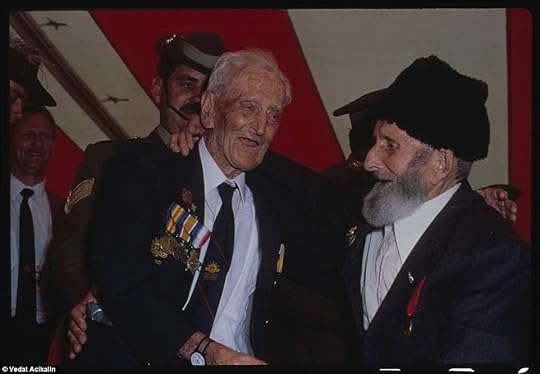
The Turks don't remain an abstract, either; the burial truces and less formal moments of compassion between the savage frenzy of the "Allah !"-roaring bayonet charges give the enemy a human face. Perhaps not in the "we're all in the same boat" way of the Western Front, but certainly in the mutual "they have pluck, too" way. There's a very touching 75th anniversary picture to go with this:

description

Any gripes ? There's a fair focus on the importance of the ANZAC "spray de corps" to the nurturing of a nationhood for the young Dominions... but that is an aspect that hardly reasonates with a foreign audience... and it helps to have read up a bit on the campaign, because this casual cruise is not the best at painting the big picture
Profile Image for Zitong Ren.
522 reviews181 followers
January 29, 2020
Everyone look, I finally read a book that is non-fiction. I know that lots of people out there adore non-fiction, but personally I never could really get into it since it sometimes can feel like studying and I have enough of that already in my life. The only reason I picked up this was because I was given it and ran out of books at home yet wasn’t able to go to the library to pick up more books. It’s about the Gallipoli campaign, which as an Australian, I already knew a decent amount about since we have an entire day every year(ANZAC day) celebrating the feats of these soldiers, though it is now for soldiers for every war that Australia has participated in.

One of the reasons I don’t read non-fiction is that if it is an event you already know about, the ending or anything that happens isn’t really climatic. There are obviously cases where I don’t know much about, like the biography of a person, but I tend to stray away from them as well. I appreciate the fact that the author did try to make it suspenseful and dramatic of the evacuation, since it was, but it isn’t surprising to the reader exactly. As someone who doesn’t read much non-fiction, these are merely my thoughts and may not be worth a whole lot.

Something I did like was the way the book was formatted and told, in individual days and events, which I liked and made it easy to read. Furthermore, I enjoyed all of the maps that were featured since I am a sucker for maps(comes with being a fantasy fan). I also am an avid learner of history(though often through websites and YouTube videos which are easier and quicker to consume than books) so it wasn’t like that I was bored or anything by it. Non-fiction is something that I would like to potentially get into in the future so if anyone knows any good non-fiction books, recommend them to me, it’s almost impossible that I have read it yet.

I liked the aspect that the author focussed on individual soldiers and people in the war as often, we often think of wars like this as statistics. It is easy to look at something and go, oh look, millions dies on WW1. Those numbers don’t mean a whole lot, but when focussed on individual people, it makes the whole very terrifying aspect of war seem much more real to us. That was a really good part of the book that I liked. Obviously, there are lots of stats of staggering numbers, a few hundred wounded there, 10,000 dead in another worthless engagement, thousands sick and they seem to slide away, but following select characters make it seem worth more and make you realise these were all living breathing humans with families back at home wherever home may be.

For the most part, I really enjoyed reading book and expanded my knowledge of the inner workings of the Gallipoli campaign. 8/10
Profile Image for Donald Grant.
Author 9 books16 followers
May 23, 2015
Having traveled to Australia twice now, I have been curious as to why a country would “celebrate”, what seemed to me, a major defeat in World War I. To me this seemed like the United States celebrating the day we left Vietnam. This book clarified it for me.

Australia had just unified as a commonwealth of Great Britain, and World War I became the unifying factor, especially the battle fought on a small beachfront in Turkey. The story of Gallipoli is one of amazing bravery, comradery, incompetent politicians, and soldiers who did not question orders that led to so many deaths.

Peter Fitzsimons has compiled an incredible amount of research, combined with a writing style that makes this a page turner, in a book of over 700 pages. Detailing from both sides of this battle, he gives a very accurate picture of not only what happened here. but paints a vivid account of what it is like to fight a war.

The soldiers are remembered to this day in Australia as the country gathers on ANZAC day to both mourn the losses and celebrate the bravery of those who fought. I am writing this as Memorial Day approaches in the U.S., and we could take a lesson in patriotism from the Aussies and Kiwis.

The sad part of the book is the reminder of how in so many wars, those who lead us in, are often politicians who sit back and make decisions, some bad, some good, that result in the loss of so many of a country's finest. Fitzsimons does not shy away from documenting both types of decisions at Gallipoli.

This book will enlighten you, anger you, make you tear up, make you smile. An incredible read!!
Profile Image for Nikola Novaković.
151 reviews2 followers
September 13, 2021
As consistently thrilling as it is heartbreaking, this history of the doomed Gallipoli campaign serves as a fantastic insight into both the horrors of indignity these men suffered and the astonishing heroism with which they responded to those terrors. Thoroughly recommended.
Profile Image for Kris McCracken.
1,895 reviews62 followers
May 12, 2024
"Gallipoli" by Peter FitzSimons offers a comprehensive account of one of the most infamous battles in military history, providing insight into the bravery and tragedy of the soldiers who fought on both sides. FitzSimons' narrative is gripping, painting a vivid picture of the brutal realities faced by the ANZAC troops. However, while engaging, the story covers well-trodden ground, offering little fresh perspective or analysis. Despite this drawback, "Gallipoli" remains captivating for those seeking a detailed account of this pivotal moment in World War I.

To be honest, I was a little disappointed by the lack of vigour in the critique of modern politicians (and others) manipulating and misrepresenting the historical record in their celebration of what was an extraordinary waste of life.

⭐ ⭐ ⭐
Profile Image for Chris Babic.
5 reviews
December 25, 2021
DNF...made in to ~200 pages and gave up. Insanely tedious, uses four words when one would do.
Profile Image for Mrugesh.
49 reviews5 followers
September 10, 2015
It's to read like a novel. It does.

It's to be historically accurate. It is.

It's to provide an objective look at the Gallipoli campaign. It does.

It's to recall the Anzac experience in Gallipoli. It does.

It's to be enjoyable. It is.

Given that it achieves everything it aims to, this book is a success. But beyond this, what I really like is that it really is quite objective. Even when it focuses more on the Anzac experience, it spends a good deal of time with the Turks. It doesn't try to vilify anyone, and at every opportunity chooses to highlight the human side of this quite inhumane a campaign. The Turks' treatment of the was.. unexpected, but quite welcome, for instance. There is also some time spent with the Turks, most prominently with Mustafa Kamal.

I did perceive a few minor negatives. Some `linguistic mechanisms' (I don't know what the a good word for this is) feel overused at times. There were some others, but I'm just nitpicking at this point.

The book does however, spend a considerable time on the actual experience of being at Gallipoli and there are a few individual story lines that are carried throughout the book. Most notable of these are the two war correspondents - Charles Bean and Ellis Ashmead-Bartlett. This kind of story telling is quite successful here.

The Epilogue also manages to round off all the threads of the story very nicely - individual, national and military. And like this Epilogue, the book is extremely satisfying as a story with a beginning, middle and end. The events in the story themselves are quite harrowing and, as is the case with all the other WW1 books I'm reading, portray the war in a very ugly light. But then again, so does the human side illuminate a hopeful light.

This is a must read for the military history and the human experience of the Great War. Though, given that the book chooses to focus on the Anzac experience, it doesn't spend as much time with the British and the French, if at all. There aren't too many details about the personnel and the happenings at Cape Helles. Only the major events are recounted. Also, after a considerable time spent (very good time at that) with the crew of the AE-2, the rest of the naval campaign in the Dardanelles is completely devoid of even a mention.

Anyway, here at the end, I'm wondering what may have happened to .
162 reviews2 followers
March 5, 2020
Click here for a video version of this review: https://youtu.be/XCnmQPepGUc

“For the last time in this world many of us stand shoulder to shoulder. As I look down the ranks of my comrades I wonder which of us are marked for the land beyond.”

These are the words of Private Ellis Silas as he and his fellow soldiers boarded boats which would take them to where they would storm the beaches of the Gallipoli Peninsula. This event is a cornerstone of the histories of New Zealand and Australia, and the point in time where these fledgling nations joined the world stage. Their combined fighting force, the Australian and New Zealand Army Corps, came to be known as the ANZACs.

Gallipoli written by Peter FitzSimons tells the story of this ill fated military campaign over an epic 800 pages. He covers from the call to arms, to the formation and training of the forces, the entirety of the eight month campaign, and the subsequent aftermath and investigations. 

You see, the Dardanelles campaign which was to commence with the landings at Gallipoli were poorly conceived, badly managed, and ended up with 43,921 dead and 97,112 wounded over its 8 month run. Instead of being a landing followed by a rapid sweep across the land to Constantinople, the ANZACs landed on small beaches with cliff fronts populated by a well armed and entrenched enemy hell bent on defending their land. The success of the campaign had been vastly overestimated. 

FitzSimons does an excellent job of communicating just how it all unravelled and how it was doomed, almost from the beginning. After going through the formation and training of the ANZACs, the book spends the bulk of its time on the campaign. When on the battleground we move from various sites from the shore of the beach where the ground commanders were marshalling the troops, to the hills and gullies the soldiers had to fight through, to the key locations like Lone Pine. He switches between there on the front lines on the ground and back in London from where the forces were being directed. 

On the London end of things, one thing that stood out from the book was the utter disregard and dehumanising of the soldiers on the ground and what they were facing. To the point where it even changed my opinion on Winston Churchill. Churchill is most well known for being the legendary Prime Minister who led Great Britain during the second world war. At the time of the Gallipoli campaign he was First Lord of the Admiralty, and his sheer selfish glee at using the Dardanelles campaign like some large scale board game was disturbing: 

“‘My God!’ he says to the Prime Minister’s wife, Margot Asquith, at a small gathering at Walmer Castle, ‘This, this is living history. Everything we are doing and saying is thrilling – it will be read by a thousand generations, think of that! Why, I would not be out of this glorious, delicious war for anything the world could give me.”

I was shocked at his attitude like it was a game, never mind the men getting ground into mince on the battlefield. Here’s another example from the book. It’s a message from Churchill to a frontline naval commander, a commander who, at the front line was acutely aware of the difficulties literally just off the bow of his ship. Yet Churchill shouts from his comfortable government London lodgings in a telegram: 

“I DO NOT UNDERSTAND WHY MINESWEEPERS SHOULD BE INTERFERED WITH BY FIRING WHICH CAUSES NO CASUALTIES. TWO OR THREE HUNDRED CASUALTIES WOULD BE A MODERATE PRICE TO PAY FOR SWEEPING UP AS FAR AS THE NARROWS … OPERATION SHOULD NOW BE PRESSED FORWARD METHODICALLY AND RESOLUTELY AT NIGHT AND DAY. THE UNAVOIDABLE LOSSES MUST BE ACCEPTED.” 

I thought it really showed the disconnect between the politicians and those facing the bullets. But Churchill wasn’t alone, when stating their case back to London about the gross miscalculation, the Commanders were basically ignored. 

“Back at GHQ on HMT Arcadian, General Hamilton is still absorbing the disastrous news when a cable arrives from London in response to his request on 4 May that he and his forces urgently need more artillery shells to be sent out.

THE AMMUNITION SUPPLY FOR YOUR FORCE WAS NEVER CALCULATED ON THE BASIS OF A PROLONGED OCCUPATION OF THE PENINSULA. IT IS IMPORTANT TO PUSH ON.”

Hamilton was basically told “We didn’t calculate the right amount of ammo for you, so yeah, good luck!” It’s quite incredible.

I learned something from this book too. Growing up on the ANZAC legend in NZ you usually only hear about the ground forces. But the book shows how much the naval forces were involved too, in troop transport, bombarding enemy positions on the mainland, and the submarines trying to find a way through the channel full of mines. 

The whole book was great, but there were two sections in particular that stuck in my mind; the Suvla Bay landings, and The Battle for Hill 60. On Hill 60 the allied soldiers were fighting the Turks trench to trench, and sometimes in the same trench. One part describes the opposing forces in the same trench frantically flinging grenades at each other, and trying to catch them and throw them back before they explode:

“Setting to with a will, the men work feverishly in the confined space – just five yards long, four foot six inches deep, four feet wide, with a foot of earth as a parapet. It does not stop even when McNee is wounded twice in the head and in the hand, for he stays on. When Renton loses a leg, he reluctantly has to withdraw and be carried back, but still the others keep going in the now sticky trench. The leg is simply heaved over the side without ceremony. For every man who falls, another quickly comes forward. For all the gravity of the situation, still there is extraordinary levity on the Australian side – ‘It was the best bit of sport I ever had in my life,’ one soldier would recall – with those surviving having many narrow escapes that cause high hilarity.”

In my mind this perfectly sums up the madness of war and it’s truly absurd nature, right alongside the Aussie and Kiwi larrakin spirit. 

This a long but greatly satisfying read. If you want a very readable way to learn about the Gallipoli campaign, FitzSimon’s “shrimp on the barbie” conversational writing style will have you turning page after page after page. 
1,036 reviews9 followers
March 2, 2015
I think I have a soft spot for anything written about Gillipoli. I did love this, even though it frustrated me listening to the mistakes made and the horrific lost of life. Probably not much in here that I haven't read before, but I liked how it was presented.
40 reviews
November 20, 2025
A classic from Peter FitzSimons, and one that truly stands out. His meticulous research and ability to weave historical fact with human emotion makes this book both confronting and unforgettable. He captures not only the raw courage of the men at Gallipoli, but also the harsh and often senseless realities forced upon them under British command. The tragic mismanagement, arrogance, and catastrophic decisions made far from the frontline paint a devastating picture of leadership that failed its soldiers at every turn.

What strikes me most is the painful irony: despite the immense suffering inflicted by the decisions of figures like Kitchener and Churchill—men who were quick to send others to die yet never risked their own comfort—many Australians still hold the British monarchy in high regard. Our diggers did not fall on the Western Front due to fate alone; in many ways they were systematically sacrificed by military leaders whose incompetence, detachment, and cold calculations—such as valuing shells over soldiers—led to avoidable tragedy. The saddest truth is that none of these leaders were ever held accountable, let alone tried for what today would be seen as war crimes.

FitzSimons doesn’t shy away from these uncomfortable truths. He presents them plainly and powerfully, calling out the failures for exactly what they were. His honesty gives voice to the men who paid the highest price, and for me, it reshapes the meaning of ANZAC Day, adding a deeper and more sobering layer of respect for those who served and suffered.

Books like this deserve a permanent place in our school curriculum. They offer young Australians a clearer understanding of our nation’s past while fostering gratitude for the sacrifices made by those who came before us. This is a powerful, compelling, and essential read—one that every Australian should make time for.
Profile Image for Elle Smith.
22 reviews
May 21, 2017
I was never taught Australian war history in school, so my knowledge of the Gallipoli campaign was limited to the stories told at ANZAC day dawn services.

This book has made me laugh, cry (a lot) and above all, feel immensely proud to be Australian. It's fabulously written and told as a novel with the stories of specific people followed throughout. The tails of the war are truly horrendous and shocking. I don't think I'd ever fully comprehended the enormity of the task handed to the ANZACs before reading this.

It'll take me a few more days to process yet, but I believe this book has made and will continue to make a profound impact on my comprehension of war, Australia's sense of self as a nation, and my own respect toward veterans. I cannot recommend it enough.

Peter Fitzsimons, I dip me lid.
195 reviews7 followers
June 15, 2019
Given that the First World War is seen mainly as an Anglo-German conflict, this book shows how widely the wars consequences were felt. As First Lord of the Admiralty, Winston Churchill came up with the plan to knock the Kaiser’s supposedly inferior ally, the Ottoman Empire, out of the war by attacking the Dardanelles. This would lead to the disastrous Gallipoli campaign which would cost the Allies nearly 200,000 casualties and gain them nothing. Many of the dead were ANZAC troops from Australia and New Zealand and the campaign is seen as bringing about the birth of national consciousness in each of those countries as well as signifying the beginning of the new modern Turkey, created after the war by Kemal Ataturk who fought at Gallipoli. Fitzsimons brings an urgency and vibrancy to this tragic story, setting reported speech as dialogue and writing in the present tense.
Profile Image for J. M. Simmonds.
135 reviews1 follower
June 13, 2022
As an Australian, you hear to big points of Gallipoli, you see it in movies and tv series. But this account from Peter Fitzsimons was really good. I enjoyed and it was insightful. I look forward to either reading or listening to more of his stuff on audiobook. I listen to this on the way to work and back again, I rarely read Non-fiction but the audiobook was such a good way to hear it. Like everything about World War 1, it is truly sad to hear the butchery of so many. But it also makes me wonder what really made these men get out of their trenches and get massacred. It leaves me feeling that is wasn’t mateship, but something far deeper and more profound. This book even though Fitzsimon never intended it to be thought provoking has done that with me. A good read worth the time if you have it.
Profile Image for David.
377 reviews
September 27, 2022
Excellent book, for which the word enjoyable doesn't really fit, even though I'm very glad I read it! Based around two themes, searing condemnation of the futility of war, the gross ineptitude of the command structures on both sides and most of the senior officers in it, and in contrast, in effect the formation of a national spirit and identity in both Aus and NZ due to the incredible heroism of those involved (and also in Turkey who lost eqivalent mount of personel. The initial naievity of the troops, and their later incredable resolve, coupled to the general incompetance of the planning and implementation of the campaign is well portrayed. Also explains much of the antipathy in Aus to Churchill who was instumental in the tragic waste of life. In effect, one of the first times the British Empire was shown to be fallable.
Profile Image for Tianne Shaw.
323 reviews16 followers
October 13, 2025
Now this I did via audiobook while in the car and throughout I was able to focus easily with the readers voice.

Of all the Gallipoli accounts I have read none have gone into the depth this has. Not only from individuals and daily battles but also the findings after the evacuation of troops. The level of research and detail within made it a much more comprehensive view compared to previous ones. I do also have the print version so can view pictures and the maps within.
Not being biased but I have come to love how well researched and put together any of FitzSimons books are. Even meeting the man himself I can appreciate how he wants to delve deeper than most and gets these great results.
Profile Image for David Brown.
239 reviews4 followers
June 11, 2020
This is a compelling book. I found it difficult to put down. The narrative is easy to read and appears to be factual. Obviously some conversations are the author's interpretation of what might have been said. Interspersed with the horror, the author has salted his text with great examples of Australian humour. It serves to provide effective relief.

My one complaint, and this seems to be consistent in FitsSimons' work is his use of the American term Brigadier-General. The correct Australian rank is Brigadier. To me it was a continual irritant.
Profile Image for Renee.
853 reviews
June 1, 2020
Written like a novel, this account of what the ANZACs faced at Gallipoli is thorough and poignant. The author covers not just the Australian perspective, but the British, New Zealand and importantly Turkish too. I listened to the audio version and found that I couldn't stop listening. The narrator did a fabulous job with the acdents and I enjoyed his performance. What a tribute to the heroes that went before us. Lest we forget.
Profile Image for Cassidy Chellis.
42 reviews2 followers
January 10, 2021
FitzSimons doesn't write for the academic: He writes for the Australian looking into the history of their nation and its people. And while reading a book such as Gallipoli may not make one an expert on the matter, it most certainly allows one to understand the conflict.

As always, FitzSimons presents a brilliant overview of the actors, events, sentiments, and consequences of the battle which shaped the Australian identity.
Profile Image for Tony.
412 reviews2 followers
July 12, 2022
I like Peter Fitzsimons as an author and have read a number of his books but this one just didn't quite grab me. The subject matter was interesting, it was well researched, it was unbiased, it was we balanced, but for some reasons it just didn't grab me. It is quite a lengthy book and dragged a little at the start. I think I preferred the Les Carlyon book but this is still going the distance with,
196 reviews1 follower
November 2, 2022
Outstanding (as always really) from Peter Fitzsimons. Covering all aspects of the campaign in poignantly personal details, this really is a master-class and makes the story of what happened come fully alive in all it's terrible glory. As always Peter does a great job of telling both side of the story and telling it from many points of view. Really well read by Robert Meldrum as well. Highly recommended.
Profile Image for Kim Stone.
1,549 reviews1 follower
June 16, 2017
This book deserves more than five stars. Most of the time it was very hard to listen to as the reality that this was fact and not fiction. Every Australian needs to read/listen to this book. Thank you Peter from researching and collating this important stage in Australian history that needs to be know by all. RIP Sgt Albert Ernest BURN d 25 April 1915 Gallipoli
10 reviews1 follower
January 29, 2021
This is an excellent book if you want a well researched, detailed account of the events of Gallipoli. I was hoping however for a historical fiction approach rather than the approach of being more of a chronological diary. Would be an excellent reference source for someone wanting to study the history of Gallipoli
Profile Image for Mikeynom Thomason.
22 reviews
September 22, 2017
Not a fan of Fitzsimon's pose but the structure worked well. Present tense and short, sharp sections made it an easy read for the 700 pages.

Was surprised by the lack of details about the battle of Lone Pine.

Its a gripping story and just needs meat on the bone, which the author has done here.
Profile Image for Kevin Giles.
Author 8 books9 followers
February 3, 2018
Plenty to read and contemplate in this big book for students of war history. This is a deep and meticulous account of a terrible and witless slaughter of Australian men. Like many looks back at war, this story makes us think forward toward peace.
Profile Image for Anthony.
75 reviews
March 7, 2019
Typically very well researched and detailed account of the Gallipoli campaign by Peter Fitzsimons. I have always respected and been extremely thankful for the sacrifices made. However, having now finished reading Gallipoli, I am in awe of their bravery and the hardships they endured.
Profile Image for Luke.
26 reviews3 followers
April 15, 2021
A fascinating account of one of the least-known campaigns of WW1, but like FitzSimons other works, it tends to drag in the middle. His writing style makes for fascinating reading, and there's exhaustive amount of detail here, almost too exhaustive at times.
Profile Image for Maggie.
789 reviews33 followers
June 28, 2021
700 plus pages of highly detailed account. Way too much for me, I gave up before the end. I thoroughly enjoyed "Batavia" by this author, sadly disappointed with this book. I have acquired nearly all of his books based on how much I liked Batavia, hope they're not all this detailed.
Displaying 1 - 30 of 76 reviews

Can't find what you're looking for?

Get help and learn more about the design.