Author Julian Voloj and award-winning illustrator Wagner Willian’s Black & White is the first graphic novel biography following the life of Bobby Fischer, from chess wunderkind and national hero to his eventual spiral into madness and infamy.
The life of Bobby Fischer (1943–2008) had many unexpected moves—from his solitary childhood to his stratospheric accomplishments in the world of competitive chess, and eventually, his decent into mental illness and disgrace.
Black & White begins in Brooklyn, where Fischer was born and raised by a single mother. By the time he was a teen, he had established himself as a loner and dropped out of school. But none of that mattered; he had found his true calling—chess. In 1972, Fischer played what many consider “the game of the century” against the Soviet Union’s chess champion Boris Spassky at the height of the Cold War. Later, Fischer became the youngest-ever US Chess Champion and the game’s youngest grandmaster. Never before had chess received such international attention. Fischer, whose sole focus in life up until then was chess, reached the Olympus of chess at 29, and then . . . he disappeared. Suffering from mental illness, the chess genius became increasingly paranoid, lost in anti-Semitic conspiracy theories—despite the fact that he himself was Jewish—and died as a fugitive in Iceland.
Black & White is a beautiful and fascinating work that reveals Fischer’s history while also contextualizing his lasting impact on pop culture and examining the legacy he left behind.
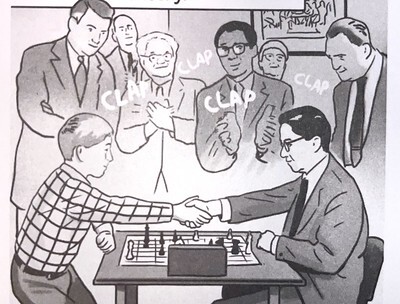
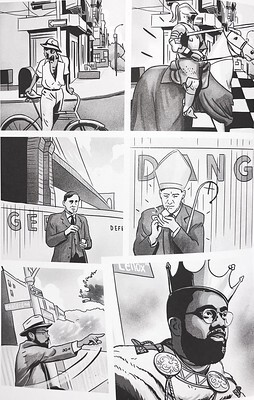
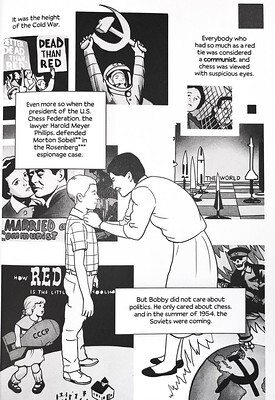
Bobby Fisher had his moment as a household name in the US chess world being a child chess prodigy, grandmaster and, later, World Champion only to more or less vanish into occasional scandal until his death in 2008. His rise to glory against Soviet chess players and his struggles with mental health and legal problems are chronicled in Black & White: The Rise and Fall of Bobby Fisher from graphic novel duo Julian Voloj and Wagner Willian. I had known little about the life of Fisher prior to reading and quite enjoyed the education though the delivery of the narrative feels more like begrudgingly completing an assignment than bestowing awe for a fascinating subject upon the reader. With serviceable art and a winding tale through the political landscapes that provided obstacles and platforms for Fisher’s career, Black & White is an interesting read even if relatively lifeless and provides an insightful look into the life of the chess champion. I’ve always had a fascination with chess and enjoy how it functions quite effectively as a metaphor or narrative focus in a lot of great literature around the world, lending tension and theme to novels from Stefan Zweig’s Chess Story to Walter Tevis’s The Queen's Gambit and Sally Rooney’s Intermezzo. While it was interesting to learn about Fisher, this graphic novel was more sluggish than stirring and seemed to present a broad array of facts without really putting any fire under the delivery. I did enjoy the aspects of visual narrative juxtaposed with the rules of chess in text and found the art to do a really great job at telling a lot of the story without relying on the text to uphold it, though aside from the rather sharp cover much of the art was rather emotionally lackluster. The more surreal moments, however, where Bobby sees the world around him as life sized chess in action were rather fun though. It was interesting to learn about this young prodigy and how he was helped into the chess world by those who recognized his early promise and covered his fees due to him coming from a family of a struggling single-mother who could not afford it. Fisher idolized the Soviet players only to go on and defeat them to earn a World Championship, though his respect for their playing also arrived alongside a “bad boy” attitude of mouthiness and disrespect that often raised eyebrows and brought about issues for him. Something this graphic novel really manages to achieve is its emphasis on how Fisher playing against the Russians was a cultural moment for the Cold War and how steeped in distrust and political maneuvering the chess matches with the Russians were in the US. The book, however, leaves much of the more controversial aspects implied and never quite addresses them head on. We do learn about Fisher’s paranoia and rather anti-semetic beliefs (though he himself was Jewish), his accusations of collusion amongst Russian players (which, apparently, is largely considered to be accurate) and how Fisher had to remain outside the US (playing in a tournament in Yugoslavia violated George Bush’s Executive Order 12810, something he spat at in an interview) but its all fairly vague. We do get some panels letting us know he got into some very anti-semetic literature and would often have outbursts that upset people, such as his interview on 9/11 where he said he was glad for what happened. Fisher would die ‘at the age of 64—the number of squares on a chess board’ in Iceland.
While Black & White made for an interesting read, it was a bit lackluster in delivery and never really found its stride. Still it was fascinating to learn about this major figure in chess and I’d recommend it to anyone who would like to know a bit about Fisher.
A fine dramatization of the life of chess genius Bobby Fischer.
While Fischer is often thought of as a prodigy, it is good to be reminded of the tremendous amount of study, practice, and competition it took for him to become an overnight sensation. It's also good to be reminded that even brilliant people can struggle with mental health issues.
This biographical comic explains how Fischer gained fame as a child chess prodigy, at one point being seen as something of a national treasure. But as time went on, his behavior became more abusive and erratic, eventually culminating in the man embracing hate group ideology and bizarre conspiracies. It's a sad and pathetic ending to his story.
This comic doesn't go too in-depth; it's rather a surface-level overview for casual readers.
Reading the final few pages, I thought that it is probably a good thing that Bobby Fischer did not live long enough to see the rise of social media political hucksters and the mainstreaming of fringe hate rhetoric. I could absolutely see this guy becoming an alt-right media personality and being embraced by a certain element of society, couldn't you?
A fine, fast review of the life of Bobby Fischer, chess prodigy turned conspiracy theorist. The largest portion of the book features the Iceland tournament in which Fischer became the first American world champion (defeating the Soviets). This part is legitimately interesting, especially with Fischer's many idiosyncrasies.
Beyond that, though, the tale moves so fast that details get lost. Basically, Fischer was a precocious kid who became a jerk and then a racist. You come away from the book thinking, "so the guy was good at chess, why's he get a book?"
Not sure how I missed all this tea behind the story of chessmaster Bobby Fischer, but this graphic novel whetted my interest to learn more. This one was very busy with chess instructions weaving in and out. Might have been a metaphor at work, but with this biography, I would think they already had plenty to work with, and might have benefited with some simplification.
This was my first time reading a graphic novel since school/high school. How well matched were the black and white graphics with the game of chess! The charm of this book lies in the details, like Bobbys checkered outfits. Definitely a must-read for all chess lovers!
Interesante figura la de Bobby. Novela gráfica muy accesible y con bonitas ilustraciones. Me ha parecido, sin embargo, que se dan grandes pinceladas y no profundiza mucho.
(3.5) Creo que es un cómic muy interesante y bien planteado sobre la historia de Bobby Fisher, al menos en la primera mitad. A partir de la mitad creo que se pierde mucho tanto el dibujo como especialmente el guión, que no termina de explicar el porqué del cambio de actitud de Bobby Fisher y su radicalización política. Guerra Fría y ajedrez.
Una lectura breve pero muy interesante sobre la vida de Fischer. Es interesante ver como se retrata superficialmente el macartismo que podían vivir él, su madre y su familia en general. También se me ha hecho especialmente interesante leer sobre su final. Lo desconocía totalmente, y lo único que sabía era que había perdido poco a poco la cordura, pero desde luego, no tenía ni idea de que hubiese caído en sectas o que le hubiera consumido de sobremanera la literatura conspiratoria. Lo del programa de radio en Japón durante el 11S me ha dejado de piedra por ejemplo. Los motivos por los que considero que es una novela de 4 estrellas (que entiendo que no todo el mundo le dará, pero que yo sí que siento que debo darle por haber aprendido con ella) son que ha habido partes que me han parecido algo inconexas dentro de cada capítulo (si es el estilo del autor, no termino de casar con él) y que a ratos el trazo y la forma de representar las escenas y los movimientos se me hacían monótonas. Pese a todo me parece una gran novela gráfica, muy disfrutable, y que hace un increíble trabajo a nivel biográfico, sintetizando mucho y con pequeños guiños a la cultura popular sembrados por toda la obra. Probablemente le recomendaría su lectura a cualquiera interesado por el personaje que trata, pero en general también a cualquiera con cierto interés por el ajedrez.
Uma história simples sobre um dos melhores jogadores do mundo, a sua ascensão e a sua queda. História fluida com um desenho simples fazem um romance gráfico que vale a pena ler. Um momento da história da guerra fria que se revive através do Xadrez.
I feel like this book really glosses over his abusive behavior and antisemitism. For a better look at those things, check out the episode of the podcast Behind the Bastards titled Bobby Fischer Chess Nazi.
The rise part of the book is interesting. The fall potion sheds no light on why Fischer disappeared into conspiracies. I didn’t need a psychological dissertation, but I expected an effort. The art is fabulous.
I waiver between 3 and 4 stars for this brief biography of Bobby Fischer, the most famous, then infamous American chess player. The thing that nudges me to four stars is that I was one of hundreds of thousands (millions?) who actually watched the Fischer-Boris Spassky World Championship ON TV in 1972, when people were still watching tv nightly, on the 3-4 available channels. Chess watched on tv, with tv trays with Salisbury steak and gravy in aluminum tins!! It happened! And I recall it! Night after night! And Fischer won!
Fischer was National US Junior Champion at 13, and National Champion (of adults!) at 14! Yes, we read about this in the papers and heard reports on the national (tv) news. He was a sensation. At one national tournament, he won all eleven matches, an unprecedented feat.
But Bobby was the Bad Boy of Chess, making snarky demands, insulting the Russians when he was there, boorish, late to matches, and so on. And after becoming World Champion, he mentally went almost immediately downhill, mentally, suddenly embracing various conspiracy theories alive at the time, especially anti-Semitic ones (and Fischer was a Jew). He became inaccessible, cut off from all others, including family. A rematch happened in 1992 improbably happened and again, Fischer won, and then was done in the public eye. He died young, in Iceland, where he had asked for asylum.
A bizarre tale that only gets introduced to new readers and chess players (or reminding older readers, as with me), with ok, largely uninviting art (though I like the cover. But it's a remarkable story, worth looking into. A story of mental health and conspiracy theory damage, which as we know is rampant today. But it was happening then, too.
Related: We recently rewatched The Queen's Gambit, on a fictional young woman's rise to chess stardom in Moscow, so good!!!
Also, there's a book and film, both great, Searching for Bobby Fischer, once very popular.
Bobby didn't like the Soviet Union, in part because his father was imprisoned in Hungary and Russia for the entirety of Fischer's life. It's a fact not mentioned in this book. Instead the Soviets are presented as magnanimous, and Fischer as a petulant nazi. The author has little interest in the games, not so much in Fischer's chess, as his use as a voice agains the US. His innovations are not mentioned, like the Fischer chess clock that adds a few seconds per move -used today, invented while he was "crazy", or the fact that he actually tutored great players of today, like Susan Polgar, or his charming writing and interviews, because these does not fit the crazy image the book is trying to present. Also not considered was the fact that, by asking for more money, Fischer paved the way to chess being taken seriously in the US. Such demands are considered signs of paranoia, or greed, or madness, but they were serious and should be taken so. And then there is the artwork of the book, it's not interesting, and in no way matches the exciting chess. Fischer's style of play was not only brilliant, but aggressive, making for games that were far more exciting than those of his Soviet opponents (Spasky was an exception here). Let the artwork show motion, ideas, but his art does not. It looks like photos redrawn. In his game of the century, Fischer kept offering free pieces to his much older, grand master opponent, Byrne. Finally, Byrne took one, the queen, and lost shortly thereafter. How is this game depicted. Completely dull. Two people looking at a board; Byrne has horses or donkeys in his eyeglasses. This artwork shows no sign of the excitement or innovation. I'm guessing that the animals are a political or social statement of some kind, but can't guess what. For an example of exciting artwork on a similar game, see "Hikaru no Go."
Black & White: The Rise and Fall of Bobby Fischer by Julian Voloj is a graphic novel that attempts to encapsulate the tumultuous life of chess prodigy Bobby Fischer. The book traces Fischer’s journey from a Brooklyn wunderkind to the world chess champion in 1972, and subsequently to his descent into paranoia and obscurity. Voloj, paired with artist Wagner Willian, uses a striking black-and-white art style to mirror the stark contrasts in Fischer’s life—genius and madness, triumph and tragedy. The narrative hits key milestones, like his iconic Cold War-era match against Boris Spassky, but often feels rushed, skimming over the psychological depth that could have made this a more compelling portrait. While the visual storytelling is ambitious, it struggles to balance Fischer’s complex personality with the constraints of the graphic novel format, leaving readers with a surface-level understanding of his rise.
The second half of the book, detailing Fischer’s fall, is where the cracks really show. His later years—marked by erratic behavior, antisemitic rants, and exile—are presented in a way that feels disjointed and underdeveloped. The artwork remains a highlight, with its bold contrasts capturing the chaos of Fischer’s mind, but the writing falters, leaning on exposition rather than nuance to explain his decline. For a figure as enigmatic as Fischer, the book misses an opportunity to delve deeper into what drove his genius or fueled his unraveling, instead offering a CliffsNotes version of a life that deserves more introspection. I’d rate it 2 out of 5—while the concept and visuals show promise, the execution lacks the depth and coherence needed to do justice to such a singular story.
Dieser biografische Comic erklärt, wie Fischer als Wunderkind im Schach berühmt wurde und eine Zeit lang als eine Art Nationalheiligtum galt. Doch im Laufe der Zeit wurde sein Verhalten immer ausfallender und unberechenbarer und gipfelte schließlich darin, dass der Mann sich der Ideologie von Hassgruppen und bizarren Verschwörungen hingab. Es ist ein trauriges und erbärmliches Ende seines Lebensweges, trotz seines Erfolges im Schach bleibt er rückblickend eine tragische Figur.
Als ich die letzten Seiten las, dachte ich, dass es wahrscheinlich gut ist, dass Bobby Fischer nicht lange genug gelebt hat, um den Aufstieg der sozialen Medien und die Verbreitung von Hass-Rhetorik mitzuerleben. Ich könnte mir gut vorstellen, dass dieser Mann zu einer Persönlichkeit der rechtsextremen Landschaft geworden wäre und von einem bestimmten Teil der Gesellschaft dafür bejubelt worden wäre. Dieser Comic geht nicht allzu sehr in die Tiefe, er ist eher ein oberflächlicher Überblick für Gelegenheitsleser.
I did a quick read of black and white the story of Bobby Fisher this morning, and I think it's a really good book. It did a nice job of explaining how the chess pieces move, which I think was targeted at a younger audience. And it really did a nice job showing how Bobby Fisher went from being obsessed with chess to being obsessed with conspiracy theories, the books makes a major tone shift when Fisher seems to drift off the deep end and fall prey to the madness inside his brain. A couple of interesting comic enhancements and inclusion of the guy from Pulp Fiction, a couple other textural jokes included, which made the reading that much better. And again, as a graphic novel, it's just so easy to read, so accessible. An excellent explanation of Bobby Fischer's history, as well as dealing with the unfortunate end of Bobby Fischer when he goes off the rails and pretty much loses his mind, a great quick read. I enjoyed black and white.
This book glosses over so many aspects of Fischer's life, including the intense obsessiveness of Fischer's childhood study habits, his friendship with Tal, the time he spent with the Polgar's, as well as his paranoia, antisemitism, and embrace of conspiracy theories and Nazi ideology. Sure, some of this is mentioned but in such a way as not to connect it with Fischer's past, nor in any way that draws the implications of the significance of mental disorder or moral and intellectual bankruptcy.
I found the framing of new chapters to be a bit annoying with the descriptions of piece properties overlaid on the illustrations, as if Fischer were still thinking about the rules of piece movement during the course of his life.
I don't expect a lot out of most graphic novels, but this just seemed half-assed.
Nice, easy to digest book about the eleventh world chess champion, Bobby Fischer. I liked how the book detailed Bobby’s early life and also gave basic information about how the game is played. The story continues on with Bobby becoming more engrossed in chess and details various tournaments. What really makes the book, though, are the illustrations, which are beautifully done and also convey a sense of the chaos and mental health issues Bobby eventually dealt with. Occasionally I was unsure of exactly what the illustrations were supposed to convey, which is why I gave it 4 stars, but in general, it was an excellent, quick read.
This was a wonderfully crafted GN, executed appropriately in black and white, and incorporating an explanation of the chess rules. It is ultimately a sad story of a true chess genius overcome by mental illness. His behavior in his later years badly marred his image and that is a large part of what is remembered about him.
Many reviewers confuse a story that is a sad one with awful actions by the protagonist as a bad book. But this GN is excellent, beautifully drawn and researched with rich characters and good pacing. It is Bobby Fischer that is the tragic figure and Voloj tells that well.
I love graphic novels but this more like reading a list of facts or even a biography written for elementary students accompanied by bland illustrations that don’t add anything, rather than an actual narrative told through both the writing and the art. The information itself was interesting but very surface level, and overall the book suffers from “telling” rather than “showing.” Overall, it’s fine enough but disappointing as both a biography and a graphic novel. Maybe I’ll feel differently on a reread but now? Pretty meh.
Komiksové zpracování životopisu americké šachové hvězdy druhé poloviny minulého století své čtenáře uchvátí výborným zpracováním. Kniha se čte téměř sama. Zaujala mě grafickým zpracováním, ale i příběhem. Život tohoto velikána židovského původu čtenáře v mnohém překvapí, zároveň vás utvrdí v tom, že nic nemusí být takové, jaké se to na první pohled zdá. Knihu mohu doporučit všem milovníkům komiksů a životopisů.
Gosto muito de Xadrez ♟️, mas nunca tive paciência para ficar a ver uma partida, lembro-me perfeitamente de Karpov e Kasparov. Nunca tinha ouvido falar de Fischer, é uma pena o que a saúde mental, paranóia podem fazer.... Infelizmente consequências trágicas, neste caso uma mente brilhante que se perdeu. Achei muito interessante esta NG pela história organizada por capítulos, em que cada capítulo é uma peça e que começa com as regras associadas a essa peça.
This entire review has been hidden because of spoilers.
I started reading this aloud to my chess loving son when he had the flu. While it was interesting, the turn of events in Bobby’s life were “hard to listen to” so he didn’t want to finish it. I finished it myself and learned quite a bit. I feel bad for Bobby, seems like he led a tortured genius life. I was surprised he only died in 2008, I thought he was older. The graphics format was well done, the whole book was in black and white / chess motif.
What a sad waste of a genius mind, descending into bigotry, paranoia, and hatefulness from such a promising start. The graphic novel does a pretty good job of telling Bobby Fischer’s story, but it is, of course, limited in scope. I think it has maybe told as much as I want to know, though.
Quick overview of Fischer’s life. I didn’t know much about him besides chess prodigy so it filled in some gaps but left me pretty curious about his life and want to know more.



![Profile Image for s.penkevich [hiatus-will return-miss you all].](https://i.gr-assets.com/images/S/compressed.photo.goodreads.com/users/1735525095i/6431467._UX200_CR0,11,200,200_.jpg)