Endorsed by the Frida Kahlo Museum in Mexico City, writer and illustrator Francisco de la Mora’s full-color graphic novel explores the public and private faces of the iconic artist.
Frida Kahlo, remembered as one of the most inspiring personalities of the 20th century, was a woman of two intertwined she was both a charismatic and empowered artist exploring themes of resistance, authenticity, cruelty, and suffering, and a more private person whose wounded body caused her a lifetime of pain that underpinned the many successes and disappointments that marked her time in the world.
Revealing and exploring these two Fridas, Francisco de la Mora’s graphic biography allows the reader to see just how far ahead of her time this complex artist was in her understanding of gender inequality and the culture of machismo, topics that remain relevant to this day and continue to lend resonance to Kahlo’s painting. Diego Rivera, Kahlo’s husband and fellow artist, described her work as “acid and tender, hard as steel but delicate and fine as a butterfly’s wing.” His words might apply equally to Frida herself.
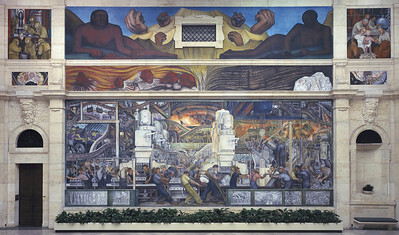
As inspiring an icon of fashion and personality as she was a painter and visionary, Frida Kahlo lived a short life but has been immortalized through her art and legacy. Francisco De La Mora's lovely graphic biography, Frida Kahlo: Her Life, Her Works, Her Home, takes us on an artistic journey through the life of the great artist, from her childhood sheltering the Zapataristas in her parent’s home, her tragic accident that left her bed-ridden for much of her days, her love for husband Diego Rivera, her miscarriages, and her travels to the US and Europe. Known for a folk art style with surreal imagery and arresting portraits, Kahlo’s work is immediately recognizable and often deals with themes of pain and, as described by André Breton, ‘wonderfully situated at the point of intersection between the political (philosophical) line and the artistic line.’ This short graphic novel is a lovely look into her life, illustrated in a style rather reflective of her own, and was a quick but enjoyable read. Growing up in Detroit, Mi, I had access to a truly amazing art museum, the DIA and was at all times waiting to visit it again. In one of the rooms was a large, 27 panel fresco depicting the Detroit auto industry in celebration of the worker, complete with a lot of rather surreal panels around it such as hands coming out of a mountain. I was enthralled by this—I mean it is huge and you can spin around and look at it for hours—especially so as my father worked for Ford Motor Co. and I saw this mural as celebratory of our family as well as the area I lived and so at a young age I became very interested in the art of Diego Rivera. Now Diego rules, but this fascination very quickly lead me to discover the artwork of Frida Kahlo and there, that was when I realized WOW I love art and this feeling of fascination and vague discomfort yet beauty I saw when I looked at it. I also loved knowing she had lived nearby during her time in the US with Rivera, it was like my first taste of “local pride” I think, even though the pair are usually associated with their home in Mexico (Kahlo and Rivera would live in two separate houses connected by a bridge, which I’ve always found rather lovely as they gave each other space but were never really apart). As a big fan of Kahlo, this of course led me to who I would probably now saw are my favorites, Remedios Varo and Leonora Carrington, but I always think about the amazing work Kahlo did in her short life. Diego Rivera mural at the Detroit Institute of Art
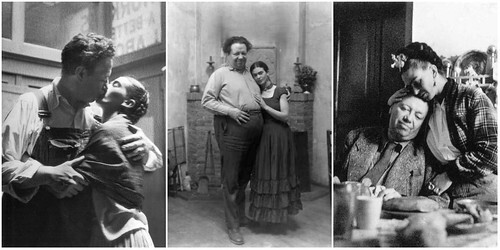
I enjoyed this little graphic novel and while it was rather brief, it does cover a lot of details about her life and never feels like it is overly shallow but also doesn’t overload you with details and dates. You see the important things and I learned quite a bit I didn’t know. She lived a fascinating life, and while she was hindered by chronic pain she knew many famous people and did incredible things. Being stuck in bed for over a year after the accident on the bus led her to begin painting a lot and many of her works depict pain and herself laying down as she was not very easily mobile, which is tragic as she already had difficulty with mobility during her childhood due to polio. But here we get to see her life with Diego, having Leon Trotsky live in her home when he fled Russia, Frida finding André Breton but thankful he gave her an exhibit in Paris (though she did not enjoy Europe and spent much of her time there in the hospital) and more. The art is done in a rather folk art way (not unlike Kahlo’s) and I enjoy the large frames though some of the looser art in the smaller frames seemed a bit lackluster to me and mostly just isn’t my favorite style. Still, it is quite pleasing and effective. Frida and Diego
I’ve long loved the works of Frida Kahlo and I hope this book inspires others to discover that same joy for themselves. This book seems more geared to someone still rather new to the artists and hoping to get a look at her biographical information more than those who would already be well-versed in her life but it is still a lovely read for anyone.
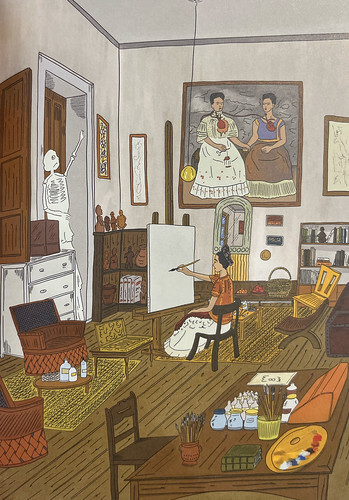
De la Mora imagines Kahlo (1907–1954) hosting a party at her famous blue house in Coyoacán, Mexico in her final summer – unknown to everyone there, it’s exactly one week before her death. “Hola, come in, welcome. I’m so glad you’re all here. Today is my birthday, and I want to tell all of you the story of my life…” she invites her guests, and thereby the reader. It’s a handy conceit that justifies a chronological approach.
I was reminded of traumatic events from Kahlo’s life that I’d already encountered in various places: childhood polio and the Mexican Revolution, the hideous bus accident that reshaped her body, and two miscarriages. Periods of confinement alternate with travels. We see her devotion to traditional dress and the development of her frank self-portraiture style. I’d forgotten, or never knew, that she married Diego Rivera twice and divorced in between. They hosted many cultural giants of the time, and both had their infidelities. I loved the use of vibrant colours, but learned little. This is really only an introduction for those new to her.
[The publicist only told me after I had posted my review that the book is geared towards a YA audience, something that was not previously made clear.]
Perfect for my high school library - a colorful rendering of the not so well known heartache and health history of the amazing Frida Kahlo. An engaging starting point for further research with meaningful graphics that don't shy away from the traumatic incidents in her life.
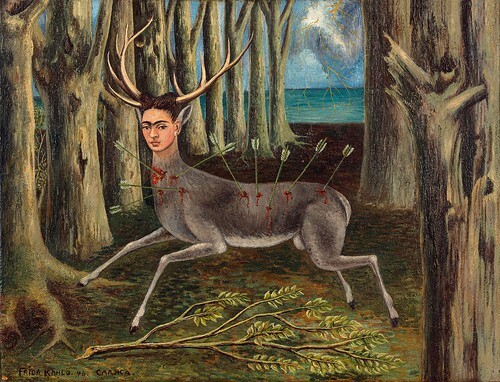
I truly enjoyed this graphic novel, both because of the way it tells Frida Kahlo's life story, and also how fitting the illustrations are - including some directly inspired by Frida's art!
This book is a great way to learn about Kahlo's life and art, and how her experiences of illness, pain, love and friendship shaped her art. It has given me insight into the process of an artist I knew and admired already, but I was really clueless about her life. I found it specially interesting that it's full of her own comments on what was happening to her through the inclusion of diary extracts, as well as her opinion and vision on art, artists and her own art too. I found specially touching how the graphic novel showed the role pain and disability had in her life (how she even painted through hospital stays!), and how her loved ones reacted to her situation and how that complicated their relationships... without giving away more details, I think the book approached this difficult subject in a very good way.
In conclusion, this graphic novel is a great way to get to know this fantastic artist and through that better understand her art and the author behind it too. Extra point for it, it includes a very handy timeline at the end :)
Thank you to the publisher who sent me a free copy of this book in exchange for an honest review.
This is a beautiful graphic novel that illustrates the complex and breathtaking life of Frida Kahlo. I learned so much about an artist I have admired for years from this book. I didn’t know Frida Kahlo struggled with stages of disability throughout her life, I didn’t know that despite suffering, challenged, and facing injustice, she persisted in being resilient through her love and passion for painting. I am inspired by Frida’s view of wearing clothing that are culturally and historically important to her, that she found balance between respecting tradition and finding her female independence. I would recommend this book to any of all ages. I highly recommend this book to middle school students, because it is during that period of time we begin to juggle expectations and asserting our identities.
Every once in a while, I pick up a graphic novel about a famous person or event in human history. This particular novel is a exceptional book about an exceptional lady and it’s sad to read and see she had such a hard life from the very beginning. A talented artist, Frida Kahlo, lived a tumultuous life with Diego Rivera. Having seen both of their work, Frida’s painting are far more emotional and deep and their effect is profound. This particular book does an exceptional job displaying the depth of Frida’s pain as the source of her soulful art. Like her exceptional paintings, I recommend this wonderful graphic novel highly. Rock on Frida. The world was and is a far greater place with you and your art in it.
While this graphic biography of Frida serves as a marvelous introduction to her for a younger audience, this was entirely disappointing if we are to evaluate it as a book targeted to adults. A few years back I read “Frida Kahlo: The Story of Her Life” by Vanna Vinci, which was one of the most beautifully illustrated, intelligently written, and lovingly dedicated graphic novels I’ve ever read. My inclination is to veer anyone interested in reading this book toward Vinci’s novel as it provides a much more in-depth exploration of Frida both as an artist and an individual.
This tribute to Kahlo is the perfect mashup of graphic art and memoir that captures what I've learned about Kahlo over the years in a succinct way that focuses on her art through many painful moments that act like markers to her life from polio at a young age, to the bus/tram accident, to her tumultuous relationship with Diego Rivera, the amputation of her leg, and death within a year of that.
It's achingly beautiful in its approach and does justice to her as a woman and an artist.
An interesting look at this Mexican artist who suffered so intensely and painted with such open and colorful abandon. I didn't know about her at all and then I saw a PBS special. When this book arrived in our library, I had to read it to see what else I could discover about this intriguing woman. Although graphics are not my favorite, it was a quick way to learn more about her.
Somewhat nice visuals, but otherwise such a boring story on such a diverse person like Kahlo. Also the time line in the end amused me: all relationships with men are listed but none with other women. And this is published in 2023.
A very quick read and light page turner. Some good points in this it’s just a little bit light. Would have been great to go a bit deeper and carry the biography a bit longer to help more of the moments in Frida’s life really shine.
Felt like too wide a lens, just hitting the highlights (and not going into depth there either). Wasn’t very fond of the art, either. I’ll have to keep looking for a better graphic biography.




![Profile Image for s.penkevich [hiatus-will return-miss you all].](/_next/image?url=https%3A%2F%2Fi.gr-assets.com%2Fimages%2FS%2Fcompressed.photo.goodreads.com%2Fusers%2F1735525095i%2F6431467._UX200_CR0%2C11%2C200%2C200_.jpg&w=128&q=75)


