Note - this is the same review I posted for episode 1, 2, & 3 as I’ve completed all releases episodes.
This is a webtoon that might sweep you off your feet, but it’s not a happy story. It’s full of rape, manipulation, mental illness, and violence. Other than the main character, Baek Na-Kyum, and a handful of supporting characters, few people in this series are decent or moral. Still, the art is gorgeous and the story compelling. I was completely immersed in its world for four days straight. I can’t wait for the next “season,” due any time now (it was originally scheduled to debut August 27th, 2021).
Note: I’m grateful that one of my undergraduates pointed out that Lezhin, the publishing company licensing the English version of the webtoon, reportedly is a scumbag corporation that takes advantage of, and sometimes doesn’t pay, its artists. It also reportedly charges draconian late fees if an artist isn’t on time submitting artwork. On the other hand, Byeonduck has filmed an interview for Lezhin and seems happy to work with them - but who knows what’s really happening. To avoid supporting a potentially repressive corporation, I bought a Japanese translation through CDJapan, hoping it wasn’t connected to Lezhin and hoping that the artist has a good deal with her Japanese distributors. There are a few illegal translation sites where people can read works such as this in English, but find someway of supporting the artist (which I’m hoping my CDJapan purchase does).
The story takes place in the Joseon dynastic kingdom in Korea, sometime during China’s Qing dynasty (1644-1912), as one character references the Opium trade, which flourished throughout this period. That’s a pretty broad stretch of time, but I haven’t found any other context clues to narrow it further.
While on the topic of history, I’d like to briefly mention a problem with Lezhin’s use of the words ‘sodomy’ and ‘sodomites’ in its translation. Granted, the author, Byeonduck, may have meant to use the Christian ‘sodomy’ libel in her work. But, historically in Korea, ‘sodomy,’ and, therefore, the Christian connotations that come with it, would not have been used. While modern Koreans are, in general, backwards in thinking of homosexuality as a disease, in Ancient Korea it was acknowledged as a common practice without negative moral connotations until the Choson dynasty, when it was considered wicked by the upper-middle classes. Nevertheless, homosexual practices were reportedly common across socioeconomic strata. Rather than ‘sodomy,’ Lezhin could have translated any number of period and culture appropriate terms for use in this webtoon/book.
So, what is Painter in the Night about?
Baek Na-Kyum is a naïve teenager with a keen haptic ability to paint what he remembers and feels. What he wants most in life is to love someone he can believe in, and to be loved with whatever amount of affection an illiterate peasant boy can find. These simple, honest desires put him at the mercy of older, more powerful men who want to use his talent and his body, and who want to break his emotionally forthright spirit.
Seung-Ho is a young, wealthy aristocrat who has made Na-Kyum work as his personal painter, specifically to paint scenes of his frequent orgies with other aristocratic men. But he soon can’t take his eyes off the beautiful Na-Kyum, and grows increasingly possessive of him. Unbalanced and psychologically unstable, Seung-Ho takes his anger out on his servants for not properly caring for Na-Kyum. He also stops hosting his regular orgies, which leaves Jihwa and Min, two local young lords, looking for revenge. It’s at this point that the threats and subterfuge surrounding Na-Kyum multiply, but, having no experience outside of his simple upbringing, he’s unable to understand what’s happening around him.
There’s a bit too much of the female revenge fantasy in this webtoon, where a young man, instead of a young woman (which is usually the case), is placed at the mercy of older, stronger, sadistic men. We see so many close-ups of Na-Kyum crying that it’s a wonder he doesn’t become dehydrated half way through the series. His boyishly feminine looks, that slightly girlish blush on the cheeks of boys just before they grow into men, is played for all it’s worth and more. In many panels, Na-Kyum looks like a girl with a shaggy bob hairstyle, though he’s clearly a boy in others.
It could all be chalked up to the tired - if at times true - contention that the uke is portrayed in a feminine way in order for female BL readers to “identify” or “project” themselves into the male uke. Never mind that empirical data from the last decade or so shows that, more typically, women identify with both the seme and uke in such stories, depending on their mood as readers or what the author does with the plot or the character’s development. According to Nagakubo Yoko’s 2005 quantitative analysis of BL themes, its more about “playing with gender” than identifying with the uke.
Yet Na-Kyum comes off as a believable character because, really, what teen wouldn’t be scared out of his wits when faced with the sociopathic lust of a rich, strong, and politically powerful aristocrat like Seung-Ho? What teen, boy or girl, wouldn’t do anything for their beloved role model, educator Jung In-Hun, to care for them, to save them? Unfortunately, in reality, Jung In-Hun is an egotistical, morally bankrupt piece of s**t, but how is a poor boy from the country to know? More than one young person has been fooled by the pompous posing of an educated pig.
Is not just the sexual violence, but also men debasing themselves that’s part of the revenge fantasy aspect of BL. Men acting like stereotypically hysterical women, throwing the canard that women are emotionally unstable and sexually desperate back onto men, is a trope that’s on full display in Painter of the Night. In a nutshell: Seung-Ho’s huge penis and charismatic, if unstable, masculinity drive the young men in other noble families to distraction. All the young male aristocrats want a piece of Seung-Ho’s dick. Here we find another, centuries old myth: the more wealthy and civilized a group becomes, the less masculine and more feminine it is (see, for example, internationally acclaimed scholar Nell Irvin Painter, whose book, “The History of White People,” traces this and other myths). At least half the young, aristocratic males fall into this category. There’s Min, the jaded “bitch” figure who get’s off on other’s misfortune, and Jihwa, the jilted, crazed mistress figure. The more jealous Jihwa gets, the more he loses his masculinity and becomes a feminine harpy, an attribute emphasized in scenes with the mysterious, square-jawed, and hyper-masculine assassin. That the assassin is astoundingly beautiful brings to mind Ralph Waldo Emerson’s fevered, nearly homoerotic imaginings of the ultra-masculine, transcendently beautiful, and totally mythical Anglo-Saxon warrior. True masculine beauty lies in those who are closest to barbarism, so goes the thinking, and a brooding hunk of an assassin falls into this category. But it’s not just beauty that we find in barbaric peoples, but honor and morality, to; the “barbaric” assassin is too noble to be hypocritical, proving himself more honest and ethically upright, in his own way, than the morally dissolute, if “civilized,” Jihwa.
Meanwhile, the heteronormative common folk, the rugged, if plain, males, who wear their everyday masculinity like they breathe the air, and the working women, proper folk who know their gender role, shake their heads at the overwrought, gender-confused feminine behavior of their social superiors.
Not that anything is ever so clear-cut. The upside to the revenge fantasy motif is that it creates mental and imaginative space for reimagining gender and societal relationships. This is a huge benefit of BL. It’s just that, in Painter of the Night, this motif is unrelenting and even a bit over the top.
Even so, and despite the fact that I am attracted to effeminate men (well, used to be, before I got married), I find the tendency to over-do the feminization of boys and men a bit tiring. This is more a critique of the genre, but, still, in this BL Na-Kyum is frequently likened to a bride or fiancée. One scene has a group of commoners talking about the “womanly wiles” that Lord Yoon Seung-Ho’s “fiancé” must have used to lure him away from men, not realizing this fiancé is a boy and so solidifying the feminization of Na-Kyum in a not-so-subtle block of concrete. Painter in the Night also builds on the myth of the erogenous male prostrate, as if it is some miraculous organ that makes men orgasm repeatedly (like women) or sends them to sexual nirvana. I’m a guy - it isn’t and it doesn’t, and although I’m a life-long top with decades of experience, I’ve certainly bottomed enough times and explored other men’s anatomy to know (for my husband of 20 years, prostrate play is a yawn fest). But despite the abuse Na-Kyum suffers, somehow this secret, mythical feminizing prostrate makes the abuse all better when touching it causes him to ejaculate. (Na-Kyum is also pictured with his anus “getting wet” for Seung-Ho. Subtle).
Worse, in the second season, after a sexual assault that leaves Na-Kyum in a near coma from the first season, Seung-Ho assaults him even more violently by re-enacting the “she said no but meant yes and wanted me to bang her senseless” defense of so many violent, sociopathic men. But this time the victim is a boy in the Joseon era with no hope of rescue or safety. The author and much of her audience seem to take delight in these re-enactments. Yes, sex often has a component of violence, but with your partner it is a controlled “violence” and keyed to their satisfaction and needs.
Reading this webtoon, with all of these issues, I’m waiting for the hero to break down the door and save the day. But, in this series, I’m not sure there is a hero - just villains and victims. Maybe it’s because it doesn’t follow the “lover as savior” trope that it is so fascinating. Well, that and Byeonduck is a gifted illustrator and excellent storyteller.
Still, I keep reading because I cling to a Pollyanna belief that there is justice in the universe. But the universe is a morally vacant space. Any moral arc we perceive is a structure of our own making, and more often than not injustice thrives like kudzu. But, again, I keep reading.
So, it says something that, despite the openly prurient themes, Painter in the Night goes beyond the raw sex, violence, and revenge fantasies, to make us feel intensely about these characters. Despite any of the criticisms above, it’s a great webtoon that totally captivated me for several days straight.
Byeonduck’s gorgeous illustrations sometimes have the low-fi feel of 1950’s color illustrations, where darks and lights weren’t achieved through the use of color (as with the Impressionists, who used deep blues, reds and purples for shadows), but rather by adding black. This isn’t a criticism, because the effect is perfect for the story. At the same time, if you read it online where you can zoom in, you’ll see that texture plays a key role in how our eyes respond to the artwork. I believe at least some of the images in the first season were first painted on textured watercolor paper (even though a Lezhin interview with her shows her working exclusively on a Cintiq Pro tablet). (The webtoon is divided into seasons rather than “volumes”). You’ll see the texture by zooming in. This effect can be added digitally, but there’s an almost too feint grid on a number of early panels that has clearly been painted over with real, not digital, paint - the paint gathers in places on the pencil lines that didn’t receive enough pressure to leave a uniform deposit of graphite. On other panels, you barely register the watercolor paper’s texture, but it’s there. The cumulative affect is that the subtle variations of color that come from the pigment pooling in the troughs of the textured paper give the art a lush atmosphere throughout. However, by season 2 these grid lines disappear and the texture seems to be added digitally - but the lush quality of the color remains.
Be that as it may, in season 1 it’s clear the artist scanned some art and then added digital drawing on top - closeups of eyes, for instance, or sun spots in a blue sky, give a totally different color feel than traditional media, a uniformity and density that you only get from digital media).
Typically, the chroma (i. e., the color saturation or intensity) is dialed down in 95% of any given panel’s surface area, but is then dialed up in the remaining areas, say, with a slightly more intense red on the cheeks as a character blushes. (It’s also in the close-ups of faces that the artist moves away from tonal color and allows herself a broader spectrum to convey skin tone). The end result is a feeling of overall intensity because of the contrast between large areas of low saturation with the smaller areas of greater saturation that call out to the viewer’s eye. The artist, similarly, takes advantage of complimentary contrast: large surface areas feature low-saturation colors that are enlivened by the careful placement of complimentary colors in smaller areas (e.g. the vibrant blue and orange resonance of colored squares on a blanket). (Ironically, because the artist is banned from depicting genitalia, she leaves penises and testicles white. This has the effect of intensifying the sexual organs more than simply illustrating them would. Against the beautiful colors used for flesh and backgrounds, these “erased” penises glow with the seething intensity of a white hot flame).
Night scenes are especially well handled. They brought to mind the skill with which Rockwell Kent painted winter scenes at night, where the brilliant white snow becomes a muted purple-gray, but still seems brilliant when placed against the charcoal grays and midnight blues seen on a nighttime walk. (The Met in New York and the Cleveland Museum of Art have excellent examples of Kent’s skill in using color for dusk and night scenes; I can’t recommend most of his work, especially his figurative pieces, but the guy knew how to use color). Likewise, Byeonduck’s scenes capture what nighttime looks and feels like in a way no camera can match. The same is true for early morning or foggy day scenes. For instance, I can feel the moist, foggy countryside through the diaphanous muting of greens and browns by a subtle, ghostly wash of silvery white over parts of the landscape.
Byeonduck is skilled in depicting body language and the natural flow of bodies in space. Once in a blue moon you might see a mannequin-like figure in this series, but the fears, desires, anxieties, shock, and physical pain we feel in each body comes directly from Byeonduck’s mastery of drawing figures that have a full range of emotional expression. 99% of the time, even background figures are shown in natural, evocative poses.
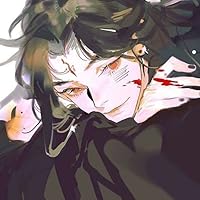
Byeonduck’s skill includes drawing the borderline-psychotic expressions that wash over Seung-Ho’s face like a wave of carpet bombs. His wide-eyed stare, a piercing gaze thrown from his head being tilted away and at an angle from the object of derision, seem to hint at the onset of madness. His blood-red irises and pin-head pupils float in the sclera’s center, touching neither the top nor bottom lid, promising either violence or, worse, a twisted deviousness that will tear someone’s life apart from the inside out. Perhaps worse is the quiet, cold, calculating stare as he weighs the best way to manipulate or undermine someone. Against this behavioral backdrop, it’s all the more remarkable when his gestures become protective and tender towards Na-Kyum. Of course, any tenderness offered by a narcissistic manipulator has a short expiration date.
I’ve talked about Na-Kyum, but what else can be said about Seung-Ho? He is a man fascinated with dominating others, and this means socially, physically, politically and sexually. His is the stereotypical male gaze taken to the extreme: he wants to watch and cherish every second of his domination, and the signifiers of his domination are pain and discomfort.
Added to his social and legal status as a noble, is his muscular body and long, thick endowment. It’s not enough for him to force submission simply because of his social standing, he wants other men to submit through the pain and desire he creates with his dick. His expressions bespeak a creature who wants to hold on to every twist, cry, and jolt of pain he creates by being inside another man. His ego swells when he hurts people and they come back for more. He is captivated with the entire process and eliminates any threat to his solipsistic pleasures.
But then he meets Na-Kyum. When his behavioral patterns begin to break down in the face of Na-Kyum’s youthful earnestness and tenacity, he doubles down. Na-Kyum, foolishly loyal to the treacherous Jung In-Hun, doubles down, too, and tries to escape more than once. Through it all, Seung-Ho unleashes himself on and in Na-Kyum’s body, but, in the exertion it takes to bring Na-Kyum to heel, discovers affection for the young man.
I won’t spoil the ending of season 2. But I will say both seasons together form a deeply satisfying, if troubling, storyline that has the tragic sense of an 18th century novel, but one which ultimately has an “overcoming all obstacles” aesthetic to please 21st century readers.
Triggers: Rape, emotional and physical abuse, manipulation, violence