

What do you think?
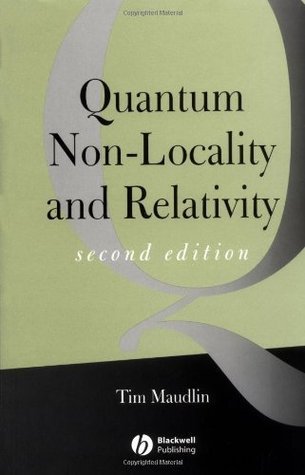
Quantum Non-Locality and Relativity: Metaphysical Intimations of Modern Physics, Second Edition
Modern physics was born from two great revolutions: relativity and quantum theory. Relativity imposed a locality constraint on physical theories: since nothing can go faster than light, very distant events cannot influence one another. Only in the last few decades has it become clear that quantum theory violates this constraint. The work of J. S. Bell has demonstrated that no local theory can return the predictions of quantum theory. Thus it would seem that the central pillars of modern physics are contradictory. Quantum Non-Locality and Relativity examines the nature and possible resolution of this conflict. Beginning with accurate but non-technical presentations of Bell's work and of Special Relativity, there follows a close examination of different interpretations of relativity and of the sort of locality each demands. The story continues with a brief discussion of the General Theory of Relativity. This second edition also includes a new author's preface and an additional appendix. The book introduces philosophers to the relevant physics and demonstrates how philosophical analysis can help to resolve some of the problems. All of the physics is presented from first principles, and as much as possible is presented pictorially.
296 pages, Paperback
First published January 1, 1994
Ratings & Reviews
Friends & Following
Create a free account to discover what your friends think of this book!
Community Reviews
Displaying 1 - 10 of 10 reviews
August 14, 2015
So. I have a bone or two to pick with this book. Yes I gave it four stars (tbh I wanted to give it 3.5 stars but I'm choosing to round up) because it improved towards the end and, for all the rage I felt when reading chapters 3 & 4, this book still has value. But I swear to God there were times (particularly in the middle of the book) where I wanted to scream at Maudlin. I kept returning to the (glowing) reviews on the Goodreads page, praising how accessible this book is and I kept muttering to myself, are all these people really reading the same book that I am? Did these reviewers actually bother reading through the book properly or did they just skim the surface of Maudlin's exposition and go, "Oh! Quantum Physics and relativity has, like, consistency issues because of the quantum correlations that violate Bell's Inequalities and it's suuuuuper hard to derive a coherent interpretation. This is like super deep stuff, man."
Well, to paraphrase what Hilary Putnam told a philosophy professor of mine: Any understanding of the world that can be put in a nutshell deserves to be put in one.
So what drove me up the wall? I've found that I absolutely cannot tolerate it when a writer introduces new terminology without properly defining what the hell they are. The first two chapters are fine - I remember feeling very happy with what I was reading, and pleased that the mathematics regarding polarizers and Lorentz transformations were simple enough to handle; but by the time I got to chapters 3 and 4, the reading experience just became incredibly tiresome and frustrating when I would have to wade through terminologies and new concepts like "Godel's Universe", "commutators" etc., stuff which was just thrown into the discussion in a very ad hoc manner, and this was incredibly offputting because as a reader who only has a rather general understanding of physics (I have some mathematical background and I did the PHYS 130s sequence in UChicago), I was already having to put in a decent amount of effort into trying to (1) follow Maudlin's arguments, and (2) keep the bigger picture in mind.
Now if this was a book intended for the specialist, then I'd be less angry and acknowledge that perhaps I needed some foundational knowledge in order to properly appreciate the merits of this book. Except that Maudlin writes this in the introduction:
Yes, Monsieur, the Key-word is "non-specialist". So, suffice it to say, I did not appreciate it when I would be repeatedly ambushed by statements like:
Especially since "isotropy" was not defined earlier.
Maudlin also writes that:
I appreciate the difficulty that Maudlin that faces, and it is this balancing act that leads to the occasionally annoying situation where a bunch of mathematics are strewn together without much of an explanation (e.g. in the technical interlude on pages 78-9, why would the change in the Hamiltonian operator A with respect to parameter b be defined as a commutator?). I can sympathise with this, however there were other times where Maudlin's exposition suffered from some unclarity that had nothing to do with this. For instance, in Chapter 3, Maudlin explains why particles cannot accelerate beyond the speed of light by the following:
He later then goes on to introduce Tachyons, or superluminal particles:
Now, intuitively, given his earlier explanation about why particles cannot travel beyond the so-called light barrier (e.g. it would require infinite amounts of energy to offset the infinite increase in mass), wouldn't Tachyons face the same problem as well? Why does it require infinite amounts of energy to accelerate subluminal particles near light speed but Tachyons are able to travel at superluminal velocities just fine?
After 5 mins worth of googling, I realised that the answer had to do with the equation m*[(1− v^2/c^2)^(-0.5)] (where m describes the object's rest mass, v its velocity and c the speed of light), which Maudlin had quoted before on numerous occasions. The reason why light's velocity acts a constraint to both subluminal and superluminal particles is because the closer some given particle's velocity gets to the speed of light, the whole equation approaches a singularity. Maudlin didn't state anything wrong in these pages, but he should have made the equation much more central to his explanation of what was going on. Perhaps he could have discussed the relevant constraints on particle velocity with regards to light's velocity the same way he discussed the probabilities of a photon passing or getting absorbed by a polarizer, i.e. by drawing a graph, illustrating the equation.
Sidenote: I did, however, appreciate the generalised version of Bell's Theorem presented in Chapter 4 and I thought that the proof was clever. I want to point out a tiny lemma which Maudlin uses to create the bounds of the generalised form of Bell's inequalities:
Maudlin's proof of this lemma appeals to how the given equation is a linear function of its four variables and how it takes its extreme values at the extreme ends of its domain. I think there's a more intuitive and straightforward way of proving this. Here's my proof of the Lemma:
So what did I like about this book? I think, for all its sins, it's a book that has moments of clarity and does a lot of useful conceptual housekeeping, particularly when it comes to taking stock of the physicists' attempts to design a relativistic theory that accommodates the violations of Bell's Inequalities (e.g. John Cramer's backward-and-forward hypothesis, many-minds ontology, relativistic flashy GRW etc.), and always making sure to identify what epistemic price we pay by opting for one interpretation of the results over another. Further, if Maudlin has not strawmanned the arguments put forward by the various noted physicists on this issue, then I think I feel safer in Maudlin's hands than in these physicists since some of their ideas seem very wishy-washy and dissatisfyingly speculative to me.
The structure of this book is also sensible, which is certainly a plus; these chapters build upon each other and explore different nooks and crannies in trying to weld together a coherent interpretation of the physical universe given the presentation of the problem in Chapter 1. Within the chapters themselves, Maudlin usually provides a good motivation for the important issues at hand, he asks sensible questions about their implications whilst also building up enough machinery for detailed analysis.
I also think that the new Chapter 10 is very good, and its addition to the 3rd edition of this book is a welcome one. It certainly gives a very helpful bird's eye view on where modern physics is at the moment. (Also, for some reason, I found Maudlin a little less stingy when it comes to providing the general reader with intuition in this chapter - perhaps it might've been because I already went through the fire of the earlier chapters, so I found the material less frustrating, but I think that Maudlin did make a conscientious effort to reduce the opacity of his exposition. Thumbs up for that, Maudlin.)
As a final note, I did finish this book wishing for more information about the "metaphysical intimations" of modern physics, beyond just examining the ontology presupposed by the various relativistic theories (e.g. the matter density ontology, the flash ontology etc.), but I think Maudlin addresses this in a later book, titled "The Metaphysics within Physics". I look forward to reading that.
Well, to paraphrase what Hilary Putnam told a philosophy professor of mine: Any understanding of the world that can be put in a nutshell deserves to be put in one.
So what drove me up the wall? I've found that I absolutely cannot tolerate it when a writer introduces new terminology without properly defining what the hell they are. The first two chapters are fine - I remember feeling very happy with what I was reading, and pleased that the mathematics regarding polarizers and Lorentz transformations were simple enough to handle; but by the time I got to chapters 3 and 4, the reading experience just became incredibly tiresome and frustrating when I would have to wade through terminologies and new concepts like "Godel's Universe", "commutators" etc., stuff which was just thrown into the discussion in a very ad hoc manner, and this was incredibly offputting because as a reader who only has a rather general understanding of physics (I have some mathematical background and I did the PHYS 130s sequence in UChicago), I was already having to put in a decent amount of effort into trying to (1) follow Maudlin's arguments, and (2) keep the bigger picture in mind.
Now if this was a book intended for the specialist, then I'd be less angry and acknowledge that perhaps I needed some foundational knowledge in order to properly appreciate the merits of this book. Except that Maudlin writes this in the introduction:
My foremost goal in composing the book has been to make it comprehensible to the non-specialist. [...] Unfortunately, much of the work done by philosophers presupposes a considerable amount of familiarity with the physics. This is particularly sad since the physics is not, in most cases, very complicated. (Maudlin, vii)
Yes, Monsieur, the Key-word is "non-specialist". So, suffice it to say, I did not appreciate it when I would be repeatedly ambushed by statements like:
It is true that the signal propagation may be isotropic only in the rest frame of the emitter, but so too are water waves isotropic only in the rest frame of the water. The laws of nature do not pick out any particular frame, only the distribution of matter does. (Maudlin, 94)
Especially since "isotropy" was not defined earlier.
Maudlin also writes that:
"I fear that many readers may be frightened off from the topic by unnecessary formalization, so I have tried to keep the mathematical complexity of the discussion to a minimum. But on the other hand, I have not wished to drop to the level of vague metaphor which sometime infects popularizations. Every compromise between rigor and simplicity is a bargain with the devil. (Maudlin, vii)
I appreciate the difficulty that Maudlin that faces, and it is this balancing act that leads to the occasionally annoying situation where a bunch of mathematics are strewn together without much of an explanation (e.g. in the technical interlude on pages 78-9, why would the change in the Hamiltonian operator A with respect to parameter b be defined as a commutator?). I can sympathise with this, however there were other times where Maudlin's exposition suffered from some unclarity that had nothing to do with this. For instance, in Chapter 3, Maudlin explains why particles cannot accelerate beyond the speed of light by the following:
"Furthermore, as the velocity approaches the speed of light, the mass approaches infinity, and hence it requires unbounded amounts of energy to get the particle to go faster. Given that only finite amounts of energy are available, it would follow that no particle which travels below the speed of light can ever be accelerated to, or beyond, that speed. So the speed of light does serve as a limit on the velocities of particles which start out traveling at sublight speeds". (Maudlin, pg. 63)
He later then goes on to introduce Tachyons, or superluminal particles:
"The Lorentz transformations and the relativistic mass increase do not per se rule out superluminal particles (tachyons), but only prohibit the acceleration of particles through the light barrier. Tachyons must be born traveling faster than light and (as we will see) cannot be slowed to sublight speeds." (Maudlin, pg. 65)
Now, intuitively, given his earlier explanation about why particles cannot travel beyond the so-called light barrier (e.g. it would require infinite amounts of energy to offset the infinite increase in mass), wouldn't Tachyons face the same problem as well? Why does it require infinite amounts of energy to accelerate subluminal particles near light speed but Tachyons are able to travel at superluminal velocities just fine?
After 5 mins worth of googling, I realised that the answer had to do with the equation m*[(1− v^2/c^2)^(-0.5)] (where m describes the object's rest mass, v its velocity and c the speed of light), which Maudlin had quoted before on numerous occasions. The reason why light's velocity acts a constraint to both subluminal and superluminal particles is because the closer some given particle's velocity gets to the speed of light, the whole equation approaches a singularity. Maudlin didn't state anything wrong in these pages, but he should have made the equation much more central to his explanation of what was going on. Perhaps he could have discussed the relevant constraints on particle velocity with regards to light's velocity the same way he discussed the probabilities of a photon passing or getting absorbed by a polarizer, i.e. by drawing a graph, illustrating the equation.
Sidenote: I did, however, appreciate the generalised version of Bell's Theorem presented in Chapter 4 and I thought that the proof was clever. I want to point out a tiny lemma which Maudlin uses to create the bounds of the generalised form of Bell's inequalities:
"If x′, x′′, y′ and y′′ are all numbers that lie between -1 and 1 (inclusive), then the quantity x′y′ + x′y′′ + x′′y′ - x′′y′′ lies between -2 and 2 (inclusive)"
Maudlin's proof of this lemma appeals to how the given equation is a linear function of its four variables and how it takes its extreme values at the extreme ends of its domain. I think there's a more intuitive and straightforward way of proving this. Here's my proof of the Lemma:
Case 1: y' > y''
(i) x'y' + x'y'' + x''y' - x''y''
= x'*(y' + y'') + x''*(y'-y'')
≤ y' + y'' + y' - y''
≤ y' + y' = 2y' ≤ 2
(ii)
x'y' + x'y'' + x''y' - x''y''
= x'*(y' + y'') + x''*(y'-y'')
≥ -(y' + y'') - (y'-y'')
= - y' - y' = -2y' ≥ -2
By (i) and (ii), -2 ≤ x'y' + x'y'' + x''y' - x''y''≤ 2 if y' > y''.
Case 2: y' = y''
Then: x'y' + x'y'' + x''y' - x''y'' = x'(2y')
= 2(x'y'), which is obviously bounded by -2 and 2.
Case 3: y' < y''
(i) x'y' + x'y'' + x''y' - x''y''
= x'*(y' + y'') + x''*(y'-y'')
≤ y' + y'' + y' - y''
≤ y' + y' = 2y' ≤ 2
(ii)
x'y' + x'y'' + x''y' - x''y''
= x'*(y' + y'') + x''*(y'-y'')
≥ -(y' + y'') + (y'-y'')
= - y'' - y'' = -2y'' ≥ -2
By Cases 1 - 3, we prove the stated lemma as above.
So what did I like about this book? I think, for all its sins, it's a book that has moments of clarity and does a lot of useful conceptual housekeeping, particularly when it comes to taking stock of the physicists' attempts to design a relativistic theory that accommodates the violations of Bell's Inequalities (e.g. John Cramer's backward-and-forward hypothesis, many-minds ontology, relativistic flashy GRW etc.), and always making sure to identify what epistemic price we pay by opting for one interpretation of the results over another. Further, if Maudlin has not strawmanned the arguments put forward by the various noted physicists on this issue, then I think I feel safer in Maudlin's hands than in these physicists since some of their ideas seem very wishy-washy and dissatisfyingly speculative to me.
The structure of this book is also sensible, which is certainly a plus; these chapters build upon each other and explore different nooks and crannies in trying to weld together a coherent interpretation of the physical universe given the presentation of the problem in Chapter 1. Within the chapters themselves, Maudlin usually provides a good motivation for the important issues at hand, he asks sensible questions about their implications whilst also building up enough machinery for detailed analysis.
I also think that the new Chapter 10 is very good, and its addition to the 3rd edition of this book is a welcome one. It certainly gives a very helpful bird's eye view on where modern physics is at the moment. (Also, for some reason, I found Maudlin a little less stingy when it comes to providing the general reader with intuition in this chapter - perhaps it might've been because I already went through the fire of the earlier chapters, so I found the material less frustrating, but I think that Maudlin did make a conscientious effort to reduce the opacity of his exposition. Thumbs up for that, Maudlin.)
As a final note, I did finish this book wishing for more information about the "metaphysical intimations" of modern physics, beyond just examining the ontology presupposed by the various relativistic theories (e.g. the matter density ontology, the flash ontology etc.), but I think Maudlin addresses this in a later book, titled "The Metaphysics within Physics". I look forward to reading that.

August 30, 2017
A thorough examination of the apparent conflict between the Lorentz invariance of special relativity and the Bell inequality violation of quantum mechanics. Maudlin shows that Lorentz invariance by itself isn't enough to rule out superluminal transmission of matter, energy, signals, information, or causal influences; that Bell inequality violation doesn't require superluminal transmission of matter, energy, or signals, but does require superluminal information transfer and causal influence. As pointed out in Chapter 3, tachyons (superluminal particles) are consistent with Lorentz invariance but turn out to be inadequate for mediating the superluminal causal influences in quantum systems. In particular, despite the possibility of Lorentz invariant superluminal behavior, any description of Bell inequality violation (illustrated throughout mostly by polarization measurements of a pair of photons entangled in a singlet state) seems to require some spacetime structure beyond the Minkowski metric, which violates Lorentz invariance.
In the end, we're left with a number of options: we can reconcile this conflict by rejecting counterfactual definiteness (and embracing a many-worlds or many-minds interpretation, although Maudlin regards the former as incoherent), positing some form of retrocausation, a scheme called "hyperplane dependence", or simply rejecting Lorentz invariance as a fundamental fact about spacetime (which requires that we explain why spacetime appears Lorentz invariant most of the time). The last chapter also describes a recent discovery: the "flash ontology" for GRW theory (a stochastic dynamical collapse quantum theory) seems to provide a Lorentz invariant description of Bell inequality violation. Maudlin seems to think "flashy GRW" is sufficiently counterintutive that we should not necessarily consider it more appealing than the above options.
In the end, we're left with a number of options: we can reconcile this conflict by rejecting counterfactual definiteness (and embracing a many-worlds or many-minds interpretation, although Maudlin regards the former as incoherent), positing some form of retrocausation, a scheme called "hyperplane dependence", or simply rejecting Lorentz invariance as a fundamental fact about spacetime (which requires that we explain why spacetime appears Lorentz invariant most of the time). The last chapter also describes a recent discovery: the "flash ontology" for GRW theory (a stochastic dynamical collapse quantum theory) seems to provide a Lorentz invariant description of Bell inequality violation. Maudlin seems to think "flashy GRW" is sufficiently counterintutive that we should not necessarily consider it more appealing than the above options.

February 13, 2014
For those, like me, who have been troubled over the decades by violations of Bell inequality, then this is a must read. This is true even if the competence you bring to the book is limited.
Requisites:
For a full critical understanding--which I did not obtain--you should understand calculus to the point of partial derivatives and should also know probability notation. Without this, the gist of arguments can be understood by anyone who does not shy away from symbolic presentations and logic (assuming a very minimal numeracy).
Appendix B, an introduction to quantum mechanics, will give one a sufficient understanding of vector states, and some generalities about classes of operators that affect their evolution (without going into unneeded detail about Hamiltonian operators). For those whose education (but not aptitude) was less numerate, one read won't suffice; I flipped back and re-read selected passages. (It is not however a reference and is never intended to be one.)
The author is a philosophy professor but he avoids having the field's terminology obscure his presentation. If one isn't already familiar with evaluating causation through counterfactuals, one can pick it up contextually. More sophisticated understanding of this and a few other issues are only needed if one wishes to follow the defensive arguments the author mounts against potential attacks from his peers.
Substance:
The author shows quite convincingly that the violations of Bell inequality (and the broader issue that was tersely represented by Bell) create deep problems (although a few claimed problems are dismissed with equal authority). He shows too, illustrated with Bohm's heretical mechanics, that the deep problems plague determinate theories as much as stochastic ones. (Bohm's physics is well presented in a chapter appendix.) Attempts to reconcile the empirical results with special relativity are shown to spin off into wildness, only to be made worse by extension to general relativity. No attempt is made to choose among the purported solutions; rather the author indicates that they lack clear criteria for preference, and hints at the possible inadequacy of the attempted reconciliation.
In the end:
It will not cure one's distress about entanglement operating between space-like-separated events, but one will have a more mature appreciation of the dilemma; this is the best that can be offered today.
Requisites:
For a full critical understanding--which I did not obtain--you should understand calculus to the point of partial derivatives and should also know probability notation. Without this, the gist of arguments can be understood by anyone who does not shy away from symbolic presentations and logic (assuming a very minimal numeracy).
Appendix B, an introduction to quantum mechanics, will give one a sufficient understanding of vector states, and some generalities about classes of operators that affect their evolution (without going into unneeded detail about Hamiltonian operators). For those whose education (but not aptitude) was less numerate, one read won't suffice; I flipped back and re-read selected passages. (It is not however a reference and is never intended to be one.)
The author is a philosophy professor but he avoids having the field's terminology obscure his presentation. If one isn't already familiar with evaluating causation through counterfactuals, one can pick it up contextually. More sophisticated understanding of this and a few other issues are only needed if one wishes to follow the defensive arguments the author mounts against potential attacks from his peers.
Substance:
The author shows quite convincingly that the violations of Bell inequality (and the broader issue that was tersely represented by Bell) create deep problems (although a few claimed problems are dismissed with equal authority). He shows too, illustrated with Bohm's heretical mechanics, that the deep problems plague determinate theories as much as stochastic ones. (Bohm's physics is well presented in a chapter appendix.) Attempts to reconcile the empirical results with special relativity are shown to spin off into wildness, only to be made worse by extension to general relativity. No attempt is made to choose among the purported solutions; rather the author indicates that they lack clear criteria for preference, and hints at the possible inadequacy of the attempted reconciliation.
In the end:
It will not cure one's distress about entanglement operating between space-like-separated events, but one will have a more mature appreciation of the dilemma; this is the best that can be offered today.
December 30, 2013
Maudlin is quite detailed and aware of the importance in a process of accumulating prior information from the previous chapters which makes the apprehension of both quantum mechanics and of special relativity a fairly easy task. The mathematical tools are simple linear equations and Lorentz transformations. Perhaps the greatest part of the book is that it delves into questions that usually physicists tend to either brush off or be completely ignorant about, that is to say the nature and compatibility of both theories in physics. This book certainly has a very concise and well-argued for thesis regarding the conceptual foundations of each theories and allows us to reflect more on the implications of modern physics rather than having the attitude of some physicists which is to just "shut up and calculate". It is primarily a work in the philosophy of physics.

November 13, 2014
I really liked this book. For almost a month this book has been my daily reading on my way to and back from work. The book offers a very good introduction to the Bell inequality and the incompatibility of quantum mechanics and relativity. I think the author succeeds in his aim: To give an accessible introduction that avoids the trap of falling into too many technical details that obscure the big picture. This does not mean that the book is not demanding, it definitely is for those with no prior knowledge about quantum mechanics and relativity! But with some effort it is quite accessible, and definitely enjoyable and intriguing.

July 10, 2022
it’s all very confusing
A fairly detailed look at the implications of Bell’s Inequality and how it brings sharply into focus the already uneasy relationship between relativity and quantum theory. Lorentz invariance, non locality, measurement, entanglement … you could go crazy trying to figure out all this stuff. Contra Einstein nature is not just subtle but mischievous as the author points out. Or perhaps just outright malicious. Nothing is at all as it seems, there are untold hidden depths. Maybe forever beyond the ken of our vainglorious little monkey brains … and maybe not. Anyway this great book will contribute some understanding and leave your brain buzzing. What else could you possibly ask for.
A fairly detailed look at the implications of Bell’s Inequality and how it brings sharply into focus the already uneasy relationship between relativity and quantum theory. Lorentz invariance, non locality, measurement, entanglement … you could go crazy trying to figure out all this stuff. Contra Einstein nature is not just subtle but mischievous as the author points out. Or perhaps just outright malicious. Nothing is at all as it seems, there are untold hidden depths. Maybe forever beyond the ken of our vainglorious little monkey brains … and maybe not. Anyway this great book will contribute some understanding and leave your brain buzzing. What else could you possibly ask for.
May 8, 2021
A very interesting read for those interested in the peculiar results of quantum mechanics.
The book is at some times quite hard to follow, and it is not always easy to separate the key arguments from the occasional obscure dives into very specific concepts.
I would recommend looking up in more detail the diverse interpretations of quantum mechanics (wikipedia is great for that), as it helped me a lot following some of the arguments.
The book is at some times quite hard to follow, and it is not always easy to separate the key arguments from the occasional obscure dives into very specific concepts.
I would recommend looking up in more detail the diverse interpretations of quantum mechanics (wikipedia is great for that), as it helped me a lot following some of the arguments.

August 6, 2008
can be difficult at times.

January 21, 2009
maudlin can be a little demanding, but this is a great overview of the problems in marrying quantum mechanics with relativity theory.
May 18, 2020
Absolutely fascinating book, one of the best ever.
Displaying 1 - 10 of 10 reviews