Jump to ratings and reviews
Rate this book

The Babylonian Story Of The Deluge 1920

Rate this book
In 1845-47 and again in 1849-51 Mr. (later Sir) A. H. Layard carried out a series of excavations among the ruins of the ancient city of Nineveh, "that great city, wherein are more than sixteen thousand persons that cannot discern between their right hand and their left; and also much cattle" (Jonah iv, II). Its ruins lie on the left or east bank of the Tigris, exactly opposite the town of Al-Mawsil, or Môsul, which was founded by the Sassanians and marks the site of Western Nineveh. At first Layard thought that these ruins were not those of Nineveh, which he placed at Nimrûd, about 20 miles downstream, but of one of the other cities that were builded by Asshur (see Gen. x, 11, 12). Thanks, however, to Christian, Roman and Muhammadan tradition, there is no room for doubt about it, and the site of Nineveh has always been known. The fortress which the Arabs built there in the seventh century was known as "Kal'at-Nînawî, i.e., "Nineveh Castle," for many centuries, and all the Arab geographers agree in saying that tile mounds opposite Môsul contain the ruins of the palaces and walls of Nineveh. And few of them fail to mention that close by them is "Tall Nabi Yûnis," i.e., the Hill from which the Prophet Jonah preached repentance to the inhabitants of Nineveh, that "exceeding great city of three days' journey" (Jonah iii, 3). Local tradition also declares that the prophet was buried in the Hill, and his supposed tomb is shown there to this day.

Kindle Edition

First published January 1, 1920

97 people are currently reading
276 people want to read

About the author

E.A. Wallis Budge

1,347 books159 followers
Sir Ernest Alfred Thompson Wallis Budge was an English Egyptologist, Orientalist, and philologist who worked for the British Museum and published numerous works on the ancient Near East.

Ratings & Reviews

What do you think?
Rate this book

Friends & Following

Create a free account to discover what your friends think of this book!

Community Reviews

5 stars
59 (27%)
4 stars
59 (27%)
3 stars
82 (38%)
2 stars
11 (5%)
1 star
4 (1%)
Displaying 1 - 21 of 21 reviews
Profile Image for Les Wilson.
1,834 reviews14 followers
May 27, 2022
The Babylonian Story Of The Deluge 1920

by E.A. Wallis Budge


I totally agree with Ericka's review so will quote it.

"13 Jan 2018

The actual stories from the tablets are interesting, but this book spends a lot of time talking about how the tablets were found, by whom, and how they were

stored, etc. I liked reading the tablet transcriptions and the abridged epic of Gilgamesh, but it took a really long time to get to the actual meat of this story.

Read from: sept 19, 2017 - sept 27, 2017"
Profile Image for CivilWar.
224 reviews
October 11, 2024
This is an interesting, very short, monograph by the famous Egyptologist and Orientalist E.A. Wallis Budge, and one of the earliest versions of the translated, "complete" Gilgamesh epic published, dating to 1920.

It comes with a small history of the discovery of the tablets which, I'll be honest, this book is so old that someone is only bound to read it out of academic research or antiquarian curiosity as is my case, so almost everyone who picks up this book now is likely already familiar with it. What is actually interesting about this small monograph that makes it worth reading now is to note how, by 1920, the plot of the Gilgamesh epic was basically more or less already figured out, and the translation of it is actually more familiar than it would be expected, even with Budge's usual awkward KJV-style pseudo-archaisms (they work quite well, literarily speaking, for his translation of the Egyptian Book of the Dead, at least) but also it is slightly mistranslated at points, which makes certain outrageous mistakes in the mythography of the past understandable, i.e. Graves' entirely incorrect notion that Ishtar sent the Deluge (and thus, must be Tiamat, the Sea) comes most certainly from the translation of a line of her lament into:

"Verily the former dispensation is turned into mud,
Because I commanded evil among the company of the gods.
When I commanded evil among the company of the gods,
I commanded battle for the destruction of my people.
Did I of myself bring forth my people
That they might fill the sea like little fishes?"

In truth these lines are better translated like this:

"Has that time really returned to clay,
Because I spoke evil in the gods' assembly?
How could I have spoken such evil in the gods' assembly?
I should have (?) ordered a battle to destroy my people;
I myself gave birth (to them), they are my own people,
Yet they fill the sea like fish spawn!"

i.e. Ishtar does not "send the flood" like Graves thought (let alone that she's Tiamat, lol), but this slight mistranslation makes what seemed to me before an outrageous misreading, a lie even, into something reasonable. Regardless, the flood tablet of Gilgamesh was in shockingly good condition even by 1920, if not earlier.

It is interesting also, to see how our understanding of the epic has gone forward: here Humbaba is not a Captain Planet-type ecological ogre, but a "king", Enkidu too was understood as a "king" to match Gilgamesh rather than merely a man. The plot that leads to their wrestling match is entirely mutilated, for it was understood like this:

The correct order of the fragments of this Tablet has not yet been ascertained, but among the contents of the first part of its text a lament by Enkidu that he was associated with the harlot seems to have had a place. Whether he had left the city of Erech and gone back to his native forest is not clear, but the god Shamash, having heard his cursing of the harlot, cried to him from heaven, saying, "Why, O Enkidu, dost thou curse the temple woman? She gave thee food to eat which was meet only for a god, she gave thee wine to drink which was meet only for a king, she arrayed thee in splendid apparel, and made thee to possess as thy friend the noble Gilgamish. And at present Gilgamish is thy bosom friend. He maketh thee to lie down on a large couch, and to sleep in a good, well-decked bed, and to occupy the chair of peace, the chair on the left-hand side. The princes of the earth kiss thy feet. He maketh the people of Erech to sigh for thee, and many folk to cry out for thee, and to serve thee. And for thy sake he putteth on coarse attire and arrayeth himself in the skin of the lion, and pursueth thee over the plain." When Enkidu heard these words his anxious heart had peace.

To the Third Tablet probably belongs the fragment in which Enkidu relates to Gilgamish a horrifying dream which he had had. In his dream it seemed to him that there were thunderings in heaven and quaking upon earth, and a being with an awful visage, and nails like all eagle's talons, gripped him and carried him off and forced him to go down into the dark abyss of the dread goddess, Irkalla. From this abode he who once "went in never came out, and he who travelled along that road never returned, he who dwelleth there is without light, the beings therein eat dust and feed upon mud; they are clad in feathers and have wings like birds, they see no light, and they live in the darkness of night." Here Enkidu saw in his dream creatures who had been kings when they lived upon the earth, and shadowy beings offering roasted meat to Anu and Enlil, and cool drinks poured out from waterskins. In this House of Dust dwelt high priests, page 45ministrants, the magician and the prophet, and the deities Etana, Sumukan, Eresh-kigal, Queen of the Earth, and Bêlitsêri, who registered the deeds done upon the earth.
Severely out of order tablet fragments, huge gaping holes, etc, plagued the old Tablet Three, it seems!

Further holes: it was unknown that Enkidu died directly due to the gods' curse, his fate being fixed by them. Amusingly, Budge writes "it is more probable that he succumbed to an attack of Mesopotamian fever", which, a curse from the gods is not very different to that in the ancient mindset, so it's a good guess. Perhaps the biggest change of all is that all of Tablet Twelve was not understood yet as being fundamentally an appendix to the main story, a translation from one of the Sumerian stories, and so Budge and everyone back then (including Robert Graves who of course made every mistake that everyone could ever make) were left with a very unsatisfying conclusion to the epic, when the real conclusion of Tablet Eleven, as Sophus Helle explains, is genuinely perfect, circular and makes an eternal recurrence out of the epic. Even then it is interesting to note that unlike what Robert Graves state, it was already understood that Gilgamesh at no point "harrowed hell".

Speaking of the Sumerian Gilgamesh, Budge and co were by this point convinced that the flood story had originally nothing to do with Gilgamesh: this may be partially true in that the Sumerian flood tablet we have - or what survives of it, lol - isn't a Gilgamesh tale, but the rest of the original Sumerian Gilgamesh Cycle has shown that Gilgamesh was already tied with discovering the flood story before the epic was even written down, so this is another notion which further finds have conclusively proven false.

Overall, nothing special obviously, it's not even the earliest piece of translation from Gilgamesh and other Mesopotamian epics - check out George Smith's very remarkable book The Chaldean Account of Genesis for that. But it is an interesting curiosity in tracking the development of our beloved Gilgamesh epic.
Profile Image for Monty Milne.
1,034 reviews76 followers
January 18, 2021
Budge was of low birth and left school at the age of twelve. Despite this, he eventually became one of England’s most distinguished academics. He was wined and dined by the greatest in the land, and showered with honours and awards. His life is the proof that Victorian England was far more socially mobile than contemporary re-imaginings suppose.

This is a short book, but even so there is quite a lot of padding. This is inevitable when the Babylonian Flood text is so short. Budge gives us quite a bit of detail about the finding of the tablets, and a summary of the rest of the Gilgamesh Epic, of which the Flood narrative forms only a part. There are some photographs of the tablets themselves. This is all available free from Project Gutenberg, but it is really only a basic introduction. Anyone whose interest is piqued should get something on the entire Gilgamesh Epic, with a more up to date translation, and should also be aware of the discussion of other recensions of the Flood narrative, such as the Atrahasis Tablet, which contains slight but interesting differences.
Profile Image for R..
1,687 reviews52 followers
September 5, 2011
Relatively hard to get through because of the incredible differences in time. This is the story of the flood that the Biblical account (i.e. Noah) was based on. This is MUCH older than the story of Noah and I would encourage everyone to read this. I also want to thank Barnes and Noble for hosting this as FREE for everyone who has a Nook. I know they didn't upload it, but Amazon censors controversial things and pulls them from the site. Buy a Kindle and support censorship!
Profile Image for Rick Zinn.
186 reviews1 follower
October 21, 2022
I read this looking to expand on The Great Course I just listened to.

As much about how the tablets were found and the condition of the tablet as what is on them. All of it is fascinating. Short read,easy to follow.
Profile Image for MBybee.
158 reviews2 followers
March 21, 2017
The stories are good, but the narrative the British Museum has wrapped around it is boring and intrusive to the extreme
Profile Image for Ericka.
277 reviews14 followers
September 28, 2017
The actual stories from the tablets are interesting, but this book spends a lot of time talking about how the tablets were found, by whom, and how they were stored, etc. I liked reading the tablet transcriptions and the abridged epic of Gilgamesh, but it took a really long time to get to the actual meat of this story.
Profile Image for J. A. Littler.
24 reviews
January 10, 2026
I was delighted by the wealth of background information and the translation also. A solid and concise treatment of ancient literature.
Profile Image for D.
309 reviews11 followers
February 19, 2018
This is the story of the Deluge, that one told in the bible, but written by different people.
Actually, this is more than that, this is a study of twelve of the tablets of Nineveh, these relate the story of Gilgamesh, a heroic mythological figure, not unlike Hercules or Jason, but much much older.
The Deluge is told in it.
It is a short book, worth for it's historical value, after all, this is probably the oldest epic of humanity still possible to read, since it's lacking only some parts.
I just don't give it a full 5 rating because I did read another one that had a more accurate translation, but unfortunately only had 2 of the 12 tablets.
Profile Image for Ania.
252 reviews37 followers
April 28, 2012
I have to say that this book was short and enjoyable, however I often wish it had maps and illustrations. For example, a map of Nineveh would be really helpful as the first part of the book talks about the discovery of tablets in a library of the temple of Nebo (aka Nabu) as well as the library of the ruler Ashur-bani-pal. Here's an example that you'll find useful. Print it out if you're going to read this book:
[image error] A map of Nineveh, pointing out all the places discussed in the book.
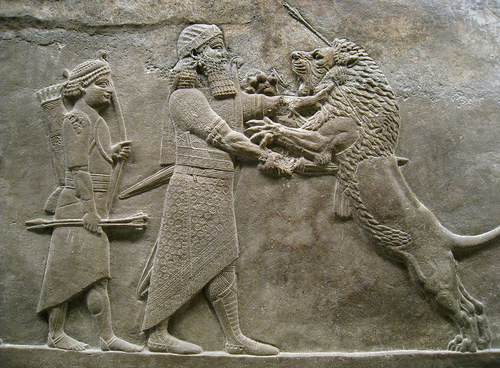
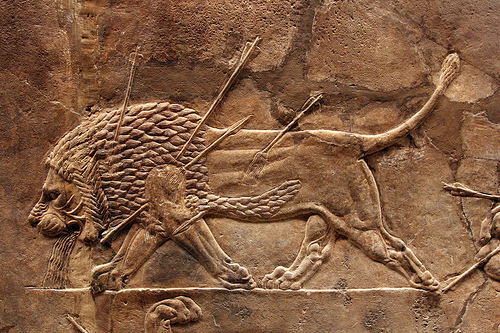
There are also times when I wish that the book provided illustrations, such as the one of the Assyrian Lion Hunt, that was discovered in the process of finding the Assyrian clay tablets which include the Babylonian Epic of the Deluge as well as of Gilgamesh. So here's a couple of the Assyrian Lion Hunt images (now at the British Museum):
description
[image error]
description Cool, right?

How the book is divided.
1) Introduction to how the clay tablets were discovered in Nineveh.
2) The Babylonian story of the Deluge and Uta-pishtim (the hero of that story)
3) Gilgamesh's quest for immortality

What I liked about this book
Although formatting at times could be better, and the book really could use a map and a few illustrations, overall it was a pleasant and informative read. I enjoyed being able to directly read a translation of the tablets with this epic, and I appreciated when the author told me where the story was fuzzy because the tablets were broken off etc. I also enjoyed the similarity of this story to Noah's Ark, which is really really apparent.

Overall, a cool fast read. Free copies are everywhere. Go check it out :)
Profile Image for Jena.
316 reviews2 followers
October 19, 2019
¡Increíble! El hallazgo de las tablillas de la biblioteca de Asurbanipal.

Merged review:

La edición de este librito es muy antigua, es de 1920, y fue escrito por Wallis Budge quien fuera el antiguo encargado de las antigüedades Egipcias y Asirias del Museo Británico. Aquí describió el cómo y el cuándo del descubrimiento de la biblioteca de Asurbanipal, en la antigua ciudad perdida de Nínive (perdida solo para los europeos). Los árabes, que invadieron Iraq desde el siglo VII, sabían que en los montículos frente a la actual Mosul se encontraban los restos de Nínive.
Nínive se encuentra ubicada en el lado suroeste del río Tigris y contaba con palacios construidos por Sargón II, Senaquerib, Esarhaddon. En otro de los montículos estaban los edificios levantados por Asurbanipal. Entre las 2 colinas está la muralla occidental, que en tiempos del Imperio Asirio era bañada por las aguas del Tigris que con el tiempo cambió su curso y ahora está a una milla de la ciudad.
Desde 1845 hasta 1852 los arqueólogos Layard y Rassom excavaron una parte de la ciudad y en el palacio del suroeste encontraron dos cámaras pequeñas llenas de piso a techo de tablillas de barro cocido, todas de diferentes tamaños, con un lado plano y el otro convexo del tamaño de un cuaderno de 25 x 20 cm.
En las tablillas una vez descifradas, se encontró la Épica de Gilgamesh y la Narración del Diluvio.
Profile Image for Philip Froloshky.
117 reviews
December 6, 2023
‎“The Babylonian Story Of The Deluge and The Epic of ‎Gilgamish” is a book relatively hard to get ‎through because of the incredible differences in time. This is perfectly normal, yet it is one of the ‎most ancient literary works preserved today. It was written in cuneiform script on clay tablets. ‎Speaking of which, the book's first part is devoted to archaeological discoveries. From them, we ‎can understand that most of the discoveries went to the British Museum. From this first part, I ‎learned that the Babylonian king "wanted to kill lions" and they have been given to him. It ‎is a good book to expand your worldview by looking at it at least to some extent through the ‎eyes of this ancient civilization.‎

This is the story of the flood that the Biblical observed and this is much older than the story ‎of Noah—another reason for me to be skeptical of the credibility of the biblical texts.‎

I listened to the book in LibriVox.
Profile Image for Adam Smith.
Author 2 books38 followers
April 6, 2012
A very interesting account of the finding of the libraries of Nineveh. The story of the deluge itself is very brief and similar to its biblical counterpart 'Noah's ark'. Also included is a detailed retelling of the epic of Gilgamesh; which is well worth the read.
Profile Image for R..
1,687 reviews52 followers
April 20, 2012
What's there to say, it's the earliest known telling of the great flood and pre-dates any Christian reference to the flood (Noah) by thousands of years.
Profile Image for Chandra Fry.
Author 93 books620 followers
April 30, 2016
Decent

I found it difficult to follow and understand a lot of what was written. It was interesting to read about the deluge from another perspective. It was worth reading.
Displaying 1 - 21 of 21 reviews

Can't find what you're looking for?

Get help and learn more about the design.