

What do you think?
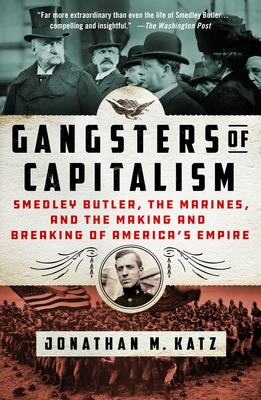
Gangsters of Capitalism
A groundbreaking journey tracing America’s forgotten path to global power ― and how its legacies shape our world today ― told through the extraordinary life of a complicated Marine.
"The book is far more extraordinary than even the life of Smedley Butler... a compelling and insightful meditation on the trauma people still feel as a result of Butler’s career and the American ambitions it represented."
― The Washington Post
Smedley Butler was the most celebrated warfighter of his time. Bestselling books were written about him. Hollywood adored him. Wherever the flag went, “The Fighting Quaker” went―serving in nearly every major overseas conflict from the Spanish War of 1898 until the eve of World War II. From his first days as a 16-year-old recruit at the newly seized Guantánamo Bay, he blazed a path for helping annex the Philippines and the land for the Panama Canal, leading troops in China (twice), and helping invade and occupy Nicaragua, Puerto Rico, Haiti, Mexico, and more. Yet in retirement, Butler turned into a warrior against war, imperialism, and big business, “I was a racketeer for capitalism."
Award-winning author Jonathan Myerson Katz traveled across the world―from China to Guantánamo, the mountains of Haiti to the Panama Canal―and pored over the personal letters of Butler, his fellow Marines, and his Quaker family on Philadelphia's Main Line. Along the way, Katz shows how the consequences of the Marines' actions are still very much talking politics with a Sandinista commander in Nicaragua, getting a martial arts lesson from a devotee of the Boxer Rebellion in China, and getting cast as a P.O.W. extra in a Filipino movie about their American War. Tracing a path from the first wave of U.S. overseas expansionism to the rise of fascism in the 1930s to the crises of democracy in our own time, Gangsters of Capitalism tells an urgent story about a formative era most Americans have never learned about, but that the rest of the world cannot forget.
"The book is far more extraordinary than even the life of Smedley Butler... a compelling and insightful meditation on the trauma people still feel as a result of Butler’s career and the American ambitions it represented."
― The Washington Post
Smedley Butler was the most celebrated warfighter of his time. Bestselling books were written about him. Hollywood adored him. Wherever the flag went, “The Fighting Quaker” went―serving in nearly every major overseas conflict from the Spanish War of 1898 until the eve of World War II. From his first days as a 16-year-old recruit at the newly seized Guantánamo Bay, he blazed a path for helping annex the Philippines and the land for the Panama Canal, leading troops in China (twice), and helping invade and occupy Nicaragua, Puerto Rico, Haiti, Mexico, and more. Yet in retirement, Butler turned into a warrior against war, imperialism, and big business, “I was a racketeer for capitalism."
Award-winning author Jonathan Myerson Katz traveled across the world―from China to Guantánamo, the mountains of Haiti to the Panama Canal―and pored over the personal letters of Butler, his fellow Marines, and his Quaker family on Philadelphia's Main Line. Along the way, Katz shows how the consequences of the Marines' actions are still very much talking politics with a Sandinista commander in Nicaragua, getting a martial arts lesson from a devotee of the Boxer Rebellion in China, and getting cast as a P.O.W. extra in a Filipino movie about their American War. Tracing a path from the first wave of U.S. overseas expansionism to the rise of fascism in the 1930s to the crises of democracy in our own time, Gangsters of Capitalism tells an urgent story about a formative era most Americans have never learned about, but that the rest of the world cannot forget.
412 pages, Paperback
First published January 18, 2022
About the author
Jonathan M. Katz
5 books173 followersJonathan Myerson Katz is a journalist and author known for his fearless reporting on politics, history, conflict, and disaster. As the Associated Press bureau chief in Haiti from 2007 to 2011, he provided crucial coverage of the 2010 earthquake and exposed the UN’s role in a post-quake cholera epidemic, earning him the Medill Medal for Courage in Journalism. Since leaving AP, Katz has contributed to major publications like the New York Times and the Guardian, and authored two award-winning books: The Big Truck That Went By: How the World Came to Save Haiti and Left Behind a Disaster (2013) and Gangsters of Capitalism: Smedley Butler, the Marines, and the Making and Breaking of America’s Empire (2022). He continues to analyze global and domestic issues through his newsletter, The Racket, and is a sought-after commentator on various media outlets, including CNN, MSNBC, and NPR.
Ratings & Reviews
Friends & Following
Create a free account to discover what your friends think of this book!
Community Reviews
Displaying 1 - 30 of 339 reviews
July 22, 2026
U.S. Power 101: Capitalism and War…
Preamble:
--Smedley Butler, Major General (U.S. Marine Corps) who ended up as an anti-war activist (War is a Racket: The Antiwar Classic by America's Most Decorated Soldier), has been my go-to for communicating with Americans propagandized to equate “support our troops” with “support our wars”. Surface appearances/identity (Major General) matter in public communication.
--My favorite quote by Butler came from his later speeches:

...Here's the rest of the quote:
...Readers of this book may learn to acknowledge the terrorism of US interventions, but may still fall for the following traps:
i) cynicism: assuming more “power” guarantees victory, with conquest being natural and inevitable.
ii) getting lost in history’s endless details, missing the forest for the trees.
…The former is particularly insidious. After all, enough of the US public flip between:
i) blissful ignorance: distracted from even considering the issue (let alone connecting it with domestic issues); or, coupling yourself to your “country” (and its wars) and thus assuming your country is on the good side.
ii) critical cynicism: eventually retracting your support for “endless wars” in a passive manner but cannot imagine/organize alternatives.
…both responses preserve public inaction, thus public consent.
--To transcend the cynicism of “might makes right”/“realism” (school of international relations theory focusing on the struggle of self-interested states; lacking class analysis), etc., I’ve been working on videos (@TheConspiracyIsCapitalism) walking through step-by-step my favourite tools (class analysis/historical materialism/divide and rule/hard power vs. soft power, etc.) and applying them to crucial case studies (ex. U.S.’s “Vietnam War” debacle, and lessons for today’s war).
Highlights:
1) Cuba:
--Columbus arrived in Cuba in 1494 and claimed it for Spain. Spanish colonialism ruled Cuba as a slave plantation (esp. sugar).
--US interest in annexing Cuba and using it as a slave state had a curious contradiction, since racism also balked at Cubans joining the US. Demand for Cuban sugar increased from US’s Civil War industrial boom.
--Cuban revolutionaries clashed with Spanish counterrevolutionaries, with the latter (“Butcher” Weyler) innovating the reconcentración (US newspapers translated as “concentration camps”). Later European fascism took inspiration from European/American colonial practices: Discourse on Colonialism
--Katz frames the US debate on intervention (in my next videos, I’ll explore how to unpack US social groups/classes in a structured manner):
a) Business: initially wary of costly war
b) Executive (President McKinley): subservient to business lobbyists
c) Congress: included former Confederates who lost their slave economy and thus their use for Cuba
d) Expansionists: decried horrors of Spanish colonialism to US public; convinced business/McKinley of war’s economic boom:
…Thus, Guantanamo Bay became the US’s oldest overseas base; in current “War on Terror” times, it has become the most infamous of US’s extralegal detention centers.
--As for the Cuban revolution against US imperialism, Katz mentions Castro’s military success, skips over the Cuban Revolution’s triumphs addressing dire social needs, and concludes with:
--It’s criminal how liberal US journalists can write an entire book on US domination over foreign people (including critiquing racism, and even capitalism!), yet still demand perfection in resistance or else ridicule it. I’m not expecting liberals to support revolution, but do your fence-sitting job and mention both the successes and failures.
--Socialist Cuba isn’t even one of the many examples of US-backed client rulers who eventually pushed back against their patron (I’ll focus on patron-client conflicts in an upcoming video), where liberals can comfortably play their fence-sitting “both sides are bad” card. This also reminds me of former NYT journalist Stephen Kinzer: Overthrow: America's Century of Regime Change from Hawaii to Iraq
2) The Philippines:
--Katz describes this as the US’s “first Asian quagmire”, after US claimed the Philippines from defeating Spain in 1898.
--Katz starts with contrasting theories on the economic contradiction: post-Civil War prosperity (from war boom) vs. growing economic depression (end of war’s demand):
a) Leftist: during depression, repression of workers led to growth of socialism/anarchism critiquing capitalist control over production.
b) “Frontier Thesis”: Frederick Jackson Turner focused on the importance of the US’s Western frontier expansionism as a “magic fountain of youth” for US free enterprise individualism, thus the end of the Western frontier brought crisis to the American project.
…Asia-Pacific became the new frontier, with a chain of stations to the Far East: Hawaii/Puerto Rico/Guam/Samoa/Wake Island/The Philippines.
--Racism once again plagued the range of contradictory elite interests:
a) Segregationists: against annexation for race purity concerns.
b) Liberal assimilation: “The White Man’s Burden” to bring higher civilization/good governance. Of course, beneath the idealist rhetoric was (capitalist) material interests: “Frontier Thesis”; imperialist competition with Europe/Japan for access to China’s markets; the Philippines’ hemp (before synthetics), etc. Expansionists would smear broader anti-war movements (ex. American Anti-Imperialist League, including Mark Twain) by grouping their anti-war positions with segregationists, then claiming hypocrisy (the latter’s support for domestic lynching). Typical liberal centrism.
c) “Redemption” (post Civil War): the compromise between segregationists and liberal assimilation was to colonize but not grant citizenship. Typical liberal centrism.
--On gender, Katz references Fighting for American Manhood: How Gender Politics Provoked the Spanish-American and Philippine-American Wars on how increased automation and decline of “masculine” manual labour led to concerns of “national feminization and ruin”, with war seen as a rejuvenation of manhood. LOL, just the other day “Secretary of War” Pete “Kegsbreath” Hegseth announced a screening program for “testosterone deficiency” for service members age 30 and above; first as tragedy, then as farce…
--US colonialism in the Philippines featured a clash between:
a) Hard power:
--Chaffee brought his 30 years of experience in wars against Native Americans (“concentration, devastation, and harassment”). Filipino revolutionaries were branded as “bandits” and treated outside of the law:
…Atrocities mounted, with concentration camps, “a new torture technique the Americans had recently learned from the Spanish—the “water cure,” an even-more-brutal precursor to waterboarding” , leaving a “howling wilderness”. In fact, soldiers’ letters with atrocities slipped past military censors and were made public by newspapers, but were brushed aside as exceptional.
--With the rising Japanese colonialism in 1905 taking Korea/Manchurian port, Katz describes how the US focused on fortifying Subic Bay with the Marines; quoting Butler’s later reflection:
--Taft supported assimilation; Katz briefly references Vicente L. Rafael in mentioning the curious revival of US soft power in the Philippines following the Philippine-American War (also see: Bound by War: How the United States and the Philippines Built America's First Pacific Century), and a recent outlier with right-wing president Duterte:
…see comments below for rest of the review:
-China
-Puerto Rico/Panama/Nicaragua
-“Northern Triangle” (Honduras/Guatemala/El Salvador)
-Mexico
-Haiti/Dominican Republic
-Philadelphia/Washington D.C.…
Preamble:
--Smedley Butler, Major General (U.S. Marine Corps) who ended up as an anti-war activist (War is a Racket: The Antiwar Classic by America's Most Decorated Soldier), has been my go-to for communicating with Americans propagandized to equate “support our troops” with “support our wars”. Surface appearances/identity (Major General) matter in public communication.
--My favorite quote by Butler came from his later speeches:
...Here's the rest of the quote:
Thus I helped make Mexico and especially Tampico safe for American oil interests in 1914. I helped make Haiti and Cuba a decent place for the National City Bank boys to collect revenues in. […] I helped purify Nicaragua for the international banking house of Brown Brothers in 1909-12. I brought light to the Dominican Republic for American sugar interests in 1916. […] During those years, I had, as the boys in the back room would say, a swell racket. I was rewarded with honors, medals, promotion. Looking back on it, I feel I might have given Al Capone a few hints. The best he could do was to operate his racket in three city districts. We Marines operated on three continents.--Katz’s book features clever storytelling, exploring the rise of the U.S. empire through detailing Butler’s career as a “gangster for capitalism”.
[-Common Sense, Vol. 4, No. 11 (November, 1935), p. 8; bold emphases added]
...Readers of this book may learn to acknowledge the terrorism of US interventions, but may still fall for the following traps:
i) cynicism: assuming more “power” guarantees victory, with conquest being natural and inevitable.
ii) getting lost in history’s endless details, missing the forest for the trees.
…The former is particularly insidious. After all, enough of the US public flip between:
i) blissful ignorance: distracted from even considering the issue (let alone connecting it with domestic issues); or, coupling yourself to your “country” (and its wars) and thus assuming your country is on the good side.
ii) critical cynicism: eventually retracting your support for “endless wars” in a passive manner but cannot imagine/organize alternatives.
…both responses preserve public inaction, thus public consent.
--To transcend the cynicism of “might makes right”/“realism” (school of international relations theory focusing on the struggle of self-interested states; lacking class analysis), etc., I’ve been working on videos (@TheConspiracyIsCapitalism) walking through step-by-step my favourite tools (class analysis/historical materialism/divide and rule/hard power vs. soft power, etc.) and applying them to crucial case studies (ex. U.S.’s “Vietnam War” debacle, and lessons for today’s war).
Highlights:
1) Cuba:
--Columbus arrived in Cuba in 1494 and claimed it for Spain. Spanish colonialism ruled Cuba as a slave plantation (esp. sugar).
--US interest in annexing Cuba and using it as a slave state had a curious contradiction, since racism also balked at Cubans joining the US. Demand for Cuban sugar increased from US’s Civil War industrial boom.
--Cuban revolutionaries clashed with Spanish counterrevolutionaries, with the latter (“Butcher” Weyler) innovating the reconcentración (US newspapers translated as “concentration camps”). Later European fascism took inspiration from European/American colonial practices: Discourse on Colonialism
--Katz frames the US debate on intervention (in my next videos, I’ll explore how to unpack US social groups/classes in a structured manner):
a) Business: initially wary of costly war
b) Executive (President McKinley): subservient to business lobbyists
c) Congress: included former Confederates who lost their slave economy and thus their use for Cuba
d) Expansionists: decried horrors of Spanish colonialism to US public; convinced business/McKinley of war’s economic boom:
Senator John Thurston declared […] “War with Spain would increase the business and the earnings of every American railroad. It would increase the output of every American factory, it would stimulate every branch of industry and domestic commerce, it would greatly increase the demand for American labor, and in the end every certificate that represented a share of an American business enterprise would be worth more money than it is worth today.”--So, US’s “first overseas war” (1898) finally featured its Marines (neglected behind the Navy), including Butler. Their conquest of Guantanamo Bay was ill-planned and only saved by an experienced Cuban ally who knew of a Spanish chokepoint (1 freshwater well).
…Thus, Guantanamo Bay became the US’s oldest overseas base; in current “War on Terror” times, it has become the most infamous of US’s extralegal detention centers.
--As for the Cuban revolution against US imperialism, Katz mentions Castro’s military success, skips over the Cuban Revolution’s triumphs addressing dire social needs, and concludes with:
On one side was a totalitarian Communist state, dedicated to thumbing its nose at U.S. imperialism while ensuring complete domination over its own people.…Right, world-class healthcare and literacy is “complete domination over its own people”…it must all be from top-down state force; no healthcare provider or teacher could possibly want to deliver accessible, quality services when they could go to the US to maximize profits and serve the rich. All this on a small island under one of the longest trade sanctions (64 years and counting) by the world superpower neighbor, but surviving this is just childish “thumbing its nose” with no moral principles. For the recent escalation of US sanctions on Cuba, here’s a couple video visits by Boy Boy and Hasanabi.
--It’s criminal how liberal US journalists can write an entire book on US domination over foreign people (including critiquing racism, and even capitalism!), yet still demand perfection in resistance or else ridicule it. I’m not expecting liberals to support revolution, but do your fence-sitting job and mention both the successes and failures.
--Socialist Cuba isn’t even one of the many examples of US-backed client rulers who eventually pushed back against their patron (I’ll focus on patron-client conflicts in an upcoming video), where liberals can comfortably play their fence-sitting “both sides are bad” card. This also reminds me of former NYT journalist Stephen Kinzer: Overthrow: America's Century of Regime Change from Hawaii to Iraq
2) The Philippines:
--Katz describes this as the US’s “first Asian quagmire”, after US claimed the Philippines from defeating Spain in 1898.
--Katz starts with contrasting theories on the economic contradiction: post-Civil War prosperity (from war boom) vs. growing economic depression (end of war’s demand):
a) Leftist: during depression, repression of workers led to growth of socialism/anarchism critiquing capitalist control over production.
b) “Frontier Thesis”: Frederick Jackson Turner focused on the importance of the US’s Western frontier expansionism as a “magic fountain of youth” for US free enterprise individualism, thus the end of the Western frontier brought crisis to the American project.
…Asia-Pacific became the new frontier, with a chain of stations to the Far East: Hawaii/Puerto Rico/Guam/Samoa/Wake Island/The Philippines.
--Racism once again plagued the range of contradictory elite interests:
a) Segregationists: against annexation for race purity concerns.
b) Liberal assimilation: “The White Man’s Burden” to bring higher civilization/good governance. Of course, beneath the idealist rhetoric was (capitalist) material interests: “Frontier Thesis”; imperialist competition with Europe/Japan for access to China’s markets; the Philippines’ hemp (before synthetics), etc. Expansionists would smear broader anti-war movements (ex. American Anti-Imperialist League, including Mark Twain) by grouping their anti-war positions with segregationists, then claiming hypocrisy (the latter’s support for domestic lynching). Typical liberal centrism.
c) “Redemption” (post Civil War): the compromise between segregationists and liberal assimilation was to colonize but not grant citizenship. Typical liberal centrism.
--On gender, Katz references Fighting for American Manhood: How Gender Politics Provoked the Spanish-American and Philippine-American Wars on how increased automation and decline of “masculine” manual labour led to concerns of “national feminization and ruin”, with war seen as a rejuvenation of manhood. LOL, just the other day “Secretary of War” Pete “Kegsbreath” Hegseth announced a screening program for “testosterone deficiency” for service members age 30 and above; first as tragedy, then as farce…
--US colonialism in the Philippines featured a clash between:
a) Hard power:
--Chaffee brought his 30 years of experience in wars against Native Americans (“concentration, devastation, and harassment”). Filipino revolutionaries were branded as “bandits” and treated outside of the law:
It was a tactic Americans have used against insurgents ever since, evolving into more modern variants such as “criminal,” “subversive,” and “terrorist.”…Katz describes how US hard power (including Butler) terrorized both revolutionary guerillas and villagers, uniting them (thus, missing an opportunity for divide and rule).
…Atrocities mounted, with concentration camps, “a new torture technique the Americans had recently learned from the Spanish—the “water cure,” an even-more-brutal precursor to waterboarding” , leaving a “howling wilderness”. In fact, soldiers’ letters with atrocities slipped past military censors and were made public by newspapers, but were brushed aside as exceptional.
--With the rising Japanese colonialism in 1905 taking Korea/Manchurian port, Katz describes how the US focused on fortifying Subic Bay with the Marines; quoting Butler’s later reflection:
”Every military and naval man in Washington who knows the situation in the Far East will tell you that [the Philippines] can’t be defended against a real attack,” […] “Sooner or later, if we hold onto them, America will be jerked into a damn war before we know what it’s all about.”b) Soft power:
But bureaucracies are where real madness always lies. Unwilling to draw down, [Theodore] Roosevelt and his advisers simply decided to shift their future war plans from the Philippines to the closer-in territory of Hawai‘i, and start the long, slow buildup of forces at Pearl Harbor instead.
--Taft supported assimilation; Katz briefly references Vicente L. Rafael in mentioning the curious revival of US soft power in the Philippines following the Philippine-American War (also see: Bound by War: How the United States and the Philippines Built America's First Pacific Century), and a recent outlier with right-wing president Duterte:
“I will start with your [the US’s] past sins. I will produce—from your archives—the photographs that you took of the people you murdered here in the Philippines.… You’re investigating me and the internal affairs of my country? I’m investigating you.”
…see comments below for rest of the review:
-China
-Puerto Rico/Panama/Nicaragua
-“Northern Triangle” (Honduras/Guatemala/El Salvador)
-Mexico
-Haiti/Dominican Republic
-Philadelphia/Washington D.C.…

September 16, 2021
I leave my perusal of Jonathan M. Katz's "Gangsters of Capitalism" (kindly provided to me by St. Martin's Press in the form of an ARC) with very mixed feelings but resolved not, myself, to fall into some of the traps that the author falls into. The problem, such as it is, revolves around the strong idealogical bias with which the author infuses this work and his own analyses of events in the life of his protagonist, General Smedley Butler, one of the most famous Marines in the history of the United States Marine Corps. My quandary, as a reviewer, is that the author's ideological stance is directly contrary to my own position, and this makes it more difficult for me to be as fair as I want to be. At the risk of oversimplifying, I suspect Mr. Katz would identify his own political (and polemical position) as what has come to be called Progressivism (in the modern far left sense) while my approach is essentially Libertarian. With that out of the way, I should point out that, as a primer on the growth of imperial diplomacy as practiced by the United States, the book is quite useful. General Butler and his policies and beliefs loom large in any study of the growth of the American Empire following the Spanish-American War. He was involved in the Philippine Islands, Cuba, Nicaragua, Haiti, China, and Panama (as well as sundry other places, including a stint as Philadelphia Chief of Police at the beginning of Prohibition)! The narrative focuses on Butler and his exploits, usually recounted in an entertaining anecdotal fashion and only strays most obviously from this when the author jumps forward in time to his own experiences in some of the places that were shaped by Butler and his men. Throughout, the author maintains a consistent position towards the events he is describing. The text, despite my disappointment with the overarching perspective, is both informative and revealing, and I would recommend it to anyone trying to discover the roots of our modern difficulties in a number of places, but most especially in Mexico and Central America. There is much to be learned here despite my reservations.

December 7, 2021
I was very surprised by this book. I thought that I was quite well read in the history of American foreign policy, but thanks to this book, I now realize that I was subjected to quite a biased education of it. You know, the "you-rah-rah" America that we were all taught in school. How the U.S. was a force of good, bringing freedom to those places that needed it.
Katz opened my eyes to a different perspective. That of the U.S. as an imperialistic force, out to further the advances of big businesses and the rich.
He does this through the eyes of a famous U.S. Marine, Smedley Butler. Raised as a Quaker, he somehow finds himself enlisted in the Marine Corps. And on to his adventures! Beginning as a tough, literally take no prisoners hellhound, he is sent to the Philippines, Cuba, Nicaragua, Haiti, China, and Panama. As he "grows", he discovers that the reasons are not just to promote the freedom-loving ways of the U.S., but to benefit the rich. He grows more and more disillusioned to the fighting and killing. Finally retiring, he finds himself being recruited into a plot to overthrow the Federal Government. To which, to his great credit, he exposes.
On a personal level, I really enjoyed the sections on China. My grandfather was in the Navy there at the same time, and now I think I have a feeling about what we went through, and why he would never talk about it. Also, regarding the ending, with the plot to overthrow the government; I could not help but draw parallels with the machinations of the Trump administration after the 2020 election (and continuing to today).
This is a long, and sometimes tiring book. But it is never boring. I really think that if you read it, you will come away with a much greater sense of our place in history. And why we have some of the problems we have today. And why some nations do not trust us.
Very educational!
Katz opened my eyes to a different perspective. That of the U.S. as an imperialistic force, out to further the advances of big businesses and the rich.
He does this through the eyes of a famous U.S. Marine, Smedley Butler. Raised as a Quaker, he somehow finds himself enlisted in the Marine Corps. And on to his adventures! Beginning as a tough, literally take no prisoners hellhound, he is sent to the Philippines, Cuba, Nicaragua, Haiti, China, and Panama. As he "grows", he discovers that the reasons are not just to promote the freedom-loving ways of the U.S., but to benefit the rich. He grows more and more disillusioned to the fighting and killing. Finally retiring, he finds himself being recruited into a plot to overthrow the Federal Government. To which, to his great credit, he exposes.
On a personal level, I really enjoyed the sections on China. My grandfather was in the Navy there at the same time, and now I think I have a feeling about what we went through, and why he would never talk about it. Also, regarding the ending, with the plot to overthrow the government; I could not help but draw parallels with the machinations of the Trump administration after the 2020 election (and continuing to today).
This is a long, and sometimes tiring book. But it is never boring. I really think that if you read it, you will come away with a much greater sense of our place in history. And why we have some of the problems we have today. And why some nations do not trust us.
Very educational!

December 16, 2024
America is an imperialist empire.
I’ve read a lot of books about American imperialism from The Jakarta Method to How to Hide and Empire and a lot more. I would say that Gangsters of Capitalism is probably the best I’ve read because it so thoroughly demonstrates that America has been and continues to be an imperialist empire. This story focuses on the US imperial expansion from the time period of 1898 to about the 1930s. The author takes us along the journey of Smedley Butler, a marine turned Major-General, as he travels at the behest of the US government to Cuba, Panama, Dominican Republic, Haiti, Mexico, China and the Philippines to occupy, squash rebellions and subjugate the native populations under the yolk of American corporate and military subjugation. Smedley fought in the Boxer Rebellion, the Mexican Revolution, the Banana Wars as well as World War I. The author rounds out his discussion by talking about current iterations of American occupation, militarism and imperialism in these very same countries now.
Ever wonder why the US still occupies Guantanamo Bay? In 1898, Butler lied about his age and joined in the invasion and capture of Guantanamo Bay in the Spanish-American War. Butler was then sent to the Philippines where the man became a drunk and finally saw some action in 1899 where he led 300 marines to take the town of Noveleta from Filipino troops. In Northern China, Butler fought in the Boxer Rebellion where the US was joined with other imperialism allies to squash a violent uprising of the Chinese against foreign Christians. The eight nation imperialist allies brought 20,000 armed troops to China where they murdered, plundered and looted the capital Beiking and executed the rebel leaders. Around 100,000 people died, the greatest of them being civilians.
And then Butler was shipped off to the Banana Wars, which were US interventions in Central America with commercial interests, particularly the United Fruit Company, to protect their interests in banana, tobacco and sugar cane in these regions with military action. The US was also trying to advance its own interests by maintaining its influence and control over the Panama Canal. Which it did. Butler served in Nicaragua and defended similar commercial interests. In Veracruz, Butler was sent to monitor revolutionary movements where he went door to door to rout out the revolutionaries. What he was really doing was securing US oil interests in a company that would later be called Texaco. Butler was involved with the same tactics in Haiti and the DR.
At the time of his death, Butler was the most decorated Marine in US history. And what was his opinion at the end of his career of his involvement in the American wars? Well, does it give a little insight to know he wrote a book titled “War is a Racket”? He became an outspoken critic of American imperialism and military interventions which he understood to be driven by US business interests. He was also courted by a fascist movement to stage and lead a coup against FDR because the man had so much experience doing such a thing in so many other countries. Something he fortunately declined.
Here’s a telling quote from Butler himself:
“What makes me mad is that the whole revolution is inspired and financed by Americans who have wild cat investments down here and want to make them good by putting in a Government which will declare a monopoly in their favor . . . The whole business is rotten to the core.”
Do we see the pattern? This is what American imperialism looks like. It’s what it still looks like today with the CIA backed coups and dictator installments in the second half of the 20th century from Indonesia, Costa Rica, Iran, Chile, Congo and so many more.
Here’s the typical playbook when a country doesn’t play by America’s rules:
First, create your own propaganda about that leader through US media. Make sure journalists are using the word "militant" or "regime" instead of "democratically elected leader". Then make sure you have CIA agents on the ground already exerting influence. Get your Generals in order within that country with bribes. Then you've got to demonize that leader by throwing harsh sanctions on them, starving the people and really just making their economy scream. Next you must completely diplomatically isolate that leader, making them an international pariah. Now fund and organize mass riots within that country against the leader. Once you've got everything in place, give the green light, assassinate whoever is still in the way, put up your feet and watch the social implosion from the other side of the globe.
Now I'm no communist, I'm not even a socialist, but books like this really clarify what is going on in the whole "capitalist v communist" narrative. This isn't about ideology, it's about power. Ideology is a rhetorical vehicle for power structures to protect themselves. When a "socialist" country appears like a dumpster fire in the US media, that portrayal is on purpose. It convinces the public that socialist policies are bad. But here's really what's going on: poorer countries that use socialist policies, like nationalization or government subsidies, are trying to protect their infant industries before they can compete on the global market. Guess who else does and has used these same socialist policies? ---->The United States. The US has used protectionist policies and a centrally planned economy just as much as any communist regime has. That’s a fact.
And I’m not even talking about the way the US exerts economic control over large sectors of the world through its IMF/World Bank arm where it extends subprime loans to countries on stipulations that it not nationalize their own resources and open them up to American interests. From subsidies, to nationalization in the New Deal era, government-private contracts, the US got the jump start on the global stage to protect their industries and which have now been expanded into a globalized world order that asserts its corporate control over the globe and prohibits countries from using the exact same strategy to gain an economic advantage. So today, socialism correlates with failed states but it's not socialism that is failing these states, it's US “foreign policy.”
The sad part is none of this is taught to Americans. The vast majority of Americans think that their country are the plucky underdogs who rose to dominance by bravery and scrappy wit and innovation. It's all just myth and propaganda.
America is irrefutably an imperialist country in every way.
I’ve read a lot of books about American imperialism from The Jakarta Method to How to Hide and Empire and a lot more. I would say that Gangsters of Capitalism is probably the best I’ve read because it so thoroughly demonstrates that America has been and continues to be an imperialist empire. This story focuses on the US imperial expansion from the time period of 1898 to about the 1930s. The author takes us along the journey of Smedley Butler, a marine turned Major-General, as he travels at the behest of the US government to Cuba, Panama, Dominican Republic, Haiti, Mexico, China and the Philippines to occupy, squash rebellions and subjugate the native populations under the yolk of American corporate and military subjugation. Smedley fought in the Boxer Rebellion, the Mexican Revolution, the Banana Wars as well as World War I. The author rounds out his discussion by talking about current iterations of American occupation, militarism and imperialism in these very same countries now.
Ever wonder why the US still occupies Guantanamo Bay? In 1898, Butler lied about his age and joined in the invasion and capture of Guantanamo Bay in the Spanish-American War. Butler was then sent to the Philippines where the man became a drunk and finally saw some action in 1899 where he led 300 marines to take the town of Noveleta from Filipino troops. In Northern China, Butler fought in the Boxer Rebellion where the US was joined with other imperialism allies to squash a violent uprising of the Chinese against foreign Christians. The eight nation imperialist allies brought 20,000 armed troops to China where they murdered, plundered and looted the capital Beiking and executed the rebel leaders. Around 100,000 people died, the greatest of them being civilians.
And then Butler was shipped off to the Banana Wars, which were US interventions in Central America with commercial interests, particularly the United Fruit Company, to protect their interests in banana, tobacco and sugar cane in these regions with military action. The US was also trying to advance its own interests by maintaining its influence and control over the Panama Canal. Which it did. Butler served in Nicaragua and defended similar commercial interests. In Veracruz, Butler was sent to monitor revolutionary movements where he went door to door to rout out the revolutionaries. What he was really doing was securing US oil interests in a company that would later be called Texaco. Butler was involved with the same tactics in Haiti and the DR.
At the time of his death, Butler was the most decorated Marine in US history. And what was his opinion at the end of his career of his involvement in the American wars? Well, does it give a little insight to know he wrote a book titled “War is a Racket”? He became an outspoken critic of American imperialism and military interventions which he understood to be driven by US business interests. He was also courted by a fascist movement to stage and lead a coup against FDR because the man had so much experience doing such a thing in so many other countries. Something he fortunately declined.
Here’s a telling quote from Butler himself:
“What makes me mad is that the whole revolution is inspired and financed by Americans who have wild cat investments down here and want to make them good by putting in a Government which will declare a monopoly in their favor . . . The whole business is rotten to the core.”
Do we see the pattern? This is what American imperialism looks like. It’s what it still looks like today with the CIA backed coups and dictator installments in the second half of the 20th century from Indonesia, Costa Rica, Iran, Chile, Congo and so many more.
Here’s the typical playbook when a country doesn’t play by America’s rules:
First, create your own propaganda about that leader through US media. Make sure journalists are using the word "militant" or "regime" instead of "democratically elected leader". Then make sure you have CIA agents on the ground already exerting influence. Get your Generals in order within that country with bribes. Then you've got to demonize that leader by throwing harsh sanctions on them, starving the people and really just making their economy scream. Next you must completely diplomatically isolate that leader, making them an international pariah. Now fund and organize mass riots within that country against the leader. Once you've got everything in place, give the green light, assassinate whoever is still in the way, put up your feet and watch the social implosion from the other side of the globe.
Now I'm no communist, I'm not even a socialist, but books like this really clarify what is going on in the whole "capitalist v communist" narrative. This isn't about ideology, it's about power. Ideology is a rhetorical vehicle for power structures to protect themselves. When a "socialist" country appears like a dumpster fire in the US media, that portrayal is on purpose. It convinces the public that socialist policies are bad. But here's really what's going on: poorer countries that use socialist policies, like nationalization or government subsidies, are trying to protect their infant industries before they can compete on the global market. Guess who else does and has used these same socialist policies? ---->The United States. The US has used protectionist policies and a centrally planned economy just as much as any communist regime has. That’s a fact.
And I’m not even talking about the way the US exerts economic control over large sectors of the world through its IMF/World Bank arm where it extends subprime loans to countries on stipulations that it not nationalize their own resources and open them up to American interests. From subsidies, to nationalization in the New Deal era, government-private contracts, the US got the jump start on the global stage to protect their industries and which have now been expanded into a globalized world order that asserts its corporate control over the globe and prohibits countries from using the exact same strategy to gain an economic advantage. So today, socialism correlates with failed states but it's not socialism that is failing these states, it's US “foreign policy.”
The sad part is none of this is taught to Americans. The vast majority of Americans think that their country are the plucky underdogs who rose to dominance by bravery and scrappy wit and innovation. It's all just myth and propaganda.
America is irrefutably an imperialist country in every way.

November 14, 2021
I received an advance copy of this book through a goodreads giveaway. The book was excellent and I highly recommend it for anyone who wants a concise history of US interventionism and the covering up of inconvenient information.
It is very well-researched, with sources for almost every claim, including some interesting historical asides in the footnotes. My only critique ends up also being the book's greatest asset; that Katz sometimes takes liberty with the description of action in certain points of Butler's life, making scenes from the past come to life, but in some cases the description of the action isn't cited from one of Butler'sletters, it's not clear how much is historical and how much is embellishment describing how a scene might have occurred.
With the narrative and reportage style of writing (similar to some books by Erik Larson, but not as dry), the book is an excellent introduction to the rise of the American empire and how the world has been influenced by it. I especially liked the fact that Katz switches between a view of the past through Butler's eyes (often as the leader of an invading force), and then his own experience in those countries years later while doing research for this book. Seeing how other countries remember and continue to remember the US invasions is a powerful reminder that these events are not over and done with as many Americans would like to think. As well as the fact that he relied as much (if not more) on historians from the countries Butler traveled to as historians from the US to tell the story.
The book is as much about American interventionism as it is a critical review about how the US (and other countries) teaches history and how that teaching can define common enemies while completely erasing others for the benefit of the wealthiest and most influential leaders.
It is very well-researched, with sources for almost every claim, including some interesting historical asides in the footnotes. My only critique ends up also being the book's greatest asset; that Katz sometimes takes liberty with the description of action in certain points of Butler's life, making scenes from the past come to life, but in some cases the description of the action isn't cited from one of Butler'sletters, it's not clear how much is historical and how much is embellishment describing how a scene might have occurred.
With the narrative and reportage style of writing (similar to some books by Erik Larson, but not as dry), the book is an excellent introduction to the rise of the American empire and how the world has been influenced by it. I especially liked the fact that Katz switches between a view of the past through Butler's eyes (often as the leader of an invading force), and then his own experience in those countries years later while doing research for this book. Seeing how other countries remember and continue to remember the US invasions is a powerful reminder that these events are not over and done with as many Americans would like to think. As well as the fact that he relied as much (if not more) on historians from the countries Butler traveled to as historians from the US to tell the story.
The book is as much about American interventionism as it is a critical review about how the US (and other countries) teaches history and how that teaching can define common enemies while completely erasing others for the benefit of the wealthiest and most influential leaders.
![Profile Image for laurel [the suspected bibliophile].](https://i.gr-assets.com/images/S/compressed.photo.goodreads.com/users/1645808644i/7494844._UX200_CR0,6,200,200_.jpg)
November 13, 2023
A most fitting read for Veterans Day, and the Marine Corps birthday (which falls a day before).
As a Marine, I was taught that Smedley Butler was a humongous hero who received two Medals of Honor, the only other Marine aside from Dan Daly to receive two. However, where Dan Daly is revered and his famous "Come on you sons of bitches, do you want to live forever?" (there's debate whether or not he actually said this) lives on, there's not much said of Smedley Butler beyond his nickname of "Old Gimlet Eye."
That's probably because of Butler's legacy as an outspoken critic of war profiteering and imperialism.
Katz does a great job chronicling Butler's life through his various campaigns. Basically, if it was overseas between the years 1898 and 1921, he was there in the thick of it. Getting shot, getting sick, murdering people and overthrowing governments. In many places his reputation lives on over a 100 years later in many of the locations—and not for good reasons. He was a complicated man who was somehow a Quaker, who also really liked killing and controlling people. Lots of cognitive dissonance going on there (along with a shit ton of undiagnosed PTSD). In many ways his frequent insubordination was protected by his prominent father, a representative on the House Committee on Naval Affairs.
In addition to writing about Butler's life, Katz connects the campaigns into the context of US imperialism, capitalism and warmongering. Many of the "advances" in warfighting that were supposedly first seen in WWI were tested in the colonized lands of the Philippines, Haiti, Nicaragua, Panama, and the Dominican Republic. Much of the imperialism was a product of unchecked capitalism, with prominent profiteers seeing vulnerable and richly resourced places as ripe for the picking.
So much of Marine Corps legend and history (Katz spent a lot of time at the Marine Corps Library in Quantico and the National Museum of the Marine Corps) has been pivoted to position Marines as heroes—hard fighting men who came in, did what had to be done, and "kept their honor clean." In fact, for many years they were used as the militant arm of the State Department, and often went into foreign sovereign countries and overthrew valid, democratic governments that opposed the US in order to install figureheads "loyal" to the US. Many of these engagements are euphemistically called "the Banana Wars."
Katz ties these events through to present day, as he journeyed to each of the locations Butler had been and spoke with local inhabitants and local experts—to varying degrees of success. In many places, a lot has changed since the US sent in the Marines, but often not exactly for the better. Many areas still suffer from the lingering aftermath (and continual presence) of US military and capitalistic endeavors.
Anywho, I double dog dare the Commandant to put this book on his Reading List.
This is the history all Marines need to know.
And no, the absolute irony of reading this through the DoD's digital library was not lost on me.
As a Marine, I was taught that Smedley Butler was a humongous hero who received two Medals of Honor, the only other Marine aside from Dan Daly to receive two. However, where Dan Daly is revered and his famous "Come on you sons of bitches, do you want to live forever?" (there's debate whether or not he actually said this) lives on, there's not much said of Smedley Butler beyond his nickname of "Old Gimlet Eye."
That's probably because of Butler's legacy as an outspoken critic of war profiteering and imperialism.
Katz does a great job chronicling Butler's life through his various campaigns. Basically, if it was overseas between the years 1898 and 1921, he was there in the thick of it. Getting shot, getting sick, murdering people and overthrowing governments. In many places his reputation lives on over a 100 years later in many of the locations—and not for good reasons. He was a complicated man who was somehow a Quaker, who also really liked killing and controlling people. Lots of cognitive dissonance going on there (along with a shit ton of undiagnosed PTSD). In many ways his frequent insubordination was protected by his prominent father, a representative on the House Committee on Naval Affairs.
In addition to writing about Butler's life, Katz connects the campaigns into the context of US imperialism, capitalism and warmongering. Many of the "advances" in warfighting that were supposedly first seen in WWI were tested in the colonized lands of the Philippines, Haiti, Nicaragua, Panama, and the Dominican Republic. Much of the imperialism was a product of unchecked capitalism, with prominent profiteers seeing vulnerable and richly resourced places as ripe for the picking.
So much of Marine Corps legend and history (Katz spent a lot of time at the Marine Corps Library in Quantico and the National Museum of the Marine Corps) has been pivoted to position Marines as heroes—hard fighting men who came in, did what had to be done, and "kept their honor clean." In fact, for many years they were used as the militant arm of the State Department, and often went into foreign sovereign countries and overthrew valid, democratic governments that opposed the US in order to install figureheads "loyal" to the US. Many of these engagements are euphemistically called "the Banana Wars."
Katz ties these events through to present day, as he journeyed to each of the locations Butler had been and spoke with local inhabitants and local experts—to varying degrees of success. In many places, a lot has changed since the US sent in the Marines, but often not exactly for the better. Many areas still suffer from the lingering aftermath (and continual presence) of US military and capitalistic endeavors.
Anywho, I double dog dare the Commandant to put this book on his Reading List.
This is the history all Marines need to know.
And no, the absolute irony of reading this through the DoD's digital library was not lost on me.

January 31, 2022
Having served 30 years in the Marines, the last five as a historian, I thought I knew most of Butler’s story. I was wrong. Katz does a brilliant job of telling his story as the enforcer of American imperialism. As much as it is biographical it is a concise history of American imperialism for five decades as well.
I think the most startling and appalling revelation for me was the “heist” by Marines of the Haitian Bank’s coffers and subsequent transfer to Wall Street. This precipitated a political crisis and civil chaos which the United Stated used as a pretext to invade and further control the people and the resources of Haiti.
As for Butler’s record I find it not worthy of emulation or approbation. He’s basically a rich kid from Philadelphia who never completed high school but was intoxicated by going off to the Spanish American War before he was of age. His father was a congressman who later rose to chairman of the then equivalent of our current Armed Services Committee. He missed combat in Cuba but caught some action in the Philippines. More combat in China during the Boxer Rebellion. I was appalled at the looting. He also caught typhoid and was sidelined medically afterwards.
He is assigned to Subic Bay as a newlywed but has a nervous breakdown while tasked with installing gun emplacements. He takes a leave of absence from the Corps and works managing a coal mine in West Virginia. That’s not something that would happen today. He’s promoted to major and is assigned to the Canal Zone while the canal is being constructed. Then to Nicaragua. Involved in the Mexican Revolution with American landing at Vera Cruz where he was awarded the MOH.
Butler was the first person to downplay this award. He tried to refuse it. He certainly didn’t believe he merited it. It was awarded liberally. Later after an intense gunfight at a Caco rebel stronghold in Haiti he would be awarded his second MOH but only after he hosted FDR ( worked in SecNav) on a visit to Port au Prince. One wonders at the politics of this too. Chesty Puller, another icon of the Corps, was awarded five Navy Crosses but never the MOH. Puller was the more courageous IMHO.
One can’t help but wonder if Butler’s father’s position as a Congressman ensured his continued career success. Butler would write his parents assiduously. In yet another irony he was marooned in Haiti and considered too valuable to go to the “real war.” He lamented missing out on the real war in Europe. He was a schemer too; he got the SecNav’s son assigned to be his aide betting it would result in his unit being assigned to France. Butler finally got to France in September 1918 but the war would be over. However, he also brought influenza and would deal with it as the Commander of Camp Pontanezen in Brest.
Another leave of absence to be the police commissioner in Philadelphia. He proved himself to be incorruptible.
An intriguing and ironic man Smedley Butler was a Quaker who fought people of color without a thought. Later he had thoughts and was woke to what he had done and became the “anti-Marine.” He went from a teenager aspiring to free Cubans from Spain to destroying democracy in Haiti as a colonel. He died much too young at age 58 right before World War II. The Haitians would say the “Evil One’s” death was ordained and justice for all he had done to their country. Cursed?
I think the most startling and appalling revelation for me was the “heist” by Marines of the Haitian Bank’s coffers and subsequent transfer to Wall Street. This precipitated a political crisis and civil chaos which the United Stated used as a pretext to invade and further control the people and the resources of Haiti.
As for Butler’s record I find it not worthy of emulation or approbation. He’s basically a rich kid from Philadelphia who never completed high school but was intoxicated by going off to the Spanish American War before he was of age. His father was a congressman who later rose to chairman of the then equivalent of our current Armed Services Committee. He missed combat in Cuba but caught some action in the Philippines. More combat in China during the Boxer Rebellion. I was appalled at the looting. He also caught typhoid and was sidelined medically afterwards.
He is assigned to Subic Bay as a newlywed but has a nervous breakdown while tasked with installing gun emplacements. He takes a leave of absence from the Corps and works managing a coal mine in West Virginia. That’s not something that would happen today. He’s promoted to major and is assigned to the Canal Zone while the canal is being constructed. Then to Nicaragua. Involved in the Mexican Revolution with American landing at Vera Cruz where he was awarded the MOH.
Butler was the first person to downplay this award. He tried to refuse it. He certainly didn’t believe he merited it. It was awarded liberally. Later after an intense gunfight at a Caco rebel stronghold in Haiti he would be awarded his second MOH but only after he hosted FDR ( worked in SecNav) on a visit to Port au Prince. One wonders at the politics of this too. Chesty Puller, another icon of the Corps, was awarded five Navy Crosses but never the MOH. Puller was the more courageous IMHO.
One can’t help but wonder if Butler’s father’s position as a Congressman ensured his continued career success. Butler would write his parents assiduously. In yet another irony he was marooned in Haiti and considered too valuable to go to the “real war.” He lamented missing out on the real war in Europe. He was a schemer too; he got the SecNav’s son assigned to be his aide betting it would result in his unit being assigned to France. Butler finally got to France in September 1918 but the war would be over. However, he also brought influenza and would deal with it as the Commander of Camp Pontanezen in Brest.
Another leave of absence to be the police commissioner in Philadelphia. He proved himself to be incorruptible.
An intriguing and ironic man Smedley Butler was a Quaker who fought people of color without a thought. Later he had thoughts and was woke to what he had done and became the “anti-Marine.” He went from a teenager aspiring to free Cubans from Spain to destroying democracy in Haiti as a colonel. He died much too young at age 58 right before World War II. The Haitians would say the “Evil One’s” death was ordained and justice for all he had done to their country. Cursed?

February 22, 2022
This is not a typical book that I would pick up, but I listened to this via audio and thought it was both well written and the pacing was steady. My interest was held throughout and it did not get dry or slow as nonfiction can sometimes do. Katz used great examples and focused the story around one person, Smedley Butler, which helped me keep up with the topic of the book a lot easier.
Overall, I learned a lot about American foreign policy, mainly that other countries seemed to know and remember more than we do about history and that is sad. For that reason I am glad I read this and will definitely recommend it to others.
Thank you to St. Martin's Press for the ARC to review.
Overall, I learned a lot about American foreign policy, mainly that other countries seemed to know and remember more than we do about history and that is sad. For that reason I am glad I read this and will definitely recommend it to others.
Thank you to St. Martin's Press for the ARC to review.

October 9, 2022
The US has fought an ungodly number of wars in its 250 or so years of history, starting with the American Revolution itself -- more than 150, most of which you and I have never heard of. Mostly, these have been commercial wars, the familiar struggles for wealth and power, layered with whatever ideological or mythological justification was then in vogue: fighting communism, defeating terrorism, or occasionally even defending US sovereignty in the form of two US Navy sailors seized from a small dinghy off the coast of Veracruz. Did you know the US invaded Mexico in 1914? I didn't. US oil interests in the Veracruz-Tampico area were endangered during the Civil War in Mexico triggered by a military coup there, and the Navy and Marines charged right in with guns blazing, sparked by the infamous affair of the US-flagged dinghy.
Gangsters of Capitalism is nominally about the decades-long career of US general Smedley Butler, who seemingly fought in every one of his country's wars from the Spanish-American War in 1898 to his last skirmish sometime in the 1930's. The incredible litany of wars, large and small, in which he fought is either eye-opening or mind-numbing, depending on your tastes. These include: Cuba, the Philippines (more than once), Haiti, the Dominican Republic, Panama, the Canal Zone, Honduras, Mexico, China, and I'm sure others I've forgotten. Butler's career provides the narrative thread to unify this tale of old-fashioned US imperialism, complete with colonies and their trappings, though we were careful to never call them colonies.
The author traveled to all of the places where Butler served and fought, using these travels as a means of also telling the contemporary story of these countries, showing the impact of the US interventions of a century ago. It's not hard to see the roots of the instability of those shaky democracies in Central America, for example, undermined by Spanish colonialism and endless US military interventions, backing the interests of US agricultural firms and of local economic and political elites who promised to support US interests. There's a reason these countries were called "banana republics": their governments stood or fell at the pleasure of the United Fruit Company, of Chiquita banana fame.
And Smedley Butler, the US Marines and the US Navy were always there as the sharp point of the spear of US policy.
Eventually, even Butler, raised as a member of the Philadelphia elite and son of a powerful US congressman who helped speed his son's rise through the ranks, figured out that this was all a game in which he and his comrades were expendable pawns. Nearing retirement, he shed his apolitical stance, published a book called "War is a Racket", started speaking out in front of groups of angry veterans and other like-minded folks, and was soon out of the military.
All of this might be of only historical interest if the US as a country had learned any lessons from this sorry imperial past. Arguably, it has made some progress, though the pace of US warmaking has not slowed down much if at all. Sometimes the wars even make moral and strategic sense: Bosnia, the first Persian Gulf War and (in the form of massive aid only, so far) Ukraine. But then there are nutty ventures like Iraq, a thinly veiled intervention in support of oil interests, fueled by deep historical ignorance, misplaced ideological delusions about fighting terrorism, a dash of racism, and a weak George Bush Jr wanting to look stronger than George Bush Sr.
The US still struggles with the duties and responsibilities of being a superpower, at least as much as in Smedley Butler's day.
Gangsters of Capitalism is nominally about the decades-long career of US general Smedley Butler, who seemingly fought in every one of his country's wars from the Spanish-American War in 1898 to his last skirmish sometime in the 1930's. The incredible litany of wars, large and small, in which he fought is either eye-opening or mind-numbing, depending on your tastes. These include: Cuba, the Philippines (more than once), Haiti, the Dominican Republic, Panama, the Canal Zone, Honduras, Mexico, China, and I'm sure others I've forgotten. Butler's career provides the narrative thread to unify this tale of old-fashioned US imperialism, complete with colonies and their trappings, though we were careful to never call them colonies.
The author traveled to all of the places where Butler served and fought, using these travels as a means of also telling the contemporary story of these countries, showing the impact of the US interventions of a century ago. It's not hard to see the roots of the instability of those shaky democracies in Central America, for example, undermined by Spanish colonialism and endless US military interventions, backing the interests of US agricultural firms and of local economic and political elites who promised to support US interests. There's a reason these countries were called "banana republics": their governments stood or fell at the pleasure of the United Fruit Company, of Chiquita banana fame.
And Smedley Butler, the US Marines and the US Navy were always there as the sharp point of the spear of US policy.
Eventually, even Butler, raised as a member of the Philadelphia elite and son of a powerful US congressman who helped speed his son's rise through the ranks, figured out that this was all a game in which he and his comrades were expendable pawns. Nearing retirement, he shed his apolitical stance, published a book called "War is a Racket", started speaking out in front of groups of angry veterans and other like-minded folks, and was soon out of the military.
All of this might be of only historical interest if the US as a country had learned any lessons from this sorry imperial past. Arguably, it has made some progress, though the pace of US warmaking has not slowed down much if at all. Sometimes the wars even make moral and strategic sense: Bosnia, the first Persian Gulf War and (in the form of massive aid only, so far) Ukraine. But then there are nutty ventures like Iraq, a thinly veiled intervention in support of oil interests, fueled by deep historical ignorance, misplaced ideological delusions about fighting terrorism, a dash of racism, and a weak George Bush Jr wanting to look stronger than George Bush Sr.
The US still struggles with the duties and responsibilities of being a superpower, at least as much as in Smedley Butler's day.

February 19, 2022
Great title, awful book. The main problem I find with this book is that it is all over the place in more ways than one. It jumps from Cuba, to Nicaragua, to the Phillipines to China, to history, to present, to personal stories to the author's travels, etc. It does not concentrate on one topic long enough for the reader to get a concrete and comprehensive idea of what the topic at hand. Jonathan Katz also a hypocrite, his book is a criticism of American "imperialism" and uses Smedley Butler's criticism of American policy as authority for his thesis; However never delves into why Butler only reflected on the flaws of America's foreign policy after he retired from the military and never while he was in the military for decades, supporting and enforcing that policy.

January 19, 2022
The book is well-paced and the writing is great. The story of Butler told through locations is a great way to view the narrative as it reaches beyond a simple idealogical biography. The author joins the story too often with his own political views, which I view as misplaced in some respects. Certainly a good book and worth the time, but could’ve done more to explore the impacts of the military in Butler’s time. Really felt the author wanted to say more on certain issues but constrained himself to make the book more passable as a standard biography.

April 28, 2022
5 stars for the book
0 stars for America’s aggressively imperialist history of foreign policy
0 stars for America’s aggressively imperialist history of foreign policy

August 9, 2023
Prior to reading this book, the most I knew about Smedley Butler was that he had been a bold, intrepid, and headstrong officer in the U.S. Marine Corps who had been the recipient of two Medals of Honor - no mean feat, that! And then, after retiring from the Marine Corps, for speaking truth to power to the people through his book, War is a Racket, which was published during the 1930s.
In GANGSTERS OF CAPITALISM: Smedley Butler, the Marines, and the Making and Breaking of America's Empire, Jonathan Katz sets out to explore and examine the full range of Smedley Butler's life and military service, which had begun in 1898. age 16. He saw action in Cuba, China (during the 1900 Boxer Rebellion), the Philippines (during the insurrection there, in which the U.S. brutally suppressed an independence movement), Panama, Nicaragua, Mexico, Haiti (during the U.S. occupation there, which lasted from 1915 to 1934), the Dominican Republic, France in 1918 (he was put in a non-combatant command role there, so he missed out on fighting in World War I), and Shanghai during the mid-1920s. Butler retired as a Major General. He was an interesting man. It seems after retiring from the Marines that Butler gave a lot of thought about what he had been called upon to do by the U.S. government as a Marine, which explains why he would later say that war is a racket. He had seen how big business from the U.S., along with the banks, would come into these countries (Cuba, Panama, Nicaragua, Haiti, Mexico, and China) and exploit their natural resources and economies.
Katz himself went on an odyssey, retracing Butler's steps through the countries in which he had so faithfully served the interests of the U.S. government. By so doing, he provides the reader with interesting parallels between now and Butler's time. This is a book I would urge anyone to read who wants to better understand the world in which we now live and how various parts of it were impacted (Katz stresses the negatives) by U.S. foreign policy from the presidencies of William McKinley to Herbert Hoover.
In GANGSTERS OF CAPITALISM: Smedley Butler, the Marines, and the Making and Breaking of America's Empire, Jonathan Katz sets out to explore and examine the full range of Smedley Butler's life and military service, which had begun in 1898. age 16. He saw action in Cuba, China (during the 1900 Boxer Rebellion), the Philippines (during the insurrection there, in which the U.S. brutally suppressed an independence movement), Panama, Nicaragua, Mexico, Haiti (during the U.S. occupation there, which lasted from 1915 to 1934), the Dominican Republic, France in 1918 (he was put in a non-combatant command role there, so he missed out on fighting in World War I), and Shanghai during the mid-1920s. Butler retired as a Major General. He was an interesting man. It seems after retiring from the Marines that Butler gave a lot of thought about what he had been called upon to do by the U.S. government as a Marine, which explains why he would later say that war is a racket. He had seen how big business from the U.S., along with the banks, would come into these countries (Cuba, Panama, Nicaragua, Haiti, Mexico, and China) and exploit their natural resources and economies.
Katz himself went on an odyssey, retracing Butler's steps through the countries in which he had so faithfully served the interests of the U.S. government. By so doing, he provides the reader with interesting parallels between now and Butler's time. This is a book I would urge anyone to read who wants to better understand the world in which we now live and how various parts of it were impacted (Katz stresses the negatives) by U.S. foreign policy from the presidencies of William McKinley to Herbert Hoover.

December 25, 2025
"While Americans subverted democracy abroad, they still practiced a limited form of it at home."
"There is no such thing as security for any nation or individual in a world ruled by the principles of gangsterism."
Smedley Butler is probably one of the most celebrated warfighters and you've never heard of him. Butler had a very important role in America becoming the super power it is today. As a marine he helped destabilize several countries in the name of capitalism. But later in his life he came out against war and big business.
The author interviewed Butler's 85 year old granddaughter and he asked her if January 6th would have happened when Butler was a Marine what would he have thought of it? Her answer was that " I think he would have been in there. He would have been in the fray somehow." He asked her later in life if Butler would have been with the people storming the Capitol? She said "No! Heavens no.
People can change for the better. Butler was responsible for a lot of violence and terrorism in other countries but he later felt that it was wrong and he tried in his last days to stem the rise of the "America First" movement.
"What is fascism but colonialism in the heart of a traditionally colonialist country?"
An interesting peak at how America became the America of today and how capitalist have shaped foreign policy.
"Indeed the divide between fascism and the American elite was paper thin."
"They overthrew governments, We defended legitimate ones; they were expansionist, We went abroad only in defense of freedom."
I highly recommend this book to History buffs.
"There is no such thing as security for any nation or individual in a world ruled by the principles of gangsterism."
Smedley Butler is probably one of the most celebrated warfighters and you've never heard of him. Butler had a very important role in America becoming the super power it is today. As a marine he helped destabilize several countries in the name of capitalism. But later in his life he came out against war and big business.
The author interviewed Butler's 85 year old granddaughter and he asked her if January 6th would have happened when Butler was a Marine what would he have thought of it? Her answer was that " I think he would have been in there. He would have been in the fray somehow." He asked her later in life if Butler would have been with the people storming the Capitol? She said "No! Heavens no.
People can change for the better. Butler was responsible for a lot of violence and terrorism in other countries but he later felt that it was wrong and he tried in his last days to stem the rise of the "America First" movement.
"What is fascism but colonialism in the heart of a traditionally colonialist country?"
An interesting peak at how America became the America of today and how capitalist have shaped foreign policy.
"Indeed the divide between fascism and the American elite was paper thin."
"They overthrew governments, We defended legitimate ones; they were expansionist, We went abroad only in defense of freedom."
I highly recommend this book to History buffs.

February 13, 2026
This book was so amazingly well researched and composed that I found myself often in awe. The author's breadth of familiarity with the geographic areas in question adds greatly to the finished product. His knowledge of the historical context leaves no doubt as to his conclusions. I would recommend this book to all who enjoy history as a tool to better understand our present circumstances. When you read about the military being sent in to burn the Bonus Army encampment , you can’t help but be reminded of the occupation of Minneapolis, When you discover the business plot to overthrow the government, you can’t help but be reminded the present day oligarchs who lavish praise upon the current administration in order to have their way in policy making. When you are inspired by those who put aside the perverse logic of bigotry to engage in a collective project of liberation, then you might have learned a tool especially useful to us at this moment. When you understand how the military occupation of foreign people eventually becomes the same tools deployed at home, then you will better appreciate what many people call the “boomerang” effect, and as such, be better prepared to organize an effective opposition.
This imminently readable book at first appears as a travelog/adventure featuring our hero, Smedley Butler, as he joins the marines and travels the world during a period of tremendous colonial expansion when President McKinley sought to enlarge imperial possessions in the Caribbean, the Pacific, and Asia. But the book is much, much, more than a military adventure. It also traces the path by which a conflicted man comes to terms with his understanding of the democratic process.
With each new military conquest Butler is recognized for his skills and promoted accordingly. The author travels to each of these sites of these conquests and makes every effort to provide the reader with greater historical context. We may better understand the conditions that led up to the military invasion, as well as the consequences of depriving these regions of their democratic sovereignty. Butler believes in democracy but is not initially conviced it can be practiced by those with black or brown skin. Hence the conflict. In the last fifty or so pages of this book we finally get to the juicy plot to overthrow FDR and install a Nazi inspired dictatorship, the part of the books that has special relevance to present day activities in the US.
One of the strong themes woven through this narrative is that Butler may have been a heroic marine filled with conflict. The idea that black or brown skinned people were incapable of self determination without the paternalistic guidance of white people was so ubiquitious that it was echoed in the Congressional record by those politicians who relished imperial expansion. These same politicians claimed to be spreading "freedom", so you can appreciate the confusion.
At the same time, each new invasion made it ever more clear to Butler that his military incursions were not intended to further democracy as much as they were necessary to protect the investment of American captains of industry poised to extract the maximum amount of resources at the lowest cost possible. So if banana plantation workers wanted to strike for higher wages, the marines went in to protect the interests of Chiquita. If Columbia was unable to release land for the building of a new canal, the marines were there to ensure a more receptive regime was installed in a new breakaway territory that would become the nation of Panama. If things were getting out of hand in Cuba, Haiti, Mexico, China, Nicaragua, or the Phillipines, the marines were sent in to set things right.
Later in life Butler would pen a pamphlet/book called War is a Rackett, dedicated to the idea that if the military were to be divorced from business interests, war itself would end. It is curious that the Quaker Butler could so easily manage the cognitive dissonance of both being opposed to war and in support of democratic sovereignty, but at the same was the guy who marched into the Haitian Parliament on the day they were going to ratify a new constitution and have his marines bar the doors while he waved guns around to coerce members of Parliament to abandon their new constitution and replace it with a more US friendly document written by the US State Department. In letters he wrote to his congressman father, Butler referred to the Haitian enlistees to his new police department as his “little chocolate soldiers”, but least you imagine this to be a term of endearment he was more explicit in another letter where he wrote: “you can never trust a nigger with a gun.”
This schizoid interest in self-determination and imperialism came to head when, post retirement, he and his son entered into a Bonus Army encampment in Washington DC (originally known as “Hootervilles”) to rally those advocating for an advance on the money promised to veterans of WWI and other military exercises that occurred before the economic depression of 1929. Butler recognized some of these soldiers as formerly under his command. He found his voice in praising the veteran soldiers and encouraging them to stand up for their rights. “Never back down” he told them.. He was received warmly and was fondly remembered for his powerful words of encouragement. It bothered Butler greatly that these men put their lives on the line for the gangster class of US capitalists, but afterwards were dismissed as no longer relevant when “order” was restored. Nine days later this particular Hooterville was burned to the ground at the behest of President Hoover himself, under direction of General Douglas MacArthur, and with the assistance of George Patton. At least three people were killed including a twelve week old baby. Smoke from the flames mixed with tear gas to obscure the view of the Capital Dome in the background. The historical parallels are ominous.
The attack on the veterans did not go over well with the voting populace and because this was an election year Herbert Hoover was released from office in favor of FDR who, even though he shared all of the class privileges of the former Republican administration, saw the writing on the wall and recognized the need to save capitalism from itself and institute a series of reforms dedicated to the uplift of working people which he referred to as “The New Deal”. But consider the cognitive dissonance on display again here. FDR’s uncle Teddy was responsible for cheering on some of that imperial expansion that Butler facilitated, and FDR himself was often deployed by the US to review these overseas adventures. FDR and Butler actually met when Butler was deployed to put down the war of independence undertaken by citizens of the Philippines when the US assumed control of that nation from the Spanish.
Because of the prominence provided to the retired General Butler for his support of the Bonus March, Butler was tapped by a cabal of industrialists, and bribed to the tune of several thousand dollars, to lead the unwashed proletariat veterans into a putsch designed to topple FDR from power and restore liberty to the US. The other end of this coup organized politicians in opposition to FDR (and in favor of the corporate interests) to install a kind of authoritarian dictatorship along the lines of the emerging fashionable fascism of Germany and Italy during that time. This two-pronged approach lined up the politicians required to seize control while asking Butler to lead his veteran army to attack the capital in a mob like fashion inspired by the successful Croix de Feu uprising in Paris just a few months prior where Nazi-sympathizer Frenchmen attacked the French National Assembly and forced the Social Democrat Prime Minister to resign. The model for this part of the coup plans looks very much like what was attempted on the US Capitol Building in January of 2021.
The planned coup, which was revealed in testimony delivered to a Special House Committee on Unamerican Activities in November of 1934, has several startling parallels to the ascendency of Neofascism in the present day US, especially when you consider that Gangsters of Capitalism was published in 2021, prior to the installation of Trump's second term. The bulk of what was to be called the “business plot”, which included the major oil companies, Ford Motor Company, General Mills, Coca-cola, IBM, DuPont and many others (known collectively as “The Liberty Leaugue”), was largely dismissed and belittled by the corporate owned press at the time, most notably The New York Times and Time magazine, who made a satire of the plot and likened Butler to a “con man”.
The emerging new communicative technology of the time, radio, featured voices such as Father Charles Coughlin, a Catholic priest who used his nationally syndicated radio show to lavish praise upon Hitler and promoted his brand of conspiracy theory that featured a Jewish and Communist attempt to take global power. The economic downturn we refer to as the great depression allowed other demagogues such as Coughlin to proliferate and spread the politics of hate and fear, far and wide. If voices such as Butler’s did not arise at this moment to assert a belief that people power is more important to democracy than corporate control, who knows what side of the war the US would eventually enter?
Butler died in June of 1940 of cancer, but in the years and months prior to his death he traveled tirelessly around the country delivering speeches and writing articles for leftist magazines. He was strident and his audiences did not always agree with him, but appreciated his passion at the podium. He railed against entering the war, a curious pacifist with so much blood on his hands. In January of 1936 he shared a stage at the Cleveland Public Auditorium with Langston Huges (among others). During his speech he implored his audience to “lay aside all religious and racial feeling and stand together”, suggesting that at this point in his life he had overcome his racist beliefs and choose class solidarity instead. This from the guy who was in the Philippines when they invented water boarding that one soldier witness described as: “They swell up like toads’”. This from the guy who evidently suffered from nightmares (PTSD) from some of the various slaughters he participated in. Testament that any of us can change at any point in our lives, no matter our previous beliefs.
This imminently readable book at first appears as a travelog/adventure featuring our hero, Smedley Butler, as he joins the marines and travels the world during a period of tremendous colonial expansion when President McKinley sought to enlarge imperial possessions in the Caribbean, the Pacific, and Asia. But the book is much, much, more than a military adventure. It also traces the path by which a conflicted man comes to terms with his understanding of the democratic process.
With each new military conquest Butler is recognized for his skills and promoted accordingly. The author travels to each of these sites of these conquests and makes every effort to provide the reader with greater historical context. We may better understand the conditions that led up to the military invasion, as well as the consequences of depriving these regions of their democratic sovereignty. Butler believes in democracy but is not initially conviced it can be practiced by those with black or brown skin. Hence the conflict. In the last fifty or so pages of this book we finally get to the juicy plot to overthrow FDR and install a Nazi inspired dictatorship, the part of the books that has special relevance to present day activities in the US.
One of the strong themes woven through this narrative is that Butler may have been a heroic marine filled with conflict. The idea that black or brown skinned people were incapable of self determination without the paternalistic guidance of white people was so ubiquitious that it was echoed in the Congressional record by those politicians who relished imperial expansion. These same politicians claimed to be spreading "freedom", so you can appreciate the confusion.
At the same time, each new invasion made it ever more clear to Butler that his military incursions were not intended to further democracy as much as they were necessary to protect the investment of American captains of industry poised to extract the maximum amount of resources at the lowest cost possible. So if banana plantation workers wanted to strike for higher wages, the marines went in to protect the interests of Chiquita. If Columbia was unable to release land for the building of a new canal, the marines were there to ensure a more receptive regime was installed in a new breakaway territory that would become the nation of Panama. If things were getting out of hand in Cuba, Haiti, Mexico, China, Nicaragua, or the Phillipines, the marines were sent in to set things right.
Later in life Butler would pen a pamphlet/book called War is a Rackett, dedicated to the idea that if the military were to be divorced from business interests, war itself would end. It is curious that the Quaker Butler could so easily manage the cognitive dissonance of both being opposed to war and in support of democratic sovereignty, but at the same was the guy who marched into the Haitian Parliament on the day they were going to ratify a new constitution and have his marines bar the doors while he waved guns around to coerce members of Parliament to abandon their new constitution and replace it with a more US friendly document written by the US State Department. In letters he wrote to his congressman father, Butler referred to the Haitian enlistees to his new police department as his “little chocolate soldiers”, but least you imagine this to be a term of endearment he was more explicit in another letter where he wrote: “you can never trust a nigger with a gun.”
This schizoid interest in self-determination and imperialism came to head when, post retirement, he and his son entered into a Bonus Army encampment in Washington DC (originally known as “Hootervilles”) to rally those advocating for an advance on the money promised to veterans of WWI and other military exercises that occurred before the economic depression of 1929. Butler recognized some of these soldiers as formerly under his command. He found his voice in praising the veteran soldiers and encouraging them to stand up for their rights. “Never back down” he told them.. He was received warmly and was fondly remembered for his powerful words of encouragement. It bothered Butler greatly that these men put their lives on the line for the gangster class of US capitalists, but afterwards were dismissed as no longer relevant when “order” was restored. Nine days later this particular Hooterville was burned to the ground at the behest of President Hoover himself, under direction of General Douglas MacArthur, and with the assistance of George Patton. At least three people were killed including a twelve week old baby. Smoke from the flames mixed with tear gas to obscure the view of the Capital Dome in the background. The historical parallels are ominous.
The attack on the veterans did not go over well with the voting populace and because this was an election year Herbert Hoover was released from office in favor of FDR who, even though he shared all of the class privileges of the former Republican administration, saw the writing on the wall and recognized the need to save capitalism from itself and institute a series of reforms dedicated to the uplift of working people which he referred to as “The New Deal”. But consider the cognitive dissonance on display again here. FDR’s uncle Teddy was responsible for cheering on some of that imperial expansion that Butler facilitated, and FDR himself was often deployed by the US to review these overseas adventures. FDR and Butler actually met when Butler was deployed to put down the war of independence undertaken by citizens of the Philippines when the US assumed control of that nation from the Spanish.
Because of the prominence provided to the retired General Butler for his support of the Bonus March, Butler was tapped by a cabal of industrialists, and bribed to the tune of several thousand dollars, to lead the unwashed proletariat veterans into a putsch designed to topple FDR from power and restore liberty to the US. The other end of this coup organized politicians in opposition to FDR (and in favor of the corporate interests) to install a kind of authoritarian dictatorship along the lines of the emerging fashionable fascism of Germany and Italy during that time. This two-pronged approach lined up the politicians required to seize control while asking Butler to lead his veteran army to attack the capital in a mob like fashion inspired by the successful Croix de Feu uprising in Paris just a few months prior where Nazi-sympathizer Frenchmen attacked the French National Assembly and forced the Social Democrat Prime Minister to resign. The model for this part of the coup plans looks very much like what was attempted on the US Capitol Building in January of 2021.
The planned coup, which was revealed in testimony delivered to a Special House Committee on Unamerican Activities in November of 1934, has several startling parallels to the ascendency of Neofascism in the present day US, especially when you consider that Gangsters of Capitalism was published in 2021, prior to the installation of Trump's second term. The bulk of what was to be called the “business plot”, which included the major oil companies, Ford Motor Company, General Mills, Coca-cola, IBM, DuPont and many others (known collectively as “The Liberty Leaugue”), was largely dismissed and belittled by the corporate owned press at the time, most notably The New York Times and Time magazine, who made a satire of the plot and likened Butler to a “con man”.
The emerging new communicative technology of the time, radio, featured voices such as Father Charles Coughlin, a Catholic priest who used his nationally syndicated radio show to lavish praise upon Hitler and promoted his brand of conspiracy theory that featured a Jewish and Communist attempt to take global power. The economic downturn we refer to as the great depression allowed other demagogues such as Coughlin to proliferate and spread the politics of hate and fear, far and wide. If voices such as Butler’s did not arise at this moment to assert a belief that people power is more important to democracy than corporate control, who knows what side of the war the US would eventually enter?
Butler died in June of 1940 of cancer, but in the years and months prior to his death he traveled tirelessly around the country delivering speeches and writing articles for leftist magazines. He was strident and his audiences did not always agree with him, but appreciated his passion at the podium. He railed against entering the war, a curious pacifist with so much blood on his hands. In January of 1936 he shared a stage at the Cleveland Public Auditorium with Langston Huges (among others). During his speech he implored his audience to “lay aside all religious and racial feeling and stand together”, suggesting that at this point in his life he had overcome his racist beliefs and choose class solidarity instead. This from the guy who was in the Philippines when they invented water boarding that one soldier witness described as: “They swell up like toads’”. This from the guy who evidently suffered from nightmares (PTSD) from some of the various slaughters he participated in. Testament that any of us can change at any point in our lives, no matter our previous beliefs.

September 10, 2022
An overview of many situations in which the US or Americans took over a place for imperialism or to make money. Some examples are Honduras and the Philippines.

February 5, 2022
If you haven't read General Butler's polemic
War is a Racket
, you owe it yourself. Short, sharp, and incisive, Butler explains the reality of empire with the clarity of bloody hands. Katz's book is a valuable companion, explaining the context of Butler's life when the actions have slipped from current events to untaught history.
Smedley Butler was born in 1881 to a prosperous Quaker family in Philadelphia. As the Spanish-American war heat up, Butler spurned his pacifist upbringing and gave into the jingoism of the times, joining the Marines as an officer candidate. He missed major action in Cuba, but was soon thrown into the bloody invasion and occupation of the Philippines, a colonial war which saw the death of approximately a million Filipinos with brutal "anti-bandit" tactics. Butler rose rapidly through the ranks, a true Old Salt Marine with an unbreakable devotion to the Corps and his men. He saw action in China, Panama, Mexico, Honduras, Haiti, France (though not the Western Front command he craved), and China again, with a brief interlude as an ani-corrption police chief in Philadelphia.
As Butler himself would describe, his career was marked with heroism, including two Medals of Honor, but this heroism was carried out entirely in the service of American companies, including United Fruit, Standard Oil, and Morgan Stanley. American foreign policy involved manufacturing an incident, a cassus belli to send the Marines, using superior firepower to knock out local resistance, and then setting up a pro-American gendarmie, while maintaining American control over customs and key strategic resources. Haiti is perhaps the most demonstrative case, as Butler's Marines stole the national gold reserves in a bank heist, deposed Parliament when they balked at a new constitution which would permit foreigners to own land, and used forced corvee labor to expand the national road network.
On retirement, Butler became a staunch anti-militarist. In one of the odder moments, he alleged that a Business Plot, orchestrated by bond salesmen Gerald P. MacGuire and Grayson M–P Murphy, had approached him to lead an army of veterans in coup to overthrow FDR. There is little evidence for the Business Plot, aside from Butler's testimony, and the investigation at the time was certainly bungled. The outline is plausible, except it's unclear why anyone would pick Butler as their man on a white horse when Douglas MacArthur is right there. Butler spent the 30s campaigning against fascism, war and Wall Street, and passed away in 1940 of stomach cancer.
Katz mixes the history with a contemporary travelogue to the places Butler touched, looking at how American Empire is remembered by the descendents of those who experienced it. I'm mixed on the blend. We live in a world Butler warned us about, decades of anti-Communist containment blending easily into the War on Drugs and the War on Terror, a bloody empire where as Butler warned and Fanon described, the violence of the frontier has come home to the metropole. But Katz is much less engaging as a subject than Butler himself. Butler's 'small wars' are the direct ancestors of today's counter-terrorism and counter-insurgency tactics, and while anyone who's paying attention can see the parallels, I wish more words had been used in analysis than on tourism. Still, there might not be an easier way to demonstrate the blunt fact that America's Empire is not a matter of the past, an embarrassing colonial interlude by our great-great-grandparents, but a live and going concern.
Smedley Butler was born in 1881 to a prosperous Quaker family in Philadelphia. As the Spanish-American war heat up, Butler spurned his pacifist upbringing and gave into the jingoism of the times, joining the Marines as an officer candidate. He missed major action in Cuba, but was soon thrown into the bloody invasion and occupation of the Philippines, a colonial war which saw the death of approximately a million Filipinos with brutal "anti-bandit" tactics. Butler rose rapidly through the ranks, a true Old Salt Marine with an unbreakable devotion to the Corps and his men. He saw action in China, Panama, Mexico, Honduras, Haiti, France (though not the Western Front command he craved), and China again, with a brief interlude as an ani-corrption police chief in Philadelphia.
As Butler himself would describe, his career was marked with heroism, including two Medals of Honor, but this heroism was carried out entirely in the service of American companies, including United Fruit, Standard Oil, and Morgan Stanley. American foreign policy involved manufacturing an incident, a cassus belli to send the Marines, using superior firepower to knock out local resistance, and then setting up a pro-American gendarmie, while maintaining American control over customs and key strategic resources. Haiti is perhaps the most demonstrative case, as Butler's Marines stole the national gold reserves in a bank heist, deposed Parliament when they balked at a new constitution which would permit foreigners to own land, and used forced corvee labor to expand the national road network.
On retirement, Butler became a staunch anti-militarist. In one of the odder moments, he alleged that a Business Plot, orchestrated by bond salesmen Gerald P. MacGuire and Grayson M–P Murphy, had approached him to lead an army of veterans in coup to overthrow FDR. There is little evidence for the Business Plot, aside from Butler's testimony, and the investigation at the time was certainly bungled. The outline is plausible, except it's unclear why anyone would pick Butler as their man on a white horse when Douglas MacArthur is right there. Butler spent the 30s campaigning against fascism, war and Wall Street, and passed away in 1940 of stomach cancer.
Katz mixes the history with a contemporary travelogue to the places Butler touched, looking at how American Empire is remembered by the descendents of those who experienced it. I'm mixed on the blend. We live in a world Butler warned us about, decades of anti-Communist containment blending easily into the War on Drugs and the War on Terror, a bloody empire where as Butler warned and Fanon described, the violence of the frontier has come home to the metropole. But Katz is much less engaging as a subject than Butler himself. Butler's 'small wars' are the direct ancestors of today's counter-terrorism and counter-insurgency tactics, and while anyone who's paying attention can see the parallels, I wish more words had been used in analysis than on tourism. Still, there might not be an easier way to demonstrate the blunt fact that America's Empire is not a matter of the past, an embarrassing colonial interlude by our great-great-grandparents, but a live and going concern.
February 10, 2022
“The one who deals the blow forgets.
The one who carries the scar remembers.”
—Haitian proverb
This is my new favorite book. It will undoubtedly reach my top 5 of the year and is my #1 recommendation about the history of US Imperialism.
This book ties together 3 stories:
• A biography of Major General Smedley Butler and his adventures in US Imperialism from the Spanish-American War to campaigning against war before WW2.
• The author traveling the world to see the real places associated with Smedley’s adventures
• An expanded history of US Imperialism beyond what Smedley Butler was involved in.
His story IS the story of US Imperialism. He fought the Spanish after the original false flag explosion of the USS Maine, resulting in the US colonizing Cuba, the Philippines, Puerto Rico, and the creation of the infamous military installation in Guantanamo Bay. He was in China during the Boxer Rebellion, the first time the United States invaded China, along with other Imperial nations. Then he defended corporate oil interests the SECOND time the US sent soldiers into China. He personally overthrew the democracy of Haiti and implemented slave labor. This is why Haitians see him as a devil, but Americans don’t have any idea about any of this.
He did a lot of terrible things at the behest of the US government. He also helped stop a fascist coup to overthrow FDR. One that has eerie similarities to the January 6th putsch.
But it wasn’t until he left the military that he was fully able to articulate what he truly was: A racketeer for capitalism.
There’s a reason why the US empire grew in power right alongside US companies becoming international mega-corporations. These two things went hand in hand. Smedley Butler saw it. Hell, he DID it!
“I helped make Mexico, especially Tampico, safe for American oil interests in 1914. I helped make Haiti and Cuba a decent place for the National City Bank [now PNC] boys to collect revenues in. I helped in the raping of half a dozen Central American republics for the benefits of Wall Street. The record of racketeering is long. I helped purify Nicaragua for the international banking house of Brown Brothers [now BBH] in 1909-1912. I brought light to the Dominican Republic for American sugar interests in 1916. In China I helped to see to it that Standard Oil [now Chevron, ExxonMobil, Amoco, and Marathon] went its way unmolested”
He committed atrocities against oppressed people for the interests of corporations that still exist to this day. He blazed the trail for what the US Government and corporations continue to do to this day: oppress peoples across the world to extract wealth from weaker nations. We are rich because they are poor. Imperialism is truly the highest form of Capitalism. Two heads of the same hydra.
But there’s another head of that hydra. The specter of fascism hovers over this nation. Capitalists stood with the fascists then, they plotted to overthrew the government in 1933 to stop the modest Social Democrat reforms from FDR, the self-proclaimed “savior of capitalism”. They stood with Mussolini and Hitler before the US joined and actively got rich off of those fascist countries. And they’ll do it again if given the chance. Because they would rather give up Democracy itself than an iota of profits. Fascism is Capitalism in decay.
Read this book. It’s incredible and important.
The one who carries the scar remembers.”
—Haitian proverb
This is my new favorite book. It will undoubtedly reach my top 5 of the year and is my #1 recommendation about the history of US Imperialism.
This book ties together 3 stories:
• A biography of Major General Smedley Butler and his adventures in US Imperialism from the Spanish-American War to campaigning against war before WW2.
• The author traveling the world to see the real places associated with Smedley’s adventures
• An expanded history of US Imperialism beyond what Smedley Butler was involved in.
His story IS the story of US Imperialism. He fought the Spanish after the original false flag explosion of the USS Maine, resulting in the US colonizing Cuba, the Philippines, Puerto Rico, and the creation of the infamous military installation in Guantanamo Bay. He was in China during the Boxer Rebellion, the first time the United States invaded China, along with other Imperial nations. Then he defended corporate oil interests the SECOND time the US sent soldiers into China. He personally overthrew the democracy of Haiti and implemented slave labor. This is why Haitians see him as a devil, but Americans don’t have any idea about any of this.
He did a lot of terrible things at the behest of the US government. He also helped stop a fascist coup to overthrow FDR. One that has eerie similarities to the January 6th putsch.
But it wasn’t until he left the military that he was fully able to articulate what he truly was: A racketeer for capitalism.
There’s a reason why the US empire grew in power right alongside US companies becoming international mega-corporations. These two things went hand in hand. Smedley Butler saw it. Hell, he DID it!
“I helped make Mexico, especially Tampico, safe for American oil interests in 1914. I helped make Haiti and Cuba a decent place for the National City Bank [now PNC] boys to collect revenues in. I helped in the raping of half a dozen Central American republics for the benefits of Wall Street. The record of racketeering is long. I helped purify Nicaragua for the international banking house of Brown Brothers [now BBH] in 1909-1912. I brought light to the Dominican Republic for American sugar interests in 1916. In China I helped to see to it that Standard Oil [now Chevron, ExxonMobil, Amoco, and Marathon] went its way unmolested”
He committed atrocities against oppressed people for the interests of corporations that still exist to this day. He blazed the trail for what the US Government and corporations continue to do to this day: oppress peoples across the world to extract wealth from weaker nations. We are rich because they are poor. Imperialism is truly the highest form of Capitalism. Two heads of the same hydra.
But there’s another head of that hydra. The specter of fascism hovers over this nation. Capitalists stood with the fascists then, they plotted to overthrew the government in 1933 to stop the modest Social Democrat reforms from FDR, the self-proclaimed “savior of capitalism”. They stood with Mussolini and Hitler before the US joined and actively got rich off of those fascist countries. And they’ll do it again if given the chance. Because they would rather give up Democracy itself than an iota of profits. Fascism is Capitalism in decay.
Read this book. It’s incredible and important.

March 16, 2023
I'd like this book a lot more if the author had culled the portions of it that are more travelogue than history. I understand his attempt at using 21st Century accounts to illustrate the long-term, poisonous effects of colonialism but I would have found them more effective with no first person pronouns or digressions. The author doesn't need to be part of the story.
The historical parts are pretty good: a detailed account of the career of a reluctant --at least near the end of his career -- imperialist who helped put American interests in the business of running national economies worldwide, often at the expense of indigenous lives. The US came a little late to the world of global exploitation but we certainly proved our prowess at making everywhere safe for Coca Cola and Mickey Mouse. Compared to nations like Britain though we were rank amateurs, and one of this book's other problems is the isolation of American atrocities from the international circumstances that surrounded them. Too often, complex issues are ignored in the author's rush to blame the US solely for destructive policies -- not that there isn't plenty of blame to go around. If nothing else, this book is a relentless demonstration that every nation does awful things when manipulated by their internal elites.
The book's other grindable axe is the fragility of American democracy. In the 30s, Butler was allegedly approached by businessmen and politicians to head a coup against FDR, but the material here on that conspiracy is sketchy, perhaps because almost a century of cover-up has managed to bury the evidence. Certainly very few politicians paid any price at all for being pro-fascist before Pearl Harbor, so the idea of an unindicted cabal of traitors is not hard to absorb. Just in case we miss that point, Katz has plenty to say about our modern fascist wannabes, including the orange idiot we voted out of office. Unfortunately, ideology usually occludes history rather than illuminating it.
Recommended with reservations. Personally I'd skip the travelogues.
The historical parts are pretty good: a detailed account of the career of a reluctant --at least near the end of his career -- imperialist who helped put American interests in the business of running national economies worldwide, often at the expense of indigenous lives. The US came a little late to the world of global exploitation but we certainly proved our prowess at making everywhere safe for Coca Cola and Mickey Mouse. Compared to nations like Britain though we were rank amateurs, and one of this book's other problems is the isolation of American atrocities from the international circumstances that surrounded them. Too often, complex issues are ignored in the author's rush to blame the US solely for destructive policies -- not that there isn't plenty of blame to go around. If nothing else, this book is a relentless demonstration that every nation does awful things when manipulated by their internal elites.
The book's other grindable axe is the fragility of American democracy. In the 30s, Butler was allegedly approached by businessmen and politicians to head a coup against FDR, but the material here on that conspiracy is sketchy, perhaps because almost a century of cover-up has managed to bury the evidence. Certainly very few politicians paid any price at all for being pro-fascist before Pearl Harbor, so the idea of an unindicted cabal of traitors is not hard to absorb. Just in case we miss that point, Katz has plenty to say about our modern fascist wannabes, including the orange idiot we voted out of office. Unfortunately, ideology usually occludes history rather than illuminating it.
Recommended with reservations. Personally I'd skip the travelogues.
July 8, 2022
In an era when it’s fashionable for journalists to apologies worldwide for America’s past, it’s apparent the author Johnathan Katz foremost wrote the book to make a bold broad stroke political anti-American statement like Jane Fonda.
The biography of Smedley Butler, who was credited with the Medal of Honor twice, is a backdrop distant second. Katz is against capitalism, the history and heritage of the Marine Corps and successful wealthy business individuals. The author also hates former President Trump and although Butler died in 1940, he managed to insert Trump into the book covering 14 pages on issues from January 6th to Black Lives Matter. The author is not against everything as he did favor Castro and his control of Cuba.
The status of Butler’s prominent father Thomas, a career U.S. Representative, who sat on the House Committee on Naval Affairs that funded the Marine Corps cannot be ignored. Later in life Smedley Butler transitioned back to his Quaker roots becoming both a pacifist and socialist, while holding a distain for capitalists drawing America into war. The fact is Marines come from all walks of life and often have unique personalities and political views. As an example, Lee Harvey Oswald, who was a Marine was also a communist.
America, capitalism and the Marine Corps are not perfect, but I believe America is the best nation with a unique Constitution providing individual freedom and liberty. War is ugly and should be avoided if possible. I wonder if the author supports Ukraine and their war efforts through American funding that involves capitalist big tech and military corporations.
The biography of Smedley Butler, who was credited with the Medal of Honor twice, is a backdrop distant second. Katz is against capitalism, the history and heritage of the Marine Corps and successful wealthy business individuals. The author also hates former President Trump and although Butler died in 1940, he managed to insert Trump into the book covering 14 pages on issues from January 6th to Black Lives Matter. The author is not against everything as he did favor Castro and his control of Cuba.
The status of Butler’s prominent father Thomas, a career U.S. Representative, who sat on the House Committee on Naval Affairs that funded the Marine Corps cannot be ignored. Later in life Smedley Butler transitioned back to his Quaker roots becoming both a pacifist and socialist, while holding a distain for capitalists drawing America into war. The fact is Marines come from all walks of life and often have unique personalities and political views. As an example, Lee Harvey Oswald, who was a Marine was also a communist.
America, capitalism and the Marine Corps are not perfect, but I believe America is the best nation with a unique Constitution providing individual freedom and liberty. War is ugly and should be avoided if possible. I wonder if the author supports Ukraine and their war efforts through American funding that involves capitalist big tech and military corporations.
December 14, 2021
I was excited to have won an Advance Reader Copy of this book. While living in North America now, I grew up in Europe where my schooling took place. I loved the opportunity to learn more about US history, outside of its borders, through following the career of Smedley Butler from the late 1800's to the start of WWII.
The book is meticulously researched and makes for easy reading in spite of the idea that, perhaps such content may be somewhat dry. At times, I had to remind myself I was not reading fiction with a fast paced story taking me to different places in the world, but rather facts of history. Very small point: I would have loved for the book to have included an illustrated map of the time, showing the places of US military action (just me being a lover of maps).
The author's emotion in its telling comes through in many instances. Looking through the lens of today's values, there is no denying the racism, violence and greed of those times, with (a lot) more progress to be made in today's world.
Smedley, likewise, decided war and greed are not the answer and spoke out against it in later years. The author reflects in the epilogue: who knows what comes next will be better or worse. Let's hope for the better.
The book is meticulously researched and makes for easy reading in spite of the idea that, perhaps such content may be somewhat dry. At times, I had to remind myself I was not reading fiction with a fast paced story taking me to different places in the world, but rather facts of history. Very small point: I would have loved for the book to have included an illustrated map of the time, showing the places of US military action (just me being a lover of maps).
The author's emotion in its telling comes through in many instances. Looking through the lens of today's values, there is no denying the racism, violence and greed of those times, with (a lot) more progress to be made in today's world.
Smedley, likewise, decided war and greed are not the answer and spoke out against it in later years. The author reflects in the epilogue: who knows what comes next will be better or worse. Let's hope for the better.

June 10, 2025
History = 5 stars, learned a lot.
Where the author really lost me was how disjointed the story was. Jumped everywhere—1898, now I’m hearing about the author’s travels in 2017, now 1954, now 1901, etc etc. I’m a simple man who likes linear writing.
Where the author really lost me was how disjointed the story was. Jumped everywhere—1898, now I’m hearing about the author’s travels in 2017, now 1954, now 1901, etc etc. I’m a simple man who likes linear writing.
February 15, 2022
This was one of the best books I've read all year. Katz traces the evolution of American imperialism throughout the late 1800s / early 1900s by focusing on General Smedley Butler's storied career in the Marines, which begins with the invasion of Cuba in the 1899 Spanish-American War. Katz follows Butler as he is sent into Cuba, the Phillipines, Nicaragua, Honduras, Panama, and China, using a rich blend of primary sources (letters that Butler and his family wrote one another, newspaper clippings, photographs, etc.). Katz also physically travels to these countries (especially the cities or locales which saw the brunt of the fighting) to offer the reader an understanding of the implications of American colonialism in these areas.
Butler is a fascinating figure -- a Quaker who joined the Marines, loved his men, was full of contempt for the peoples he subjugated, and who eventually grew so disillusioned by the influence of industrialists, bankers, and financiers on American foreign policy that he wrote War is a Racket. Here is an illustrative snippet:
"I helped make Mexico, especially Tampico, safe for American oil interests in 1914. I helped make Haiti and Cuba a decent place for the National City Bank boys to collect revenues in. I helped in the raping of half a dozen Central American republics for the benefits of Wall Street. The record of racketeering is long. I helped purify Nicaragua for the international banking house of Brown Brothers in 1909-1912. I brought light to the Dominican Republic for American sugar interests in 1916. In China I helped to see to it that Standard Oil went its way unmolested.
During those years, I had, as the boys in the back room would say, a swell racket. Looking back on it, I feel that I could have given Al Capone a few hints. The best he could do was to operate his racket in three districts. I operated on three continents."
I think Americans should read this book and understand the legacy of their empire, something that most people I talk to aren't aware of. Why are migrant 'caravans' from Honduras and Nicaragua pushing north? Why is Haiti, the first free Black republic, mired in poverty and corruption? Why is Panama such a stratified society, with a strong legacy of segregation between Euro-Panamanians and Carribean-Panamanians? The answer to all these questions lies in a particularly dark and violent chapter of American history.
Butler also warned of the dangers presented by European fascism, and was instrumental in preventing a similar putsch (funded by Wall Street bankers and other leading industrialists) from taking place in America ( see the Wall Street Putsch)
In the aftermath of the Trumpist putsch, Katz presents a quote by Franz Fanon, which sums up the current resurgence of fascist thought in America: "What is fascism if not colonialism when rooted in a traditionally colonialist country?" America's long engagement in military action and subjugation of peoples on its periphery has informed multiple domestic policies: the War on Drugs, the militarization of police, the designation of citizens as 'domestic terrorists' (which legally opens up a Pandora's Box of counterinsurgency operations against Americans).
Overall review: Fantastic book, full of anecdotes about the different players in the different countries presented, expositions on contemporary American foreign policy, and all weaved together by Katz into an engaging narrative.
Fairly long, finished in 10 days of intermittent reading.
Butler is a fascinating figure -- a Quaker who joined the Marines, loved his men, was full of contempt for the peoples he subjugated, and who eventually grew so disillusioned by the influence of industrialists, bankers, and financiers on American foreign policy that he wrote War is a Racket. Here is an illustrative snippet:
"I helped make Mexico, especially Tampico, safe for American oil interests in 1914. I helped make Haiti and Cuba a decent place for the National City Bank boys to collect revenues in. I helped in the raping of half a dozen Central American republics for the benefits of Wall Street. The record of racketeering is long. I helped purify Nicaragua for the international banking house of Brown Brothers in 1909-1912. I brought light to the Dominican Republic for American sugar interests in 1916. In China I helped to see to it that Standard Oil went its way unmolested.
During those years, I had, as the boys in the back room would say, a swell racket. Looking back on it, I feel that I could have given Al Capone a few hints. The best he could do was to operate his racket in three districts. I operated on three continents."
I think Americans should read this book and understand the legacy of their empire, something that most people I talk to aren't aware of. Why are migrant 'caravans' from Honduras and Nicaragua pushing north? Why is Haiti, the first free Black republic, mired in poverty and corruption? Why is Panama such a stratified society, with a strong legacy of segregation between Euro-Panamanians and Carribean-Panamanians? The answer to all these questions lies in a particularly dark and violent chapter of American history.
Butler also warned of the dangers presented by European fascism, and was instrumental in preventing a similar putsch (funded by Wall Street bankers and other leading industrialists) from taking place in America ( see the Wall Street Putsch)
In the aftermath of the Trumpist putsch, Katz presents a quote by Franz Fanon, which sums up the current resurgence of fascist thought in America: "What is fascism if not colonialism when rooted in a traditionally colonialist country?" America's long engagement in military action and subjugation of peoples on its periphery has informed multiple domestic policies: the War on Drugs, the militarization of police, the designation of citizens as 'domestic terrorists' (which legally opens up a Pandora's Box of counterinsurgency operations against Americans).
Overall review: Fantastic book, full of anecdotes about the different players in the different countries presented, expositions on contemporary American foreign policy, and all weaved together by Katz into an engaging narrative.
Fairly long, finished in 10 days of intermittent reading.

February 18, 2022
This is an incredible book that was written at either exactly the right time or the worst possible time. It will certainly play into the jaws of the political divide that is paralyzing the US at the moment, although I don’t believe that is the author’s intent.
It is not a political book. I don’t recall that either political party is ever mentioned by name. And the most popular political slogans of the day are skillfully, and intentionally, I believe, omitted. It is a book specifically about American foreign policy and why we seem to be, in fact are, constantly at war beyond our borders.
It is ultimately the story of Smedley Butler, one of the most celebrated, decorated, and famous Marines of the early 20th Century, who fought in wars from Cuba to Haiti to the Philippines and China. Fifteen of those conflicts are covered here, covering a period from 1898 – 1927.
Ultimately, however, he concluded that he and his fellow Marines had been duped. He wasn’t risking his life to promote democracy or to defend the oppressed. He was often part of the oppression, both literally and figuratively. He was fighting, pure and simple, to protect and/or further the interests of America’s capitalists who ultimately control the American political process.
“I spent 33 years and 4 months in active service as a member of our country’s most agile military force – the Marine Corps. I served in all commissioned ranks from a second lieutenant to Major-General. And during that period I spent most of my time being a high-class muscle man for Big Business, for Wall Street and the bankers. In short, I was a racketeer for capitalism.”
It is a fascinating story, very well written, and exhaustively researched. Katz actually travels to many of the places that play prominent roles in Butler’s story. And it is a history you most certainly did not learn in school.
The wars were often surgical in precision, sometimes clandestine, and more than a few times involved more money than men. But the defense industry always benefited. As did the capitalists who wanted to expand their empires and engorge their coffers. In Smedley’s days that usually meant the oil companies. Today it is the tech companies who look to expand their markets through the use of a favorable American foreign policy that often puts America’s true interests – the interests of all of the people – at risk. And, of course, the companies that make the instruments of war always, always, always benefited, often immensely so.
In the end this is not a critique of the military. And some wars are clearly justified for legitimate reasons. It would have been immoral, for example, for the US not to join WWII.
It is really a book about Orwellian doublespeak and could have easily been titled “War is Peace.” And a book about an incredibly brave but complex and far from angelic Marine named Smedley Butler.
I highly recommend you read it.
It is not a political book. I don’t recall that either political party is ever mentioned by name. And the most popular political slogans of the day are skillfully, and intentionally, I believe, omitted. It is a book specifically about American foreign policy and why we seem to be, in fact are, constantly at war beyond our borders.
It is ultimately the story of Smedley Butler, one of the most celebrated, decorated, and famous Marines of the early 20th Century, who fought in wars from Cuba to Haiti to the Philippines and China. Fifteen of those conflicts are covered here, covering a period from 1898 – 1927.
Ultimately, however, he concluded that he and his fellow Marines had been duped. He wasn’t risking his life to promote democracy or to defend the oppressed. He was often part of the oppression, both literally and figuratively. He was fighting, pure and simple, to protect and/or further the interests of America’s capitalists who ultimately control the American political process.
“I spent 33 years and 4 months in active service as a member of our country’s most agile military force – the Marine Corps. I served in all commissioned ranks from a second lieutenant to Major-General. And during that period I spent most of my time being a high-class muscle man for Big Business, for Wall Street and the bankers. In short, I was a racketeer for capitalism.”
It is a fascinating story, very well written, and exhaustively researched. Katz actually travels to many of the places that play prominent roles in Butler’s story. And it is a history you most certainly did not learn in school.
The wars were often surgical in precision, sometimes clandestine, and more than a few times involved more money than men. But the defense industry always benefited. As did the capitalists who wanted to expand their empires and engorge their coffers. In Smedley’s days that usually meant the oil companies. Today it is the tech companies who look to expand their markets through the use of a favorable American foreign policy that often puts America’s true interests – the interests of all of the people – at risk. And, of course, the companies that make the instruments of war always, always, always benefited, often immensely so.
In the end this is not a critique of the military. And some wars are clearly justified for legitimate reasons. It would have been immoral, for example, for the US not to join WWII.
It is really a book about Orwellian doublespeak and could have easily been titled “War is Peace.” And a book about an incredibly brave but complex and far from angelic Marine named Smedley Butler.
I highly recommend you read it.
April 12, 2026
“I spent 33 years and four months in active military service and during that period I spent most of my time as a high class muscle man for Big Business, for Wall Street and the bankers. In short, I was a racketeer, a gangster for capitalism. I helped make Mexico and especially Tampico safe for American oil interests in 1914. I helped make Haiti and Cuba a decent place for the National City Bank boys to collect revenues in... Looking back on it, I might have given Al Capone a few hints. The best he could do was to operate his racket in three districts. I operated on three continents.”
These words are from Smedley Butler, a decorated Marine who served in multiple foreign interventions. He was proud to join the Marine Corps and serve his country. Later in his career he realized he was fighting for corporate interests.
Jonathan Katz does well providing background on Butler and US interventions in other countries. Some of these I did not know about, so I found this book to be extremely informing. This book was readable, and I have recommended it to several people.
These words are from Smedley Butler, a decorated Marine who served in multiple foreign interventions. He was proud to join the Marine Corps and serve his country. Later in his career he realized he was fighting for corporate interests.
Jonathan Katz does well providing background on Butler and US interventions in other countries. Some of these I did not know about, so I found this book to be extremely informing. This book was readable, and I have recommended it to several people.

April 26, 2022
An excellent read and an infuriating read. Worth all five stars. And like Du Bois’ Black Reconstruction and Ackerman’s Reign of Terror, you’re guaranteed to be peeved on every page.
I knew the United States had a colonizing history dating back, well really to its foundation through the US-Mexican War of the 1840s, but more specifically from the end of the 19th century onwards. I knew that we captured many islands in the Caribbean and Pacific respectively, even if I didn’t know the hows-and-whys.
Jonathan M. Katz does a great job filling in the hows and whys through the life of Smedley Butler, a well-regarded Marine commander who led many of the bloody missions.
This book functions in three specific ways and I’m amazed that Katz melded them together so well: a journey of Butler’s imperialist activities on behalf of the United States, a mini-history of each and every conquered or disrupted land, and a travelogue by the author to the present day locations of past US offenses to glean the pain they hath wrought.
The result is a readable, digestible, enlightening and angering work of quality narrative non-fiction.
We can have our disagreements on politics and even American history to a degree. That’s all well and good. What cannot be argued is the atrocities our country committed in the name of racial supremacy and financial dominance. Katz extracts the economics of every invasion: what banks and companies stood to benefit from every war, how Butler realized even from a young age that he was being used (but still continued to fight) and how even in interventions like the 1920s one in China, how he was there for no other reason than to protect US interests (the Marines literally defended the Standard Oil fields).
Butler later took a publicly repentant tone, whose cries for peace and pacifism were poorly timed to be just before WWII (else they may be better remembered). He is critical of Butler’s violence and racism but he doesn’t make Butler the straw man, rather the through line. If it wasn’t Butler, it’d have been someone else. That doesn’t exculpate Butler but it also doesn’t make him the sole driving force.
This is an important story, well-told and should be read by every resident of the United States.
I knew the United States had a colonizing history dating back, well really to its foundation through the US-Mexican War of the 1840s, but more specifically from the end of the 19th century onwards. I knew that we captured many islands in the Caribbean and Pacific respectively, even if I didn’t know the hows-and-whys.
Jonathan M. Katz does a great job filling in the hows and whys through the life of Smedley Butler, a well-regarded Marine commander who led many of the bloody missions.
This book functions in three specific ways and I’m amazed that Katz melded them together so well: a journey of Butler’s imperialist activities on behalf of the United States, a mini-history of each and every conquered or disrupted land, and a travelogue by the author to the present day locations of past US offenses to glean the pain they hath wrought.
The result is a readable, digestible, enlightening and angering work of quality narrative non-fiction.
We can have our disagreements on politics and even American history to a degree. That’s all well and good. What cannot be argued is the atrocities our country committed in the name of racial supremacy and financial dominance. Katz extracts the economics of every invasion: what banks and companies stood to benefit from every war, how Butler realized even from a young age that he was being used (but still continued to fight) and how even in interventions like the 1920s one in China, how he was there for no other reason than to protect US interests (the Marines literally defended the Standard Oil fields).
Butler later took a publicly repentant tone, whose cries for peace and pacifism were poorly timed to be just before WWII (else they may be better remembered). He is critical of Butler’s violence and racism but he doesn’t make Butler the straw man, rather the through line. If it wasn’t Butler, it’d have been someone else. That doesn’t exculpate Butler but it also doesn’t make him the sole driving force.
This is an important story, well-told and should be read by every resident of the United States.

January 23, 2022
Genre: history, politics
Pub date: 1/18/22 (out now)
In one sentence (from the publisher): A groundbreaking journey tracing America’s forgotten path to global power—and how its legacies shape our world today—told through the extraordinary life of a complicated Marine.
I hadn't heard of Smedley Butler prior to reading the book, and I'm betting this is the case for most Americans of my generation. Butler started his Marine career at age 16, helping drive US colonial ambitions in the Philippines, Haiti, Panama, Nicaragua, and more. The stories of his cruelty towards native populations are horrifying - as author Jonathan Katz follows Butler's path, Butler is referred to as the devil by multiple interviewees. Even more shocking is the fact that Butler came to regret his work - doing a 180 to call himself a gangster and insist that "war is a racket".
This is a strong piece of nonfiction covering US history that has been glossed over due to its brutality. I enjoyed the structure focused on Butler but also covering events more broadly - following one central character gave the book a nice narrative. Katz also discusses the imperialist attitudes of politicians of the times, including Teddy Roosevelt, Woodrow Wilson, Herbert Hoover, and FDR. In support of Butler's claim that war is a racket, Katz shows how veterans were abandoned during the Depression and how various titans of industry profited from war and colonization.
I also enjoyed how Katz tied the events of Butler's lifetime to later conflicts in Vietnam and the Middle East, showing how the US continues to repeat its earlier mistakes. I recommend this book to anyone seeking to learn more about the US imperialist past - it covers some of the same themes as How to Hide an Empire and Lies My Teacher Told Me. Both text and audio are enjoyable - narrator Adam Barr has a nice rhythm to his narration that keeps the book from being too dry - it felt like listening to a good podcast!
Thank you to St. Martin's Press and Macmillan Audio for providing text and audio advanced copies in exchange for an honest review.
Pub date: 1/18/22 (out now)
In one sentence (from the publisher): A groundbreaking journey tracing America’s forgotten path to global power—and how its legacies shape our world today—told through the extraordinary life of a complicated Marine.
I hadn't heard of Smedley Butler prior to reading the book, and I'm betting this is the case for most Americans of my generation. Butler started his Marine career at age 16, helping drive US colonial ambitions in the Philippines, Haiti, Panama, Nicaragua, and more. The stories of his cruelty towards native populations are horrifying - as author Jonathan Katz follows Butler's path, Butler is referred to as the devil by multiple interviewees. Even more shocking is the fact that Butler came to regret his work - doing a 180 to call himself a gangster and insist that "war is a racket".
This is a strong piece of nonfiction covering US history that has been glossed over due to its brutality. I enjoyed the structure focused on Butler but also covering events more broadly - following one central character gave the book a nice narrative. Katz also discusses the imperialist attitudes of politicians of the times, including Teddy Roosevelt, Woodrow Wilson, Herbert Hoover, and FDR. In support of Butler's claim that war is a racket, Katz shows how veterans were abandoned during the Depression and how various titans of industry profited from war and colonization.
I also enjoyed how Katz tied the events of Butler's lifetime to later conflicts in Vietnam and the Middle East, showing how the US continues to repeat its earlier mistakes. I recommend this book to anyone seeking to learn more about the US imperialist past - it covers some of the same themes as How to Hide an Empire and Lies My Teacher Told Me. Both text and audio are enjoyable - narrator Adam Barr has a nice rhythm to his narration that keeps the book from being too dry - it felt like listening to a good podcast!
Thank you to St. Martin's Press and Macmillan Audio for providing text and audio advanced copies in exchange for an honest review.

May 19, 2022
This volume contains a book that I'd rate four stars: a well-researched biography of the under-remembered Marine commander Smedley Butler, who in his time was a genuine celebrity. Katz is an opinioned biographer, but there's nothing wrong with that as he covers some of the genuinely disturbing things Butler and the Marines did in the years when American Marines invaded everywhere from Haiti to the Philippines, suppressing native resistance and overthrowing genuinely elected governments.
Unfortunately the historical biography only makes up about two-thirds of this book. The remainder is first-person, memoir-style recollections of Katz's reporting trips to the places Butler had invaded a century prior, exploring the lasting impact of American intervention. The information Katz gathers here is useful, but I have a visceral dislike of this memoirist style of writing. This is purely subjective, and many people might enjoy these interludes. But it just took me right out of the history; I'd have *much* rather had this information contained in the same third-person historical style that the rest of the book was told in.
Still informative, but dragged down for me by the authorial decision to switch back and forth between different writing styles.
Unfortunately the historical biography only makes up about two-thirds of this book. The remainder is first-person, memoir-style recollections of Katz's reporting trips to the places Butler had invaded a century prior, exploring the lasting impact of American intervention. The information Katz gathers here is useful, but I have a visceral dislike of this memoirist style of writing. This is purely subjective, and many people might enjoy these interludes. But it just took me right out of the history; I'd have *much* rather had this information contained in the same third-person historical style that the rest of the book was told in.
Still informative, but dragged down for me by the authorial decision to switch back and forth between different writing styles.

August 19, 2022
As I read this I just kept thinking to myself a statement that I heard someone say awhile back (sorry I can't give credit to the source), "history that makes you feel good is propaganda." As a history teacher from the USA, I can talk for hours about Europe's Scramble for Africa and how that contributed to WWI, but I continue to know little about and have to really seek out information (hence why I was drawn to this book) on the Spanish American War and other examples of American imperialism. In addition, I am from Pennsylvania, how have I never heard of Smedley Butler (Can I make an excuse here and say I'm from the Western PA)!??!?!? Most remotely educated people know that Puerto Ricans are American citizens without much inquiry as to why. This book provides an excellent overview of American imperialism, as well as modern connections/impacts. Very worthwhile with unique and important content. Highly recommended!

February 6, 2022
Fascinating book, which is part travelogue, part history, and part biography of the veritable Forrest Gump of early 20th century American imperialism. Particularly like the connection of imperial violence abroad with democratic breakdown at home; he leans into the comparison between the Business Plot that Butler blew the whistle on and the January 6th Capitol riot.
Displaying 1 - 30 of 339 reviews