

What do you think?

The Long Form
Helen and her young baby, Rose, are awake. It is first thing on a new morning. They move, they rest, they communicate; Rose feeds. Thoughts and associations travel far beyond the remit of the front room in their rented flat, which they pace, and which, alive with them, continually becomes new. Their delicate balance is interrupted by the delivery of A History of Tom Jones by Henry Fielding - a novel which describes itself, semi-seriously, as inventing the novel-form for the very first time. As the morning progresses, Helen starts reading it. Indirectly, and each in their own distinct ways, Helen and Rose start thinking about it: its claims to newness, its length, its essayistic digressions, its invitation to imagine old and new forms of life, writing, and experience. The Long Form, Windham Campbell Prize-winner Kate Briggs' long-awaited debut fiction, unmakes and remakes the novel to meditate on very real social issues, from housing, to care-taking, to friendship, laying bare the settings and support structures that make durational forms of co-existence first thinkable, then possible. At once acrobatic and deeply attentive, The Long Form insists on the creativity inherent in everyday life, showing how the acts of social composition (living arrangements) are continuous with the acts of artistic composition (page arrangements). It is a brilliant novel of profound contrasts and productive co-dependencies, in which the small details of a day speak to the largest questions of form, responsibility, continuation and love.
480 pages, Paperback
First published January 1, 2023
About the author
Kate Briggs
25 books64 followersKate Briggs was born in Somerset, United Kingdom.
Writer, essayist, and translator from French into English of authors such as Roland Barthes and Hélène Bessette. She lives and works in Rotterdam, where she founded and co-directs the writing and publishing workshop Short Pieces That Move and teaches at the Piet Zwart Institute.
In addition to The Long Form, her first novel, her works This little art and Entertaining Ideas.
In 2021, Kate Briggs received the Windham–Campbell Prize.
Writer, essayist, and translator from French into English of authors such as Roland Barthes and Hélène Bessette. She lives and works in Rotterdam, where she founded and co-directs the writing and publishing workshop Short Pieces That Move and teaches at the Piet Zwart Institute.
In addition to The Long Form, her first novel, her works This little art and Entertaining Ideas.
In 2021, Kate Briggs received the Windham–Campbell Prize.
Ratings & Reviews
Friends & Following
Create a free account to discover what your friends think of this book!
Community Reviews
Displaying 1 - 30 of 153 reviews
Read
February 15, 2024Longlisted for Republic Of Consciousness Prize 2024 US version.
The award accepts only small independent presses and usually champions daring and experimental novels, like this one. The long Form was also shortlisted for the Goldsmith Prize in 2023.
I gave up this novel/essay collection after struggling through about half of it. I decided not to rate it because the book is actually good, however I am not the reader she deserves. The perfect reader for The Long Form is someone who loves heavy, cryptic prose, full of philosophic ideas. If that person knows his Barthes well, it is even better. Unfortunately, I am none of those. I only heard of Barthes and I do not like to read a sentence 3 times trying to catch its meaning, especially at 11 pm, when it is the only time I get chance to read physical books.
Kate Briggs is a translator and she even wrote a book about her trade, called This Little Art. That title suggests that she takes her job very seriously, as she should. When she decided to write a novel, she made sure to use all she learned from her translations and to do a proper job of it. Having translated many of Barthes’ books she used one of his essays as the inspiration for the structure. The title come from Barthes as well. She got inspired from other philosophers/theorists that I’ve never heard of, they are all mentioned at the back of the book. Reading her inspirations made me feel very inadequate right from the start.
The book is part novel and part a collection of essays on different themes. In the novel part, we have Helen, a new, exhausted, single mum who struggles to go through a normal day with her daughter. Feed time, play, walk, sleep and repeat (at nauseum). At some point, a courier rings the doorbell to deliver a book, The History of Tom Jones, a Foundling. Unfortunately, he wakes up the baby and angers the mum. I wanted to kill him then and there myself. Whoever had kids knows how hard it is to put them to sleep and how impossible it is to repeat the procedure if they wake up. The writing is very complicated and cryptic but I could relate to much of what she wrote. I even remembered why I do not want any more kids.
The essayistic part covers mainly the analysis of Tom Jones and the creative process of a novel, put next to the rearing of a baby. I decided to listened to the abridged version of Tom Jones to better understand this book. Although I enjoyed Jones’ adventures, I do not think it brought in too much light as regards to deciphering The Long Form, though I understood why she chose that book in particular. It is one of the earliest novels and it is also a combination between a novel and lots of digressions on different themes. It also contains muses about the creation of a novel. Everything is carefully thought out in this book, maybe too much so. One review in the Guardian mentions this detail.
I liked the idea and the way they book was structured but it was too much work for me. I could not understand half of it, to be honest and it was too long (hint in the title) to keep going.
The award accepts only small independent presses and usually champions daring and experimental novels, like this one. The long Form was also shortlisted for the Goldsmith Prize in 2023.
I gave up this novel/essay collection after struggling through about half of it. I decided not to rate it because the book is actually good, however I am not the reader she deserves. The perfect reader for The Long Form is someone who loves heavy, cryptic prose, full of philosophic ideas. If that person knows his Barthes well, it is even better. Unfortunately, I am none of those. I only heard of Barthes and I do not like to read a sentence 3 times trying to catch its meaning, especially at 11 pm, when it is the only time I get chance to read physical books.
Kate Briggs is a translator and she even wrote a book about her trade, called This Little Art. That title suggests that she takes her job very seriously, as she should. When she decided to write a novel, she made sure to use all she learned from her translations and to do a proper job of it. Having translated many of Barthes’ books she used one of his essays as the inspiration for the structure. The title come from Barthes as well. She got inspired from other philosophers/theorists that I’ve never heard of, they are all mentioned at the back of the book. Reading her inspirations made me feel very inadequate right from the start.
The book is part novel and part a collection of essays on different themes. In the novel part, we have Helen, a new, exhausted, single mum who struggles to go through a normal day with her daughter. Feed time, play, walk, sleep and repeat (at nauseum). At some point, a courier rings the doorbell to deliver a book, The History of Tom Jones, a Foundling. Unfortunately, he wakes up the baby and angers the mum. I wanted to kill him then and there myself. Whoever had kids knows how hard it is to put them to sleep and how impossible it is to repeat the procedure if they wake up. The writing is very complicated and cryptic but I could relate to much of what she wrote. I even remembered why I do not want any more kids.
The essayistic part covers mainly the analysis of Tom Jones and the creative process of a novel, put next to the rearing of a baby. I decided to listened to the abridged version of Tom Jones to better understand this book. Although I enjoyed Jones’ adventures, I do not think it brought in too much light as regards to deciphering The Long Form, though I understood why she chose that book in particular. It is one of the earliest novels and it is also a combination between a novel and lots of digressions on different themes. It also contains muses about the creation of a novel. Everything is carefully thought out in this book, maybe too much so. One review in the Guardian mentions this detail.
I liked the idea and the way they book was structured but it was too much work for me. I could not understand half of it, to be honest and it was too long (hint in the title) to keep going.

Read
November 5, 2023How to pass from the notes I made while reading this exciting novel to a review is a challenge I've put off for several days now. In fact I ended up abandoning the notes, and turning back to the first pages of the book instead so that I could view them with the eyes and mind that has already read the last pages.
The fact is, when I begin a novel for the first time, I'm mostly paying attention to the 'what' of it: what it seems to be about; but when I reread it, I begin to pay more attention to the 'how': how the writer is constructing the novel; how the novel holds its 'what' and makes it a solid, believable fiction.
This novel, like a few others I've read lately, invites particular attention to the 'how'. At the end of it, Kate Briggs includes a long list of works that have fed into the making of the 450 page novel/essay that is The Long Form (the title means 'long form fiction', a novel therefore, as opposed to shorter pieces of writing).
The works she references range from Henry Fielding's 1749 novel, Tom Jones, a Foundling, to other novels, essays and critical works that have something to say about the creation of novels and the various ways writers find of mothering them into being.
I used the word 'mothering' just now because it is clear as I reread The Long Form that Kate Briggs uses the premise of one day in the life of a new mother and her baby (the 'what' of this book) as the basis for her examination of 'how' a writer might compose their first novel (and this is Brigg's first novel though she has written short pieces on translation—and 'written' many translations as well).
Yes, on one level, The Long Form is a very credible and readable fiction about a single mother called Helen, home alone with her six-week old baby, Rose, and still figuring out how to mother this new being: how to hold her, how to vary the holding, how to see the world from her perspective, how to anticipate her needs, how to get through the bouts of crying, both her own and the baby's, and how to stay awake and minimally nourished while doing it all.
And behind everything lies the huge realization that she is no longer a carefree individual but now has all the responsibilities that go with being a mother.
Through this story of Helen and her baby, Kate Briggs makes us realise that writing your first novel must be exactly like that: you start out with a premise but then you must find a frame to place it in, something to hold it and carry it forward. You must vary the holding and carrying in order to sustain your own and the (future) reader's interest. You must feed it ideas, nurse it gently along, and keep yourself awake while helping it develop, snatching food and rest when your inspiration falls asleep, becoming alert when inspiration wakes up again, forgetting hunger and thirst while the narrative flow is in full progress, breaking down in tears when it all gets too much.
But above all, facing the realization that you've now got the responsibility that goes with having transitioned from being a reader to being a writer.
And just as babies move on from the constant-care early weeks of their lives, novels too move on and get delivered to their publishers—as this one fortunately did.
And coincidentally, a novel actually gets delivered within the space of the Helen and Rose story: a copy of Henry Fielding's Tom Jones, a Foundling is delivered to Helen's door by a courier (who rings the bell and wakens the finally-asleep Rose (if you've been the mother of a new-born, you'll know the pain of this)). However, in spite of that painful delivery, Helen later snatches a few moments while Rose is staring up at a mobile made of contrasting patterns and hues (isn't a novel something like that?) to look inside Fielding's book (which I recently read). And although Fielding's novel is centered around a new-born baby, one of the wonderful things about it from Helen's point of view is that she can leave it down and pick it up later, if and when it suits her—which is a nice reminder to this reviewer that babies and books are not the same thing!
But Fielding's book, perhaps the first long-form credible novel in English, is much more than just Helen's reading material during the course of the day described in The Long Form. Its organisation into short chapters of narrative contrasted with essays on both novel writing and the wider society, becomes the pattern of Kate Briggs's novel as well. While Helen's hands and arms care for Rose, her mind examines a range of knowledge related to novel writing but also related to childcare (how to hold a baby), to the layout of living spaces (she walks up and down her own small space over and over), and to the organisation of cities and parks (she takes herself and Rose outdoors when indoors suffocates her). Everything she sees and experiences inspires her thoughts, and her thoughts are very rich.
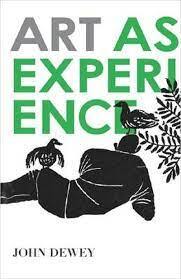
One of the focuses of her attention as she walks up and down her living space, carrying Rose in a multitude of positions, is John Dewey's Art as Experience which is propped up on her bookshelf. She stops in front of it frequently to think about the cover image and its contents:
The book of philosophy on the shelf, set facing the room, the figure on the cover with his back to them, engaging closely with his own concerns. But even so: sharing out its mood, its big, provoking ideas. Its insistence on ‘the continuity of esthetic experience with normal processes of living’; its arguments and vocabulary.
That 'continuity of esthetic experience with normal processes of living' is what Kate Briggs has managed to create in this novel full of big, provoking ideas but which is contained within the ordinary routines of a young mother caring for her baby, just as Henry Fielding's book, full of new and exciting thoughts on novel writing and on society is also the day to day account of the normal processes of living in England in the 1740s.
…………………………………
*The epigraph at the beginning of The Long Form:
‘My problem: how to pass … from a short, fragmented form (“notes”) to a long, continuous form (typically called “the novel”).’ — Roland Barthes, 1978, tr. Kate Briggs (2011; 2022)
The fact is, when I begin a novel for the first time, I'm mostly paying attention to the 'what' of it: what it seems to be about; but when I reread it, I begin to pay more attention to the 'how': how the writer is constructing the novel; how the novel holds its 'what' and makes it a solid, believable fiction.
This novel, like a few others I've read lately, invites particular attention to the 'how'. At the end of it, Kate Briggs includes a long list of works that have fed into the making of the 450 page novel/essay that is The Long Form (the title means 'long form fiction', a novel therefore, as opposed to shorter pieces of writing).
The works she references range from Henry Fielding's 1749 novel, Tom Jones, a Foundling, to other novels, essays and critical works that have something to say about the creation of novels and the various ways writers find of mothering them into being.
I used the word 'mothering' just now because it is clear as I reread The Long Form that Kate Briggs uses the premise of one day in the life of a new mother and her baby (the 'what' of this book) as the basis for her examination of 'how' a writer might compose their first novel (and this is Brigg's first novel though she has written short pieces on translation—and 'written' many translations as well).
Yes, on one level, The Long Form is a very credible and readable fiction about a single mother called Helen, home alone with her six-week old baby, Rose, and still figuring out how to mother this new being: how to hold her, how to vary the holding, how to see the world from her perspective, how to anticipate her needs, how to get through the bouts of crying, both her own and the baby's, and how to stay awake and minimally nourished while doing it all.
And behind everything lies the huge realization that she is no longer a carefree individual but now has all the responsibilities that go with being a mother.
Through this story of Helen and her baby, Kate Briggs makes us realise that writing your first novel must be exactly like that: you start out with a premise but then you must find a frame to place it in, something to hold it and carry it forward. You must vary the holding and carrying in order to sustain your own and the (future) reader's interest. You must feed it ideas, nurse it gently along, and keep yourself awake while helping it develop, snatching food and rest when your inspiration falls asleep, becoming alert when inspiration wakes up again, forgetting hunger and thirst while the narrative flow is in full progress, breaking down in tears when it all gets too much.
But above all, facing the realization that you've now got the responsibility that goes with having transitioned from being a reader to being a writer.
And just as babies move on from the constant-care early weeks of their lives, novels too move on and get delivered to their publishers—as this one fortunately did.
And coincidentally, a novel actually gets delivered within the space of the Helen and Rose story: a copy of Henry Fielding's Tom Jones, a Foundling is delivered to Helen's door by a courier (who rings the bell and wakens the finally-asleep Rose (if you've been the mother of a new-born, you'll know the pain of this)). However, in spite of that painful delivery, Helen later snatches a few moments while Rose is staring up at a mobile made of contrasting patterns and hues (isn't a novel something like that?) to look inside Fielding's book (which I recently read). And although Fielding's novel is centered around a new-born baby, one of the wonderful things about it from Helen's point of view is that she can leave it down and pick it up later, if and when it suits her—which is a nice reminder to this reviewer that babies and books are not the same thing!
But Fielding's book, perhaps the first long-form credible novel in English, is much more than just Helen's reading material during the course of the day described in The Long Form. Its organisation into short chapters of narrative contrasted with essays on both novel writing and the wider society, becomes the pattern of Kate Briggs's novel as well. While Helen's hands and arms care for Rose, her mind examines a range of knowledge related to novel writing but also related to childcare (how to hold a baby), to the layout of living spaces (she walks up and down her own small space over and over), and to the organisation of cities and parks (she takes herself and Rose outdoors when indoors suffocates her). Everything she sees and experiences inspires her thoughts, and her thoughts are very rich.
One of the focuses of her attention as she walks up and down her living space, carrying Rose in a multitude of positions, is John Dewey's Art as Experience which is propped up on her bookshelf. She stops in front of it frequently to think about the cover image and its contents:
The book of philosophy on the shelf, set facing the room, the figure on the cover with his back to them, engaging closely with his own concerns. But even so: sharing out its mood, its big, provoking ideas. Its insistence on ‘the continuity of esthetic experience with normal processes of living’; its arguments and vocabulary.
That 'continuity of esthetic experience with normal processes of living' is what Kate Briggs has managed to create in this novel full of big, provoking ideas but which is contained within the ordinary routines of a young mother caring for her baby, just as Henry Fielding's book, full of new and exciting thoughts on novel writing and on society is also the day to day account of the normal processes of living in England in the 1740s.
…………………………………
*The epigraph at the beginning of The Long Form:
‘My problem: how to pass … from a short, fragmented form (“notes”) to a long, continuous form (typically called “the novel”).’ — Roland Barthes, 1978, tr. Kate Briggs (2011; 2022)

February 7, 2023
Despite the deceptively-simple storyline, this is an intricate, ambitious merging of novel and essay. Kate Briggs follows Helen and her six-week-old baby Rose. Alone in a rented flat they’re bound together in a process of learning and sharing of experiences, sometimes in sync, sometimes each a mystery to the other. In a series of snatched moments, Kate removes herself from her immediate surroundings by immersing herself in a worn copy of Fielding’s classic The History of Tom Jones, a Foundling An interaction that also opens up a dialogue between Helen and Rose’s narrative and Fielding’s and then by extension the nature of the novel itself. An interrogation that links back to Briggs’s earlier work on translation and her thoughts on Barthes and the novel, or as he dubbed it, the long form. Elements of Briggs’s structuring of her ideas also reminded me of aspects of Barthes’s writing, particularly the ordered, yet fragmented, A Lover’s Discourse - further echoed in a sub-plot involving the delivery driver who carried Fielding’s novel to Helen’s door.
Through The Long Form Briggs interrogates the nature of representation, the ways that narrative might shape or be shaped by forms of knowledge and experience. She probes its machinery: how it might operate; be structured; what it might contain. As Rose and Helen map out space and time, over days spent in their ground-floor home, Briggs contrasts their experiences with the operations of the novel as form and object. She examines the novel – or rather the British, English-language novel – from a range of perspectives not least its interrelations with the book as material object, something that circulates in wider social and cultural contexts, bringing to mind Chartier and Genette and their ideas about reception and processes of reading, the myriad complex encounters between reader and text.
As much as Briggs is caught up in the nature, the limits, and the possibilities of fiction, she’s clearly invested too in issues about literary value and what stories are considered worthy of being told. This is made explicit by her focus on a narrowly-confined, “domestic” narrative. One that’s centred on care-giving, and notions of the maternal and the consciousness of a baby - the sorts of story and characters that’ve often been judged as peripheral or lacking gravity, all too often excluded from the canon of so-called "serious literature".
Briggs's book's a heavily referential, deeply thoughtful, analytical piece, a carefully-spun web of influences and ideas with a pronounced architectural quality. Briggs is in conversation here with literary theory, philosophy, and fiction - she helpfully includes an annotated list of her main sources of inspiration. She’s also very cleverly engaged in a process of making and remaking the “women’s novel” using it to gesture at wider social, aesthetic and ideological relations. I found this surprisingly compelling although for anyone, including me, who’s studied literary and/or cultural theory she’s often covering familiar ground. Her approach often felt fresh and thought-provoking but it could also feel overly-dense, sometimes stretched out and too reliant on the descriptive. I also liked the concept, which flows from Helen’s interaction with Fielding’s novel, of constructing an argument through juxtaposing and interweaving different genres, but it could also obscure the central points being put forward.
Thanks to Netgalley and publisher Fitzcarraldo Editions for an ARC
Through The Long Form Briggs interrogates the nature of representation, the ways that narrative might shape or be shaped by forms of knowledge and experience. She probes its machinery: how it might operate; be structured; what it might contain. As Rose and Helen map out space and time, over days spent in their ground-floor home, Briggs contrasts their experiences with the operations of the novel as form and object. She examines the novel – or rather the British, English-language novel – from a range of perspectives not least its interrelations with the book as material object, something that circulates in wider social and cultural contexts, bringing to mind Chartier and Genette and their ideas about reception and processes of reading, the myriad complex encounters between reader and text.
As much as Briggs is caught up in the nature, the limits, and the possibilities of fiction, she’s clearly invested too in issues about literary value and what stories are considered worthy of being told. This is made explicit by her focus on a narrowly-confined, “domestic” narrative. One that’s centred on care-giving, and notions of the maternal and the consciousness of a baby - the sorts of story and characters that’ve often been judged as peripheral or lacking gravity, all too often excluded from the canon of so-called "serious literature".
Briggs's book's a heavily referential, deeply thoughtful, analytical piece, a carefully-spun web of influences and ideas with a pronounced architectural quality. Briggs is in conversation here with literary theory, philosophy, and fiction - she helpfully includes an annotated list of her main sources of inspiration. She’s also very cleverly engaged in a process of making and remaking the “women’s novel” using it to gesture at wider social, aesthetic and ideological relations. I found this surprisingly compelling although for anyone, including me, who’s studied literary and/or cultural theory she’s often covering familiar ground. Her approach often felt fresh and thought-provoking but it could also feel overly-dense, sometimes stretched out and too reliant on the descriptive. I also liked the concept, which flows from Helen’s interaction with Fielding’s novel, of constructing an argument through juxtaposing and interweaving different genres, but it could also obscure the central points being put forward.
Thanks to Netgalley and publisher Fitzcarraldo Editions for an ARC

February 7, 2023
This is a very literary novel that takes its lead from theories of fiction, especially, though certainly not exclusively, from Roland Barthes, Mikhail Bakhtin and, to a lesser extent, Gérard Genette. Briggs seems to be putting theory into practice in this book as she explores dynamics and dialogism around and between author, characters and reader.
At the same time, this probes those spaces and thresholds where theory shades into philosophy especially around issues of existence, consciousness, experience and responsibility, of how we 'read' narratives and discourses that are extra-textual.
Henry Fielding's The History of Tom Jones, a Foundling is a marvellously apposite text to weave into this as the book that Helen is reading since it is a kind of 'postmodern' fiction from the eighteenth century (1749) and one of the earliest prose works to be designated a 'novel' in English literary history. Fielding uses some of the techniques that are part of the tool-kit of post-/modernist and contemporary writers: breaking through the fictionality of fiction, self-consciously addressing the reader and thinking about the reception of the text, expanding and contracting the representation of time, and questioning what are appropriate topics for fiction to express.
Briggs also takes a concern with the political from these theorists though she's more radical than the essentially conservative Fielding. She puts into play the Bakhtinian idea of existence as a form of dialogue and reaches out to the reader to play.
For all the stuff I loved, this is, ironically, too long (Barthes termed the novel 'the long form'). In challenging what makes up material for a novel - especially, perhaps, a female-authored novel - this, paradoxically, makes the mundane domesticity of caring for a baby, textually mundane (at least for me). At times, this felt like a very, very long form, indeed!
Nevertheless, Briggs is doing something intellectually dense here that I appreciated. At times this reminded me of Virginia Woolf 'doing' theory - though Woolf had a lighter touch. A challenging read, then, but also an exhilarating one - and one to read and then put back on the pile to re-read.
3.5 stars rounded up to 4
Many thanks to Fitzcarraldo Editions for an ARC via NetGalley.
At the same time, this probes those spaces and thresholds where theory shades into philosophy especially around issues of existence, consciousness, experience and responsibility, of how we 'read' narratives and discourses that are extra-textual.
Henry Fielding's The History of Tom Jones, a Foundling is a marvellously apposite text to weave into this as the book that Helen is reading since it is a kind of 'postmodern' fiction from the eighteenth century (1749) and one of the earliest prose works to be designated a 'novel' in English literary history. Fielding uses some of the techniques that are part of the tool-kit of post-/modernist and contemporary writers: breaking through the fictionality of fiction, self-consciously addressing the reader and thinking about the reception of the text, expanding and contracting the representation of time, and questioning what are appropriate topics for fiction to express.
Briggs also takes a concern with the political from these theorists though she's more radical than the essentially conservative Fielding. She puts into play the Bakhtinian idea of existence as a form of dialogue and reaches out to the reader to play.
For all the stuff I loved, this is, ironically, too long (Barthes termed the novel 'the long form'). In challenging what makes up material for a novel - especially, perhaps, a female-authored novel - this, paradoxically, makes the mundane domesticity of caring for a baby, textually mundane (at least for me). At times, this felt like a very, very long form, indeed!
Nevertheless, Briggs is doing something intellectually dense here that I appreciated. At times this reminded me of Virginia Woolf 'doing' theory - though Woolf had a lighter touch. A challenging read, then, but also an exhilarating one - and one to read and then put back on the pile to re-read.
3.5 stars rounded up to 4
Many thanks to Fitzcarraldo Editions for an ARC via NetGalley.

April 21, 2023
Shortlisted for the 2023 Republic of Consciousness Prize US & Canada
Shortlisted for the Goldsmiths Prize as I very much hoped it would be
FIRST THING
GUESSING AND MOVEMENT IN THE LIVING ROOM
The beginning of each new project was always a continuation. For the time being, it was the basic but not obvious project of sleep.
A co-project: involving Helen and her baby, starting out from where they were first thing in the morning, carrying forward the experience of their long and wakeful, interactive night.
In The Long Form, Kate Briggs has conceived and given birth to a wonderful hybrid work, which explores the relationship between a mother and her new-born baby in parallel with the history of the novel form, drawing on Henry Fielding's Tom Jones, one of those novels that, like Don Quixote and The Life and Opinions of Tristram Shandy, Gentleman was post-post-modern before there was even a modern to be post-, or post-post-, of.
Briggs novel is the type of book which the Goldsmiths Prize was invented to reward, to celebrate the qualities of creative daring associated with the College and to reward fiction that breaks the mould or extends the possibilities of the novel form, and I would be highly disappointed if it does not feature. And Briggs's quotes from another previous winner of that prize, and another whose books fit the prize's ethos perfectly:
Isabel Waidner: 'The British novel reproduces white middle-class values and aesthetics' (an interview in The New Statesman, UK edition, 3 November 2021). The question ‘Do we already know (What would it mean to claim to already know? And, therefore, to use the novel as a mechanism never to expand on but merely to confirm and repeatedly reproduce?) what "an agent (a human agent, a live creature, living out their own intensive version of‘`ordinary," uniquely situated life) is capable of?' in the section titled LIFE-LIKE references this comment from Waidner: 'I have come to think of the British novel as a — if not the — technology for the reproduction of-white middle-class values, aesthetics and a certain type of “acceptable" nationalism.'
And Fielding and Waidner are just two of around 90 authors, critics, theorists and artists whose work Briggs has drawn upon in this novel, a group as diverse as Hans Christian Andersen, Mikhail Bakhtin, Roland Barthes (in Briggs' own translation), Bridget Brophy,Rachel Cusk, Craig David, Giles Delueze, Chalres Dickens, Clarice Lispector, Preti Taneja, James Wood and Virginia Woolf.
As an example the style of the book draws on Rosamarie Waldrop's The Hanky of Pippin’s Daughter, as described by Ben Lerner in the New Yorker, with it's "destabilizing section headings" which produce "a standoff between flow and fragmentation.".
And in one brilliant section she quotes from Hannah Arendt's definition of beginning - it is in the nature of beginningthat something new is started which cannot be expected from whatever may have happened alongside Penelope Leach's Your Baby and Child and Leach's explanation of the newness - the novelty? - of any newborn baby: Anyone who looks after a newborn baby — parent, substitute-parent or professional — inevitably lacks the first essential for watchful care: baselines. The baby is brand-new. However much you know about babies in general, neither you nor anyone else knows anything about this one in particular. You do not know how she looks and behaves when she is well and content, so it is difficult for you to know when she is sick or miserable. You do not know how much she "usually" cries because she has not been around for long enough for anything to be usual.
It's hard to get away from the fact that the novel is long, particularly given the density of the prose at times - and although I could have happily read another 480 pages, it's almost best dipped into rather than read straight through - as well as an odd mixture of a relatively light story with at times quite essayistic comments on the novel. But crucially - and what I think this review in the Guardian misses - is that that's part of the conceit, drawing on the precedent of Tom Jones.
A very impressive work, published by Fitzcarraldo Editions.
--------------
The LIFE-LIKE section inspired by Waidner's quote:
LIFE-LIKE
But what is life like, really? The necessary, pressing, open question. And for whom? Questions that the novel, through its descriptions, the sharing out of its attention, both answers and asks. What is it like - 'ordinary' life? 'Common', 'plausible' credible' life? On what scales of action is it to be narrated, how fast should it move? Does it exclude chance, weirdness, transformation - the imagination?
Fielding's instruction to future novel-writers: 'in relating actions, great care is to be taken that we do not exceed the capacity of the agent described'.
It is important that great care be taken to remain always within the recognized capacities of agencies described.
The question this opens and begs, phrased again in the phrasing of the philosophers.
Do we already know (What would it mean to claim to already know? And, therefore, to use the novel as a mechanism never to expand on but merely to confirm and repeatedly reproduce?) What an agent' (a human agent, a live creature, living out their intense version of ‘ordinary’ uniquely situated life) is capable off.
The publisher
Published in the UK by Fitzcarraldo, which is the edition I read as a subscriber, but in the US, and for the purposes of the RofC Prize, by Dorothy.
Dorothy, a publishing project is an award-winning feminist press dedicated to works of fiction or near fiction or writing about fiction.
Each fall, we publish two new books simultaneously. We work to pair books that draw upon different aesthetic traditions, because a large part of our interest in literature lies in its possibilities, its endless stylistic and formal variety.
The press is named for its editor’s great-aunt Dorothy Traver, a librarian, rose gardener, animal lover, children’s book author, and bookmobile driver who gifted her niece books stamped with an owl bookplate.
Dorothy
Shortlisted for the Goldsmiths Prize as I very much hoped it would be
FIRST THING
GUESSING AND MOVEMENT IN THE LIVING ROOM
The beginning of each new project was always a continuation. For the time being, it was the basic but not obvious project of sleep.
A co-project: involving Helen and her baby, starting out from where they were first thing in the morning, carrying forward the experience of their long and wakeful, interactive night.
In The Long Form, Kate Briggs has conceived and given birth to a wonderful hybrid work, which explores the relationship between a mother and her new-born baby in parallel with the history of the novel form, drawing on Henry Fielding's Tom Jones, one of those novels that, like Don Quixote and The Life and Opinions of Tristram Shandy, Gentleman was post-post-modern before there was even a modern to be post-, or post-post-, of.
Briggs novel is the type of book which the Goldsmiths Prize was invented to reward, to celebrate the qualities of creative daring associated with the College and to reward fiction that breaks the mould or extends the possibilities of the novel form, and I would be highly disappointed if it does not feature. And Briggs's quotes from another previous winner of that prize, and another whose books fit the prize's ethos perfectly:
Isabel Waidner: 'The British novel reproduces white middle-class values and aesthetics' (an interview in The New Statesman, UK edition, 3 November 2021). The question ‘Do we already know (What would it mean to claim to already know? And, therefore, to use the novel as a mechanism never to expand on but merely to confirm and repeatedly reproduce?) what "an agent (a human agent, a live creature, living out their own intensive version of‘`ordinary," uniquely situated life) is capable of?' in the section titled LIFE-LIKE references this comment from Waidner: 'I have come to think of the British novel as a — if not the — technology for the reproduction of-white middle-class values, aesthetics and a certain type of “acceptable" nationalism.'
And Fielding and Waidner are just two of around 90 authors, critics, theorists and artists whose work Briggs has drawn upon in this novel, a group as diverse as Hans Christian Andersen, Mikhail Bakhtin, Roland Barthes (in Briggs' own translation), Bridget Brophy,Rachel Cusk, Craig David, Giles Delueze, Chalres Dickens, Clarice Lispector, Preti Taneja, James Wood and Virginia Woolf.
As an example the style of the book draws on Rosamarie Waldrop's The Hanky of Pippin’s Daughter, as described by Ben Lerner in the New Yorker, with it's "destabilizing section headings" which produce "a standoff between flow and fragmentation.".
And in one brilliant section she quotes from Hannah Arendt's definition of beginning - it is in the nature of beginningthat something new is started which cannot be expected from whatever may have happened alongside Penelope Leach's Your Baby and Child and Leach's explanation of the newness - the novelty? - of any newborn baby: Anyone who looks after a newborn baby — parent, substitute-parent or professional — inevitably lacks the first essential for watchful care: baselines. The baby is brand-new. However much you know about babies in general, neither you nor anyone else knows anything about this one in particular. You do not know how she looks and behaves when she is well and content, so it is difficult for you to know when she is sick or miserable. You do not know how much she "usually" cries because she has not been around for long enough for anything to be usual.
It's hard to get away from the fact that the novel is long, particularly given the density of the prose at times - and although I could have happily read another 480 pages, it's almost best dipped into rather than read straight through - as well as an odd mixture of a relatively light story with at times quite essayistic comments on the novel. But crucially - and what I think this review in the Guardian misses - is that that's part of the conceit, drawing on the precedent of Tom Jones.
A very impressive work, published by Fitzcarraldo Editions.
--------------
The LIFE-LIKE section inspired by Waidner's quote:
LIFE-LIKE
But what is life like, really? The necessary, pressing, open question. And for whom? Questions that the novel, through its descriptions, the sharing out of its attention, both answers and asks. What is it like - 'ordinary' life? 'Common', 'plausible' credible' life? On what scales of action is it to be narrated, how fast should it move? Does it exclude chance, weirdness, transformation - the imagination?
Fielding's instruction to future novel-writers: 'in relating actions, great care is to be taken that we do not exceed the capacity of the agent described'.
It is important that great care be taken to remain always within the recognized capacities of agencies described.
The question this opens and begs, phrased again in the phrasing of the philosophers.
Do we already know (What would it mean to claim to already know? And, therefore, to use the novel as a mechanism never to expand on but merely to confirm and repeatedly reproduce?) What an agent' (a human agent, a live creature, living out their intense version of ‘ordinary’ uniquely situated life) is capable off.
The publisher
Published in the UK by Fitzcarraldo, which is the edition I read as a subscriber, but in the US, and for the purposes of the RofC Prize, by Dorothy.
Dorothy, a publishing project is an award-winning feminist press dedicated to works of fiction or near fiction or writing about fiction.
Each fall, we publish two new books simultaneously. We work to pair books that draw upon different aesthetic traditions, because a large part of our interest in literature lies in its possibilities, its endless stylistic and formal variety.
The press is named for its editor’s great-aunt Dorothy Traver, a librarian, rose gardener, animal lover, children’s book author, and bookmobile driver who gifted her niece books stamped with an owl bookplate.
Dorothy

Read
March 8, 2024DNF at the halfway point. The novel's proustian prolongation of individual moments, combined with a writing style where Briggs creates the impression that she is considering the words of her sentences in situ, writing phrases/adjectives with the same semantic meaning in 2, 3, 4, or more different ways in a given sentence, make this novel a challenge for me to read.
I keep thinking of this exquisite sentence in Mrs. Dalloway:
How fresh, how calm, stiller than this of course, the air was in the early morning; like the flap of a wave; the kiss of a wave; chill and sharp and yet (for a girl of eighteen as she then was) solemn, feeling as she did, standing there at the open window, that something awful was about to happen.
Woolf employs this repeating, reforming, restating method that Briggs also uses--"how fresh, how calm stiller than this"...."like the flap of a wave; the kiss of a wave..." and it's one of my favorite sentences at all time.
But when this hesitation and repetition is used 4-5 times per page, 3-4 attempts to find the "right" word per sentence, and when these are more like restatements of what has already been written, vs. adding new information, then it's hard for me to stay engaged.
I keep thinking of this exquisite sentence in Mrs. Dalloway:
How fresh, how calm, stiller than this of course, the air was in the early morning; like the flap of a wave; the kiss of a wave; chill and sharp and yet (for a girl of eighteen as she then was) solemn, feeling as she did, standing there at the open window, that something awful was about to happen.
Woolf employs this repeating, reforming, restating method that Briggs also uses--"how fresh, how calm stiller than this"...."like the flap of a wave; the kiss of a wave..." and it's one of my favorite sentences at all time.
But when this hesitation and repetition is used 4-5 times per page, 3-4 attempts to find the "right" word per sentence, and when these are more like restatements of what has already been written, vs. adding new information, then it's hard for me to stay engaged.
October 31, 2023
A few years ago Kate Briggs has written a brilliant extended essay on translation This Little Art. I admired it for its creativity and erudition. Respectively, I was looking forward to more of her work. It has come in a shape of this self-referential “The Long Form”. In my view, this novel is a logical continuation of "This Little Art", only more ambitious in scope. In the essay, Briggs was preoccupied with the translation as an art and a social phenomena - “thinking on reading, writing and living with the works of others” (from its blurb). This work tackles a similar area but a novel as a form has replaced translation as a focus of her investigation.
Again, Briggs’s main interest, it seems, is co-existence, sharing a certain space and time. The co-existence in the broadest form: the interactions between human beings within these spacial and temporal limits or the interactions between a human and an a book, a “container” of other humans’ wisdom; or indeed - any object. She is very much interested how these interactive spaces are structured. And this has created the opportunity for an analogy between the structure of a novel, relationship between its different elements and a relationship between a mother and a new baby for obvious reasons situated in a shared space and time.
“The principles of aesthetic composition extending and repeating – or were they prefiguring and re-grounding – the principles of social composition. The layout of a room. The form of a book. A novel: a source of suggestion (detailed speculation) as to how – in what kinds of real or invented spaces, and under what rhythmic conditions – it might be possible for live creatures, with their ages and energies and competing authorities, their interests and their needs, to co-exist, to live together.”
If it is sounds complicated, it is. However, Briggs helps her readers by constructing a working space on her own for this investigation. She models her work on The History of Tom Jones, a Foundling by Henry Fielding. Similarly to "Tom Jones", the text is structured into relatively short, creatively named chapters intermingling mini-essays with the parts of a longer narrative. The majority of the essays are devoted to the different aspects of the theory of a novel; while the narrative is a day from life of Helen and Rose, new mother and her baby with all its routines, and highs, and lows. But also there are flashbacks into Helen’s prior life, her best-friendship, Rose’s birth and the pregnancy. The recursive loop is closed when on the day we spend with Helen she is actually starting to read “Tom Jones” (when Rose allows her to do so).
It is a daring and peculiar organism of a book. I’ve learned a lot from the essayistic part. Briggs went through enormous research and read substantial volume of criticism in narratology from Bakhtin and E M Foster to much more contemporary writers (all referenced and explained in the last 20 pages of the book). I couldn't help but feel that i save a lot of time by reading her book rather than all this vastness of primary analysis myself. She touches upon many interesting theoretical issues. For example, the role of the names of the characters or the usefulness of certain steady expressions which are often called “cliches”: “eyes sparkled” or rain (‘pitter-patter’)”. She comes to the conclusion:
“it’s what familiarity with these phrasings (their patterns and their pictures) allows us collectively to feel: let’s meet in the commonplace. Say it this way and there’s a chance I’ll know how you feel”.
Incidentally, I recently was reading The Melancholy of Resistance where the author is actually playing with this feature. He deliberately indicates these phrasings in his characters’ speech by “quotation marks”. Not unlike Briggs, he conveys their usefulness for effective communication. But unlike Briggs he also shows how this delivers the power to manipulate with people thoughts and intentions. I find this discussion fascinating and deserving more time by itself. But I raised it here just to illustrate the variety of literary arguments in this book.
Also she introduced me to some professional voices writing on baby’s early development and care. Having been through the experience of having a baby (albeit only once), I’ve never heard of Donald Winnicott, for example. And there is apparently a whole theory how one is supposed to hold a baby! A bit too late for me on this one.
Compared to the essays, I was a little less enthused by the mother-baby part. Through this hyperreal narrative, Briggs is conveying the minute details of this unique experience: being a new first-time mother and also being a new baby in this world. Reading it made me think that this search for the ways of the new co-exiting is not unlike a dance of two new partners who are not able to communicate otherwise. I think the baby’s perspective was actually quite strong feature here. A 6 weeks baby does not let one to be too creative in her depiction - she does what babies are good at: cries, eats, sleeps or does not sleep. And it should be very difficult to convey her interiority without too much speculation. But Briggs has just about managed to reveal something unique about this particular baby. Helen’s experience on the other hand was too relatable for me to be engaged on the page. It might sound paradoxical, but I was hoping Briggs would manage to defamiliarise it enough for me to see a new side of this experience. But Helen’s day sounded painfully familiar to me: sleepless night, crying in the park while baby is finally asleep and no-one can see you; open doors to the showers and loos not to leave the baby alone. Baby’s constant, unconditional and unpredictable demand on my time, all of it - yes. And even a moment that might be considered a gentle culmination of the narrative in “A little chapter, in which is contained a very great incident” was easily anticipatable from the beginning as soon as i’ve realised that the baby is 6 weeks old. One remembers those milestones long time one does not need them anymore.
Strangely, this part of the book has reminded me the second instalment A Man in Love of “My struggle”, the famous autofiction by Knausgaard. In that instalment it was an episode when he took care of his two small children. It might seem the most unlikely comparison: this one is totally fictional narrative while “My struggle” is auto fictional; here we have a mum while it was a dad there; tea getting cold here; coffee and cigarets there. But the hyperreal level of details, the depiction of the very loving, but by default a bit unpredictable, a bit dysfunctional and very demanding relationship validates the comparison. In general i wonder how the people without children would read this part. I think they might find it more revealing and effective than i did. However, another similarity that, in spite of this familiarity, at the end I found “The Long Form” quite addictive reading experience, both in terms of profundity and density of essays and the poignancy of predictable routines with the baby.
Needless to say, I’ve enjoyed the novel. I also cannot wait to find out which literary genre Briggs would investigate next. I only wish for this work that together with the structure Briggs also inherited from “Tom Jones” its playfulness and maybe even bring a bit of humour. When she does play (like with the chapters’ headings or in an episode when Helen is crashing on E. M. Foster’s lecture) it works brilliantly. Also spending a day with a small baby in a small apartment without a bit of self-deprecating laugh might be too hard even with a good novel in hand.
A few Quotes:
"On the contrary, what these patches say is this: that what the novel narrates (what it writes) is precisely all it knows. This – gapped and roving – is the fullness of what it knows. A form of knowledge not assignable to a given subject (for example – the narrator), because it is contingent upon, which is to say it is produced by, the interplay of the whole composition. Its intention may always be to intend more than its own limit-views. But that expansion will happen with the reader, the other mind in the different environment it was written for, with which it is intended to interact."
"Reading Fielding’s essay on contrast, Robert L. Chibka shows how the composite form repeatedly rephrases and unsettles the question: Which is the more authoritative? Which is the more essential – the most powerful and important? Which of the parts, really, can be skipped over, and dismissed? Background or foreground? Day or night? Essay (thesis) or narration (fiction)? Large general statements or the smaller situated actions? Supporter or supported – Helen or Rose? When the point is: they are all so sensitive to each other. They have been conceived and set in relation to each other. They have been made to turn about each other. To think about and redescribe each other. When they live in such proximity to each other. In the same living space, if not always in exactly the same rooms."
"The part-novel, the novel-essay, its compound-form based on the conviction that: ‘There is never any problem, ever, which can be confined within a single framework.’"
Again, Briggs’s main interest, it seems, is co-existence, sharing a certain space and time. The co-existence in the broadest form: the interactions between human beings within these spacial and temporal limits or the interactions between a human and an a book, a “container” of other humans’ wisdom; or indeed - any object. She is very much interested how these interactive spaces are structured. And this has created the opportunity for an analogy between the structure of a novel, relationship between its different elements and a relationship between a mother and a new baby for obvious reasons situated in a shared space and time.
“The principles of aesthetic composition extending and repeating – or were they prefiguring and re-grounding – the principles of social composition. The layout of a room. The form of a book. A novel: a source of suggestion (detailed speculation) as to how – in what kinds of real or invented spaces, and under what rhythmic conditions – it might be possible for live creatures, with their ages and energies and competing authorities, their interests and their needs, to co-exist, to live together.”
If it is sounds complicated, it is. However, Briggs helps her readers by constructing a working space on her own for this investigation. She models her work on The History of Tom Jones, a Foundling by Henry Fielding. Similarly to "Tom Jones", the text is structured into relatively short, creatively named chapters intermingling mini-essays with the parts of a longer narrative. The majority of the essays are devoted to the different aspects of the theory of a novel; while the narrative is a day from life of Helen and Rose, new mother and her baby with all its routines, and highs, and lows. But also there are flashbacks into Helen’s prior life, her best-friendship, Rose’s birth and the pregnancy. The recursive loop is closed when on the day we spend with Helen she is actually starting to read “Tom Jones” (when Rose allows her to do so).
It is a daring and peculiar organism of a book. I’ve learned a lot from the essayistic part. Briggs went through enormous research and read substantial volume of criticism in narratology from Bakhtin and E M Foster to much more contemporary writers (all referenced and explained in the last 20 pages of the book). I couldn't help but feel that i save a lot of time by reading her book rather than all this vastness of primary analysis myself. She touches upon many interesting theoretical issues. For example, the role of the names of the characters or the usefulness of certain steady expressions which are often called “cliches”: “eyes sparkled” or rain (‘pitter-patter’)”. She comes to the conclusion:
“it’s what familiarity with these phrasings (their patterns and their pictures) allows us collectively to feel: let’s meet in the commonplace. Say it this way and there’s a chance I’ll know how you feel”.
Incidentally, I recently was reading The Melancholy of Resistance where the author is actually playing with this feature. He deliberately indicates these phrasings in his characters’ speech by “quotation marks”. Not unlike Briggs, he conveys their usefulness for effective communication. But unlike Briggs he also shows how this delivers the power to manipulate with people thoughts and intentions. I find this discussion fascinating and deserving more time by itself. But I raised it here just to illustrate the variety of literary arguments in this book.
Also she introduced me to some professional voices writing on baby’s early development and care. Having been through the experience of having a baby (albeit only once), I’ve never heard of Donald Winnicott, for example. And there is apparently a whole theory how one is supposed to hold a baby! A bit too late for me on this one.
Compared to the essays, I was a little less enthused by the mother-baby part. Through this hyperreal narrative, Briggs is conveying the minute details of this unique experience: being a new first-time mother and also being a new baby in this world. Reading it made me think that this search for the ways of the new co-exiting is not unlike a dance of two new partners who are not able to communicate otherwise. I think the baby’s perspective was actually quite strong feature here. A 6 weeks baby does not let one to be too creative in her depiction - she does what babies are good at: cries, eats, sleeps or does not sleep. And it should be very difficult to convey her interiority without too much speculation. But Briggs has just about managed to reveal something unique about this particular baby. Helen’s experience on the other hand was too relatable for me to be engaged on the page. It might sound paradoxical, but I was hoping Briggs would manage to defamiliarise it enough for me to see a new side of this experience. But Helen’s day sounded painfully familiar to me: sleepless night, crying in the park while baby is finally asleep and no-one can see you; open doors to the showers and loos not to leave the baby alone. Baby’s constant, unconditional and unpredictable demand on my time, all of it - yes. And even a moment that might be considered a gentle culmination of the narrative in “A little chapter, in which is contained a very great incident” was easily anticipatable from the beginning as soon as i’ve realised that the baby is 6 weeks old. One remembers those milestones long time one does not need them anymore.
Strangely, this part of the book has reminded me the second instalment A Man in Love of “My struggle”, the famous autofiction by Knausgaard. In that instalment it was an episode when he took care of his two small children. It might seem the most unlikely comparison: this one is totally fictional narrative while “My struggle” is auto fictional; here we have a mum while it was a dad there; tea getting cold here; coffee and cigarets there. But the hyperreal level of details, the depiction of the very loving, but by default a bit unpredictable, a bit dysfunctional and very demanding relationship validates the comparison. In general i wonder how the people without children would read this part. I think they might find it more revealing and effective than i did. However, another similarity that, in spite of this familiarity, at the end I found “The Long Form” quite addictive reading experience, both in terms of profundity and density of essays and the poignancy of predictable routines with the baby.
Needless to say, I’ve enjoyed the novel. I also cannot wait to find out which literary genre Briggs would investigate next. I only wish for this work that together with the structure Briggs also inherited from “Tom Jones” its playfulness and maybe even bring a bit of humour. When she does play (like with the chapters’ headings or in an episode when Helen is crashing on E. M. Foster’s lecture) it works brilliantly. Also spending a day with a small baby in a small apartment without a bit of self-deprecating laugh might be too hard even with a good novel in hand.
A few Quotes:
"On the contrary, what these patches say is this: that what the novel narrates (what it writes) is precisely all it knows. This – gapped and roving – is the fullness of what it knows. A form of knowledge not assignable to a given subject (for example – the narrator), because it is contingent upon, which is to say it is produced by, the interplay of the whole composition. Its intention may always be to intend more than its own limit-views. But that expansion will happen with the reader, the other mind in the different environment it was written for, with which it is intended to interact."
"Reading Fielding’s essay on contrast, Robert L. Chibka shows how the composite form repeatedly rephrases and unsettles the question: Which is the more authoritative? Which is the more essential – the most powerful and important? Which of the parts, really, can be skipped over, and dismissed? Background or foreground? Day or night? Essay (thesis) or narration (fiction)? Large general statements or the smaller situated actions? Supporter or supported – Helen or Rose? When the point is: they are all so sensitive to each other. They have been conceived and set in relation to each other. They have been made to turn about each other. To think about and redescribe each other. When they live in such proximity to each other. In the same living space, if not always in exactly the same rooms."
"The part-novel, the novel-essay, its compound-form based on the conviction that: ‘There is never any problem, ever, which can be confined within a single framework.’"
September 12, 2023
The Long Form was the sleeper hit of my summer reading, a beautiful, calm, measured, analytical and questioning novel that considers the form of the novel itself, the rhythms of everyday life, the dynamics of living with, caring for, another, considerations such as public space, play and friendship. I loved it. I had to read it too fast, so as to have a lighter suitcase coming home.
About them were just the ordinary house sounds. The living sounds, not too loud: hums and murmurs. For now, there was no treading from upstairs: a temporary reprieve from Helen’s self-consciousness of that presence and power.
There were street sounds falling in from the outside….
Dewey: ‘we all need a “space of time” in which to accomplish anything significant.' Our life’s projects. Tower building. Tower collapsing, playing at anything, testing the possibilities of anything, collaboration…
The story is a day in the life of Helen and Rose. Helen is a new mother, Rose is six weeks old. Despite that framework it is quite different to other mother-and-baby books. It shows how two people, newly together, learn to live in one another’s rhythms. We see the world through Helen’s eyes mostly, and sometimes through Rose’s raw consciousness. Helen receives a package, Henry Fielding’s Tom Jones, which begins with a baby found in a bed and interrogates the newly, truly novel, novel form throughout its many chapters. Helen begins to read and consider the novel form herself, and the idea of personhood, through this lens. Many layers and ideas are repeated through the book and come together at the end.
In one part, EM Forster makes a speech, and Helen observes (and eventually interrupts).
This was another of Forster’s observations, something he said in a lecture on the kinds of made-up people (and in what phases of their lives) a novel is most likely to pay attention to. Which is to say: adults. He noted: ‘When a baby appears in a novel it usually has the air of being posted. It is delivered “off”; one of the elder characters goes and picks it up and shows it to the reader, after which it is usually laid in cold storage until it can talk or otherwise assist in the action.’
Meanwhile Helen sits on the sofa, walks in the rain, goes to the supermarket, passes a day alone and yet not alone. There is also a wonderful depiction of friendship.
In the midst of all this, provoked by all of this: LOVE…
Love proposed as involving a rhythm. As an involvement of rhythm. Or, a rhythmed involvement. But where the accent falls not on syncing…
An original reading experience (a novel reading experience), of the type that makes you look with new eyes at how rain falls and how babies breathe.
About them were just the ordinary house sounds. The living sounds, not too loud: hums and murmurs. For now, there was no treading from upstairs: a temporary reprieve from Helen’s self-consciousness of that presence and power.
There were street sounds falling in from the outside….
Dewey: ‘we all need a “space of time” in which to accomplish anything significant.' Our life’s projects. Tower building. Tower collapsing, playing at anything, testing the possibilities of anything, collaboration…
The story is a day in the life of Helen and Rose. Helen is a new mother, Rose is six weeks old. Despite that framework it is quite different to other mother-and-baby books. It shows how two people, newly together, learn to live in one another’s rhythms. We see the world through Helen’s eyes mostly, and sometimes through Rose’s raw consciousness. Helen receives a package, Henry Fielding’s Tom Jones, which begins with a baby found in a bed and interrogates the newly, truly novel, novel form throughout its many chapters. Helen begins to read and consider the novel form herself, and the idea of personhood, through this lens. Many layers and ideas are repeated through the book and come together at the end.
In one part, EM Forster makes a speech, and Helen observes (and eventually interrupts).
This was another of Forster’s observations, something he said in a lecture on the kinds of made-up people (and in what phases of their lives) a novel is most likely to pay attention to. Which is to say: adults. He noted: ‘When a baby appears in a novel it usually has the air of being posted. It is delivered “off”; one of the elder characters goes and picks it up and shows it to the reader, after which it is usually laid in cold storage until it can talk or otherwise assist in the action.’
Meanwhile Helen sits on the sofa, walks in the rain, goes to the supermarket, passes a day alone and yet not alone. There is also a wonderful depiction of friendship.
In the midst of all this, provoked by all of this: LOVE…
Love proposed as involving a rhythm. As an involvement of rhythm. Or, a rhythmed involvement. But where the accent falls not on syncing…
An original reading experience (a novel reading experience), of the type that makes you look with new eyes at how rain falls and how babies breathe.

March 26, 2025
Literary AF

July 21, 2023
As one would expect from a writer who first made her name as a translator of Barthes, and who also wrote This Little Art, a brilliant and idiosyncratic account of the challenges of translation, this debut novel is far from straightforward. It mixes a non-linear story of a young single woman coming to terms with living with her baby daughter with metafictional elements, and quite a lot of Tom Jones, which is weaved into the plot as what the woman was trying to read. As the end-note reveals, it is full of other cultural references and quotations, so in a sense is a conversation with her literary influences that is far more interesting than the core story.
Well worth reading, but a book that I would be very surprised to see on the Booker list - Goldsmiths seems more likely.
Well worth reading, but a book that I would be very surprised to see on the Booker list - Goldsmiths seems more likely.

June 23, 2024
4.25 stars
“I know time. I know time differently now. I know it because I am unlearning it. I know it because the baby is teaching me that the rhythms of the clock and the calendar, and even the most elemental diurnal patterns – they don’t go without saying: they are acquired, if not violently imposed. It is a lived and not an abstract form of knowledge that comes from living alongside a beginner – the way the days can all of a sudden feel like they're undivided, divided by nothing, only water.”
This is another example of a novel set in just one day. It revolves around Helen and her baby Rose (about six weeks old). Their interactions in different parts of the flat in which they live form the centre of the book. There is an Amazon delivery, a second hand copy of the novel of Tom Jones. In the afternoon there is a walk in the park and in the evening Helen’s friend Rebba drops in. There is a bit of food and some breast feeding. In terms of action and events that is pretty much it, in almost five hundred pages.
Briggs breaks up the novel into smaller chunks, paragraphs, sentences, different fonts, spaces, squares, circles, shading, diagrams, indentations, a fair amount of experimenting.
Of course there is much more going on. Briggs is also a translator and has translated Barthes (it shows). There is a fair amount of philosophy, Dewey pops up periodically. There is a detailed bibliography at the end. The title itself is a quote from Barthes, who called the novel “the long form”.
Then there is the novel Tom Jones which Helen starts to read. Tom Jones is also experimental, moving between essay and novel itself, the same as The Long Form. There is also a fair amount of Literary Criticism (including E M Forster amongst others) in relation to Tom Jones and some analysis of the novel. Winnicot also pops up talking about motherhood.
It's a combination of essay, philosophy, reflection, literary criticism, the nature of love and of motherhood and the minutiae of everyday life:
“Some moments, hours, days, last longer for some people than others, depending. Daily life, whatever it may be really, is practically composed of two lives, said Forster: the life in time, ticking, marching by, regular, implacable, and the life by values, slowing or accelerating, shrinking or expanding, condensing or prolonging. The same sixty-second spans experienced as short minutes, as elongated minutes (as thin minutes or thicker minutes). As separated minutes: distinctive pockets, or stand-out portions of detached, delimited time.”
Some people will hate this, but on the whole I did enjoy it and it went in unexpected directions.
“I know time. I know time differently now. I know it because I am unlearning it. I know it because the baby is teaching me that the rhythms of the clock and the calendar, and even the most elemental diurnal patterns – they don’t go without saying: they are acquired, if not violently imposed. It is a lived and not an abstract form of knowledge that comes from living alongside a beginner – the way the days can all of a sudden feel like they're undivided, divided by nothing, only water.”
This is another example of a novel set in just one day. It revolves around Helen and her baby Rose (about six weeks old). Their interactions in different parts of the flat in which they live form the centre of the book. There is an Amazon delivery, a second hand copy of the novel of Tom Jones. In the afternoon there is a walk in the park and in the evening Helen’s friend Rebba drops in. There is a bit of food and some breast feeding. In terms of action and events that is pretty much it, in almost five hundred pages.
Briggs breaks up the novel into smaller chunks, paragraphs, sentences, different fonts, spaces, squares, circles, shading, diagrams, indentations, a fair amount of experimenting.
Of course there is much more going on. Briggs is also a translator and has translated Barthes (it shows). There is a fair amount of philosophy, Dewey pops up periodically. There is a detailed bibliography at the end. The title itself is a quote from Barthes, who called the novel “the long form”.
Then there is the novel Tom Jones which Helen starts to read. Tom Jones is also experimental, moving between essay and novel itself, the same as The Long Form. There is also a fair amount of Literary Criticism (including E M Forster amongst others) in relation to Tom Jones and some analysis of the novel. Winnicot also pops up talking about motherhood.
It's a combination of essay, philosophy, reflection, literary criticism, the nature of love and of motherhood and the minutiae of everyday life:
“Some moments, hours, days, last longer for some people than others, depending. Daily life, whatever it may be really, is practically composed of two lives, said Forster: the life in time, ticking, marching by, regular, implacable, and the life by values, slowing or accelerating, shrinking or expanding, condensing or prolonging. The same sixty-second spans experienced as short minutes, as elongated minutes (as thin minutes or thicker minutes). As separated minutes: distinctive pockets, or stand-out portions of detached, delimited time.”
Some people will hate this, but on the whole I did enjoy it and it went in unexpected directions.

November 19, 2024
I hesitate to label this mix of narrative and literary theory—if that’s even what it is. I read it slowly with an online group’s schedule and that turned out to be perfect, allowing a lot of space for my thoughts, just as the book itself presents its spaces thoughtfully.
In fact, “space” seems to be one of its main themes—the spaces we need to live in, literally and metaphorically; empty spaces, not to be filled up, but for contrast and for breathing; and the accommodations we make when special (hopefully) beings intrude (necessarily) on and into our spaces: all crucial for enjoying life and feeling alive—and all applied to the creation of “the long form”: the Novel.
In fact, “space” seems to be one of its main themes—the spaces we need to live in, literally and metaphorically; empty spaces, not to be filled up, but for contrast and for breathing; and the accommodations we make when special (hopefully) beings intrude (necessarily) on and into our spaces: all crucial for enjoying life and feeling alive—and all applied to the creation of “the long form”: the Novel.

July 6, 2023
Lately I've become a bit enamoured with books published by Fitzcarraldo: the majority are innovative which challenge the notion of literature. Sure there are a couple of readable ones and those are great but the bolder ones fascinate me and The Long form is no exception.
The book's writing style is not dissimilar to a documentary - by this I mean that the prose describes actions in a slightly voyeuristic way. In this case the main subjects are Helen and her baby daughter Rose.
The Long Form focuses on the minutiae of Helen's life, from the mat she places her baby on to her reaction to the doorbell ringing. One may think that the novel is about spaces in the vein of Nicholson Baker or the slow prose of Simon Okotie and in a way there are those elements but Kate Briggs takes the story to more interesting routes.
First of all the intense descriptions to not only rely on one room in the house. Slowly things expand and we move on to Helen's work area to her journeys outside her house.
Secondly Helen receives a copy of Henry Fielding's Tom Jones, which is one of the pioneering works of adventurous fiction and this leads to discussions (digressions?) about what constitutes a novel? The book's title refers to Barthes theory of natural occurrences in novels and that happens here.
Delving deeper The Long Form is an investigation of what constitutes fiction, when the book itself defies concepts of a novel as well, with its factual descriptions, use of mathematical diagrams and passages about emotions.
There are fiction elements as well, Like MFA-style novels Kate Briggs delays certain details about her characters from Rose's name to her conception. Thus The Long Form is a book which, like Tom Jones, straddles many worlds and ultimately it's up to the reader to decide what it actually is.
I like it when novels tease and tickle our brain cells and The Long Form does that, and in a playful way. An adventurous novel should be fun and The Long Form embodies a sense of exuberance.
The book's writing style is not dissimilar to a documentary - by this I mean that the prose describes actions in a slightly voyeuristic way. In this case the main subjects are Helen and her baby daughter Rose.
The Long Form focuses on the minutiae of Helen's life, from the mat she places her baby on to her reaction to the doorbell ringing. One may think that the novel is about spaces in the vein of Nicholson Baker or the slow prose of Simon Okotie and in a way there are those elements but Kate Briggs takes the story to more interesting routes.
First of all the intense descriptions to not only rely on one room in the house. Slowly things expand and we move on to Helen's work area to her journeys outside her house.
Secondly Helen receives a copy of Henry Fielding's Tom Jones, which is one of the pioneering works of adventurous fiction and this leads to discussions (digressions?) about what constitutes a novel? The book's title refers to Barthes theory of natural occurrences in novels and that happens here.
Delving deeper The Long Form is an investigation of what constitutes fiction, when the book itself defies concepts of a novel as well, with its factual descriptions, use of mathematical diagrams and passages about emotions.
There are fiction elements as well, Like MFA-style novels Kate Briggs delays certain details about her characters from Rose's name to her conception. Thus The Long Form is a book which, like Tom Jones, straddles many worlds and ultimately it's up to the reader to decide what it actually is.
I like it when novels tease and tickle our brain cells and The Long Form does that, and in a playful way. An adventurous novel should be fun and The Long Form embodies a sense of exuberance.

April 28, 2023
What a transcendent reading experience this was. I’m glad I took my time with it — it’s worth living with for awhile.
June 3, 2023
Chapeau.

April 30, 2024
wow what an expansive, far reaching debut novel! kate briggs is deftly weaving together a lot of different threads in the long form. taking place over the course of a day in the life of new mother helen and her newborn daughter rose, we get a tender look at the daily intimacies between mother and baby, helen’s own struggles and doubts about her parenting abilities, and even a peek into how rose might be perceiving the world when everything is brand new to her. i really enjoyed seeing the progression of helen’s realization that their routine together will have ebbs and flows as rose develops and comes into her own.
briggs doesn’t leave it at a simple story about motherhood - the short chapters rotate through a variety of other themes as well. she weaves in literary criticism and ideas about henry fielding’s early novel the history of tom jones and explores the novelistic form. she also characterizes helen with stories about her past and her sweet friendship with her former roommate rebba, and we even get a glimpse into the life of the delivery driver whose doorbell ringing woke up rose when he delivered helen’s copy of tom jones.
even though this is a longer book, the short chapters helped it move along at a nice pace and the further along i got, the more i looked forward to picking it up each day. i loved briggs’ style when writing about the minutiae of motherhood, and found that the parts exploring the henry fielding book were accessible, for the most part. there were some really funny, heartwarming, and thought provoking moments in here another one to add to the list of books about motherhood! looking forward to reading her other book this little art.
briggs doesn’t leave it at a simple story about motherhood - the short chapters rotate through a variety of other themes as well. she weaves in literary criticism and ideas about henry fielding’s early novel the history of tom jones and explores the novelistic form. she also characterizes helen with stories about her past and her sweet friendship with her former roommate rebba, and we even get a glimpse into the life of the delivery driver whose doorbell ringing woke up rose when he delivered helen’s copy of tom jones.
even though this is a longer book, the short chapters helped it move along at a nice pace and the further along i got, the more i looked forward to picking it up each day. i loved briggs’ style when writing about the minutiae of motherhood, and found that the parts exploring the henry fielding book were accessible, for the most part. there were some really funny, heartwarming, and thought provoking moments in here another one to add to the list of books about motherhood! looking forward to reading her other book this little art.

December 11, 2023
A rather fascinating amalgamation of a book from an author who seems incredibly intelligent. But I'm not really sure what I thought of it overall. It made me think. It did a wonderful job of both exploring/questioning and demonstrating how we experience time as humans, as parents, as readers, and as writers. In this way the book felt like an ouroboros growing as it fed upon itself---namely, it discusses character as the baby Rose develops a sense of identity and personality; Briggs examines time as a duration/sequence, as well as an intensity, while the narrative demonstrates the way a young baby quite literally changes the experience of time and the narrative stretches its form out by representing a single day; it plumbs the definitions of the novel while taking part in becoming a novel or some derivation of what we know as a novel; etc.). We're left with the defining characteristic of a novel being its length, which allows for a myriad of approaches and techniques bent on representing and exploring time in a way other forms do not.
------------------------------
NEW-TO-ME WORDS
commodious | eleemosynary | aperiodic | bract
------------------------------
NEW-TO-ME WORDS
commodious | eleemosynary | aperiodic | bract

April 21, 2024
Superb. A novelistic essay, an essayist novel - whatever. It's great.
I'm no good at providing critical insights, I tend to resort to lazy comparisons. So here's my tuppence worth - reminds me (slightly) of W G SEBALD
Would you believe it - but when it came to putting this on the bookshelf it ended up right next to The History of Tom Jones, a Foundling (I'd have added photographic proof but can't see how to get GR to play ball)
I'm no good at providing critical insights, I tend to resort to lazy comparisons. So here's my tuppence worth - reminds me (slightly) of W G SEBALD
Would you believe it - but when it came to putting this on the bookshelf it ended up right next to The History of Tom Jones, a Foundling (I'd have added photographic proof but can't see how to get GR to play ball)

March 19, 2024
It looked like what will the world look like (how will they live in it) (will it be a liveable place, for them, when Rose is older, or grown up). It looked like please (let her grow up) (let me grow old so I can watch her grow up).

December 25, 2024
the long form sanırım çok çok uzun zamandır okuduğum en iyi kitap. bunun birçok sebebi var: yapısının orjinalliği, içeriğinin sakinliği, hikayenin duruluğu, entelektüel doygunluğu, özenli ilişkileri, vb. vb.
kitap, helen (single mother) ve rose'un (altı haftalık bebeği) bir gününü anlatıyor aslında. gün, helen'in 1.3 pound'a sipariş ettiği henry fielding - tom jones kitabını kargocunun eve getirmesiyle ve zili çalarak rose'u uyandırmasıyla başlıyor. burdan sonrası bugüne kadar benzerine asla karşılaşmadığım bir anne bebek hikayesi. ikisinin de birbirine yabancılığını, alışma sürecini, birbirlerinin ritimlerini öğrenme sürecini öyle sakin, öyle dürüst anlatıyor ki bir anlığına anne olma fikrini bile kolaylaştırdı gözümde.
ancak kitap sadece bu değil, kendisi de çevirmen olan kate briggs (ki this little art tamamen bunun üstüne) okurluk, roman teorisi, çeviri hakkında pasajlarına da çokça, hatta muhtemelen hikayeden daha çok yer ayırıyor. ve bir şekilde bu pasajlar asla doğrudan olmasa da helen'le ilişkilendirilebilir bence. tom jones'la ilgili pasajlar da oldukça sık, zaten ana akslarından biri hikayenin. öncesinde tom jones'u okuyup ÇOK sevdiğim için oralara da bayıldım. şart değil bence önceden okumuş olmak, ama kesinlikle daha keyifli hale getiriyor.
diğer yandan çok yakın kız arkadaşlıkla aşkın ortasında bir yerde duran rebba (helen'in eski ev arkadaşı) ve helen ilişkisi o kadar güzel yazılmış ki mest oldum. birlikte geçirilen vaktin bu kadar değerli olduğunun farkında ve o anlara hak ettiği özeni gösteren iki insan yazmak, günümüzün toksik ve bencil ilişkilenme trendine karşı muazzam bir duruş.
kate briggs'in yaşına dair hiçbir bilgiye erişemedim, ama 21. yüzyıl yazınına sadece iki kitabıyla bile yeni bir yön verdiğini düşünüyorum. postmodernle klasiği, kurguyla kurgu dışını bu kadar güzel harmanlayan örneğe ben rastlamadım. umarım çevirmenlikten yazarlığa tam zamanlı geçiş yapar.
kitap, helen (single mother) ve rose'un (altı haftalık bebeği) bir gününü anlatıyor aslında. gün, helen'in 1.3 pound'a sipariş ettiği henry fielding - tom jones kitabını kargocunun eve getirmesiyle ve zili çalarak rose'u uyandırmasıyla başlıyor. burdan sonrası bugüne kadar benzerine asla karşılaşmadığım bir anne bebek hikayesi. ikisinin de birbirine yabancılığını, alışma sürecini, birbirlerinin ritimlerini öğrenme sürecini öyle sakin, öyle dürüst anlatıyor ki bir anlığına anne olma fikrini bile kolaylaştırdı gözümde.
ancak kitap sadece bu değil, kendisi de çevirmen olan kate briggs (ki this little art tamamen bunun üstüne) okurluk, roman teorisi, çeviri hakkında pasajlarına da çokça, hatta muhtemelen hikayeden daha çok yer ayırıyor. ve bir şekilde bu pasajlar asla doğrudan olmasa da helen'le ilişkilendirilebilir bence. tom jones'la ilgili pasajlar da oldukça sık, zaten ana akslarından biri hikayenin. öncesinde tom jones'u okuyup ÇOK sevdiğim için oralara da bayıldım. şart değil bence önceden okumuş olmak, ama kesinlikle daha keyifli hale getiriyor.
diğer yandan çok yakın kız arkadaşlıkla aşkın ortasında bir yerde duran rebba (helen'in eski ev arkadaşı) ve helen ilişkisi o kadar güzel yazılmış ki mest oldum. birlikte geçirilen vaktin bu kadar değerli olduğunun farkında ve o anlara hak ettiği özeni gösteren iki insan yazmak, günümüzün toksik ve bencil ilişkilenme trendine karşı muazzam bir duruş.
kate briggs'in yaşına dair hiçbir bilgiye erişemedim, ama 21. yüzyıl yazınına sadece iki kitabıyla bile yeni bir yön verdiğini düşünüyorum. postmodernle klasiği, kurguyla kurgu dışını bu kadar güzel harmanlayan örneğe ben rastlamadım. umarım çevirmenlikten yazarlığa tam zamanlı geçiş yapar.


April 22, 2024
What a triumph. Ever since Nicholson Baker's "The Mezzanine" I've enjoyed able, discursive writing about absurdly commonplace experiences, and Briggs' 420+ novel about the everyday care and feeding of a newborn positively luxuriates in its examination of the experience of mothering. I.e., what it feels like to have one's life turned upside-down by a life form whose behavior is ungrounded in predictable schedules, patterns of behavior or emotions. And not only what it feels like but literally what it FEELS like, what jerks and head bobbles and stretches signal and must represent of the little being's ventures into its environs. But there are a wealth of psychological, sensory and philosophical divagations interspersed, and Briggs' lyrical, nuanced prose is more than up to the task; indeed, it's the novel's justification.
As to action, little happens, other than contending with little Rose. A book arrives at the door, a Fielding novel, Tom Jones (a used copy, ordered online). The mother, Helen, starts reading it. Her old roommate drops by a few times to visit, to allow the mother a few moments freedom. Mother and daughter go to the park. And that's pretty much the full dramatic arc. (There are other episodes, including a flashback to the first night in the hospital, but these come late in the novel)
This initially reminded me of Lydia Davis' short essay, "What You Learn about the Baby," which is similarly observant and reflective. It’s 10 pages long. At 420+ pages (with additional footnotes), Briggs' novel is indeed the "long form." Curious that Davis and Briggs are both translators in their other lives, I'd want to ask Briggs if she'd been aware of Davis's essay before beginning this. As a childless 80 y/o, much was new territory for me, but I can imagine a mother of five enjoying it equally, so dense are its reflections and so rich its observations. This is really a fine achievement; it stretches what a novel can be and demonstrates how intensely intimate experiences can be opened up for universal appreciation.
As to action, little happens, other than contending with little Rose. A book arrives at the door, a Fielding novel, Tom Jones (a used copy, ordered online). The mother, Helen, starts reading it. Her old roommate drops by a few times to visit, to allow the mother a few moments freedom. Mother and daughter go to the park. And that's pretty much the full dramatic arc. (There are other episodes, including a flashback to the first night in the hospital, but these come late in the novel)
This initially reminded me of Lydia Davis' short essay, "What You Learn about the Baby," which is similarly observant and reflective. It’s 10 pages long. At 420+ pages (with additional footnotes), Briggs' novel is indeed the "long form." Curious that Davis and Briggs are both translators in their other lives, I'd want to ask Briggs if she'd been aware of Davis's essay before beginning this. As a childless 80 y/o, much was new territory for me, but I can imagine a mother of five enjoying it equally, so dense are its reflections and so rich its observations. This is really a fine achievement; it stretches what a novel can be and demonstrates how intensely intimate experiences can be opened up for universal appreciation.

May 5, 2024
This book was on the short list for the 2023 US/Canada RoC.
I don't know how to rate this.
A caution -- do no t read this in audio, as it is almost impossible to follow.
There are a couple of things going on in this book. First is the interaction between mother Helen and newborn Rose and their individual thoughts about it. I found this tiresome and enjoyed it not one bit. Second is Helen's thoughts and digressions about the book she is reading The History of Tom Jones, a Foundling. I found this interesting and often enjoyable. The problem is listening to this in audio is that I would tune out on the first thing and then suddenly find myself in the second and wondering when the switch happened. However I did not like the second thing enough to get a print copy.
So, I'll give this a 3 with no recommendation, other than to say it is the worst type of book to listen to when walking or biking.
I don't know how to rate this.
A caution -- do no t read this in audio, as it is almost impossible to follow.
There are a couple of things going on in this book. First is the interaction between mother Helen and newborn Rose and their individual thoughts about it. I found this tiresome and enjoyed it not one bit. Second is Helen's thoughts and digressions about the book she is reading The History of Tom Jones, a Foundling. I found this interesting and often enjoyable. The problem is listening to this in audio is that I would tune out on the first thing and then suddenly find myself in the second and wondering when the switch happened. However I did not like the second thing enough to get a print copy.
So, I'll give this a 3 with no recommendation, other than to say it is the worst type of book to listen to when walking or biking.

February 21, 2024
The Long Form is what Roland Barthes called the novel. A long time ago when I was in grad school all the English Literature PhD candidates who were my friends, made fun of Roland Barthes. They were all studying Shakespeare. This made me all the more intrigued by what exactly it was that Barthes was saying.
So I read this book which is partly the story of a woman raising her baby, partly a discussion of Fielding’s Tom Jones, and partly a lesson in literary theory. I loved reading it and was fascinated all the way through. I do feel, though, like I’ve barely scratched the surface of what it wanted to tell me. Hopefully, I can continue to educate myself.
So I read this book which is partly the story of a woman raising her baby, partly a discussion of Fielding’s Tom Jones, and partly a lesson in literary theory. I loved reading it and was fascinated all the way through. I do feel, though, like I’ve barely scratched the surface of what it wanted to tell me. Hopefully, I can continue to educate myself.

June 27, 2025
At once a novel about a mother in the early days of motherhood and also a literary criticism. I really loved the sections about Helen, our narrator, and her feelings and experiences with Rose, her young baby. Kate Briggs so fully encapsulated so many different feelings that (I can only imagine) come with mothering. Interspersed with these moments between Rose and Helen we also get very in depth close reading of a book that Helen is reading and discussion about the form of the novel more broadly - Briggs cites philosophers and psychoanalysts. Those sections felt a little bit like a slog for me. I think it might be a me problem - I'm on my summer vibe and looking for something a little less theoretical. That said, maybe it's not a me problem and the book was just a little heady. Either way I would've loved it more if it had been more focused on the moments between Helen and Rose.
November 30, 2025
I picked up The Long Song on a whim. I was in a bookshop with a friend, usually drawn to Fitzcarraldo Editions but rarely brave enough to pick one. The cover—like all Fitz covers—gave nothing away. But a small line about a woman and her six-week-old baby caught my eye. As a postpartum mum myself, with a tiny two-month-old in my arms, it called to me.
I started reading that same day—something I almost never do. This is a slow, gentle, deeply reflective book, and I loved every bit of it. It captures the small, fleeting, intimate moments of early motherhood: how the world shrinks to the a baby’s needs. It understands how exhausting and transformative those weeks are, and how the tiniest moments carry entire universes of feeling—stepping outside for a walk, watching the cot mobile turn, laying the baby on the playmat, staying perfectly still while they nap, the cold, forgotten cup of tea.
The book weaves reflections on the nature of novels into the Mother’s day—quotes from writers and lectures, thoughts on structure, on what a story needs and how a narrative takes shape.
I don’t think I would have ever chosen a book like this before becoming a mother, but reading it now, with my own tiny human, made it feel right. It’s a book about paying attention—about the slowness and the enormity of each moment. And it felt like exactly what I needed.
A quiet, beautiful, human read.
I started reading that same day—something I almost never do. This is a slow, gentle, deeply reflective book, and I loved every bit of it. It captures the small, fleeting, intimate moments of early motherhood: how the world shrinks to the a baby’s needs. It understands how exhausting and transformative those weeks are, and how the tiniest moments carry entire universes of feeling—stepping outside for a walk, watching the cot mobile turn, laying the baby on the playmat, staying perfectly still while they nap, the cold, forgotten cup of tea.
The book weaves reflections on the nature of novels into the Mother’s day—quotes from writers and lectures, thoughts on structure, on what a story needs and how a narrative takes shape.
I don’t think I would have ever chosen a book like this before becoming a mother, but reading it now, with my own tiny human, made it feel right. It’s a book about paying attention—about the slowness and the enormity of each moment. And it felt like exactly what I needed.
A quiet, beautiful, human read.
September 22, 2025
Despite not always liking this book, I think it is genuinely excellent. The book itself is sort of a work of fiction/nonfiction. The entirety of the story takes place over one day with sufficient room for contemplation and essays throughout. Helen is reading The History of Tom Jones which itself is a work of fiction/nonfiction. The novel is about motherhood and friendships and the written word itself. There are extensive works cited, and the book left me with a feeling of being better off for reading it. I don’t often reread books, but this is one I could see myself reading time and time again. It’s not a favorite, but something about the way it is written just opens the door for contemplation. After all, what makes a book? What makes a mother? What makes a home?
August 25, 2026
ambitious and worth the reach. often thrillingly precise but sometimes irritatingly pregnant. at times boring, but so rewarding of effort that it felt like my fault. a very admirable book. and i was transported by it.

October 23, 2023
450+ pages about a woman trying to get a baby to go to sleep while failing to start reading a novel. But the author is a translator of Roland Barthes, and there's a 17-page bibliography at the end explaining where everything in the book originates, from chapter titles to names to structural conceits to one-off phrases.
And despite all this, and the lack of *anything* really happening, it's deeply readable, remarkably engaging, and really quite memorable. I feel like I know this woman. This child. This flat. That park where they get caught in the rain. The experience of parenthood (despite never having been a parent).
Not bad at all. 4.5 stars. And it probably would have been five if I had the first clue what all the geometric shape illustrations were meant to signify...
And despite all this, and the lack of *anything* really happening, it's deeply readable, remarkably engaging, and really quite memorable. I feel like I know this woman. This child. This flat. That park where they get caught in the rain. The experience of parenthood (despite never having been a parent).
Not bad at all. 4.5 stars. And it probably would have been five if I had the first clue what all the geometric shape illustrations were meant to signify...

October 15, 2023
I read this book as part of the 2023 Goldsmith's Award shortlist, a prize for books that are "innovative" and "original" in theme, writing or structure.
LONG FORM does these things by juxtaposing the story of a new mother building a relationship with her baby against a meta-fictional element analyzing her thoughts of TOM JONES, the book she is reading and other meta-fictional elements.
While I can see how this is artfully done and how well it meets the requirements of the prize, it had just a little too much BABY and not enough TOM for my taste, though this could quite possibly be from my lack of experience and interest in the minutia of baby care! 3.5 stars rounded to 4.
LONG FORM does these things by juxtaposing the story of a new mother building a relationship with her baby against a meta-fictional element analyzing her thoughts of TOM JONES, the book she is reading and other meta-fictional elements.
While I can see how this is artfully done and how well it meets the requirements of the prize, it had just a little too much BABY and not enough TOM for my taste, though this could quite possibly be from my lack of experience and interest in the minutia of baby care! 3.5 stars rounded to 4.
Displaying 1 - 30 of 153 reviews