What do you think?
Rate this book


Hardcover
First published January 1, 1621


The Anatomy of Melancholy, What It Is,
With All The Kinds, Causes, Symptoms, Prognostics, And Several Cures Of It.
In Three Partitions.
With Their Several Sections, Members, and Subsections,
Philosophically, Medically, Historically Opened And Cut Up.
By Democritus Junior.
With a Satirical Preface, Conducing To The Following Discourse.
A New Edition, Corrected, And Enriched By Translations Of The Numerous Classical Extracts.
By Democritus Minor. To Which Is Prefixed An Account Of The Author.
The narrower your description, the more cliched and uncommunicative, the more of the object you leave behind. Art is simply being able to communicate an object in its entirety, and it is just beyond the realm of human capability. The proponents of the encyclopedic novel, the so-called novel of learning, Sterne, Rabelais, Cervantes—and Burton in his book—have nevertheless had great fun trying to refute this. -- RoCF Interview, 1991.
The Anatomy of Melancholy, Robert Burton (1621): This is a dense, digressive, wonderfully learned, quasi-autobiographical, quasi-psychological exploded encyclopedia of all things melancholic and otherwise—a mishmash of case studies (a man who thought he was turned to glass), citations from contradictory ancient and modern authorities (c. 1620), quotations from the Bible, essays on geography and climatology, observations on the deficiencies of the Catholic Church, recommendations of study as a cure for melancholy (and then reflections on study as a cause of melancholy), a utopia. Burton described his Anatomy as: “a rhapsody of rags gathered together from several dung-hills, excrements of authors, toys and fopperies confusedly tumbled out, without art, invention, judgement, wit, learning, harsh, raw, rude, phantastical, absurd, insolent, indiscreet, ill-composed, indigested, vain, scurrile, idle, dull, and dry…” Indeed, such it is, and for this intellectually dense disorder, the book can be baffling and dizzy-making (esp. if you read the NYRB edition, the most readily available, which has very close-set type and does not translate all of Burton’s Latin). Burton’s long, loose, Latinate sentences can also be rough going. But it is very much worth a try. Burton is an endearingly humble narrator who, while he calls himself an ignorant smatterer, might teach you to accept the incurable madness— melancholy— fallenness—of humankind.
Abderitanae pectora plebis habes.Haec te paucis admonitum volo (male feriate Lector) abi.
——quæ primum exordia sumam?--2023 Edit
[. . . what opening words should I choose?] —Virgil. 4 Aen. 3.2.5.5
quicquid dixeris minus erit, &c. [whatever you say will be inadequate, etc.] 3.2.3.1
Cui soli patuit scibile quicquid erat,
[To whom alone, all that was knowable was revealed.] —Pars epitaphii ejus [Part of his {Peter Abelard's} epitaph]
I am not poor, I am not rich; nihil est, nihil deest, I have little, I want nothing: all my treasure is in Minerva's tower. DJR
"For others it will be pleasurably difficult beyond all measure. For myself, it was mental rest. Mine was the kind of reading which is often described as “letting the prose just flow over you.” My reading was one of phrases, quotations, lists, words, names, daydreams, and melancholy, but not of sentences. No question that my reading was not a close reading. One need not analyze a friend to death with every conversation. Just listen. Just dance." —Nathan "N.R." Gaddis
They are melancholic. They are erudite. They revel in learning. They know that the world is their books. They can step out of their 21st century vanity and return to a 17th text and feel at home. They know that science changed but did not advance with Sir Bacon (side of eggs, please). They know that Burton will feel more modern and kin-like than what is passed off as the Latest Thing today. They will understand that our neuronal superstitions today are no advancement over the theory of humours. They will, in all likelihood, be brimming with black bile. They will be readers who will nevernever find too many words between the covers of a book.
An Anatomy of THE ANATOMY OF MELANCHOLY
WHAT IT IS.
WITH ALL THE CAUSES, QUOTATIONS, AND QUIBBLES THEREIN
IN THREE MAIN PARTITIONS.
OPENED AND CUT UP.
BY
BURTONIUS JUNIOR
With a Satirical P R E F A C E, conducing us to the following Discourse.
P R E F A C E
THE FIRST PARTITION
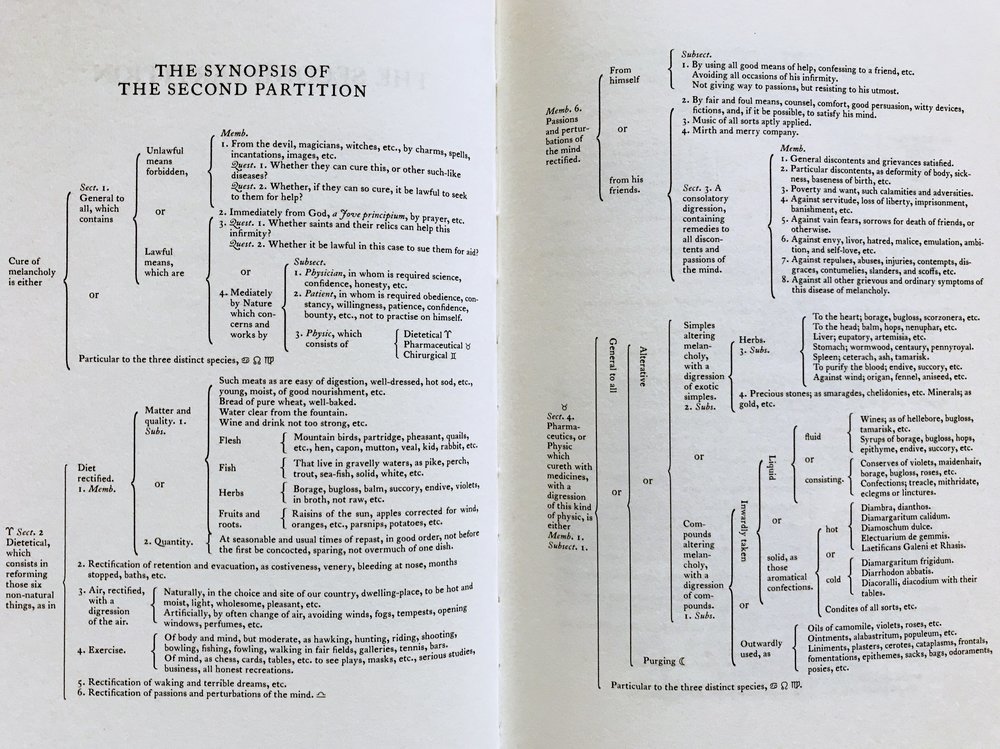
THE SECOND PARTITION
THE THIRD PARTITION
I'd wandered away awhile, but Burton always awaits with open arms.
I finished the Second Partition today. It ends weakly (unlike the First, or the Preface) but is still strong overall, and is just as heavily marginalia'd.
I've begun the Third, on Love Melancholy, and it is beautiful. From the endless variety of ills, to the endless variety of cures, to, now, the endlessness of love.
Burton is my Virgil.
Digressions, incontestably, are the sunshine;——they are the life, the soul of reading!—take them out of this book, for instance,—you might as well take the book along with them;—one cold eternal winter would reign in every page of it; restore them to the writer;—he steps forth like a bridegroom,—bids All-hail; brings in variety, and forbids the appetite to fail.