

What do you think?

Into Every Generation a Slayer Is Born: How Buffy Staked Our Hearts
The oral history and exploration of the cultural impact of Buffy the Vampire Slayer, the classic, ground-breaking television show still adored by fans old and new, from pop culture critic and lifelong devotee of the show Evan Ross Katz, social media's foremost Sarah Michelle Gellar historian.
Over the course of its seven-year run, Buffy the Vampire Slayer cultivated a loyal fandom and featured a strong, complex female lead, at a time when such a character was a rarity. In Into Every Generation, pop culture critic Evan Ross Katz, social media’s Sarah Michelle Gellar expert, will explore the show’s history and cultural relevance through a book that is part oral history, part celebration, and part memoir of a very personal fandom that has universal resonance. Katz—with the help of the show’s cast, creators, and crew—will reveal that although the show contributed to important conversations about gender, sexuality, and race, it was not free of internal strife and controversy. Men—both on screen and off—would taint its reputation as a feminist masterpiece, and changing networks would drastically impact the show’s tone and the lives of its cast. How those disruptions impact the show’s production, the lives of its cast members, and, more broadly, pop culture will be examined. Katz will address these issues and more, including interviews with stars such as Sarah Michelle Gellar and Charisma Carpenter, as well as conversations with celebrity Buffy fanatics including Tavi Gevinson, Pedro Pascal, Selma Blair, and Retta. Furthermore, Into Every Generation will explore the very notion of fandom, and the ways a show like Buffy can influence not only how we see the world but how we exist within it.
Over the course of its seven-year run, Buffy the Vampire Slayer cultivated a loyal fandom and featured a strong, complex female lead, at a time when such a character was a rarity. In Into Every Generation, pop culture critic Evan Ross Katz, social media’s Sarah Michelle Gellar expert, will explore the show’s history and cultural relevance through a book that is part oral history, part celebration, and part memoir of a very personal fandom that has universal resonance. Katz—with the help of the show’s cast, creators, and crew—will reveal that although the show contributed to important conversations about gender, sexuality, and race, it was not free of internal strife and controversy. Men—both on screen and off—would taint its reputation as a feminist masterpiece, and changing networks would drastically impact the show’s tone and the lives of its cast. How those disruptions impact the show’s production, the lives of its cast members, and, more broadly, pop culture will be examined. Katz will address these issues and more, including interviews with stars such as Sarah Michelle Gellar and Charisma Carpenter, as well as conversations with celebrity Buffy fanatics including Tavi Gevinson, Pedro Pascal, Selma Blair, and Retta. Furthermore, Into Every Generation will explore the very notion of fandom, and the ways a show like Buffy can influence not only how we see the world but how we exist within it.
Audiobook
First published March 15, 2022
Ratings & Reviews
Friends & Following
Create a free account to discover what your friends think of this book!
Community Reviews
Displaying 1 - 30 of 555 reviews

April 8, 2022
4.5 stars
Warning, this review will be VERY gif-tastic.

Buffy was an incredibly formative show for me. I stumbled across an episode while at a sleepover in middle school and wanted more. And I became OBSESSED. I mean like, people made fun of me for loving it so much, even through college (but like seriously, can we stop putting down people for loving things?). I loved the show so much and made many friendships simply because we both loved the show. I have many memories of taping it on VHS when it was on and then repeatedly watching the episodes. When the DVDs came out? Chef’s kiss. Greatest invention ever at that point. I’ve rewatched the show many times throughout the years and to this day still excitedly talk about it with other nerds who also loved it.
I knew right away I wanted to read this book because the author, Evan Ross Katz, has been called the “Sarah Michelle Gellar historian”, from accounts like Deumoix on Instagram and Andy Cohen has endorsed him. And I am beyond glad we got this book. Because while it pointed out many things about the show that I already knew, I learned a heck of a lot of what happened behind the scenes. Being as I watched this as a kid in the early 2000’s I didn’t have much access to the gossip surrounding the show so that was fairly new to me. I didn’t realize there had been rumors about Sarah Michelle Gellar (SMG) being difficult or mean. So I was relieved when upon finding this out in the book, the author mainly went on to dispel these rumors with cast interviews. I also didn’t realize what actual trash Nicholas Brendon is (willful ignorance maybe?) and with every interview it got worse and worse.
I thought this book did a great job addressing a lot of the social issues surrounding the show, things that as a white cis woman I might not have realized at the time but seem glaringly obvious now. Like the fact that Willow and Tara, a gay couple, didn’t on screen kiss until the fifth season because the network didn’t allow it (what the actual F*CK by the way). The lack of diversity which makes sense for the time it came out but now seems completely unacceptable. I wish we had had a more diverse and rich cast from the beginning and if there’s ever a reboot I hope they address this. Also the dream sequence with Tara speaking for the first slayer? Thinking of that now gives me ick, it’s so blatantly awful now.

And also, because of brave actors and actresses speaking out recently, we learned what a terrible place the show was for a lot of people. It brings me great sadness that something I love and cherish caused pain for many people. But I am also very glad they were brave enough to speak out about these experiences and did not remain silent. While it makes me look at the show and its creator much differently than it once did, it doesn’t ruin the entire show for me. I remember even as a teenager and watching what happened with Cordelia’s character made zero sense to me, and then Charisma spoke out and it made perfect sense. I just want to hug her and all of the cast who had similar/worse experiences.
I thought the author did an absolutely fantastic job putting this book together, using older interviews, conducting new ones, citing quotes from conferences, citing the show, interviewing crew and not just cast. Researched incredibly well. Where it’s not a perfect five stars for me was I felt he inserted his own opinions too often or at points where I didn’t feel it was necessary. It doesn’t feel great to read him constantly bashing one of your favorite seasons (we get it you hate season 6). And also he seemed SUPER bitter and petty about interviews being declined with him (we get it, Marti Noxon didn’t call you back). But aside from that I really enjoyed this book and learning more about a tv show that was and is so fundamental to me. Even though I got made fun of a lot for loving this show, I am glad that in a small way I am part of the cultural impact of it and was along for the ride.

Warning, this review will be VERY gif-tastic.
Buffy was an incredibly formative show for me. I stumbled across an episode while at a sleepover in middle school and wanted more. And I became OBSESSED. I mean like, people made fun of me for loving it so much, even through college (but like seriously, can we stop putting down people for loving things?). I loved the show so much and made many friendships simply because we both loved the show. I have many memories of taping it on VHS when it was on and then repeatedly watching the episodes. When the DVDs came out? Chef’s kiss. Greatest invention ever at that point. I’ve rewatched the show many times throughout the years and to this day still excitedly talk about it with other nerds who also loved it.
I knew right away I wanted to read this book because the author, Evan Ross Katz, has been called the “Sarah Michelle Gellar historian”, from accounts like Deumoix on Instagram and Andy Cohen has endorsed him. And I am beyond glad we got this book. Because while it pointed out many things about the show that I already knew, I learned a heck of a lot of what happened behind the scenes. Being as I watched this as a kid in the early 2000’s I didn’t have much access to the gossip surrounding the show so that was fairly new to me. I didn’t realize there had been rumors about Sarah Michelle Gellar (SMG) being difficult or mean. So I was relieved when upon finding this out in the book, the author mainly went on to dispel these rumors with cast interviews. I also didn’t realize what actual trash Nicholas Brendon is (willful ignorance maybe?) and with every interview it got worse and worse.
I thought this book did a great job addressing a lot of the social issues surrounding the show, things that as a white cis woman I might not have realized at the time but seem glaringly obvious now. Like the fact that Willow and Tara, a gay couple, didn’t on screen kiss until the fifth season because the network didn’t allow it (what the actual F*CK by the way). The lack of diversity which makes sense for the time it came out but now seems completely unacceptable. I wish we had had a more diverse and rich cast from the beginning and if there’s ever a reboot I hope they address this. Also the dream sequence with Tara speaking for the first slayer? Thinking of that now gives me ick, it’s so blatantly awful now.
And also, because of brave actors and actresses speaking out recently, we learned what a terrible place the show was for a lot of people. It brings me great sadness that something I love and cherish caused pain for many people. But I am also very glad they were brave enough to speak out about these experiences and did not remain silent. While it makes me look at the show and its creator much differently than it once did, it doesn’t ruin the entire show for me. I remember even as a teenager and watching what happened with Cordelia’s character made zero sense to me, and then Charisma spoke out and it made perfect sense. I just want to hug her and all of the cast who had similar/worse experiences.
I thought the author did an absolutely fantastic job putting this book together, using older interviews, conducting new ones, citing quotes from conferences, citing the show, interviewing crew and not just cast. Researched incredibly well. Where it’s not a perfect five stars for me was I felt he inserted his own opinions too often or at points where I didn’t feel it was necessary. It doesn’t feel great to read him constantly bashing one of your favorite seasons (we get it you hate season 6). And also he seemed SUPER bitter and petty about interviews being declined with him (we get it, Marti Noxon didn’t call you back). But aside from that I really enjoyed this book and learning more about a tv show that was and is so fundamental to me. Even though I got made fun of a lot for loving this show, I am glad that in a small way I am part of the cultural impact of it and was along for the ride.

October 13, 2021
Makes me want to binge Buffy again!

I requested this book for a few reasons:
1. I love Buffy, she is tough and snarky and very cool!
2. I love Angel, he is handsome, brooding and a good vampire (Mostly).
3. I love Spike, he is hilarious and crazy!
4. It was listed in the category of “Arts and Photography”. So I thought there would be a lot of reminiscing about the show and photos to boot.

Alas there wasn’t any photos, but there are a ton online so it wasn’t hard to find a bunch for my review. Though there was certainly a lot of reminiscing but also much more. The book has interviews of cast, crew and fans and delves into things like how Buffy the Vampire Slayer, (which will have premiered 25 years ago by the time the book is released) was not only a cultural phenomenon but ahead of its time for focusing on female empowerment.
Evan Katz doesn’t shy away from the disparity between highlighting the show as a feminist touchpoint and the fact that many years later allegations were made against its’ creator Joss Whedon for creating a toxic work environment. I hadn’t known about those allegations prior to reading this since I have had my head in books since 2017 and haven’t watched much entertainment news. However, it certainly needed to be addressed and Katz did that early on in the book.
Katz readily admits just how much he loves both the show and Sarah Michelle Gellar herself and is not afraid of putting his feelings out there in a witty and self depreciating manner. I not only enjoyed this, but totally understood his feelings since I loved the show nearly as much as Katz.
Katz also mentions the “Buffy the Vampire Slayer” movie starring Kristy Swanson, Luke Perry and host of others. As all of us Buffy fans know, the movie that the TV show was based on was very different than the show in a multitude of ways. Though I like the quote in the book which tells how the film-makers took Joss Whedon’s admittedly dark humor and turned it into schlocky horror.
“Schlocky Horror” is exactly what comes to mind when I think of the Buffy movie. Not that the show didn’t have some of that at times, but the show had so much more as well. It had wit, fun, romance, awesome characters, camaraderie and the dark humor to top it all off. Like Zander, I think many of the fans had some “what wold Buffy do” moments, especially us girls when confronted with monsters in our lives.
The book was overall an enlightening and enjoyable nostalgic look at the iconic TV show.
I voluntarily read & reviewed an advanced copy of this book. All thoughts & opinions are my own.
Blog|Goodreads|Facebook|Instagram|Twitter|BookBub
I requested this book for a few reasons:
1. I love Buffy, she is tough and snarky and very cool!
2. I love Angel, he is handsome, brooding and a good vampire (Mostly).
3. I love Spike, he is hilarious and crazy!
4. It was listed in the category of “Arts and Photography”. So I thought there would be a lot of reminiscing about the show and photos to boot.
Alas there wasn’t any photos, but there are a ton online so it wasn’t hard to find a bunch for my review. Though there was certainly a lot of reminiscing but also much more. The book has interviews of cast, crew and fans and delves into things like how Buffy the Vampire Slayer, (which will have premiered 25 years ago by the time the book is released) was not only a cultural phenomenon but ahead of its time for focusing on female empowerment.
Evan Katz doesn’t shy away from the disparity between highlighting the show as a feminist touchpoint and the fact that many years later allegations were made against its’ creator Joss Whedon for creating a toxic work environment. I hadn’t known about those allegations prior to reading this since I have had my head in books since 2017 and haven’t watched much entertainment news. However, it certainly needed to be addressed and Katz did that early on in the book.
Katz readily admits just how much he loves both the show and Sarah Michelle Gellar herself and is not afraid of putting his feelings out there in a witty and self depreciating manner. I not only enjoyed this, but totally understood his feelings since I loved the show nearly as much as Katz.
“When Tom Cruise tells Renée Zellweger “You complete me” in Jerry Maguire? It’s very that steez for Buffy and me, but objectively less reciprocal.”
“It became my “thing,” intrinsic to my being years before my homosexuality or Judaism came to dominate my cultural identity. Before I was an American, I was a Buffy fan, I would joke. But I wasn’t joking. I loved this show. I loved to love this show. And I loved how much people seemed to love my love for this show (“seemed to” being the operative words).”
Katz also mentions the “Buffy the Vampire Slayer” movie starring Kristy Swanson, Luke Perry and host of others. As all of us Buffy fans know, the movie that the TV show was based on was very different than the show in a multitude of ways. Though I like the quote in the book which tells how the film-makers took Joss Whedon’s admittedly dark humor and turned it into schlocky horror.
“Schlocky Horror” is exactly what comes to mind when I think of the Buffy movie. Not that the show didn’t have some of that at times, but the show had so much more as well. It had wit, fun, romance, awesome characters, camaraderie and the dark humor to top it all off. Like Zander, I think many of the fans had some “what wold Buffy do” moments, especially us girls when confronted with monsters in our lives.
The book was overall an enlightening and enjoyable nostalgic look at the iconic TV show.
I voluntarily read & reviewed an advanced copy of this book. All thoughts & opinions are my own.
Blog|Goodreads|Facebook|Instagram|Twitter|BookBub

January 29, 2022
1.5 stars for giving me an excuse to return to the world of Buffy, but I'm so sad that this wasn't what I wanted it to be or what I feel like I was promised.
I wanted and expected a book that was about the cultural impact of Buffy at the time it was airing and since it premiered 25 years ago. This book is marketed as "part oral history, part celebration, and part memoir of a personal fandom that has universal resonance still, decades later." But that's... not entirely accurate.
This is definitely part memoir. Katz frequently inserts himself into the narrative, mostly to the detriment of the material. It gives the book a rather flippant feeling, like we're reading someone's LiveJournal entries rather than a serious work of non-fiction about the show's cultural relevance and lasting legacy.
It's also something of an oral history. The first few chapters are bizarrely structured summaries of each season with reflections from some of the folks who were there. It's not structured as an oral history in the way Not All Diamonds and Rosé: The Real Housewives Spilling Tea, Throwing Shade, and Sharing Secrets and other oral histories are, but rather it includes interview quotes and things of that nature peppered throughout the seasons' plot points.
What it's not, really, is part celebration. So much of this book is bogged down in the Joss Whedon of it all. You cannot discuss Buffy without discussing the man who created her, and the man who created her is not exactly the most popular person in the world right now. So much of the rest of this book ends up being about searching for clues to Joss's abusive behavior in past interviews (he is not interviewed specifically for this book) or asking cast members how they feel about the reckoning Whedon is going through. It turns from a celebration of the show's legacy to a criticism of it through a 2020s lens. There are entire chapters detailing the show's lack of racial diversity and Joss's skewed representation of feminism and the treatment of its LGBTQ characters. There's much lamenting done about the show not being progressive enough.
But... it was. This was the 90s and very early 00s. As Danny Strong points out several times, Buffy having what little racial diversity it did was just as much (if not more) as other shows on the air. While we can look back on the show as portraying "white feminism," that was more than other shows were doing. It was still breaking new ground. The reason we can criticize these things in 2022 is because Buffy put them on TV when it did.
Between this and the cast/crew interviews about the workplace being toxic, without very many details being revealed (beyond Charisma Carpenter's well-known allegations), it doesn't feel like this book celebrates anything. The critiques and comments brought up here about racial bias and "burying your gays" and the joy Whedon got from killing off characters when he didn't like the actors are valid and should be explored. But for a book that is claiming to be "part celebration," Katz seems to come down really hard on the show. Even just reading the first chapters summarizing each season, he mentions how much he dislikes seasons four and six. There is quite a bit of space given to the show's narrative shortcomings. I don't really know how to fully explain myself, but more of this book seemed to be designed to criticize (and not always in a constructive way) the show and not to "celebrate" it, as the description promises. Of course we can (and should!) look at the things we love through a critical lens, but that's not what I was lead to believe this book was.
It also mostly fails on an oral history level because many, many major players are not interviewed, including the one who gets the most page space: Whedon, himself. Others who did not participate: Alyson Hannigan, David Boreanaz, Michelle Trachtenberg, Eliza Dushku, Marti Noxon, any directors, and more.
I don't know... everything that's here is worth exploring and holding space for. But I feel like I was sold one thing and given another. Add that feeling to the sloppy writing and structure, and I was severely underwhelmed. Honestly, this felt like an old Buffy fansite in book form at times, when I wanted something more intellectual (why was there nothing about how Buffy is taught in colleges?), or at the very least, if Katz was going down the route of asking actors' feelings on things, something more tell-all and gossipy. This just didn't end up being for me, which is fine: not all Buffy stans are created equal. (I, for one, love season four. Sorry, not sorry.)
(My apologies if this review makes little-to-no sense. I had a lot of feelings, and I didn't edit for clarity or content. I just went with my gut.)
I wanted and expected a book that was about the cultural impact of Buffy at the time it was airing and since it premiered 25 years ago. This book is marketed as "part oral history, part celebration, and part memoir of a personal fandom that has universal resonance still, decades later." But that's... not entirely accurate.
This is definitely part memoir. Katz frequently inserts himself into the narrative, mostly to the detriment of the material. It gives the book a rather flippant feeling, like we're reading someone's LiveJournal entries rather than a serious work of non-fiction about the show's cultural relevance and lasting legacy.
It's also something of an oral history. The first few chapters are bizarrely structured summaries of each season with reflections from some of the folks who were there. It's not structured as an oral history in the way Not All Diamonds and Rosé: The Real Housewives Spilling Tea, Throwing Shade, and Sharing Secrets and other oral histories are, but rather it includes interview quotes and things of that nature peppered throughout the seasons' plot points.
What it's not, really, is part celebration. So much of this book is bogged down in the Joss Whedon of it all. You cannot discuss Buffy without discussing the man who created her, and the man who created her is not exactly the most popular person in the world right now. So much of the rest of this book ends up being about searching for clues to Joss's abusive behavior in past interviews (he is not interviewed specifically for this book) or asking cast members how they feel about the reckoning Whedon is going through. It turns from a celebration of the show's legacy to a criticism of it through a 2020s lens. There are entire chapters detailing the show's lack of racial diversity and Joss's skewed representation of feminism and the treatment of its LGBTQ characters. There's much lamenting done about the show not being progressive enough.
But... it was. This was the 90s and very early 00s. As Danny Strong points out several times, Buffy having what little racial diversity it did was just as much (if not more) as other shows on the air. While we can look back on the show as portraying "white feminism," that was more than other shows were doing. It was still breaking new ground. The reason we can criticize these things in 2022 is because Buffy put them on TV when it did.
Between this and the cast/crew interviews about the workplace being toxic, without very many details being revealed (beyond Charisma Carpenter's well-known allegations), it doesn't feel like this book celebrates anything. The critiques and comments brought up here about racial bias and "burying your gays" and the joy Whedon got from killing off characters when he didn't like the actors are valid and should be explored. But for a book that is claiming to be "part celebration," Katz seems to come down really hard on the show. Even just reading the first chapters summarizing each season, he mentions how much he dislikes seasons four and six. There is quite a bit of space given to the show's narrative shortcomings. I don't really know how to fully explain myself, but more of this book seemed to be designed to criticize (and not always in a constructive way) the show and not to "celebrate" it, as the description promises. Of course we can (and should!) look at the things we love through a critical lens, but that's not what I was lead to believe this book was.
It also mostly fails on an oral history level because many, many major players are not interviewed, including the one who gets the most page space: Whedon, himself. Others who did not participate: Alyson Hannigan, David Boreanaz, Michelle Trachtenberg, Eliza Dushku, Marti Noxon, any directors, and more.
I don't know... everything that's here is worth exploring and holding space for. But I feel like I was sold one thing and given another. Add that feeling to the sloppy writing and structure, and I was severely underwhelmed. Honestly, this felt like an old Buffy fansite in book form at times, when I wanted something more intellectual (why was there nothing about how Buffy is taught in colleges?), or at the very least, if Katz was going down the route of asking actors' feelings on things, something more tell-all and gossipy. This just didn't end up being for me, which is fine: not all Buffy stans are created equal. (I, for one, love season four. Sorry, not sorry.)
(My apologies if this review makes little-to-no sense. I had a lot of feelings, and I didn't edit for clarity or content. I just went with my gut.)

May 28, 2022
What even is this book?
I am a BIG Buffy fan. Huge. I've watched the series through several times, and have watched my favorites episodes 10+ times. I know a decent amount about the show, and so was very excited when I heard this book was coming out. I put a hold at the library a full MONTH before the book even came out.
All I gotta say is: I am so happy I didn't spend a cent on this pile of garbage.
Get ready for a rant. Here are some of my biggest complaints:
1) A full third of this book is just Evan Ross Katz summarizing each season of the show. He EXTENSIVELY quotes full scenes from episodes. He's not even breaking them down. He's just like: this happened, then this happened. Check out this scene! I very much doubt folks are picking up this book unless they've watched the show. Did he have a page count to meet or something? This was asinine.
2) Despite summarizing the entire fucking series... he doesn't know it? One tiny example: he says the character Andrew is Tucker Wells' cousins. They're brothers!!! Evan Ross Katz clearly needs to watch the show again.
3) Every opinion Evan Ross Katz has about the show is correct, and any deviating opinions are stupid. Are you a Spike/Buffy fan rather than an Angel/Buffy fan? Well, then, you're the dumbest dumb to ever dumb, according to Evan Ross Katz. Like, what? Art is subjective? Sit the fuck down.
4) He is incredibly cruel regarding some the cast members who made themselves available to be interviewed. The most insidious example of this was when Evan Ross Katz was talking to James Marsters about playing Spike. I'm gonna pull a page out of Katz's book, and quote extensively here:
But my real disdain for Spike is informed by something James Marsters said in a 2001 E! special titled Buffy's Back... "The first time Spike saw Buffy, he was hunting her, which has a very sexual undertone," he says. "And I played that very heavily. It's kind of the same thing [as] some man hunting a woman at a bar, looking at her dancing, walking across the bar, and just noticing her. It's both sexual and violent. And I played that." I get that a vampire has no soul, and for them violence isn't just palatable, it's tasty. But the comparison in real life, and the use of the words "hunting" and "violent" spoke volumes about Marsters's [sic] worldview at the time, which, if we're keeping it 100, feels grossly misaligned with the show's themes of female empowerment.
I'm going to do something that Katz never does in his book: I'm going to break this down.
Firstly, Katz contradicts this last sentence later in the book. He questions whether the show is actually about female empowerment, so... is it grossly misaligned? Make up your mind. Katz also later discusses, in depth, the fact that James Marsters approached the character of Spike using method acting. He needed to get into the mind of something evil, and so he chose the closest real-world example he could find: predatory men at bars. This is a very real thing. Does Evan Ross Katz think it's not? Or, does he think vampires are real and Marsters should have pulled from them??? Evan Ross Katz appears to be trying to suggest that James Marsters is a bad person because he was trying to do his job and portray a character who is a bad man... and this is the only example he could come up with. Go ahead and watch the interview being referenced. We don't hear the question James Marsters was even asked. How leading was it? And how does it have a single thing to do with James Marsters as a person? This says way more to me about Evan Ross Katz than it does about James Marsters.
5) Evan Ross Katz is a terrible interviewer, and doesn't know the first thing about pulling quotes. He'll transcribe paragraphs and paragraphs of quotes, completely unpolished, every "uh" and "ah" intact. What a dick.
6) In addition to interviewing cast and crew, he interviewed a few random people who have no business being quoted so extensively in the book. What the fuck do I care what Claire Saffitz has to say about Buffy the Vampire Slayer? I barely even trust what she has to say about cookies, and baking is her literal job. He also interviews Kristin Russo who doesn't even like the show. Has Evan Ross Katz even listened to her podcast? She is objectively not an authority on the show at all. Why were there 10+ pages of sound bytes from her?
7) There's an entire chapter about Buffy's wardrobe, and an entire chapter about how much Evan Ross Katz loves Sarah Michelle Gellar... where of course he had to quote every single compliment she has ever paid him. Gag me.
8) The final chapter hints at some interpersonal issues on set. As some folks may know: Nicholas Brendan has had some personal issues, there are rumors that Alyson Hannigan and Sarah Michelle Gellar never got along, David Boreanez wants nothing to do with the show anymore... but Katz just briefly mentions this and moves on. $10 Sarah Michelle Gellar asked him to dance around these actual interesting behind-the-scene bits. Or the fact that he just briefly mentions that there was an on-set rule that Michelle Trachtenberg wasn't allowed to be left in a room with Joss Whedon alone? He just mentions that and changes the subject? What the what???
9) Eliza Dushku, David Boreanez, Alyson Hannigan, and Michelle Trachtenberg all declined to talk to him. He blames it on the Joss Whedon issues that have bubbled up over the past year or so. I think they just knew he's a terrible writer and a terrible person and thus made the absolutely correct decision to not talk to this guy.
All this to say: Into Every Generation... was an easy paycheck for Evan Ross Katz to chat with Sarah Michelle Gellar and summarize a show he likes. Really, truly, don't waste your time. Watch some older interviews with cast members, and certainly watch the show, but this book will make you dumber if you try to read it.
I am a BIG Buffy fan. Huge. I've watched the series through several times, and have watched my favorites episodes 10+ times. I know a decent amount about the show, and so was very excited when I heard this book was coming out. I put a hold at the library a full MONTH before the book even came out.
All I gotta say is: I am so happy I didn't spend a cent on this pile of garbage.
Get ready for a rant. Here are some of my biggest complaints:
1) A full third of this book is just Evan Ross Katz summarizing each season of the show. He EXTENSIVELY quotes full scenes from episodes. He's not even breaking them down. He's just like: this happened, then this happened. Check out this scene! I very much doubt folks are picking up this book unless they've watched the show. Did he have a page count to meet or something? This was asinine.
2) Despite summarizing the entire fucking series... he doesn't know it? One tiny example: he says the character Andrew is Tucker Wells' cousins. They're brothers!!! Evan Ross Katz clearly needs to watch the show again.
3) Every opinion Evan Ross Katz has about the show is correct, and any deviating opinions are stupid. Are you a Spike/Buffy fan rather than an Angel/Buffy fan? Well, then, you're the dumbest dumb to ever dumb, according to Evan Ross Katz. Like, what? Art is subjective? Sit the fuck down.
4) He is incredibly cruel regarding some the cast members who made themselves available to be interviewed. The most insidious example of this was when Evan Ross Katz was talking to James Marsters about playing Spike. I'm gonna pull a page out of Katz's book, and quote extensively here:
But my real disdain for Spike is informed by something James Marsters said in a 2001 E! special titled Buffy's Back... "The first time Spike saw Buffy, he was hunting her, which has a very sexual undertone," he says. "And I played that very heavily. It's kind of the same thing [as] some man hunting a woman at a bar, looking at her dancing, walking across the bar, and just noticing her. It's both sexual and violent. And I played that." I get that a vampire has no soul, and for them violence isn't just palatable, it's tasty. But the comparison in real life, and the use of the words "hunting" and "violent" spoke volumes about Marsters's [sic] worldview at the time, which, if we're keeping it 100, feels grossly misaligned with the show's themes of female empowerment.
I'm going to do something that Katz never does in his book: I'm going to break this down.
Firstly, Katz contradicts this last sentence later in the book. He questions whether the show is actually about female empowerment, so... is it grossly misaligned? Make up your mind. Katz also later discusses, in depth, the fact that James Marsters approached the character of Spike using method acting. He needed to get into the mind of something evil, and so he chose the closest real-world example he could find: predatory men at bars. This is a very real thing. Does Evan Ross Katz think it's not? Or, does he think vampires are real and Marsters should have pulled from them??? Evan Ross Katz appears to be trying to suggest that James Marsters is a bad person because he was trying to do his job and portray a character who is a bad man... and this is the only example he could come up with. Go ahead and watch the interview being referenced. We don't hear the question James Marsters was even asked. How leading was it? And how does it have a single thing to do with James Marsters as a person? This says way more to me about Evan Ross Katz than it does about James Marsters.
5) Evan Ross Katz is a terrible interviewer, and doesn't know the first thing about pulling quotes. He'll transcribe paragraphs and paragraphs of quotes, completely unpolished, every "uh" and "ah" intact. What a dick.
6) In addition to interviewing cast and crew, he interviewed a few random people who have no business being quoted so extensively in the book. What the fuck do I care what Claire Saffitz has to say about Buffy the Vampire Slayer? I barely even trust what she has to say about cookies, and baking is her literal job. He also interviews Kristin Russo who doesn't even like the show. Has Evan Ross Katz even listened to her podcast? She is objectively not an authority on the show at all. Why were there 10+ pages of sound bytes from her?
7) There's an entire chapter about Buffy's wardrobe, and an entire chapter about how much Evan Ross Katz loves Sarah Michelle Gellar... where of course he had to quote every single compliment she has ever paid him. Gag me.
8) The final chapter hints at some interpersonal issues on set. As some folks may know: Nicholas Brendan has had some personal issues, there are rumors that Alyson Hannigan and Sarah Michelle Gellar never got along, David Boreanez wants nothing to do with the show anymore... but Katz just briefly mentions this and moves on. $10 Sarah Michelle Gellar asked him to dance around these actual interesting behind-the-scene bits. Or the fact that he just briefly mentions that there was an on-set rule that Michelle Trachtenberg wasn't allowed to be left in a room with Joss Whedon alone? He just mentions that and changes the subject? What the what???
9) Eliza Dushku, David Boreanez, Alyson Hannigan, and Michelle Trachtenberg all declined to talk to him. He blames it on the Joss Whedon issues that have bubbled up over the past year or so. I think they just knew he's a terrible writer and a terrible person and thus made the absolutely correct decision to not talk to this guy.
All this to say: Into Every Generation... was an easy paycheck for Evan Ross Katz to chat with Sarah Michelle Gellar and summarize a show he likes. Really, truly, don't waste your time. Watch some older interviews with cast members, and certainly watch the show, but this book will make you dumber if you try to read it.

March 18, 2022
Have you ever been reading something that has grabbed you so hard and so fast that you just can’t wait to tell other people what a fantastic book you’ve discovered?
This book is responsible for the complete and utter opposite of that feeling.
There’s an old adage about books and covers that goes something like “Always judge a book by its cover. You’ll never go wrong!” Well, I’m here to tell you that old adage is a lie! If you were to judge this book by its cover, you might think you were going to read a history of the TV show Buffy the Vampire Slayer. You’d also think that if you’d been noticing the select, salacious quotes that have been leaked to the media upon the book's release. After all, there’s still a few headlines to squeeze out of the whole Joss Whedon scandal, in which his boorish behavior and inability to keep his dick in his pants destroyed his reputation. There's no shortage of websites ready to wring this book of usable click-bait. But don’t believe those stories and don’t believe the title. If this book is to be correctly judged by its cover, then the title should be Insufferable Douchebag: A Book About Me, Because I’m Fabulous! (Oh, and I Mention This One TV Show Every Now and Again).
The author wastes no time in living up to the first two words in that alternate title. Did you know Evan has a podcast? You will, because he mentions it three times in one page! I can’t help but imagine him at a party, telling someone about his podcast three times in three minutes, the person listening to him with a rictus grin, a glazed look in their eyes as they desperately wish they were talking to anyone else. Did you know Kristen Chenoweth replied to one of Evan’s tweets? Don’t tell me you don’t know or don’t care who she is, because Evan’s met a lot of B-list celebrities you either don’t know or don’t care about, and he wants to tell you about all of them! Did you know Evan was an undergraduate in the Drama program at NYU? Did I tell you that Evan has a podcast?
I guess the Goodreads description of this book does mention that it’s "part memoir." If I had known that, I would have been leery about diving in. If there’s one subgenre that leaves me cold, it’s memoirs by non-famous people. Most of them don’t have a life compelling enough for me to care about or they’re not able to write well enough to hold my interest. Both of those failings go double for Evan. I admit that, since I was quickly tiring of this insufferable douchebag I started nit-picking what I was reading. I’ll spare you most of that, except for one line that was so dumb it left me laughing out loud. He’s describing one of the show’s characters as “...that senior you meet in your freshman year of high school who bestows you with your first cigarette…” Uh, that’s not how the word “bestow” works. You don’t “bestow” something to someone, you “bestow” something upon someone. It's right there in my online dictionary. I guess Evan should have been an undergraduate in the English program at NYU instead. Maybe his writing would have risen above the level of a junior high diary.
The only thing this book has to offer is an interview with Sara Michelle Gellar. She hasn’t spoken much about her experience playing the show’s title character, certainly not after the whole Whedon cultural car crash. Hearing what she and other castmates have to say would be interesting, but it’s just not worth it to wade through the author’s dime-store narcissism and buffoonery to make it worthwhile. This show deserves to have a good history written about it. This book doesn’t even come close. Drive a stake through its heart before it can suck precious hours of your life away.
A "Curmudgeon Corner" Edit
I had to make this edit because I've been coming to a realization since I wrote this review. Maybe I should have judged this book by its cover. Because its completely-stupid title should have clued me in to the inanity that awaited me between the covers. How Buffy Staked Our Hearts? You mean like what happened to the human assistant to the mayor in Season 3? Having his heart staked didn't look like very much fun, especially since it killed him. I get that it's supposed to be a reference to one of the show's most prevalent methods of slaying a vampire, but it doesn't make any sense as a title. How about something like How Buffy Saved Our Worlds... A Lot. Like what was written on her Season 5 tombstone. Hey, it ain't perfect, but it's nowhere near as ridiculous as How Buffy Murdered Each and Every One of Us.
This book is responsible for the complete and utter opposite of that feeling.
There’s an old adage about books and covers that goes something like “Always judge a book by its cover. You’ll never go wrong!” Well, I’m here to tell you that old adage is a lie! If you were to judge this book by its cover, you might think you were going to read a history of the TV show Buffy the Vampire Slayer. You’d also think that if you’d been noticing the select, salacious quotes that have been leaked to the media upon the book's release. After all, there’s still a few headlines to squeeze out of the whole Joss Whedon scandal, in which his boorish behavior and inability to keep his dick in his pants destroyed his reputation. There's no shortage of websites ready to wring this book of usable click-bait. But don’t believe those stories and don’t believe the title. If this book is to be correctly judged by its cover, then the title should be Insufferable Douchebag: A Book About Me, Because I’m Fabulous! (Oh, and I Mention This One TV Show Every Now and Again).
The author wastes no time in living up to the first two words in that alternate title. Did you know Evan has a podcast? You will, because he mentions it three times in one page! I can’t help but imagine him at a party, telling someone about his podcast three times in three minutes, the person listening to him with a rictus grin, a glazed look in their eyes as they desperately wish they were talking to anyone else. Did you know Kristen Chenoweth replied to one of Evan’s tweets? Don’t tell me you don’t know or don’t care who she is, because Evan’s met a lot of B-list celebrities you either don’t know or don’t care about, and he wants to tell you about all of them! Did you know Evan was an undergraduate in the Drama program at NYU? Did I tell you that Evan has a podcast?
I guess the Goodreads description of this book does mention that it’s "part memoir." If I had known that, I would have been leery about diving in. If there’s one subgenre that leaves me cold, it’s memoirs by non-famous people. Most of them don’t have a life compelling enough for me to care about or they’re not able to write well enough to hold my interest. Both of those failings go double for Evan. I admit that, since I was quickly tiring of this insufferable douchebag I started nit-picking what I was reading. I’ll spare you most of that, except for one line that was so dumb it left me laughing out loud. He’s describing one of the show’s characters as “...that senior you meet in your freshman year of high school who bestows you with your first cigarette…” Uh, that’s not how the word “bestow” works. You don’t “bestow” something to someone, you “bestow” something upon someone. It's right there in my online dictionary. I guess Evan should have been an undergraduate in the English program at NYU instead. Maybe his writing would have risen above the level of a junior high diary.
The only thing this book has to offer is an interview with Sara Michelle Gellar. She hasn’t spoken much about her experience playing the show’s title character, certainly not after the whole Whedon cultural car crash. Hearing what she and other castmates have to say would be interesting, but it’s just not worth it to wade through the author’s dime-store narcissism and buffoonery to make it worthwhile. This show deserves to have a good history written about it. This book doesn’t even come close. Drive a stake through its heart before it can suck precious hours of your life away.
A "Curmudgeon Corner" Edit
I had to make this edit because I've been coming to a realization since I wrote this review. Maybe I should have judged this book by its cover. Because its completely-stupid title should have clued me in to the inanity that awaited me between the covers. How Buffy Staked Our Hearts? You mean like what happened to the human assistant to the mayor in Season 3? Having his heart staked didn't look like very much fun, especially since it killed him. I get that it's supposed to be a reference to one of the show's most prevalent methods of slaying a vampire, but it doesn't make any sense as a title. How about something like How Buffy Saved Our Worlds... A Lot. Like what was written on her Season 5 tombstone. Hey, it ain't perfect, but it's nowhere near as ridiculous as How Buffy Murdered Each and Every One of Us.

February 28, 2022
Buffy the vampire slayer was huge when I was growing up, so this book automatically had me. In all honesty I thought I might be setting my expectations too high, but it was so good! It's so much more than how Buffy kept many young people captivated and empowered. Anyone Buffy fan will have all the feels reading this.

March 25, 2022
I don’t generally write reviews on here, but I’m shocked this book was released—by an actual publisher—in its current form.
The Good:
There are plenty of new interviews with cast and crew members who offer some interesting details and insight that should be new to even diehard fans.
The Rest:
I have to assume this book was never edited in any meaningful way. The writing throughout is horrendous and disjointed. It’s as though the author wanted to mimic the show’s unique voice, but ultimately just demonstrated how difficult it is to pull off. (Maybe that was the point he was trying to make? If so, choose a different point to make.)
The whole book is positioned as a sort of celebration/reckoning of the show, 25 years on from its premiere. And there’s a LOT to say about Buffy these days. But the book takes such a shallow approach—you can tell it wants to dig down deep, but it just doesn’t dig deep enough.
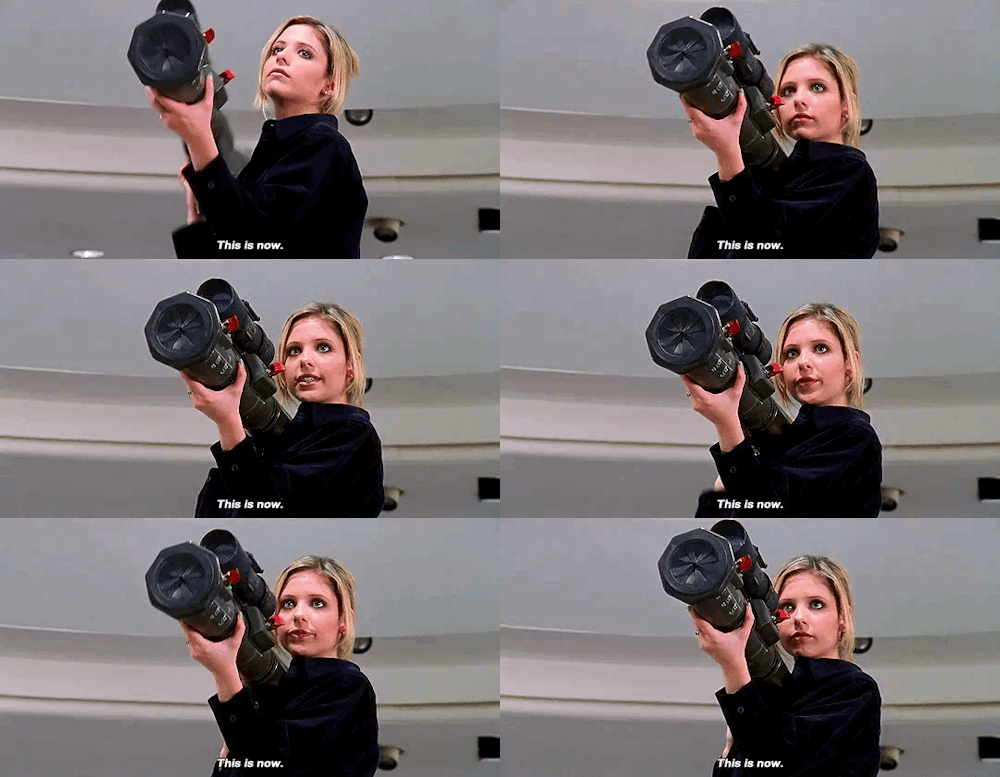
In fact, half of the book just reads like an unnecessary series plot summary—seriously, no one is reading this book who doesn’t already know exactly when, why, and how Buffy acquires a rocket launcher in season 2*—with giant pull quotes of dialogue from the series.
The rest of it is mostly just the author repeating the same phrases over and over again. “But we’ll get to that later” was probably the most common one, followed by “A theme!” and “To quote [insert awkward pop culture reference here].” Not to mention more than a little whining about a few sources that didn’t agree to be interviewed.
I think the main reason I’m frustrated is that there could easily be a good, if not great, version of this book. The author had access to plenty of fantastic sources. He is clearly a fan and understands most of the major themes of the show and its place in pop culture. This could’ve been a modern, definitive take on a series that was foundational to a generation of writers, queer folks, and TV-lovers.
Instead, we got a first draft.
* As a total nerd, it also just annoys me that there are two instances in the book where the author mentions this plot point, but mistakes what episode it occurred in. In Chapter 6, it’s referenced as part of a plot summary for “Passion.” And in Chapter 21, it’s referenced as occurring in the episode “Consequences.” Any diehard would know that it’s part of “Innocence.” Again, someone please edit this book.
The Good:
There are plenty of new interviews with cast and crew members who offer some interesting details and insight that should be new to even diehard fans.
The Rest:
I have to assume this book was never edited in any meaningful way. The writing throughout is horrendous and disjointed. It’s as though the author wanted to mimic the show’s unique voice, but ultimately just demonstrated how difficult it is to pull off. (Maybe that was the point he was trying to make? If so, choose a different point to make.)
The whole book is positioned as a sort of celebration/reckoning of the show, 25 years on from its premiere. And there’s a LOT to say about Buffy these days. But the book takes such a shallow approach—you can tell it wants to dig down deep, but it just doesn’t dig deep enough.
In fact, half of the book just reads like an unnecessary series plot summary—seriously, no one is reading this book who doesn’t already know exactly when, why, and how Buffy acquires a rocket launcher in season 2*—with giant pull quotes of dialogue from the series.
The rest of it is mostly just the author repeating the same phrases over and over again. “But we’ll get to that later” was probably the most common one, followed by “A theme!” and “To quote [insert awkward pop culture reference here].” Not to mention more than a little whining about a few sources that didn’t agree to be interviewed.
I think the main reason I’m frustrated is that there could easily be a good, if not great, version of this book. The author had access to plenty of fantastic sources. He is clearly a fan and understands most of the major themes of the show and its place in pop culture. This could’ve been a modern, definitive take on a series that was foundational to a generation of writers, queer folks, and TV-lovers.
Instead, we got a first draft.
* As a total nerd, it also just annoys me that there are two instances in the book where the author mentions this plot point, but mistakes what episode it occurred in. In Chapter 6, it’s referenced as part of a plot summary for “Passion.” And in Chapter 21, it’s referenced as occurring in the episode “Consequences.” Any diehard would know that it’s part of “Innocence.” Again, someone please edit this book.

March 16, 2022
This year is the twenty-fifth anniversary of the premiere of Buffy the Vampire Slayer. Did you know that I host a Buffy rewatch podcast,
Prophecy Girls
? So when this book came up on NetGalley, I jumped at getting an eARC—and I was also fortunate enough that Hachette sent review copies to myself and my podcast co-host for us to promote on our show. And what an easy book to promote: Evan Ross Katz’s writing is at turns informative, funny, and poignant. He combines his obvious love for Buffy with the interview access he has as a celebrity columnist to cover the show’s cultural impact and legacy—kind of like what Stephanie and I try to do on our podcast, but in book form!
The book loosely follows a chronological structure, discussing first the movie and the genesis of the TV series, before moving swiftly through each season. There is also a chapter dedicated specifically to Joss Whedon and the allegations of abuse against him from Buffy cast members and others he has worked with since, along with a chapter about the musical episode, one that focuses on Sarah Michelle Gellar and her approach to playing Buffy, etc. The chapters are all fairly long and very comprehensive. The book as a whole never really coheres into a single message (beyond, perhaps, “I love Buffy”). Yet that doesn’t matter—I just took the book as a series of loosely connected essays, and it works well that way.
Katz’s writing is on the extreme end of conversational. There’s a plethora of parentheticals, lots of personal connections to his own gay love of Buffy, and puns and jokes galore. This is probably my least favourite aspect of the book, but that might be a result of my personal bias towards more academic analysis anyway. Which is all to say that, unlike a lot of the “Buffy studies” books out there, this one is not one of those. It does have some serious thought behind it; it isn’t all light and fluffy. But the style and tone throughout are that of a gossip columnist, to good effect.
Skeptical fans might question whether this book is necessary, whether it’s really just a money grab—and I would say no. Yes, there’s so much Buffy lore out there on the Internet from two and a half decades of interviews, message board posts, convention chats, etc. Many of the stories you hear Katz repeat here will be familiar to you, from the famous origin of Buffy as the subverted cheerleader trope to the show’s network move from WB to UPN for its final two seasons. But there was plenty that was new to me—and I will admit I’m not particularly plugged into the behind-the-scenes lore, but there are also plenty of new interviews that Katz did with the cast and crew. For example, there’s an uncomfortable and hilarious moment where Katz presses Nicholas Brendon to say one nice thing about David Boreanaz.
Similarly, I know many are struggling to re-evaluate Buffy in light of the allegations around Joss Whedon. Steph and I plan to add our thoughts to this conversation in a bonus episode in the coming months. I really like how Katz handles it here. First, of course, he foregrounds what people like Charisma Carpenter and Ray Fisher actually said about Whedon’s behaviour—he prints Carpenter’s statement in full. Second, he covers multiple perspectives, quoting both fans who are more willing to separate Whedon from the show as well as others who feel like that isn’t possible. Indeed, perhaps one of the strongest arguments for the necessity of this book is that it clearly lays out what has been happening with Whedon and these allegations over the past five years—unless you’ve been paying close attention, especially on Instagram, you have probably missed some of it. Buffy fans who want to get caught up on these troubling allegations will benefit from how Katz explains it all here.
At the end of the day, it shouldn’t come as a surprise though that this book wishes to firmly enshrine Buffy as one of the all-time great television series—and why shouldn’t it? I doubt that people who have never watched the series will enjoy Into Every Generation a Slayer Is Born. New viewers, if they don’t mind some spoilers, might find that this book helps them love the series even more as they start their journey. Nevertheless, the audience here is obviously the legion of Buffy fans hungry for new content twenty-five years later. That includes me.
Informative? Yes. Makes you cry at certain points? Yes—bring tissues. Thoughtful? Also yes. It’s tempting to call this a “love letter to Buffy,” but that description of a book so clichéd these days, and it doesn’t really capture what Katz is doing here. Yes, he loves Buffy, but he’s really trying to understand why we love Buffy, and why we still love it twenty-five years and an entire wave of feminism later. If you’re wondering that … well, you’ll have to read the book to find out.
Originally posted on Kara.Reviews, where you can easily browse all my reviews and subscribe to my newsletter.

The book loosely follows a chronological structure, discussing first the movie and the genesis of the TV series, before moving swiftly through each season. There is also a chapter dedicated specifically to Joss Whedon and the allegations of abuse against him from Buffy cast members and others he has worked with since, along with a chapter about the musical episode, one that focuses on Sarah Michelle Gellar and her approach to playing Buffy, etc. The chapters are all fairly long and very comprehensive. The book as a whole never really coheres into a single message (beyond, perhaps, “I love Buffy”). Yet that doesn’t matter—I just took the book as a series of loosely connected essays, and it works well that way.
Katz’s writing is on the extreme end of conversational. There’s a plethora of parentheticals, lots of personal connections to his own gay love of Buffy, and puns and jokes galore. This is probably my least favourite aspect of the book, but that might be a result of my personal bias towards more academic analysis anyway. Which is all to say that, unlike a lot of the “Buffy studies” books out there, this one is not one of those. It does have some serious thought behind it; it isn’t all light and fluffy. But the style and tone throughout are that of a gossip columnist, to good effect.
Skeptical fans might question whether this book is necessary, whether it’s really just a money grab—and I would say no. Yes, there’s so much Buffy lore out there on the Internet from two and a half decades of interviews, message board posts, convention chats, etc. Many of the stories you hear Katz repeat here will be familiar to you, from the famous origin of Buffy as the subverted cheerleader trope to the show’s network move from WB to UPN for its final two seasons. But there was plenty that was new to me—and I will admit I’m not particularly plugged into the behind-the-scenes lore, but there are also plenty of new interviews that Katz did with the cast and crew. For example, there’s an uncomfortable and hilarious moment where Katz presses Nicholas Brendon to say one nice thing about David Boreanaz.
Similarly, I know many are struggling to re-evaluate Buffy in light of the allegations around Joss Whedon. Steph and I plan to add our thoughts to this conversation in a bonus episode in the coming months. I really like how Katz handles it here. First, of course, he foregrounds what people like Charisma Carpenter and Ray Fisher actually said about Whedon’s behaviour—he prints Carpenter’s statement in full. Second, he covers multiple perspectives, quoting both fans who are more willing to separate Whedon from the show as well as others who feel like that isn’t possible. Indeed, perhaps one of the strongest arguments for the necessity of this book is that it clearly lays out what has been happening with Whedon and these allegations over the past five years—unless you’ve been paying close attention, especially on Instagram, you have probably missed some of it. Buffy fans who want to get caught up on these troubling allegations will benefit from how Katz explains it all here.
At the end of the day, it shouldn’t come as a surprise though that this book wishes to firmly enshrine Buffy as one of the all-time great television series—and why shouldn’t it? I doubt that people who have never watched the series will enjoy Into Every Generation a Slayer Is Born. New viewers, if they don’t mind some spoilers, might find that this book helps them love the series even more as they start their journey. Nevertheless, the audience here is obviously the legion of Buffy fans hungry for new content twenty-five years later. That includes me.
Informative? Yes. Makes you cry at certain points? Yes—bring tissues. Thoughtful? Also yes. It’s tempting to call this a “love letter to Buffy,” but that description of a book so clichéd these days, and it doesn’t really capture what Katz is doing here. Yes, he loves Buffy, but he’s really trying to understand why we love Buffy, and why we still love it twenty-five years and an entire wave of feminism later. If you’re wondering that … well, you’ll have to read the book to find out.
Originally posted on Kara.Reviews, where you can easily browse all my reviews and subscribe to my newsletter.

March 20, 2022
I love Buffy and was excited there was a new book, but compared to some of the other books out there featuring deep analysis of the show this book came off a bit fluffy.
The author annoyed me deeply. I wasn't interested in his opinions but we sure got them, incessantly, about everything. He came off like a pop culture jester, worshipful of celebrity and taking every opportunity to promote himself and his own awesomeness. He also systematically framed my favorite season as the worst season in a whole chapter designed to disparage and criticize season six.
The first half of the book goes through every season with a lot of unnecessary recaps and whole scenes recreated on the page. We've seen the show, we don't need all that. The interesting moments were about the making of those seasons, the people involved, and what was happening at the time.
I did appreciate that there was a significant amount of time dedicated to the accusations made against Joss Whedon and the toxic environment he created for his actors and crew. The interview with Nicholas Brendan seemed almost exploitative, though.
There was also an intelligent discussion of Buffy and it's lack of representation when it came to people of color, and how poorly it handles the characters who were POC, like the untimely and unnecessary death of Kendra.
A lot of the later chapters cover familiar territory like Buffy speak, the fashion, the music, and how great SMG is.
I enjoyed reading about all the people who love the show and the reasons why. The book starts out with an interview with Stacy Abrams about her love of Buffy, but we also hear from Cynthia Erivo, Claire Saffitz, and several others. I appreciated that there was an intense appreciation and also criticism of the show that was very much from the point of view of this modern time.
The author annoyed me deeply. I wasn't interested in his opinions but we sure got them, incessantly, about everything. He came off like a pop culture jester, worshipful of celebrity and taking every opportunity to promote himself and his own awesomeness. He also systematically framed my favorite season as the worst season in a whole chapter designed to disparage and criticize season six.
The first half of the book goes through every season with a lot of unnecessary recaps and whole scenes recreated on the page. We've seen the show, we don't need all that. The interesting moments were about the making of those seasons, the people involved, and what was happening at the time.
I did appreciate that there was a significant amount of time dedicated to the accusations made against Joss Whedon and the toxic environment he created for his actors and crew. The interview with Nicholas Brendan seemed almost exploitative, though.
There was also an intelligent discussion of Buffy and it's lack of representation when it came to people of color, and how poorly it handles the characters who were POC, like the untimely and unnecessary death of Kendra.
A lot of the later chapters cover familiar territory like Buffy speak, the fashion, the music, and how great SMG is.
I enjoyed reading about all the people who love the show and the reasons why. The book starts out with an interview with Stacy Abrams about her love of Buffy, but we also hear from Cynthia Erivo, Claire Saffitz, and several others. I appreciated that there was an intense appreciation and also criticism of the show that was very much from the point of view of this modern time.

November 18, 2022
As a Buffy fan and self proclaimed scholar, I loved this book. When you get to the level of fan that I am, a lot of this information that comes up in this book is pretty common knowledge but they went above and beyond. I learned a lot and yelled about a lot of it to my boyfriend. I appreciated and enjoyed the interviews with the cast, esp the goddess SMG herself, except for that sort of unhinged one. And most of all, I appreciated the full on criticism of the show’s creator and production, while simotaniously praising the actors and characters that move beyond him.
This show is more than it’s creator. I’ve followed this idea myself the past few years as I’ve been working, on and off, on this personal multidisciplinary book about/inspired by my love of this show and it’s role in my life. This book has only just reignited that fire I had for the project and for Buffy so I’m grateful for that!
This show is more than it’s creator. I’ve followed this idea myself the past few years as I’ve been working, on and off, on this personal multidisciplinary book about/inspired by my love of this show and it’s role in my life. This book has only just reignited that fire I had for the project and for Buffy so I’m grateful for that!
July 8, 2022
Buffy is one of my all time favorite shows, I've watched it too many times to count. Which is why I had to have this book.
The first half was a stunning 5 stars. Loved, loved, loved. The second half was a 3, at best, and felt unnecessary.
I know some of the people he was supposed to interview dropped out (Willow, most notably), but the queen of all things, Sarah Michelle Gellar, actually did do one. I struggle to understand why there was so many more quotes and tidbits from his interviews with Glory and Tara as opposed to BUFFY. A lot from some of the writers, which only about half was relevant/interesting, and a ton from podcasters and bloggers, which was annoying.
There is no doubt he did his research and spent the time writing this book that it deserved. If you love the show, read this. If you're just curious about it, you should probably skip it... at least until after you watch the show and adore it like the rest of us.
The first half was a stunning 5 stars. Loved, loved, loved. The second half was a 3, at best, and felt unnecessary.
I know some of the people he was supposed to interview dropped out (Willow, most notably), but the queen of all things, Sarah Michelle Gellar, actually did do one. I struggle to understand why there was so many more quotes and tidbits from his interviews with Glory and Tara as opposed to BUFFY. A lot from some of the writers, which only about half was relevant/interesting, and a ton from podcasters and bloggers, which was annoying.
There is no doubt he did his research and spent the time writing this book that it deserved. If you love the show, read this. If you're just curious about it, you should probably skip it... at least until after you watch the show and adore it like the rest of us.
March 29, 2022
the author felt the need to state his distate for spuffy in the prologue, prompting me to worry about his ability to objectively discuss/analyze the show. and, yeah. this book would’ve been better in the hands of someone who had that ability. which is disappointing because pop culture related nonfiction is a favorite obscure genre of mine.
content/trigger warnings; discussions/mentions of sex, sexual assault/rape, physical violence, domestic violence, child abuse, infidelity, addiction, homophobia, lesbophobia, racism, sexism, misogyny, workplace abuse,
i’m sure there are people who are curious, so: alyson hannigan, michelle trachtenburg, david boreanez, eliza dushku, writer marti noxon, and joss whedon did not interview for this book.
overall it kind of feels like the book doesn’t know what is is. a cast/crew tell all? critical analysis from famous and quasi-famous fans? recap? summary of the fall of joss whedon? love letter to sarah michelle gellar? outlet for the author’s obsession? there are aspects to all of those, but some more than others and none of them are really done well.
it’s disorganized to say the least; we jump back and forth between topics, rehash topics that have already entire chapters dedicated to them, and so many times topics are mentioned early on only for the author to say “but more on that later”.
when it comes to the actual interviews, it would’ve been so much better if what the interviewees had to say was just left to stand on its own, but the author cuts and pastes, paraphrases, conceals parts of what they said, and interjects his own opinions and interpretations of their words/tones.
the book is longer than it needs to be because the majority of it is just different ways of saying the same things; loving and hating joss whedon, being positively and negatively affected by being part of the show, and how groundbreaking and regressive the show was.
now let’s talk about the author before getting into show related stuff. the author might be a super passionate fan of btvs, but he is unable to be objective or fair in his coverage. he literally says “ugh, is my bias showing?” at one point.
one reviewer said they feel the author’s opinions “left little room for the other side of the fanbase who loved the things he didn’t” and yeah, that. he spends most time on the characters, actors, relationships, and seasons that he likes and fails to criticize them at all. and when he talks about the characters, actors, relationships, and seasons that he doesn’t like, he skims over the good and focuses on the bad.
he mocks fans who ask people “bangel or spuffy” as if they’re lesser than fans for caring about that, yet makes his choice clear and asks everyone which one they prefer. he also refers to people as “real fans”. he makes snide commentary on some people’s opinions/quotes if he disagrees with them.
he is so bitter than writer marti noxon ignored all of his attempts to get in touch with her to interview her that he makes multiple rude comments about her, dismisses her support for the women who spoke out about joss whedon by saying “she had very little to say” and “a week later she was tweeting about sniffing tupperware”, and then asks other people for their opinion on her, hoping to hear something negative.
he emailed people who never responded multiple times, repeatedly asked people after they declined, went through various channels including other cast members in order to get people to interview. and i get that he wanted the book to be “complete” but it comes off a bit like he harassed these people a bit. (he seemed to be proud that kim cattrall blocked him on twitter for, you guessed it, constantly bombarding her with questions.)
at times he doesn’t press further out of supposed respect for what people are willing to share, but other times he does press and even prompts the information he wants by masking his intent in seemingly innocent responses. it comes off as if he’s trying to protect/secure personal relationships with some, but not caring about the rest.
he notes several times that the accusations against several abusers “have not been proven” and the abusers “have denied/not admitted to this behavior” and it feels slimy.
and now onto the rest. i’m really disappointed by the commentary on the queer representation of btvs. it is entirely uncritical praise, not even in hindsight. first, folks just wax poetic about how super duper queer the show is. to me, that feels like giving credit where it isn’t due. i’m not saying willow/tara wasn’t important or groundbreaking at the time. i’m saying don’t overstate the queerness of the show, don’t praise the show for things aren’t explicit queer representation/conversations, but interpretations and subtext.
i’m saying we should be able to look back on a show that was important in its time through today’s lens and see where it doesn’t hold up or could’ve been better. btvs might’ve eventually, temporarily had two queer leads, but in my opinion, that doesn’t make it a queer show. nor does having storylines that queer people are able to relate to their queerness (by that logic, uh, every show is a queer show?).
then the author boldly states that willow and tara were “hardly token gays”, that there are other “lgbtq+” characters on the show. aside from willow (cis white lesbian, lead, 144 episodes) and tara (cis white lesbian, recurring, 29 episodes; lead, 17 episodes, killed off), there are three other characters on the show who are said on screen to be queer. larry (cis white gay, guest, 5 episodes), scott (cis white gay, guest, 3 episodes), and kennedy (cis mexican lesbian, recurring, 13 episodes). i have to note that we only learn scott is gay through a season seven mentions of it.
(andrew, also a cis white gay recurring character in 28 episodes, isn’t confirmed canonically until the comics. and while buffy hooks up with a woman in the comics, she isn’t canonically queer.)
that’s it. that is all the canon queer rep in the show. that’s hardly a stunning selection of queer representation. you can’t boast about all the “lgbtq+” rep on the show when you take into consideration more than the number of characters. (not sure why 5 would be bragworthy anyways). all are cis, all but 1 are white, all are either gay or lesbian, and all but 2 are not important/notable characters. it’s not their existence that matters, it’s who they’re representing, how they’re treated and how important to the story they are. the discussion of the queer rep begins and ends with “this show is a win for the queers” which is shallow and lacking nuance. it’s a win for cis white lesbians, (to a degree, considering the “bury your gays” and “evil queer” tropes). it isn’t a win for queer people of other queer identities or marginalizations.
and that brings me into the next thing. it’s said a few times that the show got gender and sexuality right, but failed with race. and yeah, there were barely any characters of color, and the ones who did exist are stereotypes, sidelined, only in a few episodes, killed off, etc. remember what i said about more than the existence mattering? yeah. BUT. women, queer people, and people of color are not mutually exclusive groups that you can blanket succeed in representing one but not others. because they intersect, there are people who belong to two or all three groups. if you are only representing white queer women in any meaningful way, you are not representing women or queerness in any meaningful way. it’s really disappointing that this wasn’t acknowledged.
last main topic. spuffy. the way spuffy (and spike in general) is handled, or more accurately, not handled at all, is annoying. first, spike and spuffy are barely discussed, whereas other characters and relationships got a lot of focus. and the development of spike and spuffy are ignored completely. there are things spike did that he was condemned for by folks in this book, but other characters who also did those things weren’t. the bad aspects of spuffy were the focus of conversation, but the bad aspects of other relationships were never even mentioned. it just feels so unfair, not only to the fans of spike and spuffy, but to james, too. and it’s never once acknowledged that in season six, spuffy is MUTUALLY unhealthy, violent, and abusive. and i hate how hard people try to separate willow, xander, and angel from the evil they’ve done while “dark” and “possessed” and “soulless”, while spike is always just spike and they never wave away, downplay, or easily forgive the things he’s done while soulless once he gets his soul. at least be consistent.
other notes:
this book said justice for kendra, as it should
xander was a self-insert for joss whedon??? suddenly it makes sense
the work environment on btvs and joss whedon as a human being are truly horrifying
i have conflicting feelings about nicholas brendon. i feel for his struggles with mental illness, what he’s spoken about his childhood, and how hurt and sad he is over his nonexistent relationships with the cast. but at the same time, he was arrested for domestic violence twice, seems to be a joss whedon fanboy, and irt the accusations about joss whedon said people need to “grow a pair” and unless he’s “fingering your pussy like trump” it’s just “cancel culture and political correctness”. given that, it’s hard to understand why charisma carpenter is the only one he has a relationship with.
“spike, a character nearly as indelible in the series lore as its title star” god damn right
that said, i do think it was unnecessarily cruel of the author, who knew how hurt brendon was about being left out of cast events, to tell him that people didn’t want him to be included in this book
hearing james marsters talk about how emotionally and mentally affected by some of spike’s storylines/scenes had him, to the extent of curling up in the fetal position between takes, having dark thoughts, and going on medication for clinically depression, is so fucked up.
sarah michelle gellar made a super yikes comment about how because buffy is more powerful than spike that she could’ve stopped him when he tried to rape her but she didn’t so she must have let it happen
a gay writer for the show said killing tara wasn’t the “bury your gays” trope because he doesn’t know what the trope is. it’s not when a queer character is killed out of not knowing what to do with them and being relieved that the gay was gone, it’s when queer characters are killed off right as they’re getting their happy ending, disproportionate to the nonqueer characters.
“angel, in my opinion, is worse than those twilight fuckers. i’m not sure if i’m talking about david or angel at this point now.” god damn nicholas brendon has an axe to grind with david boreanez
the discussion about networks preventing and cutting same gender kisses......enraging
super weird section where fans of the show say they were grateful the accusations about joss whedon came after they had watched the show, because knowing those things would’ve ruined the show for them and idk about y’all but that seems like centering your enjoyment of a show over the abuse of real people
james marsters being so excited and proud of finally getting the willow/tara kiss was cute
james marsters said joss whedon only wrote the attempted rape scene because he was pissed off that fans loved spike (joss also backed james into a wall and threatened to fire him because fans loved him) and spuffy, so he wanted to prove to them out of spite that he was evil. james said joss took it too far with that scene, and even knowing that it negatively affected james, the author says he’s “adamant that it needed to devolve to attempted” rape. all around, what the fuck.
(can we talk about how joss whedon clearly took his frustration with his self-insert character not being the fan favorite out on james and spike, the actual fan favorite? because....)
people in this book, including the author and amber benson, erase and invalidate willow’s lesbianism, even while acknowledging she says she’s a lesbian on screen. to say willow is or should’ve been bisexual and that it’s bi erasure for a woman character who has been with men to develop feelings for a woman and realize she’s a lesbian without first “considering” bisexuality is lesbophobic. period. you can’t headcanon or interpret canon queer characters as other sexualities. that is what’s erasure and queerphobic.
content/trigger warnings; discussions/mentions of sex, sexual assault/rape, physical violence, domestic violence, child abuse, infidelity, addiction, homophobia, lesbophobia, racism, sexism, misogyny, workplace abuse,
i’m sure there are people who are curious, so: alyson hannigan, michelle trachtenburg, david boreanez, eliza dushku, writer marti noxon, and joss whedon did not interview for this book.
overall it kind of feels like the book doesn’t know what is is. a cast/crew tell all? critical analysis from famous and quasi-famous fans? recap? summary of the fall of joss whedon? love letter to sarah michelle gellar? outlet for the author’s obsession? there are aspects to all of those, but some more than others and none of them are really done well.
it’s disorganized to say the least; we jump back and forth between topics, rehash topics that have already entire chapters dedicated to them, and so many times topics are mentioned early on only for the author to say “but more on that later”.
when it comes to the actual interviews, it would’ve been so much better if what the interviewees had to say was just left to stand on its own, but the author cuts and pastes, paraphrases, conceals parts of what they said, and interjects his own opinions and interpretations of their words/tones.
the book is longer than it needs to be because the majority of it is just different ways of saying the same things; loving and hating joss whedon, being positively and negatively affected by being part of the show, and how groundbreaking and regressive the show was.
now let’s talk about the author before getting into show related stuff. the author might be a super passionate fan of btvs, but he is unable to be objective or fair in his coverage. he literally says “ugh, is my bias showing?” at one point.
one reviewer said they feel the author’s opinions “left little room for the other side of the fanbase who loved the things he didn’t” and yeah, that. he spends most time on the characters, actors, relationships, and seasons that he likes and fails to criticize them at all. and when he talks about the characters, actors, relationships, and seasons that he doesn’t like, he skims over the good and focuses on the bad.
he mocks fans who ask people “bangel or spuffy” as if they’re lesser than fans for caring about that, yet makes his choice clear and asks everyone which one they prefer. he also refers to people as “real fans”. he makes snide commentary on some people’s opinions/quotes if he disagrees with them.
he is so bitter than writer marti noxon ignored all of his attempts to get in touch with her to interview her that he makes multiple rude comments about her, dismisses her support for the women who spoke out about joss whedon by saying “she had very little to say” and “a week later she was tweeting about sniffing tupperware”, and then asks other people for their opinion on her, hoping to hear something negative.
he emailed people who never responded multiple times, repeatedly asked people after they declined, went through various channels including other cast members in order to get people to interview. and i get that he wanted the book to be “complete” but it comes off a bit like he harassed these people a bit. (he seemed to be proud that kim cattrall blocked him on twitter for, you guessed it, constantly bombarding her with questions.)
at times he doesn’t press further out of supposed respect for what people are willing to share, but other times he does press and even prompts the information he wants by masking his intent in seemingly innocent responses. it comes off as if he’s trying to protect/secure personal relationships with some, but not caring about the rest.
he notes several times that the accusations against several abusers “have not been proven” and the abusers “have denied/not admitted to this behavior” and it feels slimy.
and now onto the rest. i’m really disappointed by the commentary on the queer representation of btvs. it is entirely uncritical praise, not even in hindsight. first, folks just wax poetic about how super duper queer the show is. to me, that feels like giving credit where it isn’t due. i’m not saying willow/tara wasn’t important or groundbreaking at the time. i’m saying don’t overstate the queerness of the show, don’t praise the show for things aren’t explicit queer representation/conversations, but interpretations and subtext.
i’m saying we should be able to look back on a show that was important in its time through today’s lens and see where it doesn’t hold up or could’ve been better. btvs might’ve eventually, temporarily had two queer leads, but in my opinion, that doesn’t make it a queer show. nor does having storylines that queer people are able to relate to their queerness (by that logic, uh, every show is a queer show?).
then the author boldly states that willow and tara were “hardly token gays”, that there are other “lgbtq+” characters on the show. aside from willow (cis white lesbian, lead, 144 episodes) and tara (cis white lesbian, recurring, 29 episodes; lead, 17 episodes, killed off), there are three other characters on the show who are said on screen to be queer. larry (cis white gay, guest, 5 episodes), scott (cis white gay, guest, 3 episodes), and kennedy (cis mexican lesbian, recurring, 13 episodes). i have to note that we only learn scott is gay through a season seven mentions of it.
(andrew, also a cis white gay recurring character in 28 episodes, isn’t confirmed canonically until the comics. and while buffy hooks up with a woman in the comics, she isn’t canonically queer.)
that’s it. that is all the canon queer rep in the show. that’s hardly a stunning selection of queer representation. you can’t boast about all the “lgbtq+” rep on the show when you take into consideration more than the number of characters. (not sure why 5 would be bragworthy anyways). all are cis, all but 1 are white, all are either gay or lesbian, and all but 2 are not important/notable characters. it’s not their existence that matters, it’s who they’re representing, how they’re treated and how important to the story they are. the discussion of the queer rep begins and ends with “this show is a win for the queers” which is shallow and lacking nuance. it’s a win for cis white lesbians, (to a degree, considering the “bury your gays” and “evil queer” tropes). it isn’t a win for queer people of other queer identities or marginalizations.
and that brings me into the next thing. it’s said a few times that the show got gender and sexuality right, but failed with race. and yeah, there were barely any characters of color, and the ones who did exist are stereotypes, sidelined, only in a few episodes, killed off, etc. remember what i said about more than the existence mattering? yeah. BUT. women, queer people, and people of color are not mutually exclusive groups that you can blanket succeed in representing one but not others. because they intersect, there are people who belong to two or all three groups. if you are only representing white queer women in any meaningful way, you are not representing women or queerness in any meaningful way. it’s really disappointing that this wasn’t acknowledged.
last main topic. spuffy. the way spuffy (and spike in general) is handled, or more accurately, not handled at all, is annoying. first, spike and spuffy are barely discussed, whereas other characters and relationships got a lot of focus. and the development of spike and spuffy are ignored completely. there are things spike did that he was condemned for by folks in this book, but other characters who also did those things weren’t. the bad aspects of spuffy were the focus of conversation, but the bad aspects of other relationships were never even mentioned. it just feels so unfair, not only to the fans of spike and spuffy, but to james, too. and it’s never once acknowledged that in season six, spuffy is MUTUALLY unhealthy, violent, and abusive. and i hate how hard people try to separate willow, xander, and angel from the evil they’ve done while “dark” and “possessed” and “soulless”, while spike is always just spike and they never wave away, downplay, or easily forgive the things he’s done while soulless once he gets his soul. at least be consistent.
other notes:
this book said justice for kendra, as it should
xander was a self-insert for joss whedon??? suddenly it makes sense
the work environment on btvs and joss whedon as a human being are truly horrifying
i have conflicting feelings about nicholas brendon. i feel for his struggles with mental illness, what he’s spoken about his childhood, and how hurt and sad he is over his nonexistent relationships with the cast. but at the same time, he was arrested for domestic violence twice, seems to be a joss whedon fanboy, and irt the accusations about joss whedon said people need to “grow a pair” and unless he’s “fingering your pussy like trump” it’s just “cancel culture and political correctness”. given that, it’s hard to understand why charisma carpenter is the only one he has a relationship with.
“spike, a character nearly as indelible in the series lore as its title star” god damn right
that said, i do think it was unnecessarily cruel of the author, who knew how hurt brendon was about being left out of cast events, to tell him that people didn’t want him to be included in this book
hearing james marsters talk about how emotionally and mentally affected by some of spike’s storylines/scenes had him, to the extent of curling up in the fetal position between takes, having dark thoughts, and going on medication for clinically depression, is so fucked up.
sarah michelle gellar made a super yikes comment about how because buffy is more powerful than spike that she could’ve stopped him when he tried to rape her but she didn’t so she must have let it happen
a gay writer for the show said killing tara wasn’t the “bury your gays” trope because he doesn’t know what the trope is. it’s not when a queer character is killed out of not knowing what to do with them and being relieved that the gay was gone, it’s when queer characters are killed off right as they’re getting their happy ending, disproportionate to the nonqueer characters.
“angel, in my opinion, is worse than those twilight fuckers. i’m not sure if i’m talking about david or angel at this point now.” god damn nicholas brendon has an axe to grind with david boreanez
the discussion about networks preventing and cutting same gender kisses......enraging
super weird section where fans of the show say they were grateful the accusations about joss whedon came after they had watched the show, because knowing those things would’ve ruined the show for them and idk about y’all but that seems like centering your enjoyment of a show over the abuse of real people
james marsters being so excited and proud of finally getting the willow/tara kiss was cute
james marsters said joss whedon only wrote the attempted rape scene because he was pissed off that fans loved spike (joss also backed james into a wall and threatened to fire him because fans loved him) and spuffy, so he wanted to prove to them out of spite that he was evil. james said joss took it too far with that scene, and even knowing that it negatively affected james, the author says he’s “adamant that it needed to devolve to attempted” rape. all around, what the fuck.
(can we talk about how joss whedon clearly took his frustration with his self-insert character not being the fan favorite out on james and spike, the actual fan favorite? because....)
people in this book, including the author and amber benson, erase and invalidate willow’s lesbianism, even while acknowledging she says she’s a lesbian on screen. to say willow is or should’ve been bisexual and that it’s bi erasure for a woman character who has been with men to develop feelings for a woman and realize she’s a lesbian without first “considering” bisexuality is lesbophobic. period. you can’t headcanon or interpret canon queer characters as other sexualities. that is what’s erasure and queerphobic.

April 12, 2022
I thought the first half of this book was wonderful and it gave me fond memories of watching Buffy. The second half was hit and miss for me with more misses. All in all, it was a bit of a disappointment.

March 26, 2022
Absolute shit

June 1, 2022
(Full disclosure: I've written three novels and co-written one reference book for the BUFFY THE VAMPIRE SLAYER franchise between 1998 and 2007.)
This is a fun look back at BUFFY THE VAMPIRE SLAYER twenty-five years on. Katz is effusive in his praise of the show's good qualities and cultural impact, but equally open and honest about the show's many problems, including the revelations over the past several years about Joss Whedon's own terrible behavior.
Several folks are interviewed, including the usually reticent Sarah Michelle Gellar (seriously, this book has more quotes from SMG about Buffy than I've seen in one place, certainly since the show went off the air...). Katz also talks to some other crew members and writers, as well as fans and social media personalities. Katz's breezy style works particularly well in the audio book, which he also reads, as it feels pleasantly like Katz sitting in a bar babbling with you about his favorite show.
The book is a victim of two bits of bad timing, one minor, one major. The former is that it was written before the release of ZACK SNYDER'S JUSTICE LEAGUE, which showed just how much of Ray Fisher's Cyborg was cut out of the JUSTICE LEAGUE movie by Whedon, which would have added some texture to the discussions of Fisher's allegations against Whedon and the chapter on Whedon's problematic issues with race.
The latter is Whedon's January 2022 interview with NEW YORK, which didn't drop until after the book had gone to press, and which would have added considerably to the discussions herein.
Alas and alack.
The book has some other issues. Katz writes as if BUFFY created the notion of hardcore fandom, and the Mickey Mouse Club and Bjo Trimble's letter-writing campaign to save STAR TREK would like to have a word. Also the book talks as if Buffy was the first ever powerful female lead on television, blazing a trail for future TV shows, forgetting that Buffy was part of a slew of great women on genre TV in the 1990s -- Xena and Gabrielle, Kira Nerys, Susan Ivanova, Kathryn Janeway, Nikita, Aeryn Sun.
Still, this is a fun, in-depth look at a cultural phenomenon from the distance of two-and-a-half decades.

October 23, 2021
Into Every Generation a Slayer is Born is a fantastic analysis of the cultural impact that show Buffy the Vampire Slayer had when it was first released and the impact it continues to have to this day. Written by one of Sarah Michelle Gellar's biggest fans and a true fan of the show, Evan Ross Katz provides such a gratifying read.
The book starts with an interview that Evan had with the one and only Stacey Abrams. They talk about their favorite parts of the show, what worked and what didn't, and why they connected with the story. It is such a great opening because it shows you how a single show can impact so many people. It reminded me of the first time I watched the show and how quickly I became a fan.
As the book goes on, the author breaks down every season bringing up moments that made Buffy so great for its time. I really liked that Evan doesn't hold back. Just because you are a fan of the show it doesn't mean that you have to agree with every storyline or actor who portrays your favorite character. He tells it like it is and that is much appreciated.
I know that the show is important because it finally showcased a strong female character who could hold her own. Buffy didn't need a knight in shining armor to help fix every problem she came across. Yes, Buffy is a show that is celebrated for its feminism and that's why is so perplexing to learn that its creator, Joss Whedon is such a different person than what the show stood for. Evan delves into scandals of the show and how its creator established a toxic environment for so many of the actors on the show.
There are interviews from cast members including Buffy herself, Sarah Michelle Gellar. The stories that were shared give readers a new perspective on what it was like filming, their day-to-day experiences with one another, and again the impact of the show.
I give Into Every Generation a Slayer is Born all the Buffy stars! This is a must-read for fans of the show! I think fans will appreciate the details and exploration of the show. Also, it will most likely lead to another binge-watching of the entire series. It will not only let remind you of great scenes and dialogue but it will also bring up conversation. The love that Evan has for the show and its leading lady is so apparent and I am so glad that a true fan is able to write this entertaining and astonishing book!
The book starts with an interview that Evan had with the one and only Stacey Abrams. They talk about their favorite parts of the show, what worked and what didn't, and why they connected with the story. It is such a great opening because it shows you how a single show can impact so many people. It reminded me of the first time I watched the show and how quickly I became a fan.
As the book goes on, the author breaks down every season bringing up moments that made Buffy so great for its time. I really liked that Evan doesn't hold back. Just because you are a fan of the show it doesn't mean that you have to agree with every storyline or actor who portrays your favorite character. He tells it like it is and that is much appreciated.
I know that the show is important because it finally showcased a strong female character who could hold her own. Buffy didn't need a knight in shining armor to help fix every problem she came across. Yes, Buffy is a show that is celebrated for its feminism and that's why is so perplexing to learn that its creator, Joss Whedon is such a different person than what the show stood for. Evan delves into scandals of the show and how its creator established a toxic environment for so many of the actors on the show.
There are interviews from cast members including Buffy herself, Sarah Michelle Gellar. The stories that were shared give readers a new perspective on what it was like filming, their day-to-day experiences with one another, and again the impact of the show.
I give Into Every Generation a Slayer is Born all the Buffy stars! This is a must-read for fans of the show! I think fans will appreciate the details and exploration of the show. Also, it will most likely lead to another binge-watching of the entire series. It will not only let remind you of great scenes and dialogue but it will also bring up conversation. The love that Evan has for the show and its leading lady is so apparent and I am so glad that a true fan is able to write this entertaining and astonishing book!

June 13, 2022
I loved this book! It was such an engaging and illuminating recollection of the show. This was the first Buffy book I read that attempted to dissect the relationship between the show, the actors and Joss Whedon. And I think it really benefited from this. The book answers a lot of questions about Whedon's behavior while letting us know that we may have to live with not knowing. Katz wrote the cast's stories with such grace and respect for their experiences that he inadvertently became the heart of the story himself. His narration is truly what sets this book apart from other Buffy books. In allowing his personality to shine, he becomes a character in the book too. I think this really helps fill in the gaps left by Buffy members who chose not to participate in the book. His love and joy for the show is contagious and I came away from this book loving it even more.

March 12, 2022
The book Buffy fans need in 2022.

October 18, 2023
At least 200 pages too long...

April 25, 2022
Before anything else I HAVE to say that the two aspects that would have elevated this book to a full 5-stars would be:
1- Katz not writing the entire thing like it was one big gossip piece for "People" magazine. It was SO gossipy and name-drop-y that I had to read in small chunks to not get annoyed with the writing style. He also lets a incredible amount of his personal bias pour into the book; it would have been much stronger writing if he had been able to set aside his many, many, MANY, MANYYYY opinions on "Buffy" and just focus on research instead.
2- Editing. There is literally no reason there should just be PARAGRAPHS of word-for-for dialogue from the show slapped onto the page. When recapping all 7 seasons, Katz would have been better off just taking smaller pieces and examining them rather than dumping half an episode's script on the reader.
Okay, that aside: this was actually a decent look at both "Buffy" the show, Buffy the character, and "Buffy"/Buffy's long-lasting legacy. Katz did a strong job of examining these things in different (albeit biased) lights, from the writing to the fashion, the actors to the controversies. I especially enjoyed how there were plenty of interviews with not just cast members but also "Buffy" fans, researchers, podcasters, etc. It offered up a very genuine and heartfelt look at the show, one that I think fans both old and new would enjoy reading!
1- Katz not writing the entire thing like it was one big gossip piece for "People" magazine. It was SO gossipy and name-drop-y that I had to read in small chunks to not get annoyed with the writing style. He also lets a incredible amount of his personal bias pour into the book; it would have been much stronger writing if he had been able to set aside his many, many, MANY, MANYYYY opinions on "Buffy" and just focus on research instead.
2- Editing. There is literally no reason there should just be PARAGRAPHS of word-for-for dialogue from the show slapped onto the page. When recapping all 7 seasons, Katz would have been better off just taking smaller pieces and examining them rather than dumping half an episode's script on the reader.
Okay, that aside: this was actually a decent look at both "Buffy" the show, Buffy the character, and "Buffy"/Buffy's long-lasting legacy. Katz did a strong job of examining these things in different (albeit biased) lights, from the writing to the fashion, the actors to the controversies. I especially enjoyed how there were plenty of interviews with not just cast members but also "Buffy" fans, researchers, podcasters, etc. It offered up a very genuine and heartfelt look at the show, one that I think fans both old and new would enjoy reading!

October 22, 2021
(Full review to come when I stop crying 😭😭😭)

February 14, 2025
Only recommended for established Buffy fans. Without the context of the show to fully understand the in-depth look both on screen and behind the scenes, this book would not be fully appreciated for the nuanced examination into the pop culture phenomenon that is Buffy the Vampire Slayer. Katz interviewed every cast member that he could as well as multiple writers and others on set for the show to provide the fullest picture available to him. Some notable insights are absent, but not without his trying to gather them. Because of the behavior of some associated with Buffy, namely Joss Whedon, the book has its darker subject matter, but that is to be expected in light of everything that's come out for public knowledge. Still, I like the the season by season study of the show and all the information shared garnered from his research. One complex character that I wish had more coverage in the book is Anya, which is interesting considering the implied interview time Caulfield had with Katz. Audiobook is best for Katz's narration and the several scenes from the show that are played during the discussion.
This entire review has been hidden because of spoilers.

April 7, 2022
As disappointing as it is vapid, Katz’s book on the seminal “Buffy the Vampire Slayer” is written in as overwrought a form as “literature” comes.
Either as a form of gassing up page count, or of having no idea who the book is written for (and the only answer I can reach for this question is as an ego trip for the author himself), the books first 11 (!) or so chapters are essentially a blow-by-blow of plot points from the show, as if the readership of the book isn’t a cohort of fans of the show who know it so well they READ A BOOK ABOUT IT.
Is there insight from cast, crew and creative staff? Yes, and thus an extra star for the review: Katz has access to lynchpin creatives of the show’s 7 year run, and that is an interesting listen. However, it is underpinned by poor citation; the author will tell you what an individual had said, and then quote what he has just told you, and he may even conclude the section by telling you again. There is bad amongst any good to be found here.
It is woefully written, an individual who doesn’t know the difference between antonyms (corporeal/incorporeal), has very much a “Google a synonym for…” approach to the book’s overall lexicon—and, generally, has a lowbrow, vapid and sloppy approach when it comes to language, word choice and prose.
The book comes across as vacuous, brazenly confident about a half-baked knowledge (scenes are misremembered; a call-back to an early season is given the wrong season as reference).
Katz’s criticisms of the treatment of queer characters, and characters of colour, are fair, but when dealing with his criticism of queerness, Katz’s pathos feels decidedly one-note, underdeveloped and in ignorance to much of the context auspicious to the show and it’s original run.
His criticism of Buffy’s stunning lack of racial diversity (it never had a non-white regularly billed actor) feels more straightforward and astute, but could do with as much focus as Katz’s attention to Buffy’s treatment of the queer.
The poor writing is exemplified by the numerous iterations of “more on that later”; a trope that smacks of bad authorship louder than examples I’ve earlier stated.
The decision to eternally and comprehensively quote audience responses he’s received also feels like a poor editorial choice; it simply drags on and on, in what feels like a paper-filling exercise.
And conclusively, this would read much better as (yet another) long form essay through an online platform; with the hot air of the “unofficial guide” style retread being eradicated entirely, and focusing on the access Katz has to first-person sources that add the required quality that raise the work above sub-standard accumulated junk that has been attached to Buffy for decades.
As an aside, the reading of the audiobook is incredibly difficult to listen to; there is only so much of that ONE cadence in phrase that one can possibly take.
Either as a form of gassing up page count, or of having no idea who the book is written for (and the only answer I can reach for this question is as an ego trip for the author himself), the books first 11 (!) or so chapters are essentially a blow-by-blow of plot points from the show, as if the readership of the book isn’t a cohort of fans of the show who know it so well they READ A BOOK ABOUT IT.
Is there insight from cast, crew and creative staff? Yes, and thus an extra star for the review: Katz has access to lynchpin creatives of the show’s 7 year run, and that is an interesting listen. However, it is underpinned by poor citation; the author will tell you what an individual had said, and then quote what he has just told you, and he may even conclude the section by telling you again. There is bad amongst any good to be found here.
It is woefully written, an individual who doesn’t know the difference between antonyms (corporeal/incorporeal), has very much a “Google a synonym for…” approach to the book’s overall lexicon—and, generally, has a lowbrow, vapid and sloppy approach when it comes to language, word choice and prose.
The book comes across as vacuous, brazenly confident about a half-baked knowledge (scenes are misremembered; a call-back to an early season is given the wrong season as reference).
Katz’s criticisms of the treatment of queer characters, and characters of colour, are fair, but when dealing with his criticism of queerness, Katz’s pathos feels decidedly one-note, underdeveloped and in ignorance to much of the context auspicious to the show and it’s original run.
His criticism of Buffy’s stunning lack of racial diversity (it never had a non-white regularly billed actor) feels more straightforward and astute, but could do with as much focus as Katz’s attention to Buffy’s treatment of the queer.
The poor writing is exemplified by the numerous iterations of “more on that later”; a trope that smacks of bad authorship louder than examples I’ve earlier stated.
The decision to eternally and comprehensively quote audience responses he’s received also feels like a poor editorial choice; it simply drags on and on, in what feels like a paper-filling exercise.
And conclusively, this would read much better as (yet another) long form essay through an online platform; with the hot air of the “unofficial guide” style retread being eradicated entirely, and focusing on the access Katz has to first-person sources that add the required quality that raise the work above sub-standard accumulated junk that has been attached to Buffy for decades.
As an aside, the reading of the audiobook is incredibly difficult to listen to; there is only so much of that ONE cadence in phrase that one can possibly take.

December 8, 2025
This book had a problem with staying on track. It felt very choppily edited. Katz does this thing where he says “More on that later” or something along those lines, and I’m sure he does get to it later, but there’s like 10 different topics he does that with so it was easy to lose track.
I did really like the interviews, specifically from the crew. They’re not as media-trained as the cast so I think their responses usually feel a little more fluid, and their insight is just generally pretty fascinating. I had a lot more criticisms of this book written down in my notes app, but I’m just going to leave it here. The book was messy but I had a pretty good time.
I did really like the interviews, specifically from the crew. They’re not as media-trained as the cast so I think their responses usually feel a little more fluid, and their insight is just generally pretty fascinating. I had a lot more criticisms of this book written down in my notes app, but I’m just going to leave it here. The book was messy but I had a pretty good time.

May 14, 2022
I like many people who will read this book are huge buffy fan growing up and now, this show has and will always be a massive part of my life and i'm thankful that this show is still talked about 25 years later it's something not a lot of things can achive.
I wasn't sure how this book was going to be tackled when i first saw this being announced and I myself am pretty happy with how this book was dealt with and written. Evan has written a book for fans who love the show and we get a glimpse into how things came to be, interviews with various cast and crew. The major dark cloud that has hung over the buffyverse over the past few years have to do with the shows creator Joss Wedon and I'm glad that cast members were brave enough to come forward with their stories and even though it has tarnished the show's repuation i think we have to think about the cast and crew who are the real people who brought this show to life over seven years when it was on the air.
As i've said Buffy has been apart of my life since i was a kid when i shouldn't really have been watching this show however i did and loved it from the very first time i watched it. I recently just finished a re-watch of the show and now in my 20's I can have a better understanding of the shows themes and what topics they tackled because for a show in the late 90s/ early 00's it was one that hit the mark in talking about really big topics that weren't really talked about back then as they are today. This show's topics included sexual assult, LBGTI+ characters, dealing with loss and so many more that i can now take more notice and have more of a critical thinking to them where as when i was a kid didn't really take much notice.
This show has done something that a lot of shows can do and that is being talked about, being studied and having such a passionate fan base that has spanned 25 years. This show also has a lot problems and look we can sit here and nit pick at every single thing that this show got right and wrong but you can admit that it really did push boundaries and did hit some topics in that time were not talked about on tv. If this show was made today it would be a totally different show with how far techonology has come, the cast would have been more diverse, a lot of storylines would have been changed or done differently but for it's time for me it still holds up.
This book also talked about a reboot for this show and with it being said would a reboot work today? absoulety not and I think it would lose its appeal that the show had and wouldn't work with television and fans today. I would personally love a story about one of the newly made slayers and have a different set cast with topics and issues that are relevant that would work today, I would love to see that and maybe we could get a poc in charge of being the slayer for the show that is something i would love to see.
I love buffy a lot and its one of the few tv shows that i can come back to everytime i watch it and pick it up straight away and it always feels like your reuniting with old friends.
I wasn't sure how this book was going to be tackled when i first saw this being announced and I myself am pretty happy with how this book was dealt with and written. Evan has written a book for fans who love the show and we get a glimpse into how things came to be, interviews with various cast and crew. The major dark cloud that has hung over the buffyverse over the past few years have to do with the shows creator Joss Wedon and I'm glad that cast members were brave enough to come forward with their stories and even though it has tarnished the show's repuation i think we have to think about the cast and crew who are the real people who brought this show to life over seven years when it was on the air.
As i've said Buffy has been apart of my life since i was a kid when i shouldn't really have been watching this show however i did and loved it from the very first time i watched it. I recently just finished a re-watch of the show and now in my 20's I can have a better understanding of the shows themes and what topics they tackled because for a show in the late 90s/ early 00's it was one that hit the mark in talking about really big topics that weren't really talked about back then as they are today. This show's topics included sexual assult, LBGTI+ characters, dealing with loss and so many more that i can now take more notice and have more of a critical thinking to them where as when i was a kid didn't really take much notice.
This show has done something that a lot of shows can do and that is being talked about, being studied and having such a passionate fan base that has spanned 25 years. This show also has a lot problems and look we can sit here and nit pick at every single thing that this show got right and wrong but you can admit that it really did push boundaries and did hit some topics in that time were not talked about on tv. If this show was made today it would be a totally different show with how far techonology has come, the cast would have been more diverse, a lot of storylines would have been changed or done differently but for it's time for me it still holds up.
This book also talked about a reboot for this show and with it being said would a reboot work today? absoulety not and I think it would lose its appeal that the show had and wouldn't work with television and fans today. I would personally love a story about one of the newly made slayers and have a different set cast with topics and issues that are relevant that would work today, I would love to see that and maybe we could get a poc in charge of being the slayer for the show that is something i would love to see.
I love buffy a lot and its one of the few tv shows that i can come back to everytime i watch it and pick it up straight away and it always feels like your reuniting with old friends.

September 14, 2022
This was a fun dive into the impact BtVS has left on popular culture. I appreciated that the book didn't hold back from talking about the allegations against Joss Whedon and the trauma some of the (female) cast went through on his set. I would have liked the chapters to flow a bit better from one conversation to the next and parts were repetitive and had lines that felt like chapter bait ("But we'll get to that in a later chapter...").

March 21, 2022
I have a fondness for this type of book: a retrospective look at a series that defined a generation. Katz has managed the narrative well, threading the interviews carefully and he addressed the controversy surrounding the allegations about Joss Whedon objectively, allowing his interviewees the space to tell their own version of events without prejudice or editorial.

March 20, 2022
Reviewed for Library Journal.

April 9, 2022
I wanted to like this book so much. The Buffy series has a special place in my heart and was excited to read a book filled with interviews from cast, crew, and other people who were influenced by the show.
But this book is SO poorly written and near as I can tell, barely edited. It jumps around topics and rehashes them at the same level of detail multiple times over the course of a book. At one point, he publishes an actor’s statement verbatim, only to reiterate the exact same thing on the next page.
As a result you’re left with this feeling that the book is about a 1/3 longer than it should have been, and the author’s personal commentary comes off as more inflated ego prancing than self reflection.
So incredibly disappointing. The second star comes entirely from the breadth of cast and crew commentary. I don’t know if I could have finished this if I didn’t love the show as much as I do.
But this book is SO poorly written and near as I can tell, barely edited. It jumps around topics and rehashes them at the same level of detail multiple times over the course of a book. At one point, he publishes an actor’s statement verbatim, only to reiterate the exact same thing on the next page.
As a result you’re left with this feeling that the book is about a 1/3 longer than it should have been, and the author’s personal commentary comes off as more inflated ego prancing than self reflection.
So incredibly disappointing. The second star comes entirely from the breadth of cast and crew commentary. I don’t know if I could have finished this if I didn’t love the show as much as I do.

March 21, 2022
This was a fascinating, albeit choppy, look at the history of Buffy the Vampire Slayer as well as its legacy. It needed an editor, and it took me a little bit to get used to the flippant tone, but ultimately I think it did what it intended - it made me nostalgic, and sad, and even more appreciative of Sarah Michelle Gellar than I had been previously. (And did I come out of it loathing Joss Whedon even more than before? Yes, and my dislike was already pretty potent.)
Displaying 1 - 30 of 555 reviews