Pol Detson, son of Lord Det of Rondoval, has come home. He is now a powerful sorceror of unsurpassed natural ability - in a world where the power of magic is the only kind that matters. But Pol is still an untrained talent, a 'MADWAND'. To take control of his powers, to rule in his father's place, he must survive arduous training and a fantastic initiation into the rites of sorcery. As friends, Pol has one dragon and one thief. As enemies he has the most powerful wizards of the land. And at least one of them wants him dead.
Roger Joseph Zelazny was an American fantasy and science fiction writer known for his short stories and novels, best known for The Chronicles of Amber. He won the Nebula Award three times (out of 14 nominations) and the Hugo Award six times (also out of 14 nominations), including two Hugos for novels: the serialized novel ...And Call Me Conrad (1965), subsequently published under the title This Immortal (1966), and the novel Lord of Light (1967).
“What exactly do you mean when you say Madwand?” he asked. “Those like yourself with a natural aptitude for the Art,” Ryle said, “those possessed of a closer, more personal relationship with its forces – its artists rather than its technicians, I suppose.”
Roger Zelazny is a great artists and I’m one of his biggest fans, but sometimes even his most ardent supporters must wonder : what the heck was he smoking when he wrote this stuff? I had a similar reaction while reading the Nine Books of Amber, and I would say Madwand is one the finest example of psychedelic dream journey in a fantasy story but a little harder to follow as traditional sword & sorcery fare.
Changeling is such a well constructed and beautifully written adventure that is doesn’t really need a sequel. Yet here we are, back to Castle Randoval, where arch-wizard Pol Detson and his friend, the thief Mouseglove, are relaxing over a good meal and drinks while hundreds of dragons sleep in the bowels of their demesne. Pol has defeated his Nemesis in the first book, demonstrating the superiority of magic over technology in this alternate universe.
Two of the forces at work upon this world are science and magic. At times they are opposed to one another. We are on the side of the magic.
He is now studying the archives left behind by his father, hoping to better understand and control the forces of magic at his disposal. Meanwhile, the past refuses to stay buried and a powerful sorcerer sends an assassin to Randoval Castle. Pol survives the first battle and decides to go to the wizard convention for more information.
“Every four years there is a gathering of sorcerers at Belken, a mountain to the northwest. Ever hear of it?”
The journey is long, but the destination is spectacular, if illusory: a splendid city of swirling colours and impossible arches, made wholesale out of magical fabric. Pol’s dreams are even wilder, as he flies night after night to a monumental gate atop a mountain, a gate that leads to an ancient realm governed by giant deities in the shape of raptor and snake. At the sorcerer convention, Pol finds out he is a Madwand, a sort of wildcard among practitioners who must spend long years of apprenticeship before they are allowed to cast spells. Pol is a natural talent that must to be brought into alignment with the general rules of the guild, so he is invited to undergo a dangerous initiation ritual along the other candidates deemed worthy at the convention. The initiation is another psychedelic nightmare, a descent into a polychromatic hell through twelve dark caverns stringed along a stone labyrinth. Pol is again attacked by his mysterious adversary, leading to a final confrontation before the magic gate from his dreams, which turns out to be a real thing, after all.
Motives and objectives are seldom of matching moral color.
Zelazny doesn’t quite match the moral ambiguities of Jack Vance, but he does a fine effort here. I liked in particular the separate mystery of an aethereal creature awakened in Castle Sandoval, a predator entity with lost memories that follows Pol on his journey in an effort to discover its own purpose and identity. This creature has its own first person narration.
Is life a quick illusion or a long song? I asked myself, as I was in need of new philosophical pursuits.
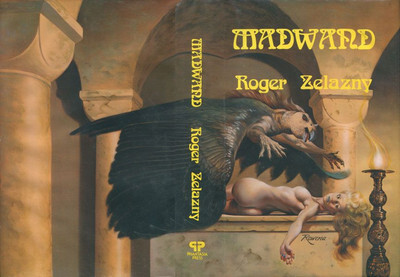
I could, with a little effort, untangle the threads of the plot into something simple and straightforward, but in this case the journey is probably more interesting and spectacular than the arrival at an answer. Blurb writers try to entice readers with promises of dark bestial erotic magic and the original cover by Rowena Morrill is sure to reinforce the appeal to horny teenagers.
There’s nothing lurid or smutty about the novel, on the contrary I found it rather too esoteric and rambling for an action adventure. The long dream sequences are well written and inventive, even tinged with a dose of sly humour:
Avocado, ranging to a very pale green, I finally decided.
Apparently, the author wanted to write a sequel, but even he could not come up with a solid idea for another book in the same setting. Oh well, at least my electronic edition includes the fantastic artwork of Judy King Rieniets, a wonderful addition in support of the text.
Madworld is a sequel to Changeling, but I didn't like it as much as the original. Rather than expanding the concept of the conflict between magic and technology, or exploring the opposed worlds and philosophies, it takes focus on a somewhat pedestrian and lackluster murder mystery. It's a fine story on its own with some amusing bits and pieces but disappoints a little because it doesn't live up to its potential.
This is the second in the "Changling" series of books, which series is a total of two. So I guess it's just a sequel but it seems like it could've played out for 2 or 3 more books. It's okay, though: Neither this, nor Changeling are written as cliffhangers so you don't feel ripped off. You could even read them in reverse order, I think, without diminishing your experience too much.
N.B. that I read "Changeling" 20-30 years ago. But what stuck with me was Zelazny's magic system: Our hero is Pol Detson, a man who grew up on (non-magical, modern-day) earth who is transported to a magical world where wizards study for years to learn how to manipulate the threads of magic that flow and gather around object on the material plane. (I thought that was an way to approach magic.) While Pol never had the opportunity to study, he's what's known as a "madwand": Someone with a native ability to manipulate these threads.
In the hands of lesser writers, this can be an awful cheat. How powerful is Pol? Well, exactly as powerful as the narrative needs to be, right? Zelazny carefully maps out the growth in Pol's power, gives substance to his limitations, and to how easily he can be beaten by virtue of being more-or-less clueless about the world he's found himself thrust into. In fact, throughout the story, Pol is constantly being manipulated by forces he doesn't understand—though he does get to resent these guys.
There are three parts of this book that went on longer than I thought they should—thinking, basically, that Zelazny was indulging in a little writing-for-writing's-sake—but every one of them turns out to be important later on. (Given that I have a LOT of books to get through, I tend to be sensitive to authorial indulgence.)
I particularly loved the boldness of certain narrative choices: The book starts with a first person account by a non-corporeal entity that has no memory, and has only recently become aware. This consciousness gradually evolves through the book to a fairly satisfying conclusion (and maybe one supported by the previous book; I don't recall), but also serves as a fish-out-of-water to explain things that go on in the universe. This keeps our hero from having to have everything explained to him, and the main understanding he has to struggle with is the Big Picture: Given a world where the larger narrative is unknown to you, how do you know what actions to take?
There's a dream-as-prophecy device here which has a nice little twist at the end that plays into the whole thing, and also pleasantly recalls certain Lovecraftian tropes.
Anyway, good stuff. Since I'm about to go back to "A", I'll probably see if I can fill in the gaps in my Zelazny series' (Princess of Amber? Lords of Light?) for my next lap around.
Zelazny’s fantasy books almost always offer something to separate them from pure fantasy: Jack of Shadows gave us a sword-and-sorcery thief living on a non-rotating planet whose dark side bred magic and light side fostered technology; The Amber Series introduced us to a scheming family with the ability to pass through universes of all sorts, be they primitive and marvelous or developed and scientific. And then there’s Lord of Light, which, while generally considered a SF novel, definitely has elements of fantasy to it.
Changeling, the book preceding Madwand in this unfinished trilogy, is somewhat similar to Jack of Shadows in its meeting of scientific and magical worlds. But Madwand is something of a Zelazny anomaly (Zelnomalzy?) in that it’s pretty much a straight-up fantasy book with plenty of the old tropes and cliches: you’ve got a thief named after a rodent, a wizard born into a strange and powerful destiny, a classic struggle between good and evil, and, of course, dragons.
In a way, this may seem to make Madwand a sub-par effort from Zelazny. But he’s still got a few traits that set his book apart from the rest of the overdone fantasy stories out there: intrigue and imagination.
Yes, I know, these are two things that most fantasy books have to some degree. But Zelazny’s version of these classic characteristics, I feel, puts him ahead of the crowd.
As far as intrigue goes, it’s always fun to see how skillfully Zelazny planned things out in advance. He’s got a lot of different moving parts to his stories, and they always seem to fit together in just the right way at just the right time.
And the imagination, well—let’s just say that there are plenty of ways to do a sorcerous duel, but few are going to be as interesting as the ones in Madwand. Mind you, I did feel that the fights went a little too long in some cases, but I still had to respect the amount of thought that went into the magical system here. It’s a beautiful, visually stimulating thing when protagonist Pol Detson finds himself locking horns with his various antagonists.
As far as Zelazny books go, this isn’t one of his best—I’d much rather have the variety and trope-dodging found in some of his other works. But I did still enjoy Madwand, and I’m saddened the author never got around to finishing the trilogy; I’d have liked to have seen where things went from here.
Nothing special for Zelazny: a fast-paced fantasy adventure whose protagonists oscillate between two worlds, one ruled by science, the other by magic. A boilerplate genre concept, but one that Zelazny handles with skill and occasional flourish.
This is a very inventive world that Roger Zelazny has created. Wizards, dragons, and spirits are in a battle to the death over a gateway to another realm.
One character is a disembodied spirit. Another one has no magic but is a fiercely loyal thief who is friends with the main protagonist,Pol, a Madwand (untutored wizard with latent powers) who has to feel his way through the world he finds himself in without benefit of memory or knowledge of his powers.
This book really begs you to read the book that precedes it! Although it seems like a standalone book, I kept feeling like I’d picked up some chapters in the middle of a much larger book.
That being said, I’d wanted to read something by Roger Zelazny and now I know why his name is enshrined in the pantheon of great fantasy writers. He has created a marvelous dreamscape peopled by men (his female characters are a vain witch and a ghost, both rather 2-D) who do what men do: ie search for meaning, discover their power and fight with other men, but the language is lovely and the story engaging. I gave it 4 stars because it is not a standalone book and because there were some things that happened that were not resolved or explained.
My suggestion is buy the series and read it in order.
The sequel to Changeling. Sometimes the books are published together as Wizard World (now there's an uninspired title!).
I wanted to like this book, but it falls into the category of Zelazny's "railroaded protagonist" books, where the hero, in spite of having considerable power (although inexperienced with it), has no idea about what's going on, and is constantly herded towards some final destination by a variety of other characters yet more powerful. It gets old, as it does in the second set of Amber books. The initiation scene in the middle goes on interminably, and I don't see the point of the first-person interludes, or at least the point of making them first person. Are we supposed to assume the narrator is actually the narrator of the entire story? And why does it matter? I just couldn't get entirely behind it.
This is the second & final book - although it leaves us hanging terribly - in the Changeling saga. The first book, 'The Changeling' is able to stand alone. This book is an excellent addition, but it certainly leaves us wanting at least one more book. Unfortunately, Zelazny died before writing the conclusion. Our loss.
If you don't mind getting hung up on a cliff hanger, by all means read this. It's interesting, well written & has a pretty neat view of magic; threads for spells, a newly create demon that doesn't know its name & an interesting rite of passage. If you like things wrapped up neat & tidy, stick with the Changeling only.
Shades of Lord Dunsnay & Lovecraft with sinister dark forces mixed with personable magicians like those in Jack Vance's Lyonesse trilogy. Add a touch of subtle humour as found in his unmissable R.Sheckley collaborations like"Bring me the Head of Prince Charming" and although not SF but fantasy this is an excellent adventure in weirdness - not to be missed.
Surely a fantasy book by Zelazny, with multiple intricately drawn images of dragon(s) (and scenes from the book) by Judy King Rieniets must be good, right? The art was enthralling!
New to Zelazny, but aware of his literary impact on others I have read (Neil Gaiman, George R.R., etc.) I couldn't let this book slip away. Only to find out that it is the sequel to an earlier book (although not addressed on the title page, so how was I to know?) in the Changeling saga.
Anyway, ever onward, I delved into this brief but all-encompassing fantasy story of many worlds, where the main character, Pol, is recently returned (from non-magic Earth?) to a magical world. Transposed with another young male, who Pol supposedly killed in the previous story, to return to the magic realm of his own birthrite.
I immediately felt bewildered upon reading the opening pages told by an ethereal presence describing his formation and philosophical needs. Highly captivating and thought provoking, if nothing else.
Then introduced to the main, yet adjacent, story, I grasped the young initiate, Pol, and his quest to learn magic, along with his thief and best-friend? Mouseglove who wields a pistol? But I never really connected with the pair, even after a magical duel, which was held for some unexplained reason. (Clearly, there was something to be gleaned in the previous story, about the Castle Rondavol, seven statuettes as keys, a dragon mark on Pol's arm, etc.) Pol could switch to second sight? perform and create various magical weaponry, and there were dragons nearby. Never really felt the magic system was explained to my liking.
Pol's travel to the magic gathering, held every four years, was mildly engaging, with new support characters introduced, expected magical activities as part of the initiation ritual performed, and a subversive plot leading to the final act. And some nameless magician providing needed support along the way because... I don't know why.
The story starts to combine theories and characters, with exposition of magic past, Pol's father and his buddies as part of a triumvirate, and the randomly inserted passages about the mysterious Gate from Pol's dreams. Highly detailed and convoluted, about an alien race waiting for a connection through the portal, that when combined with the present magic world, would place the current world's magic users as gods? Between the visions/traveling beyond the door and the ethereal presence sequences, I began to question my own intelligence as to why I wasn't getting this story.
Not until near the end does the reader find out the identity of the ethereal presence (underwhelming), even then it felt highly WTF. But the good guys prevailed, I guess, because it said so however it felt like there was more to the story, (just not included.)
Nothing about this book (aside from the artwork) generated anticipation, interest, tension, or caring about the characters, for me. I didn't not like it, I just feel like I didn't get it somehow, which sucks. The story felt like a combination of ideas, descriptive sentences-tech versus magic, and philosophical meanderings that came across some magic users in the midst of dueling for supremacy.
I can't in good conscience recommend this one. Perhaps the first in the saga is better? No matter, I am not seeking it out.
This is nominally a sequel to “Changeling” but is better thought of as a reboot. In “Changeling”, Pol is an extremely powerful wizard, and quite possibly the only wizard in the world: at the very least, the only other wizards we meet in the book are members of his family. “Madwand”, on the other hand, opens with a strange wizard appearing from nowhere and almost killing Pol, who is saved only by the intervention of one of the mysterious figurines that are also in some way wizards that never really seemed to fit into the first book. This means, though nothing is ever said, that the titanic collision of science and magic that was the centerpiece of “Changeling” may not have been quite so earth-shakingly important after all, as none of the many powerful wizards we are to meet in “Madwand” could be bothered to show up and defend magic against its technological opponent. Which is fine, as that whole plot never really made much sense, and was overly rigid and schematic. (However, the quest that Pol goes in to retrieve his father’s scepter is now a pretty significant plot hole: apparently, none of the many wizards in the world were interested in picking up this quite powerful item.) Instead, Pol has a new identity as a powerful but untrained wizard, who goes off to meet some fellow wizards and gets caught up in a years-old plot the ramifications of which he never really understands. And neither, frankly, does the reader: if “Changeling” suffered from an overly structured plot, “Madwand” could use a bit more structure, with the ending in particular leaving loose ends dangling everywhere. (Maybe Zelazny was planning a sequel to tie everything together, but if so he never wrote it.) Instead, the book seems more like a loosely-connected series of experiments on Zelazny’s part: the first-person narration by the demon who begins the book not even knowing that it is a demon, the phantasmagorical interludes in the the other world, and the magical battles in which Pol is basically figuring it out as he goes along could easily have come from three different books. As these are all enjoyable enough, even if the plot doesn’t so much as connect them as get the reader from one to the next, and Pol himself is basically a standard-issue Zelazny hero in this book — laconic, stubborn, independent-minded, cracking wise on a regular basis — it ends up being more readable than “Changeling”, but it’s still definitely not Zelazny’s best work.
This book is a bit of an oddity in the Zelazny canon: a sequel to a previous novel. When I read Changeling recently, I knew that there was this sequel. What I didn't realize until I'd gotten to the end of this one, is that the series was intended to continue, at least for one more book. I don't know why Zelazny never continued it, so what we're left with is two novels about the same character(s). Madwand is a pretty direct sequel, picking up shortly after Changeling ends. Pol Detson is now the ruler of Rondoval, his ancestral castle home, and a powerful wizard. He is attacked by an unknown wizard, whom he defeats, and then sets out for Belken, a site of a gathering of wizards, where he'll be initiated into the arts. (Rather than learning from others, Pol's abilities have come to him naturally, without training, making him a Madwand.) He meets another wizard along the way, who agrees to sponsor Pol. Much intrigue ensues, many magical battles are fought, and we find out who is out to get Pol and why. In the end *spoiler alert* the main bad guy gets away and the reader is left waiting for another sequel which never came. This is pretty straightforward fantasy that captures that elusive Zelazny magic much better than Changeling did. The characters are more fleshed out and likeable. I cared more what happened to them here. (My review of Changeling says the "writing is stiff" and "characterization and dialogue are both fairly pedestrian.") I was intrigued right off the bat this time as there are sections written in first person (most of the book, describing Pol's adventures, are in third) from the viewpoint of some type of amorphous, possibly purely energy, creature that doesn't even know what it is or what purpose it might serve. All is revealed near the end, but this mystery held my interest, and felt like more of a "Zelazny touch" than anything in Changeling. Once again, the prose is accompanied by quite a few full-page illustrations, although despite what the book jacket (and Goodreads) says, they are not by Estaban Maroto this time around, but an artist named Judy King Rieniets. While not one of Zelazny's best novels, it's certainly not his worst, and an improvement from the previous novel in the series, Changeling.
I love a certain something about fantasy written by guys who cut their teeth on hardboiled pulp. There's something low and comforting in their "high" fantasy. Whether it's Fafhrd and the Gray Mouser or Zelazny's own Amber series... maybe it's something in the tone. You aren't so much transported to an alien world. There's a familiarity in the way men speak to one another, over drinks and cigarettes, that even if they are universe-bending Princes, they still seem like just some guys you'd meet on a train or in a dive bar. Or even if they are world-destroying sorcerers.
Madwand is apparently a sequel. I didn't know this until I saw the back flap of the dust jacket. I picked it up at a used bookstore as it was Zelazny, and something I'd never heard of. But really, it read just fine without knowing that.
The story's ok. It goes into that kind of dreamlike world of magic that seems mostly like an acid trip and you don't really understand it too much. As most Zelazny, the joy is in having fantastic creatures perform verbal repartee between one another, and there's plenty of that here, including a humorous inner dialogue of a silent witness to much of the plot.
Sorcerer duels don't translate as interestingly to text as sword duels but Zelazny writes them as well as can be. There are definitely some satisfying twists here and there as well. But all in all, I view it as an interesting art piece. A lot to take in but after you're no longer looking at it, not that much to retain and think about.
The sequel to Changeling was not as sharp a novel as the first, and might explain why a third book did not come in what was clearly intended to be a new series by Zelazny. I think that in part the book was less successful because it lacked both the clear opposing lines of the first book—magic versus technology—and the underlying feeling of tragedy that developed out of the certainty that the two antagonists should have been friends.
Instead, what we get is a mystery. Someone is trying to kill Pol for unknown reasons. And a mysterious figure is trying to help Pol, but his unwillingness to explain why makes the reader suspect that he is not really a friend. There is plenty of moral hypocrisy in this novel as supposedly white magicians engage in evil actions. The central problem appears to be that everyone assumes Pol must be evil because they believe his father was and apparently blood runs true. Yet, they all forget that it was Pol’s grandfather who defeated his father, and he was not evil. There are further examples of blood not running true in the story as well.
Perhaps the biggest weakness of the story is that too many characters have the sarcastic personality that Zelazny often gives to his heroes, which makes multiple people in the book appear to be the same. The best things about the novel are the beautiful illustrations—and that’s not a good thing to note about a medium that depends on the written word.
I had kept this book from years ago, probably from my college days based on the publication date. I'm sure I must have read it then but didn't remember any of it. Now that I've read it again, I know why I didn't remember it. Completely forgettable. The real mystery is why i bothered to keep it. (Cleaning the attic once in a while is a good thing, btw.)
There is a lot of description for atmosphere and very little plot. For example, "A bright meteor cut a long, slow trail above and before him; and he heard a sound like thunder though there were no clouds in the sky. His velocity seemed to increase, and the moaning of the wind rose in pitch. Far below him, the dark and light patches of the land moved in a sea of distortions, rendering themselves into momentary faces - elongate, twisted, beautiful, alien, angry, composed, bereft." The entire book is written like this. Time to let this book go because I won't be reading it again.
once again, I am falling behind on my reviews considerably.
Madwand is the second of Roger Zelazny's Changeling saga, it has been on my to-read shelf for a while but I am VERY glad I waited until I could get my hands on Changeling #1 before reading it.
Madwand starts with a VERY intriguing character - elemental? Ghost? we do not know! In the castle and this character, which is newly introduced in this book makes a fascinating other narrator throughout. It was so tempting to start reading it.... But Changeling is pretty much essential pre-reading to get the most out of this book.
Pol Detson, son of Lord Det of Rondoval, has come home. He is now a powerful sorceror of unsurpassed natural ability - in a world where the power of magic is the only kind that matters. But Pol is still an untrained talent, a 'MADWAND'. To take control of his powers, to rule in his father's place, he must survive arduous training and a fantastic initiation into the rites of sorcery. As friends, Pol has one dragon and one thief. As enemies he has the most powerful wizards of the land. And at least one of them wants him dead. About the Author Zelazny wrote many novels, short stories, and novellas, including Nebula and Hugo Award winners 24 VIEWS OF MOUNT FUJI, BY HOKUSAI, PERMAFROST and HOME IS THE HANGMAN.
this gets interesting but not really great. a story of a natural self taught wizard called a madwand his training his initiation as a full wizard capture and ultimate battle... the stories not terrible just not set up as to why we should care, the side quest with the demons not bad though. probably would have enjoyed it more if i had read the previous book first.
I'm not sure how this ended up on my to-read list. It's a 1981 teenage metalhead wet dream of a novel. I mean for heaven's sake, the main character is named "Pol" and his nemesis is "Harry Spier"! And the number of "gleaming shafts" that get waved around is just embarrassing. I just can't with this era of fantasy. I'm not doing it again.
I’ve always remembered the secondary story line (and its ‘mystery’ character) with great fondness. It’s why I re-read the book so many years later. The plot line is typically fast pasted for the author. Boredom is not welcome here. Character development is sparse, but you’ll barely have time to notice.
Ik heb deel 1 niet gelezen dus ik miste op het eind wel wat context, maar het was een prima fantasy verhaal. Vooral het mysterie personage was interessant. Alleen minpunten voor de cover van mijn versie, een blote vogelvrouw, ik denk dat het een demon moet voorstellen die in het verhaal voorkomt maar zij speelt vrijwel geen rol.
Something I really admire about Zelazny is you can pick up his books in any order and read them without context. I didnt even realize this one was a sequel until like 2/3rds of the way through. Illustrations are great, plot is ridiculous, whole thing owns. DO MORE DRUGS.
I didn't think it was as good as Changeling. It felt . . . unpolished. It was clearly a Zelazny book, but it didn't quite feel like his work. Like maybe he never gave it a final polish.
Other than that, though, it concluded the story nicely, and was well worth reading.
This seems like a run-of-the-mill 1980s fantasy novel, as opposed to one of Zelazny’s subtle masterpieces. There’s a small but non-negligible chance that there’s more going on here than I took note of, so maybe it’s really much better than I thought. Maybe.