

What do you think?
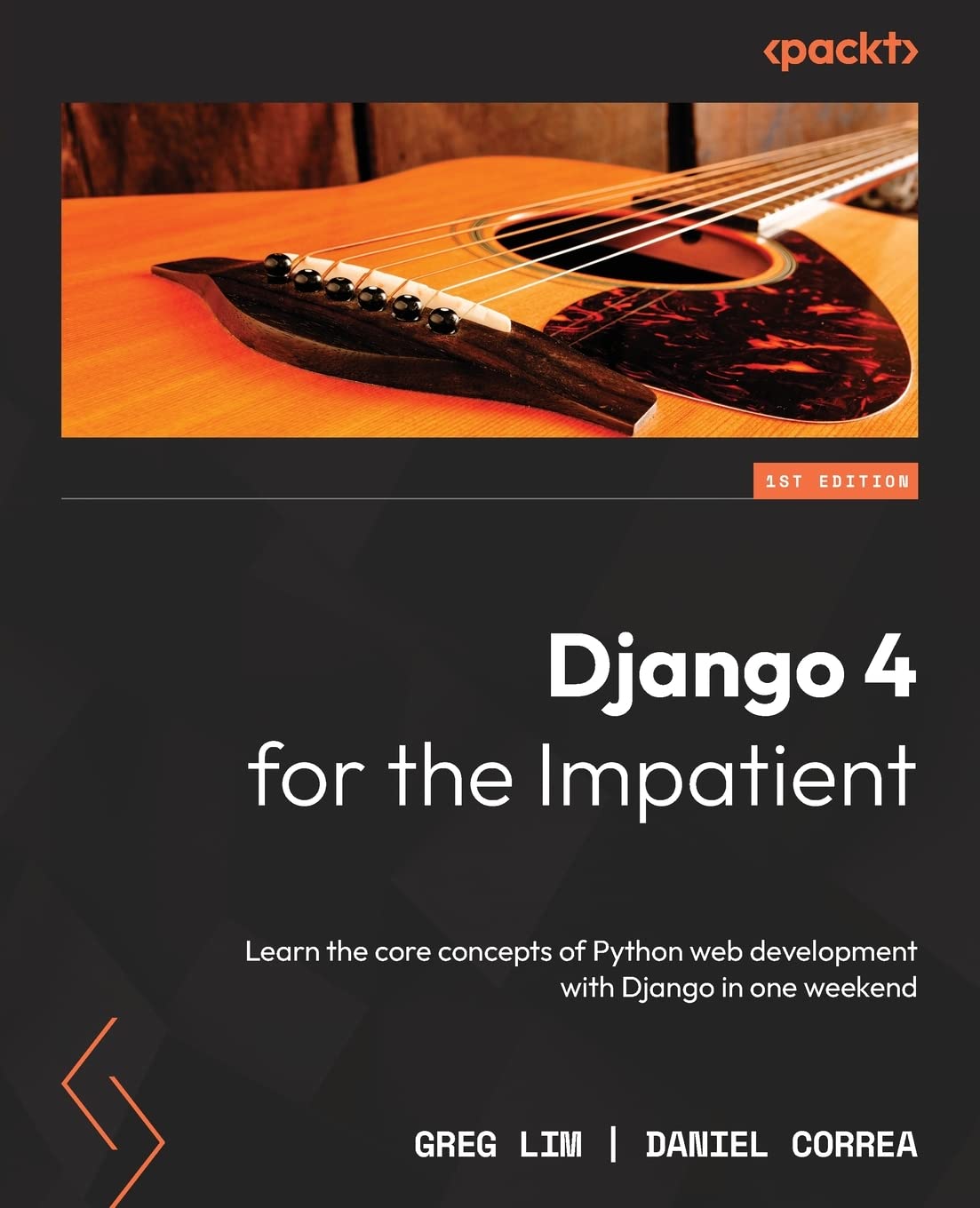
Django 4 for the Impatient: Learn the core concepts of Python web development with Django in one weekend
Learning Django can be a tricky and time-consuming activity. There are hundreds of tutorials, loads of documentation, and many explanations that are hard to digest. However, this book enables you to use and learn Django in just a couple of days.
In this book, you'll go on a fun, hands-on, and pragmatic journey to learn Django full stack development. You'll start building your first Django app within minutes. You'll be provided with short explanations and a practical approach that cover some of the most important Django features, such as Django Apps' structure, URLs, views, templates, models, CSS inclusion, image storage, authentication and authorization, Django admin panel, and many more. You'll also use Django to develop a movies review app and deploy it to the internet.
By the end of this book, you'll be able to build and deploy your own Django web applications.
In this book, you'll go on a fun, hands-on, and pragmatic journey to learn Django full stack development. You'll start building your first Django app within minutes. You'll be provided with short explanations and a practical approach that cover some of the most important Django features, such as Django Apps' structure, URLs, views, templates, models, CSS inclusion, image storage, authentication and authorization, Django admin panel, and many more. You'll also use Django to develop a movies review app and deploy it to the internet.
By the end of this book, you'll be able to build and deploy your own Django web applications.
- GenresTechnologyProgramming
190 pages, Paperback
Published June 24, 2022
Ratings & Reviews
Friends & Following
Create a free account to discover what your friends think of this book!
Community Reviews
Displaying 1 - 6 of 6 reviews

August 31, 2022
I'm kind of torn on my review of this book. On the one hand, this is kind of a decent introduction to Django 4, but on the other hand, this is much more of a tutorial than a real explanation of the proper use of Django. The whole book is centered around a single project, which is interesting enough to build. The problem is that although I have a much clearer idea now as to how Django is used, I'm not really sure I know much more about how it works.
Then again, this only a short book, and is only intended as an introduction. By that metric, I can't pretend that it has failed in its goals. But I definitely need to read a lot more on this topic to properly grasp the ideas that this book is trying to put forward.
Then again, this only a short book, and is only intended as an introduction. By that metric, I can't pretend that it has failed in its goals. But I definitely need to read a lot more on this topic to properly grasp the ideas that this book is trying to put forward.

August 28, 2026
Django 4 for the Impatient, by Greg Lim, is exactly what it promises: a fast, hands-on route into Django built around a single project you construct piece by piece over a weekend. Rather than teaching concepts in isolation, Lim has you build a movie review site from scratch, and that project becomes the thread that ties every chapter together.
The book opens with the basics of project and app scaffolding, starting a project with django-admin startproject and then creating separate apps for movies, news, and accounts. It's a good early lesson in Django's core split: the project holds site-wide config like settings and root URLs, while each app is a self-contained feature with its own models, views, urls, and templates. From there it moves into the simplest possible request-view-response loop, with plain function views returning HttpResponse before templates even enter the picture. Once that loop is established, the book swaps in real templates, introducing a shared base.html shell with block content and the app-namespaced template folder convention that Django needs since it pools templates from every app together.
Before touching the database at all, Lim has you build GET-based forms, a search box and a mailing list signup, both read back with request.GET.get(). It's a small but deliberate choice, letting you learn the form-to-view-to-template round trip before the ORM, Django's object-relational mapper, adds another layer of complexity. Only after that does the book bring in the first real model, Movie, and with it the makemigrations and migrate workflow that keeps the model in sync with the actual database schema. Registering the model in the admin panel follows naturally, giving you a working CRUD (create, read, update, delete) interface over your data with almost no extra code.
The second half of the book is where things start to compound. Filtering movies by title moves from GET-based demo forms into a genuine ORM query, and the addition of a second app, news, is the first point where routing is split out into its own urls.py and included into the project rather than being handled entirely from the root. A proper Bootstrap navbar brings in the book's first bit of JavaScript, and a detail view for individual movies introduces path converters and the get_object_or_404 pattern. The accounts app that follows is a nice demonstration of how much Django's built-in auth system gives you for free: signup, login, and logout built entirely on the built-in User model, password hashing and session handling included, with the navbar automatically reflecting login state through Django's auth context processor.
The final stretch, a full CRUD review feature with one review per user per movie, is where the book earns its keep. It's the first place authentication and authorization are clearly separated: being logged in only gets you so far, and the edit and delete views separately check that you're the review's owner before allowing changes. The redirect-after-login flow is handled safely too, with validation against open redirects. The book closes on deployment readiness, moving settings to environment variables with safe local fallbacks and setting up static file handling for production.
What I appreciated most is how deliberately structured the whole thing is. Each chapter adds exactly one new concept on top of what came before, and the running movie review project means nothing feels like a disconnected exercise. By the time you reach authentication and CRUD with ownership, you're not learning them cold, you're applying them to a codebase you already understand inside and out. For anyone who wants a weekend crash course that leaves them with both a working app and a genuine feel for how Django's pieces fit together, this book delivers.
The book opens with the basics of project and app scaffolding, starting a project with django-admin startproject and then creating separate apps for movies, news, and accounts. It's a good early lesson in Django's core split: the project holds site-wide config like settings and root URLs, while each app is a self-contained feature with its own models, views, urls, and templates. From there it moves into the simplest possible request-view-response loop, with plain function views returning HttpResponse before templates even enter the picture. Once that loop is established, the book swaps in real templates, introducing a shared base.html shell with block content and the app-namespaced template folder convention that Django needs since it pools templates from every app together.
Before touching the database at all, Lim has you build GET-based forms, a search box and a mailing list signup, both read back with request.GET.get(). It's a small but deliberate choice, letting you learn the form-to-view-to-template round trip before the ORM, Django's object-relational mapper, adds another layer of complexity. Only after that does the book bring in the first real model, Movie, and with it the makemigrations and migrate workflow that keeps the model in sync with the actual database schema. Registering the model in the admin panel follows naturally, giving you a working CRUD (create, read, update, delete) interface over your data with almost no extra code.
The second half of the book is where things start to compound. Filtering movies by title moves from GET-based demo forms into a genuine ORM query, and the addition of a second app, news, is the first point where routing is split out into its own urls.py and included into the project rather than being handled entirely from the root. A proper Bootstrap navbar brings in the book's first bit of JavaScript, and a detail view for individual movies introduces path converters and the get_object_or_404 pattern. The accounts app that follows is a nice demonstration of how much Django's built-in auth system gives you for free: signup, login, and logout built entirely on the built-in User model, password hashing and session handling included, with the navbar automatically reflecting login state through Django's auth context processor.
The final stretch, a full CRUD review feature with one review per user per movie, is where the book earns its keep. It's the first place authentication and authorization are clearly separated: being logged in only gets you so far, and the edit and delete views separately check that you're the review's owner before allowing changes. The redirect-after-login flow is handled safely too, with validation against open redirects. The book closes on deployment readiness, moving settings to environment variables with safe local fallbacks and setting up static file handling for production.
What I appreciated most is how deliberately structured the whole thing is. Each chapter adds exactly one new concept on top of what came before, and the running movie review project means nothing feels like a disconnected exercise. By the time you reach authentication and CRUD with ownership, you're not learning them cold, you're applying them to a codebase you already understand inside and out. For anyone who wants a weekend crash course that leaves them with both a working app and a genuine feel for how Django's pieces fit together, this book delivers.

November 15, 2022
I found this to be an excellent resource to kick-start web development using the Django framework. I worked with an earlier version of Django about 2-3 years ago, but only briefly; I have programmed websites using other technologies and I have worked with Python over the years as well. So I came to this book not as a beginner but as someone with lots of familiarity with general concepts who wanted to learn specifics of using this framework to create a website from scratch.
This book helped me achieve that goal very quickly and effectively. The title is exactly correct: this really is a guide to learn the nuts and bolts of using Django without dwelling on a lot of background or detail. In just a few evenings, I built a working sample website, and what's more I have a firm understanding of how to proceed using Django to make the website(s) that I really want to create. The book offers instruction that's fast, accurate, and satisfies the general use case for a typical site. There will be lots of adjusting and calibrating to do, and I can read other books or the Django documentation to find that out when I need to. I am delighted that I am equipped with a sound knowledge of the fundamentals to proceed!
The writing is very clear and very easy to understand. This is one of the best tutorials for a software development framework/tool that I have come across.
This book helped me achieve that goal very quickly and effectively. The title is exactly correct: this really is a guide to learn the nuts and bolts of using Django without dwelling on a lot of background or detail. In just a few evenings, I built a working sample website, and what's more I have a firm understanding of how to proceed using Django to make the website(s) that I really want to create. The book offers instruction that's fast, accurate, and satisfies the general use case for a typical site. There will be lots of adjusting and calibrating to do, and I can read other books or the Django documentation to find that out when I need to. I am delighted that I am equipped with a sound knowledge of the fundamentals to proceed!
The writing is very clear and very easy to understand. This is one of the best tutorials for a software development framework/tool that I have come across.
August 3, 2024
This is great book, where we build a movie review project from the very start till the app deployment. The instructions are easy to follow and multiple code snippets and screenshots help a lot. The patterns introduced in this book will useful in a variety of problem statements. This book does not go into a lot of details of the framework or deliberate on best practices, but that is perfectly fine for sucj a concise book.

June 21, 2023
Superb book! If you're totally new to Django and want to explore it, i can't recommend enough to this resource.
Straight to the point and cover the main features with real world example.
I can finish the book under one day.
Go get it!
Straight to the point and cover the main features with real world example.
I can finish the book under one day.
Go get it!
February 1, 2023
you cant learn django in just a weekend
Displaying 1 - 6 of 6 reviews