

What do you think?
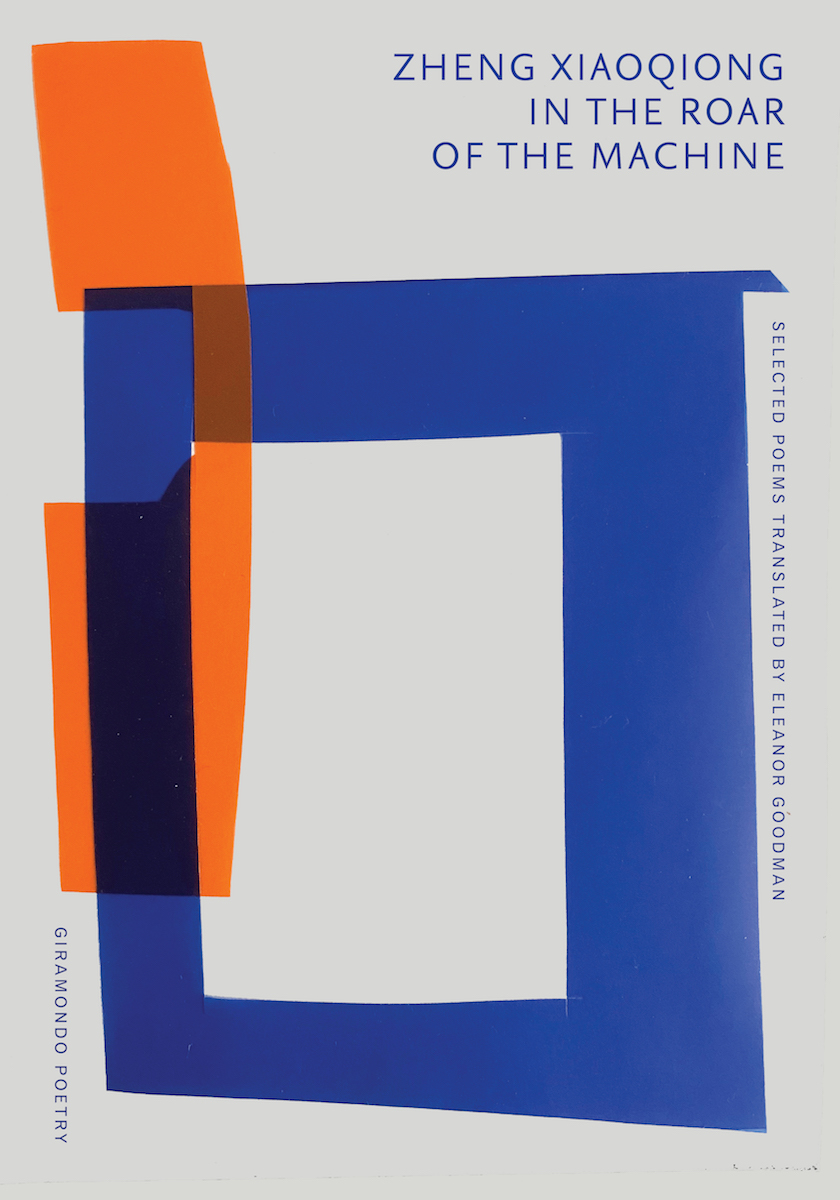
In the Roar of the Machine
This book collects some of the most influential and moving work of the poet Zheng Xiaoqiong, who spent nearly a decade at the beginning of the century working in the newly created factories and warehouses in what has become one of the largest manufacturing centres in the world, southern China. Her poetry is full of the dramatic details of days and nights spent in physical labor, the din of the workshops, the acute dangers associated with working with heavy machinery, and the exploitation, abuse, and indignity workers are subject to given the pressures of global capitalism and a lack of oversight and protection. But the poems also speak of pleasure and of love, memories of the ancestors, the natural environment of southern China and her native Huangma Mountains in central Sichuan. Zheng writes moving portraits of her fellow workers, voices the rarely addressed issues facing women workers in particular, and paints a vivid picture of the vast population of migrant labourers, displaced from their homes and desperately seeking ways to express their experiences. She is a poet of this century, speaking to a community which consumes the products of this labour: from iPhones to Christmas decorations to the components of machinery used across the world.
112 pages, Paperback
Published July 1, 2022
About the author
Zheng Xiaoqiong
7 books3 followersZheng Xiaoqiong (Chinese name: 郑小琼) was born in Nanchong, a city in the southwestern province of Sichuan. After nursing school, she worked in a local hospital for a time, but, unhappy with the working conditions, she left in 2001. She headed to Dongguan, which, like Guangzhou and Shenzhen, is one of the major industrial cities in the south where many Chinese migrant workers have settled over the past decades in hopes of a better life. There, she worked on assembly lines in various factories. After a while, she started to write poetry in which the life of factory workers plays a large part. Soon her work was noticed. Around 2007, she broke through and she has published almost a dozen collections, won a great many awards, and been translated in various languages.
Ratings & Reviews
Friends & Following
Create a free account to discover what your friends think of this book!
Community Reviews
Displaying 1 - 11 of 11 reviews

November 30, 2024
silent and lonely as iron —
the darkness
in the midst of forgotten time, I see my youth
wriggling away through clean, transparent grief
withering in the vastness of my country
the darkness
in the midst of forgotten time, I see my youth
wriggling away through clean, transparent grief
withering in the vastness of my country

August 17, 2025
Born in China in 1980 on the cusp of the nation becoming a world-dominant manufacturing behemoth, by the time Zheng Xioaqiong was 21, China’s manufacturing was running full-bore, providing steady employment and pay for tens of millions of people from the countryside who would otherwise live at subsistence level, at best. As a woman, and an internal migrant, Zheng Xioaqiong would be paid less than men who, like her, also worked shifts of 11 or 12 hours a day, seven days a week, not including mandatory overtime, with one weekend off a month, sleeping eight to a dorm room (likely unairconditioned at the time). The work is both tediously repetitive and dangerous. The women hope to find husbands. Barring that, they turn to prostitution or return to their villages empty-handed. Many women send the money they manage to save back home. (In one of Zheng’s poems, a pay of 1,000 yen is mentioned—presumably pay for a month of 11-hour shifts—which amount to less than $140. From this amount, a frugal worker might wrest $20 spare to send back home.)
Anyone who’s ever worked in a factory can recognize or empathize with the lines beginning “Life,” the initial poem from Zheng’s first collection, Huanmaling (2006), which sets the tone for the whole volume:
What you don’t know is that my name has been hidden by an employee ID
my hands become part of the assembly line, my body signed over
to a contract, my black hair is turning white, leaving noise and toil. . .
The line workers know each other by number only, cogs enumerated for ease of replacement. Yet, Zheng sees how her ant-like labor in a vast Chinese factory fits into a larger neo-liberal nightmare, described in “Industrial Age”:
At the US-owned factory Japanese machines run Brazilian mines
to produce iron pieces, Germany’s lathes shape France’s
coastline, South Korea’s shelves are filled with Italian parts. . .
And so forth, for another dozen lines.
Zheng’s collection Woman Worker (2012) consists of prose poem vignettes describing the lives, hopes, and disappointments of female factory workers, most limned as individual portraits. The collective “Middle-Aged Prostitutes”—women abandoned by lovers after becoming pregnant, some the sole source of their distant family’s income, placid in the company of fellow prostitutes, though impoverished.
Respite from eternal toil is found in nature (the Rose Courtyard poems) and poetry itself. From “To Give”:
The fading away of gentle youth
for many years life has been
like a dull word I’ve been revising
. . . I live in perplexity
turned melancholy by distant events
used up by drudgery, allowing a few words
to suffuse my life, like disgrace, grief,
loneliness—but there is a quieter word too: poetry.
Zheng’s poetry voices a demand for dignity and grace, one imbued with the dreams of humanity rather than the drive of industry.
For more of my reviews, please see https://www.thebookbeat.com/backroom/...
Anyone who’s ever worked in a factory can recognize or empathize with the lines beginning “Life,” the initial poem from Zheng’s first collection, Huanmaling (2006), which sets the tone for the whole volume:
What you don’t know is that my name has been hidden by an employee ID
my hands become part of the assembly line, my body signed over
to a contract, my black hair is turning white, leaving noise and toil. . .
The line workers know each other by number only, cogs enumerated for ease of replacement. Yet, Zheng sees how her ant-like labor in a vast Chinese factory fits into a larger neo-liberal nightmare, described in “Industrial Age”:
At the US-owned factory Japanese machines run Brazilian mines
to produce iron pieces, Germany’s lathes shape France’s
coastline, South Korea’s shelves are filled with Italian parts. . .
And so forth, for another dozen lines.
Zheng’s collection Woman Worker (2012) consists of prose poem vignettes describing the lives, hopes, and disappointments of female factory workers, most limned as individual portraits. The collective “Middle-Aged Prostitutes”—women abandoned by lovers after becoming pregnant, some the sole source of their distant family’s income, placid in the company of fellow prostitutes, though impoverished.
Respite from eternal toil is found in nature (the Rose Courtyard poems) and poetry itself. From “To Give”:
The fading away of gentle youth
for many years life has been
like a dull word I’ve been revising
. . . I live in perplexity
turned melancholy by distant events
used up by drudgery, allowing a few words
to suffuse my life, like disgrace, grief,
loneliness—but there is a quieter word too: poetry.
Zheng’s poetry voices a demand for dignity and grace, one imbued with the dreams of humanity rather than the drive of industry.
For more of my reviews, please see https://www.thebookbeat.com/backroom/...

July 26, 2025
Zheng is known for her migrant worker poetry (dagong) written from the firsthand perspective of mainly rural women who move to industrial cities to work as wage slaves. The Poet in this collection functions as a kind of adapted Emersonian eye: the all-seeing observer who can move from the courtyard or rural mountains to the polluted factory floors, witnessing women of all eras at once, from grandmothers of the past with their dignified and ancient communal traditions to the young migrant women of the present who have lost all identity and individuality as they are forced into prostitution to compensate for unlivable wages. Lychee trees pervade the early poems, which I interpret as suggesting the sweet fruit of a generation crushed by an arid existence in the assembly line factory. Once again, the Poet sees the trees as both flourishing (in the ideal rural past) and dying (in the grim urban present) as the industrial world chokes and pollutes their young lives.
In that sense, these poems are also masterpieces of Naturalist verse – proof that Naturalism should return as a defining literary genre of our time. Marriage becomes impractical. Families are hampered by the one-child policy. Women are forced to supplement their meager income through prostitution. Love is an impossibility when young womanhood is crushed by draining work, low pay, and life in the cramped worker dorms. Amid shattered dreams and identities reduced to (and concealed by) a factory ID badge, there is a yearning to return to the village. Sichuan is mentioned in the couple poems, standing as an ideal pastoral past that can never be recovered amid the industrial pollution. In the classic Naturalist tradition, both dreams of the future and memories of the past are equally impossible, stunted, or blocked: “memory lies in waste like a development zone.”
There are sections of this collection that remind me of the Moloch scene from Metropolis (1927), as the beast of industry consumes the migrant workers, whose suffering is concealed from the sight of Chinese citizens in the cities. The Poet sees, experiences, and communicates that suffering through her poetry. Highly recommended.
In that sense, these poems are also masterpieces of Naturalist verse – proof that Naturalism should return as a defining literary genre of our time. Marriage becomes impractical. Families are hampered by the one-child policy. Women are forced to supplement their meager income through prostitution. Love is an impossibility when young womanhood is crushed by draining work, low pay, and life in the cramped worker dorms. Amid shattered dreams and identities reduced to (and concealed by) a factory ID badge, there is a yearning to return to the village. Sichuan is mentioned in the couple poems, standing as an ideal pastoral past that can never be recovered amid the industrial pollution. In the classic Naturalist tradition, both dreams of the future and memories of the past are equally impossible, stunted, or blocked: “memory lies in waste like a development zone.”
There are sections of this collection that remind me of the Moloch scene from Metropolis (1927), as the beast of industry consumes the migrant workers, whose suffering is concealed from the sight of Chinese citizens in the cities. The Poet sees, experiences, and communicates that suffering through her poetry. Highly recommended.
April 27, 2026
Stellvertretend für die deutschsprachige Sammlung "Erzählung von den Kosumgütern. Die Texte aus dem "Buch der Arbeiterinnen" überzeugen, diejenigen der "Fußgängerhimmelsbrücke" dagegen enttäuschen auf ganzer Linie, weil sie der ganz große Wurf sein wollen, aber nur bedeutungsschwere Worte und Wortfolgen in unsinnige Zusammenhänge bringen.

April 6, 2026
In The Roar of the Machine by Zheng Xiaoqiong trans. Eleanor Goodman (Giramondo, 2022) Xiaqiong (b. 1980, Nanchong, Sichuan, China) is often called the most well-known contemporary Chinese migrant worker poet – a group of poets first introduced by the White Pine press Iron Moon: An Anthology of Chinese Worker Poetry. She might just be the most well-known contemporary Chinese poet. And she might be my favorite contemporary poet. She writes in long clattering lines that balance strange subject shifts and juxtapositions with an absolute dedication to naming the stuff of the world—the objective world—that constitute a life fixed in a place by repetitive work. From her avalanching ten page “In the Hardware Factory”: “and you’re nothing but a lump of iron, thinking of words involving iron / like sheen, iron oxide, cast iron, steel, thinking of its sharpness/ and the pain it causes as it pricks the body, thinking of its enormous / spindles, pulverizing dreams into powder, thinking of its steel needle / sewing up a wound, if needed” or “polishing poems amid machines, moulding it with iron and blueprints, life is / this toil, the burning heat of the hardware workshop, electric saws and steel hammers, the sago palms on the windowsill, the palms outside / traditional food, they’re formed into frames, strips, shapes, like ancient doctrines / you hold tight to Japanese silk roses, German gears, imitation calipers.” Hope you’re seeing how intricately Xiaoqiong employs repetition. The poems will speak to anyone whose spent their 6th straight day on a ten hour night shift wondering what all that work is pounding out of them. A whole hell of a lot of people. But they also contain their own particularities, of being a female factory worker (the majority of light industrial workers are women from global majority countries), of being a migrant worker (a particular status of worker who enjoys less access to the social safety net, a condition more and more frequent across the globe as corporations perfect ways to displace and entrap workers in superexploitative conditions). And of course the poems are their own thing in excess of all these things, no more than when the long lines telescope subjects of vastly different scales into a just so unity: “the women are fish, working night and day, dragging along / the boss’s order forms, profit, the GDP, youth, visions, dreams.” In a country at least duly interested in international lit, we’d be reading the shit out of these poems. The vision of these poems also stands in stark contrast to a recent, dispiriting U.S. anthology of poems about work I’ve been browsing. Where Xiaoqiong’s poems light up individual subjectivity, a larger collective subjectivity, and industrial settings all enmeshed in each other, the poems in this anthology, firmly in 1-page lyric narrative mode, seem so utterly stuck in the mode of individual commenting on their experiences with work. They assert a fundamentally false division between the self and work—a self that can be extracted from work; the sick truth is that our subservience to labor is constantly speaking through us! It’s in the pith of our core and surround; it’s when we’re on the clock and off. In preserving the autonomy of their subjectivity, well, they fail. And—here we’ll become a prosody freak—their rhythms lose something that Xiaoqiong-Goodman’s rumbling lines almost always make evident.

May 25, 2026
In the Roar of the Machine is a documentary‑lyric portrait of China’s migrant workforce. Women workers emerge as vividly individuated figures—Liu Meili, Shu Miao, Ding Min—whose lives are shaped by low wages, reproductive risk, and threat of dismissal or return to the village. Yet rhey retain stubborn desires for ‘more,’ a more that is also the subject of extensive critique. The book as a whole fuses reportage, lyricism, and critique, arguing that bodies, landscapes, and language itself are re‑forged (literally iron-born) by global capital and state ideology.
The standout piece is the long final poem, “In the Hardware Factory,” which feels like the book’s summation and its sharpest weapon. It opens with a dark joke that collapses theology and assembly‑line labor:
“God’s lazy too and produced humans on an assembly line / I could find my other half anywhere they’re as standardized as goods made in a factory, a marriage gives rise to thorns of resentment, from noon to sunset you live among the thorns, the pain is hard to bear…”
From there, the poem braids bone disease, machine parts, and political history into one continuous system of damage:
“…your disease started with the beast of a machine, from levers to screws, from blueprints to callipers from loneliness to a lost youth, it smells of hardware factory tools and you’re nothing but a lump of iron, thinking of words involving iron like sheen, iron oxide, cast iron, steel, thinking of its sharpness and the pain it causes as it pricks the body…”
What makes this poem the strongest is how it scales up from the single worker’s body to a whole allegorical “iron nation.” Iron becomes a kind of grotesque citizen and party member:
“from ore to iron, from iron to products, this is the process of iron establishing a political party, it uses callipers, blueprints, switches, and of course electricity… iron turns electricity into party regulations and power, these collective parties of iron tools start to tell me what to do drill holes here, fold there…”
At the end, the poem forces you to see the continuum from mined rock to machined part to injured body as one long, nearly inescapable corridor:
“Now I return to the center of iron, and where does it come from— a mountain’s depths, a coal mine, from outside the country, it was once in buried stone dug up, pulverized, it contains the earth’s coughing its dark grey body is wracked by late-stage disease… from stone to iron from iron to product, it encounters nonstop time it is cut into incomplete shapes, of yesterday, today, tomorrow.”
Because it holds together those scales—personal, industrial, ideological—and never lets any of them off the hook, “In the Hardware Factory” lands as the book’s most devastating and complete statement, the place where all the earlier motifs of iron, contracts, disease, and erased identities click into a single, furious vision.
The standout piece is the long final poem, “In the Hardware Factory,” which feels like the book’s summation and its sharpest weapon. It opens with a dark joke that collapses theology and assembly‑line labor:
“God’s lazy too and produced humans on an assembly line / I could find my other half anywhere they’re as standardized as goods made in a factory, a marriage gives rise to thorns of resentment, from noon to sunset you live among the thorns, the pain is hard to bear…”
From there, the poem braids bone disease, machine parts, and political history into one continuous system of damage:
“…your disease started with the beast of a machine, from levers to screws, from blueprints to callipers from loneliness to a lost youth, it smells of hardware factory tools and you’re nothing but a lump of iron, thinking of words involving iron like sheen, iron oxide, cast iron, steel, thinking of its sharpness and the pain it causes as it pricks the body…”
What makes this poem the strongest is how it scales up from the single worker’s body to a whole allegorical “iron nation.” Iron becomes a kind of grotesque citizen and party member:
“from ore to iron, from iron to products, this is the process of iron establishing a political party, it uses callipers, blueprints, switches, and of course electricity… iron turns electricity into party regulations and power, these collective parties of iron tools start to tell me what to do drill holes here, fold there…”
At the end, the poem forces you to see the continuum from mined rock to machined part to injured body as one long, nearly inescapable corridor:
“Now I return to the center of iron, and where does it come from— a mountain’s depths, a coal mine, from outside the country, it was once in buried stone dug up, pulverized, it contains the earth’s coughing its dark grey body is wracked by late-stage disease… from stone to iron from iron to product, it encounters nonstop time it is cut into incomplete shapes, of yesterday, today, tomorrow.”
Because it holds together those scales—personal, industrial, ideological—and never lets any of them off the hook, “In the Hardware Factory” lands as the book’s most devastating and complete statement, the place where all the earlier motifs of iron, contracts, disease, and erased identities click into a single, furious vision.
May 18, 2026
“In the Roar of the Machine” is a stunning poetry book by Zheng Xiaoqiong, full of iron, grit, industry and injury, gardens, longing, and Chinese labor and domestic migration stories. So glad I spontaneously picked this up at Elliott Bay Book Company in Seattle.
Some of many favorite excerpts:
“you just want to find a place on the train or in the world
to live, to love, to slowly grow old”
“any clear consciousness is tormented by the narcotic of profit”
“those fields not yet gone, those people, middle-aged
newly landless farmers gather under the trees to remember, the memories not yet faded
the stubbornness that takes root in reinforced concrete,
changes to the paper and TV
modernization, the orchestra of economic indicators, old village farmers
with nothing to do, hoes, plows, wooden rakes hung on brick walls
remembering the past”
“a cool brook plays a thousand-year-old
country melody—it can’t adjust to the Industrial Age
it knows nothing of the hustle and bustle, it retains
an ancient slowness and sorrow, it lies like a sick patient
oily, dark, silted up with the stench of industrial waste”
“you grow tired of a rootless life
but our lives are destined to float through this world
we make restless attempts to settle down
only to return to restlessness”
“in her last life she was a phoenix, reborn as a lion, the steel
is too dark
the isms too many, leaving her shapely body to surrender to
the world, interact with the night
appearing, intersecting, coinciding, and they have identical
faces”
“I felt in my insomnia a silent woman worker”
“life can’t tolerate overly perfect things, it has a dangerous
jealous heart, the beginning is the end, and I’m still longing
for ancient times as I stand at this modern machine”
Some of many favorite excerpts:
“you just want to find a place on the train or in the world
to live, to love, to slowly grow old”
“any clear consciousness is tormented by the narcotic of profit”
“those fields not yet gone, those people, middle-aged
newly landless farmers gather under the trees to remember, the memories not yet faded
the stubbornness that takes root in reinforced concrete,
changes to the paper and TV
modernization, the orchestra of economic indicators, old village farmers
with nothing to do, hoes, plows, wooden rakes hung on brick walls
remembering the past”
“a cool brook plays a thousand-year-old
country melody—it can’t adjust to the Industrial Age
it knows nothing of the hustle and bustle, it retains
an ancient slowness and sorrow, it lies like a sick patient
oily, dark, silted up with the stench of industrial waste”
“you grow tired of a rootless life
but our lives are destined to float through this world
we make restless attempts to settle down
only to return to restlessness”
“in her last life she was a phoenix, reborn as a lion, the steel
is too dark
the isms too many, leaving her shapely body to surrender to
the world, interact with the night
appearing, intersecting, coinciding, and they have identical
faces”
“I felt in my insomnia a silent woman worker”
“life can’t tolerate overly perfect things, it has a dangerous
jealous heart, the beginning is the end, and I’m still longing
for ancient times as I stand at this modern machine”

July 8, 2025
An indictment of our world. I felt all reading this, and felt for all who live under the thumb of exploitation. And for what, to sustain the meaningless consumerist whims of those in the west.
“I remember their faces, their turbulent eyes and subtle/ trembling/ their calloused fingers, their rough and simple lives/ I say quietly: they are me, I am they/ our grief and pain and hope are kept silent and forbearing/ our confessions and hearts and loves are in tears,/ as silent and lonely as iron, or as pain”
“I remember their faces, their turbulent eyes and subtle/ trembling/ their calloused fingers, their rough and simple lives/ I say quietly: they are me, I am they/ our grief and pain and hope are kept silent and forbearing/ our confessions and hearts and loves are in tears,/ as silent and lonely as iron, or as pain”

December 4, 2023
stunning!! a work of art!! my favourite was ‘the mutating villages’, so plz enjoy a quote “house after house turns to fine powder, person after person enters the
yellow earth, souls missing for years gather by brooks and banyan trees only to collapse in an instant, thousands of years of preserved traditions fall and keep falling, excavators extend their enormous iron sawteeth severing the distant umbilical cord between my ancestors and me”
yellow earth, souls missing for years gather by brooks and banyan trees only to collapse in an instant, thousands of years of preserved traditions fall and keep falling, excavators extend their enormous iron sawteeth severing the distant umbilical cord between my ancestors and me”
July 11, 2024
I liked the later ones better. Pretty grim but vivid

August 3, 2025
poetry about modern day factory conditions tied with traditional chinese imagery around nature goes so hard
Displaying 1 - 11 of 11 reviews