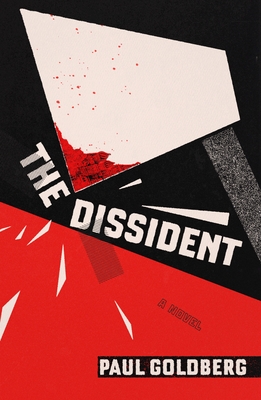
A thrilling, witty, and slyly original Cold War mystery about a ragtag group of Jewish refuseniks in Moscow.
On his wedding day in 1976, Viktor Moroz stumbles upon a murder: two gay men, one of them a U.S. official, have been axed to death in Moscow. Viktor, a Jewish refusenik, is stuck in the Soviet Union because the government has denied his application to leave for Israel; he sits “in refusal” alongside his wife and their group of intellectuals, Jewish and not. But the KGB spots Viktor leaving the murder scene. Plucked off the street, he’s given a chance to find the murderer or become the suspect of convenience. His deadline is nine days later, when Henry Kissinger will be arriving in Moscow. Unsolved ax murders, it seems, aren’t good for politics.
Immersive, unpredictable, and always ax-sharp, The Dissident is Cold War intrigue at its most inventive. It is an uncompromising look at sacrifice, community, and the scars of history and identity, from an expert storyteller.
Paul Goldberg has three novels out. I've now read two of them and am eager to track down the third. Both of the novels I've read, The Dissident and The Yid, are set in the Soviet Union. Both employ a style that I think of as uniquely his: a combination of narrative and transcriptions of conversations. We never know who the narrator is in The Dissident, but that narrator clearly has access to classified documents—secretly recorded conversations; the possessions of dissident writers executed by the Soviet state, including their unpublished work; verified timelines, and the like.
I find reading Goldberg challenging in a rewarding way. He has detailed knowledge of Soviet history and US-Soviet relationships, and his books assume a similar level of knowledge in his readers, which in my case simply isn't true. The Dissident is set in the USSR in 1976, shortly before a visit by Henry Kissinger. My memories of that era are newspapers I mostly skimmed over each morning before walking to high school. I knew there was something called detente (which I thought was pronounced day-TEN-tay), but had no idea what it was exactly. So, for me, reading Goldberg is a bit like solving a puzzle. I can use my fragmented memories along with the material both directly stated and implied in his writing to infer specifics of the overall context of his writing. As I read Goldberg, I experience dozens of small light bulbs flashing on in my mind.
Goldberg's novels are built around what I might call hyperbolic realism. The plots and characters (at least some of them) are outlandish, but Goldberg pulls me in and has me reading as if there were nothing unusual about them. The Yid was built around an attempt by a mostly geriatric group of Soviet Jews plotting the assassination of Stalin.
The Dissident early on narrates the discovery of a pair of murder victims by Viktor Moroz on his wedding day: one of the two victims, a friend who is a black marketer, has promised to provide the necessary script and celebrants/elders for Viktor's Jewish wedding, given that the Jews involved have lived their lives in a forcibly secularized USSR and have little knowledge of the rituals of Judaism. The other is an employee at the U.S. embassy.
Viktor returns to his wedding, which is celebrated with the help of a not-very-well-informed Catholic priest who is part of the same dissident community as Viktor and those present at the wedding. Not long after, Viktor is "pulled in" by the KGB and given a choice: either be put on trial for the murders himself or help identify the murderer. The KGB wants this problem setttled in just over a week—before Kissinger arrives.
Viktor's investigation stumbles along. He's not sure whether he'd be better off being put on trial, with the hopes of a reduced sentence, or identifying the murderer, in which case he may be marked for murder himself, depending upon who that murderer is. Meanwhile the day-to-day life of the refusenik community Viktor belongs to continues: forbidden goods are brought into the country and distributed, agents of one kind or another seem to be following everyone, games of political "chicken" abound, and there are fierce debates among community members, including a debate about whether Mikhail Bulgakov's The Master and Margarita can be of any use in illuminating the experiences of Jews in 1970s Moscow.
If you enjoy historical fiction that is at once ridiculous and perceptive, you're in for a treat with The Dissident. If you're like me, just take your time as you read, pulling together the threads of your own knowledge and the clues offered in the book, and you'll find yourself deeply satisfied in the end.
I received a free electronic review copy of this title from the publisher via Edelweiss; the opinions are my own.
Goldberg’s infectiously engaging novel may be mischaracterized as a murder mystery. That’s not primarily what it delivers and is a bit like describing “The Cherry Orchard” (which gets more than a glancing reference here) as a show about real estate. What this novel offers in abundance is the opportunity to be transported to Moscow in 1976 amidst a vibrant community of refuseniks and political dissidents. These outcast citizens are at once the most threatened by the oppressive machinery of the Soviet state, and paradoxically also the most free — in the sense of “freedom’s just another word for nothing left to lose.” Goldberg’s mastery of these characters and their milieu renders creates an authenticity that’s akin to a level of bicultural literacy that’s a rare experience for English readers. You understand Moscow as the characters experience it and their affection for it — even as they seek to leave it behind. Finally, I’ll mention that “The Dissident” is a kind of Talmudic novel that takes as its source text Bulgakov’s “Master and Margarita” to contemplate themes of collaboration, spirituality, sense of place, good and evil. I’m only vaguely familiar with “Master” but it very interesting to read how each of the characters related to the text.
Utterly brilliant! An ode to the city of Moscow and those groups of dissidents and refuseniks who in 1970s began to inform the world what it means to free your spirit from decades of totalitarian rule and soul death. Goldberg uses one week in 1976, when Henry Kissinger came to talk with Brezhnev, to illustrate decades upon decades of cruelty, absurdity, chicanery, defiance, and millions of acts of personal courage. This is a political manifesto, a comical farce, a murder mystery, a lesson in literary criticism( lovers of The Master and Margherita take heart! ), a caustic commentary upon the continued artifice of lies that is the Russian government and so much more. It is hilarious and simultaneously heart felt. Unless you are familiar with Russian history,literature and politics, this book ( as one poor reviewer wrote) will be " unreadable". If you have been paying attention to the last century or so of Russian life, you will be astounded by the layers of insight Goldberg brings to the table, or should I say cellar? This is a book that demands re-reading and without fanfare has crept into our present moment stealthily, with killer effect. Bravo Norm and Oksana and Victor! Your real life role models may not be free, but you are. ("So Mr Putin, put this on your reading list or conversely, shove it up your a--. Your choice, Mr. KGB.").
This book is a lot more than a whodunnit. It is a wonderfully entertaining literary novel that takes you deeply into Soviet Moscow of the 1970s. It is saturated with sly humor, venom directed at the KGB, ridicule of the Soviet government, and scathing satire; a joy to read. The author, a Russian emigree, is intimately acquainted with Moscow, aka the Big Potato, and the people he has portrayed in these pages. It's obvious that Mr. Goldberg loves the Russian language and culture. It's likely that he may have a touch of permanent homesickness.
Among the motley group of characters are Jews trying to leave the country, international reporters, black marketeers, shadowy KGB thugs, and Henry Kissinger. Some of these folks are fiction. Some are historical figures. Don't try to figure out who committed the crime. Just enjoy the ride.
Viktort is soon to marry his lovely fiancee, a fellow "refusenik" he met at a Zionist protest. The traditional Jewish ceremony is going off without a hitch-that is, until his friend, crucial to carrying the rites, doesn't show up. So, he hitches a taxi to go find him, certain it's nothing to worry about.
Then he finds him bludgeoned with an ax, mid-coitus with an American official who has also been gruesomely hacked to bits. Then the KGB discovers his prints at the scene. And Kissinger arrives in just two weeks-a certain recipe for disaster. And so, if Viktor can't find them, he will be framed by a surprisingly reasonable KGB agent.
And so this fascinating and erudite novel goes, expanding beyond the trappings of the mystery novel in a hilarious, affecting narrative about Judaism's utility as a political pawn during the Cold War and the uselessness of art. Viktor is all too eager to be a martyr, openly taking guffawing liberal academics on tours of the streets, wandering into KGB offices grinning at the prospect of being executed or tortured. Meanwhile, his allies-an Orthodox priest that shares a name with Bulgakov, a former Soviet spy whose quiet assassinations and rubles schemes do far more damage than anything Viktor could ever write-do all of the consequential work. Goldberg takes delight in mocking journalists and authors for their arrogance-surely, art and reporting does nothing materially!
Ironically enough, the audiences of Viktor's literature are those chiefly concerned with oppressing him. The KGB agents love "refusenik" literature-part of why they joined was so they could access banned works. And the Ivy League-connected American intelligence loves it for its utility in furthering American dominance. Subterfuge is more dangerous, but more effective. Writing and protesting is meaningless, yet comfortable.
Although compelling, the book feels overstuffed, chatty. Goldberg's presence is felt all throughout, with annotations, metatextual winks and nods at the audience. The murder mystery at the center is dropped for almost the entire first third, as Viktor tediously (though humorously) puzzles out the merits of collaborating with Russian secret agents to absolve himself. Thankfully the narrative energy and sharp setpieces carry through to its terrific ending, as the whodunit twist is revealed in a satisfying, sad coda.
Complaints aside, this is a terrific novel from a terrific author, whose uniquely Jewish voice and energetic writing is gripping from start to finish.
I have FINALLY finished this. I was really excited by the summary of the book, but the story itself really ended up dragging on. I feel like the actual plot was pretty interesting, but something about the writing style took me out of it. Part of the reason I had such a problem reading this was probably because it was the e-Book version. There were so many different characters as well as a ton of footnotes and Russian that were confusing to look up and lose your place in the book (so I just scanned over a lot of things honestly). There were too many characters in this book. The ones you did really care about, I feel like I barely got any real sense of besides maybe Norm. And then there were so many other people thrown in, I think I just gave up on understanding any of them. By the end of the book, I had to go back and look who the murderer was because I couldn't remember who he was by that point. This might be a case of maybe I'm just too stupid to read this book, but I just found it such a chore to get through even though a murder plot in the USSR should be interesting.
fast paced, funny, with excellent characterizations. Rewards attention-paying, illuminates a chapter of recent history, and gave me an unexpected feeling of affection for Moscow in the 1970's — a place I have never been, shortly before I was born. Got me through my second bout of covid. So, thank you!
A picture into life under an authoritarian regime that left me wanting me more. I really appreciated the tone of the writing in addition to the setting, they both lent a very somber mood to the story that I enjoyed. I thought the pacing rather odd and characters rather bland.
Well, I'll just come out and say it... I think this book is too smart for me. It's poetically chaotic, highly Sholem Aleichem-esque, and then sprinkled with quickly delivered, deep intellectual lines which I absorb like Keanu in a Bill & Ted movie, or maybe like Tommy Chong in character. Blink, pause, "wait, what," read again several times, stare blankly, repeat for several minutes, squint, "whoa."
The other thing the book delivers is heavy doses of soporific, atmospheric, ancestral comfort for me. There was another book that did this-- A Replacement Life, by Boris Fishman. The milieu is like returning to the womb or something, and I'm lulled into the heavy sleep of homecoming of the soul from world weariness. Unfortunately, that means I can never finish the book to find out what happens.
This book simply tries too hard and consistently failed to gain my interest. The author packs in lots of little facts about places and life in Moscow, phrases in Russian (some translated, some just transliterated, and some not translated), and tries to be witty social commentary at the same time. I just didn't think it worked as a cohesive and interesting story, and it ended up being just random vignettes and a bit of a slog to the underwhelming finish.
I read a free advance digital review copy provided by the publisher, via Netgalley.
Viktor Moroz is a young Russian Jew in the 1970s, which means he knows he’s a Jew but doesn’t know much of anything about the religion or its traditions. Still, he throws himself in with a group of dissidents, particularly so-called “refuseniks,” those Jews who have been denied applications to leave the country. Refuseniks usually were fired from their jobs and then punished for being parasites, one of the many classic absurdities of the Soviet state.
On the night Viktor is trying to marry his girlfriend Oksana in a Jewish ceremony—which requires the presence of a fellow dissident, Schwartz, and a collection of old men Schwartz has promised to bring along because they know the old rituals—Viktor discovers that Schwartz has been ax-murdered, along with Foxman, an American with CIA connections. Like any rational Soviet citizen, Viktor flees the scene but has been spotted by the KGB. His oddly cordial interrogator (or “curator” as she insists she should be known), Lydia Ivanovna, offers him a deal: (A) Solve the murders before Henry Kissinger’s Moscow visit in a week, and Viktor and Oksana will be allowed to leave the USSR, or (B) Don’t solve the murders and be put on trial himself.
This is an off-kilter novel populated with all kinds of misfits connected to the dissident community, including a Jewish Russian Orthodox priest and “Mad Dog” Dymshitz, an American newspaperman stationed in Moscow. While Viktor is unsure what to do, Oksana is full steam ahead. And when Mad Dog’s father, Norm, comes to town, things really start happening. This is to be expected, considering Norm escaped from Sobibor during the Holocaust and spent the rest of the war as a partisan fighter, becoming an expert in sneak attacks on Nazis. He’s not fazed by an unknown ax murderer on one side and the KGB on the other.
This novel’s setup reminds me of David Benioff’s City of Thieves, set during World War II, in which a Red Army deserter and a young thief are given a brief period to find a dozen eggs for a colonel’s daughter’s wedding cake or, failing that, to be executed. Both books are funny, scary and thrilling, as Soviet man comes up against the impossible and ludicrous demands of the Soviet state. This book adds in the machinations of US government as well, in the person of Henry Kissinger.
A very hard book to read, and like, in my opinion. Another of my choices to read and rate for the Mark Twain American Voice in Literature Award, I had very different expectations, based on the brief synopsis provided by the prize organizers (and the rather deceptive jacket copy).
Set in 1978, as the Soviet Union was beginning to disintegrate, it is a story about Refuseniks, especially one in particular, Viktor, a Jewish man who is stuck in Moscow, since the government has refused his visa request to emigrate to Israel. Of course, this was a common situation at that time with many Jews seeking to leave for Israel or the United States. I knew a few who managed it, and spent some time getting a taste of their world in Brighton Beach, Brooklyn, visiting the shops and restaurants.
Since it is the Soviet Union, he gets caught up in the impenetrable web of a KGB murder investigation, after he comes upon the scene of the crime, and is seen leaving the site. Viktor's hero is none other than Henry Kissinger, certainly a highly controversial figure on his own, but who is supposed to be arriving for a state visit when the murder, which involved an American, took place. The investigation must be resolved before Kissinger's visit, as it will be a diplomatic issue.
As Winston Churchill said, Soviet Russia is "A riddle wrapped in a mystery inside an enigma.", and that is certainly true of this novel. Perhaps obtaining a view of that warped world was the author's point, but I just couldn't go along.
In my Mark Twain reviewer's scoring form, I said that this book did not represent an American voice, but while that's not entirely correct, the form does not provide a lot of space to elaborate. The author is a Russian immigrant who came to the United States as a teenager, so while you could say his is one of many hyphenated American ethnicities writing in the United States today, with the setting of this book in Moscow, it is very far away from what I find to be a relatable tale or an accessible point of view.
When reading the opening pages of Paul Goldberg’s first novel “The Yid,” I groaned because it seemed clear it was going to be so depressing. Instead, it turned into a crazy, joyous, wonderful ride. I wasn’t the only person to love the book: it was a finalist for the Sami Rohr Prize for Jewish Literature and the National Jewish Book Award’s Goldberg Prize for Debut Fiction. While Goldberg’s second novel “The Chateau” didn’t win any awards, it contained one of the greatest comic monsters I’ve ever had the pleasure to read about. To say that I had high expectations for his third novel “The Dissident” (Farrar, Straus and Giroux) would not be an exaggeration, although I reminded myself not to expect greatness each time. Fortunately, Goldberg succeeds once again, only this time, he delivers a great satire about refuseniks living in the Soviet Union during the mid-1970s. See the rest of my review at https://www.thereportergroup.org/book...
This book was a strange ride. It's billed as a murder mystery type in some of the descriptions but it is not really in that vein at all. The subject was very interesting me to having read "When They Come for Us, We'll be Gone" by Gal Beckerman. It is interesting to think about how much some contextual knowledge of the subject is or is not necessary for following the plot and what it would have been like to read it without that background knowledge.
The story itself is multilingual and multi-textual. I personally enjoyed the expository footnotes and translations provided in all directions and was able to appreciate them even more as a Russian speaker.
There are claims and assumptions made about the resolution of the "murder mystery" part of the book that didn't feel fully explained or justified based on everything that happened before.
Political novel set in 1976 Moscow about a group of Refuseniks and Dissidents. Viktor, a young Jewish man who wants to leave the USSR and is a refusenik, is forced by the KGB to investigate the double murder of a dissident and an American. The book has a strong sense of place and is about the political factions of the time - it is not a pure mystery or a thriller. There are unique characters including a Polish Jew turned American who escaped from Sobibor and a Jewish man who is now an Orthodox priest. There are lots of references to Russian literature, especially The Master and the Margarita. I liked the strong sense of place and the information about a movement I knew little about but I would have probably enjoyed it more if I knew more about Russia, especially the language.
This book about dissidents in the USSR rings true because its author is an American who started out a citizen of the former Soviet Union. If you read this book do read the Afterword about the author. Much of the book is based on evidence from documents and diaries etc. That fact makes the work feel like reading a story in a fun house mirror. Everything is topsy turvey .
It is very much a cloak and dagger, spy vs spy novel. For anyone with an interest in The USSR in the 1970s will find this book very enlightening. I had some difficulty keeping track of the name of the many characters but my trusty Kindle helped me refresh my memory. This book is very well worth reading. I am going to read another one of his books that my library stocks.
I can’t get over how awful this book is. Almost unreadable. And I am kicking myself for staying with it for about a week, thinking it’s got to get better. The author’s arrogance in putting footnotes in a work of fiction on over half the pages is mind-blowing, compounded by the fact that most are in Russian. Come on. What could have been a sweet little double-homicide in Soviet Russia was totally lost in the weeds with the author’s choice of switching around writing styles, characters, and the aforementioned footnotes, which add nothing to the story. Books like this make me want to publish my own stories. They can’t be any worse!
Another triumph of historical fiction. Admittedly, I loved Goldberg's The Yid, and this picks up near where that left off (not literally). As a person who aspires to write, this work is inspiring as it focuses on such a small moment in time and amplifies it so gorgeously. Goldberg is able to weave a suspense/mystery within a subculture of an isolated world (Soviet Moscow) and brings the richness of complete characters within a vivid world without sacrifice the humor of the absurd in any of it. I was also struck by Goldberg's ability to weave the fabric of Russian literature and it's societal and personal importance into the tale. Truly a delight.
The idea of this book is creative and interesting and I was looking forward to reading this. However, the execution was unfinished, rushed, and boring. For example, the reader finds out about the murders in the first 25 pages, but Viktor doesn’t make his decision about whether he wants to solve the murders until page 310?? The reveal of the murderer, too, was so poorly done. With 15 pages left to go, all of a sudden the murders were solved and the murderer was caught with no insight into how it was actually solved.
It truly felt like this author wanted to write a history book under the guise of being a “novel,” which it certainly is not. Would not recommend.
This entire review has been hidden because of spoilers.
I enjoyed this book. Based in the tradition of Russian literature with a pre-post-soviet atmosphere, the story takes place in the big Potato (Moscow). A city in which a number of Jewish "refusniks" have carved out a little heaven for themselves. The best aspects of this book were the interactions between the cast of characters and moscow. Norm, Victor, Mad Dog, Osanka, all of their antics in the "primes of their lives" in Moscow. As far as the plot, the characters were compelling, but the story was largely just ok. I wish this book had been longer.
There were parts of this book I really enjoyed, as someone who has read a lot of history of the Soviet Union as well as various different descriptions and depictions of its culture, but overall the book is too haphazardly plotted, too poorly put together, and too disjointed (even assuming that this is a stylistic choice by the author, seeking to put us in the mindset of the Soviet Jews about which he writes--it's just not done well enough if it's inentional) to get more than three stars from me.
The Dissident written by Paul Goldberg is a fascinating historical fiction novel taking place in Russia in 1976. I didn't realize there were still Jews living in Russia. Goldberg uses the narrator as a character which can be distracting. He also uses the word prostate often. Amazing that they used Klezmer music for a production of The Cherry Orchard. The two main characters, Viktor and Oksana are married but it's an odd relationship. Not much chemistry. They both are political so I suppose that's more important than love
A complex novel about the lives of Refusniks in the Soviet Union in the mid-1970's accompanied by a mystery. Who murdered two men, one of whom was a US citizen and probably an CIA agent. Filled with interesting characters, philosophy and challenges to the Soviet system. While Viktor and Oksana, the main couple remind me of the sotry of Shransky, they are fictional.
3.5 stars. Don't expect a mystery thriller (the solution to these murders is almost an afterthought). Read this book for its wonderful Russian Jewish narrative voice--cynical but imbued with love for the Moscow of the Cold War era--and its intimate depiction of life in the city's dissident and refusenik communities in the mid-1970s Soviet Union.
One of those books that was trying to be clever and just wasn't working for me as a summer read. Might eventually revisit, but there were people waiting for it and so I returned it to the library.
Goldberg's style is somewhat discursive, with a lot of often-brilliant, sarcastic asides. I thought that worked great in his earlier novel, The Yid, which I read twice. But not so well in this novel. At least, this reader got tired of the asides and wanted the plot to move on.
I got through 60% of the book and then I felt like puking after the amputation part! No author should have to describe a gruesome murder with every detail described meticulously. I wonder if the author got the research from a prisoner in jail for murdering someone