A virtuosic new poetry collection from Sally Wen Mao, “a consistently inspiring and exciting voice” (Morgan Parker)
In The Kingdom of Surfaces, award-winning poet Sally Wen Mao examines art and history—especially the provenance of objects such as porcelain, silk, and pearls—to frame an important conversation on beauty, empire, commodification, and violence. In lyric poems and wide-ranging sequences, Mao interrogates gendered expressions such as the contemporary “leftover women,” which denotes unmarried women, and the historical “castle-toppler,” a term used to describe a concubine whose beauty ruins an emperor and his empire. These poems also explore the permeability of object and subject through the history of Chinese women in America, labor practices around the silk loom, and the ongoing violence against Asian people during the COVID-19 pandemic.
At its heart, The Kingdom of Surfaces imagines the poet wandering into a Western fantasy, which covets, imitates, and appropriates Chinese aesthetics via Chinamania and the nineteenth-century Aesthetic movement, while perpetuating state violence upon actual lives. The title poem is a speculative recasting of “Through the Looking-Glass,” set in a surreal topsy-turvy version of the China-themed 2015 Metropolitan Museum of Art Gala. The Kingdom of Surfaces is a brilliantly conceived call for those who recognize the horrors of American exceptionalism to topple the empire that values capital over lives and power over liberation.
Sally Wen Mao is the author of Mad Honey Symposium (Alice James Books, 2014), the winner of the 2012 Kinereth Gensler Award. Her work has been anthologized in The Best American Poetry 2013 and the Pushcart Prize Anthology. She has a forthcoming book, Oculus, out from Graywolf Press in 2019.
this rating is largely a matter of personal preference. i think i’m realizing that i like dry, in-your-face, didactic poetry (and novels, to be fair) less and less these days, and a lot of this collection was poeticized moral teachings that i encounter in all the online spaces i frequent anyway (albeit in more bite-sized formats). very little is oblique or abstract or veiled in the kingdom of surfaces and for that reason, i found it to be a major drag. i loveeeee sally wen mao’s more conceptual collection oculus, which, while still intensely and undeniably political, also did a lot of stylistic work that felt refreshing and original. this is more like a 2.7/5 for me.💔
Jess sent me this book so so so so long ago and admittedly it was a drag at some points because of my slowness with poetry in general but each time I picked it up, I marveled at the ways that Sally Wen Mao wrestled with objectification, fetishization, the fraught history of being Asian in America with such delicacy. She used such exquisite imagery and ended with such rage. I'm so happy I got a copy of this -- I'll treasure it dearly.
I don’t read a lot of poetry (even though I definitely should) but this collection was stunning and hit immensely close to home. I love Asian and Chinese women so much and this scratched an itch in my brain (and soul) I wasn’t fully aware existed??
Also taking this as a sign for an amazing year of reading ahead 🫡
i didn't really like this as much as i wanted to; some poems just dragged on for me and i feel like a second read would have me appreciating it more, but i don't see myself doing that anytime soon. i really liked some bits here and there though!
The Kingdom of Surfaces is a solid third poetry collection by two-time Pushcart Prize-winning poet Sally Wen Mao. Following her previous collections Oculus (Graywolf Press, 2019) and Mad Honey Symposium (Alice James Books, 2014.)
Surfaces is a collection that dwells on the relationships between art and identity. Artworks from China trafficked into American museum collections, immigrants traveling across borders, the COVID pandemic that made many of us rethink our relationships to art and one another. Sinophobia and anti-Asian prejudice are common themes, approached from many different angles with sharpness and elegance. The poetry style is flexible, everything from concrete poems to free verse, and it makes for a lively collection that is a pleasure to read. For those interested in reading poetry, particularly poetry about art, this is a worthwhile collection to enjoy.
DNF 50%: A major slog to read. Dry, pedantic, moralistic rehashing of a high school world history textbook. Not a single poem that feels like it wants to be read aloud. Poets like Mai Der Vang and Solmaz Sharif, also published by Graywolf Press, are doing contemporary English-language anticolonial poems much better than this.
I heard that Mao's collection Oculus is quite different, so I'm going to give that a try instead. Bummed this was my first poetry collection of 2024.
Thank you Graywolf Press and NetGalley for the Advanced Reader's Copy!
Available August 1st 2023.
Evocative and endlessly imaginative, Sally Wen Mao's The Kingdom of Surfaces crosses time and space to bridge together the migration story of East Asian American women and femmes. Using fashion and art as her portals to the past, Mao effortlessly crosses through different eras of Chinese and American history. By juxtaposing past and present, she creates a "looking glass" distortion, showing how the distant past is very much still alive today. I was constantly looking up the artwork she was referring to, which made for a fun scavenger hunt type of reading experience. Somewhere between poetry and prose, between art history lessons and fiction, Mao's women demand to be seen, heard, and respected.
The kind of capitalism we live under: zombifying hope / cannibalizing desire / mummifying pain…
In the desert, everything grew wild. I expected an expanse of death, but everything sprouted before me, more alive than I could ever hope to be.
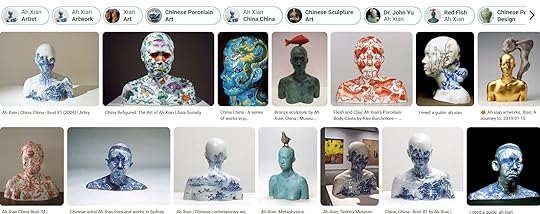
I read this and All Souls: Poems by Saskia Hamilton at the same time, and there was a theme of looking at and experiencing made things in museums that also correlates with Well of Souls: Uncovering the Banjo's Hidden History by Kristina R. Gaddy in beautiful ways. I was transfixed with the cover art on The Kingdom of Surfaces, a sculpture by Chinese Australian artist Ah Xian and I fell into his work.
Sally Wen Mao is a magnificently talented poet, and I hope she garners more attention with this book of poems. Decolonization is my song this year, and these poems reclaim and reorient the narrative of Asian portrayals, significantly with a lens from Lewis Carrols Through the Looking Glass. I remember learning about Zen Buddhism, meditation, mindfulness, Taoism, and falling in love with the cultures that produced them; and something about the gracefulness of Chinese characters, each a piece of art, solidified a deep interest and care for the entirety of the Asian culture, and I am grateful for the ways these poems explicate some of the ways that same interest or fascination in earlier times created, oppressed, and did violence to the culture and the people. I want to make sure I can notice when the prevailing culture, or me, appropriates or distorts the art and religion created by Asians and Asian Americans.
We are doing a training at work right now that really amplifies mindfulness as a tool, with no acknowledgement of where it originated and how it has been appropriated into Western culture. It is one of the beautiful paradoxes, since it is helpful to so many, saving lives, opening our minds, and I do cherish it as a tool from a wisdom tradition, but I wish we had better ways to acknowledge where it was taken from. That is how I know I am learning the colonization songs to try to oversing or harmonize with a decolonization. Perhaps like an land acknowledgement, we should say one before using a tool gleaned from other cultures.
These poems do all that, and more, and create the most intricately vivid scenes that reverberates, like the visual art of the Ah Xian, and the auditory arts, and a masterpiece of a recipe, and makes the world so much more beautiful and expansive.
ON SILK
Nomads love silk. For lifetimes they’ve walked the desert. The light material exposed their skin to the kisses of a long cool breeze.
Years ago, I visited Suzhou, world capital of silk and wedding dresses. At the Silk Museum, the silkworms crumpled themselves in baskets, lazy and dazed in the spoils of mulberry. weft / weave / reeling / warp / dye After the first molting, the second molting, silk moths lay eggs. Then the weavers—at the museum, these wax dolls—brought offerings to the gods of sericulture.
Shanghai, 2018: I wore the qipao to the Eileen Chang-themed café in the Jing’an District, in Eileen’s former residence, Changde Apartment. She lived there in the 1940s, wrote Romances and Love in a Fallen City. My friend, visiting from Kunming, said Eileen’s advice for wearing qipao is not to be afraid of showing off the belly’s curve.
red coral, topaz, lapis lazuli / religion, contagion / spices, agate, copper red sea pearls, apricots, jade / glassware, silver, indigo / frankincense peaches from Samarkand / spider silks, wild silks / raw at every edge
rose agate / cinnabar, high winds / mouth of a golden snake / minarets, musks, and melons
Everything crackling, everything burning, but these glamorous women kept smiling in these paintings, even after time ran out, their smiles so charming they sell osmanthus perfume oil, which I bought at a cosmetics shop in Yuyuan Garden, and wear on my neck to this very day.
When I found the water, I debated drinking its mirage. In the desert, everything grew wild. I expected an expanse of death, but everything sprouted before me, more alive than I could ever hope to be.
POPPIES AND JADE In the Peacock Room of the Freer Gallery of Art, the blue-and-white porcelain jardiniere floats on a velvet bed. Forged in the Qing dynasty, the jardiniere is symmetrical. So many have died for a symmetry like this. The color, too. A blue-white line divides the reverie from the suffering life. So many poisoned—blue so deep its cut would clean a gash or sharpen the edges of a dream. Or a red cadmium satin glaze so hot it butters the bisque in fever. Carmine—like poppies, their crepe pistils dusting the edges of a mouth. Would you rather: a pistil or a pistol?
AUBADE WITH GRAVEL AND GOLD I’m sick of speaking for women who’ve died Their stories and their disappearances bludgeon me in my sleep Their language is the skein in my throat that unravels every time a bullhorn blows, every time a road is paved, every time a railroad is constructed, ballast to blast, built to last against the orange flames of an open, unwritten sky
I am trapped in someone else’s imagination. My borders lose shape. I become a woman without boundaries, permeable as water. From my mouth, sepals fall. From my skin, armor and scales slough off. I am a silkworm before the harvest. In my throat, a protest—but no sound escapes, except the soporific sound of a reed flute. Where am I? I try to ask. Whose fantasy is this? What are the implications of living in your fantasy? Nothing. No answers.
WHICH DREAMED IT?
Rather than censor or disregard depictions of cultural others that are not wholly accurate, it advocates studying these representations on their own terms, appreciating them from the outset as having been infused with imagination and discovering in this complex dialogue of elided or transfigured meanings, a unified language of shared signs.
And if art transgresses the boundaries of artifice? And if reverie reels in reality?
That evening after leaving the museum, I go into Central Park. Dazed, I walk along the reservoir. Sometimes people fish here and I’ve seen their lures search for mouths under the membrane of water. Sometimes a turtle climbs over the lily pads. Sometimes a weed blooms at my feet. I throw my robe up. It floats over the reservoir like a silk moth. It doesn’t sink. Inside the kiln of history, a porcelain chest drum burns, beats, breaks. We tread on, frail and frayed and afraid as we are, to a kingdom with a better imagination. Silkworms always die for human imagination. It’s a miracle that I am ...more
AMERICAN LONELINESS I used to be proud of not conforming to stereotypes, such as: meek, submissive Asian woman I used to relish the startled looks of street harassers when I talk back To the white man who groped me on a drawbridge in Ithaca, I said I’m going to murder you That feral night in 2011, there were no stones to pelt him with But when he started sprinting in the opposite direction, I chased after him, because if he was so dangerous, why would he run away?
I used to be ashamed of how the Asian stereotype meant: docile and accommodating, conformist, collectivist, faceless, generic, robotic, never complaining, eager to be exploited, taking mistreatment just as a fact of life And I was so eager to be different because being the same was not an option
For example, the first Chinese women to immigrate to San Francisco were sold in the barracoons as sex slaves, their naked bodies probed by strangers and appraised For example, the first documented person to die of COVID-19 was a sixty-one-year-old man who loved going to the seafood market on Saturdays to buy dried squid And that’s how this city, my birthplace, became a household name—Wuhan, the first epicenter of a deadly pandemic
The first thing you might notice about The Kingdom of Surfaces is its incredible cover art, a picture of a real Jingdezhen-style porcelain modern art piece. It's a fitting image for a poetry collection that explores the West's obsession with Chinoiserie and its consequences.
Mao weaves into these poems the histories and realities of porcelain, pearls, silk, poppies, jade, and bronzes, as art objects, commodities, and colonial loot. These products have an inherent violence that isn't always apparent from first glance: the brutal labor practices, the soldiers storming the palace, or the necessity of death in its process. Porcelain is tackled in a series of shape poems which also reference more modern abuses and injustices, while "On Silk" is an entire journey on the emotional and cultural resonance of this material. (Incidentally, I learned so much about sericulture!)
The progression from poem to poem is stunning here, blending seamlessly and building on previous themes and perspectives. I loved the back to back of "Nucleation" and "Red Tide", and the thematic of the third section, radiant with rage over misogyny. The centerpiece is the title poem, a dialogue with the Met Museum's 2015 exhibition "China: Through the Looking Glass", which utilizes the Alice in Wonderland metaphor to critique the exhibit's categorization of orientalism and Chinamania as "appreciative" attitudes. Appropriately enough, Mao was included in programming for the "Monstrous Beauty" exhibit at the Met this year, which revisited Chinoiserie through a feminist lens.
This is a beautifully evocative and deeply resonant collection that will stay with me for a while. I disagree with other reviewers about a didactic tone - the personal is the political, after all - and am glad to learn as well as to feel.
I wanted to love this so much, but the poems didn't resonate with me as much as it should have (as I found all the content highly relatable yet too guided - rather than letting me form my own connections and opinions or conjectures about the writer's thoughts, it was laid out too easily and a bit monotonously). I did love the ideas and the imagery, but the writing style felt too on-the-nose for my taste in poetry. I would have loved it in a creative essay/non-fiction format. Still, bumped up to 4 stars because this is a treasure trove of artistic and intellectual inspiration.
I heard a lot about this from friends online and immediately bought a copy.
It’s the first poetry book I’ve ever read cover to cover. The book had tremendous power when read in that way, because more than any other poetry collection I can recall, it became a powerful argument, even slipping often into lyrical essay. I absolutely fell in love with her writing about porcelain-- and I love the poems that are printed in the shape of vases each one appearing on the first page of the three main sections. Poems about porcelain don't just speak to and about the history of porcelain, but also how the West long coveted it, looted it, sold it. The research and thought involved in that collection was staggering I thought, and it gave me a lot to think about it was an aesthetic experience, but it was also in intellectually stimulating experience.
In “Batshit,” a porcelain vase is “[s]tolen several times in its lifetime” only to be “sold at a Christie’s auction // for $20 million.” The follow-up thought can only be blunt: “Enough to feed a village and supply / its hospitals.”
The titular poem. The kingdom of surfaces is grounded in the metropolitan museum art exhibition "China through the looking glass,” which was a pretty strange exhibition concept. She looks long and hard at the fetishizing of China and specifically of women. On a similar note, she had two poems which had lines about the dangers of white women’s tears. By coincidence I met someone recently who was talking about this very thing. Helen tears that burned Troy…
There was a gorgeous poem about Paris and one about kintsugi that I fell in love with.
I devoured this beautiful and incredibly thought-provoking book. I am going to keep it out on my night stand to re-read. And re-read. And re-read. to light up my imagination…
For more about one of my favorite poems, see my post Yang Guifei and Sally Wen Mao here
“And I was so eager to be different because being the same was not an option // …. // Perhaps American exceptionalism is really just American loneliness” (from “American Loneliness”)
Sally Wen Mao does it again in her latest (incredibly well-researched, well-constructed, excellently road-mapped) collection! I loved being able to read through this collection and recognize all of the arts & works (especially the use of Alice Through the Looking Glass x the 2015 Met exhibition “China: Through the Looking Glass” as a structural framework) in her treatise on beauty, empire, provenance, and violence. Her poems are so timely but also timeless—I recognized some impressions of myself in these pages, even though Sally Wen Mao is writing across centuries and realities.
It was such a wonder to read and explore these worlds within The Kingdom of Surfaces; I was recalling memories of thesis-writing, and how the entire time I was calling out toward the future, I didn’t realize I was leaving a voicemail on the phone that Sally Wen Mao did not pick up because she was busy curating a collection that would answer all of those questions.
This is a really wonderful collection in general, but it shines in “The Kingdom of Surfaces.” I feel this poem is where Sally Wen Mao most successfully weaves history and personal experience together, and the result is gutting in the best way.
There are a few poems that don’t “work” quite as well, but I don’t know that there would have been a way to make them work. For example, “American Loneliness” falters a bit by losing (some of) the specificity of the poet’s experience in favor of trying to think more universally about Asian-American identity. This poem, like a few others, is characterized by righteous anger and urgency in responding to the rise in anti-Asian hate crimes, but I think it highlights how there can’t really be a coherent response to the irrational problem of violence.
The poem seems to search for a “why” when there isn’t one to be found, but maybe that is the point.
It’s a testament to the Sally Wen Mao’s ability, though, that even a weaker poem in the collection still has moments that are stunning, and in most other collections, it would be the pinnacle of the book.
This was definitely a step up from her previous collection, Oculus: Poems, although she revisits the focus on Anna May Wong from that collection in a few of these poems. I enjoyed that throughline. This collection also has some of the best COVID-related poetry I've read, some of which I had read previously in different journals but still felt fresh. The only aspect of this collection that didn't really work for me was the middle section, which had dual conceits of Alice in Wonderland and an exhibition from the Met. There wasn't a lot of breathing room in those poems, if you know what I mean. They felt weighed down by the concepts. You need to take your time with this collection, but I found it a worthwhile read thanks to the range and depth of the poet's references. I'm also super intrigued by her forthcoming short story collection, Ninetails: Nine Tales.
Sally Wen Mao strikes again with yet another lyrical and thought-provoking collection and, this time, puts the (mis)treatment of East Asian women in dialogue with stolen Chinese art (e.g., silk and porcelain). It was especially interesting to see how Mao explored how her two subjects experience objectification and fetishization in tandem with violence.
Much like her past poems, Mao plays a lot with form and style, ranging from concrete poems in the shape of vases through her "On Porcelain" poems, to free verse poems. Her poems shift in tone more in this collection, I feel, than her previous two, which I found engaging.
Some favorites: "On Porcelain" poems, "Batshit," "On Silk," "The Kingdom of Surfaces," "Playing Dead," "American Loneliness," and "On Garbage"
A lovely full-length collection of poems that explores the intersection of beauty and violence, commodification and colonization through motifs of porcelain, silk, and pearls. Sally Wen Mao's verse is both delicate and powerful as it uses fragile images like vases to invoke heavy subject such as anti-Asian hate perpetuated by the COVID-19 pandemic. While I wholly enjoyed the writing style and resonated with much of the themes discussed, I felt the collection was a little too drawn-out and that many of the poems (specifically in the middle part) could've been cut out as they covered such similar ground. With that said, I still really enjoyed this collection and hope to check out more of the author's works soon. Favorites include: All the "On Porcelain"s, "Batshit," "Minted," and "American Loneliness."
A collection of poems about identity, identity, immigration, family, art, and colonialism.
from Loquats: "Comatose in my love, my refuse, futility fuels / my every waking hour. The tree inside me isn't loquat // but strangler fig. A tree so pretty and snakelike / it leaves you breathless, then worthless, all at once."
from Batshit: "People petition against the lychee // and dog meat festival in Yulin—they call eating dog barbaric, / but not police brutality. They hate a caged animal in a foreign / country, but ignore the border camps in their own."
from Cherry-Picking Season: "I wish we could harvest time. / Days ago, the cardiologist broke: / my grandmother harbors / an abnormal growth / in her heart valves. The walls of her / ventricles too hard, / each artery barklike. Anytime / now, they will burst. / My grandmother a tree / feeding all her children."
poems I enjoyed: - Haibun: Spring -Playing Dead -The Belladonna of Sadness -American Loneliness thoughts: - porcelain shaped poems: the first poem of each section (4 sec.) -chimera --(in Greek mythology) a fire-breathing female monster with a lion's head, a goat's body, and a serpent's tail. --a thing that is hoped or wished for but in fact is illusory or impossible to achieve. -American obsession with freedom = death quotes: -"eating my disquiet" p56 -"Old men leered at bodies they couldn't touch/until they did. I shouldn't have laughed but I laughed/"
Thank you to Netgalley, the publisher of Graywolf Press and the author Sally Wen Mao for an ARC in exchange for an honest review. I highly anticipated this collection of poetry and if you're a fan of Oculus, you're bound to like it. This collection is an improvement in Mao's poetry with her focus on Chinese history, Chinese American diaspora, and social injustice. I always love her fixation on Anna May Wong. No one is devoted to Anna May Wong like Mao is. I'm excited to see Mao's writing in the form of prose.
So glad I was able to get a copy of this book from my local library. Sally Wen Mao's previous work really stuck to me to the point that I bought a copy so I had to read her newest work. It took me longer to work through this given my mental health (and the entire state of the world falling apart as we watch the U.S. empire go into flames) but it was still a very solid collection of poetry.
My favorite poems in no particular order: "Humpty Dumpty" "On Porcelain" "On Garbage" "Romance of the Castle-Topper"
Wavering between intellectualism / borderline elitism and a raging lion, face bloodied from devouring the intestines of its persecutors, the collection of poetry is wild, alive, poignant, sadly seductive, bitterly resolved and poised for presentation in a museum like a porcelain artifact. As a 6’4” man, it’s delightful to enter the world of this Asian woman and find that, authentically, we are all the same - wounded with a bashful desire for healing through being witnessed and loved. Excellent book.
Became a rather factual poetry collection that taught me about people and periods in Chinese history. I enjoyed Mao's poems about her relationships with other people in addition to these historically centered pieces. It was cool to know about the places she was referencing when she wrote about New York City. Sally Wen Mao's blend of writing formats was refreshing to me in relation to the poetry I have been reading recently while also presenting languages in several different fashions and threaded into time and between reality.
This was my first book by Mao that I've read. (I have her other two poetry books bookmarked for later!) This poetry collection was marvelous in its language, juxtaposing past and present in poems about the Chinese-American diaspora and social injustices. Reading this collection once through, I now want to read it again. There's so much layered in each poem that deserves many more reads.
Pros of this collection: lots of interesting themes and storylines, effectively communicates that many small things we don't even notice in the world are actually the result of much larger global forces and often great sacrifice
Cons of this collection: I've never described a poetry collection as dry, but this one is in places. Some of the poems read more like essays to me, and I have to agree with other reviewers that this does drag on sometimes.
"The kind of capitalism we live under: zombifying hope / cannibalizing desire / mummifying pain"
A great and powerful voice. I loved this book! Also, a new author discovered.
Her poetry touches themes such as racism, family, memory, the hate the asian community faced after COVID, british looting, Chinamania, Anna May Wong, social critique of the fetishism of Chinese (and Asian) women's bodies and the current hatred and contempt towards Chinese.
“The Kingdom of Surfaces is mesmerizing, gorgeous for its attention to language and image, and equally horrifying for what it holds before our gaze and how it challenges that gaze.”
My full review can be read at New York Journal of Books:
So much depth and wisdom about the Female Chinese American experience. Sally Wen Mao talks about so many important issues such as museums, Covid Era Sinophobia, and the trauma of immigrants. Most of the poems really hit and I loved all the symbols in the book. I will say sometimes the poems do lean a little TMI though LOL.