

What do you think?

Murder at Myall Creek
One of the most shocking murder trials in Australia's legal history, and the tribulations of the prosecutor who conducted it.
In 1838, eleven convicts and former convicts were put on trial for the brutal murder of 28 Aboriginal men, women and children at Myall Creek in northern New South Wales. The trial created an enormous amount of controversy because it was almost unknown for Europeans to be charged with the murder of Aborigines. It would become the most serious trial of mass murder in Australia’s history.
The trial’s prosecutor was the Attorney General of New South Wales, John Hubert Plunkett. It proved to be Plunkett’s greatest test, as it pitted his forensic brilliance and his belief in equality before the law against the combined forces of the free settlers, the squatters, the military, the emancipists, the newspapers, and even the convict population.
From the bestselling author of Kidnapped and Eugenia , Murder at Myall Creek follows the journey of the man who who arguably achieved more for modern-day civil rights in Australia than anyone else before or since.
In 1838, eleven convicts and former convicts were put on trial for the brutal murder of 28 Aboriginal men, women and children at Myall Creek in northern New South Wales. The trial created an enormous amount of controversy because it was almost unknown for Europeans to be charged with the murder of Aborigines. It would become the most serious trial of mass murder in Australia’s history.
The trial’s prosecutor was the Attorney General of New South Wales, John Hubert Plunkett. It proved to be Plunkett’s greatest test, as it pitted his forensic brilliance and his belief in equality before the law against the combined forces of the free settlers, the squatters, the military, the emancipists, the newspapers, and even the convict population.
From the bestselling author of Kidnapped and Eugenia , Murder at Myall Creek follows the journey of the man who who arguably achieved more for modern-day civil rights in Australia than anyone else before or since.
352 pages, Paperback
First published November 1, 2016
About the author
Mark Tedeschi
7 books29 followersMark Alfred Guido Tedeschi, AM, QC (born 1952) is an Australian barrister, law professor, photographer and author. He has won numerous awards for his photography and has been featured in galleries throughout the world including in the State Library of New South Wales, the New South Wales Art Gallery, the Center for Fine Art Photography in Colorado, and the National Library in Canberra. He is the Senior Crown Prosecutor for New South Wales and the Head of Chambers of the 84 Crown Prosecutors. He is the founder and president of the Australian Association of Crown Prosecutors and a visiting professor at the University of Wollongong. As a prosecutor, Tedeschi is best known for the prosecution of numerous high-profile cases in Australia including the 2006 conviction of Dr. Suman Sood for illegal abortion and the Backpacker Murders committed by Ivan Milat in the 1990s.
Tedeschi is the author of two books, one on law and the other on photography. In 1980, he co-authored Law of International Business in Australia with Dr. P.J. O'Keefe. He released a book of photograph in 2012 entitled Shooting Around Corners which featured over twenty five years of his photography.
Tedeschi is the author of a true crime book called Eugenia, published in 2012 by Simon & Schuster, which tells the story of Eugenia Falleni, a woman of Italian and New Zealand background who lived in Australia as a man from 1898 until she was charged with the murder of her first "wife" in 1920. In this book, Tedeschi describes the tortuous life that Eugenia Falleni led as a woman trying to lead life as a man in a society that did not understand such things. He describes her murder trial in Sydney in 1920 in which she was prosecuted by the first Senior Crown Prosecutor, William Coyle KC. Part of the book describes this very complex and interesting trial, and Eugenia Falleni's life after her trial.
Kidnapped will be published by Simon & Schuster in 2015.
Tedeschi is the author of two books, one on law and the other on photography. In 1980, he co-authored Law of International Business in Australia with Dr. P.J. O'Keefe. He released a book of photograph in 2012 entitled Shooting Around Corners which featured over twenty five years of his photography.
Tedeschi is the author of a true crime book called Eugenia, published in 2012 by Simon & Schuster, which tells the story of Eugenia Falleni, a woman of Italian and New Zealand background who lived in Australia as a man from 1898 until she was charged with the murder of her first "wife" in 1920. In this book, Tedeschi describes the tortuous life that Eugenia Falleni led as a woman trying to lead life as a man in a society that did not understand such things. He describes her murder trial in Sydney in 1920 in which she was prosecuted by the first Senior Crown Prosecutor, William Coyle KC. Part of the book describes this very complex and interesting trial, and Eugenia Falleni's life after her trial.
Kidnapped will be published by Simon & Schuster in 2015.
Ratings & Reviews
Friends & Following
Create a free account to discover what your friends think of this book!
Community Reviews
Displaying 1 - 30 of 52 reviews

November 8, 2017
UPDATED May 2022
Guardian article: "Not calling a massacre a massacre is ridiculous’: a model of truth-telling at Myall Creek."
https://www.theguardian.com/australia...
UPDATED NOV 2019:
"Ben Quilty paints trauma of Myall Creek and other Australian massacre sites in Rorschach landscapes"
https://www.abc.net.au/news/2019-11-1...
5★
“The stockmen did not need to use their precious ball and powder on their victims when they could just as easily dispose of them by sword or by crushing them.
The gully was filled with the screams of the victims and the war cries of the horsemen as a thick cloud of dust kicked up by the horses became intermingled with the blood and mangled bodies of the Wirrayaraay. The stench of death was everywhere.”
I had heard of this event because I lived in the region at one time, but all I knew was there was something called the Myall Creek Massacre that happened “a long time ago” (June 1838, so let’s move on, it’s in the past, nothing to do with us now, and so on). I did know it was the first time white men were tried, convicted, and hanged for killing Aborigines.
What I didn’t know was everything Tedeschi has laid out accurately, interestingly, and heart-wrenchingly well – that a bunch of white settlers decided to teach “the blacks” a lesson to scare them off of the land the settlers had taken over.
In an extremely loose Native American American analogy, I’d say these were peaceful Hopis compared to Comanches.
“John Fleming and his ten mounted stockmen journeyed for some days, visiting many of the stations in the district, looking for any blacks to kill.
The fact that the Wirrayaraay at Myall Creek could not possibly have been responsible for the depredations – because prior to taking up residence at Myall Creek they had been living peacefully for many months at McIntyre’s and Wiseman’s stations, and that they had had most harmonious relationships with the whites at each of these stations – was of no consequence to the marauding stockmen.
As they approached the Myall Creek Station, they were in a murderous state of mind, intent on suppressing the Indigenous challenge to white pastoral supremacy.”
They stormed onto the property, tied all the people together on a long rope (mums and babies and kiddies, too), marched them out of sight over a hill, saying they’d just fire a couple of warning shots to frighten them.
True, they did fire only two shots. But then they charged the horses through them, mowing them down with swords, like something out of Braveheart or the Crusades, except these were just defenceless families being chopped to pieces. Eventually, the stockmen set fire to them, raking up and tending the fire in the following days.
The stuff of nightmares. Two little boys escaped.
The crime was reported, and John Hubert Plunkett, who was both the Solicitor General and Attorney General for NSW, was to prosecute the case. The government’s position was clear. Britain had abolished slavery five years earlier (more than 30 years before the American Civil War, incidentally), and a Select Committee of the House of Commons had issued a damning report on the treatment of natives generally, and Australian Aborigines specifically, saying.
‘‘In the formation of these [penal] settlements, it does not appear that the territorial rights of the natives were considered, and very little care has since been taken to protect them from the violence or the contamination of the dregs of our countrymen.”
The dregs, all right! But Plunkett was up against public opinion and the newspapers. How dare these men be charged with murder? It was common practice to go on a “bushwhack” as they called it, to wipe out the local native troublemakers.
But they didn’t count on Plunkett’s determination and strong appetite for fighting injustice. He was an Irish Catholic who came to the colonies because it was the only place he could gain a good appointment, Britain being “pure” Anglican, courtesy of divorce-loving Henry VIII who broke from Rome and appointed his own bishops.
[Sorry if I offend any Anglicans/Episcopalians. That’s how I was raised, and I was ignorant until a Catholic friend bragged about “her” bishops going back to St Peter while “mine” went back to a lecherous Tudor king. But I digress.]
Plunkett persevered through two separate trials, and Tedeschi describes them in detail. Suffice to say that a major hurdle was that the eye-witness to the event was an Aborigine who hid but was not allowed to testify, nor were any Aborigines in those days.
Why? Well, it’s obvious, isn’t it? They hadn’t been enlightened and saved yet so had no concept of hell or fear of the eternal damnation of their souls if they lied under oath, so they couldn’t take an oath. White witnesses, presumably, never ever dared lie under oath for fear of the fire and brimstone that surely awaited them.
But Plunkett prevailed and some of the guilty were hanged. Today this would have been considered a war crimes trial.
Mind you, after the trial, the settlers resorted to poisoning water holes and distributing poison flour to continue their miserable campaign of eradication. [Lousy buggers, pardon my French.]
What I also didn’t know was how much Australian society owes to John Plunkett, and this book is really a biography of him as well as a grim account of Australia’s bloody history. I will break up the following long passage to better highlight his achievements: constitution, schools, hospitals. [And what did I achieve today myself? Yeah, well . . . ]
And I also didn’t know that Aunty Sue Blacklock AM of Tingha, NSW, and mother of well-known footballer Nathan Blacklock (friend of one of my kids), is a great-great-great granddaughter of one of the two little boys who escaped the slaughter.
And I'm ashamed I didn’t know.
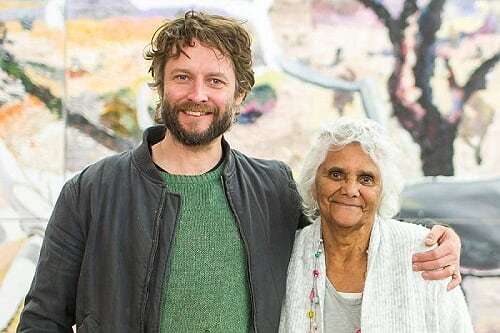
Ben Quilty and Aunty Sue Blacklock AM
This should be required reading in Aussie schools.
ABC: "Call for National Indigenous Keeping Place at NSW massacre site"
http://www.abc.net.au/news/2016-06-16...
Guardian article: "Not calling a massacre a massacre is ridiculous’: a model of truth-telling at Myall Creek."
https://www.theguardian.com/australia...
UPDATED NOV 2019:
"Ben Quilty paints trauma of Myall Creek and other Australian massacre sites in Rorschach landscapes"
https://www.abc.net.au/news/2019-11-1...
5★
“The stockmen did not need to use their precious ball and powder on their victims when they could just as easily dispose of them by sword or by crushing them.
The gully was filled with the screams of the victims and the war cries of the horsemen as a thick cloud of dust kicked up by the horses became intermingled with the blood and mangled bodies of the Wirrayaraay. The stench of death was everywhere.”
I had heard of this event because I lived in the region at one time, but all I knew was there was something called the Myall Creek Massacre that happened “a long time ago” (June 1838, so let’s move on, it’s in the past, nothing to do with us now, and so on). I did know it was the first time white men were tried, convicted, and hanged for killing Aborigines.
What I didn’t know was everything Tedeschi has laid out accurately, interestingly, and heart-wrenchingly well – that a bunch of white settlers decided to teach “the blacks” a lesson to scare them off of the land the settlers had taken over.
In an extremely loose Native American American analogy, I’d say these were peaceful Hopis compared to Comanches.
“John Fleming and his ten mounted stockmen journeyed for some days, visiting many of the stations in the district, looking for any blacks to kill.
The fact that the Wirrayaraay at Myall Creek could not possibly have been responsible for the depredations – because prior to taking up residence at Myall Creek they had been living peacefully for many months at McIntyre’s and Wiseman’s stations, and that they had had most harmonious relationships with the whites at each of these stations – was of no consequence to the marauding stockmen.
As they approached the Myall Creek Station, they were in a murderous state of mind, intent on suppressing the Indigenous challenge to white pastoral supremacy.”
They stormed onto the property, tied all the people together on a long rope (mums and babies and kiddies, too), marched them out of sight over a hill, saying they’d just fire a couple of warning shots to frighten them.
True, they did fire only two shots. But then they charged the horses through them, mowing them down with swords, like something out of Braveheart or the Crusades, except these were just defenceless families being chopped to pieces. Eventually, the stockmen set fire to them, raking up and tending the fire in the following days.
The stuff of nightmares. Two little boys escaped.
The crime was reported, and John Hubert Plunkett, who was both the Solicitor General and Attorney General for NSW, was to prosecute the case. The government’s position was clear. Britain had abolished slavery five years earlier (more than 30 years before the American Civil War, incidentally), and a Select Committee of the House of Commons had issued a damning report on the treatment of natives generally, and Australian Aborigines specifically, saying.
‘‘In the formation of these [penal] settlements, it does not appear that the territorial rights of the natives were considered, and very little care has since been taken to protect them from the violence or the contamination of the dregs of our countrymen.”
The dregs, all right! But Plunkett was up against public opinion and the newspapers. How dare these men be charged with murder? It was common practice to go on a “bushwhack” as they called it, to wipe out the local native troublemakers.
But they didn’t count on Plunkett’s determination and strong appetite for fighting injustice. He was an Irish Catholic who came to the colonies because it was the only place he could gain a good appointment, Britain being “pure” Anglican, courtesy of divorce-loving Henry VIII who broke from Rome and appointed his own bishops.
[Sorry if I offend any Anglicans/Episcopalians. That’s how I was raised, and I was ignorant until a Catholic friend bragged about “her” bishops going back to St Peter while “mine” went back to a lecherous Tudor king. But I digress.]
Plunkett persevered through two separate trials, and Tedeschi describes them in detail. Suffice to say that a major hurdle was that the eye-witness to the event was an Aborigine who hid but was not allowed to testify, nor were any Aborigines in those days.
Why? Well, it’s obvious, isn’t it? They hadn’t been enlightened and saved yet so had no concept of hell or fear of the eternal damnation of their souls if they lied under oath, so they couldn’t take an oath. White witnesses, presumably, never ever dared lie under oath for fear of the fire and brimstone that surely awaited them.
But Plunkett prevailed and some of the guilty were hanged. Today this would have been considered a war crimes trial.
Mind you, after the trial, the settlers resorted to poisoning water holes and distributing poison flour to continue their miserable campaign of eradication. [Lousy buggers, pardon my French.]
What I also didn’t know was how much Australian society owes to John Plunkett, and this book is really a biography of him as well as a grim account of Australia’s bloody history. I will break up the following long passage to better highlight his achievements: constitution, schools, hospitals. [And what did I achieve today myself? Yeah, well . . . ]
“John Hubert Plunkett had a most illustrious career in New South Wales. Many of the reforms he introduced had a lasting effect on the colony, some of which have endured until today.
- During the Australian Constitutional Conventions prior to federation in 1901, there was no question but that the new nation would be secular, with no religion of state. In fact, the federal Constitution expressly precludes the Commonwealth from passing laws to establish any religion, to impose any religious observance, or to prohibit the free exercise of any religion.
- It also provides that no religious test shall be required as a qualification for any office under the Commonwealth.10 It is in no small measure due to the actions of John Plunkett that this principle was accepted so early in the history of the colony.
- Similarly, the existence of a vigorous state school system side-by-side with religious schools – all funded by government – was due to a policy developed and pursued by John Plunkett.
- The University of Sydney and Sydney Grammar School, with their traditions of excellence in secular, liberal education, were, and still are, important community assets for which we should be grateful to those who were responsible for their establishment, including John Hubert Plunkett. Today, the University of Sydney is ranked among the best in the world,11 while Sydney Grammar School is one of the foremost secondary schools in Australia.
- St Vincent’s Hospital in Sydney is still one of the largest teaching hospitals in New South Wales, as it provides first-rate medical services to people of any religion without discrimination or proselytism.
And I also didn’t know that Aunty Sue Blacklock AM of Tingha, NSW, and mother of well-known footballer Nathan Blacklock (friend of one of my kids), is a great-great-great granddaughter of one of the two little boys who escaped the slaughter.
And I'm ashamed I didn’t know.
Ben Quilty and Aunty Sue Blacklock AM
This should be required reading in Aussie schools.
ABC: "Call for National Indigenous Keeping Place at NSW massacre site"
http://www.abc.net.au/news/2016-06-16...
November 2, 2016
This is an interesting book but it should probably be re-branded as more of a biography of colonial NSW Attorney General John Plunkett and his impact on the legal system of New South Wales, and less of a broad title on the Myall Creek Massacre.
What it adds to the record are insights into why Plunkett moved for an immediate second trial of some of the massacre perpetrators, and how the risk paid dividends in terms of a generally just outcome.
Tedeschi makes the case for a better understanding of Plunkett's character and exactly what he added to Australian civil rights. He also argues for why Plunkett has been largely forgotten by a nation whose history he impacted so significantly.
Elucidating the differences between Colonial and modern Australian legal processes is one of the key aspects to Tedeschi's work, and this focus is essential to a full understanding of the prosecutions, and several unjust outcomes of the trial.
This book will become an crucial resource for whoever creates the definitive, mainstream title on this critical episode of modern Australian history.
What it adds to the record are insights into why Plunkett moved for an immediate second trial of some of the massacre perpetrators, and how the risk paid dividends in terms of a generally just outcome.
Tedeschi makes the case for a better understanding of Plunkett's character and exactly what he added to Australian civil rights. He also argues for why Plunkett has been largely forgotten by a nation whose history he impacted so significantly.
Elucidating the differences between Colonial and modern Australian legal processes is one of the key aspects to Tedeschi's work, and this focus is essential to a full understanding of the prosecutions, and several unjust outcomes of the trial.
This book will become an crucial resource for whoever creates the definitive, mainstream title on this critical episode of modern Australian history.
November 30, 2018
Following on from Terry Smythe's Denny Day Mark Tedeschi QC picks up the story of the aftermath of the Myall Creek Massacre, concentrating on events and the participants around the trial of the perpetrators of the massacre of 28 Aboriginal men, women and children in 1838 in northern New South Wales.
The cover of the book refers to it as the "trial that defined a nation" and it's hard not to agree 100% with that statement. Whilst it could be said that the book concentrates considerably more on the outcomes and surrounding civil changes that occurred at the time of the trial - rather than the massacre itself - it's important to realise that out of the dreadful acts of eleven men, some good eventuated including modern-day civil rights, equality, religious freedoms and the secular state. That doesn't hold true, unfortunately, for recognition of the lives lost in the massacre itself and we should never forget that or them.
The circumstances and events surrounding this massacre are utterly appalling. These killers behaved appallingly. Their crimes were appalling and we should all be aware of what they did, and the manner in which they did it. We should also remember that this trial came at a time when it was virtually unknown for Europeans to be charged with any crimes against Aboriginal people. As a consequence of this trial, some small amount of justice was achieved. Awareness was raised, and good people were able to stand up for what is right.
At the heart of these people is a most fascinating man I'd never heard of. The Attorney General of New South Wales at the time - John Hubert Plunkett is a study all to himself, a religious man who believed fervently in the separation of church and State; the provision of secular education; the provision of health care to all regardless of religious background; equality before the law; emancipation; and fair and decent treatment of all people regardless of their backgrounds.
The fact that Plunkett persisted with two trials of the alleged murderers is a relief. What he also did for the society in which we now live is worth knowing.
https://www.austcrimefiction.org/revi...
The cover of the book refers to it as the "trial that defined a nation" and it's hard not to agree 100% with that statement. Whilst it could be said that the book concentrates considerably more on the outcomes and surrounding civil changes that occurred at the time of the trial - rather than the massacre itself - it's important to realise that out of the dreadful acts of eleven men, some good eventuated including modern-day civil rights, equality, religious freedoms and the secular state. That doesn't hold true, unfortunately, for recognition of the lives lost in the massacre itself and we should never forget that or them.
The circumstances and events surrounding this massacre are utterly appalling. These killers behaved appallingly. Their crimes were appalling and we should all be aware of what they did, and the manner in which they did it. We should also remember that this trial came at a time when it was virtually unknown for Europeans to be charged with any crimes against Aboriginal people. As a consequence of this trial, some small amount of justice was achieved. Awareness was raised, and good people were able to stand up for what is right.
At the heart of these people is a most fascinating man I'd never heard of. The Attorney General of New South Wales at the time - John Hubert Plunkett is a study all to himself, a religious man who believed fervently in the separation of church and State; the provision of secular education; the provision of health care to all regardless of religious background; equality before the law; emancipation; and fair and decent treatment of all people regardless of their backgrounds.
The fact that Plunkett persisted with two trials of the alleged murderers is a relief. What he also did for the society in which we now live is worth knowing.
https://www.austcrimefiction.org/revi...
February 16, 2022
What a shame that so few Australians (incl myself) have not heard of John Hubert Plunkett. Here is a man who was so ahead of his time, a visionary in colonial Australia. He held many public posts in the new colony of New South Wales, including the Attorney General (of NSW). His attitude towards equality and justice for all was unparalleled in his time (and for many years after that ). Plunkett was responsible for much: abolishing the worst aspects of convict life, inc ending transportation, supporting public education, opposing the death penalty, establishing civil rights for minority groups, and his never ending fight to protect the Aboriginal population.
His greatest challenge was prosecuting eleven white men for the massacre of twenty-eight Aboriginal men, women and children, in a time when this was unheard of. He did this at despite much hatred and vitriol directed at him and at risk to his reputation and standing in the colony.
There are parts of this book that are very hard to read (Chapter 7). Nonetheless, I'm so glad I dusted this book off my bookshelf as I had heard about the Myall Creek murders without knowing too much about them. It is without doubt, a great tragedy.
His greatest challenge was prosecuting eleven white men for the massacre of twenty-eight Aboriginal men, women and children, in a time when this was unheard of. He did this at despite much hatred and vitriol directed at him and at risk to his reputation and standing in the colony.
There are parts of this book that are very hard to read (Chapter 7). Nonetheless, I'm so glad I dusted this book off my bookshelf as I had heard about the Myall Creek murders without knowing too much about them. It is without doubt, a great tragedy.

March 21, 2020
Trigger warnings: mass murder, death of Indigenous people, graphic descriptions of murder, gun violence.
I had such high hopes for this book, because Myall Creek is such an important and overlooked event in Australia's history. Unfortunately, the title here is slightly deceptive because it's less about Myall Creek and more a biography of John Hubert Plunkett.
And, like, that's FINE. Plunkett is a significant character in Australia's social and legal history.
But be upfront about the fact that it's a book about Plunkett that dedicates a couple of chapters to Myall Creek, rather than making out like the entire thing is about Myall Creek. At no point in this book is there an Aboriginal perspective on Myall Creek or the impact the massacre has had. Add in a reeeeeeeally awkward full page discussion of the "similarities" between Plunkett and Martin Luther King Jr and I sadly did not love this.
I had such high hopes for this book, because Myall Creek is such an important and overlooked event in Australia's history. Unfortunately, the title here is slightly deceptive because it's less about Myall Creek and more a biography of John Hubert Plunkett.
And, like, that's FINE. Plunkett is a significant character in Australia's social and legal history.
But be upfront about the fact that it's a book about Plunkett that dedicates a couple of chapters to Myall Creek, rather than making out like the entire thing is about Myall Creek. At no point in this book is there an Aboriginal perspective on Myall Creek or the impact the massacre has had. Add in a reeeeeeeally awkward full page discussion of the "similarities" between Plunkett and Martin Luther King Jr and I sadly did not love this.
December 15, 2017
This book is shocking! I mean it's contents. The book is set mostly up in the area in which I live at the moment - Bingara near Inverell in NW NSW Australia. It is hard to fathom how so many indigenous people could be slaughtered and yet the community was not outraged. Tedeschi gives a great account of John Hubert Plunkett the then Attorney General and the fight he puts up to have the murderers brought to justice. But still the killings continued. I found this book was not as easy a read than his other book I have read- Kidnapped. Perhaps this is because it is set way back in the 1800s. A real eye opener and worth the read. Just a word of warning ... keep your dictionary handy as Tedeschi thinks he is still in court!

January 12, 2021
I struggled to put it down.
I had a rough knowledge of the massacre at Myall Creek but reading the material of the trial proceedings written by a Crown Solicitor in Mark Tedeschi made it all so much more vivid.
For trial Prosecutor and Attorney General of New South Wales John Hubert Plunkett it tested his prowess, his value/belief system of 'equality before the law' and his forensic brilliance in 1838. While a talented and interesting man I think he would have been hard work socially. Plunkett went on to carve himself a memorable career in the antipodes. This case was his stellar achievement.
The book made me angry as it makes very clear the inequalities between our First Nation's people and the white people who invaded Australia. The fact that 30 years ago a report was released about Aboriginal deaths in custody and most of the recommendations were not implemented and we are now up to approximately 450 deaths with 5 in the last month - not much has changed if you look more broadly.
The responses and social mores of this period leave you in no doubt where the land lay. Colonisation of Australia as initially a penal settlement and subsequent emancipists, military, free settler's under the banner of a British Commonwealth, was never going to have a good outcome for Australia's inhabitants but regardless of which of the European countries made claim to the Great Southern Land I doubt the outcome would have differed.
If you like your history, with a bit of courtroom drama, you appreciate the pitfalls of colonisation and you know how ugly some humans can be. This is a book for you.
Overall a well researched and written book about a very ugly part of Australian history that was not a one off in terms of the event but a singular event in which the jury finally got it right.
Absolutely worth the read and I will be reading Tedeschi's other offerings.
I had a rough knowledge of the massacre at Myall Creek but reading the material of the trial proceedings written by a Crown Solicitor in Mark Tedeschi made it all so much more vivid.
For trial Prosecutor and Attorney General of New South Wales John Hubert Plunkett it tested his prowess, his value/belief system of 'equality before the law' and his forensic brilliance in 1838. While a talented and interesting man I think he would have been hard work socially. Plunkett went on to carve himself a memorable career in the antipodes. This case was his stellar achievement.
The book made me angry as it makes very clear the inequalities between our First Nation's people and the white people who invaded Australia. The fact that 30 years ago a report was released about Aboriginal deaths in custody and most of the recommendations were not implemented and we are now up to approximately 450 deaths with 5 in the last month - not much has changed if you look more broadly.
The responses and social mores of this period leave you in no doubt where the land lay. Colonisation of Australia as initially a penal settlement and subsequent emancipists, military, free settler's under the banner of a British Commonwealth, was never going to have a good outcome for Australia's inhabitants but regardless of which of the European countries made claim to the Great Southern Land I doubt the outcome would have differed.
If you like your history, with a bit of courtroom drama, you appreciate the pitfalls of colonisation and you know how ugly some humans can be. This is a book for you.
Overall a well researched and written book about a very ugly part of Australian history that was not a one off in terms of the event but a singular event in which the jury finally got it right.
Absolutely worth the read and I will be reading Tedeschi's other offerings.
This entire review has been hidden because of spoilers.
April 12, 2017
An interesting account of the life of an unsung hero of Australian law and governance. John Hubert Plunkett seems to have been largely forgotten by history and Mark Tedeschi is on a mission to remedy this. The trial of the perpetrators of the Myall Creek massacre is a central part of Plunkett's career as solicitor general and attorney general of the young colony of NSW. I do think the title is misleading - perhaps a subtitle referencing Plunkett would be a good idea?

March 13, 2017
A really interesting book about a terrible, hidden part of Australia's history. It is awful to realise that so many massacres of the Australian Indigenous population occurred but even more horrifying to realise how few perpetrators were bought to justice by a legal and governing system that frequently condone such murders.
This book tells the story of John Hubert Plunkett who had a major impact on the legislation of Australia and the equality of all persons under law in Australia. The secular nature of Australian society was almost singularly instigated by Plunkett.
This book tells the story of John Hubert Plunkett who had a major impact on the legislation of Australia and the equality of all persons under law in Australia. The secular nature of Australian society was almost singularly instigated by Plunkett.

December 15, 2016
This to me is a 2.5* book.
I have rounded up for three reasons.
1. I feel these stories are important to a broader understanding of Australia's not so glorious past that we do not often hear about.
2. I feel this is a technically sound book, well researched and engagingly written.
3. I grew up (and still live) very close to the area where this tragic event occurred. I know this event and the impact on the communities more than a century later.
However I felt this is a book about Mr Plunkett and his impact (which is not insignificant) on the legal community of Australia rather than an account of the Murder at Myall Creek. I wanted the stories of the people involved, not just the prosecutor. He was an admirable man, however there were other voices in this narrative I wish I could have heard as well.
I have rounded up for three reasons.
1. I feel these stories are important to a broader understanding of Australia's not so glorious past that we do not often hear about.
2. I feel this is a technically sound book, well researched and engagingly written.
3. I grew up (and still live) very close to the area where this tragic event occurred. I know this event and the impact on the communities more than a century later.
However I felt this is a book about Mr Plunkett and his impact (which is not insignificant) on the legal community of Australia rather than an account of the Murder at Myall Creek. I wanted the stories of the people involved, not just the prosecutor. He was an admirable man, however there were other voices in this narrative I wish I could have heard as well.

June 26, 2019
Historical account of early colonial Australia and the significant lifetime achievements of human rights advocate John Plunkett. The book in particular highlights the landmark case involving the Myall Creek massacre of up to 30 indigenous men, women and children and the historical genocide that continued prior and beyond the Myall Creek murders. An incredibly important book that contains content that should be taught in every school. The silence and covering up of national atrocities is ongoing and the fact that this is not public knowledge, taught in schools or recognised within our history as much as it should be shows that Australia is no less guilty than other countries to which we typically throw our arms up in horror. Another excellent piece of work by Mark Tedeschi.

May 25, 2017
The murder of 28 Aboriginals at Myall Creek in 1838 covers about 100 pages. The book main focus is the NSW Attorney General John Plunkett an Irish Catholic and his contribution in establishing a non-secular governmental system, early education systems and promotion of equality for all (regardless of colour, race or religion). His actions are set within the ongoing tensions of Catholics and Anglicans, the tragedy of Aboriginals suffering from the greed of the invading settlers and the political/legal position on NSW in the mid-1800s. It's written by a lawyer and it reads like it.

August 6, 2018
An important book:
Australians should know about the incredible work of John Hubert Plunkett; his contribution to Australia, including his efforts to seek equality for Aboriginal people. Plus they should know about the atrocities committed against Aboriginal people including the harrowing murders at Myall Creek.
Australians should know about the incredible work of John Hubert Plunkett; his contribution to Australia, including his efforts to seek equality for Aboriginal people. Plus they should know about the atrocities committed against Aboriginal people including the harrowing murders at Myall Creek.

February 5, 2017
Finished reading … Murder at Myall Creek: the trial that defined a nation / Mark Tedeschi … 03 Feb. 2017
ISBN: 9781925456264
The title of this book is misleading. But then again, would anyone read it if it were titled “The Legal Career of John Hubert Plunkett in the Colony of New South Wales”? And people should definitely read it, including high school students of Australian history. I doubt many Australians would have much, if any, knowledge of the reality of Aboriginals, convicts and free settlers in colonial NSW as portrayed in this book.
Plunkett's overarching belief was that all are equal before the law, a belief founded on his experience of bigotry as an Irish (and therefore Catholic) man under British (and therefore Protestant) rule. His move to Australia was the result of career progress being blocked to him in Ireland on account of such bigotry.
The trials following the Myall Creek massacre (there were two, in itself controversial) was certainly a turning point, the first time anyone had been tried for murdering Aboriginals. The guilty verdict was highly unpopular and Plunkett's career suffered on account of it. This book shows how widespread the appalling treatment of Indigenous Australians was - much worse than shameful, more like ethnic cleansing in many places. Aboriginals continue to pay the price.
Many other laws in the colony came about through or with the help of Plunkett's involvement. To mention only a couple that I found particularly interesting: the separation of Church and State, i.e. no established religion as in the UK, and the promotion of state education for all.
Although there is a legal focus to the book, it is written for and easy to understand by those without a legal background. The facts behind the laws make it a rivetting read.
Very highly recommended.
Borrowed from my local library.
August 24, 2018
I think this would have been better if it had focused on what it was supposed to - the massacre at Myall Creek. The deviation plunging into Plunkett read like a biography that started to sprout praise on Catholicism and the legal profession. This was especially evident at the start and the finish. I wish Tedeschi had spent more time fleshing out the characters lives, even the bad ones.

November 22, 2016
Although this book is about the terrible atrocity at Myall Creek it is also an account of the largely unsung hero John Plunkett. John Plunkett was a key figure in shaping many of the better things in our society.
April 26, 2018
An extremely worthwhile read.
February 16, 2026
“One of the jurors was alleged to have said later: ‘I knew well they were guilty of the murder, but I for one would never see a white man suffer for shooting a black.’”
3.5 stars.
Tedeschi’s biggest strength in this book was when he focused on analysing the legal system of New South Wales in the context of the Myall Creek trial. The event was unique and understanding the specific circumstances which arose which allowed for the eventual prosecution of seven of the men involved in the Myall Creek massacre is a very interesting and valuable line of inquiry. His legal background was his speciality, and definitely made for the most interesting sections of the book.
However, I did find Tedeschi’s approach to writing about the characters involved a little questionable, especially those in the peripherals to the narrative such as W. C. Wentworth. For example, I don’t think Wentworth was that progressive when he said that white men would work alongside Chinese men. He just wanted to justify cheap Chinese labour in Australia because he didn’t want to pay people properly. As such, I also question the romanticised lens Tedeschi portrayed Plunkett with, especially as he acknowledges there is a lack of sources that really present Plunkett’s perspective properly. Regardless, I do think it’s an interesting read for anyone who wants to engage with the Myall Creek massacre and understand the legal system which allowed for the subsequent trials and prosecutions to occur.
3.5 stars.
Tedeschi’s biggest strength in this book was when he focused on analysing the legal system of New South Wales in the context of the Myall Creek trial. The event was unique and understanding the specific circumstances which arose which allowed for the eventual prosecution of seven of the men involved in the Myall Creek massacre is a very interesting and valuable line of inquiry. His legal background was his speciality, and definitely made for the most interesting sections of the book.
However, I did find Tedeschi’s approach to writing about the characters involved a little questionable, especially those in the peripherals to the narrative such as W. C. Wentworth. For example, I don’t think Wentworth was that progressive when he said that white men would work alongside Chinese men. He just wanted to justify cheap Chinese labour in Australia because he didn’t want to pay people properly. As such, I also question the romanticised lens Tedeschi portrayed Plunkett with, especially as he acknowledges there is a lack of sources that really present Plunkett’s perspective properly. Regardless, I do think it’s an interesting read for anyone who wants to engage with the Myall Creek massacre and understand the legal system which allowed for the subsequent trials and prosecutions to occur.
June 21, 2025
A book club read. A relatively short book containing such a lot of this country’s history around the settlement of Sydney, abhorrent treatment of the Aborigines, convict transportation and slavery, the setting up of the legal system. A wealthy landowner takes a posse of 10 men to track down Aborigines who poached cattle. They come across a peaceful group of 28 Aboriginal men, women and children who they slaughter and burn.
John Plunkett, an Irish Catholic is the central character who works hard as the Attorney General (later becoming the country’s 1st Queen’s Counsellor), prosecutes the murderers. After 2 trials he managed to obtain death penalties for 7 of the murderers. He goes on to draft many new Acts for the fledgling colony, some making him unpopular with the rich. He was a driving force for voting rights to male convicts after serving their sentence, Aboriginals having witnesses at trial, the setting up of St Vincents Hospital, our education system, the Reform, Evidence and Marriage Acts. The author portrays him as an unsung hero.
John Plunkett, an Irish Catholic is the central character who works hard as the Attorney General (later becoming the country’s 1st Queen’s Counsellor), prosecutes the murderers. After 2 trials he managed to obtain death penalties for 7 of the murderers. He goes on to draft many new Acts for the fledgling colony, some making him unpopular with the rich. He was a driving force for voting rights to male convicts after serving their sentence, Aboriginals having witnesses at trial, the setting up of St Vincents Hospital, our education system, the Reform, Evidence and Marriage Acts. The author portrays him as an unsung hero.
May 22, 2019
As several reviewers have noted, this is as much a biography of John Hubert Plunkett as a history of the Myall Creek murders. It's also a worthwhile exploration of colonial government, with a particular focus on the administration of justice. I would highly recommend the book, but have some reservations. The narrative gets ragged and repetitive towards the end, and the writing style is sometimes stiff and colourless.
The fascinating thing about the Myall Creek trials, for me, is that Plunkett pursued the cases despite vehement opposition. He was clearly in a minority who felt that Aboriginal people should have equal protection under the law. His stand was single-minded and quite heroic. It's odd, then, that Tedeschi dismisses Plunkett's later opposition to Chinese immigration as simply being the norm for the time. It's a paradox that didn't deserve to be glibly glossed over.
The fascinating thing about the Myall Creek trials, for me, is that Plunkett pursued the cases despite vehement opposition. He was clearly in a minority who felt that Aboriginal people should have equal protection under the law. His stand was single-minded and quite heroic. It's odd, then, that Tedeschi dismisses Plunkett's later opposition to Chinese immigration as simply being the norm for the time. It's a paradox that didn't deserve to be glibly glossed over.
July 12, 2020
I’m glad that the largely forgotten John Hubert Plunkett (1802, Ireland - 1869, Melbourne) has been given some recognition at last by way of this book. He was responsible for helping to make Australia a more civilised place. Although a devout Catholic he saw no place for religion in government and thankfully by holding responsible positions in the colony of NSW established this principal very early in its history. He also headed the prosecution of eleven men charged with the murders of a group of Aboriginal men, women and children in 1838. The author shows that this was part of a War Crime, the genocide of the Indigenous people. If you want to be really informed about Australian history, read this book. Maybe one day Australians will learn the true history of their country while at school. I know In my youth we were raised in ignorance.

May 8, 2022
4⭐️
It’s 1838 in the colony of New South Wales and Aboriginal people are more often then not treated badly by European settlers and convicts alike. Police also looked the other way when white people killed Aboriginals, so when John Plunkett (the then Attorney General of the colony) made it his mission to prosecute eleven white men for the mass and brutal murder of twenty eight Aboriginal men, women and children at Myall Creek he created a controversy like no other.
What came next was not just the unprecedented trial of the eleven accused; but also of Plunkett in both the court of public opinion and through trial by media. A case that would not only test every fibre of Plunkett’s being, it’s very existence would also see it become one of Australia’s greatest cases for equality in a time when society was anything but.
Did Plunkett succeed? Well you’re just going to have to read Murder at Myall Creek by Mark Tedeschi QC to find out.
The massacre at Myall Creek tells the story of yet another disgraceful and horrific stain on the historical fabric that is the treatment of Indigenous people and is something that all Australians should be aware of. Big ticks to Tedeschi for the amount of research that has gone into it, his use of primary sources and for this strong and descriptive writing that transported me to the Creek and then into the courtroom.
What I wasn’t expecting though was that a good half of the book focused on Plunkett the man. There was a lot of information on his life and his practice in the law beyond the trial. I felt a little cheated about this rather than pleased that I had the benefit of getting extra information, as there was nothing that alluded to this in either the title or the blurb; and at times these parts were a little long winded for me.
As a lawyer with an interest in Australian history the book as a whole was still relevant to me; but I feel that for non-lawyers or history buffs, you might not appreciate its content as much. I do recommend it though. If nothing else you should read it as a tale of why equity before the law is vital and how lucky we are to have people like Plunkett stand up for those who can’t fight for themselves.
To play along with my book bingo and to see what else I’m reading, go to #ktbookbingo and @kt_elder on Instagram.
It’s 1838 in the colony of New South Wales and Aboriginal people are more often then not treated badly by European settlers and convicts alike. Police also looked the other way when white people killed Aboriginals, so when John Plunkett (the then Attorney General of the colony) made it his mission to prosecute eleven white men for the mass and brutal murder of twenty eight Aboriginal men, women and children at Myall Creek he created a controversy like no other.
What came next was not just the unprecedented trial of the eleven accused; but also of Plunkett in both the court of public opinion and through trial by media. A case that would not only test every fibre of Plunkett’s being, it’s very existence would also see it become one of Australia’s greatest cases for equality in a time when society was anything but.
Did Plunkett succeed? Well you’re just going to have to read Murder at Myall Creek by Mark Tedeschi QC to find out.
The massacre at Myall Creek tells the story of yet another disgraceful and horrific stain on the historical fabric that is the treatment of Indigenous people and is something that all Australians should be aware of. Big ticks to Tedeschi for the amount of research that has gone into it, his use of primary sources and for this strong and descriptive writing that transported me to the Creek and then into the courtroom.
What I wasn’t expecting though was that a good half of the book focused on Plunkett the man. There was a lot of information on his life and his practice in the law beyond the trial. I felt a little cheated about this rather than pleased that I had the benefit of getting extra information, as there was nothing that alluded to this in either the title or the blurb; and at times these parts were a little long winded for me.
As a lawyer with an interest in Australian history the book as a whole was still relevant to me; but I feel that for non-lawyers or history buffs, you might not appreciate its content as much. I do recommend it though. If nothing else you should read it as a tale of why equity before the law is vital and how lucky we are to have people like Plunkett stand up for those who can’t fight for themselves.
To play along with my book bingo and to see what else I’m reading, go to #ktbookbingo and @kt_elder on Instagram.

March 15, 2025
One good thing about recent Australian non-fiction works is that many are now focusing on areas of our history that have not received much attention in the past. This is one of those books.
Back in 1838, eleven convicts including a few former convicts, were placed on trial for the brutal murder of 28 First Nations men, women and children at Myall Creek. As can be imagined, the trial generated a lot of interest at the time especially as Europeans never usually faced any consequences for how they treated our Indigenous people.
The prosecutor, John Plunkett, Attorney General of NSW, found this to be one of the most challenging cases of his time. He never gave up his belief that everyone is equal before the law. Does this make John Plunkett one of Australia's first civil rights activists?
A very interesting read.
Back in 1838, eleven convicts including a few former convicts, were placed on trial for the brutal murder of 28 First Nations men, women and children at Myall Creek. As can be imagined, the trial generated a lot of interest at the time especially as Europeans never usually faced any consequences for how they treated our Indigenous people.
The prosecutor, John Plunkett, Attorney General of NSW, found this to be one of the most challenging cases of his time. He never gave up his belief that everyone is equal before the law. Does this make John Plunkett one of Australia's first civil rights activists?
A very interesting read.
July 8, 2024
This is an important work for Australia. I was intrigued by the facts that put to rest the usual myths about convicts being free when slavery was so common in the early days. Plunkett was so important to our history but I do wonder whether we have progressed as much as Tedeschi argues when our government still blocks action against genocide with full support from so many Australians. The book gave me a deeper understanding of how power works in communities and even today people speak about the squatters being fearsome country builders when they seem to have been thieves of the land and what's also important is the factual evidence that Aboriginal people fought back and did not, as the myths suggest simply acquiesce to whites. The book was beautifully written.
July 6, 2017
In 1838, eleven convicts and former convicts were put on trial for the terrible murder of 28 Aboriginal men, women and children. The trial was controversial as it was the first time white Europeans were charged with the murder of Aborigines. I found this book enthralling and very readable but I would say it was more a biography of John Plunkett, Attorney General and Crown Prosecutor in the Myall Creek Murder trail. But how have I never heard of this man who believed in equality before the law regardless of education, race, background, etc. and put in place foundations for the separation of church and state and our public education system. A great history lesson.

July 27, 2025
A history lesson. An historical account that again details the cowboy mentality of the early settlers here is Australia..1830’s- 1870s. Lots of greeedy land owners accumulating wealth and power on the back of the indigenous people’s as well as the convicts sent out from England to atone their ‘crimes’
The work, with its roots in Irish/English and Catholic/ Church of England disfunction, weaves in and out of early settlement, crime, law making and equality and the fair mindedness of NSW Attorney General John Hubert Plunket who brought to some justice the murder of peaceful Aboriginal people.
This account circles around just one massacre, Myall Creek, amongst hundreds! Shocking!
The work, with its roots in Irish/English and Catholic/ Church of England disfunction, weaves in and out of early settlement, crime, law making and equality and the fair mindedness of NSW Attorney General John Hubert Plunket who brought to some justice the murder of peaceful Aboriginal people.
This account circles around just one massacre, Myall Creek, amongst hundreds! Shocking!
June 21, 2020
In a time of debates and discussions and demonstrations about Black Live Matters, it seemed time to read this piece of colonial history about one of the many massacres of indigenous people in colonial Australia. As others have correctly pointed out, this is a biography of a lawyer, John Hubert Plunkett, and although it tells the story of the Myall Creek massacre, it doesn't contain an indigenous voice/perspective. Still, it's an important story to tell and one of the only time in which white perpetrators of violence against indigenous people were held to account in a court of law.

July 8, 2020
Whilst the story was fascinating, I find his writing black and white with little emotion nor description. I am ashamed to admit that I had never heard of this particular massacre so this book enlightened me to a piece of Australia’s history. I think the book was predominantly about Plunkett and his contributions to early NSW so the title is somewhat misleading. However, the legal history was fascinating too. I just hope one day to be able to go to the Memorial and pay my respects. Whilst jarringly written, the book is very interesting and well researched.
January 27, 2021
John Hubert Plunkett and the trial of the murderers responsible for the massacre at Myall Creek is history that should be taught in school. For all the atrocities committed against the indigenous people in early Australian colonisation, there were some but way too few like Plunkett, who earnestly tried to give them protection under the law. Sadly, history tells us he could not. It really brings home the terrible damage that has been done to these first Australians, and gives some understanding of why reconciliation is so difficult.
August 3, 2025
A very good account of the Myall Creek massacre and resultant trial. I actually came to the conclusion that the men hanged for the crime were scapegoated and treated unfairly particularly in relation to their boss who escaped and eventually treated as a respected citizen.
More significantly the book outlines the life and good works of John Hubert Plunkett the prosecutor in the above case who went on the serve New South Wales so well and incorruptly. He cared so little for his own circumstance that his wife was destitute after his death.
More significantly the book outlines the life and good works of John Hubert Plunkett the prosecutor in the above case who went on the serve New South Wales so well and incorruptly. He cared so little for his own circumstance that his wife was destitute after his death.
Displaying 1 - 30 of 52 reviews