An impassioned and inventive debut novel about two people earnestly searching for a way to preserve their friendship across seemingly insurmountable political divides...IN A NAMELESS COUNTRY under military occupation, two friends prepare to attend a wedding. The young man is from the occupied region (“This Place”), the woman is from the occupying nation-state (“That Place”). The complicated relationship between these two protagonists with unusual professions—he is a Protest Designer and she is a De-programmer—is tested when, on the eve of the wedding, the occupying power, That Place, formally annexes This Place and declares a curfew. Suddenly finding themselves confined to the same isolated space, the young woman and man try to kill time but inevitably wind up talking about the ways in which the war between their homelands pervades the unexplored and undeniable attraction between them. Will their relationship become another casualty of war? This Place | That Place is an evocative debut that functions as a bold allegory for militarized occupations anywhere. As much a visual read as it is a literary one, this brilliant literary debut provides new ways to think about the intersections between the personal and the political; between occupier and occupied; between the kinds of bonds that endure, and those that have no choice but to fracture.
This is a fascinating and entertaining read that intelligently explores what it is like to live in a curfew. The book comes at a time where people not in a military-imposed lockdown are more experienced with figuring out how to pass time at home: during the pandemic. Most territories have now experienced some form of lockdown to try and slow the spread and this book shows yet another angle. When the lockdown is instead imposed by political/military control.
If this all sounds a bit heavy then don't fear: this is an immensely readable book. It's told in a constantly changing structure. Two individuals, one from This Place that is being occupied and the other from That Place that is doing the occupying, are in conversation for 1.5 days. The dialogue comes in the form of bullets. Interspersed with this form of storytelling are the fruits of their respective labors: the woman from That Place is trying to low-key deprogramme soldiers occupying This Place, the man from This Place designs and choreographs protests (essentially organizin the protest in the best way to achieve its goals). Both of them have produced literature they want the other to read as they've formed a friendship over close to a decade and the literature is filled with their comments and critiques. Whilst her document is the deprogramming course outline, his is a guide to surviving lockdowns.
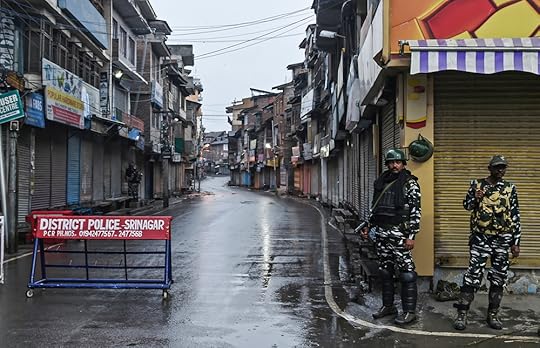
I enjoyed the premise, overall structure, and execution of this story. I believe it achieved what it intended: giving me a personal sense of what the day-to-day is could be in an occupied state like Kashmir. The reason this isn't a five star is that it's just a little bit too long. The portion between pages 150-200 dragged a bit I think because we spent too long on the deprogramming manifesto. Rather than progress the story it felt like just that: a manifesto in the middle of a fiction. The ending made up for it and pushed this up to from a 3-star to a 4. That kind of brutal, stark trust in the reader was missing from the middle of the book.
Overall then this is well worth the read. If you want more context for the book, Dinesh discusses her background and influences briefly here. Pass it on.
On an unrelated note, this was my first bookbox from SF's Green Apple Books Apple-a-month bookclub and I'm over-the-moon with their first selection as well as the witty slip that accompanied it. Check them out here.
This Place, That Place by Nandita Dinesh from Melville House is a book that explores how military oppression/occupation affects interpersonal relationships, especially when the members are of opposing groups but want to break out of that dynamic. Additionally, it is a book about isolation and how people have to adapt to overcome psychological distress during a government mandated curfew.
I don't think I have read a book like this before but it made me feel like when I read The Giver (though admittedly it has been a long time since I have read it). I thought the book was intimate, original, and effective in making me engage with the characters and their discussions. You do have to spend a bit of time thinking about who is speaking and when the conversations are taking place, but I think this was intentional and there is payoff in the end.
One of my favorite books of all time --- Read if you like: political fiction, introspection, dialogue heavy structure, study of interpersonal relationships Pass if you need: fast-paced plot, clearly defined characters and setting --- 1 star: I probably won't have one star ratings because I will DNF it and I only rate books I finish 2 star: I had a reason force myself to finish the book but I had issues with it. 3 star: Nothing wrong with being mid 4 star: Am glad to have read this book 5 star: I will greatly miss the characters/world this author created. I neglected responsibilities to read this book.
“…responses fuelled by unquestioned patriotism rather than a desire for an informed opinion?”
Hmmm… I know that description… Trumpers.
Occupation. Curfew. Propaganda. Us vs. Them. De-programming. This book is very, very interesting - and complex. "That Place" has occupied "This Place" and two young people exchange texts, dialogues, and ideas about what that all means for the two countries, and for themselves. It is also a book that is written in a multitude of styles that can be at times both engaging, and occasionally, confusing. I can't wait to have a friend read this so that we can really deconstruct it. Very thought provoking!
A young man from This Place and a young woman from That Place are stuck inside during a military curfew in an unnamed country. They share stories, argue, discuss survival during curfew, and she explains her work in deprogramming soldiers. They’re in love, but nobody from either place would understand or condone the relationship in this fascinating allegory about war, family, love, and living in a complex world.
I had to DNF this about 25% in. I found the formatting extremely confusing, and the lack of names for everyone even more so. Are there only two people, a man and a woman? Who are the emails to? Are the emails from the past? I was so confused that I couldn't even really pay attention to This Place / That Place in terms of analyzing oppression and colonization. Maybe something thoughtful for a book club, but too much concentration required for me.
this isn’t a book i ever would’ve picked up on my own, but i’m so glad i read it. it took the first hundred or so pages for me to get into it and have a semblance of understanding about the plot, but once i was in, i was in.
such a beautiful and aching and timely story — the style is definitely not for everyone, but i recommend giving it a try even if it doesn’t seem like your kind of thing.
More of a 3.5 star read for me, but mainly on the basis as this was very hard for me to read and get into. However, I can see myself rereading this in a few months and being able to appreciate this story more fully. It’s hard to appreciate such a strong, heavy story when you have heavy things going on in your every day. The story though is something I believe should be read by the masses, maybe we might gain empathy, kindness; hope for better humans.
A fascinating tale of occupation and love across cultures, borders, and militarized occupation. Honestly, kind of hard to read due to the fact that there are no chapters and absolutely no identifying information. But I loved that the vagueness of it allowed me to imagine several places/storylines at once.
Definitely a unique format for a book, which was the reason I picked it up and probably my favorite aspect of it. There were times when it got a little bit confusing or the format changed and I wasn’t sure why. My main knock is that I just found it boring in a lot of parts. It was really repetitive, down to specific phrases.
I have a lot of thoughts and none of them are fully formed. A beautiful book. A terrible book, in that the world in which it is set is terrible, and it makes you realize that world is our world too. One of the best books I've read in a moment. (Also if you know me and read this, let me know. We've got an unofficial book club going).
This took me over two years to finish because my tiny brain doesn't cope easily with change (layout slightly different to typical novels). Its upsetting but lovely and made me feel a lot more than I usually do reading, which I'm not sure I like! I want to dissociate!
This book had some interesting things to say about oppression that will leave you chewing on them for awhile. The formatting and lack of names for people/places created a fun puzzle. My only disappointment is that some of the characters were not as compelling as they could have been. The pacing of the book was definitely slow as well and there were some dry places. Overall a worthwhile read in spite of this
This is writing at its best – innovative, playful, and boundless, and Dinesh’s background in theatre really shines through (in the best way possible). As opposed to some of the other reviews on here, I absolutely LOVED the formatting of the novel. Mixing voices and media – dialogue, thoughts, films, emails, document comments, critiques – in this way makes for such intelligent and holistic storytelling.
The entire story is so well-paced and the curfew survival tactics invited introspection and slowing down, which wasn’t only the point, but also (for me, at least) very appreciated. I made my boyfriend read this book too, and after counting the rice he said he was too exhausted to do anything else than take a nap. Doesn’t that feel like the whole point? Sleep passes time; time which looses its rigid borders in a surprise lockdown. // Speaking of sleep, the night-part was my favorite; so visual (again – theatrical in the best sense). // Taking control of time and inviting for a pondering of the concept of time feels all-important in our fast-paced world. On that note, this books comes at an excellent time, with borders becoming ever-more apparent with travel bans due to COVID and with lockdowns all over the world happening so quickly, suddenly, and (often) with little transparency.
Of course, this is also a romantic story between a man and a woman, and a story of how borders — however trivial they may seem – hold the power to affect us/dictate our futures on this deeply personal level.
On a different note, I am sad to see previous reviews marking it as DNF – especially the review about the “F bombs”? I feel like that is missing the point. On the contrary, I feel like this is incredibly thoughtful writing, and it all felt very intentional. What do “F bombs” signify? Youth, frustration, and nihilism? How do they not fit into this story?
Lastly, bonus points for the normalization of women in places they are not usually in; deprogramming the military, as soldiers, as leaders. And for LGBTQ+ relationships being so undramatic, so normal, so subtle. Easily my best read of 2022 so far.