

What do you think?

La carte postale
La carte postale est arrivée dans notre boîte aux lettres au milieu des traditionnelles cartes de vœux. Elle n’était pas signée, l’auteur avait voulu rester anonyme. Il y avait l’opéra Garnier d’un côté, et de l’autre, les prénoms des grands-parents de ma mère, de sa tante et son oncle, morts à Auschwitz en 1942. Vingt ans plus tard, j’ai décidé de savoir qui nous avait envoyé cette carte postale, en explorant toutes les hypothèses qui s’ouvraient à moi.
J’ai retracé le destin romanesque des Rabinovitch, leur fuite de Russie, leur voyage en Lettonie puis en Palestine. Et enfin, leur arrivée à Paris, avec la guerre et son désastre.
J’ai retracé le destin romanesque des Rabinovitch, leur fuite de Russie, leur voyage en Lettonie puis en Palestine. Et enfin, leur arrivée à Paris, avec la guerre et son désastre.
576 pages, Mass Market Paperback
First published August 18, 2021
About the author
Anne Berest
14 books656 followersAnne Berest is the bestselling co-author of How to Be Parisian Wherever You Are (Doubleday, 2014) and the author of a novel based on the life of French writer Françoise Sagan. With her sister Claire, she is also the author of Gabriële, a critically acclaimed biography of her great-grandmother, Gabriële Buffet-Picabia, Marcel Duchamp’s lover and muse. She is the great-granddaughter of the painter Francis Picabia. For her work as a writer and prize-winning showrunner, she has been profiled in publications such as French Vogue and Haaretz newspaper. The recipient of numerous literary awards, The Postcard was a finalist for the Goncourt Prize and has been a long-selling bestseller in France.
Ratings & Reviews
Friends & Following
Create a free account to discover what your friends think of this book!
Community Reviews
Displaying 1 - 30 of 4,973 reviews

May 16, 2023
In January 2003, an unsigned postcard is delivered to the Berest home with a picture of the Opera Garnier in Paris addressed to the author’s late grandmother. Handwritten, on the back of the postcard were four names – Ephraïm, Emma, Jacques, and Noémie – the names of four members of the Rabinovitch family, all of whom lost their lives during the Holocaust at Auschwitz. Ephraïm and Emma were the parents of Anne’s grandmother Myriam who was the only member of the Rabinovitch family who survived the Holocaust. However, that traumatic era in family history was seldom discussed at the Berest home and though Anne and her mother were Jewish, faith did not play a significant role in Anne’s upbringing. In fact, after the postcard arrived, it was filed away without much thought given to it. This novel is inspired by the author’s investigation of her family’s history.
Fifteen years later, after an uncomfortable Passover gathering at a friend's home and an unfortunate incident with her six-year-old daughter at school, Anne begins to ponder over her family history and more importantly her identity as a Jew. She recalls the postcard with the names of her ancestors and decides to use that as a starting point for research realizing that by understanding her painful family history and the struggles her mother and grandmother endured will she be able to begin to understand her legacy and how it has impacted her life. What follows is an in-depth exploration of the history of the Rabinovich family spanning four generations from 1918-19 to the present day. Anne’s research begins with whatever information she can glean from her mother, existing documentation and her mother’s own research into Myriam’s family. Anne’s journey is one of looking backward in an effort to move forward.
“I found myself confronted with a latent contradiction. On one side, there was the utopia my parents described as a model society to be built, instilling in us, day after day, the idea that religion was an evil to be fought against. And on the other side, hidden away in some dark crevice of our family life, was the existence of a hidden identity, a mysterious heritage, a strange lineage that drew its raison d’être from the very heart of religion. We were all one big family, no matter the color of our skin or our country of origin; we were all connected to one another through our humanity. But, in the midst of this enlightened discourse, there was that word that kept returning, circling back like a dark star, like some bizarre constellation, surrounded by a halo of mystery. Jew.”
Meticulously researched, informative and insightful, thought-provoking and profoundly moving, The Postcard by Anne Berest (translated by Tina Kover from the original French) is the story of a family, the story of war-torn Europe, the Holocaust and the story of survival and generational trauma. The author also explores anti-Semitism both in the context of the Holocaust as well as in contemporary times. The narrative moves between past and present with the past timeline tracing the family history beginning in the pre-WWII years and how Ephraim and Emma moved their family from Russia to Latvia, with a few years in Palestine, and finally, France from where they were deported to Auschwitz, where they perished in 1942. The author vividly describes the oppression of Jews in Nazi-occupied France and the atrocities exacted upon the Jewish population per the dictates of the Nazi regime. Myriam’s story in the later years of the war gives us a glimpse into the Resistance movement in France and the post-war years after the liberation of the concentration camps. Much of what we learn of Myriam's later life is from memories shared by Lelia. The present-day timeline follows Anne and Lelia as they leave no stone unturned in trying to track down the identity of the person who sent the postcard. The author skillfully weaves the different timelines and characters into a gripping and well-paced narrative. Part –memoir, part historical fiction, this is an important book that I would not hesitate to recommend. A must-read for those who enjoy historical fiction with an element of mystery and appreciate stories inspired by true events.
Many thanks to Europa Editions and NetGalley for the digital review copy of this extraordinary novel. All opinions expressed in this review are my own.
“I see obstacles where others do not. I struggle endlessly to make a connection between the thought of my family and the mythologized occurrence that is genocide. And that struggle is what constitutes me. It is the thing that defines me. For almost forty years, I have tried to draw a shape that resembles me, but without success. Today, though, I can connect those disparate dots. I can see, in the constellation of fragments scattered over the page, a silhouette in which I recognize myself at last: I am the daughter, and the granddaughter, of survivors.”

May 12, 2023
The Postcard by Anne Berest
Translated by Tina Kover
Anne Berest has written a compelling book about her own relations who died during the Holocaust. In 2003, a postcard with four names arrives at the home of Anne and her parents. The four names on the postcard are Ephraïm and Emma, and their children, Noémie and Jacques, all of whom died at Auschwitz in 1942. It wasn't until she was pregnant ten years later that Anne sat down with her mother and learned the details of her family's history. Anne's mother had gathered all the information and documentation that she could about her own mother, Myriam, and how she became the only Holocaust survivor of her family.
Later, Anne and her mother dig even deeper to try to fill in gaps in what they knew about their family history. So much of history has been hidden, some of it in an effort to alleviate guilt, or to prevent more persecution, or because of indifference, or a myriad of other reasons. This book is listed under Biographical Fiction but much of it is documented and factual. The story of Anne's family is heartbreaking and just a tiny drop among all the cruelty and heartbreak of this place and time.
The way the book is written helped me to know and understand the choices of families like Anne's. With hindsight, knowing what is coming for them, literally coming to wipe them them off the face of the planet, I wanted to warn them but we can't change what has already happened. We learn the details of the persecution that started long before WWII. Anne's family and others had already lost so much before this time but would often still try to work within the confines of what they were allowed. It couldn't get any worse could it? There had to be a limit to the deprivation that would be inflicted on the Jewish people, surely! But no, it would get worse and the regrets pile on for not running sooner, before it was too late, of not knowing where to run, who to hide, who to trust, because there comes a time when you find out who your friends really are and the traitorous decisions of your neighbors can be the end of you.
More and more I'm appreciating books that stick closely to the facts. This book shows us the family in their everyday lives, their successes and their failures, and it's so hard to see the future marching towards them. I can understand why this would be hard to discuss by everyone, the survivors and those who came after them, the persecutors and those who came after them. I think the translator did an excellent job. I got a sense of place and time while still understanding the story as it's told.
Pub May 16, 2023
Thank you to Europa Editions and Edelweiss for this ARC.
Translated by Tina Kover
Anne Berest has written a compelling book about her own relations who died during the Holocaust. In 2003, a postcard with four names arrives at the home of Anne and her parents. The four names on the postcard are Ephraïm and Emma, and their children, Noémie and Jacques, all of whom died at Auschwitz in 1942. It wasn't until she was pregnant ten years later that Anne sat down with her mother and learned the details of her family's history. Anne's mother had gathered all the information and documentation that she could about her own mother, Myriam, and how she became the only Holocaust survivor of her family.
Later, Anne and her mother dig even deeper to try to fill in gaps in what they knew about their family history. So much of history has been hidden, some of it in an effort to alleviate guilt, or to prevent more persecution, or because of indifference, or a myriad of other reasons. This book is listed under Biographical Fiction but much of it is documented and factual. The story of Anne's family is heartbreaking and just a tiny drop among all the cruelty and heartbreak of this place and time.
The way the book is written helped me to know and understand the choices of families like Anne's. With hindsight, knowing what is coming for them, literally coming to wipe them them off the face of the planet, I wanted to warn them but we can't change what has already happened. We learn the details of the persecution that started long before WWII. Anne's family and others had already lost so much before this time but would often still try to work within the confines of what they were allowed. It couldn't get any worse could it? There had to be a limit to the deprivation that would be inflicted on the Jewish people, surely! But no, it would get worse and the regrets pile on for not running sooner, before it was too late, of not knowing where to run, who to hide, who to trust, because there comes a time when you find out who your friends really are and the traitorous decisions of your neighbors can be the end of you.
More and more I'm appreciating books that stick closely to the facts. This book shows us the family in their everyday lives, their successes and their failures, and it's so hard to see the future marching towards them. I can understand why this would be hard to discuss by everyone, the survivors and those who came after them, the persecutors and those who came after them. I think the translator did an excellent job. I got a sense of place and time while still understanding the story as it's told.
Pub May 16, 2023
Thank you to Europa Editions and Edelweiss for this ARC.

June 7, 2022
LA NOTTE ESCE LENTAMENTE DALLA TERRA

Immagini tratte da “The Auschwitz Album” dello Yad Vashem.
La fine è nota. È stata raccontata centinaia, migliaia di volte: la Soluzione Finale. I forni crematori. L’eliminazione di tutti gli ebrei, almeno quelli europei.
Ma Anne Berest è brava a raccontarla come se fosse la prima volta: l’ho sentita e risentita, letta e vista, eppure questa volta mi è sembrata materia nuova. La prima volta.
Ed è doppiamente brava perché nonostante la storia sia tragica, e nonostante lei la racconti attraverso ricordi personali, di famiglia, a lei prossimi e cari, si tiene lontana da qualsiasi tinta sottolineata, da qualsiasi retorica, e momento di lacrima assicurata, ed enfasi.

Il retro della carte postale che innesca il racconto.
Il 3 gennaio del 2003 a casa Berest arriva una cartolina. Senza mittente, anonima. Raffigura l’Opera Garnier. Il testo è composto da soli quattro nomi ed è indirizzato a Myriam, la mamma di Lélia, che è la mamma della scrittrice Berest e personaggio ricorrente in queste pagine.
I nomi sono quelli di suo padre e sua madre, Ephraïm ed Emma, di sua sorella e suo fratello, Noémie e Jacques.
E quindi il grado di parentela per Anne Berest si allunga di una generazione: nonno e nonna, zia e zio.
Ma perché quei nomi, proprio quei quattro, solo quei quattro nomi?
Di loro si sa che sono morti ad Auschwitz nel 1942. Che senso ha nominarli out-of-the-blue?
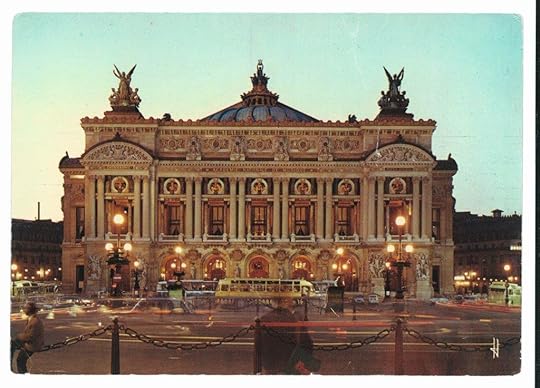
Sul fronte della cartolina: l’Opera Garnier, il primo monumento visitato a Parigi da Hitler nella sua prima visita da invasore, quello che più di tutti voleva ‘importare' (= imitare) a Berlino.
Più o meno la prima parte del libro è dedicata a ripercorrere la storia familiare: i Rabinovitch, ricchi ebrei russi scappati da Mosca su un carro nel 1919 - per quanto avessero abbracciato la Rivoluzione bolscevica, molto presto erano finiti nel numero di quelli da eliminare. Purghe interne al movimento rivoluzionario, aggravate dalla loro razza.
Dalla Russia la famiglia si divide per dirigersi in posti diversi e lontani: i capofamiglia emigrano in Palestina dove hanno comprato un aranceto da coltivare, il ramo che interessa questa storia si trasferisce a Riga; uno zio in Cecoslovacchia, il fratello più giovane a Parigi (a fare l’attore nei film di René Clair). La diaspora.
Negli anni venti e Trenta l’Europa diventa per gli ebrei un luogo sempre più pericoloso. Ma non tutti lo percepiscono alla stessa maniera: qualcuno, previdente, sceglie d’emigrare in America, altri rimangono. Stanchi di spostarsi, di ricominciare daccapo, decidono di restare (di resistere?).
Tra questi ultimi i quattro nomi riportati sulla cartolina. Destinati a finire ad Auschwitz (zia Noémie scriveva e voleva pubblicare: nel campo di prigionia segue a distanza di poco lo stesso percorso fisico di Iréne Nemirovsky, citata più volte).

Francis Picabia: Tre clown (1936). Vicente, figlio del pittore Picabia, sposa Myriam: dal loro matrimonio nasce Lélia, madre di Anne Berest.
Nel 2019 Anne Berest decide di scoprire chi ha mandato la cartolina. Sono passati sedici anni da quando è arrivata. La scintilla è un episodio successo a scuola a sua figlia di sei anni: un compagnetto le ha detto che la sua famiglia non ama gli ebrei.
E così inizia la seconda parte del libro. Chiamata appunto Libro Secondo.
Che si sviluppa come una classica inchiesta, in prima battuta consultando addirittura una prestigiosa agenzia d’investigazione, detective privati (“proprio come nei film di Truffaut”, esclama Anne), passando poi per un criminologo esperto di grafologia, per approdare al classico porta a porta: sul luogo del “misfatto”, la casa in campagna dove vivevano i Rabinovitch e nella quale furono arrestati nell’estate del 1942, una sera durante la cena prima i due figli minori (16 il maschio, 19 la femmina), e a breve distanza i genitori.
I due capofamiglia aspettavano l’arresto ed erano convinti che avrebbero riabbracciato i figli all’arrivo nel campo tedesco. Invece Jacques entra nel forno crematorio la sera stessa del suo arrivo. Noémi lo segue pochi giorni dopo.

Il puzzle familiare che Anne e sua madre Lélia compongono pezzo su pezzo.
Man mano, i libri, o le parti di questo libro aumentano, la storia si arricchisce, perché entra in gioco anche quella personale di Anne, oggi quarantenne: nelle sue ricerche per scoprire chi ha mandato la cartolina del titolo e perché lo ha fatto, Anne porta a galla ricordi che pensava d’aver cancellato: lei bambina a sei anni, le estati con la nonna Myriam – da lei sempre considerata francese al 100%, ignorando che fosse invece nata a Mosca e approdata in Francia solo intorno ai vent’anni – il secondo marito di lei, (Yves, personaggio importante), la Haute Provence e il Luberon (una regione che amo molto). Ogni volta sono sussulti per il lettore, iniezioni di interesse e partecipazione.
Berest non è cognome ebreo: Rabinovitch era quello del ceppo originale russo. Poi ci sono stati innesti: Myriam sposa il figlio del pittore Francis Picabia e diventa Myriam Picabia. In seconde nozze diventa Bouveris, il cognome indicato sulla cartolina. La quarantenne Anne Berest ha alle spalle un bel carico di storia familiare, ricca, intrecciata, girovaga, dolorosa, tragica.

Per me è l’ennesima conferma che le storie sono una manciata, o giù di lì: ma diventano sterminate e infinite in base al modo di raccontarle. Anne Berest ne sceglie uno originale, personale, coinvolgente, per ripercorrere la storia della Shoah. E cosa significhi essere ebrei.
Sono tua figlia, mamma. Mi hai insegnato tu a fare ricerche, a incrociare le informazioni, a far parlare ogni minimo pezzetto di carta. In un certo senso sto andando a fondo di un lavoro che ho imparato da te, non faccio altro che perpetrarlo.
Ho preso da te questa forza che mi spinge a ricostruire il passato.
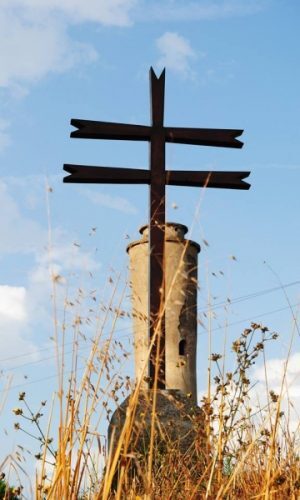
La croce di Lorena che, in contrapposizione alla svastica nazista, divenne il simbolo del movimento di resistenza Francia Libera. Questa si trova a Castel di Guido, nei pressi di Roma.
Immagini tratte da “The Auschwitz Album” dello Yad Vashem.
La fine è nota. È stata raccontata centinaia, migliaia di volte: la Soluzione Finale. I forni crematori. L’eliminazione di tutti gli ebrei, almeno quelli europei.
Ma Anne Berest è brava a raccontarla come se fosse la prima volta: l’ho sentita e risentita, letta e vista, eppure questa volta mi è sembrata materia nuova. La prima volta.
Ed è doppiamente brava perché nonostante la storia sia tragica, e nonostante lei la racconti attraverso ricordi personali, di famiglia, a lei prossimi e cari, si tiene lontana da qualsiasi tinta sottolineata, da qualsiasi retorica, e momento di lacrima assicurata, ed enfasi.
Il retro della carte postale che innesca il racconto.
Il 3 gennaio del 2003 a casa Berest arriva una cartolina. Senza mittente, anonima. Raffigura l’Opera Garnier. Il testo è composto da soli quattro nomi ed è indirizzato a Myriam, la mamma di Lélia, che è la mamma della scrittrice Berest e personaggio ricorrente in queste pagine.
I nomi sono quelli di suo padre e sua madre, Ephraïm ed Emma, di sua sorella e suo fratello, Noémie e Jacques.
E quindi il grado di parentela per Anne Berest si allunga di una generazione: nonno e nonna, zia e zio.
Ma perché quei nomi, proprio quei quattro, solo quei quattro nomi?
Di loro si sa che sono morti ad Auschwitz nel 1942. Che senso ha nominarli out-of-the-blue?
Sul fronte della cartolina: l’Opera Garnier, il primo monumento visitato a Parigi da Hitler nella sua prima visita da invasore, quello che più di tutti voleva ‘importare' (= imitare) a Berlino.
Più o meno la prima parte del libro è dedicata a ripercorrere la storia familiare: i Rabinovitch, ricchi ebrei russi scappati da Mosca su un carro nel 1919 - per quanto avessero abbracciato la Rivoluzione bolscevica, molto presto erano finiti nel numero di quelli da eliminare. Purghe interne al movimento rivoluzionario, aggravate dalla loro razza.
Dalla Russia la famiglia si divide per dirigersi in posti diversi e lontani: i capofamiglia emigrano in Palestina dove hanno comprato un aranceto da coltivare, il ramo che interessa questa storia si trasferisce a Riga; uno zio in Cecoslovacchia, il fratello più giovane a Parigi (a fare l’attore nei film di René Clair). La diaspora.
Negli anni venti e Trenta l’Europa diventa per gli ebrei un luogo sempre più pericoloso. Ma non tutti lo percepiscono alla stessa maniera: qualcuno, previdente, sceglie d’emigrare in America, altri rimangono. Stanchi di spostarsi, di ricominciare daccapo, decidono di restare (di resistere?).
Tra questi ultimi i quattro nomi riportati sulla cartolina. Destinati a finire ad Auschwitz (zia Noémie scriveva e voleva pubblicare: nel campo di prigionia segue a distanza di poco lo stesso percorso fisico di Iréne Nemirovsky, citata più volte).
Francis Picabia: Tre clown (1936). Vicente, figlio del pittore Picabia, sposa Myriam: dal loro matrimonio nasce Lélia, madre di Anne Berest.
Nel 2019 Anne Berest decide di scoprire chi ha mandato la cartolina. Sono passati sedici anni da quando è arrivata. La scintilla è un episodio successo a scuola a sua figlia di sei anni: un compagnetto le ha detto che la sua famiglia non ama gli ebrei.
E così inizia la seconda parte del libro. Chiamata appunto Libro Secondo.
Che si sviluppa come una classica inchiesta, in prima battuta consultando addirittura una prestigiosa agenzia d’investigazione, detective privati (“proprio come nei film di Truffaut”, esclama Anne), passando poi per un criminologo esperto di grafologia, per approdare al classico porta a porta: sul luogo del “misfatto”, la casa in campagna dove vivevano i Rabinovitch e nella quale furono arrestati nell’estate del 1942, una sera durante la cena prima i due figli minori (16 il maschio, 19 la femmina), e a breve distanza i genitori.
I due capofamiglia aspettavano l’arresto ed erano convinti che avrebbero riabbracciato i figli all’arrivo nel campo tedesco. Invece Jacques entra nel forno crematorio la sera stessa del suo arrivo. Noémi lo segue pochi giorni dopo.
Il puzzle familiare che Anne e sua madre Lélia compongono pezzo su pezzo.
Man mano, i libri, o le parti di questo libro aumentano, la storia si arricchisce, perché entra in gioco anche quella personale di Anne, oggi quarantenne: nelle sue ricerche per scoprire chi ha mandato la cartolina del titolo e perché lo ha fatto, Anne porta a galla ricordi che pensava d’aver cancellato: lei bambina a sei anni, le estati con la nonna Myriam – da lei sempre considerata francese al 100%, ignorando che fosse invece nata a Mosca e approdata in Francia solo intorno ai vent’anni – il secondo marito di lei, (Yves, personaggio importante), la Haute Provence e il Luberon (una regione che amo molto). Ogni volta sono sussulti per il lettore, iniezioni di interesse e partecipazione.
Berest non è cognome ebreo: Rabinovitch era quello del ceppo originale russo. Poi ci sono stati innesti: Myriam sposa il figlio del pittore Francis Picabia e diventa Myriam Picabia. In seconde nozze diventa Bouveris, il cognome indicato sulla cartolina. La quarantenne Anne Berest ha alle spalle un bel carico di storia familiare, ricca, intrecciata, girovaga, dolorosa, tragica.
Per me è l’ennesima conferma che le storie sono una manciata, o giù di lì: ma diventano sterminate e infinite in base al modo di raccontarle. Anne Berest ne sceglie uno originale, personale, coinvolgente, per ripercorrere la storia della Shoah. E cosa significhi essere ebrei.
Sono tua figlia, mamma. Mi hai insegnato tu a fare ricerche, a incrociare le informazioni, a far parlare ogni minimo pezzetto di carta. In un certo senso sto andando a fondo di un lavoro che ho imparato da te, non faccio altro che perpetrarlo.
Ho preso da te questa forza che mi spinge a ricostruire il passato.
La croce di Lorena che, in contrapposizione alla svastica nazista, divenne il simbolo del movimento di resistenza Francia Libera. Questa si trova a Castel di Guido, nei pressi di Roma.

October 27, 2022
Una novela que emociona e impresiona a partes iguales.
Está construida en torno a una historia real. La investigación de Anne Berest sobre su familia materna exterminada durante el Holocausto. Ha sido premiada con el Premio Renaudot des lycéens 2021, el Premio Goncourt: la elección de los Estados Unidos 2021 y el Gran Premio de la novela Elle. Premios, todos ellos, muy merecidos.
Fue en enero de 2003. En el buzón de la casa familiar apareció una extraña postal sin firma: en el anverso, la Ópera Garnier, y en el reverso, cuatro nombres, los de los bisabuelos maternos de Anne Berest —Ephraïm y Emma—, y los hijos de estos —Noémie y Jacques—, todos ellos fallecidos en Auschwitz en 1942. ¿Quién envió la tarjeta y con qué siniestra intención? Veinte años después, la autora decide averiguarlo y remontarse un siglo atrás para reconstruir el periplo vital de los Rabinovitch: su huida de Rusia, su viaje a Letonia, Palestina y París, y luego la guerra. Una investigación exhaustiva y apasionante, para la cual cuenta con la ayuda de su madre, un detective privado y un grafólogo, y que la llevará a interrogar a los habitantes del pueblo donde sus parientes fueron detenidos, a buscar indicios en los libros y a ahondar en la vida de la única superviviente de la saga: su abuela Myriam.
Mis impresiones.
Como nos dice la sinopsis, en el 2003, la madre de Anne Berest, Lélia, recibe una postal con cuatro nombres en el reverso, Ephraïm, Emma, Noémie y Jacques. Son los nombres de los abuelos de Lélia y dos de sus hijos. Los cuatro fallecieron en Auschwitz en 1942 por su condición de judíos. Diez años después, Anne, a punto de ser madre, decide investigar tanto la historia de su familia como quién pudo enviar la postal. Una investigación que la llevará a reconstruir la vida de la familia Rabinovitch desde principios del siglo XX.
Estrictamente hablando, no es un libro sobre la Segunda Guerra Mundial. Es la historia de una familia marcada por sus orígenes. De Rusia a Francia, pasando por Lituania, Polonia y Palestina. Judíos apátridas, siempre perseguidos por ser lo que son. Ephraïm no es un hombre religioso. La educación que les proporciona a sus hijos es de tipo laico, encaminada a la asimilación del país, Francia, en el que finalmente se asientan. Sin embargo, los prejuicios hacia su raza, latentes en todos los países por los que pasan, determinarán sus vidas.
La novela se estructura en cuatro partes. Muy bien desarrollada, compagina historia, misterio e investigación. En este empeño de Anne por conocer la vida de sus cuatro familiares, contará con la ayuda de su madre. Lélia, recopiló durante muchos años, documentos extraídos de archivos, cartas, libros, publicaciones, testimonios, conversaciones, etc, que le permitieron reconstruir de manera bastante fidedigna, las vidas de sus abuelos, su madre Myriam (única superviviente), y sus dos tíos. En la primera parte de la novela "Tierras prometidas", Lélia le cuenta a Anne todo lo que ella pudo averiguar. A partir de ahí, madre e hija, rellenarán juntas los huecos en la historia e intentarán dar respuesta al último interrogante ¿quién envió la postal y por qué?
Los personajes de la novela son reales. Toda una rama familiar exterminada. La familia de Emma en Polonia, los hermanos de Ephraïm y el destino de sus tres hijos. Tremendo el conocer los anhelos de Noémie y Jacques, sus vidas truncadas. Igualmente tremendo lo que le toca vivir a Myriam, la hija que sobrevive, marcada emocionalmente de por vida. Lo silencios de Myriam, la distancia que establece entre ella y sus seres queridos hablan por sí solos.
Resaltar, finalmente, las reflexiones y emociones que suscitan la lectura de este libro. Imposible citarlas todas. Me quedo con los tres aspectos que más me han impresionado.
El primero, la condición de apátridas de la familia Rabinovitch, como la de tantos y tantos judíos durante el siglo XX. Las reticencias de las sociedades occidentales a concederles la nacionalidad, así como lo que significa ser judío en la actualidad. Clara, la hija de Anne, escucha en el colegio las mismas frases que antes escucharan, Anne y Lélia. Así mismo esclarecedor el testimonio de George. Da qué pensar.
El segundo, la duplicidad del gobierno y de buena parte del pueblo francés hacia el exterminio de los judíos que vivían en su territorio. Si malo fue lo ocurrido durante la ocupación, peor aún, querer barrerlo debajo de la alfombra tras la liberación.
Por último, la vuelta de los supervivientes acogidos en el Hotel Lutetia. Uno de los pasajes más duros de la novela, de los que te oprimen el corazón y hace que se te salte alguna lágrima. La displicencia de los comentarios de algunos ciudadanos y periódicos franceses ante las condiciones en las que esta pobre gente volvía, me revolvió el estómago.
En conclusión. Una novela que es al mismo tiempo reconstrucción y testimonio. Bien escrita, muy dura y de las que llegan al corazón. Recomendable.
Está construida en torno a una historia real. La investigación de Anne Berest sobre su familia materna exterminada durante el Holocausto. Ha sido premiada con el Premio Renaudot des lycéens 2021, el Premio Goncourt: la elección de los Estados Unidos 2021 y el Gran Premio de la novela Elle. Premios, todos ellos, muy merecidos.
Fue en enero de 2003. En el buzón de la casa familiar apareció una extraña postal sin firma: en el anverso, la Ópera Garnier, y en el reverso, cuatro nombres, los de los bisabuelos maternos de Anne Berest —Ephraïm y Emma—, y los hijos de estos —Noémie y Jacques—, todos ellos fallecidos en Auschwitz en 1942. ¿Quién envió la tarjeta y con qué siniestra intención? Veinte años después, la autora decide averiguarlo y remontarse un siglo atrás para reconstruir el periplo vital de los Rabinovitch: su huida de Rusia, su viaje a Letonia, Palestina y París, y luego la guerra. Una investigación exhaustiva y apasionante, para la cual cuenta con la ayuda de su madre, un detective privado y un grafólogo, y que la llevará a interrogar a los habitantes del pueblo donde sus parientes fueron detenidos, a buscar indicios en los libros y a ahondar en la vida de la única superviviente de la saga: su abuela Myriam.
Mis impresiones.
Como nos dice la sinopsis, en el 2003, la madre de Anne Berest, Lélia, recibe una postal con cuatro nombres en el reverso, Ephraïm, Emma, Noémie y Jacques. Son los nombres de los abuelos de Lélia y dos de sus hijos. Los cuatro fallecieron en Auschwitz en 1942 por su condición de judíos. Diez años después, Anne, a punto de ser madre, decide investigar tanto la historia de su familia como quién pudo enviar la postal. Una investigación que la llevará a reconstruir la vida de la familia Rabinovitch desde principios del siglo XX.
Estrictamente hablando, no es un libro sobre la Segunda Guerra Mundial. Es la historia de una familia marcada por sus orígenes. De Rusia a Francia, pasando por Lituania, Polonia y Palestina. Judíos apátridas, siempre perseguidos por ser lo que son. Ephraïm no es un hombre religioso. La educación que les proporciona a sus hijos es de tipo laico, encaminada a la asimilación del país, Francia, en el que finalmente se asientan. Sin embargo, los prejuicios hacia su raza, latentes en todos los países por los que pasan, determinarán sus vidas.
La novela se estructura en cuatro partes. Muy bien desarrollada, compagina historia, misterio e investigación. En este empeño de Anne por conocer la vida de sus cuatro familiares, contará con la ayuda de su madre. Lélia, recopiló durante muchos años, documentos extraídos de archivos, cartas, libros, publicaciones, testimonios, conversaciones, etc, que le permitieron reconstruir de manera bastante fidedigna, las vidas de sus abuelos, su madre Myriam (única superviviente), y sus dos tíos. En la primera parte de la novela "Tierras prometidas", Lélia le cuenta a Anne todo lo que ella pudo averiguar. A partir de ahí, madre e hija, rellenarán juntas los huecos en la historia e intentarán dar respuesta al último interrogante ¿quién envió la postal y por qué?
Los personajes de la novela son reales. Toda una rama familiar exterminada. La familia de Emma en Polonia, los hermanos de Ephraïm y el destino de sus tres hijos. Tremendo el conocer los anhelos de Noémie y Jacques, sus vidas truncadas. Igualmente tremendo lo que le toca vivir a Myriam, la hija que sobrevive, marcada emocionalmente de por vida. Lo silencios de Myriam, la distancia que establece entre ella y sus seres queridos hablan por sí solos.
Resaltar, finalmente, las reflexiones y emociones que suscitan la lectura de este libro. Imposible citarlas todas. Me quedo con los tres aspectos que más me han impresionado.
El primero, la condición de apátridas de la familia Rabinovitch, como la de tantos y tantos judíos durante el siglo XX. Las reticencias de las sociedades occidentales a concederles la nacionalidad, así como lo que significa ser judío en la actualidad. Clara, la hija de Anne, escucha en el colegio las mismas frases que antes escucharan, Anne y Lélia. Así mismo esclarecedor el testimonio de George. Da qué pensar.
El segundo, la duplicidad del gobierno y de buena parte del pueblo francés hacia el exterminio de los judíos que vivían en su territorio. Si malo fue lo ocurrido durante la ocupación, peor aún, querer barrerlo debajo de la alfombra tras la liberación.
Por último, la vuelta de los supervivientes acogidos en el Hotel Lutetia. Uno de los pasajes más duros de la novela, de los que te oprimen el corazón y hace que se te salte alguna lágrima. La displicencia de los comentarios de algunos ciudadanos y periódicos franceses ante las condiciones en las que esta pobre gente volvía, me revolvió el estómago.
En conclusión. Una novela que es al mismo tiempo reconstrucción y testimonio. Bien escrita, muy dura y de las que llegan al corazón. Recomendable.

January 25, 2023
Wow!! I’ll review sometime soon — going back to sleep — I was a crying sobbing mess towards the end — wasn’t expecting to feel so emotional—
WONDERFUL BOOK!!!! Intimate- sad - gripping storytelling- sooooo very heartfelt!!!
REVIEW:
“The Postcard” is deeply intimate and personal…..
……historical….and autobiographical….
…..investigating an anonymous unsigned postcard….[Leila Picabia, Anne Berest’s mother, received a mysterious postcard in 2003 at her Paris home with four first names of her ancestors, Ephraim, Emma, Noemie, and Jacques—all of whom died at Auschwitz in 1942: on the front of the postcard was a photo of the Opera Garnier in Paris]…..
…..But it also chronicles everything that makes us human. It’s a portrait of society, history, (traumas from the Holocaust), geography, (Russia, Poland, France, United States, Nazi-occupied Europe, pre-state Israel),
injustice, (anti-Semitism),identity, life and death…..and it’s love in all the forms.
The first book that left a sizable awakening for me about the role France played in ‘rounding-up’ Jews in German-occupied Paris in 1942 ….and the participation of bureaucracy in Vichy France ….
was “Sarah’s Key”, by Tatiana de Rosnay….
I don’t recall reading ‘another’ book that so clearly exhibits evidence of crimes against humanity—the French Police rallied with the Nazi German military rounding up Jews to be delivered to the death camps. ….
until now: after reading “The Postcard”.
Anne Berest is a remarkable writer….. she did a marvelous job putting us, the reader, smack into the story itself; we get emotionally close to the characters, the pure brutality of the history of war, and the fascination about the mystery of that postcard…. secrets are revealed…..(revelations that made me cry), and a serious look at antisemitism from in the past and how antisemitism still was relevant in Anne’s present life…..
MAKING THIS STORY VERY PERSONAL for Anne.
……NOTE…..unfortunately — Anti-Semitism is on the rise today. MAKING THIS STORY VERY PERSONAL TO ME TOO.
…..and honest to God …..page turning storytelling with whodunnit perplexities.
After it was clear that the Rabinovitch family needed to leave Russia — following the revolution — Nachman and his wife Esther Rabinovitch moved to Palestine…..and became Zionist.
They bought a piece of land near Haifa where they planned to grow oranges. He offered to buy land for all of his adult kids and grandchildren to have them all live close by. ……
First born son, Ephraim and his wife Emma (expecting their first baby) were not happy ‘living-off-the-land’ in Palestine—desert- dust living just wasn’t what Ephraim — or Esther wanted. (Five years was enough. They missed the city life in Europe).
So Ephraim, Esther and their children left for Paris. Ephraim would arrive in Paris with this new bread baking machine invention…and his big dreams of business success. Esther planned to teach piano lessons. By this time they had three children: Myriam, Noemie, and Jacques.
Ephriam’s brother, Emmanuel was already living in France having some success with acting.
Ephriam’s bread business didn’t manifest — but he got a job working for an engineering firm…a promising start for a man who wanted to establish himself in the business world of France.
Emma did teach piano — and their kids (Myriam and Noemie went to a prestigious school where they had to commute on the metro each day) Jacques, the youngest wasn’t in school - yet.
But months and years passed — everyone was getting older —
By the time Jacques was ten years of age — now definitely in school — he came home crying one day because of something one of his classmates had said to him in the yard. “Pull the ear of one Jew, and they all have trouble hearing”….
This disturbing classmate type comment won’t be the last —
years later, Anne’s six year old daughter, had a similar type school-yard experience.
Concerns of anti-semitism were an issue.
We will learn why Anne had a strong pull to learn more about the postcard that her mother, Leila had received years ago - tucking it way. We will learn more about the string that ties three generations of mothers together: Anne (whom this story most belongs to), her chain-smoking mother, Leila…and her grandmother, Myriam.
Anne’s determination to find out who the hell sent that postcard is tied to herself: her own identity….and the need to understand her family history.
Leila’s mother, Myriam (Anne’s grandmother), died in Moscow on August 7, 1919…. according to the papers issued by the refugee office in Paris.
There is sooo much pack in this book — based on a true story with some fiction added. It’s easy to read - easy to follow — simply outstanding….
Emotions ARE INVOLVED.
We follow Anne through her childhood- her teen years - clearly not an observant Jew - to a dire need to come to terms with her past - a need to know more about her ancestors and how she was very deeply psychologically connected.
Being Jewish —born Jewish — brings up many thoughts between being non-observant and observant Jews: shame, righteousness, feelings of being left out, wanting to belong, but religiously apprehensive….
There is a dinner scene (Pesach) that will make readers stomach ache….about what a ‘good’ Jew should be. I wanted to throw spitballs a one of the ladies.
As a Jew myself — I can clearly relate to comments from other more orthodox Jews about me being a reform Jew (I’m not very active in synagogue life today as years ago, but I’m still a member and participate occasionally)—I have felt a range of judgments throughout the years —am I Jewish enough? Why do any of us need to justify who we are - our beliefs- our education- or lack of - our lifestyle choices, etc. to anyone? …..
Anne did an excellent job examining these Jewish - enough - issues.
Frankly …. ha…. most of my Jewish friends happen to be a little like me —none of us are super religious — we just happen to be Jewish and feel a bond together…
Maybe it’s because of our common family histories—through the trauma from the Holocaust….
Maybe because we have felt antisemitism in our lives at one time or another…
Maybe it’s the Jewish foods — comforting matzo ball soup—crispy - potato latkes … or the recognizable stereotypes….and or the in-house jokes ….
I have no idea!!!!!!…..
…..but I will admit to absolutely loving my Jewish friends. As far as I know none of ‘my’ Jewish friends (observant or not) is testing anyone on how much Hebrew is remembered from our Bar and Bat Mitzvah’s, — or had one at all — or care one way or another if we take part in Halftarah readings…early morning Shabbat services or any Jewish festivals.
Although — most Jews I know — most non Jews I know —- NONE OF US ARE A FANS OF ANTI-SEMITISM.
THIS BOOK …. the stories, the history, the memories, the themes, the characters, the mystery, the diligent investigation….it’s a magnificent reading experience.
In two days, Jan 27th, is the International Holocaust Remembrance Day….an annual day of commemoration…. in honor of the six million Jewish victims.
It’s no accident I read this book — this month. I’m thankful — I loved it. Anne Berest deserved - deserves - every award for this book — its a wonderful-powerful book “A favorite to remember”.
One last comment — sometime around last year and the year before I thought I was done, or a little burnt out from reading any book related to the Holocaust. As I’ve read hundreds. But this book is ‘really-really’ special (not a boring aspect about it) —and in fact — it only makes me want to read Holocaust-family stories - more again.
The publishing date for “The Postcard” is May 16, 2003. Highly recommended!
Thank you Europa Editions and Netgalley for an early copy.
P.S.
I already left several excerpts on Goodreads - while reading this — but here is one more:
“But Maman, don’t forget that you suffer, because of those silences of hers. And not just her silences—the feeling that she was shutting you out of a story that didn’t involve you”.
“I understand that what I’m finding out it’s overwhelming for you”.
“But Maman, this is my story too. And sometimes, almost like Myriam, you treat me like a foreigner in the land of your past. You were born into a world of silences. It’s only natural that your children would be thirsty for words”.
WONDERFUL BOOK!!!! Intimate- sad - gripping storytelling- sooooo very heartfelt!!!
REVIEW:
“The Postcard” is deeply intimate and personal…..
……historical….and autobiographical….
…..investigating an anonymous unsigned postcard….[Leila Picabia, Anne Berest’s mother, received a mysterious postcard in 2003 at her Paris home with four first names of her ancestors, Ephraim, Emma, Noemie, and Jacques—all of whom died at Auschwitz in 1942: on the front of the postcard was a photo of the Opera Garnier in Paris]…..
…..But it also chronicles everything that makes us human. It’s a portrait of society, history, (traumas from the Holocaust), geography, (Russia, Poland, France, United States, Nazi-occupied Europe, pre-state Israel),
injustice, (anti-Semitism),identity, life and death…..and it’s love in all the forms.
The first book that left a sizable awakening for me about the role France played in ‘rounding-up’ Jews in German-occupied Paris in 1942 ….and the participation of bureaucracy in Vichy France ….
was “Sarah’s Key”, by Tatiana de Rosnay….
I don’t recall reading ‘another’ book that so clearly exhibits evidence of crimes against humanity—the French Police rallied with the Nazi German military rounding up Jews to be delivered to the death camps. ….
until now: after reading “The Postcard”.
Anne Berest is a remarkable writer….. she did a marvelous job putting us, the reader, smack into the story itself; we get emotionally close to the characters, the pure brutality of the history of war, and the fascination about the mystery of that postcard…. secrets are revealed…..(revelations that made me cry), and a serious look at antisemitism from in the past and how antisemitism still was relevant in Anne’s present life…..
MAKING THIS STORY VERY PERSONAL for Anne.
……NOTE…..unfortunately — Anti-Semitism is on the rise today. MAKING THIS STORY VERY PERSONAL TO ME TOO.
…..and honest to God …..page turning storytelling with whodunnit perplexities.
After it was clear that the Rabinovitch family needed to leave Russia — following the revolution — Nachman and his wife Esther Rabinovitch moved to Palestine…..and became Zionist.
They bought a piece of land near Haifa where they planned to grow oranges. He offered to buy land for all of his adult kids and grandchildren to have them all live close by. ……
First born son, Ephraim and his wife Emma (expecting their first baby) were not happy ‘living-off-the-land’ in Palestine—desert- dust living just wasn’t what Ephraim — or Esther wanted. (Five years was enough. They missed the city life in Europe).
So Ephraim, Esther and their children left for Paris. Ephraim would arrive in Paris with this new bread baking machine invention…and his big dreams of business success. Esther planned to teach piano lessons. By this time they had three children: Myriam, Noemie, and Jacques.
Ephriam’s brother, Emmanuel was already living in France having some success with acting.
Ephriam’s bread business didn’t manifest — but he got a job working for an engineering firm…a promising start for a man who wanted to establish himself in the business world of France.
Emma did teach piano — and their kids (Myriam and Noemie went to a prestigious school where they had to commute on the metro each day) Jacques, the youngest wasn’t in school - yet.
But months and years passed — everyone was getting older —
By the time Jacques was ten years of age — now definitely in school — he came home crying one day because of something one of his classmates had said to him in the yard. “Pull the ear of one Jew, and they all have trouble hearing”….
This disturbing classmate type comment won’t be the last —
years later, Anne’s six year old daughter, had a similar type school-yard experience.
Concerns of anti-semitism were an issue.
We will learn why Anne had a strong pull to learn more about the postcard that her mother, Leila had received years ago - tucking it way. We will learn more about the string that ties three generations of mothers together: Anne (whom this story most belongs to), her chain-smoking mother, Leila…and her grandmother, Myriam.
Anne’s determination to find out who the hell sent that postcard is tied to herself: her own identity….and the need to understand her family history.
Leila’s mother, Myriam (Anne’s grandmother), died in Moscow on August 7, 1919…. according to the papers issued by the refugee office in Paris.
There is sooo much pack in this book — based on a true story with some fiction added. It’s easy to read - easy to follow — simply outstanding….
Emotions ARE INVOLVED.
We follow Anne through her childhood- her teen years - clearly not an observant Jew - to a dire need to come to terms with her past - a need to know more about her ancestors and how she was very deeply psychologically connected.
Being Jewish —born Jewish — brings up many thoughts between being non-observant and observant Jews: shame, righteousness, feelings of being left out, wanting to belong, but religiously apprehensive….
There is a dinner scene (Pesach) that will make readers stomach ache….about what a ‘good’ Jew should be. I wanted to throw spitballs a one of the ladies.
As a Jew myself — I can clearly relate to comments from other more orthodox Jews about me being a reform Jew (I’m not very active in synagogue life today as years ago, but I’m still a member and participate occasionally)—I have felt a range of judgments throughout the years —am I Jewish enough? Why do any of us need to justify who we are - our beliefs- our education- or lack of - our lifestyle choices, etc. to anyone? …..
Anne did an excellent job examining these Jewish - enough - issues.
Frankly …. ha…. most of my Jewish friends happen to be a little like me —none of us are super religious — we just happen to be Jewish and feel a bond together…
Maybe it’s because of our common family histories—through the trauma from the Holocaust….
Maybe because we have felt antisemitism in our lives at one time or another…
Maybe it’s the Jewish foods — comforting matzo ball soup—crispy - potato latkes … or the recognizable stereotypes….and or the in-house jokes ….
I have no idea!!!!!!…..
…..but I will admit to absolutely loving my Jewish friends. As far as I know none of ‘my’ Jewish friends (observant or not) is testing anyone on how much Hebrew is remembered from our Bar and Bat Mitzvah’s, — or had one at all — or care one way or another if we take part in Halftarah readings…early morning Shabbat services or any Jewish festivals.
Although — most Jews I know — most non Jews I know —- NONE OF US ARE A FANS OF ANTI-SEMITISM.
THIS BOOK …. the stories, the history, the memories, the themes, the characters, the mystery, the diligent investigation….it’s a magnificent reading experience.
In two days, Jan 27th, is the International Holocaust Remembrance Day….an annual day of commemoration…. in honor of the six million Jewish victims.
It’s no accident I read this book — this month. I’m thankful — I loved it. Anne Berest deserved - deserves - every award for this book — its a wonderful-powerful book “A favorite to remember”.
One last comment — sometime around last year and the year before I thought I was done, or a little burnt out from reading any book related to the Holocaust. As I’ve read hundreds. But this book is ‘really-really’ special (not a boring aspect about it) —and in fact — it only makes me want to read Holocaust-family stories - more again.
The publishing date for “The Postcard” is May 16, 2003. Highly recommended!
Thank you Europa Editions and Netgalley for an early copy.
P.S.
I already left several excerpts on Goodreads - while reading this — but here is one more:
“But Maman, don’t forget that you suffer, because of those silences of hers. And not just her silences—the feeling that she was shutting you out of a story that didn’t involve you”.
“I understand that what I’m finding out it’s overwhelming for you”.
“But Maman, this is my story too. And sometimes, almost like Myriam, you treat me like a foreigner in the land of your past. You were born into a world of silences. It’s only natural that your children would be thirsty for words”.

May 15, 2023
The Postcard by Anne Berest was written with love, curiosity, determination, strength, and for the main purpose of discovery. Anne Berest’s novel was based on the true story of her own family. It was one of the most moving and powerful books I have read about the Holocaust in a very long time. The writing was painfully honest and yet exquisite. The Postcard was divided into four parts and alternated between narratives that seamlessly wove the past and present together. Included were authentic reactions and commentary from ordinary citizens of Paris in reference to their reactions when they came face to face with the “deportees” as they returned to Paris after the camps were liberated. Never in all the books that I have read about the Holocaust have I read such brutally raw and frank comments expressed. It was so obvious that the atrocities that the Nazis inflicted upon the “deportees “ were not known or acknowledged until that point. The scene of a young child being reunited with her mother, a “surviving deportee” was heart wrenching. So many scenes like these were included and broke my heart.
Although Anne was the granddaughter of a Holocaust survivor, her grandmother’s story was never revealed to her or to Anne’s mother, Lelia. Anne’s grandmother, Myriam, carried too much guilt about her own survival to share any details about her life and the family she lost at the hands of the French authorities and the Nazis with anyone. So many aspects of Myriam’s life remained a complete mystery to her family. Myriam kept them bottled deep inside her. When Myriam died, Anne’s mother, Lelia, archived all the pictures and scraps of information she could find about Myriam’s life. Lelia conducted her own research about these family members and when Anne was near the end of her pregnancy and required bed rest she invited Anne to her home on the pretext of taking care of her. It was at that time that Anne learned about the fates of her great grandfather Ephriam, great grandmother Emma, aunt Noemie, and uncle Jacques Rabinovitch. They had all perished at Auschwitz in 1942. Anne had never known about these family members. Gaining this knowledge, triggered a memory in Anne’s mind.
Back in January of 2003, Anne’s family retrieved their mail from there far from new mailbox one day. As the family sat together at the table that day, one piece of mail stood out among all the rest. It was a postcard. On the front of the postcard was a picture of the Opera Garnier in Paris and on the back printed in a very distinctive style of handwriting were four names printed one under the other. The names were Ephriam, Emma, Noemie and Jacques. Perhaps one of the most puzzling things about the postcard was that it was not signed by anyone. Who could have sent this postcard to their family and why? Anne’s mother put the postcard away and no one thought about it for years.
After hearing about the lives and fates of her great grandparents, aunt and uncle, an old memory awoke in Anne. She remembered the postcard and was determined to find out who had sent it to her family and why. It was now 2019 and fifteen years had passed since the postcard had been delivered to them. Anne recruited help from her mother, other family members, friends, a private investigator, a graphologist and others to aid her search. She traveled and visited places where her family members had resided by herself and with their mother. Anne was determined to discover who sent that ominous postcard but also was determined to uncover the fate of her family members during World War II and the Holocaust as they made their way from Russia to Latvia, to Palestine, to Paris.
Anne also explored her “Jewishness “ throughout The Postcard and the rise of antisemitism reawakening right before her eyes. Although Anne was Jewish by birth, her family had never been religious or had they observed Jewish holidays. For all her life, she was more secular than religious. As a granddaughter of a Holocaust survivor, religion was not a priority in her life. It wasn’t until Anne was invited to a Passover Seder by the man she was dating that she realized how little she knew about being Jewish. At that time she was both embarrassed and ashamed at her lack of familiarity with the customs and holidays of the Jewish people. Upon further reflection, Anne decided to admit her family’s history to the man she cared deeply about. Once he understood her upbringing and the reasons behind it there was a new feeling of respect between them. As for antisemitism, her young daughter experienced those issues on the playground one day while attending public school. Anne’s young daughter was wise beyond her years. Through a pointed conversation with the person who conveyed those feelings to her daughter, the misunderstanding was remedied. Anne did bring it to the attention of her daughter’s school as well.
The Postcard by Anne Berest was an historical investigation that brought closure and clarity to one family. It was a sweeping family saga and brought with it the guilt and shame survivors of the Holocaust experienced. Vividly portrayed in The Postcard was also the active participation and antisemitism that the Vichy government openly displayed toward the Jews that lived in France during and after WWII. The Postcard was an impressive undertaking. It was captivating and so important. In my opinion, it is an essential read for all. It was about family, memories, loss, guilt, survival, hope, loyalty, love, identity and home. The ending was fitting and hopeful. I cannot recommend this book enough. Publication was May 16, 2023.
Thank you to Europa Editions for allowing me to read The Postcard by Anne Berest through Netgalley in exchange for an honest review. All opinions expressed in this review are completely my own.
Although Anne was the granddaughter of a Holocaust survivor, her grandmother’s story was never revealed to her or to Anne’s mother, Lelia. Anne’s grandmother, Myriam, carried too much guilt about her own survival to share any details about her life and the family she lost at the hands of the French authorities and the Nazis with anyone. So many aspects of Myriam’s life remained a complete mystery to her family. Myriam kept them bottled deep inside her. When Myriam died, Anne’s mother, Lelia, archived all the pictures and scraps of information she could find about Myriam’s life. Lelia conducted her own research about these family members and when Anne was near the end of her pregnancy and required bed rest she invited Anne to her home on the pretext of taking care of her. It was at that time that Anne learned about the fates of her great grandfather Ephriam, great grandmother Emma, aunt Noemie, and uncle Jacques Rabinovitch. They had all perished at Auschwitz in 1942. Anne had never known about these family members. Gaining this knowledge, triggered a memory in Anne’s mind.
Back in January of 2003, Anne’s family retrieved their mail from there far from new mailbox one day. As the family sat together at the table that day, one piece of mail stood out among all the rest. It was a postcard. On the front of the postcard was a picture of the Opera Garnier in Paris and on the back printed in a very distinctive style of handwriting were four names printed one under the other. The names were Ephriam, Emma, Noemie and Jacques. Perhaps one of the most puzzling things about the postcard was that it was not signed by anyone. Who could have sent this postcard to their family and why? Anne’s mother put the postcard away and no one thought about it for years.
After hearing about the lives and fates of her great grandparents, aunt and uncle, an old memory awoke in Anne. She remembered the postcard and was determined to find out who had sent it to her family and why. It was now 2019 and fifteen years had passed since the postcard had been delivered to them. Anne recruited help from her mother, other family members, friends, a private investigator, a graphologist and others to aid her search. She traveled and visited places where her family members had resided by herself and with their mother. Anne was determined to discover who sent that ominous postcard but also was determined to uncover the fate of her family members during World War II and the Holocaust as they made their way from Russia to Latvia, to Palestine, to Paris.
Anne also explored her “Jewishness “ throughout The Postcard and the rise of antisemitism reawakening right before her eyes. Although Anne was Jewish by birth, her family had never been religious or had they observed Jewish holidays. For all her life, she was more secular than religious. As a granddaughter of a Holocaust survivor, religion was not a priority in her life. It wasn’t until Anne was invited to a Passover Seder by the man she was dating that she realized how little she knew about being Jewish. At that time she was both embarrassed and ashamed at her lack of familiarity with the customs and holidays of the Jewish people. Upon further reflection, Anne decided to admit her family’s history to the man she cared deeply about. Once he understood her upbringing and the reasons behind it there was a new feeling of respect between them. As for antisemitism, her young daughter experienced those issues on the playground one day while attending public school. Anne’s young daughter was wise beyond her years. Through a pointed conversation with the person who conveyed those feelings to her daughter, the misunderstanding was remedied. Anne did bring it to the attention of her daughter’s school as well.
The Postcard by Anne Berest was an historical investigation that brought closure and clarity to one family. It was a sweeping family saga and brought with it the guilt and shame survivors of the Holocaust experienced. Vividly portrayed in The Postcard was also the active participation and antisemitism that the Vichy government openly displayed toward the Jews that lived in France during and after WWII. The Postcard was an impressive undertaking. It was captivating and so important. In my opinion, it is an essential read for all. It was about family, memories, loss, guilt, survival, hope, loyalty, love, identity and home. The ending was fitting and hopeful. I cannot recommend this book enough. Publication was May 16, 2023.
Thank you to Europa Editions for allowing me to read The Postcard by Anne Berest through Netgalley in exchange for an honest review. All opinions expressed in this review are completely my own.

February 5, 2025
4.5 stars rounded up.
I’ve read a good number of books about the Holocaust because I believe it’s so important for us to remember what happened. January 27th was Internationsl Holocaust Remembrance Day, the day Soviet Red Army liberated Auschwitz-Birkenau, so it seemed like a good time to pick up another. Any time is a good time to remember, especially now with the rise of antisemitism in the world today and the fact that there are so few Holocaust survivors. What makes this story so meaningful in this light is that this is a story about the importance of remembering .
This book is described as a novel based on the author’s family history. At times it read like a novel and at times it read more like nonfiction. Maybe that was the intent of the author, but I would have preferred one slant or the other. Having said that, this is an important book illustrating the horrific effect of the Holocaust on one family and the effect it has on future generations. Blending the past and more recent times, it’s also about a woman confronting her own identity as a Jew in as she seeks to know more about what happened to her family when she works to trace the origin of a postcard sent to her mother bearing the names of her grandparents, aunt and uncle. I’ve read some translations that feel like translations because words or phrases don’t quite feel appropriate . This was not one of those. It’s very well done. This is gut wrenching, moving, and thought provoking and the ending is so very touching. The day to day life of this family before they were impacted is skillfully portrayed and well researched. I highly recommend it .
I received a copy of this book from Europa through Edelweiss .
I’ve read a good number of books about the Holocaust because I believe it’s so important for us to remember what happened. January 27th was Internationsl Holocaust Remembrance Day, the day Soviet Red Army liberated Auschwitz-Birkenau, so it seemed like a good time to pick up another. Any time is a good time to remember, especially now with the rise of antisemitism in the world today and the fact that there are so few Holocaust survivors. What makes this story so meaningful in this light is that this is a story about the importance of remembering .
This book is described as a novel based on the author’s family history. At times it read like a novel and at times it read more like nonfiction. Maybe that was the intent of the author, but I would have preferred one slant or the other. Having said that, this is an important book illustrating the horrific effect of the Holocaust on one family and the effect it has on future generations. Blending the past and more recent times, it’s also about a woman confronting her own identity as a Jew in as she seeks to know more about what happened to her family when she works to trace the origin of a postcard sent to her mother bearing the names of her grandparents, aunt and uncle. I’ve read some translations that feel like translations because words or phrases don’t quite feel appropriate . This was not one of those. It’s very well done. This is gut wrenching, moving, and thought provoking and the ending is so very touching. The day to day life of this family before they were impacted is skillfully portrayed and well researched. I highly recommend it .
I received a copy of this book from Europa through Edelweiss .

Read
December 18, 2024Ten years ago I attempted to read Jonathan Littell's The Kindly Ones, a re-creation of the happenings a fictional nazi officer might have ordered or simply witnessed in France, Germany, Poland and Russia during WWII.
When I reached a scene in which a group of men with dogs hunted a lone women through a forest in Poland, I had to abandon the book. It was fiction but I knew it had happened, and not once but many times over.
I thought of that scene while reading Anne Berest's reconstruction of her family's history in La Carte postale. Not that she or her family were hunted like beasts through a forest but because of a recurring fear she has of exactly that situation.
Anne Berest is a French woman of the twenty-first century (b. 1979) who's never known the terror of pogroms or genocide.
She's a young woman whose mother and grandmother (the only Jews among her near relatives, her father and other three grandparents being Christian) lived all their lives in a secular manner, never attending synagogue, never celebrating the ceremonies of the Jewish year. She in turn is bringing up her young daughter in the same secular way.
But for all that her mother, grandmother, and herself have tried to ignore their Jewishness, the world has not allowed them to forget it.
She remembers that in 1986 when she was six years old, someone sprayed a swaztika onto the walls of her Paris home. Her mother Lélia scrubbed it off and reassured her child as best she could, but the six-year old absorbed the menace of antisemitism all the same. The fear of being someone's target started then, and she recounts how she refused to play hide and seek games at school, terrified to be the quarry that others hunted. When a teacher asked why she wouldn't play the game, she remembers answering, "Dans ma famille on est juifs." ("In my family we are Jewish.")
In 2019, Anne Berest's six-year old daughter Clara has a similar epiphany when a school friend refuses to pick her for his team —'because she's Jewish'. But Clara didn't know she was Jewish or what that meant and had to ask when she got home.
Clara's experience, combined with Anne's own experience at the same age, plus the memory of an upsetting anonymous postcard her family received in 2003, motivates Anne Berest to research the history of her mother's family, something her mother Lélia, and grandmother Myriam had always refused to talk about.
As Anne explains to a friend who remarks on how un-Jewish she seems,
Yes, when Ephraïm Rabinovitch fled Russia in 1919 with his Polish wife Emma, and their little daughters, he wanted nothing more than to find a country where he could settle down and fully assimilate. They tried Lithuania but were ostracized and had to leave. Poland was no better. Eventually they settled in Paris in the mid 1920s and thought they were safe.
But Ephraïm, Emma, their young son Jacques and daughter Noémie, were sent to concentration camps in Germany in 1942 and never returned.
At one point, Anne Berest quotes the artist Louise Bourgeois, who attended the same school in Paris as Anne's grandmother Myriam, and as she did herself much later. Louise Bourgeois said, "Si vous ne pouvez pas vous résoudre à abandonner le passé, alors vous devez le recréer."
(If you can't bring yourself to abandon the past then you must recreate it.)
In 'La Carte Postale', Anne Berest has done an extraordinary act of re-creation which, although it reads like fiction, is entirely based on fact: conversations with her mother Lélia, letters from relatives, her grandmother's diaries, part of her grand-aunt Noémie's unfinished novel, public records and other documents, some of which were very hard to track down. She discovers how difficult it is to find out anything related to France under German occupation—many records were destroyed after the war.
But Anne Berest shows amazing persistence, and some of that persistence comes from the fact that when the world looks at the women in her family, they note first that they are Jewish—in spite of other characteristics they may have:
When I said earlier that this reads like fiction, I wasn't overstating the case. That's partly due to the unbelievable amount of famous people in Anne Berest's background, partly due to the way she reconstructs dialogues and nail-biting episodes in her grandmother's life in hiding during the war, and partly due to the way she maintains the mystery around the anonymous postcard her mother received in 2003 until the very end of the book.
But none of this is done in a sensationalist way. There is great sensitivity shown towards her relatives and their life choices, her great-grandfather Ephraïm, for example, who, although confronted by many proofs of how unwelcome he'd become in France by 1940, still refused to leave, a decision that lead to the deaths in 1942 of himself, his wife, his son, and one of his two daughters.
In an interview, Anne Berest has said, “It became a traumatic question: Why did my family not leave? Will I, who come from a family that failed to get out of harm’s way, be able to? I became obsessed by this question. It’s the book’s central interrogation.”
It's an important question, and this book answers it as well as it possibly can. I think it may be the most important book I've read this year.
……………………………………………………
Anne Berest mentions how, on more than one occasion, being in the right place at the right time led to finding documents (eg, Noémie Rabinovitch's unfinished novel), or meeting a person who held the answers to some of the mysteries around her great-grandparent's final days and her grandmother's miraculous escape from the same fate.
I too can say that I was in the right place at the right time when I found her book. In November, I was in a famous bookshop I'd long wanted to visit, and in honor of the visit, I decided to treat myself to books I wouldn't usually come across. And so I selected several works of nonfiction: this book by Anne Berest, plus memoirs by Patrick Modiano and Annie Ernaux.
I read the Modiano before Anne Berest's book and the Ernaux after it, and I found interesting overlaps between the three. Patrick Modiano and Annie Ernaux are contemporaries of Anne Berest's mother Lélia, and the France they remember from their childhood is the same one she grew up in.
Like Modiano, whose parents were absent for a lot of his childhood due to post-war related reasons, Lélia's parents were also absent because of post-war trauma. And like Annie Ernaux, Lélia eventually threw herself into academic life to escape her family background. And the biggest overlap of all: Anne Berest has written a stage play based on Modiano's memoir!
All three of these books were richer for me for being read one after the other.
And if I had any doubt that my books hold hands, it would be blown away completely by the book I picked up after the three I just mentioned: German author Jenny Erpenbeck's collection of memoir-type essays called Not a Novel. Jenny Erpenbeck, who has Jewish relatives and who grew up in post-war East Germany, writes the following testimony in an essay called 'Hope':
Anne Berest's grandmother Myriam hoped her parents, Ephraïm and Emma, her sister Noémie, and her brother Jacques, would return from Germany after the war. Every day for months she checked the latest list of survivors who'd been found. But her family's names never appeared on any list.
When I reached a scene in which a group of men with dogs hunted a lone women through a forest in Poland, I had to abandon the book. It was fiction but I knew it had happened, and not once but many times over.
I thought of that scene while reading Anne Berest's reconstruction of her family's history in La Carte postale. Not that she or her family were hunted like beasts through a forest but because of a recurring fear she has of exactly that situation.
Anne Berest is a French woman of the twenty-first century (b. 1979) who's never known the terror of pogroms or genocide.
She's a young woman whose mother and grandmother (the only Jews among her near relatives, her father and other three grandparents being Christian) lived all their lives in a secular manner, never attending synagogue, never celebrating the ceremonies of the Jewish year. She in turn is bringing up her young daughter in the same secular way.
But for all that her mother, grandmother, and herself have tried to ignore their Jewishness, the world has not allowed them to forget it.
She remembers that in 1986 when she was six years old, someone sprayed a swaztika onto the walls of her Paris home. Her mother Lélia scrubbed it off and reassured her child as best she could, but the six-year old absorbed the menace of antisemitism all the same. The fear of being someone's target started then, and she recounts how she refused to play hide and seek games at school, terrified to be the quarry that others hunted. When a teacher asked why she wouldn't play the game, she remembers answering, "Dans ma famille on est juifs." ("In my family we are Jewish.")
In 2019, Anne Berest's six-year old daughter Clara has a similar epiphany when a school friend refuses to pick her for his team —'because she's Jewish'. But Clara didn't know she was Jewish or what that meant and had to ask when she got home.
Clara's experience, combined with Anne's own experience at the same age, plus the memory of an upsetting anonymous postcard her family received in 2003, motivates Anne Berest to research the history of her mother's family, something her mother Lélia, and grandmother Myriam had always refused to talk about.
As Anne explains to a friend who remarks on how un-Jewish she seems,
"…dans ma vie j’ai toujours eu beaucoup de mal à prononcer la phrase : « Je suis juive. » Je ne me sentais pas autorisée à la dire. Et puis… c’est bizarre… comme si j’avais intégré les peurs de ma grand-mère. D’une certaine manière, la partie juive cachée en moi était rassurée que la partie goy la recouvre, pour la rendre invisible. Je suis insoupçonnable. Je suis le rêve accompli de mon arrière-grand-père Ephraïm, j’ai le visage de la France."
"…all my life, I've found it difficult to say "I'm Jewish". I didn't feel I had the right to say that. And then...it's strange...it's as if I've internalized my grandmother's fears [of being a fugitive during the war]. In a way, the Jewish part of me took comfort in the non-Jewish part that made it invisible. I am undetectable. I'm my great grandfather Ephraïm's dream realised, I look thoroughly French."
Yes, when Ephraïm Rabinovitch fled Russia in 1919 with his Polish wife Emma, and their little daughters, he wanted nothing more than to find a country where he could settle down and fully assimilate. They tried Lithuania but were ostracized and had to leave. Poland was no better. Eventually they settled in Paris in the mid 1920s and thought they were safe.
But Ephraïm, Emma, their young son Jacques and daughter Noémie, were sent to concentration camps in Germany in 1942 and never returned.
At one point, Anne Berest quotes the artist Louise Bourgeois, who attended the same school in Paris as Anne's grandmother Myriam, and as she did herself much later. Louise Bourgeois said, "Si vous ne pouvez pas vous résoudre à abandonner le passé, alors vous devez le recréer."
(If you can't bring yourself to abandon the past then you must recreate it.)
In 'La Carte Postale', Anne Berest has done an extraordinary act of re-creation which, although it reads like fiction, is entirely based on fact: conversations with her mother Lélia, letters from relatives, her grandmother's diaries, part of her grand-aunt Noémie's unfinished novel, public records and other documents, some of which were very hard to track down. She discovers how difficult it is to find out anything related to France under German occupation—many records were destroyed after the war.
But Anne Berest shows amazing persistence, and some of that persistence comes from the fact that when the world looks at the women in her family, they note first that they are Jewish—in spite of other characteristics they may have:
"Je pouvais avoir un grand-père au sang espagnol ou un autre de sang breton, un arrière-grand-père peintre ou un autre commandant de brise-glace, mais rien, absolument rien, n’était comparable au fait d’être issue d’une lignée de femmes juives."
"I might have a Spanish-origin grandfather, and another from Brittany, a great-grandfather who was an artist and another who commanded a ship that forged passages through Arctic ice, but nothing, nothing, equaled the fact that I was descended from a long line of Jewish women."
When I said earlier that this reads like fiction, I wasn't overstating the case. That's partly due to the unbelievable amount of famous people in Anne Berest's background, partly due to the way she reconstructs dialogues and nail-biting episodes in her grandmother's life in hiding during the war, and partly due to the way she maintains the mystery around the anonymous postcard her mother received in 2003 until the very end of the book.
But none of this is done in a sensationalist way. There is great sensitivity shown towards her relatives and their life choices, her great-grandfather Ephraïm, for example, who, although confronted by many proofs of how unwelcome he'd become in France by 1940, still refused to leave, a decision that lead to the deaths in 1942 of himself, his wife, his son, and one of his two daughters.
In an interview, Anne Berest has said, “It became a traumatic question: Why did my family not leave? Will I, who come from a family that failed to get out of harm’s way, be able to? I became obsessed by this question. It’s the book’s central interrogation.”
It's an important question, and this book answers it as well as it possibly can. I think it may be the most important book I've read this year.
……………………………………………………
Anne Berest mentions how, on more than one occasion, being in the right place at the right time led to finding documents (eg, Noémie Rabinovitch's unfinished novel), or meeting a person who held the answers to some of the mysteries around her great-grandparent's final days and her grandmother's miraculous escape from the same fate.
I too can say that I was in the right place at the right time when I found her book. In November, I was in a famous bookshop I'd long wanted to visit, and in honor of the visit, I decided to treat myself to books I wouldn't usually come across. And so I selected several works of nonfiction: this book by Anne Berest, plus memoirs by Patrick Modiano and Annie Ernaux.
I read the Modiano before Anne Berest's book and the Ernaux after it, and I found interesting overlaps between the three. Patrick Modiano and Annie Ernaux are contemporaries of Anne Berest's mother Lélia, and the France they remember from their childhood is the same one she grew up in.
Like Modiano, whose parents were absent for a lot of his childhood due to post-war related reasons, Lélia's parents were also absent because of post-war trauma. And like Annie Ernaux, Lélia eventually threw herself into academic life to escape her family background. And the biggest overlap of all: Anne Berest has written a stage play based on Modiano's memoir!
All three of these books were richer for me for being read one after the other.
And if I had any doubt that my books hold hands, it would be blown away completely by the book I picked up after the three I just mentioned: German author Jenny Erpenbeck's collection of memoir-type essays called Not a Novel. Jenny Erpenbeck, who has Jewish relatives and who grew up in post-war East Germany, writes the following testimony in an essay called 'Hope':
"When my grandmother was a young woman, she hoped to return home from a Soviet prison camp to her three children.
When my grandmother was deported to the prison camp, my great-grandmother hoped her daughter would come home.
When my mother was a small child, she perched on my great-grandmother’s lap and hoped the bombs would fall on other houses.
When the family had to leave East Prussia, my great-grandmother hoped she would survive the journey with her three small grandchildren.
When my grandmother returned from the prison camp, she hoped she would remember the names of her three children."
Anne Berest's grandmother Myriam hoped her parents, Ephraïm and Emma, her sister Noémie, and her brother Jacques, would return from Germany after the war. Every day for months she checked the latest list of survivors who'd been found. But her family's names never appeared on any list.

January 9, 2025
‘I can’t forget them. If I do, there will be no one left to remember that they ever existed.’
Anne Berest’s reconstruction of the lives of her family members who were murdered in Auschwitz begins when her mother Lélia receives an unsettling anonymous postcard addressed to her deceased grandmother Myriam. The postcard has four names - Ephraïm, Emma, Noémie and Jacques - the family of which Myriam was the only survivor. The search for the author of the postcard starts a search for the history of the family, the history that was buried in the horrors of the Holocaust, and at the same time a painful look at her own Jewish identity and its meaning, and the continuing antisemitism from the Second World War until present time; the world in which your ancestry defines everything about you to others, blinding them to anything else about you.
“That was how my mother learned that she was Jewish. That incident in the schoolyard in 1950. Thunk. Suddenly, and without explanation. The stone that hit her was much like the stone that had hit Myriam at the same age, that one thrown by Polish children in Lodz when she went to meet her cousins for the first time.
1925 and 1950 weren’t so very far apart.
For the children of Céreste, like the children of Lodz—and the children of Paris in 2019, for that matter—it was nothing more than a joke, a schoolyard taunt like any other. But for Myriam, and Lélia, and Clara, it was an interrogation.”
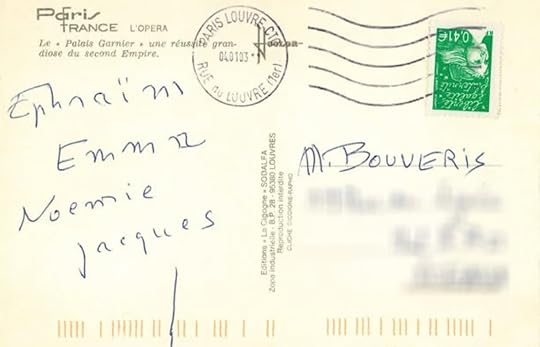
Berest’s ancestors - her great-grandfather Ephraïm Rabinovitch, his wife Emma and their children Myriam, Noémie and Jacques - came to France via Russia, Latvia, Poland and Palestine, and tried to establish a normal life in France, but no attempts at assimilation protected them from eventually perishing in the concentration camps after the poison of the Nazis and the Vichy government and the sometimes silent and sometimes open prejudice-fueled collaboration of their own neighbors and compatriots.
By 1942, four out of five members of the Rabinovitch family are dead, and Myriam is the only survivor who joins French Resistance. Her experiences are never really shared with her children or grandchildren, but Berest and her mother painstakingly research and recreate those years of pain and suffering and resilience. This research lets us see the glimpses into the less savory corners of historical legacy, where some of the furniture pilfered from the Rabinovitches house still sits in the homes of the former neighbors who stole it (it’s not just the occupying forces but the occupied themselves who seemed quite willing to put the blame for everything on the Jewish people, and police and officials seemed very willing to participate in the genocide), and those who signed the warrants and provided Jewish quotas to the camps continued on in the society, and kids on the playground still dislike Myriam’s daughter and granddaughter and great-granddaughter for their Jewishness, even if that seems to be hidden, even if the lives are secular and the features are quintessentially French. You can’t hide from hatred even if you try.
“As the years passed, the issue remained complex, intangible, incomparable to anything else. I might have one Spanish grandfather and one Breton one, a great-grandfather who was a painter and another who’d captained an ice-breaking ship, but nothing—absolutely nothing—mattered as much as that I was descended from a line of Jewish women.”
The book is a strange mixture of unsettling and moving while keeping you a bit at a distance at the same time with the years passed and information found second-hand through research rather than direct telling (as all who could have told it directly to Anne are dead). Parts of it are certainly fictionalized and novelized for better narrative flow (and as Berest mentioned in an interview with NPR, some names and places were changed to protect the descendants of those that have denounced and hurt the Rabinovitches) but the core remains deeply impactful and heartbreaking.
“I struggle endlessly to make a connection between the thought of my family and the mythologized occurrence that is genocide. And that struggle is what constitutes me. It is the thing that defines me. For almost forty years, I have tried to draw a shape that resembles me, but without success. Today, though, I can connect those disparate dots. I can see, in the constellation of fragments scattered over the page, a silhouette in which I recognize myself at last: I am the daughter, and the granddaughter, of survivors.”
4 solid stars.
——————
Also posted on my blog.

August 8, 2023
This is one of those books that I really wanted to love: from the intriguing portrait on the front cover to the idea of a tragic family history. In lots of ways this is the history of the European twentieth century made up of persecution, racism and anti-Semitism, emigration, politics and murder in the Nazi death camps. What's missing though for me is a sense of the personal, something that makes this family who they were, and not just another group caught up in the maelstrom.
Although this is billed as fiction, it feels like family history/biography. The interjections of the narrator and her mother interrupt the lives and bring us constantly back to the present. Almost all my friends in my generation have a similar history with ancestors uprooted as a result of WW2 and its aftermath but we don't have direct experience ourselves of those events - and I'd say that's what comes over in this book. For all the research done, the people never really came to life for me and the stories from Russia to Latvia to France to Nazi Germany felt horribly similar to those we've already read. Which is important in itself, of course, as the sheer numbers of, in this case, Jews murdered is precisely what makes this such a shared story.
All the same, as a book this just wasn't the emotive and moving story that I'd expected. For someone younger or less well-versed in this history perhaps this will be more illuminating and revelatory.
Many thanks to Europa Editions for an ARC via NetGalley
Although this is billed as fiction, it feels like family history/biography. The interjections of the narrator and her mother interrupt the lives and bring us constantly back to the present. Almost all my friends in my generation have a similar history with ancestors uprooted as a result of WW2 and its aftermath but we don't have direct experience ourselves of those events - and I'd say that's what comes over in this book. For all the research done, the people never really came to life for me and the stories from Russia to Latvia to France to Nazi Germany felt horribly similar to those we've already read. Which is important in itself, of course, as the sheer numbers of, in this case, Jews murdered is precisely what makes this such a shared story.
All the same, as a book this just wasn't the emotive and moving story that I'd expected. For someone younger or less well-versed in this history perhaps this will be more illuminating and revelatory.
Many thanks to Europa Editions for an ARC via NetGalley
December 28, 2022
4.5 rounded up.
This is a truly extraordinary book, disturbing and provocative in equal measure. And, sad to say, alarmingly timely. The GR description adequately captures the broad outline of what it’s about: the 2003 mysterious arrival at the home of a French translator of an unsigned postcard on which are written the first names of four people in her family, all of whom were killed in the Holocaust. On the other side of the card is an unremarkable photo of Paris’s Opera Garnier: unremarkable save that it was the first building Hitler visited after the Nazis captured the city in 1940; one of the iconic images of the Occupation is a photo of the front of that building festooned with long swastika banners. The book begins almost 20 years after the card’s arrival when the translator’s daughter, novelist Anne Berest, sees it. Their conversation sets them off on a journey to discover who sent the postcard and why. As part of the journey, Anne learns about the four relatives who perished, as well as those few who survived.
There’s another story that runs parallel to this narrative: Anne’s personal struggle to figure out what it means to be a Jew in modern day France. Indeed, what it means to be Jewish at all. I don’t say this to suggest this effort is spiritual. Rather, it’s about what it means to be a Jew of any kind, by any definition, her own or by others others. She knew she was Jewish, of course, but she had no firm sense what that meant. She recounts a memory from when she was very young of being told by protective adults that the numbers she occasionally saw on the arms of old people were their phone numbers, just in case they got lost. Later, as an 8 year old girl, she asked her mother what “Jewish” meant. After a moment of thought, her mother took a book down from the shelf and opened it on the floor, revealing “black and white photographs, images of ravaged bodies in striped pajamas, of barbed wire in the snow, of corpses stacked atop one another, of mountains of clothes and shoes and eyeglasses.”
How does a child begin to process this kind of information? What awful echoes does it set off when the child is grown and awful events in the present day sound disconcertingly like the past? As she told one interviewer, “It became a traumatic question: Why did my family not leave? Will I, who come from a family that failed to get out of harm’s way, be able to? I became obsessed by this question. It’s the book’s central interrogation.”
Berest’s recounting of what her ancestors experienced has sadly familiar elements to it: pogroms of Eastern Europe that sent the family elsewhere, to Palestine and, in time, to France. The creation of new lives there, of becoming more and more French, tastes of success and security. And then watching uncomprehendingly as it all falls apart and descends into something utterly unimaginable. Familiar yes, but also different.
How to explain what I mean? On the one hand there is the framing device: the efforts by mother and daughter to solve the mystery of the postcards. We watch that inquiry unfold, listen in on their conversations with one another and accompany them when they visit a detective, handwriting analyst, former neighbors, and so on.
Then there is the story of the people whose names are on the card and others in Berest’s family. All this is recounted in a manner I found very powerful, very intimate. A 1940 order from the government that French Jews (and Jews living in France) register themselves sets off arguments within the family. The girls, young teens, at first refuse to do so. Why should they? After all, they’re as French as the other girls in their school. Their father feels differently: “Ephraïm was angry; his daughters had no idea of the danger they were putting themselves in. Emma, distraught, begged the girls to comply, and so four days later, on October 18, 1940, with great reluctance, Myriam and Noémie went to the prefecture together to sign the register.” A later argument about the same order between Ephraïm and his brother, Emmanuel, leads to a different outcome when Emmanuel says, “I don’t give a shit about the government. They can go fuck themselves.” With the book open before us, we read these exchanges knowing who will survive and who will be killed in the camps. (Again, from her interview, these haunting questions: “Why did my family not leave? Will I, who come from a family that failed to get out of harm’s way, be able to?”
I won’t write about how events transpired for the family. Berest tells their stories well. (One thing I’d never heard before, that shocked me in its hideous banality: to encourage Jews to voluntarily go to Germany, Nazi officials handed out leaflets that read, “IF YOU WANT TO EARN MORE MONEY, COME WORK IN GERMANY. FOR MORE INFORMATION, CONTACT THE GERMAN PLACEMENT OFFICE, FELDKOMMANDANTUR, OR KREISKOMMANDANTUR.”)
Yet other things, though familiar to me, took on added, horrific weight in Berest’s telling. I had read elsewhere of Jews being “interned” in the Vel' d’Hiv' biking arena, but never like this — more than 13,000 people, no bathrooms, no food or water, the dome overhead sending the temperature soaring. No accommodation had been made at all for infants. No way to clean their diapers, no way to replace them. No milk to feed them. An inspection report about this situation sent to the official in charge of the arena resulted not in relief but in the installation of barbed wire so small children couldn’t slip through and escape.
Finally, there is the level at which Anne Berest, the person, reacts to mounting threats from reactionary antisemitic forces in the France she and her family now live in. What might in earlier times have been academic questions to her — Why didn’t they leave while they could? Why didn’t non-Jews help them? — have suddenly become intensely personal.
One day she is invited (by the first Jewish man she’d ever dated) to attend a Passover seder. She had never been to one before, had no experience with any Jewish ritual and prayer and custom. She immediately does a Google search of “Appropriate outfit for Pesach.” The seder part of the evening goes for her as one might expect — alternately confusing and somehow “soothing”. Over dinner after the seder, the conversation turns to current events and whether as Jews they are at heightened risk now. Some at the table think not: “Let’s be realistic…. Even though I’m Jewish, I think it’ll be undocumented workers, Africans, immigrants who will be the ones in danger. Sorry to disappoint you, gentlemen, but you’re not the ones they’ll be arresting in the streets.” (A rational viewpoint, to be sure, but also a problematic one. As one person says in response, “Yeah, but here’s the problem: are you prepared to fight for people other than yourselves?… How much would you risk? What if you weren’t the victims, for once, but the people who could actually help?” Tough question.)
On the other side of the issue, another guest says, “We live in a country where there is still a huge amount of anti-Semitism. Now imagine the National Front coming to power and trying to challenge the system when the people at the highest levels of government aren’t on your side.”
Then this: "We all consider ourselves totally assimilated. All our names sound foreign, and yet we know the best domestic wines, we’ve read all the classic French literature, we all know how to cook blanquette de veau. But take a good, hard look at yourselves and ask the question: isn’t this feeling of being deeply anchored in France the same way French Jews felt in 1942? A lot of them had fought for this country in the first World War. And yet they were put on those trains.”
(Need I point out how common these conversations are among Jews today? At the end of December this year, the Washington Post ran an article about American Jews wrestling with questions of safety and thinking about whether they should leave the country. The article — https://www.washingtonpost.com/dc-md-... — was very much on my mind as I wrote this review.)
Berest sits silently at the table as the talk goes back and forth. Eventually, in response to a question, she talks a little about her very secular upbringing. Her story about a seemingly minor incident at her young daughter’s school that she decided not to pursue leads one of the guests to angrily say, “If you were truly Jewish, you wouldn’t take it so lightly. Do you ever mention Judaism in your books? The truth, as far as I can tell, is that you’re only Jewish when it suits you.”
“If you were truly Jewish…” What do these words mean? This is one of the big questions that “The Postcard” wrestles with. Near the end of the book Berest offers a reply to the seder guest's remark, but here she poses the matter in cryptic (yet reasonable fashion, I think): “What does it mean to be Jewish? Maybe the answer was contained within another question: What does it mean to wonder what it means to be Jewish?”
In the realest sense, “The Postcard” is her attempt at an answer. What did it mean for her ancestors to be seen as Jews? Murdered as Jews? What does it mean to her today, to the safety of her child (who comes home from school one day and announces that people there "don't like Jews")? The French edition of “The Postcard” has received numerous honors and rewards. The English translation, due for release in June (and very well done!), will likely attract similar attention. As it should.
My sincere thanks to Europa Editions and Edelweis for providing an advance digital copy of "The Postcard" in return for an honest review.
(A brief postscript: The GR summary calls the book a “novel.” So does Europa Editions, publishers of the English translation. Elsewhere it's been described as “autofiction,” by which is meant a work that combines autobiography and fiction. I find both terms problematic so let’s just say, until more definitive information becomes available, that “The Postcard” is a true story that the author uses fictive techniques to tell. By and large, she does so successfully.)
This is a truly extraordinary book, disturbing and provocative in equal measure. And, sad to say, alarmingly timely. The GR description adequately captures the broad outline of what it’s about: the 2003 mysterious arrival at the home of a French translator of an unsigned postcard on which are written the first names of four people in her family, all of whom were killed in the Holocaust. On the other side of the card is an unremarkable photo of Paris’s Opera Garnier: unremarkable save that it was the first building Hitler visited after the Nazis captured the city in 1940; one of the iconic images of the Occupation is a photo of the front of that building festooned with long swastika banners. The book begins almost 20 years after the card’s arrival when the translator’s daughter, novelist Anne Berest, sees it. Their conversation sets them off on a journey to discover who sent the postcard and why. As part of the journey, Anne learns about the four relatives who perished, as well as those few who survived.
There’s another story that runs parallel to this narrative: Anne’s personal struggle to figure out what it means to be a Jew in modern day France. Indeed, what it means to be Jewish at all. I don’t say this to suggest this effort is spiritual. Rather, it’s about what it means to be a Jew of any kind, by any definition, her own or by others others. She knew she was Jewish, of course, but she had no firm sense what that meant. She recounts a memory from when she was very young of being told by protective adults that the numbers she occasionally saw on the arms of old people were their phone numbers, just in case they got lost. Later, as an 8 year old girl, she asked her mother what “Jewish” meant. After a moment of thought, her mother took a book down from the shelf and opened it on the floor, revealing “black and white photographs, images of ravaged bodies in striped pajamas, of barbed wire in the snow, of corpses stacked atop one another, of mountains of clothes and shoes and eyeglasses.”
How does a child begin to process this kind of information? What awful echoes does it set off when the child is grown and awful events in the present day sound disconcertingly like the past? As she told one interviewer, “It became a traumatic question: Why did my family not leave? Will I, who come from a family that failed to get out of harm’s way, be able to? I became obsessed by this question. It’s the book’s central interrogation.”
Berest’s recounting of what her ancestors experienced has sadly familiar elements to it: pogroms of Eastern Europe that sent the family elsewhere, to Palestine and, in time, to France. The creation of new lives there, of becoming more and more French, tastes of success and security. And then watching uncomprehendingly as it all falls apart and descends into something utterly unimaginable. Familiar yes, but also different.
How to explain what I mean? On the one hand there is the framing device: the efforts by mother and daughter to solve the mystery of the postcards. We watch that inquiry unfold, listen in on their conversations with one another and accompany them when they visit a detective, handwriting analyst, former neighbors, and so on.
Then there is the story of the people whose names are on the card and others in Berest’s family. All this is recounted in a manner I found very powerful, very intimate. A 1940 order from the government that French Jews (and Jews living in France) register themselves sets off arguments within the family. The girls, young teens, at first refuse to do so. Why should they? After all, they’re as French as the other girls in their school. Their father feels differently: “Ephraïm was angry; his daughters had no idea of the danger they were putting themselves in. Emma, distraught, begged the girls to comply, and so four days later, on October 18, 1940, with great reluctance, Myriam and Noémie went to the prefecture together to sign the register.” A later argument about the same order between Ephraïm and his brother, Emmanuel, leads to a different outcome when Emmanuel says, “I don’t give a shit about the government. They can go fuck themselves.” With the book open before us, we read these exchanges knowing who will survive and who will be killed in the camps. (Again, from her interview, these haunting questions: “Why did my family not leave? Will I, who come from a family that failed to get out of harm’s way, be able to?”
I won’t write about how events transpired for the family. Berest tells their stories well. (One thing I’d never heard before, that shocked me in its hideous banality: to encourage Jews to voluntarily go to Germany, Nazi officials handed out leaflets that read, “IF YOU WANT TO EARN MORE MONEY, COME WORK IN GERMANY. FOR MORE INFORMATION, CONTACT THE GERMAN PLACEMENT OFFICE, FELDKOMMANDANTUR, OR KREISKOMMANDANTUR.”)
Yet other things, though familiar to me, took on added, horrific weight in Berest’s telling. I had read elsewhere of Jews being “interned” in the Vel' d’Hiv' biking arena, but never like this — more than 13,000 people, no bathrooms, no food or water, the dome overhead sending the temperature soaring. No accommodation had been made at all for infants. No way to clean their diapers, no way to replace them. No milk to feed them. An inspection report about this situation sent to the official in charge of the arena resulted not in relief but in the installation of barbed wire so small children couldn’t slip through and escape.
Finally, there is the level at which Anne Berest, the person, reacts to mounting threats from reactionary antisemitic forces in the France she and her family now live in. What might in earlier times have been academic questions to her — Why didn’t they leave while they could? Why didn’t non-Jews help them? — have suddenly become intensely personal.
One day she is invited (by the first Jewish man she’d ever dated) to attend a Passover seder. She had never been to one before, had no experience with any Jewish ritual and prayer and custom. She immediately does a Google search of “Appropriate outfit for Pesach.” The seder part of the evening goes for her as one might expect — alternately confusing and somehow “soothing”. Over dinner after the seder, the conversation turns to current events and whether as Jews they are at heightened risk now. Some at the table think not: “Let’s be realistic…. Even though I’m Jewish, I think it’ll be undocumented workers, Africans, immigrants who will be the ones in danger. Sorry to disappoint you, gentlemen, but you’re not the ones they’ll be arresting in the streets.” (A rational viewpoint, to be sure, but also a problematic one. As one person says in response, “Yeah, but here’s the problem: are you prepared to fight for people other than yourselves?… How much would you risk? What if you weren’t the victims, for once, but the people who could actually help?” Tough question.)
On the other side of the issue, another guest says, “We live in a country where there is still a huge amount of anti-Semitism. Now imagine the National Front coming to power and trying to challenge the system when the people at the highest levels of government aren’t on your side.”
Then this: "We all consider ourselves totally assimilated. All our names sound foreign, and yet we know the best domestic wines, we’ve read all the classic French literature, we all know how to cook blanquette de veau. But take a good, hard look at yourselves and ask the question: isn’t this feeling of being deeply anchored in France the same way French Jews felt in 1942? A lot of them had fought for this country in the first World War. And yet they were put on those trains.”
(Need I point out how common these conversations are among Jews today? At the end of December this year, the Washington Post ran an article about American Jews wrestling with questions of safety and thinking about whether they should leave the country. The article — https://www.washingtonpost.com/dc-md-... — was very much on my mind as I wrote this review.)
Berest sits silently at the table as the talk goes back and forth. Eventually, in response to a question, she talks a little about her very secular upbringing. Her story about a seemingly minor incident at her young daughter’s school that she decided not to pursue leads one of the guests to angrily say, “If you were truly Jewish, you wouldn’t take it so lightly. Do you ever mention Judaism in your books? The truth, as far as I can tell, is that you’re only Jewish when it suits you.”
“If you were truly Jewish…” What do these words mean? This is one of the big questions that “The Postcard” wrestles with. Near the end of the book Berest offers a reply to the seder guest's remark, but here she poses the matter in cryptic (yet reasonable fashion, I think): “What does it mean to be Jewish? Maybe the answer was contained within another question: What does it mean to wonder what it means to be Jewish?”
In the realest sense, “The Postcard” is her attempt at an answer. What did it mean for her ancestors to be seen as Jews? Murdered as Jews? What does it mean to her today, to the safety of her child (who comes home from school one day and announces that people there "don't like Jews")? The French edition of “The Postcard” has received numerous honors and rewards. The English translation, due for release in June (and very well done!), will likely attract similar attention. As it should.
My sincere thanks to Europa Editions and Edelweis for providing an advance digital copy of "The Postcard" in return for an honest review.
(A brief postscript: The GR summary calls the book a “novel.” So does Europa Editions, publishers of the English translation. Elsewhere it's been described as “autofiction,” by which is meant a work that combines autobiography and fiction. I find both terms problematic so let’s just say, until more definitive information becomes available, that “The Postcard” is a true story that the author uses fictive techniques to tell. By and large, she does so successfully.)

August 12, 2026
The Postcard by Anne Berest is not just another Holocaust book. It is more than that. An absolute gem, it explores the ongoing effects of that shameful chapter in human history on subsequent generations. Thought-provoking, the novel is based on the experiences of the author’s own family, 5 of whose forebears perished in Auschwitz. It also examines the impact of antisemitism on the family. Parts of the story are brutal and heart-wrenching. The author tells the story in a forthright, honest way. She doesn’t shy away from frankness. Do yourself a favour and read this book.

April 6, 2023
4 solid stars for an absorbing historical fiction book. This book was originally written in French and won several prestigious literary prizes. It was a best seller in France. The translation is excellent.
The book opens in January 2003 when Leila receives an anonymous postcard, with 4 names written on it: Ephraïm and Emma, and their children, Noémie and Jacques. The 4 persons named are the maternal grandparents and aunt and uncle of Lelia, mother of Anne. All 4 were murdered at Auschwitz in 1942. Ten years later, Anne decides to find out who sent the postcard.
This leads Anne and Lelia on a journey of discovery of terrible events, and how 1 member of her family survived the Holocaust. That person was Myriam, her grandmother.
There are some controversial issues discussed in this book:
How the French Vichy government and police were deeply involved in arresting Jews en masse.
Many of the French government officials were still holding the same offices after the war.
The French post war government, in an effort at "reconciliation" decided to bury these horrible events as much as possible.
Recurring incidents of anti antisemitism throughout various countries and over a century(1919 to present day).
Not until the 80s, with the movie "Shoah" did the truth start to emerge.
Along the way, I learned new words, such as Pesach, celebration of Passover, and the ingredients for
this Pesach dinner, including honeyed apples, meant to remind Jews to be wary of ease and comfort.
One quote: "One day, Jacques, who was almost ten, came home from school in tears. He locked himself in his room and refused to speak to anyone. All because of something one of his classmates had said in the schoolyard: "Pull the ear of one Jew and they'll all have trouble hearing."
It is a long book at 464 pages and it took me 9 days to read it.
Thanks to Kristi Bontrager at Europa Editions for sending me this eARC through Edelweiss.
Pub. date May 16, 2023.
The book opens in January 2003 when Leila receives an anonymous postcard, with 4 names written on it: Ephraïm and Emma, and their children, Noémie and Jacques. The 4 persons named are the maternal grandparents and aunt and uncle of Lelia, mother of Anne. All 4 were murdered at Auschwitz in 1942. Ten years later, Anne decides to find out who sent the postcard.
This leads Anne and Lelia on a journey of discovery of terrible events, and how 1 member of her family survived the Holocaust. That person was Myriam, her grandmother.
There are some controversial issues discussed in this book:
How the French Vichy government and police were deeply involved in arresting Jews en masse.
Many of the French government officials were still holding the same offices after the war.
The French post war government, in an effort at "reconciliation" decided to bury these horrible events as much as possible.
Recurring incidents of anti antisemitism throughout various countries and over a century(1919 to present day).
Not until the 80s, with the movie "Shoah" did the truth start to emerge.
Along the way, I learned new words, such as Pesach, celebration of Passover, and the ingredients for
this Pesach dinner, including honeyed apples, meant to remind Jews to be wary of ease and comfort.
One quote: "One day, Jacques, who was almost ten, came home from school in tears. He locked himself in his room and refused to speak to anyone. All because of something one of his classmates had said in the schoolyard: "Pull the ear of one Jew and they'll all have trouble hearing."
It is a long book at 464 pages and it took me 9 days to read it.
Thanks to Kristi Bontrager at Europa Editions for sending me this eARC through Edelweiss.
Pub. date May 16, 2023.

August 24, 2023
Let me start with a fair warning. This is what happens when you read The Postcard (2021) by Anne Berest while cooking:
This novel is one of the most gripping, addictive and unputdownable books I have ever read and the consequences of my total immersion are visible above. I was really caught up in this bleak, tragic but also painfully beautiful story. On the surface, Anne Berest's novel is an account of a historical investigation the author and her mother pursued, hiring a private detective and graphologist included, after they had received a bizarre and disturbing postcard. But besides family history, the book grapples with the Holocaust, loss, grieving, inherited trauma, antisemitism, what it means to be Jewish, some difficult chapters of the history of France, memory, strange coincidences and more.
In the last few years, I've noticed an abundance of new books that trivialize the Holocaust and the way the Auschwitz theme is being monetarized and exploited makes me sick. Fortunately, The Postcard is not the case. The author's empathy and emotional engagement are exceptional.
It is difficult, maybe even impossible, to turn off emotions while discussing this book and to be objective. I couldn't stop obsessively comparing it to Edmund de Waal's The Hare With Amber Eyes: A Family's Century of Art and Loss and Letters to Camondo. And obviously W.G. Sebald's Austerlitz and his The Emigrants. The Postcard felt a bit short on some levels compared to these four books I absolutely love. Maybe this analogy wasn't fair but I couldn't stop obtrusive associations.
I found the historical, non-fiction parts of The Postcard much more engaging than the contemporary ones. The parts in which the author lets the facts, documents and characters speak are gorgeous. The passages in which the book morphs into a kind of romantic drama did not appeal to me very much. I wonder why Anne Beres decided to devote so much time and attention to annoying Vicente while Yves was left almost like a blank page. I suspect the Vicente part was intended to add intensity and piquancy to the story but did this novel really need such adornments? The register shifts in The Postcard grated a bit too, for example, the opium scene felt like a fragment from a different book inserted into Anne Berest's novel.
At first, I thought it was a pity that family photos were not included in the book but the one on the cover breaks my heart every time I see it so maybe it's better this way. Speaking of broken heart, my burnt pot mentioned above has been successfully restored as near as possible to its original state but I haven't yet and probably the healing process will go on for some time. I can hardly find the words to describe the visceral emotional impact of The Postcard, my caveats notwithstanding.

Artwork by Shmuel Dresner.
[Image source.]
This novel is one of the most gripping, addictive and unputdownable books I have ever read and the consequences of my total immersion are visible above. I was really caught up in this bleak, tragic but also painfully beautiful story. On the surface, Anne Berest's novel is an account of a historical investigation the author and her mother pursued, hiring a private detective and graphologist included, after they had received a bizarre and disturbing postcard. But besides family history, the book grapples with the Holocaust, loss, grieving, inherited trauma, antisemitism, what it means to be Jewish, some difficult chapters of the history of France, memory, strange coincidences and more.
In the last few years, I've noticed an abundance of new books that trivialize the Holocaust and the way the Auschwitz theme is being monetarized and exploited makes me sick. Fortunately, The Postcard is not the case. The author's empathy and emotional engagement are exceptional.
It is difficult, maybe even impossible, to turn off emotions while discussing this book and to be objective. I couldn't stop obsessively comparing it to Edmund de Waal's The Hare With Amber Eyes: A Family's Century of Art and Loss and Letters to Camondo. And obviously W.G. Sebald's Austerlitz and his The Emigrants. The Postcard felt a bit short on some levels compared to these four books I absolutely love. Maybe this analogy wasn't fair but I couldn't stop obtrusive associations.
I found the historical, non-fiction parts of The Postcard much more engaging than the contemporary ones. The parts in which the author lets the facts, documents and characters speak are gorgeous. The passages in which the book morphs into a kind of romantic drama did not appeal to me very much. I wonder why Anne Beres decided to devote so much time and attention to annoying Vicente while Yves was left almost like a blank page. I suspect the Vicente part was intended to add intensity and piquancy to the story but did this novel really need such adornments? The register shifts in The Postcard grated a bit too, for example, the opium scene felt like a fragment from a different book inserted into Anne Berest's novel.
At first, I thought it was a pity that family photos were not included in the book but the one on the cover breaks my heart every time I see it so maybe it's better this way. Speaking of broken heart, my burnt pot mentioned above has been successfully restored as near as possible to its original state but I haven't yet and probably the healing process will go on for some time. I can hardly find the words to describe the visceral emotional impact of The Postcard, my caveats notwithstanding.
Artwork by Shmuel Dresner.
[Image source.]

May 29, 2023
5★
Moscow, April 1919
“Nachman picked up a small pencil and moistened its tip between his lips. His eyes still fixed on his children and grandchildren, he added, ‘Now, I’m going to go around the table. And I want each of you—every one of you, do you hear me?—to give me a destination. I will go and buy steamer tickets for everyone. You must leave the country within the next three months; is that understood? Bella, I’ll begin with you—it’s simple; you’re coming with us. I’ll write it down: Bella, Haifa, Palestine. Ephraïm?’
. . .
Before closing the dining room door, Nachman asked them all to think carefully, concluding, ‘You must understand something. One day, they’ll want us all to disappear.’”
More than 90 years later, an anonymous postcard is delivered to a woman in Paris. There is no return address, but there is a roughly written list of four names printed on the back.
“ Then she read the four names, written in the form of a list. Ephraïm Emma Noémie Jacques They were the names of her maternal grandparents, her aunt, and her uncle. All four had been deported two years before she was born. They died in Auschwitz in 1942. And now, sixty-one years later, they had reappeared in our mailbox. It was Monday, January 6, 2003.”
I’m not sure if there’s a genre called fictional biography or not, but that’s what this is. The author is the daughter of the woman who received the postcard, and while she’s curious about it, it’s not until her little girl asks questions many years later that she feels compelled to follow it up.
The family story begins early in the book as historical fiction, which I was surprised to find less engaging than I expected. The family moved several times, trying to stay ahead of the growing hounding and victimisation of Jews, who were considered ‘the other’ or outsiders, no matter where they’d been born or how long they’d lived there.
If a country or politician needed a scapegoat, Jews were handy and accepted by the rest of the general public. Paris became unsafe, but many in the Jewish community hoped the French would stick by them.
It became more interesting to me as the investigation ramped up and the relationship between mother and daughter was featured. Anne has a six-year-old daughter of her own, Clara, whom her mother picks up from school on Mondays so they can spend some time together.
“ ‘Grandma, are you Jewish?’
‘Yes, I’m Jewish.’
‘And Grandpa, too?’
‘No, he isn’t Jewish.’
‘Oh. Is Maman Jewish?’
‘Yes.’
‘So I am, too?’
‘Yes, you are, too.’
‘Okay, that’s what I thought.’
‘Why are you making that face, sweetheart?’
‘I really don’t like what you just said.’
‘But why?’
‘They don’t like Jews very much at school.’ ”
When Lélia calls her daughter later to tell her of the conversation, she struggles to speak. She is a chain-smoker and all of her movements and speech are interrupted and punctuated by lighting of cigarettes, sometimes stalling for time. When she finally manages to tell Anne of Clara’s questions, Anne is beside herself with anxiety.
“From that moment onward, I was on the case. I wanted to find the author of the anonymous postcard my mother had received sixteen years earlier, whatever it took. The idea of finding the culprit became an obsession. I had to understand why that card had been sent.”
Her mother still has the card. Determined to track down the sender and the reason for the card, Anne leads the hunt, beginning with helping her mother unpack and unpick the childhood memories she has hidden from herself.
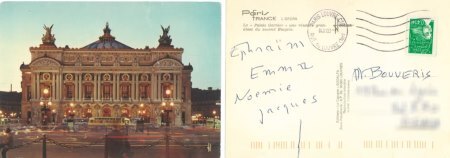
The postcard, front and back
Their detective work is amazing – there is so little to go on. They study every mark on the card, the stamp, the postmark, the shapes of the letters, and they contact everyone they can think of who knew or might have known some member of the Rabinovitch family. They travel in person to visit, to question, to compare Lélia’s memories with what they can see today.
Once I was caught up in the story, I was completely hooked. I really thought they were grasping at straws – and whatever other cliché you can think of about a hopeless cause – but never underestimate the power of women like these or a family like theirs.
If you’re a recently reformed smoker, you may have trouble with Lélia’s non-stop chimney effect and the frequent references to needing to unfug the car when they’re driving. [My word – seemed apt].
Terrific biography and fiction and history that deserves the accolades it’s getting. Thanks to NetGalley and Europa Editions for the copy for review.
Below is the source of the photo I used plus an excellent article and a couple of family photos.
https://english.elpais.com/culture/20...
The beautiful photo on the cover of the book is of Noémie.
Moscow, April 1919
“Nachman picked up a small pencil and moistened its tip between his lips. His eyes still fixed on his children and grandchildren, he added, ‘Now, I’m going to go around the table. And I want each of you—every one of you, do you hear me?—to give me a destination. I will go and buy steamer tickets for everyone. You must leave the country within the next three months; is that understood? Bella, I’ll begin with you—it’s simple; you’re coming with us. I’ll write it down: Bella, Haifa, Palestine. Ephraïm?’
. . .
Before closing the dining room door, Nachman asked them all to think carefully, concluding, ‘You must understand something. One day, they’ll want us all to disappear.’”
More than 90 years later, an anonymous postcard is delivered to a woman in Paris. There is no return address, but there is a roughly written list of four names printed on the back.
“ Then she read the four names, written in the form of a list. Ephraïm Emma Noémie Jacques They were the names of her maternal grandparents, her aunt, and her uncle. All four had been deported two years before she was born. They died in Auschwitz in 1942. And now, sixty-one years later, they had reappeared in our mailbox. It was Monday, January 6, 2003.”
I’m not sure if there’s a genre called fictional biography or not, but that’s what this is. The author is the daughter of the woman who received the postcard, and while she’s curious about it, it’s not until her little girl asks questions many years later that she feels compelled to follow it up.
The family story begins early in the book as historical fiction, which I was surprised to find less engaging than I expected. The family moved several times, trying to stay ahead of the growing hounding and victimisation of Jews, who were considered ‘the other’ or outsiders, no matter where they’d been born or how long they’d lived there.
If a country or politician needed a scapegoat, Jews were handy and accepted by the rest of the general public. Paris became unsafe, but many in the Jewish community hoped the French would stick by them.
It became more interesting to me as the investigation ramped up and the relationship between mother and daughter was featured. Anne has a six-year-old daughter of her own, Clara, whom her mother picks up from school on Mondays so they can spend some time together.
“ ‘Grandma, are you Jewish?’
‘Yes, I’m Jewish.’
‘And Grandpa, too?’
‘No, he isn’t Jewish.’
‘Oh. Is Maman Jewish?’
‘Yes.’
‘So I am, too?’
‘Yes, you are, too.’
‘Okay, that’s what I thought.’
‘Why are you making that face, sweetheart?’
‘I really don’t like what you just said.’
‘But why?’
‘They don’t like Jews very much at school.’ ”
When Lélia calls her daughter later to tell her of the conversation, she struggles to speak. She is a chain-smoker and all of her movements and speech are interrupted and punctuated by lighting of cigarettes, sometimes stalling for time. When she finally manages to tell Anne of Clara’s questions, Anne is beside herself with anxiety.
“From that moment onward, I was on the case. I wanted to find the author of the anonymous postcard my mother had received sixteen years earlier, whatever it took. The idea of finding the culprit became an obsession. I had to understand why that card had been sent.”
Her mother still has the card. Determined to track down the sender and the reason for the card, Anne leads the hunt, beginning with helping her mother unpack and unpick the childhood memories she has hidden from herself.
The postcard, front and back
Their detective work is amazing – there is so little to go on. They study every mark on the card, the stamp, the postmark, the shapes of the letters, and they contact everyone they can think of who knew or might have known some member of the Rabinovitch family. They travel in person to visit, to question, to compare Lélia’s memories with what they can see today.
Once I was caught up in the story, I was completely hooked. I really thought they were grasping at straws – and whatever other cliché you can think of about a hopeless cause – but never underestimate the power of women like these or a family like theirs.
If you’re a recently reformed smoker, you may have trouble with Lélia’s non-stop chimney effect and the frequent references to needing to unfug the car when they’re driving. [My word – seemed apt].
Terrific biography and fiction and history that deserves the accolades it’s getting. Thanks to NetGalley and Europa Editions for the copy for review.
Below is the source of the photo I used plus an excellent article and a couple of family photos.
https://english.elpais.com/culture/20...
The beautiful photo on the cover of the book is of Noémie.
December 22, 2024
4.5/5 Estrellas
Hay acontecimientos históricos que conviene mantener frescos en la memoria, individual y colectiva. El holocausto es uno de ellos. Nunca jamás debería volver a suceder algo como esto, aunque ya sabemos que el ser humano es capaz de todo, de tropezar una y otra vez en la misma piedra, sólo hay que echar un vistazo a las noticias.
Por mi parte, intento leer un par de libros al año, para no olvidar y tener claro hasta donde pueden llegar los límites de la barbarie humana.
"La Postal", es un libro autobiográfico, con partes de autoficción, supongo, en aquellos acontecimientos o espacios temporales, que no se han podido reconstruir con datos fiables. Anne Berest reconstruye la historia de la familia Rabinovich, sus ancestros. Desde la lejana Rusia revolucionaria de los años 20, esta familia de judíos askenazíes, peregrinó por el este de Europa y Palestina, hasta llegar a la republicana Francia en busca de un futuro mejor y huyendo de los progromos y leyes antisemitas que los habían perseguido por siglos. Nunca pensaban que pudiera suceder lo que ocurrió, nadie lo pensó.
Estupendamente escrito, de la mano de cartas, fotografías, recuerdos, testimonios de vecinos, conocidos y distintas personas, reconstruimos las vidas de Efraïm, Emma, Noemi, Jacques y Myriam. Los 4 primeros murieron en Auschwitz, Myriam sobrevivió y engendró a Leila. Esta, a su vez, es la madre de Anne y Claire Berest.
Myriam sobrevivió pero, como muchos supervivientes, perseguida por una suerte de culpabilidad por permanecer, cuando casi todo el mundo fue asesinado, se encerró en un mutismo obstinado, en una incapacidad por revivir los momentos y las circunstancias terribles de la ocupación, las detenciones, las deportaciones, la resistencia, la posguerra. Mejor callar, mejor no decir nada......pero los muertos, los asesinados merecen ser recordados. Una postal con los nombres de Efraïm, Emma, Noemi y Jacques a nombre de Myriam, llega a casa de Leila, cuando su madre ya ha muerto. La memoria de sus abuelos y tíos, su derecho a ser recordados, despierta en Leila y sus hijas la necesidad de saber, de reivindicar su memoria. Y así nace este maravillosos libro.
Francia está manchada. Todos tenemos claro el papel de la Alemania nazi en el holocausto. Pero es necesario decirlo, Francia colaboró activamente en la segregación, detención, deportación (y muerte), de cientos de miles de judíos que vivían en el país. Muchos de ellos acababan de llegar del este de Europa, pero muchos otros llevaban generaciones viviendo en Francia. Da igual, es una vergüenza, un estigma que tendrán de por vida. Ni siquiera fue necesaria la presión de los ocupantes nazis. En la Francia libre, la de Vichy, se promulgaron leyes antisemitas por iniciativa propia que prepararon el terreno al horror que se desencadenó poco después. El antisemitismo estaba ahí, latente, como en todo el mundo. Todo hay que decirlo, fue en este país donde más persona se jugaron el pellejo por salvar a sus vecinos y conocidos de origen judío. Sirva de descargo, pero la mancha está ahí.
Y no puedo dejar de pensarlo y verbalizarlo: ¿Cómo los descendientes de estas gentes, o algunos de ellos, pueden estar perpetrando los asesinatos que se están produciendo en Palestina, teniendo en su memoria colectiva como pueblo, el Holocausto? Para mi es incomprensible. El ser humano no deja de sorprenderme, para mal.
Lectura obligatoria, sin duda.
Hay acontecimientos históricos que conviene mantener frescos en la memoria, individual y colectiva. El holocausto es uno de ellos. Nunca jamás debería volver a suceder algo como esto, aunque ya sabemos que el ser humano es capaz de todo, de tropezar una y otra vez en la misma piedra, sólo hay que echar un vistazo a las noticias.
Por mi parte, intento leer un par de libros al año, para no olvidar y tener claro hasta donde pueden llegar los límites de la barbarie humana.
"La Postal", es un libro autobiográfico, con partes de autoficción, supongo, en aquellos acontecimientos o espacios temporales, que no se han podido reconstruir con datos fiables. Anne Berest reconstruye la historia de la familia Rabinovich, sus ancestros. Desde la lejana Rusia revolucionaria de los años 20, esta familia de judíos askenazíes, peregrinó por el este de Europa y Palestina, hasta llegar a la republicana Francia en busca de un futuro mejor y huyendo de los progromos y leyes antisemitas que los habían perseguido por siglos. Nunca pensaban que pudiera suceder lo que ocurrió, nadie lo pensó.
Estupendamente escrito, de la mano de cartas, fotografías, recuerdos, testimonios de vecinos, conocidos y distintas personas, reconstruimos las vidas de Efraïm, Emma, Noemi, Jacques y Myriam. Los 4 primeros murieron en Auschwitz, Myriam sobrevivió y engendró a Leila. Esta, a su vez, es la madre de Anne y Claire Berest.
Myriam sobrevivió pero, como muchos supervivientes, perseguida por una suerte de culpabilidad por permanecer, cuando casi todo el mundo fue asesinado, se encerró en un mutismo obstinado, en una incapacidad por revivir los momentos y las circunstancias terribles de la ocupación, las detenciones, las deportaciones, la resistencia, la posguerra. Mejor callar, mejor no decir nada......pero los muertos, los asesinados merecen ser recordados. Una postal con los nombres de Efraïm, Emma, Noemi y Jacques a nombre de Myriam, llega a casa de Leila, cuando su madre ya ha muerto. La memoria de sus abuelos y tíos, su derecho a ser recordados, despierta en Leila y sus hijas la necesidad de saber, de reivindicar su memoria. Y así nace este maravillosos libro.
Francia está manchada. Todos tenemos claro el papel de la Alemania nazi en el holocausto. Pero es necesario decirlo, Francia colaboró activamente en la segregación, detención, deportación (y muerte), de cientos de miles de judíos que vivían en el país. Muchos de ellos acababan de llegar del este de Europa, pero muchos otros llevaban generaciones viviendo en Francia. Da igual, es una vergüenza, un estigma que tendrán de por vida. Ni siquiera fue necesaria la presión de los ocupantes nazis. En la Francia libre, la de Vichy, se promulgaron leyes antisemitas por iniciativa propia que prepararon el terreno al horror que se desencadenó poco después. El antisemitismo estaba ahí, latente, como en todo el mundo. Todo hay que decirlo, fue en este país donde más persona se jugaron el pellejo por salvar a sus vecinos y conocidos de origen judío. Sirva de descargo, pero la mancha está ahí.
Y no puedo dejar de pensarlo y verbalizarlo: ¿Cómo los descendientes de estas gentes, o algunos de ellos, pueden estar perpetrando los asesinatos que se están produciendo en Palestina, teniendo en su memoria colectiva como pueblo, el Holocausto? Para mi es incomprensible. El ser humano no deja de sorprenderme, para mal.
Lectura obligatoria, sin duda.

Read
July 3, 2023This is the Modern Mrs Darcy Book Club July 2023 selection and a 2023 Summer Reading Guide Minimalist Pick.
If a mysterious postcard, star-crossed lovers, and a chain-smoking, meticulous genealogical note-keeping mother sounds good to you, use the sunny days of summer to balance out this heavy but moving French novel.
If a mysterious postcard, star-crossed lovers, and a chain-smoking, meticulous genealogical note-keeping mother sounds good to you, use the sunny days of summer to balance out this heavy but moving French novel.

September 12, 2023
When I first received this book from the library, I was intimidated by the size of it, 475 pages. For anybody who has been reading my reviews, I am not a person attracted to large books. Typically I will walk away.
But…This one was different.
When I began to read, I couldn’t stop.
It started with an old postcard with 4 names written on it – they were the names of her maternal grandparents, her aunt and her uncle. All had died at Auschwitz in 1942. Who would be so cruel as to send Lelia this postcard all these years later, she says out loud to her family.
And thus begins the story of not only finding out more about her family, the names on the postcard – Ephraim, Emma, Noemie, and Jacques, but who sent the postcard and why.
The story may be long, but the explanation, simple.
And, readers need to wait for it. It does eventually come.
Part novel and part documentary (biography), this book, translated from French by Tina Kover, is an account of Anne’s attempt to solve the mystery of this postcard which is also in part a reflection of her own family history.
The postcard may have been received, but it isn’t until Anne’s daughter has an an antisemitic encounter at school several years later, feels the violence of it, and the school’s indifference to it, that she remembers the postcard.
Moving between past and present, with her mother’s help, Anne begins to piece together her family’s story.
We meet Myriam, the eldest Rabinovich child who has married Vicente, a non-Jew. And because of that singular act, has survived the horrors the rest of her family has not when all her relatives are rounded up and deported and killed.
Lelia tells her daughter, “All our lives were spun from that impossibly slender thread of luck.” Myriam is Lelia’s mother, and Anne’s grandmother.
Some of the translations were off, which made it difficult to read, at times. As an example, Kover translated Passover as Jewish Easter. In a book that is literally about the attempt to exterminate the Jews and their traditions, it is important to recognize the fullness of Jewish culture correctly.
Still…This novel is engaging. There was a mystery to be solved. And even if there was a simplicity to its resolution, there was richness in the history that the author was unraveling.
And… As we continue to explore more about what the Holocaust has done, through stories like “The Postcard,” we, must not forget.
But…This one was different.
When I began to read, I couldn’t stop.
It started with an old postcard with 4 names written on it – they were the names of her maternal grandparents, her aunt and her uncle. All had died at Auschwitz in 1942. Who would be so cruel as to send Lelia this postcard all these years later, she says out loud to her family.
And thus begins the story of not only finding out more about her family, the names on the postcard – Ephraim, Emma, Noemie, and Jacques, but who sent the postcard and why.
The story may be long, but the explanation, simple.
And, readers need to wait for it. It does eventually come.
Part novel and part documentary (biography), this book, translated from French by Tina Kover, is an account of Anne’s attempt to solve the mystery of this postcard which is also in part a reflection of her own family history.
The postcard may have been received, but it isn’t until Anne’s daughter has an an antisemitic encounter at school several years later, feels the violence of it, and the school’s indifference to it, that she remembers the postcard.
Moving between past and present, with her mother’s help, Anne begins to piece together her family’s story.
We meet Myriam, the eldest Rabinovich child who has married Vicente, a non-Jew. And because of that singular act, has survived the horrors the rest of her family has not when all her relatives are rounded up and deported and killed.
Lelia tells her daughter, “All our lives were spun from that impossibly slender thread of luck.” Myriam is Lelia’s mother, and Anne’s grandmother.
Some of the translations were off, which made it difficult to read, at times. As an example, Kover translated Passover as Jewish Easter. In a book that is literally about the attempt to exterminate the Jews and their traditions, it is important to recognize the fullness of Jewish culture correctly.
Still…This novel is engaging. There was a mystery to be solved. And even if there was a simplicity to its resolution, there was richness in the history that the author was unraveling.
And… As we continue to explore more about what the Holocaust has done, through stories like “The Postcard,” we, must not forget.

October 30, 2023
The Postcard What a compelling read…… I couldn’t put it down.
This story is based on the authors own tragic family history. In 2003, the Berest family receive a mysterious, unsigned postcard. On one side was an image of the Opéra Garnier; on the other, the names of their relatives who were killed in Auschwitz: Ephraïm, Emma, Noémie and Jacques.
Many yeasts later the author, Anne , sought to find the truth behind this postcard. With the help of her mother, she delves 100 years into her family’s past. She learns of the flight of her Jewish ancestors from Russia following the revolution, their journey to Latvia, Palestine, and Paris, the war, and its aftermath. This is a story that you will be as eager as Anne to learn the fate of the names on the postcard.
Some authors have a unique way of telling a story and Anne Berest certainly has captured the art of storytelling. From the very first chapter I was putty in her hands.
I really enjoyed this book so much; I appreciated the depth of research that went into a book like this and am so glad that this was translated from French to English and that I had the pleasure of reading this story. I especially enjoyed the dinner party and the conversations that took place, I loved the mystery around the postcard and the trips back to the village where Anne's ancestors have lived.
I was a little disappointed that there were no photographs or even an image of the postcard included in the book. A family tree would have been very helpful. I read this on Kindle and listened on audio as well, so perhaps the hard copy had photos that I missed out on. Also, an author’s note at the end to explain what was real and what was imagined would have been very helpful.
Having said that I really enjoyed the book and look forward to adding a copy of this one to my real-life bookshelf.
This story is based on the authors own tragic family history. In 2003, the Berest family receive a mysterious, unsigned postcard. On one side was an image of the Opéra Garnier; on the other, the names of their relatives who were killed in Auschwitz: Ephraïm, Emma, Noémie and Jacques.
Many yeasts later the author, Anne , sought to find the truth behind this postcard. With the help of her mother, she delves 100 years into her family’s past. She learns of the flight of her Jewish ancestors from Russia following the revolution, their journey to Latvia, Palestine, and Paris, the war, and its aftermath. This is a story that you will be as eager as Anne to learn the fate of the names on the postcard.
Some authors have a unique way of telling a story and Anne Berest certainly has captured the art of storytelling. From the very first chapter I was putty in her hands.
I really enjoyed this book so much; I appreciated the depth of research that went into a book like this and am so glad that this was translated from French to English and that I had the pleasure of reading this story. I especially enjoyed the dinner party and the conversations that took place, I loved the mystery around the postcard and the trips back to the village where Anne's ancestors have lived.
I was a little disappointed that there were no photographs or even an image of the postcard included in the book. A family tree would have been very helpful. I read this on Kindle and listened on audio as well, so perhaps the hard copy had photos that I missed out on. Also, an author’s note at the end to explain what was real and what was imagined would have been very helpful.
Having said that I really enjoyed the book and look forward to adding a copy of this one to my real-life bookshelf.

August 29, 2024
This is truly an original, beautifully written, deeply thought, and page-turning book that cannot be easily defined.
It's labeled a novel, perhaps because of its structure and because the author admits that she imagines some of the scenes and dialogue in her family's history (especially those involving her grandmother, Myriam). Yet it's based on her family's true story, including an amazing depth of research into decades-0ld government papers, Holocaust archival records, interviews, and a lot of lucky encounters.
One note: I read this book in the original French, so I can appreciate the beauty and power of the author's actual writing.
Berest's research is launched after her family receives an odd postcard apparently addressed to the long-deceased Myriam, containing just four words --the first names of Myriam's parents, brother, and sister who were all murdered at Auschwitz. Luckily, Berest's mother, Lelia, is an academic with superpower research skills who had already spent years digging into the family history leading up to those Holocaust murders, which gave Berest a starting point. But the research provided no clues as to who might have sent the postcard or why.
In seeking to unravel this mystery, Berest beautifully interweaves Lelia's, her own, and her young daughter's experiences with antisemitism; her thoughts about being Jewish; her relationships with her mother, sister, daughter, grandmother, and boyfriend; and harrowing descriptions of historical periods such as the desperate return of Holocaust survivors to France after the war. (There's also a fascinating scene in an opium den in Paris.)
The book's only flaw, in my opinion, is that Berest seems to catch too many lucky breaks. Several times, just when her search hits a brick wall, someone conveniently remembers a neighbor or village official who might have known her grandmother or saved some letters ... Still, this book is fact, not fiction, so I can't really complain about overly-coincidental plotting.
One of the best books I've read this year!
It's labeled a novel, perhaps because of its structure and because the author admits that she imagines some of the scenes and dialogue in her family's history (especially those involving her grandmother, Myriam). Yet it's based on her family's true story, including an amazing depth of research into decades-0ld government papers, Holocaust archival records, interviews, and a lot of lucky encounters.
One note: I read this book in the original French, so I can appreciate the beauty and power of the author's actual writing.
Berest's research is launched after her family receives an odd postcard apparently addressed to the long-deceased Myriam, containing just four words --the first names of Myriam's parents, brother, and sister who were all murdered at Auschwitz. Luckily, Berest's mother, Lelia, is an academic with superpower research skills who had already spent years digging into the family history leading up to those Holocaust murders, which gave Berest a starting point. But the research provided no clues as to who might have sent the postcard or why.
In seeking to unravel this mystery, Berest beautifully interweaves Lelia's, her own, and her young daughter's experiences with antisemitism; her thoughts about being Jewish; her relationships with her mother, sister, daughter, grandmother, and boyfriend; and harrowing descriptions of historical periods such as the desperate return of Holocaust survivors to France after the war. (There's also a fascinating scene in an opium den in Paris.)
The book's only flaw, in my opinion, is that Berest seems to catch too many lucky breaks. Several times, just when her search hits a brick wall, someone conveniently remembers a neighbor or village official who might have known her grandmother or saved some letters ... Still, this book is fact, not fiction, so I can't really complain about overly-coincidental plotting.
One of the best books I've read this year!

November 28, 2023
“I’ve realized that, when we were born, our parents gave us both Hebrew first names as middle names. Hidden first names. I’m Myriam, and you’re Noémie. We’re the Berest sisters, but on the inside, we’re also the Rabinovitch sisters. I’m the one who survives, and you’re the one who doesn’t. I’m the one who escapes. You are the one who is killed. I don’t know which is the heavier burden to bear, and I wouldn’t dare to guess. It’s a lose-lose situation, this inheritance of ours.”
Ephraïm.
Emma.
Noémie.
Jacques.
The power of first names.
There is a cellular memory in every family tree. It runs like sap along the branches, it lives deep within the trunk. It throbs, it pushes, it disappears inside, skips a generation and then resurfaces.
It acts like white or black magic in our daily existence, like the day Anne Berest’s mother received an anonymous postcard with the names of her grandparents, uncle and aunt, all killed in Auschwitz in 1942.
The sudden appearance of these names gives birth to one of the most extraordinary books I have ever read on the subject of filiation, transmission, memory, remembrance, family, collective and individual Jewish histories, identity.
An existential quest for knowledge that reads like a thriller, both distant and immediate, elegiac and close to the bone, where the powers of the imagination pale in comparison to real life.
A book that is built like a hall of mirrors, where first names echo each other across the centuries, where the past infiltrates the present, when the build-up of sap/cellular memory explodes into a most formidable act of creative self-understanding.
A miraculous book, quite simply, that was fated to exist.
Beware the power of first names.
Ephraïm.
Emma.
Noémie.
Jacques.
The power of first names.
There is a cellular memory in every family tree. It runs like sap along the branches, it lives deep within the trunk. It throbs, it pushes, it disappears inside, skips a generation and then resurfaces.
It acts like white or black magic in our daily existence, like the day Anne Berest’s mother received an anonymous postcard with the names of her grandparents, uncle and aunt, all killed in Auschwitz in 1942.
The sudden appearance of these names gives birth to one of the most extraordinary books I have ever read on the subject of filiation, transmission, memory, remembrance, family, collective and individual Jewish histories, identity.
An existential quest for knowledge that reads like a thriller, both distant and immediate, elegiac and close to the bone, where the powers of the imagination pale in comparison to real life.
A book that is built like a hall of mirrors, where first names echo each other across the centuries, where the past infiltrates the present, when the build-up of sap/cellular memory explodes into a most formidable act of creative self-understanding.
A miraculous book, quite simply, that was fated to exist.
Beware the power of first names.

January 18, 2022
Quelle claque ce bouquin. Difficile de trouver les mots pour en parler. C'est dur, c'est rude, c'est nécessaire, c'est émouvant, c'est beau. A lire absolument.

June 2, 2023
I’ve read a lot of WW2 books. Whether it's fiction, non-fiction, or memoirs, I feel like I've covered so many aspects of the war and the people involved. Reading The Postcard, however, made me realise there will always be new depths, greater heartache, and ongoing generational grief; the subject can never be fully told. 'The uniqueness of this catastrophe lay in the paradox of its insidious slowness and viciousness. Looking back, everyone wondered why they hadn't reacted sooner...'.
After receiving a mysterious postcard, listing the names of four family members who died in Auschwitz, questions begin to be asked. Despite burying the postcard in a drawer, to be forgotten, it was too late to smother the burning question: why? Painstaking research pieces together the life of these four family members, whose journey just began when they were forced to flee their Russian homeland after the Revolution. 'You must understand something. One day, they'll want us all to disappear.
This book is biographical fiction but really more like a saga; stories within stories. Lifetimes. It was cruel, it was heartbreaking, it was mystifying, it was redemptive. Most of all it was educational in the stark reality of what was and what still is. The absolute horror of concentration camps and knowing your neighbour may have betrayed you or, have been complicit in their silence as your relatives were rounded up for transportation is hard to reconcile. Harder still, is knowing that this abomination of history has not resolved, nor even diminished racism and hate. The inter-generational collateral damage persists. It is our collective responsibility to never forget or, 'there will be no one left to remember that they ever existed.' I recommend this book to anyone.
After receiving a mysterious postcard, listing the names of four family members who died in Auschwitz, questions begin to be asked. Despite burying the postcard in a drawer, to be forgotten, it was too late to smother the burning question: why? Painstaking research pieces together the life of these four family members, whose journey just began when they were forced to flee their Russian homeland after the Revolution. 'You must understand something. One day, they'll want us all to disappear.
This book is biographical fiction but really more like a saga; stories within stories. Lifetimes. It was cruel, it was heartbreaking, it was mystifying, it was redemptive. Most of all it was educational in the stark reality of what was and what still is. The absolute horror of concentration camps and knowing your neighbour may have betrayed you or, have been complicit in their silence as your relatives were rounded up for transportation is hard to reconcile. Harder still, is knowing that this abomination of history has not resolved, nor even diminished racism and hate. The inter-generational collateral damage persists. It is our collective responsibility to never forget or, 'there will be no one left to remember that they ever existed.' I recommend this book to anyone.

July 24, 2023
To say I was possessed by The Postcard and its author, Anne Berest, is not an exaggeration. I was possessed, obsessed, and grateful. It is 475 pages that I only put down when my eyes felt swollen: a novelized true story of Berest’s family’s experience when Nazis invaded and occupied France and Berest’s investigation of that many years later. It is only called a novel because Berest wanted to write it as a nonlinear novel with dialogue and full characters, changing names of collaborators so that their descendants would not be persecuted, but this is a copiously researched investigation of what happened, who did what, and how Berest came to be a secularized Jew—when she began her investigation, she didn’t identify as Jewish, look Jewish, had never followed the religion or been in a synagogue and had no experience in the culture.
This mystery, quest, hunt—told with all the dramatic tension of such stories—quickly became one of the most deeply personal experiences I’ve had.
When my parents married, both had had bad experiences of being Jewish and they mutually decided to erase the whole thing. We kids were only told that if we’d lived in Hitler’s Germany, we’d have been killed in ovens, but other than that, we had no religion or affiliation.
I found a sister in Anne Berest. As she wrote memories—of her grandmother trying to tell her something when they were alone together, something Anne could not understand, but in retrospect, now that she is investigating her roots, she thinks it has to do with the story she is telling—as I read this, I recalled my grandmother telling something I cannot remember but I remember her voice breaking in a cry as she said the word “pograms.” I’ll never know what that attempt to pass on history was about, but as an adult I can imagine my parents shutting her down.
Unlike Berest, I look like a typical New York City Ashkenazi Jew, so my experience was that the outside world was constantly labeling me; as a young actress, I was qualified as an “ethnic” and therefore not considered for most commercial jobs in the 1970s and ’80s. Yet I had no background to match my look and was forever furious when other Jews made assumptions about me that had nothing to do with my life. (See my use of all this in my first novel, Plan Z by Leslie Kove .)
And yet I feel Jewish. I feel it in my bone marrow.
Anne Berest’s book throws illumination on this.
At the same time that I was reading this, a friend on Facebook posted this remarkable 18-minute documentary, giving the history of the Jews through the Barbie Doll, whose inventor was Jewish: The Tribe.
And here is a wonderful bookstore-recorded talk by Anne Berest: Anne Berest on Diving into Her History for The Postcard
However this most definitely is a book for everybody.
It is a compelling and necessary book for all of us at this critical time when we seem to be blindly repeating history:
How does one ever trust anybody again after living in a country where neighbors or a postman (all who remain your neighbors and postman after the war is over) report you to the occupying forces, where a “white-haired, kind-faced clergyman, was in reality working for German military intelligence, paid 12,000 francs per month to be a double agent. A priest and member of the Resistance by day, by night, he lived on the rue Spontini, in the 16th arrondissement, with two mistresses—whom he supported with the money he earned as a collaborator. His specialty was encouraging young people to join the Resistance—then betraying them and pocketing the reward. (415)”?
A major prize-winner in France, The Postcard deserves all the adulation and press it is getting. It is that rare page-turner drama with something that the world needs now more than ever. I hope if you read it, it’ll wake you up in whatever area you are asleep. For me, it was about my right to call myself a Jew—without confusion, apology, or explanation. For others, it may be a needed shove into activism, fighting book bans, bigotry in all forms, and the dissolution of personal body rights and democracy.
This mystery, quest, hunt—told with all the dramatic tension of such stories—quickly became one of the most deeply personal experiences I’ve had.
When my parents married, both had had bad experiences of being Jewish and they mutually decided to erase the whole thing. We kids were only told that if we’d lived in Hitler’s Germany, we’d have been killed in ovens, but other than that, we had no religion or affiliation.
I found a sister in Anne Berest. As she wrote memories—of her grandmother trying to tell her something when they were alone together, something Anne could not understand, but in retrospect, now that she is investigating her roots, she thinks it has to do with the story she is telling—as I read this, I recalled my grandmother telling something I cannot remember but I remember her voice breaking in a cry as she said the word “pograms.” I’ll never know what that attempt to pass on history was about, but as an adult I can imagine my parents shutting her down.
Unlike Berest, I look like a typical New York City Ashkenazi Jew, so my experience was that the outside world was constantly labeling me; as a young actress, I was qualified as an “ethnic” and therefore not considered for most commercial jobs in the 1970s and ’80s. Yet I had no background to match my look and was forever furious when other Jews made assumptions about me that had nothing to do with my life. (See my use of all this in my first novel, Plan Z by Leslie Kove .)
And yet I feel Jewish. I feel it in my bone marrow.
Anne Berest’s book throws illumination on this.
At the same time that I was reading this, a friend on Facebook posted this remarkable 18-minute documentary, giving the history of the Jews through the Barbie Doll, whose inventor was Jewish: The Tribe.
And here is a wonderful bookstore-recorded talk by Anne Berest: Anne Berest on Diving into Her History for The Postcard
However this most definitely is a book for everybody.
It is a compelling and necessary book for all of us at this critical time when we seem to be blindly repeating history:
The uniqueness of this catastrophe lay in the paradox of its insidious slowness and its viciousness. Looking back, everyone wondered why they hadn’t reacted sooner, when there had been so much time to do so. How they had been so blithely optimistic? But it was too late now. The law of October 3, 1940, stated that “any person with three grandparents of the Jewish race, or with two grandparents of that race if his/her spouse is Jewish” would be considered a Jew themselves. It also prohibited Jews from holding any sort of public office. Teachers, military personnel, government employees, and those who worked for public authorities—all were obliged to resign from their positions. Jews were also forbidden to publish articles in newspapers or participate in any of the performing arts: theatre, film, radio.
[Anne talking with her mother in present day]“Wasn’t there also a list or authors whose books were banned?”
“Quite. The Liste Otto, named after the German ambassador to Paris. Otto Abetz. It listed all the books withdrawn from sale in bookstores. All the Jewish authors were there, of course, but also communist ones and French writers who were considered ‘disruptive’ by the regime, including Colette, Aristide Bruant, André Malraux, Louis Aragon, and even some dead authors, like Jean de la Fontaine. (98–99)”
How does one ever trust anybody again after living in a country where neighbors or a postman (all who remain your neighbors and postman after the war is over) report you to the occupying forces, where a “white-haired, kind-faced clergyman, was in reality working for German military intelligence, paid 12,000 francs per month to be a double agent. A priest and member of the Resistance by day, by night, he lived on the rue Spontini, in the 16th arrondissement, with two mistresses—whom he supported with the money he earned as a collaborator. His specialty was encouraging young people to join the Resistance—then betraying them and pocketing the reward. (415)”?
A major prize-winner in France, The Postcard deserves all the adulation and press it is getting. It is that rare page-turner drama with something that the world needs now more than ever. I hope if you read it, it’ll wake you up in whatever area you are asleep. For me, it was about my right to call myself a Jew—without confusion, apology, or explanation. For others, it may be a needed shove into activism, fighting book bans, bigotry in all forms, and the dissolution of personal body rights and democracy.

April 20, 2023
It is impossible to begin this magnificent novel without confronting the cover image of a pleasing young woman – full-lipped with a mysterious smile playing across her face, her eyes a little dreamy and filled with the promise of youth. To the right of the photo is a French stamp, placed upside down.
The woman is Neomie Rabinovitch, the aunt of the author, a brilliant and talented young woman who, at 19, had ambitions similar to Anne Frank. She, her brother Jacques, and soon after, their parents would be savagely rounded up, subjected to the most inhumane treatment, and callously left to die in the Nazi concentration camps. Fortunately, her niece, whose grandmother Myriam was the only one to escape their fate, does not allow her to fade into obscurity. She bears witness. And in doing so, she creates a masterwork that will bring tears to anyone who truly has a heart.
Right from the start, we know that Anne’s chain-smoking mother received a touristy postcard with a photo of the Opera Garnier on the cover and four names, written as a list: Ephraim, Emma, Noemie, Jacques. The postcard was mailed in the early 1990s, decades after the genocide. Who sent it? And why was it sent?
The resultant quest, written somewhat like a detective story, begins with a straightforward narrative of the family of four who were murdered at Auschwitz in 1941 – a loving, intelligent family with so much potential it made me ache to think of how wantonly it was snuffed out. We have, unfortunately, hear stories like this before: after all six million Jews were murdered in monstrous fashion.
But then, the narrative begins to veer towards more unfamiliar territory. As the author’s mother Lelia says, “The characters in this story are only shadows now. There’s no one left who can describe their lives in exact detail.” After doing an admirable job of filling in those shadows, Ann Berest questions what it is like to be a Jewish child without a synagogue – a non-observant Jew who still feels Jewish right down to her bones. As someone who can claim that status, I will say that the reflection, examination, and deeper question of that word whose definition remains elusive (“What does it mean to wonder what it means to be Jewish?”) may be the most poignant and yes, authentic, that I have ever read.
The Postcard, at its core, is about why it’s important to never forget and to continue to tell the most unsettling stories. As Anne Berest reveals, the forces of hate that elevated evil to a whole new level were and remain at work after the Holocaust – in the deeply-ingrained anti-Semitism of too many of the French population and even today, as it raises its ugly head over and over.
Surely this will be my best book of 2023. I owe deep gratitude to Europa Editions, for publishing such an important book and for allowing me to be an early reader in exchange for an honest review. I hope The Postcard gets the wide readership that it so very much deserves.
The woman is Neomie Rabinovitch, the aunt of the author, a brilliant and talented young woman who, at 19, had ambitions similar to Anne Frank. She, her brother Jacques, and soon after, their parents would be savagely rounded up, subjected to the most inhumane treatment, and callously left to die in the Nazi concentration camps. Fortunately, her niece, whose grandmother Myriam was the only one to escape their fate, does not allow her to fade into obscurity. She bears witness. And in doing so, she creates a masterwork that will bring tears to anyone who truly has a heart.
Right from the start, we know that Anne’s chain-smoking mother received a touristy postcard with a photo of the Opera Garnier on the cover and four names, written as a list: Ephraim, Emma, Noemie, Jacques. The postcard was mailed in the early 1990s, decades after the genocide. Who sent it? And why was it sent?
The resultant quest, written somewhat like a detective story, begins with a straightforward narrative of the family of four who were murdered at Auschwitz in 1941 – a loving, intelligent family with so much potential it made me ache to think of how wantonly it was snuffed out. We have, unfortunately, hear stories like this before: after all six million Jews were murdered in monstrous fashion.
But then, the narrative begins to veer towards more unfamiliar territory. As the author’s mother Lelia says, “The characters in this story are only shadows now. There’s no one left who can describe their lives in exact detail.” After doing an admirable job of filling in those shadows, Ann Berest questions what it is like to be a Jewish child without a synagogue – a non-observant Jew who still feels Jewish right down to her bones. As someone who can claim that status, I will say that the reflection, examination, and deeper question of that word whose definition remains elusive (“What does it mean to wonder what it means to be Jewish?”) may be the most poignant and yes, authentic, that I have ever read.
The Postcard, at its core, is about why it’s important to never forget and to continue to tell the most unsettling stories. As Anne Berest reveals, the forces of hate that elevated evil to a whole new level were and remain at work after the Holocaust – in the deeply-ingrained anti-Semitism of too many of the French population and even today, as it raises its ugly head over and over.
Surely this will be my best book of 2023. I owe deep gratitude to Europa Editions, for publishing such an important book and for allowing me to be an early reader in exchange for an honest review. I hope The Postcard gets the wide readership that it so very much deserves.

January 3, 2024
Unpopular opinion alert. I would feel bad, but my not-so-great review isn't going to hurt something with such a high rating that has already earned the Goncourt prize.
I get that this is a book written about the Jewish experience in WWII, so it's practically a third rail. I get that this is largely biographical about the author's family. But I have so may problems with the way it's told!
For starters, it jumps in with the Rabinowitch story in Moscow. You know that someone is telling this story...but you don't really know who or why? The first 1/4 of the book is basically backstory about how the family got to Paris. Which means I was kind of bored that first 1/4 waiting for something to happen.
In Part II, you begin to understand who is telling the story. And thankfully you get to the action in the past. I began to think that maybe I would like this after all.
But the book kept going down rabbit holes. So. many. characters. I realize these are people in history the author feels are deserving of mention. But they don't add to the story. In fact, they take me away from the story.
When we get to the love triangle between Myriam, Vicente, and Yves, it's very cringy. Yes, it's part of the history, but did we need it in this story? And I wanted to scream at Myriam. Why did she ever marry Vicente? He's selfish and spoiled and, we find out, an addict.
Finally we get to the reveal, who sent the postcard, and it's like an afterthought! So underwhelming!
This should've either been a biographical non-fiction book or a better novel. Instead, we get the mashup of the two and it's honestly a hot mess. This history deserves a better book.
I get that this is a book written about the Jewish experience in WWII, so it's practically a third rail. I get that this is largely biographical about the author's family. But I have so may problems with the way it's told!
For starters, it jumps in with the Rabinowitch story in Moscow. You know that someone is telling this story...but you don't really know who or why? The first 1/4 of the book is basically backstory about how the family got to Paris. Which means I was kind of bored that first 1/4 waiting for something to happen.
In Part II, you begin to understand who is telling the story. And thankfully you get to the action in the past. I began to think that maybe I would like this after all.
But the book kept going down rabbit holes. So. many. characters. I realize these are people in history the author feels are deserving of mention. But they don't add to the story. In fact, they take me away from the story.
When we get to the love triangle between Myriam, Vicente, and Yves, it's very cringy. Yes, it's part of the history, but did we need it in this story? And I wanted to scream at Myriam. Why did she ever marry Vicente? He's selfish and spoiled and, we find out, an addict.
Finally we get to the reveal, who sent the postcard, and it's like an afterthought! So underwhelming!
This should've either been a biographical non-fiction book or a better novel. Instead, we get the mashup of the two and it's honestly a hot mess. This history deserves a better book.

May 27, 2023
In this eloquently written family story, Anne Berest has presented a carefully recreated portrait of a small Jewish family lost to the Holocaust. In 2003, her mother Leila received a postcard of the Opera Garnier in Paris with an unusual message: four names listed, Ephraim, Emma, Noemie, Jacques; these were Leila’s grandparents, aunt and uncle who died in the Holocaust. After Leila’s initial discussion of this postcard and what it’s possible meaning could be with her husband and daughters, it was filed away. Until some ten years later, when Anne was pregnant, consigned to rest and spending time with her parents. On the eve of becoming a mother Anne wanted to know more about those who had come before her. And the seeds of this story were born.
Actually, as becomes obvious, the seeds began earlier in searches Leila had made through various archives in France to track her family’s history. But Anne, already an investigator and writer, would go much further. This story combines biography, history, recreation of some events with fact based historical fiction, and a loving restoration of a full family story. Along the way, there is much to learn about the Parisian arts culture pre-war, the way that Jewish people tried to exist in various places in Europe before the war, the insidious methods that the Nazis used to remove those they wanted gone, etc.
Although I have read other literature of this time, I still found much that was new in addition to the deeply human story. The translation appears to be excellent and the tale flows.
I recommend this book to all history lovers, those interested in biographies and also those interested in a different view of a family searching the Holocaust.
A copy of this book was provided by Europa Editions through NetGalley. The review is my own.
Actually, as becomes obvious, the seeds began earlier in searches Leila had made through various archives in France to track her family’s history. But Anne, already an investigator and writer, would go much further. This story combines biography, history, recreation of some events with fact based historical fiction, and a loving restoration of a full family story. Along the way, there is much to learn about the Parisian arts culture pre-war, the way that Jewish people tried to exist in various places in Europe before the war, the insidious methods that the Nazis used to remove those they wanted gone, etc.
Although I have read other literature of this time, I still found much that was new in addition to the deeply human story. The translation appears to be excellent and the tale flows.
I recommend this book to all history lovers, those interested in biographies and also those interested in a different view of a family searching the Holocaust.
A copy of this book was provided by Europa Editions through NetGalley. The review is my own.

April 28, 2023
Imagine sorting through your mail and noticing that you’ve just received a cryptic postcard with a picture of the Paris Opera House on one side and only four names on the reverse. Imagine then how you’d react after remembering, a few minutes later, that the Paris Opera House was one of the headquarters of the Nazi occupation of Paris and that the names were actually those of your ancestors who perished in the Holocaust. Would you feel threatened? Curious?
This REALLY happened in 2003.
In 2019, the author decided to try and solve the mystery. This is her story.
Berest has incredible talent. The retelling of facts is not boring. It’s told in such a way that readers are reliving her ancestor’s experience through flashbacks. It’s truly a captivating style and story.
“In life you will find that you have to know how to anticipate things. Hold on to that. Being one step ahead of the game is more useful than being a genius.”
Berest’s book focuses on the role of Holocaust trauma, antisemitism, and the French Jews’ desperate search for safety that still continues today. I appreciated the effort Berest made to explain to those of us non-Jewish readers what it really means to be Jewish - both then and now - and what it’s like to live in the shadow of a painful past. Like Berest, readers will be left with questions….questions that may never be answered.
The writing style and compelling narrative instantly pulled me in and I was not aware of the length of this book nor that it was a translation. Berest’s quest to reclaim her ancestry is absolutely captivating.
I was gifted this copy by Europa Editions and NetGalley and was under no obligation to provide a review.
This REALLY happened in 2003.
In 2019, the author decided to try and solve the mystery. This is her story.
Berest has incredible talent. The retelling of facts is not boring. It’s told in such a way that readers are reliving her ancestor’s experience through flashbacks. It’s truly a captivating style and story.
“In life you will find that you have to know how to anticipate things. Hold on to that. Being one step ahead of the game is more useful than being a genius.”
Berest’s book focuses on the role of Holocaust trauma, antisemitism, and the French Jews’ desperate search for safety that still continues today. I appreciated the effort Berest made to explain to those of us non-Jewish readers what it really means to be Jewish - both then and now - and what it’s like to live in the shadow of a painful past. Like Berest, readers will be left with questions….questions that may never be answered.
The writing style and compelling narrative instantly pulled me in and I was not aware of the length of this book nor that it was a translation. Berest’s quest to reclaim her ancestry is absolutely captivating.
I was gifted this copy by Europa Editions and NetGalley and was under no obligation to provide a review.
March 9, 2023
j'ai pleuré 👍 deux fois 👍

Displaying 1 - 30 of 4,973 reviews