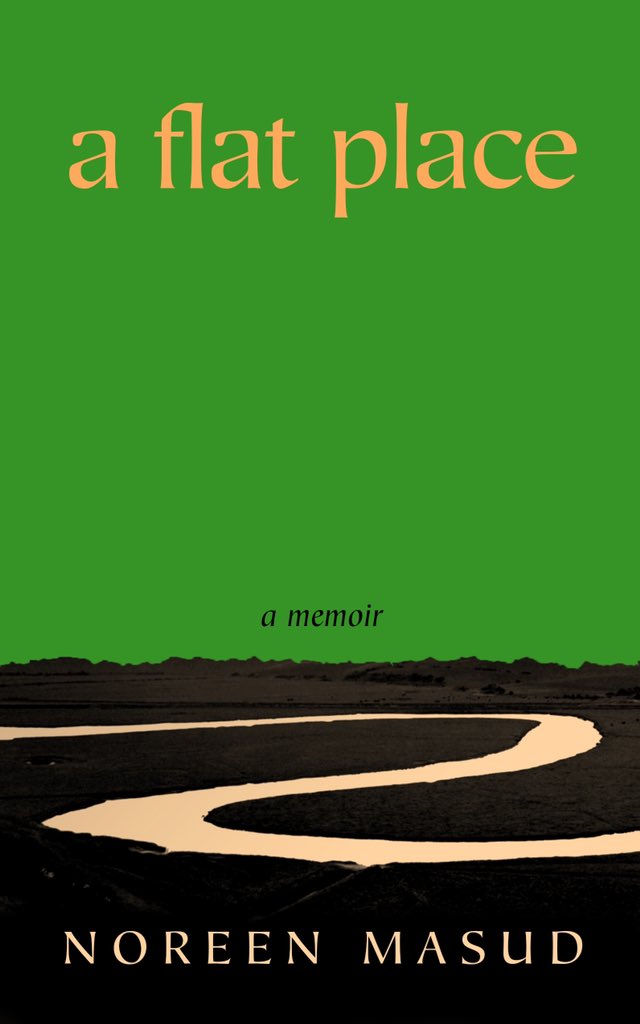
Raw and radical, strange and beguiling -a love letter to Britain's breathtaking flatlands, from Orford Ness to Orkney, and a reckoning with the painful, hidden histories they contain'Expansive, arresting, with sly humour... Masud establishes herself as a significant chronicler of personal and national experience' Financial Times'Noreen Masud fathoms the depths of flat landscapes - sharp, subtle and very moving' Robert Macfarlane'Haunting and generous, beautifully written - this book is a gift' Preti Taneja'A Flat Place reminds us that there is hope in the smallest of gestures' Sara AhmedNoreen Masud has always loved flatlands. Her earliest memory is of a wide, flat field glimpsed from the back seat of her father's car in Lahore. As an adult in Britain she has discovered many more flat landscapes to Orford Ness, the Cambridgeshire Fens, Morecambe Bay, Orkney. These bare, haunted expanses remind her of the flat place inside the place created by trauma.Noreen suffers from complex post-traumatic stress the product of a profoundly disrupted and unstable childhood. It flattens her emotions, blanks out parts of her memory, and colours her world with anxiety. Undertaking a pilgrimage around Britain's flatlands, seeking solace and belonging, she weaves her impressions of the natural world with poetry, folklore and history, and with recollections of her own early life.Noreen's British-Pakistani heritage makes her a partial outsider in these both coloniser and colonised, inheritor and dispossessed. Here violence lies beneath the fantasy of pastoral innocence, and histories of harm are interwoven with nature's power to heal. Here, as in her own family history, are many stories that resist the telling. She pursues these paradoxes fearlessly across the flat, haunted spaces she loves, offering a startlingly strange, vivid and intimate account of the land beneath her feet.
What I love about beautiful language in books is that it isn't just beautiful for its own sake. Its rhythms and pauses and propulsions create deeper meanings. They enrich the meanings already contained in the words themselves.
This is a beautifully written book. Its language is so lovely. Its meanings are so fully supported by the music of the words. There must be a word that defines this kind of writing. It's like 'linguistic synesthesia' to me--and heck if I know what I mean by that, but here I go, I'm trying to explain. The language is compressed in a way that one meaning pushes agains another meaning, the way sound can press against color, or taste against sound, in actual synesthesia.
"Near the end of my British grandmother's life, one memory came back to her again and again, as her appetite dwindled and she shrank into her chair."
'At night mosquitoes arrived, buzzing malaria.'
'The wind which ran its blade down the flat land seemed to scrape away all color. What I remember is bleached green, and my feet in leather shoes, moving over the ground as if through a trance.'
This is one of those rare and precious memoirs that is so full of empathy and self-understanding that it gives you as much a sense of your own self as it gives you an understanding of its author.
A sort of memoir, sort of self analysis, sort of travelogue, written by a British Pakistani woman about her abusive upbringing in Pakistan, her cPTSD, and her travels in Britain's flat places. (The Fens, Morecambe Bay, the Orkneys etc.)
It's beautifully written, and it conveys her psychological state with a lot of insight, but there are some major gaps or holes or something unacknowledged. It's really obvious the author isn't in a terrific place mentally, and I ended up having an itchy feeling that I wasn't sure I should be reading this. Which is stupid in that the author is an autonomous person who chose to put the book out there. But I wasn't comfortable with the level of intimacy/exposure this offers to the author's mind and experience which is ironic, given it's about a person who struggles to make connections with other people.
I don't know. It's terrifically well written and I found it compelling but increasingly jarring emotionally, and that's an entirely personal rather than literary response which I think I need to sit on for a while. Would also be very interested in responses from people with cPTSD.
(4.5) Longlisted for the Women’s Prize for Non-Fiction and the Jhalak Prize; shortlisted for the Sunday Times/Charlotte Aitken Young Writer of the Year Award. I also expect this to be a strong contender for the Wainwright Prize for nature writing, and hope it doesn’t end up being a multi-prize bridesmaid as it is an excellent book but an unusual one that is hard to pin down by genre. Most simply, it is a travel memoir taking in flat landscapes of the British Isles: the Cambridgeshire fens, Orford Ness in Suffolk, Morecambe Bay, Newcastle Moor, and the Orkney Islands.
But flatness is a psychological motif as well as a physical reality here. Growing up in Pakistan with a violent Pakistani father and a passive Scottish mother, Masud chose the “freeze” option when in fight-or-flight situations. When she was 15, her father disowned her and she moved with her mother and sisters to Scotland. Though no particularly awful things happened, a childhood lack of safety, belonging and love left her with complex PTSD that still affects how she relates to her body and to other people, even after her father’s death.
Masud is clear-eyed about her self and gains a new understanding of what her mother went through during their trip to Orkney. The Newcastle chapter explores lockdown as a literal Covid-era circumstance but also as a state of mind – the enforced solitude and stillness suited her just fine. Her descriptions of landscapes and journeys are engaging and her metaphors are vibrant: “South Nuns Moor stretched wide, like mint in my throat”; “I couldn’t stop thinking about the Holm of Grimbister, floating like a communion wafer on the blue water.” Although she is an academic, her language is never off-puttingly scholarly. There is a political message here about the fundamental trauma of colonialism and its ongoing effects on people of colour. “I don’t want ever to be wholly relaxed, wholly at home, in a world of flowing fresh water built on the parched pain of others,” she writes.
What initially seems like a flat authorial affect softens through the book as Masud learns strategies for relating to her past. “All families are cults. All parents let their children down.” Geography, history and social justice are a backdrop for a stirring personal story. Literally my only annoyance was the pseudonyms she gives to her sisters (Rabbit, Spot and Forget-Me-Not).
"I was held captive by this unyielding, silent space, and I began to understand two things. That flatness wasn't absence... but something strong and original and living. And that you could fall in love with flatness, gazing at it forever". WOW!!! made me cry!! so so special; insanely intimate and genuinely fascinating (so taken by the newcastle common lands "bread and daffodils for everyone"). notices connections between everything so acutely, and explains everything so poetically (colonialism, capitalism, patriarchy, phrases like "Blackberries weighed down the hedges. Some were melting, already, into wine. Others were still bound tight, like heads in hairnets"). i'm a huge fan of seeing nothing for what it is (nothing), and noreen just gets that better than anyone else ("we don't know how to look at places that don't do anything"). so happy i got to go to the launch for this, now considering doing a masters just so i can finally be taught by noreen
Noreen Masud draws parallels between flat landscapes in various places and the flatness she feels inside as a result of trauma. She journeys across landscapes as a way of processing relational trauma in hopes of softening a world that feels spiky and strange.
As someone who also feels the world is spiky and strange, I find this subject relatable; however, I DNFd about 60 pages in because Masud circles back to compare people and feelings and objects to landscapes so frequently that it felt redundant. Despite choosing to set this book aside, I suspect I'll give it another go in the future.
The overwhelming majority of people love this book, so please consider other reviewers' opinions before deciding if this is the right book for you.
I bought this as I was travelling towards one of the 'flat places' of the title - Cambridgeshire, and I thought I would enjoy the read while visiting. I had thought this was primarily a nature book, and in those bits, I really enjoyed it. But, the memoir part left me cold. I found it angry and overly introspective - the musings, complaints and reflections of a woman who had experienced some devlopmental trauma and is part way through her therapeutic journey, hopefully towards acceptance and growth. She admits to being deeply introverted, preferring her own company to others - most comfortable during lockdown than at any other time of her life, yet claims to know people, nations even. She takes swipes at many others, effectively othering the reader on numerous occasions. Had this book been more about place, and less about herself, it would have been a more pleasant read. Instead, it was often tiresome, only partially rescued by her ability to immersively describe some of the great open landscapes across Britain.
Masud's A Flat Place is a slow burner. I enjoyed the reflective tone and place-based journeys this book took me on, but overall, I found it difficult to grasp the nature of the complex trauma Masud tries to excavate. This is no fault of the author: trauma is both intensely personal and difficult to name. Reading this, however, felt like rooting through the mud for an unidentified thing - only, in the end, to return empty-handed.
I feel very mixed about this book as it’s so well written and my lack of emotional connection with the narrator perfectly reflects how she describes herself as being unable to connect with others. The metaphor of flat landscapes felt overused and sometimes convenient, and what seems to be simmering anger beneath the cold prose (except when writing about her cat and a bit when writing about her mother) could have been more brought to the surface so I could feel it more; I felt it could have been portrayed more openly rather than through biting remarks about other people. I really like the way she writes about colonialism, imperialism and racism; spot on. I wish I could say the exquisite and unforgettable descriptions of nature could have made me “feel” the book more, as I appreciate Masud’s literary skill so much.
The last chapter felt softer and left me feeling more sympathy for her. I don’t need to like or feel sympathetic to a narrator to appreciate a book, but I thought it would be stronger if she had revealed more about the other side of her experience: for example, with friends and her path to university and later employment. Or perhaps she was still at the stage of wanting others to acknowledge and hold her trauma as she was coming to terms with her experience through writing about it.
I thought the theme of complex trauma would have been better served if she had written more (even if not as much) detail about her day to day experience, both past and present, as she does about the landscape and nature. I imagine that she doesn’t describe much about her siblings and her experience with or of them to protect their privacy, but she clearly has friends and it seems lovers, and she left out what made them attracted to being with her if she was so disconnected. It made me feel a sense of victimhood, understandable after the brutality of her father and passivity of her mother, but not very satisfying in a book that seems to seek understanding about her condition through the lens of finding solace from complex trauma. Overall, I felt the inclusion of “complex trauma”, as advised by her editor, could have been further developed through more details about its source and not just its effects.
Thank the universe for Noreen Masud! You, lady, have brought me out of an horrific reading slump of 1 & 2 star reads!
This book is so intelligently written. What appears at face value to be a book about "flat places" such as fens, marshes, arable farming fields, soon becomes a masterful investigation into Noreen's own terrible upbringing and the complex PTSD she has been left with, thanks to her parents.
She describes some truly freakish experiences from childhood and delves into the tangled history of post-colonial Pakistan, Muslim society, inequalities in access to society and education, patriarchy, misogyny. Her writing is both succinct yet poetic.
A phrase that Noreen says towards the end of the book really jumped out at me.......
"All families are cults. All parents let their children down".
Indeed Noreen. Families silence the truth tellers, they brush the undesirable things under the carpet, they perpetuate the myths of an idyll. And some of us emerge more scathed than others.
Ich fand sehr gut, dass hier mal Nature Writing auf der Basis von sehr wenigen winzigen und zum Teil organisierten Ausflügen in die Natur betrieben wird. Außerdem erschien es mir bisher (lag aber vielleicht nur an meiner Bücherauswahl) wie ein sehr weißes Genre, das war für mich das erste Buch, in dem es anders ist, nicht nur so aus Prinzip, sondern auf produktive Weise. Vom Untertitel sollte man sich nicht abschrecken lassen.
‘It is possible to know something you are not allowed to know. Very gently and deeply, like a whale passing beneath a boat, a long animal just under the surface.’
I loved this book and that sentence took my breath away - there were numerous moments like the above where it communicated something I’d never felt communicated and it made me catch my breath. But more than that, it was one of those rare reading experiences that makes you want to write. From the very first page, the writing feels both raw, but also fully formed, as if the writer was writing in one long flow. I wanted to write a review despite never writing these because it affected me so much in such an expected way as a read.
Initially it suggests itself as a nature book, but instead for me it read like a highly personal story about what we need from and as people to feel safe. It looks at flat landscapes in Britain through the book, landscapes like Morecambe Bay, for example, which I never knew existed, and that in itself was a pleasure, googling them and seeing their surreal qualities. But, as the book goes on, it’s less and less a nature book. It’s a book about a process one person has taken and it looks at how we might relate to landscapes in ways we can use to make sense and space for ourselves. With this process, you are on an intimate journey with the author, but it resists the need to bundle that up into a nugget for you to take away or to make it seem like when we finish writing or reading books we are all fully healed. It feels like a book about being ‘with’, and, in that way, things becoming safer over time. In the end, the author allows things to not cohere into a readable landscape. Instead, the book finishes on what we need from our mothers, and what we need to be alive. For me it was profoundly moving.
It was also challenging - the writing also made me hold my breath in sometimes, both in being with the author, but also feeling like something had been spoken I wanted to pay witness to and allow to land deep in me. Sometimes being ‘with’ the author involved having to be with them from a distance, because I am white, and the book allows itself to be written from a non-white perspective. Reading this book was profoundly good for me, in the way that sometimes what is good for us is also hard. The book itself is really interested in how we can allow things to be both at the same time. At one point, she references what George Eliot wrote - about ‘the roar on the other side of silence’. And the writing is like this: sensory, painful but never in any way prurient. It allows things to be what they are, while also sharing them with us in an important way.
The book repeatedly makes Britain’s colonial past visible, highlighting ways that Britain’s colonialist history is an ongoing reality in the present, which is clangingly open to view, everywhere and never seen. It was hard but true to read sentences like ‘Everyone makes decisions about who gets to be human’ and the book offers you ways to look and consider experiences different to your own.
And I loved its ending. Throughout the book, you can tell that this is a writer who cares profoundly about communicating, and is writing about the struggle to communicate and the struggle to exist, and the pain of being misread. But it ended in a way that made me feel that the author had reclaimed something: had reclaimed a right to not be fully understood in order to be themself, the right to be while not feeling compelled to facilitate others’ knowing. So it was a book that helped me know myself more and moved me deeply thinking about my own relationships, but also stood apart from me, as it wasn’t about me, but took me with it while claiming its own self, and throughout that felt like an intimate honour to be beside. It was a real experience - a memoir that felt fully real, fully here with you, like a person’s deepest self said out loud, live, to help them know something, and like literature - a full expression of something very important. I would definitely recommend it and will be giving it to friends.
A book that explores one person’s life by recording her response to the spirit of (flat) places. For me, the descriptive writing about landscapes resonated more, as I have been to several of those places, whether in passing, like Morecambe Bay, or on holiday, like the Orkneys and Orford. What drew me to the landscapes was probably the coast and sea, which remind me of where I was from. I enjoyed the occasional literary quotations, mainly poetry where I knew the author’s name and little else, and these felt complementary to Masud’s reflective memoir, rather than intrusions. The tangential approach to Masud’s experience (which she labels complex post-traumatic stress disorder, for want of a better description, noting that she is less interested in the diagnosis, or the term, than in the particularities of the way I experience my life) is interesting for someone who understands little of the feelings expressed. Some of the descriptions of Masud’s childhood reminded me of the first section of Kamila Shamsie’s novel, Best of Friends, and the descriptions of place are excellent.
The reflective consideration expressed through the majority of the book was marred for me by some of Masud’s homogenising anti-white racism, which lumped all white people together, and excluded any other people from that grouping of entitlement (for example, page 139 about Newcastle Moor and 2020 pandemic lockdown). I can understand the anger she may feel, but not its grouping of all white British under this “umbrella”.
A Flat Place a really thoughtful, lyrical and probing work of nonfiction that seamlessly blends personal history with landscape writing. Masud finds a sense of solace, comfort and a mechanism to confront her long suppressed demons in the expansive, arresting and uncanny aliveness of flat landscapes. It’s really powerful and doesn’t shy away from the more difficult topics like complex PTSD and Britain’s convoluted role as an imperialist power and the atrocities it’s carried out in the name of empire. The writing is assured, evocative and lyrical. I really liked this and it’s (hopefully) set the mood for a great reading year in 2025. Highly, highly recommend.
Virkelig sårbar og ærlig bog om traume og kultur. Den er meget anderledes end andet jeg har læst og lidt slow pace, men synes den var smuk på en meget umiddelbar og ligetil (eller flad) måde, hvilket passer godt til temaet
A Flat Place by Noreen Masud is a memoir which focuses on the exploration of landscapes, particularly flat ones. The author takes us on a journey through Britain and Pakistan, blending nature with personal experiences and she draws parallels between the landscapes and her experiences as a survivor of childhood trauma. These landscapes provide the author a sense of calm and refuge from the noise of the world.
Masud's writing is poignant and lyrical, pulling the reader into the beauty of landscapes such as The Fens, the Scottish coast and the Yorkshire Moors. She explores the relationship between terrains and our emotions. The one thing which distinguishes A Flat Place is it doesn't offer neat and quick resolutions. Masud embraces uncertainty and the reader is made to look upon flat landscapes not as empty areas but as spaces with numerous possibilities.
A thought provoking read for people that appreciate memoirs and writings about nature. Highly recommended!
“Flatlands seem to promise us a steady footing. We take this, as we often take our mothers, for granted. Both are expected to offer what the psychologist John Bowlby called the ‘secure base,’ a predictable environment on which one can build—a house, a city, a sense of self—and from which one can safely explore. For a baby to feel safe, the mother must hold it in a way that’s unnoticeable: as a flatland holds a city, so convenient to its inhabitants that they never have to think about it.” • This book, written like a diary, is a raw and intimate portrayal of how complex trauma affects the author’s life. She doesn’t spell out every incident that has led to her trauma but instead uses metaphors based on flat spaces and landscapes to convey her thoughts and emotions. The reader is not spoon-fed but rather invited to piece together the author’s complex mind.
The author uncovers memories that sometimes feel almost incredible, as trauma often does. You question her just as much as she questions herself. But through it all, you understand that complex trauma has many layers—whether due to generational trauma, racial issues, or economic injustice. Everything is intertwined.
At the end of the day, what I took away from this book is that people act as best as they can, but everyone has their own definition of it. We may never fully understand someone’s true intentions, but sometimes, we have to learn to trust them. Though I find that hard to do, this book reminded me that trust, while fragile, can still be possible.
This book really challenged me to think about what environments make me feel more or less comfortable, amongst many other things.
The author feels comforted by vast, flat spaces of land, and asks why so often we feel the need to be surrounded by dramatic terrains like mountains; why our eyes are drawn to them, and why we sometimes want to conquer them. I think this is already an interesting question.
I can understand why picturing an open, flat meadow can be a relaxing thought. When I think about this in more depth, what I’d find relaxing in this mental image would probably be the addition of some kind of contrast in the environment - maybe some mountains in the backdrop, a river, or some kind of plant/animal. For the author, it is the removal of these juxtapositions which make her feel most at ease.
If I imagine an empty, featureless field with nothing to focus my eyes on, I more imagine a sense of panic at not knowing where to look. I’d never thought about this before reading this book, and it’s not how I imagined I’d feel.
There were times in this book where I almost couldn’t feel more opposed to the authors feelings. I was actually about to write ‘intrinsically opposed’, but I think the main theme of this book is how experiences shape what situations and environments bring us comfort.
The author experiences complex PTSD, and she also explains how this affects her struggles to connect with other people. There were many times in this book where I felt that her outlook on life and (frequently) on other people was fairly bleak, and sometimes harsh. Though that didn’t always make for the most enjoyable reading experience, her reasoning was often justified, or her thought process explained.
I don’t think this book was perfect - it sometimes felt a bit scattered, with some parts slightly underdeveloped. And, I also found it very interesting and thought-provoking, so definitely recommend!
This is my second review as my first one was deleted by goodreads. I was lucky enough to attend a free literary festival and listen to and meet two delightful authors - Noreen and Jacqueline Crooks on a panel chaired by Aditi Jaganathan. During the first five minutes Noreen talked very passionately about the political situation in Gaza which was applauded by the audience. She is an academic and obviously didn’t expect such a scholarly and personal memoir to do so well. N talked about the power of memory and the problems of writing autobiographically. Both her and JC spoke about colonialism, dislocation and oppression. Noreen has suffered from derealisation which connects with both this subject and identity. Grief is also a major theme and she talked about the healing power of nature, but as was stressed in the Sevenoaks Bookshop podcast, this is not a middle-class national trust type of rural idyll. When Noreen signed my book we discussed her Sevenoaks podcast interview, especially the invented cocktail she told Harry about.
I've never known anyone write about landscape the way Noreen Masud does. My experience of life is very different to hers but, even so, she writes about an experience of landscape that I absolutely resonate with but have never been able to put words to myself.
I love to read nature writing but am getting tired of the usual topics and the usual writers - this was refreshing and highly memorable.
In many ways this book is a hard read, dealing as it does with controlling relationships, colonialism and racism. At no point does the writer try to soften her anger or avoid uncomfortable topics. But the writing feels so true, so honest, so intimate that I just loved it. You can tell the writer has a longstanding relationship with poetry in the way she formulates her thoughts and sentences. This is a book to absorb.
Highly recommend if you want a beautiful and unusual book and are willing to be challenged by it.
2.5? i don't know. this book definitely has a story in it and it certainly has some fantastic things to say, but its structure is just so messy. it jumps back and forward between places and times and definitely could have done with some more order to help the reader make sense of it. also, having been to most of these flat places, i found i could only visualise them because i had been there.
A lyrical meditation on family, memory, place and belonging. There is an understated emotional devastation packed into Masud’s prose. A really great memoir.
“But Pakistan stored a wordless knowledge inside me - a sure, horrifying, beautiful certainty - which is wholly at odds with the world I now live in : a reality Britain can’t absorb. And I don’t want to stop feeling the way I do. I don’t want to give up knowing, in this very visceral way, what I know about people and what they can do to you. Countries and what they can do to you. I don’t want ever to be wholly relaxed, wholly at home in a world of flowing fresh water built on the parched pain of others. The world itches, and so it should. When there is a truth which affirms itself insistently in a way that has no end and no resolution,when it receives no responsiveness or recognition, and has nowhere to site itself but in itself, entrenched in its own starkness - that’s the flat place.”
There’s a lot in this book I wanted to write about in my review. A lot of feelings I had in my childhood in Pakistan and a few oddly similar experiences and then I realised I already know all this and writing this would just be another effort of mine to be seen by others and to try convey something which can’t be conveyed because it’s meaningless to others and that’s ok.
The author captured this perfectly : “I can’t hold up what I remember as any kind of explanation. My memories matter to me. But they cannot matter to you. When you face me, I offer up something on to which - I think - you might grasp. But - like the low trees of the fens, the flowers in the hedges- it’s not enough. You pause on it, stymied, then pass on. To come to terms with myself - my ambiguously damaged self - I must become okay with that form of contact, of touch. To feel that I don’t need to explain that surface which defies attention or comprehension […] But there’s another leap i’m staring to be able to make ; to make the offering without explanation, and not to mind if sometimes I receive blank looks in return. Countless tiny things, which I cannot make mean anything in themselves, have compacted into the firm peat of my life, the surface over which I walk. What matters now is that surface. I stand on it on all the time. It’s always with me.”
So that said, I won’t bother explaining why the last chapter of this book especially meant so much to me. About the chicken wire fences, paisley carpets or armed robberies. These are my memories - and I don’t need to try force understanding into others for them to mean anything more or less. Thank you Noreen Masud.
This has been on my list (and my coffee table) for a while, and I'm so glad I finally got to it. It's exactly my cup of tea: contemplative narrative, some psychology here and there, nuanced explorations of British landscapes, 20th century authors, and beautiful prose.
My small personal complaint is that she introduces the concept of flatness as a little off the beaten trail — I understand her point, but I'm a lifelong Midwest girl and we certainly dote on the prairies, both in personal reflection and in literary tradition. But that's beside the point.
“Some things stay unresolved. You make peace with their active, living presence in your life. You live in, and with, the charged absence.”
Back in 2023, a nonfiction memoir became my favourite book of the year, for the way it combined nature-writing and descriptions of landscapes with the author’s deeply personal story of disability and chronic illness. That book was Some of Us Just Fall: On Nature and Not Getting Better, and it’s been a long time since I’ve encountered another memoir that hit similar vibes to that one. Until now. What Polly Atkin did in exploring chronic illness reflected through bodies of water, Noreen Masud does for trauma through flatlands. Beautiful prose, clear observations, striking vulnerability, and a journey that’s relatable and cathartic without sugarcoating the (emotional) landscape through which said journey takes place. More thoughts to come once my feelings about this one have fully settled.