

What do you think?

Landscapes
A darkly absorbing, prismatic debut novel from Christine Lai, set in a near future that is fraught with ecological collapse and geopolitical upheaval, Landscapes explores memory, empathy, and art as an instrument for recollection and renewal.In a ruinous country house in the now barren English countryside--decimated by heat and drought--and in a dusty library damaged by earthquake and floods, Penelope archives what remains of the estate's once notable, now diminished, art collection. As she delves into the objects and images, she also keeps a diary of her final months in the dilapidated estate that has been her home for two decades and a refuge for those who have been displaced by disasters. Out of necessity, Penelope and her partner, Aidan, have sold the house and with its scheduled demolition comes this pressing task of building the archive. But with it also comes the impending arrival of Aidan's brother, Julian, who will return to have one final look at his childhood home. Penelope suffered at the hands of Julian twenty-two years ago during a brief but violent relationship, and as his visit looms large over her, she finds herself unable to tamp down the past in her efforts to build a possible, if uncertain, future.In this elegiac and spellbinding blend of narrative, essay and diary, Penelope's past, present and future collide as fear and loss close in around her, and she clings to art as a means of understanding, of survival, and of reckoning. Recalling the works of Rachel Cusk and Kazuo Ishiguro, Landscapes is an evocative reinvention of the pastoral and the country house novel for our age of catastrophe, and announces the arrival of an extraordinarily gifted new writer.
296 pages, Hardcover
First published September 12, 2023
Ratings & Reviews
Friends & Following
Create a free account to discover what your friends think of this book!
Community Reviews
Displaying 1 - 30 of 154 reviews

January 6, 2024
Finalist for the CLMP Firecracker Award
Longlisted for the 2023 Republic of Consciousness Prize US & Canada
The truth of any single thing, Celia said in response, requires time and continual return.
Christine Lai's Landscapes is wonderful hybrid novel combining a story of ecolological collapse, the history of the violence of the male gaze in art, and the power of rememberance and preservation, and one that draws deeply from the well of modern literary.
In terms of the novel's framing and plot, it's as easy to quote the blurb as rewrite it myself:
The novel is in three intertwined parts:
- Penelope's ekphrasis of key works of art for her, which begin (see below) with Turner, her favourite artist, but increasingly focus on a more disturbing strand of how male misogynistic violence has been beautified in art (see here for the stance taken by the Isabella Gardner Museum which houses the Rape of Europa, one of the works Penelope references).
It was seeing Turner's The Rape of Proserpine (1839) in the Clore Gallery at Tate Britain in the days after Julian's had raped her which first re-orientated her art history writing towards depictions of violence against women (and from interviews re-orientated Lai's approach to the novel), in addition to a metope from the South frieze of the Parthenon of a centaur abducting a Lapith woman within the Elgin Marbles at the British Museum.
- the main narrative, in the form of a diary kept by Penelope over her last 7 months at Mornington Hall and leading up to an expected re-encounter with Julian, which she dreads after he raped her two decades earlier.
The diary includes within it catalogue entries for books and postcards from the Hall's collection (and in a Selaldian practice based on books and other material collected by Lai);
- a close third-person account from Julian's perspective, as he journeys through, a largely devastated, Europe to return to Mornington Hall (which a passing reference tells us was founded on sugar wealth i.e. the proceeds of slave labour).
The book begins with the ekphrasistic writing, beginning with Turner's various paintings and drawings that featured the ruins of Ehrenbreitstein Fortress, even after the Fortress had been reconstructed.
It was as if the painter's eyes overleapt the newly built form and his gaze continued to be held by the ruins of the half-demolished structure, poised on the threshold between collapse and renewal.
Words that speak to Penelope's own position.
The first entry in Penelope's diary is then:
SEPTEMBER 1
I picture myself standing in the midst of a ruin. All around me there are mildewed canvases, rolled up crudely or crammed into drawers. The edges of the papers, mouse-eaten or worm-eaten, fall into heaps of dust. As I work through the disorderly archive and chip away at the mountain of responsibilities, my mind is drawn back to this image of Turner's studio, left in a state of Pompeii-like destruction after the painter's death. That same atmosphere of decay permeates the Library in which I spend my mornings. On better days, disorder is forestalled, and there is only the linearity of the catalogue and the neat collection of books and objects. On days of anxiety, such as today, I find myself stranded in the wreckage. The dust that has gathered in the corners, the moldy papers, the shelves that bend under the weight of books and archival boxes, all these seem to be advancing toward me, millimeter by millimeter, until they overwhelm me.
Wonderfully, that line 'millimeter by millimeter' an explicit nod by the author to WG Sebald, a key influence on the text, and the passage from The Emigrants, in Michael Hulse's translation, and the description therein of Max Furber's studio (Ferber a fictionalised Frank Auerbach):
When one entered the studio it was a good while before one’s eyes adjusted to the curious light, and, as one began to see again, it seemed as if everything in that space, which measured perhaps twelve metres by twelve and was impenetrable to the gaze, was slowly but slowly but surely moving in upon the middle. The darkness that had gathered in the corners, the puffy tidemarked plaster and the paint that flaked off the walls, the shelves overloaded with books and piles of newspapers, the boxes, work benches and side tables, the wing armchair, the gas cooker, the mattresses, the crammed mountains of papers, crockery and various materials, the paint pots gleaming carmine red, leaf green and lead white in the gloom, the blue flames of the two paraffin heaters; the entire furniture was advancing, millimetre by millimetre, upon the central space where Ferber had set up his easel in the grey light that entered through a high north-facing window layered with the dust of decades.
Similarly a key passage in Julian's account, and one that perhaps brings him as close as such a flawed character gets on the first step to redemption - the realisation of what one has done - reads:
It strikes Julian that one's perception of time is never reliable. One lives through many different slices of time, in each of which one performs a different role. In one, he is an art historian; in another, an architect. A lover. A victim. A killer. A rapist.
Which of course mirrors the famous, and equally crucial, lines from Gabriel Josipovici's brilliant The Cemetery in Barnes:
One sprouts so many lives, he would say, and look at her and smile. One is a murderer. One an incidendary. One a suicide. One lives in London. One in Paris.
Other key works with which the novel is in dialogue include Kafka’s diaries; the writing and art of Louise Bourgeois; more of W.G. Sebald’s novels; Rainer Maria Rilke's The Notebooks of Malte Laurids Brigge; John Berger’s writing on the history of art; Calvino’s Invisible Cities; Ishiguro’s blurring of genre and his country house settings; Mirna Pavlovic’s photographs (see below), and many more (see e.g. this interview on the publisher's website).
Some works of art which are key to the novel (many more are referenced):
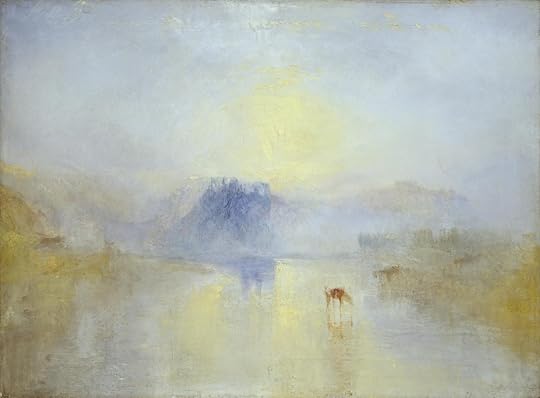
Turner's Norham Castle, Sunrise (c.1845) which Penelope says is the first art work she fell in love with, and which remains a crucial reference for her:
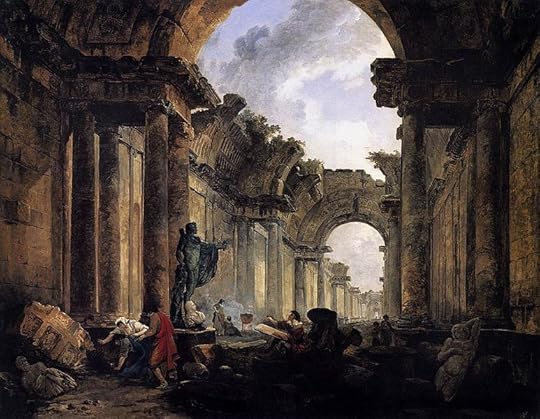
Hubert Robert - Imaginary View of the Grande Galerie in the Louvre in Ruins - a work which angers Julian when he sees it in the Louvre, but which also speaks to Penelope's artistic work in the ruins :
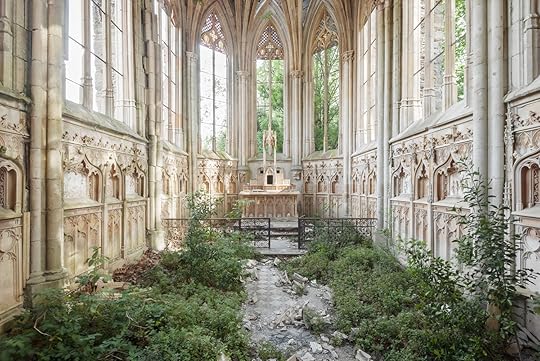
One of architectural photographer Mirna Pavlovic's works that Lai has said inspired her vision of the crumbling Mornington Hall:
Very impressive.
The publisher
Two Dollar Radio is a family-run outfit founded in 2005 with the mission to reaffirm the cultural and artistic spirit of the publishing industry.
We aim to do this by presenting bold works of literary merit, each book, individually and collectively, providing a sonic progression that we believe to be too loud to ignore.
Longlisted for the 2023 Republic of Consciousness Prize US & Canada
The truth of any single thing, Celia said in response, requires time and continual return.
Christine Lai's Landscapes is wonderful hybrid novel combining a story of ecolological collapse, the history of the violence of the male gaze in art, and the power of rememberance and preservation, and one that draws deeply from the well of modern literary.
In terms of the novel's framing and plot, it's as easy to quote the blurb as rewrite it myself:
In a ruinous country house in the now barren English countryside--decimated by heat and drought--and in a dusty library damaged by earthquake and floods, Penelope archives what remains of the estate's once notable, now diminished, art collection. As she delves into the objects and images, she also keeps a diary of her final months in the dilapidated estate that has been her home for two decades and a refuge for those who have been displaced by disasters. Out of necessity, Penelope and her partner, Aidan, have sold the house and with its scheduled demolition comes this pressing task of building the archive. But with it also comes the impending arrival of Aidan's brother, Julian, who will return to have one final look at his childhood home. Penelope suffered at the hands of Julian twenty-two years ago during a brief but violent relationship, and as his visit looms large over her, she finds herself unable to tamp down the past in her efforts to build a possible, if uncertain, future.
The novel is in three intertwined parts:
- Penelope's ekphrasis of key works of art for her, which begin (see below) with Turner, her favourite artist, but increasingly focus on a more disturbing strand of how male misogynistic violence has been beautified in art (see here for the stance taken by the Isabella Gardner Museum which houses the Rape of Europa, one of the works Penelope references).
It was seeing Turner's The Rape of Proserpine (1839) in the Clore Gallery at Tate Britain in the days after Julian's had raped her which first re-orientated her art history writing towards depictions of violence against women (and from interviews re-orientated Lai's approach to the novel), in addition to a metope from the South frieze of the Parthenon of a centaur abducting a Lapith woman within the Elgin Marbles at the British Museum.
- the main narrative, in the form of a diary kept by Penelope over her last 7 months at Mornington Hall and leading up to an expected re-encounter with Julian, which she dreads after he raped her two decades earlier.
The diary includes within it catalogue entries for books and postcards from the Hall's collection (and in a Selaldian practice based on books and other material collected by Lai);
- a close third-person account from Julian's perspective, as he journeys through, a largely devastated, Europe to return to Mornington Hall (which a passing reference tells us was founded on sugar wealth i.e. the proceeds of slave labour).
The book begins with the ekphrasistic writing, beginning with Turner's various paintings and drawings that featured the ruins of Ehrenbreitstein Fortress, even after the Fortress had been reconstructed.
It was as if the painter's eyes overleapt the newly built form and his gaze continued to be held by the ruins of the half-demolished structure, poised on the threshold between collapse and renewal.
Words that speak to Penelope's own position.
The first entry in Penelope's diary is then:
SEPTEMBER 1
I picture myself standing in the midst of a ruin. All around me there are mildewed canvases, rolled up crudely or crammed into drawers. The edges of the papers, mouse-eaten or worm-eaten, fall into heaps of dust. As I work through the disorderly archive and chip away at the mountain of responsibilities, my mind is drawn back to this image of Turner's studio, left in a state of Pompeii-like destruction after the painter's death. That same atmosphere of decay permeates the Library in which I spend my mornings. On better days, disorder is forestalled, and there is only the linearity of the catalogue and the neat collection of books and objects. On days of anxiety, such as today, I find myself stranded in the wreckage. The dust that has gathered in the corners, the moldy papers, the shelves that bend under the weight of books and archival boxes, all these seem to be advancing toward me, millimeter by millimeter, until they overwhelm me.
Wonderfully, that line 'millimeter by millimeter' an explicit nod by the author to WG Sebald, a key influence on the text, and the passage from The Emigrants, in Michael Hulse's translation, and the description therein of Max Furber's studio (Ferber a fictionalised Frank Auerbach):
When one entered the studio it was a good while before one’s eyes adjusted to the curious light, and, as one began to see again, it seemed as if everything in that space, which measured perhaps twelve metres by twelve and was impenetrable to the gaze, was slowly but slowly but surely moving in upon the middle. The darkness that had gathered in the corners, the puffy tidemarked plaster and the paint that flaked off the walls, the shelves overloaded with books and piles of newspapers, the boxes, work benches and side tables, the wing armchair, the gas cooker, the mattresses, the crammed mountains of papers, crockery and various materials, the paint pots gleaming carmine red, leaf green and lead white in the gloom, the blue flames of the two paraffin heaters; the entire furniture was advancing, millimetre by millimetre, upon the central space where Ferber had set up his easel in the grey light that entered through a high north-facing window layered with the dust of decades.
Similarly a key passage in Julian's account, and one that perhaps brings him as close as such a flawed character gets on the first step to redemption - the realisation of what one has done - reads:
It strikes Julian that one's perception of time is never reliable. One lives through many different slices of time, in each of which one performs a different role. In one, he is an art historian; in another, an architect. A lover. A victim. A killer. A rapist.
Which of course mirrors the famous, and equally crucial, lines from Gabriel Josipovici's brilliant The Cemetery in Barnes:
One sprouts so many lives, he would say, and look at her and smile. One is a murderer. One an incidendary. One a suicide. One lives in London. One in Paris.
Other key works with which the novel is in dialogue include Kafka’s diaries; the writing and art of Louise Bourgeois; more of W.G. Sebald’s novels; Rainer Maria Rilke's The Notebooks of Malte Laurids Brigge; John Berger’s writing on the history of art; Calvino’s Invisible Cities; Ishiguro’s blurring of genre and his country house settings; Mirna Pavlovic’s photographs (see below), and many more (see e.g. this interview on the publisher's website).
Some works of art which are key to the novel (many more are referenced):
Turner's Norham Castle, Sunrise (c.1845) which Penelope says is the first art work she fell in love with, and which remains a crucial reference for her:
Hubert Robert - Imaginary View of the Grande Galerie in the Louvre in Ruins - a work which angers Julian when he sees it in the Louvre, but which also speaks to Penelope's artistic work in the ruins :
One of architectural photographer Mirna Pavlovic's works that Lai has said inspired her vision of the crumbling Mornington Hall:
Very impressive.
The publisher
Two Dollar Radio is a family-run outfit founded in 2005 with the mission to reaffirm the cultural and artistic spirit of the publishing industry.
We aim to do this by presenting bold works of literary merit, each book, individually and collectively, providing a sonic progression that we believe to be too loud to ignore.

October 11, 2023
Penelope, a woman who waits, is the first-person narrator of most of this novel. Through her writing, she works through past trauma, conceding that the one who waits is the one without power. For her, this power exists in a man who was her lover and then her rapist. She awaits his arrival at his childhood home, the home of her partner, his brother. Third-person sections from this off-putting man’s perspective, as he travels toward his erstwhile home, round out the rest of the novel. It’s a fairly short book, but I didn’t find it a quick read at all.
The narrator works through her past by musing on art through the ages: how the depiction of rape was used in paintings and sculpture by the Masters (men); how, despite the titles of these works sometimes including the word ‘rape,’ these objects of art were (are) a form of titillation. Her musings conclude with descriptions of art from more recent years by women artists who create on the same theme. The difference is unstated but obvious. Interspersed with journal and archival entries, these sections of art criticism, as a whole, were my favorite part of the book.
Set in a near-future, the waiting includes the further deterioration of the climate: The beloved trees that once surrounded and protected the decaying mansion Penelope, her partner, and refugees live in needs to be demolished. Who has the power in this scenario?
3.5
The narrator works through her past by musing on art through the ages: how the depiction of rape was used in paintings and sculpture by the Masters (men); how, despite the titles of these works sometimes including the word ‘rape,’ these objects of art were (are) a form of titillation. Her musings conclude with descriptions of art from more recent years by women artists who create on the same theme. The difference is unstated but obvious. Interspersed with journal and archival entries, these sections of art criticism, as a whole, were my favorite part of the book.
Set in a near-future, the waiting includes the further deterioration of the climate: The beloved trees that once surrounded and protected the decaying mansion Penelope, her partner, and refugees live in needs to be demolished. Who has the power in this scenario?
3.5

August 23, 2023
Christine Lai’s intriguing, inventive novel revolves around Mornington Hall, a sprawling, country house founded on profits from slavery. Its shifting fortunes reflect wider historical changes, like many “great” houses it experienced periods of decline, until it was snapped up by someone rich enough to restore it. But now England’s devastated by the fallout from escalating, climate change, and the house along with it: the trees that once lined its grounds are dead or dying, earthquakes and drought have destroyed much of what’s left. The land’s sold and the Hall scheduled for demolition. Inside its crumbling walls, Penelope, a former art historian, is intent on cataloguing the remnants of its library. Her diary charts her progress, threaded through with glimpses of recent events from catastrophic floods to mass migrations. The house is currently Aidan’s, Penelope’s partner. The slender plot hinges on the imminent return of Julian, Aidan’s brother, after a twenty-year absence. But Julian was once Penelope’s boyfriend, until his brutality ended things. Haunted by what happened between them, Penelope’s diary entries are interspersed with essay-like reflections on art depicting violence against women: from paintings in the “heroic rape tradition” to Bellmer’s surrealist misogyny to Ana Mendieta’s challenge to these ways of seeing. Lai juxtaposes these sections with a detailed account of Julian’s journey from Italy to England.
Lai’s debut’s intricate and highly referential, accompanied by notes and lists of writers and artists whose work informed hers. Binaries and oppositions feature heavily, the fascination with the beauty of ruins that captivated artists like Casper David Friedrick is set against Louise Bourgeois’s refiguring of ruin and memory and her investment in art as a means of processing trauma and rebuilding. Shielded by his wealth, Julian inhabits a different world from Aidan’s and Penelope’s: as they struggle to create a sustainable future, he remains invested in consumption, obsessed with ownership. Aidan and Penelope explore communal forms of living, sharing their space with bands of displaced people, Julian uses his money to steer clear of the poor and dispossessed. Their vastly different responses to a world in crisis link to broader issues of dominance and possession versus cooperation and stewardship - with imagery of violence against women echoing aspects of the violence inflicted on nature.
This is one of those novels that left me feeling slightly conflicted. It was definitely worth the time, I liked the writing, especially in Penelope’s sections, the narrative was extremely compelling, often provocative, but I wasn’t totally convinced by it – the disparate strands just don’t quite come together. Lai’s a more-than-interesting writer but she can be quite heavy-handed. Julian, in particular, is a bit of a “stock” villain – I found it hard to believe he’d actually be invited to Mornington Hall after his horrific attack on Penelope or be brazen enough to come. I also felt the emphasis on high art and culture sometimes sat uneasily alongside Lai’s presentation of, what seemed, more pressing, political concerns in a world that’s literally falling apart.
Thanks to Edelweiss and to publisher Two Dollar Radio for an ARC
Rating: 3.5
Lai’s debut’s intricate and highly referential, accompanied by notes and lists of writers and artists whose work informed hers. Binaries and oppositions feature heavily, the fascination with the beauty of ruins that captivated artists like Casper David Friedrick is set against Louise Bourgeois’s refiguring of ruin and memory and her investment in art as a means of processing trauma and rebuilding. Shielded by his wealth, Julian inhabits a different world from Aidan’s and Penelope’s: as they struggle to create a sustainable future, he remains invested in consumption, obsessed with ownership. Aidan and Penelope explore communal forms of living, sharing their space with bands of displaced people, Julian uses his money to steer clear of the poor and dispossessed. Their vastly different responses to a world in crisis link to broader issues of dominance and possession versus cooperation and stewardship - with imagery of violence against women echoing aspects of the violence inflicted on nature.
This is one of those novels that left me feeling slightly conflicted. It was definitely worth the time, I liked the writing, especially in Penelope’s sections, the narrative was extremely compelling, often provocative, but I wasn’t totally convinced by it – the disparate strands just don’t quite come together. Lai’s a more-than-interesting writer but she can be quite heavy-handed. Julian, in particular, is a bit of a “stock” villain – I found it hard to believe he’d actually be invited to Mornington Hall after his horrific attack on Penelope or be brazen enough to come. I also felt the emphasis on high art and culture sometimes sat uneasily alongside Lai’s presentation of, what seemed, more pressing, political concerns in a world that’s literally falling apart.
Thanks to Edelweiss and to publisher Two Dollar Radio for an ARC
Rating: 3.5

Read
December 30, 2023On page 210 I read the words "I feel a tremendous sense of relief" and experienced the same feeling in my own self to see that I'd come nearly to the end of this novel, which exhausted me. It's not the book's fault. It's me, it's me, it's me. As I read along I could always tell something lovely was happening in these passing pages but I had no idea how to access it. Whether it's my mood, or the frenzied tumble of a year that's coming to a close, or for some other reason I'm not sure. I began to detach on page 8 after I came to the sentence: "And I will see, for the first time in twenty-two years, the man who forced himself upon me in the unbearable summer heat." I found the diction here to be inexplicably formal, where I wasn't sure how seriously to take this character. As I read on I kept feeling the disconnect growing. I have no excuse or justification. It just wasn't for me.

January 6, 2024
Small publisher Two Dollar Radio has done it again for me - a quiet gem of a novel that is not flashy or showy, but still not quite like anything else I've read. I was attracted to the set up of this novel - a near future eco-dystopia set around a crumbling manor house in England, but one that is focused on human relationships rather than the environmental catastrophe itself.
I was immediately drawn to the main character, Penelope, who is something I rarely see in literature - an ordinary, average kind of person, but interesting to me for the way she is processing the two traumas she's living through: ecological collapse, and the impending visit of a man who physically attacked her many years ago. Penelope is someone who establishes order around herself, building as safe and productive a world as she can - conserving, repairing and cataloging the great house and its contents, and turning it into a hostel for traveling climate refugees that is as comfortable and supportive as possible. She lives in the house with her boyfriend who is kind, steady and optimistic against all odds.
The story is told in Penelope's quiet voice and goes back in time to her childhood, and also introduces interesting residents of the manor/hostel. Penelope often processes her feelings through contemplation of the art in the house, especially the paintings and reproductions of early 19th century British painter JMW Turner. This sounds like it could be dry or pedantic, but I didn't find it that way at all. It just added to the elegiac, gentle feel of the book.
I was immediately drawn to the main character, Penelope, who is something I rarely see in literature - an ordinary, average kind of person, but interesting to me for the way she is processing the two traumas she's living through: ecological collapse, and the impending visit of a man who physically attacked her many years ago. Penelope is someone who establishes order around herself, building as safe and productive a world as she can - conserving, repairing and cataloging the great house and its contents, and turning it into a hostel for traveling climate refugees that is as comfortable and supportive as possible. She lives in the house with her boyfriend who is kind, steady and optimistic against all odds.
The story is told in Penelope's quiet voice and goes back in time to her childhood, and also introduces interesting residents of the manor/hostel. Penelope often processes her feelings through contemplation of the art in the house, especially the paintings and reproductions of early 19th century British painter JMW Turner. This sounds like it could be dry or pedantic, but I didn't find it that way at all. It just added to the elegiac, gentle feel of the book.

February 8, 2024
A gong sounds. The butler announces that dinner is served. The group proceeds to the dining room. But the woman remains standing at the window. She looks at Poussin’s painting through its reflection in the glass, its colours slightly dulled. As she studies the scene of the abducted Sabine women superimposed on the layered landscape outside — the woods emptied of a few more living beings after each hunt, the unsightly thickets that were burned, the peasants displaced by the construction of the house, the folly that was torn down after she herself, barely fifteen, was assaulted in its stony interior — as she contemplates all this, she understands, not for the first time, the true cost of all this beauty.
I think that the above passage perfectly captures the point of Christina Lai’s Landscapes: this imagined scenario — in which a woman sees the reflection of a celebrated painting that depicts the worst of human behaviour (Nicolas Poussin’s The Rape of the Sabine Women) overlaying the view of the idyllic landscape outside her manor house window — is dreamt up by the main character, Penelope, who, as an art historian and archivist living in a future England decimated by climate change, looks out the windows of the manor house she lives in (now used as a shelter for climate refugees) and wonders at the “true cost” of what she sees out there. Written as a series of Penelope’s diary entries as she and her partner prepare the dilapidated building for demolition — along with her archival notes on the last of the estate’s inventory, essays she has written on the depiction of male violence against women in art, and an intermittent third person omniscient narrative of her brother-in-law’s slow return to the family estate — this is more collage than straightforward novel; the plot is fairly thin. And as Penelope is the only character we really get to know — her partner and his brother are broadly painted as the good guy/the bad guy (as an expert on the paintings of J.M.W. Turner, Penelope identifies them from the start as the personifications of light and shadow, and I believe we are meant to see them more as types than people) — this really isn’t character driven. What Landscapes seems to intend is to give us a glimpse of a fairly grim future, and by overlaying it with the history of the depiction of violence against women in art (leading up to more recent responses by women artists), Lai is able to show the imbalanced power dynamics that have brought us to the brink; and that’s certainly worth exploring and archiving. This isn’t really an “enjoyable” read, but it is well crafted and gave me a lot to think about; that’s worth four stars any day.
It has been almost two years since it rained in this part of England. First came the floods, then came the droughts. Here at Mornington Hall, the one-thousand-acre parkland is parched, and the remaining leaves crumble between my fingers. Parts of the earth lie fractured, creating intricate webbing that spreads out like dark veins. I never thought I’d miss the cold, wet air on rainy days. We now count in millilitres, careful not to exceed the amount of water the government has allotted to the house. The small bottles Aidan and I pass between us are not only tools of survival, but also mementoes of a past that recedes further and further with each passing month.
The formerly great estate of Mornington Hall is crumbling: built with “sugar money” (ie, plantation slavery) and set in an artificially engineered idyllic landscape, the manor house has been unable to withstand earthquakes, high winds, and termite infestations; the man-made lake has dried up in the droughts; the non-native stands of trees have not survived the changing climate. It would seem that nature is fighting back against those who would presume power over it. Inside the manor’s remaining walls, Penelope works to archive the last of the estate’s possessions — most items of real value having been sold over the years to support their work as a nonprofit — and as she documents and packs the scrapbooks and postcards, she writes in her diary of her dread at seeing Julian once more: the brother she had been attracted to at first; the man who had once presumed to impose his power over her. Any tension in the plot comes from Penelope’s twin pressures: the clock ticking down on her time to complete the archive before she and Aidan must leave Mornington Hall, and the clock ticking down to her dreaded reunion with Julian. Meanwhile: Aidan is mostly absent (as an architect, he designs emergency refugee shelters) and Julian is a caricature of the filthy rich: buying out the entire first class carriage on a train so no one can presume to speak to him; literally brushing aside the poor and hungry so he can eat multi-course gourmet meals in several dome-covered city centres on his slow journey back to England.
As with the painting reflected in the window of the opening passage, this overlayering of images is a frequent motif: Penelope describes the uses of Claude glass and a stereoscope for her archive while Julian assesses the employment of holographic images to complete the facades of crumbling landmarks (like the Duomo in Florence) across Western Europe. And this overlayering effect is frequently tied with history and memory: the woman in the opening passage is forced to remember the assault she herself experienced in the past, Penelope literally saw a wash of red over everything in the aftermath of her own experience, and I believe that’s the ultimate point — the imbalance of power that leads to sexual assault is the same societal imbalance that once led to the depiction of rape as a popular artistic theme (were women clamouring for these scenes, or were they forced to concentrate on discussing technique in order to not look uncivilised?) and that’s the same societal power imbalance that has allowed for the rapacious few to despoil the Earth, unchallenged, for their personal gain; as we regard the changing landscapes outside our own windows, and overlay those sights with the history and memories we carry inside us, we have to wonder at the true cost of what we see.
When I was writing that long entry in February, I often thought of Louise Bourgeois, sculpting in her studio and transmuting emotions into physical form. Each sculpture was the chaos of memory made tangible. Art as a way of nullifying the past, of moving the self beyond pain. Once the work is done, it has served its purpose. Writing, too, is an exorcism. The past is negated through the act of transcribing words on the page, and the self re-emerges, alive in the here and now.
Writing, making art, bearing witness to reality through archiving ephemera: these seem to be the cure for the chaotic pull of memory; the appropriate response to power as we each decide what parts of our story we will memorialise, and which we will leave out. There’s so much more going on here than plot and setting and characters and Landscapes is a very worthwhile read: not least for the works of art it prompted me to look up and for what it all made me think about.

August 2, 2023
A really special book that I found both profoundly sad and ultimately therapeutic - richly steeped in the poetic details of lost objects, failing architecture, and ailing trees, canny in its observations of violence and the kinds of people who inflict it, trailblazing in its weaving of art criticism and narrative in a way that serves both dimensions beautifully, and wise about what the next few decades are probably going to feel and look like. I would recommend this book to anyone.

January 13, 2024
Set in the near future, after ecological disasters have occurred, Penelope is living and working in an old English estate, Mornington Hall, formerly owned by her partner, Aidan. She was hired on a fellowship years ago by an art historian. Aidan, has recently sold the estate and it is targeted for demolition by the new owners. The story is initially told in diary format by Penelope. Her entries contain reflections about the art and artifacts of the estate. It constitutes an archive, of sorts, preserving information about the contents of Mornington Hall for posterity.
Also included are essays about other historically important artworks, especially those portraying violence against women. A related storyline follows Aidan’s estranged brother, Julian, as he travels through Rome and Paris. Penelope and Julian have had a past relationship, which ended in a violent act of aggression. Julian is described as cold and unfeeling, though Penelope at one point thought she was in love with him.
This novel contains tidbits about lots of different topics, such as the artist J.M.W. Turner, musings on a wide variety of artworks, many literary references, archival recordkeeping processes, the deterioration of civilization, PTSD, and unhealthy interpersonal relationships. I did not feel like it was a cohesive story, and perhaps it was not intended to be, but I never felt immersed in it. As the words washed over me, I did not feel much of anything. I enjoyed the writing style at the prose level and found it intellectually stimulating. I would definitely read another book by this author, but this one is a bit too fragmented for my taste.
Also included are essays about other historically important artworks, especially those portraying violence against women. A related storyline follows Aidan’s estranged brother, Julian, as he travels through Rome and Paris. Penelope and Julian have had a past relationship, which ended in a violent act of aggression. Julian is described as cold and unfeeling, though Penelope at one point thought she was in love with him.
This novel contains tidbits about lots of different topics, such as the artist J.M.W. Turner, musings on a wide variety of artworks, many literary references, archival recordkeeping processes, the deterioration of civilization, PTSD, and unhealthy interpersonal relationships. I did not feel like it was a cohesive story, and perhaps it was not intended to be, but I never felt immersed in it. As the words washed over me, I did not feel much of anything. I enjoyed the writing style at the prose level and found it intellectually stimulating. I would definitely read another book by this author, but this one is a bit too fragmented for my taste.

February 24, 2024
“I picture myself standing in the midst of a ruin.”
The planet has experienced floods, droughts, earthquakes, and the loss of plants and animals. Over those two decades, Penelope worked as an archivist at Mornington Hall, an English estate. As the world outside falls into ruin due to climate change, the grand mansion was also falling into disrepair.
Penelope thought, “I find greater comfort in the house's current state of dereliction. It seems more honest, more aligned with the rest of the world.”
In seven months, Mornington Hall will be demolished. Currently owned by Penelope’s husband’s family, the mansion was originally built for a sugar mogul and the thousand acre grounds was designed by Lancelot “Capability” Brown. A famous landscape architect of the 18th century, Capability Brown designed English gardens and parks, removing entire villages to install gothic follies and serpentine lakes to achieve a “ natural” looking landscape. The money that originally funded the construction of Mornington Hall was accrued on sugar plantations, in European colonies, worked by slave labor.
Mornington Hall’s glass house and herbarium, with a botanical collection from across the globe, catered to the desire for the exotic. The herbarium specimen of the ginkgo leaf from Goethe’s garden at Heidelberg Castle was such an example. Ginkgo trees were introduced to Europe in the 18th century and illustrated the obsession for botanical novelties. The Lebanese cedar trees were another nonnative introduction found on the grounds of the estate. They were dying from a fungal infection and the loss of this tree canopy, the loss of shade, resulted in the disappearance of native plants from the understory and, with the drought, to depletion of the topsoil and desertification.
The sugar money that was used to build Mornington Hall also resulted in a patronage for the Romantic painter J. M. W. Turner. Turner’s painting of ruins, many a result of war, captivated Penelope.
“At a certain point, I wanted to spend my life in that landscape. By using a technique that he had perfected in watercolor, Turner applied thin layers of translucent paint which rendered everything luminous and diaphanous, the radiant forms blending into one another and melting into golden light. But the painting's radiance belies its dark core, the ghostly blue ruins…the site of battles and death. This is what I love in Turner- the way violence is embedded in a gleaming landscape.”
Penelope understood that the passions elicited by rare and exotic beauty came with costs often borne by others.
The planet has experienced floods, droughts, earthquakes, and the loss of plants and animals. Over those two decades, Penelope worked as an archivist at Mornington Hall, an English estate. As the world outside falls into ruin due to climate change, the grand mansion was also falling into disrepair.
Penelope thought, “I find greater comfort in the house's current state of dereliction. It seems more honest, more aligned with the rest of the world.”
In seven months, Mornington Hall will be demolished. Currently owned by Penelope’s husband’s family, the mansion was originally built for a sugar mogul and the thousand acre grounds was designed by Lancelot “Capability” Brown. A famous landscape architect of the 18th century, Capability Brown designed English gardens and parks, removing entire villages to install gothic follies and serpentine lakes to achieve a “ natural” looking landscape. The money that originally funded the construction of Mornington Hall was accrued on sugar plantations, in European colonies, worked by slave labor.
Mornington Hall’s glass house and herbarium, with a botanical collection from across the globe, catered to the desire for the exotic. The herbarium specimen of the ginkgo leaf from Goethe’s garden at Heidelberg Castle was such an example. Ginkgo trees were introduced to Europe in the 18th century and illustrated the obsession for botanical novelties. The Lebanese cedar trees were another nonnative introduction found on the grounds of the estate. They were dying from a fungal infection and the loss of this tree canopy, the loss of shade, resulted in the disappearance of native plants from the understory and, with the drought, to depletion of the topsoil and desertification.
The sugar money that was used to build Mornington Hall also resulted in a patronage for the Romantic painter J. M. W. Turner. Turner’s painting of ruins, many a result of war, captivated Penelope.
“At a certain point, I wanted to spend my life in that landscape. By using a technique that he had perfected in watercolor, Turner applied thin layers of translucent paint which rendered everything luminous and diaphanous, the radiant forms blending into one another and melting into golden light. But the painting's radiance belies its dark core, the ghostly blue ruins…the site of battles and death. This is what I love in Turner- the way violence is embedded in a gleaming landscape.”
Penelope understood that the passions elicited by rare and exotic beauty came with costs often borne by others.

June 21, 2023
LANDSCAPES. Boy does Christine have a way with words. Very rarely do you read something so exceptionally well written, especially from a debut author. It is one of those stories you come out knowing she has a PhD in English because her prose is simply unparalleled. I felt smarter after reading this, lol.
This book was a composite of the all the finer things I adore - art, history, books, geology, architecture, Rilke, Turner, Rodin. Even landscapes themselves. It really just combined the facets of life I love with such eloquent prose.
The backdrop set in an archival-driven manor in the English countryside reminds me of one of my favourite plays, Arcadia. It is an ode to the art and books we love and lose, and the archival process of protecting the world that decays around us.
I will be honest and say this book isn’t for everyone. With a character-driven plot, it is partially written journal style, blending the lines between narration, essay and diary. It is heavy on the art and art history commentary. And to be completely honest - requires solid reading comprehension.
All in all, this story struck me to my CORE and I cannot wait to see what else Christine publishes.
If you are looking for an incredibly well written, darkly absorbing story set in the near future on the verge of ecological collapse, this book is for you! The relationships between the main characters are fascinating, and the dynamics leave you in suspense.
I took an English course in uni all about the ‘sublime’ and I certainly think this story would’ve been included. I could not recommend this enough.
This book was a composite of the all the finer things I adore - art, history, books, geology, architecture, Rilke, Turner, Rodin. Even landscapes themselves. It really just combined the facets of life I love with such eloquent prose.
The backdrop set in an archival-driven manor in the English countryside reminds me of one of my favourite plays, Arcadia. It is an ode to the art and books we love and lose, and the archival process of protecting the world that decays around us.
I will be honest and say this book isn’t for everyone. With a character-driven plot, it is partially written journal style, blending the lines between narration, essay and diary. It is heavy on the art and art history commentary. And to be completely honest - requires solid reading comprehension.
All in all, this story struck me to my CORE and I cannot wait to see what else Christine publishes.
If you are looking for an incredibly well written, darkly absorbing story set in the near future on the verge of ecological collapse, this book is for you! The relationships between the main characters are fascinating, and the dynamics leave you in suspense.
I took an English course in uni all about the ‘sublime’ and I certainly think this story would’ve been included. I could not recommend this enough.

December 31, 2023
I feel like this book was trying to do too many different things, and it didn't succeed in the ones that I found most interesting/meaningful. First: the genre tags of "science fiction" "dystopia" "speculative fiction" and "climate change fiction" are misleading at best. Yes, it was set in a future England where climate change was impacting all aspects of life, but it wasn't about that - certainly not in the sci fi/dystopian sense. The only interesting part of this storyline was the continued divide between the haves, who travel comfortably and can easily access domed, climate-controlled city centers, vs. everyone else. But none of the rest of this theme worked. In the context of climate change induced collapse, everything about the lives that the narrator and Aiden live feel so irrelevant. Why rebuild the termite-infested wall if the whole building is about to be torn down? Why bother tearing it down? None of this part of the story made any sense.
This struck me as mostly a book about art, and I don't know enough about art to judge these parts. I enjoyed the italicized inset sections about the portrayal of rape in art, and the feminist artist response to it. This 5% was the best part of the book for me.
The whole Julian story line was implausible and repugnant. The impact of repressing the trauma was clear, and the "insight" of the Julian chapters was just kind of gross. The idea that they would invite Julian back to see the house before it was torn down, after never having dealt with his attack and its impact - just, nope. None of it made any sense. And the late reveal about the trauma in Julian's past . . . what are we meant to do with that? Not excuse him, I hope.
Maybe I just didn't get it but this book mostly just made no sense to me.
ETA: after participating in a discussion about this book, I appreciate it more than I did at first. I still didn't like it, really, but I can appreciate it more. That's the joy of reading, together.
This struck me as mostly a book about art, and I don't know enough about art to judge these parts. I enjoyed the italicized inset sections about the portrayal of rape in art, and the feminist artist response to it. This 5% was the best part of the book for me.
The whole Julian story line was implausible and repugnant. The impact of repressing the trauma was clear, and the "insight" of the Julian chapters was just kind of gross. The idea that they would invite Julian back to see the house before it was torn down, after never having dealt with his attack and its impact - just, nope. None of it made any sense. And the late reveal about the trauma in Julian's past . . . what are we meant to do with that? Not excuse him, I hope.
Maybe I just didn't get it but this book mostly just made no sense to me.
ETA: after participating in a discussion about this book, I appreciate it more than I did at first. I still didn't like it, really, but I can appreciate it more. That's the joy of reading, together.

September 24, 2023
Writing about Ana Mendieta's Siluetas series, Lai says: But there was no victimhood here. Instead, the body, half-vanishing into nature where everything changes and shifts, is a reminder of impermanence and its promise of liberation. This pretty much sums up the novel, which deals with several topics at the same time, intertwining them while keeping them separate. The topics that define the novel are sexual violence toward women and, what could be termed violence toward the environment (resulting in the climate change that serves as a background for what transpires in the novel). These two themes are then refracted through art history, artworks depicting rape and landscapes. One is invited to look for a common cause for the two, but somehow that feels like a shallow approach here. The novel invites a much deeper reflection on relations between art, violence, gender, and environment than simple cause-and-effect explanation and that is what makes it great.

January 2, 2024
This engaged me the most on the level of art criticism, something I always love seeing worked into a novel. It successfully made a case for examining how violence against women is portrayed in the masterpieces and how we have been all to willing to accept when male figures in such works are painted as heroic and successful, the female figures painted with a lack of empathy, and even as willing participants in their rapes. It then engages with some more contemporary feminist responses in art which sent me on some interesting and productive googling adventures.
In my reading of the novel it tries to personify this historical way of seeing violence against women in art through the character of Julian - a wealthy businessman who lacks empathy and has treated women with violence and disregard throughout his own life. We see how from childhood he has demonstrated that he feels nothing for victims of violence and has regarded material success as most important. He gets too cartoon-villainy in my view, however, such as in scenes in which he has a fascistic attitude of “cleanse the filth from the land” towards the dispossessed.
After a separation of two decades in time Julian is undertaking a journey back home to England, where the protagonist of the novel, the suggestively named Penelope, awaits his return. Penelope however is not a faithful wife but a rape victim. She is the one processing her trauma through her essays on gender violence in art history. Penelope is a more complex character than Julian seems to be, but, friends, if we are living in a time of social and environmental collapse and widespread human catastrophe and you say something to me like:
then I’m gonna roll my eyes pretty hard.
Because another aspect of the novel is it taking place in a near future of climate-change devastation, with city cores under geodesic domes and masses of displaced internal and external refugees struggling to survive. This is more of a background to the main concern of the novel - a novel that simply takes it for granted that this will be our future so that’s the context in which the story must be set. Or perhaps it’s just that this imagined possibility didn’t engage me as much as the rest of the book.
In what I saw only near the very end of the novel, Julian is on a character arc of ultimate redemption as paralleled by the programmatic movements of Mahler’s second symphony (the “Resurrection” symphony), which he is listening to throughout his scenes of the novel. I’m not so sure this works, Julian has been rather simplistically evil to be so quickly redeemed just at the end, though I have to admit that when he steps away from destroying himself in front of an oncoming train to the symphony’s sung lyric in the fifth and final movement, Bereite dich zu leben! (“Prepare to live!”), I did feel an endorphin kick.
In my reading of the novel it tries to personify this historical way of seeing violence against women in art through the character of Julian - a wealthy businessman who lacks empathy and has treated women with violence and disregard throughout his own life. We see how from childhood he has demonstrated that he feels nothing for victims of violence and has regarded material success as most important. He gets too cartoon-villainy in my view, however, such as in scenes in which he has a fascistic attitude of “cleanse the filth from the land” towards the dispossessed.
After a separation of two decades in time Julian is undertaking a journey back home to England, where the protagonist of the novel, the suggestively named Penelope, awaits his return. Penelope however is not a faithful wife but a rape victim. She is the one processing her trauma through her essays on gender violence in art history. Penelope is a more complex character than Julian seems to be, but, friends, if we are living in a time of social and environmental collapse and widespread human catastrophe and you say something to me like:
Most of us are vegetarians now, due to the price of meat, which is one of the few good things to have come out of the world’s catastrophes.
then I’m gonna roll my eyes pretty hard.
Because another aspect of the novel is it taking place in a near future of climate-change devastation, with city cores under geodesic domes and masses of displaced internal and external refugees struggling to survive. This is more of a background to the main concern of the novel - a novel that simply takes it for granted that this will be our future so that’s the context in which the story must be set. Or perhaps it’s just that this imagined possibility didn’t engage me as much as the rest of the book.
In what I saw only near the very end of the novel, Julian is on a character arc of ultimate redemption as paralleled by the programmatic movements of Mahler’s second symphony (the “Resurrection” symphony), which he is listening to throughout his scenes of the novel. I’m not so sure this works, Julian has been rather simplistically evil to be so quickly redeemed just at the end, though I have to admit that when he steps away from destroying himself in front of an oncoming train to the symphony’s sung lyric in the fifth and final movement, Bereite dich zu leben! (“Prepare to live!”), I did feel an endorphin kick.

March 26, 2024
Set in a near-future crumbling due to climate change and political upheaval, Landscapes follows an art expert and archivist named Penelope as she prepares to sell her husband’s family manor and reckons with memories of her rape as the rapist’s (her brother-in-law Julian) final visit to the manor slowly approaches. Penelope and Julian are both obsessive collectors and fixated by art, but for different reasons; for Penelope, art is a means of making sense of her experiences and the world around her. It is a source of passion. For Julian, art is all about accomplishment and status without any true understanding or emotional connection.
There is something to be said about their mutual obsession with cataloging, documenting, and remembering while the world deteriorates in the periphery - how much is futile distraction and clinging to denial and small forms of control, and how much is about preserving our cultural heritage as best as possible? Both characters feel somewhat emotionally muted throughout, but Penelope is doing her best to preserve what matters to her and help climate refugees, while Julian passes through a crumbling world with disgust and the complete distance that wealth brings. There’s a bit where he travels through Paris and reflects on its glorious legacy as the city of revolution, only to be astonished by getting mugged there, seemingly incapable of connecting the two afterwards.
Throughout her journal entries, Penelope recounts the development of her early relationship with Julian and the aftermath of the rape, perhaps most crucially how she uses art and writing to help her cope and understand what happened to her. Art helps her transform her personal trauma into something with a greater meaning as she starts to see paintings without her former filter of pretension and begins to analyze sexism and the sexualization of rape in art. The excerpts of art history and archive labels describing specific works scattered throughout all discuss famous works featuring rape either as something erotic intended to be consumed by the male gaze or something that is reclaimed and explored in terms of agency by women. The sum of all of these elements makes for unique reading. It gave me a great deal about as I read and I still think about it periodically, even as I write this review almost a year later (oops).
There is something to be said about their mutual obsession with cataloging, documenting, and remembering while the world deteriorates in the periphery - how much is futile distraction and clinging to denial and small forms of control, and how much is about preserving our cultural heritage as best as possible? Both characters feel somewhat emotionally muted throughout, but Penelope is doing her best to preserve what matters to her and help climate refugees, while Julian passes through a crumbling world with disgust and the complete distance that wealth brings. There’s a bit where he travels through Paris and reflects on its glorious legacy as the city of revolution, only to be astonished by getting mugged there, seemingly incapable of connecting the two afterwards.
Throughout her journal entries, Penelope recounts the development of her early relationship with Julian and the aftermath of the rape, perhaps most crucially how she uses art and writing to help her cope and understand what happened to her. Art helps her transform her personal trauma into something with a greater meaning as she starts to see paintings without her former filter of pretension and begins to analyze sexism and the sexualization of rape in art. The excerpts of art history and archive labels describing specific works scattered throughout all discuss famous works featuring rape either as something erotic intended to be consumed by the male gaze or something that is reclaimed and explored in terms of agency by women. The sum of all of these elements makes for unique reading. It gave me a great deal about as I read and I still think about it periodically, even as I write this review almost a year later (oops).

November 8, 2023
I read the first couple chapters in parallel with a travelog of bicyclists cycling from Beijing to Paris through NW China and Central Asia, through deserts with horrific sand and dust storms, and environmental destruction causing once thriving communities to be no longer sustainable. It was almost too much in conjunction with the backdrop of this novel. I spent a day or two on tenterhooks, looking around and thinking "are we there yet?"
Penelope's early sections remind me a bit of Sebald's The Rings of Saturn, with the quiet, measured prose, and numerous references to photographs, paintings and objects. (Indeed a paperback of Austerlitz is mentioned briefly.) But Landscapes changes gradually as instances of violence against women in the arts are enumerated. Just google Ana Mendieta's harrowing Rape Scene; I'm surprised this has not gotten more attention, or maybe I've just been living under a rock.
Alwynne's review is, as usual, thoughtful and absorbing. I'm also a bit sorry I have significant reservations about this. I agree that Julian is one of the least interesting of the major characters, and we are subjected to pages and pages of his navel gazing. And after the relative light touch of the early chapters, the last few can seem rather heavy-handed.
Penelope's early sections remind me a bit of Sebald's The Rings of Saturn, with the quiet, measured prose, and numerous references to photographs, paintings and objects. (Indeed a paperback of Austerlitz is mentioned briefly.) But Landscapes changes gradually as instances of violence against women in the arts are enumerated. Just google Ana Mendieta's harrowing Rape Scene; I'm surprised this has not gotten more attention, or maybe I've just been living under a rock.
Alwynne's review is, as usual, thoughtful and absorbing. I'm also a bit sorry I have significant reservations about this. I agree that Julian is one of the least interesting of the major characters, and we are subjected to pages and pages of his navel gazing. And after the relative light touch of the early chapters, the last few can seem rather heavy-handed.

January 16, 2026
It’s a good idea for a book but I did not enjoy reading it I just wanted it to end.
And I don’t like how Canadians are obsessed with catastrophe elsewhere…👁️👁️ just because Canada is a non-place and it would be impossible to set a story here because it wouldn’t mean anything
And I don’t like how Canadians are obsessed with catastrophe elsewhere…👁️👁️ just because Canada is a non-place and it would be impossible to set a story here because it wouldn’t mean anything

January 1, 2025
video review https://youtu.be/Ff65iEk5684

November 23, 2024
CW: SA and discussion of violence against women
From the prologue, we know that the author examines that tenuous place 𝒑𝒐𝒊𝒔𝒆𝒅 𝒐𝒏 𝒕𝒉𝒆 𝒕𝒉𝒓𝒆𝒔𝒉𝒐𝒍𝒅 𝒃𝒆𝒕𝒘𝒆𝒆𝒏 𝒄𝒐𝒍𝒍𝒂𝒑𝒔𝒆 𝒂𝒏𝒅 𝒓𝒆𝒏𝒆𝒘𝒂𝒍. The setting is in the U.K. in a near-future state of climate collapse. The narrator, a private library archivist for a large country estate, hangs on to the touchstones of the past like secret talismans. The book opens with that panicky feeling that chaos brings to those who value order, safety, and dependability. The narrator is stuck in a chaotic spiral that never seems to end. Lack of control over a catastrophically changing environment is one thing, but it's quite another to feel as if the chaos is ever creeping closer, nibbling on the foundation of the world. There's something deeper that is haunting the narrator. This tension suffuses the entire novel.
The narrator is subconsciously trying not to drown in her own trauma, which would cause her to go into a kind of emotional paralysis. Instead of entering a complete fugue state, the author has consciously or unconsciously chosen to step back from her own reality and interpret everything, even her own experiences, through the prism perspective of an art gallery visitor. The world as a diorama, seen through a pinhole. It seems to be the only way she can function, through the remove of a detached observer, and through constant dedication to her archival project.
She and her partner, Aidan, have poured enormous effort into keeping the roof over their heads from collapsing, because they worry that without something tangible to save, they will have nothing left to salvage but themselves. They are dedicated to helping others survive, giving them shelter, and allowing them space to heal through their art.
Art does not have the same healing effect on the narrator, who we finally learn is named Penelope. She sees herself reflected in every painting that features violence against women. It is also not lost on us that a painting, like a house, is also vulnerable, like a body, subject to damage and decay. Just in case the meaning was not clear, the author adds a scene in which the archivist cuts herself on broken stained glass, which has fallen from an oculus. Lai loves metaphors. Even the narrator's name: Penelope, is specifically chosen. The mythological Penelope spent years trying to thwart the advances of men who tried to strip her of power, to take possession of her. The only way to shield herself was through art.
At the halfway point, I began to wonder if Penelope really was moving into a fugue state, due to both the unfolding environmental catastrophe, and the damage done to her emotional and mental health by the cruel Julian. She was predisposed to shrink herself before then, however. When she relates receiving a gift from a boyfriend whom she was always afraid of losing, she says this: 𝒉𝒆 𝒈𝒂𝒗𝒆 𝒎𝒆 𝒂 𝒑𝒆𝒏𝒅𝒂𝒏𝒕 𝒘𝒊𝒕𝒉 𝒂 𝒉𝒂𝒏𝒅𝒘𝒓𝒊𝒕𝒕𝒆𝒏 𝒏𝒐𝒕𝒆 𝒊𝒏 𝒊𝒕, 𝒇𝒐𝒍𝒅𝒆𝒅 𝒊𝒏𝒕𝒐 𝒂 𝒕𝒊𝒏𝒚 𝒔𝒒𝒖𝒂𝒓𝒆, 𝒃𝒖𝒕 𝑰 𝒄𝒐𝒖𝒍𝒅 𝒏𝒐𝒕 𝒅𝒆𝒄𝒊𝒑𝒉𝒆𝒓 𝒉𝒊𝒔 𝒄𝒖𝒓𝒔𝒊𝒗𝒆 𝒔𝒄𝒓𝒊𝒑𝒕. So, wait, she wasn't curious at all about what it said, and she didn't ask him?!? That sounds absurd. Maybe I'm missing something, but someone who obsessively catalogues the contents of an archive which is soon to no longer exist, seems like someone who would have a burning desire to decipher the writing. Maybe she was afraid to find out what he [Michael] really thought of her?
I buy the idea of the main character detached from the memory of her assault, who is haunted by the echoes of that violence in art, but I'm not sure I buy that she would ever have ditched her curiosity to avoid upsetting someone. The way she tries to collect people and catalogue their details, instead of developing relationships, seems destined to blow up in her face over and over. She can see patterns in art, but not patterns in herself. It does explain how she was drawn to the artist J.M.W. Turner, not just for how he saw into the bones of things rebuilt, but also his rather obsessive need to collect and keep his own work, even if he didn't take care with it. His art became representative of himself. His immediate environment, like hers, was also a place of disarray and decay.
In that kind of setting, a person can develop obsessive fears about what they can't control. Where is the line between obsession and possession?
It is clear that this character has always had an extremely neurotic personality. She seems to become more and more unpredictable. At this point in the book, I had no idea what would happen next, but I really wanted something dramatic. I remember wondering whether Penelope was capable of going into a rage, maybe killing Julian. Only something like that would be truly satisfying for me. Maybe she could burn down the estate and make him watch. Could she do something like that? [spoiler alert: no]
Why does she even suggest that Julian should be invited to see the estate one more time, if he represents incredible emotional turmoil for her? That also seems unrealistic.
The intricate details of violence against women in art are somehow more disturbing than those in real life,and I am not sure how the author accomplishes this. It reflects the inherent dangers of not just what has happened, but what 𝒄𝒐𝒖𝒍𝒅 happen in the limitless world of dark imagination. Penelope has created a connection between desire and fear, which is both palpable and disturbing. Penelope has to create three degrees of separation. That's why she focuses on a postcard, of a painting, of an actual place. And just as there is the subject, the art, and the viewer, there is the event, the subconscious memory, and the shadow memory.
Penelope sees figures captured in art as reflections of her being trapped in her own life. Yet, only once do we witness Penelope having a moment of realization about her own emotional detachment:
𝑷𝒆𝒓𝒉𝒂𝒑𝒔 𝒊𝒕 𝒊𝒔 𝒎𝒆, 𝒂𝒏𝒅 𝒏𝒐𝒕 𝒕𝒉𝒆 𝒘𝒐𝒓𝒍𝒅, 𝒕𝒉𝒂𝒕 𝒊𝒔 𝒓𝒆𝒄𝒆𝒅𝒊𝒏𝒈.
She remains unaware that she has loosened her hold on the experiential, and locked on to physical ephemera to keep herself from falling, failing to realize that like her, those items are also falling apart.
We are all constrained in this one life, this one place, in this one time, but all of history is contained within us, which we recognize in our interaction with objects and monuments of the past. It is our way of reaching beyond our own boundaries, something Penelope is desperate to do.
The author is obviously using the relationship between art and the observer as a metaphor for how people approach the world. You'd think that the main differences between Penelope and Julian would be her compassion and generosity vs. his greed, selfishness, and cold affinity for violence. But there is one more marked distinction: she wants to possess people and things; he wants to 𝒐𝒘𝒏 them, and then discard them. Julian does not understand art for his own edification. He just doesn't want to be defeated by art, by not being able to discern its meaning. Everything for Julian is about conquest. Julian is presented as a sociopathic caricature. He values people only in terms of what he can glean from them. He doesn't know how to value people because he doesn't know how to be a person. He can't stand to see his own reflection, which suggests that he is aware enough to despise something about himself, but not enough to change. Something happened to Julian in the past. It is buried deep, but we see it in glimpses: his fear of disembodied hands, his history of panic attacks, his need to carefully regulate his sleep. Julian is most afraid of seeing himself exactly as he is.
The whole book is moving toward a spectacular collision that neither Penelope nor Julian want to have. Will she have the strength to crawl out of her battered painful shell and leave it behind, and will he be able to shove the monster within him so far down that it will never surface again? It ends up that they have both been moving not necessarily toward this anticipated confrontation, but instead toward a reversal of direction. This is not about redemption, as much as it is a path to being able to live with yourself.
The author finishes the book by reemphasizing the circle of time, experience, and memory.
From the prologue, we know that the author examines that tenuous place 𝒑𝒐𝒊𝒔𝒆𝒅 𝒐𝒏 𝒕𝒉𝒆 𝒕𝒉𝒓𝒆𝒔𝒉𝒐𝒍𝒅 𝒃𝒆𝒕𝒘𝒆𝒆𝒏 𝒄𝒐𝒍𝒍𝒂𝒑𝒔𝒆 𝒂𝒏𝒅 𝒓𝒆𝒏𝒆𝒘𝒂𝒍. The setting is in the U.K. in a near-future state of climate collapse. The narrator, a private library archivist for a large country estate, hangs on to the touchstones of the past like secret talismans. The book opens with that panicky feeling that chaos brings to those who value order, safety, and dependability. The narrator is stuck in a chaotic spiral that never seems to end. Lack of control over a catastrophically changing environment is one thing, but it's quite another to feel as if the chaos is ever creeping closer, nibbling on the foundation of the world. There's something deeper that is haunting the narrator. This tension suffuses the entire novel.
The narrator is subconsciously trying not to drown in her own trauma, which would cause her to go into a kind of emotional paralysis. Instead of entering a complete fugue state, the author has consciously or unconsciously chosen to step back from her own reality and interpret everything, even her own experiences, through the prism perspective of an art gallery visitor. The world as a diorama, seen through a pinhole. It seems to be the only way she can function, through the remove of a detached observer, and through constant dedication to her archival project.
She and her partner, Aidan, have poured enormous effort into keeping the roof over their heads from collapsing, because they worry that without something tangible to save, they will have nothing left to salvage but themselves. They are dedicated to helping others survive, giving them shelter, and allowing them space to heal through their art.
Art does not have the same healing effect on the narrator, who we finally learn is named Penelope. She sees herself reflected in every painting that features violence against women. It is also not lost on us that a painting, like a house, is also vulnerable, like a body, subject to damage and decay. Just in case the meaning was not clear, the author adds a scene in which the archivist cuts herself on broken stained glass, which has fallen from an oculus. Lai loves metaphors. Even the narrator's name: Penelope, is specifically chosen. The mythological Penelope spent years trying to thwart the advances of men who tried to strip her of power, to take possession of her. The only way to shield herself was through art.
At the halfway point, I began to wonder if Penelope really was moving into a fugue state, due to both the unfolding environmental catastrophe, and the damage done to her emotional and mental health by the cruel Julian. She was predisposed to shrink herself before then, however. When she relates receiving a gift from a boyfriend whom she was always afraid of losing, she says this: 𝒉𝒆 𝒈𝒂𝒗𝒆 𝒎𝒆 𝒂 𝒑𝒆𝒏𝒅𝒂𝒏𝒕 𝒘𝒊𝒕𝒉 𝒂 𝒉𝒂𝒏𝒅𝒘𝒓𝒊𝒕𝒕𝒆𝒏 𝒏𝒐𝒕𝒆 𝒊𝒏 𝒊𝒕, 𝒇𝒐𝒍𝒅𝒆𝒅 𝒊𝒏𝒕𝒐 𝒂 𝒕𝒊𝒏𝒚 𝒔𝒒𝒖𝒂𝒓𝒆, 𝒃𝒖𝒕 𝑰 𝒄𝒐𝒖𝒍𝒅 𝒏𝒐𝒕 𝒅𝒆𝒄𝒊𝒑𝒉𝒆𝒓 𝒉𝒊𝒔 𝒄𝒖𝒓𝒔𝒊𝒗𝒆 𝒔𝒄𝒓𝒊𝒑𝒕. So, wait, she wasn't curious at all about what it said, and she didn't ask him?!? That sounds absurd. Maybe I'm missing something, but someone who obsessively catalogues the contents of an archive which is soon to no longer exist, seems like someone who would have a burning desire to decipher the writing. Maybe she was afraid to find out what he [Michael] really thought of her?
I buy the idea of the main character detached from the memory of her assault, who is haunted by the echoes of that violence in art, but I'm not sure I buy that she would ever have ditched her curiosity to avoid upsetting someone. The way she tries to collect people and catalogue their details, instead of developing relationships, seems destined to blow up in her face over and over. She can see patterns in art, but not patterns in herself. It does explain how she was drawn to the artist J.M.W. Turner, not just for how he saw into the bones of things rebuilt, but also his rather obsessive need to collect and keep his own work, even if he didn't take care with it. His art became representative of himself. His immediate environment, like hers, was also a place of disarray and decay.
In that kind of setting, a person can develop obsessive fears about what they can't control. Where is the line between obsession and possession?
It is clear that this character has always had an extremely neurotic personality. She seems to become more and more unpredictable. At this point in the book, I had no idea what would happen next, but I really wanted something dramatic. I remember wondering whether Penelope was capable of going into a rage, maybe killing Julian. Only something like that would be truly satisfying for me. Maybe she could burn down the estate and make him watch. Could she do something like that? [spoiler alert: no]
Why does she even suggest that Julian should be invited to see the estate one more time, if he represents incredible emotional turmoil for her? That also seems unrealistic.
The intricate details of violence against women in art are somehow more disturbing than those in real life,and I am not sure how the author accomplishes this. It reflects the inherent dangers of not just what has happened, but what 𝒄𝒐𝒖𝒍𝒅 happen in the limitless world of dark imagination. Penelope has created a connection between desire and fear, which is both palpable and disturbing. Penelope has to create three degrees of separation. That's why she focuses on a postcard, of a painting, of an actual place. And just as there is the subject, the art, and the viewer, there is the event, the subconscious memory, and the shadow memory.
Penelope sees figures captured in art as reflections of her being trapped in her own life. Yet, only once do we witness Penelope having a moment of realization about her own emotional detachment:
𝑷𝒆𝒓𝒉𝒂𝒑𝒔 𝒊𝒕 𝒊𝒔 𝒎𝒆, 𝒂𝒏𝒅 𝒏𝒐𝒕 𝒕𝒉𝒆 𝒘𝒐𝒓𝒍𝒅, 𝒕𝒉𝒂𝒕 𝒊𝒔 𝒓𝒆𝒄𝒆𝒅𝒊𝒏𝒈.
She remains unaware that she has loosened her hold on the experiential, and locked on to physical ephemera to keep herself from falling, failing to realize that like her, those items are also falling apart.
We are all constrained in this one life, this one place, in this one time, but all of history is contained within us, which we recognize in our interaction with objects and monuments of the past. It is our way of reaching beyond our own boundaries, something Penelope is desperate to do.
The author is obviously using the relationship between art and the observer as a metaphor for how people approach the world. You'd think that the main differences between Penelope and Julian would be her compassion and generosity vs. his greed, selfishness, and cold affinity for violence. But there is one more marked distinction: she wants to possess people and things; he wants to 𝒐𝒘𝒏 them, and then discard them. Julian does not understand art for his own edification. He just doesn't want to be defeated by art, by not being able to discern its meaning. Everything for Julian is about conquest. Julian is presented as a sociopathic caricature. He values people only in terms of what he can glean from them. He doesn't know how to value people because he doesn't know how to be a person. He can't stand to see his own reflection, which suggests that he is aware enough to despise something about himself, but not enough to change. Something happened to Julian in the past. It is buried deep, but we see it in glimpses: his fear of disembodied hands, his history of panic attacks, his need to carefully regulate his sleep. Julian is most afraid of seeing himself exactly as he is.
The whole book is moving toward a spectacular collision that neither Penelope nor Julian want to have. Will she have the strength to crawl out of her battered painful shell and leave it behind, and will he be able to shove the monster within him so far down that it will never surface again? It ends up that they have both been moving not necessarily toward this anticipated confrontation, but instead toward a reversal of direction. This is not about redemption, as much as it is a path to being able to live with yourself.
The author finishes the book by reemphasizing the circle of time, experience, and memory.

December 21, 2023
This book is very much like a painting by Turner… facts are blurry, colours are muted, feelings are not conspicuously shown, and there are undertones of sadness. Everything seems to be happening under a dome which muffles the noise. The prose immerses the reader into the inner landscapes of the two main characters. The brushes are subtle but suggestive.
There is a feeling of waiting that permeates the story: waiting to leave a derelict house that is to be demolished, waiting for a reunion with a troubled ex-lover turned into aggressor, waiting for the trees and vegetation to die in a dystopic setting (but hoping they would not). I could feel the uneasiness of the main female character constantly, her pain and her longing were palpable. And so was her fear.
Even though I liked the writing from the start, I could not connect to the book much until the final chapters. It was then that everything tied up nicely and everything made sense. It was also then that the short art descriptions stopped seeming random and I could see the value they brought to the story.
The writing also got so much better in the final chapters. It's like calm waters of sadness had gradually turned into waves and they threatened to drown Peneloppe's psyche. The cold inner rain getting her soaked throughout the book had turned into a storm. However, just like in a Turner painting,
The storm will therefore pass.
I felt really drawn to this book when someone here on Goodreads (thanks once again, Teresa) wrote a review about it and I now know why. The book had to do with art and I have enjoyed everything that I read in the past that had to do with art.
Choosing to read this book now was quite serendipitous. I visited Colombia last month and the author introduced me to a Colombian artist (Doris Salcedo) that I had not heard about. Having just become acquainted with the history of violence from her country, I feel that Salcedo's art speaks to me and shows the facts I've learned through an original lens.
There is a feeling of waiting that permeates the story: waiting to leave a derelict house that is to be demolished, waiting for a reunion with a troubled ex-lover turned into aggressor, waiting for the trees and vegetation to die in a dystopic setting (but hoping they would not). I could feel the uneasiness of the main female character constantly, her pain and her longing were palpable. And so was her fear.
Even though I liked the writing from the start, I could not connect to the book much until the final chapters. It was then that everything tied up nicely and everything made sense. It was also then that the short art descriptions stopped seeming random and I could see the value they brought to the story.
The writing also got so much better in the final chapters. It's like calm waters of sadness had gradually turned into waves and they threatened to drown Peneloppe's psyche. The cold inner rain getting her soaked throughout the book had turned into a storm. However, just like in a Turner painting,
"The landscape she beholds is ever changing, ever shifting, robbed of certainty and predictability."
The storm will therefore pass.
I felt really drawn to this book when someone here on Goodreads (thanks once again, Teresa) wrote a review about it and I now know why. The book had to do with art and I have enjoyed everything that I read in the past that had to do with art.
Choosing to read this book now was quite serendipitous. I visited Colombia last month and the author introduced me to a Colombian artist (Doris Salcedo) that I had not heard about. Having just become acquainted with the history of violence from her country, I feel that Salcedo's art speaks to me and shows the facts I've learned through an original lens.

October 18, 2023
I read this for a book club (actually hosted at Two Dollar Radio HQ, who published the book) and am not sure it would've found its way onto or past my radar if not for that. Ultimately, I'm glad that incentive led me to give it a go, though I didn't love it quite as much as the consensus seemed to. This is a quiet, small story told pretty delicately, and I think Lai does an excellent job attending to its sensitive matters with care. It is also extremely referential (even to the point of featuring numerous archive entries Penelope completes that don't really contribute to the narrative but point to the sort of waters Lai is swimming in that have shaped the book), permeated with frequent nods to writers, painters, and other artists.
This quality was undercut or called into question by the setting, as the book takes place in the near future, closer to the precipitous brink of ecological collapse. Lai herself confesses to the uselessness of her academic training in the face of a slow-blooming apocalypse, and yet the characters never come close to relinquishing (or being released from) art's hold on how they see the world. (I guess in that sense, this feels like the more sophisticated, intellectual cousin of Station Eleven?) I appreciated Lai's subtlety on this front, and honestly how effectively prescient the book felt in that regard. Rather than leaning into sensationalism or polemics around the climate component, this reads as if it was simply written a decade or two from now when that's simply an accurate backdrop.
Despite Lai's clean, clear prose, I'm skeptical that this will stay with me for very long. It was such an interesting choice to hold back on what seemed to positioned to be a climactic moment of re-encounter between the two characters we follow most closely, and yet I'm not convinced it served the story. That restraint is perhaps the greatest example of the delicate quality I mentioned early, but it may have rendered it too delicate to make an impact. Also, Julian was a pretty cartoony villain and the scene where he witnesses That in the woods as a child felt so underdeveloped and out of place.
This quality was undercut or called into question by the setting, as the book takes place in the near future, closer to the precipitous brink of ecological collapse. Lai herself confesses to the uselessness of her academic training in the face of a slow-blooming apocalypse, and yet the characters never come close to relinquishing (or being released from) art's hold on how they see the world. (I guess in that sense, this feels like the more sophisticated, intellectual cousin of Station Eleven?) I appreciated Lai's subtlety on this front, and honestly how effectively prescient the book felt in that regard. Rather than leaning into sensationalism or polemics around the climate component, this reads as if it was simply written a decade or two from now when that's simply an accurate backdrop.
Despite Lai's clean, clear prose, I'm skeptical that this will stay with me for very long. It was such an interesting choice to hold back on what seemed to positioned to be a climactic moment of re-encounter between the two characters we follow most closely, and yet I'm not convinced it served the story. That restraint is perhaps the greatest example of the delicate quality I mentioned early, but it may have rendered it too delicate to make an impact. Also, Julian was a pretty cartoony villain and the scene where he witnesses That in the woods as a child felt so underdeveloped and out of place.

December 27, 2023
So comparing this to Tremor by Teju Cole.....this is also a book grappling with issues relating to fine art, and the author has a lot of points to make while trying to work in a fictional story. This just didn't work for me. The characters and plot seemed ridiculous (she gets raped, but then enters a relationship with her rapist's brother?? Who then invites said rapist back to their house years later?? This dynamic is never satisfyingly explored) and there's elements of climate fiction here that also aren't really discussed in a full manner. But her essays on art are very compelling! The nonfiction here is really great and it's brought down by a poor fiction story.

April 27, 2024
1.5/5
This book is almost irredeemably middle class. Don't consort with the rich, they're a bunch of barely believable vampires who will toodle around in their held-together-with-string-and-Rolex-watches personalities and are destined to suck you dry. Don't hang with the poor, they're a hoard of barely credible automatons who go through the motions of human interaction and are doomed to rape and pillage. While these are common tropes that fill a good portion, if not most, of the narratives I myself hold dear to my heart, it was a bit rich when considering the whole "feminist" social justice ploy that thwacked the reader over the head every few chapters, as all this book needed was a sprinkling of phrenology to make it a Nazi's wet dream, environmentalism and all. It's a shame, because if this book had scaled it back and focused on something other than its thinly-veiled polemic, you could have had something presciently meditative, or at least something that had tied itself together into something cohesive by the end by something other than "secret buried trauma strikes again!". In any case, for all my grousing, I still do like the overall atmosphere conjured by the text, and the physical edition is one of the best put together books I've seen in a long time. I just prefer my texts with an explicit argument rendered in ye olde third decade of the 21st c. to be a little more, y'know. Self aware?
This book is almost irredeemably middle class. Don't consort with the rich, they're a bunch of barely believable vampires who will toodle around in their held-together-with-string-and-Rolex-watches personalities and are destined to suck you dry. Don't hang with the poor, they're a hoard of barely credible automatons who go through the motions of human interaction and are doomed to rape and pillage. While these are common tropes that fill a good portion, if not most, of the narratives I myself hold dear to my heart, it was a bit rich when considering the whole "feminist" social justice ploy that thwacked the reader over the head every few chapters, as all this book needed was a sprinkling of phrenology to make it a Nazi's wet dream, environmentalism and all. It's a shame, because if this book had scaled it back and focused on something other than its thinly-veiled polemic, you could have had something presciently meditative, or at least something that had tied itself together into something cohesive by the end by something other than "secret buried trauma strikes again!". In any case, for all my grousing, I still do like the overall atmosphere conjured by the text, and the physical edition is one of the best put together books I've seen in a long time. I just prefer my texts with an explicit argument rendered in ye olde third decade of the 21st c. to be a little more, y'know. Self aware?

July 12, 2025
This novel is so cerebral, and at times it was a lot of work to keep up with all the literary and artistic references that often took up more space than the plot itself. This is the kind of book you revisit and make more connections every time you do. I love the perversion of the typical English country house story. Would definitely read again.

December 23, 2023
Self-discipline means:
not being distracted
not upsetting the balance
not dwelling
not giving in
p150
Melancholic, excruciatingly intimate; not exactly a memoir but an accounting, drenched in a cool golden mist from which precise shapes emerge for classification. There are the objects, which must be described as they are, their histories noted. Less clear and often disturbing, there are the memories which, triggered, deliver persistent nightmares that carry over to waking life.
Have the termites been fully and completely eradicated?
Ideas and theories could no longer hold together the disparate parts of the world. p11
There are the outer landscapes and the inner, each influencing the other. As the situation in this just down the road dystopia continues to worsen, the small haven that has hosted a variable group of climate refugees and strangers for various lengths of time, has been put up for sale. Drought has been unkind, especially to the trees. The buildings are crumbling beyond the means to repair.
The task now is to sort the extensive collections accrued over generations, valuable artwork sold off to pay for the upkeep of the manor. There is a keen sense of dislocation between the relics of the past and the mechanical panic in the attempts to preserve what could be transferred; and the leaving of the decaying structures, home for so long, to seek another future.
I realize that in spite of all the movement...I was in some ways standing still and waiting. p227
The metaphorically named Penelope, author of this notebook, resident curator and wife to the current owner, is not the only one waiting. The other residents, waiting for their visas and permits. Waiting for rain. And for her husband's brother, also waiting to return for one last sight of his ancestral home after over 20 years since his exile.
Readers waiting for something to happen may be disappointed if they lack the patience to arrive at the surprising event that changes everything.
The numerous artistic references were of real interest with many loose threads to be followed.
This held my interest after my interest in the central characters waned a bit, mostly due to the skimpy portraits we are given.
I cannot imagine the kind of changes that are needed in order for abundant life to return to the land. p44
4/5
5/7
not being distracted
not upsetting the balance
not dwelling
not giving in
p150
Melancholic, excruciatingly intimate; not exactly a memoir but an accounting, drenched in a cool golden mist from which precise shapes emerge for classification. There are the objects, which must be described as they are, their histories noted. Less clear and often disturbing, there are the memories which, triggered, deliver persistent nightmares that carry over to waking life.
Have the termites been fully and completely eradicated?
Ideas and theories could no longer hold together the disparate parts of the world. p11
There are the outer landscapes and the inner, each influencing the other. As the situation in this just down the road dystopia continues to worsen, the small haven that has hosted a variable group of climate refugees and strangers for various lengths of time, has been put up for sale. Drought has been unkind, especially to the trees. The buildings are crumbling beyond the means to repair.
The task now is to sort the extensive collections accrued over generations, valuable artwork sold off to pay for the upkeep of the manor. There is a keen sense of dislocation between the relics of the past and the mechanical panic in the attempts to preserve what could be transferred; and the leaving of the decaying structures, home for so long, to seek another future.
I realize that in spite of all the movement...I was in some ways standing still and waiting. p227
The metaphorically named Penelope, author of this notebook, resident curator and wife to the current owner, is not the only one waiting. The other residents, waiting for their visas and permits. Waiting for rain. And for her husband's brother, also waiting to return for one last sight of his ancestral home after over 20 years since his exile.
Readers waiting for something to happen may be disappointed if they lack the patience to arrive at the surprising event that changes everything.
The numerous artistic references were of real interest with many loose threads to be followed.
This held my interest after my interest in the central characters waned a bit, mostly due to the skimpy portraits we are given.
I cannot imagine the kind of changes that are needed in order for abundant life to return to the land. p44
4/5
5/7

September 4, 2024
Extremely layered and satisfying. Disintegrating dilapidated manor house in the English countryside with a librarian and archivist - dystopian ecolit/clific combined with feminist art critique. Why is the European conquest of land depicted with pillaging of women's bodies in paintings? I wish it had made mention of other continents like the Pacific Islands that would be on the frontline of rising ocean levels instead of concentrating on England and Europe. Ditto with the artwork and literature references. I had to look up Turner as the protagonist Penelope's thesis is on his works. Amid environment deterioration, can art last and transcend? Does art matter in a time of survival?
Had some real life resonance in the news of at least a dozen asylum seekers drowning trying to reach English shores. In the novel, Penelope (always waiting-reference to Homer's Odyssey) addresses them as travellers, some sound like climate refugees.
I felt some revulsion every time the perspective swung to Julian, perhaps that is the intention. Not sure the point on lingering on his past ( ) and thoughts, the documentation of his journey across a few major European cities shows the crumbling of social order and ecosystems. Although the choice of the piece of classical music he was listening to was significant, and his train scene strangely riveting, the choice to show his POV is still perplexing. Perhaps to show stark contrast to brother Aidan who is white moonlight? Lastly, I am always wary of analogies between defilation of women's bodies and that of the environment.
Chuffed by the reference to Maria Gainza in the acknowledgements as that's who I was thinking of when reading the book although I read Portrait of an Unknown Lady and not Optic Nerve.
Overall, a very worthwhile and timely read. 4.4 ⭐️
Had some real life resonance in the news of at least a dozen asylum seekers drowning trying to reach English shores. In the novel, Penelope (always waiting-reference to Homer's Odyssey) addresses them as travellers, some sound like climate refugees.
I felt some revulsion every time the perspective swung to Julian, perhaps that is the intention. Not sure the point on lingering on his past ( ) and thoughts, the documentation of his journey across a few major European cities shows the crumbling of social order and ecosystems. Although the choice of the piece of classical music he was listening to was significant, and his train scene strangely riveting, the choice to show his POV is still perplexing. Perhaps to show stark contrast to brother Aidan who is white moonlight? Lastly, I am always wary of analogies between defilation of women's bodies and that of the environment.
Chuffed by the reference to Maria Gainza in the acknowledgements as that's who I was thinking of when reading the book although I read Portrait of an Unknown Lady and not Optic Nerve.
Overall, a very worthwhile and timely read. 4.4 ⭐️

August 28, 2023
Loved this hybrid of archival object, diary entries, and vignettes. Lai’s academic influences seep into her style in a really satisfying way! Ekphrasis refreshed. A contemplation on waiting as the nexus of the past, present, and future as simultaneous and convergent.
Moody and patient!
Moody and patient!

February 18, 2024
The human infrastructure of the world has deteriorated as a result of climate change. A woman grapples with a dark memory as she comes to terms with the idea that the things of this world are ephemeral. Everyone knows about art and talks about art, pretty much only about art, all the time.
Two things that influenced my feelings about this book that probably mean no one should value my opinion on it (especially since there are so many glowing reviews):
1. I don't care about visual art. It doesn't interest me at all, even though I've tried to understand it via art history classes and other means. It just bores me. And in this book everything is processed through the lens of art. The narrator is an archivist tasked with archiving a library soon to be dispersed. She ruminates about paintings endlessly. Her memories are full of times that she went to see paintings. And the other character whose head we get into is exactly the same. It's not very enlightening or interesting, either, for anyone who has a passing familiarity with Western art history.
2. During the process of reading this book some bad and stressful things happened in my personal life, which I am mentioning because that fact definitely influenced my levels of frustration as I read. At a time when real problems were happening to me and my family, I felt that this book was extremely trivial. And a work of fiction about the end of human civilization should not feel MORE trivial than real life. The endless ruminations about paintings (are the hands in the process of clenching or unclenching?) irritated me.
All of the above could be totally fine and non-irritating if there was something in there that inspired me, made me think differently, entertained me, made me laugh or cry, enlightened me about something. But it's a relentlessly dreary book, utterly humorless, and full of rumination. I don't think it says anything very interesting, or rather, there is something interesting, like a little seed of something (the impulse to keep, to collect, to own, and the endless entropy that makes that impossible), but then she says it a million times, repetitively, and in very similar ways (through ruminations about paintings). We are subjected to many mini-essays about depictions of rape in works by canonical artists, not just one or two, but at least half a dozen. At the bottom of the book's humorlessness and its taking of its reflections on art ever so seriously is a core of pretension. It sets out to say something serious and interesting, but doesn't quite get there.
One part of the book that I have been unable to formulate an opinion on is the . We know what happened pretty much right away, and the entire book is built around an expectation of the meeting between perpetrator and victim that is going to happen at a certain time. It doesn't happen. At least not before the book ends. So our expectations are thwarted and the MOST INTERESTING plot point is averted. Is this a good choice or a really dumb choice? I can't decide. Personally, I was really looking forward to learning what the point was of everyone thinking about the event constantly. I may have missed the part where the characters were changed somehow, because as far as I know, they don't change and everything is pretty much the same at the end of the book as at the beginning.
I really wanted to like this and fully expected to, but clearly it's just not for me.
Two things that influenced my feelings about this book that probably mean no one should value my opinion on it (especially since there are so many glowing reviews):
1. I don't care about visual art. It doesn't interest me at all, even though I've tried to understand it via art history classes and other means. It just bores me. And in this book everything is processed through the lens of art. The narrator is an archivist tasked with archiving a library soon to be dispersed. She ruminates about paintings endlessly. Her memories are full of times that she went to see paintings. And the other character whose head we get into is exactly the same. It's not very enlightening or interesting, either, for anyone who has a passing familiarity with Western art history.
2. During the process of reading this book some bad and stressful things happened in my personal life, which I am mentioning because that fact definitely influenced my levels of frustration as I read. At a time when real problems were happening to me and my family, I felt that this book was extremely trivial. And a work of fiction about the end of human civilization should not feel MORE trivial than real life. The endless ruminations about paintings (are the hands in the process of clenching or unclenching?) irritated me.
All of the above could be totally fine and non-irritating if there was something in there that inspired me, made me think differently, entertained me, made me laugh or cry, enlightened me about something. But it's a relentlessly dreary book, utterly humorless, and full of rumination. I don't think it says anything very interesting, or rather, there is something interesting, like a little seed of something (the impulse to keep, to collect, to own, and the endless entropy that makes that impossible), but then she says it a million times, repetitively, and in very similar ways (through ruminations about paintings). We are subjected to many mini-essays about depictions of rape in works by canonical artists, not just one or two, but at least half a dozen. At the bottom of the book's humorlessness and its taking of its reflections on art ever so seriously is a core of pretension. It sets out to say something serious and interesting, but doesn't quite get there.
One part of the book that I have been unable to formulate an opinion on is the . We know what happened pretty much right away, and the entire book is built around an expectation of the meeting between perpetrator and victim that is going to happen at a certain time. It doesn't happen. At least not before the book ends. So our expectations are thwarted and the MOST INTERESTING plot point is averted. Is this a good choice or a really dumb choice? I can't decide. Personally, I was really looking forward to learning what the point was of everyone thinking about the event constantly. I may have missed the part where the characters were changed somehow, because as far as I know, they don't change and everything is pretty much the same at the end of the book as at the beginning.
I really wanted to like this and fully expected to, but clearly it's just not for me.

October 30, 2023
Being in London reminds me that people once filled the streets, banners in hand, crying for change. There was a time when brightly lit screens flickered across the faces of young and old, the same screens held up to artworks and scenery, or positioned before carefully poised bodies. A time when freedom meant having the right possessions, eating the right foods, and being far away from the crowds gathered at closed borders. That was a time when "home" seemed easy, filled with comforting narratives; a time when the world was a beautiful blue-green orb that appeared unchanging. It was a time of both comfort and unease, of decadence and the awareness of imminent loss.
Set in the future in a world suffering the consequences of climate change, Landscapes follows Penelope through her diary entries and essays and Julian, through narrative. Penelope and her partner, Aiden, previously hosted travelers at their house, Mornington Hall, but are now selling out of necessity. The house is set to be demolished. In the meantime, Penelope is archiving the contents of the house - artwork, books, and more. Penelope and Julian had a brief but violent relationship twenty plus years prior and have not seen each other since. Julian is planning on returning to Mornington before the demolition, to see his childhood home one last time. Penelope reflects on her time with Julian as she sits for a portrait with one of the travelers staying at Mornington. She also relays her experiences in the form of essays meditating on art - specifically art that focuses on the rape of women and violence committed against women.
I wondered if I would ever be able to read a book in the same way again, to study a painting and know that it is beautiful, without thinking of what had happened, what had been lost.
While the prose here is very dry, I did find it a fascinating, subtle work. I think the comparison to Kazuo Ishiguro is warranted here (I can't comment on the comparison to Rachel Cusk as I've yet to read one of her books). The subtlety of this book reminds me of Ishiguro's The Remains of the Day - quietly haunting. This is a fascinating, experimental novel - though I don't know who I'd recommend it to. I suppose if you enjoyed The Remains of the Day and don't mind the often dry writing found in non-fiction, this may be a good book for you to check out. I enjoyed it for what it was.

May 11, 2024
Longlisted for the 2024 Republic of Consciousness Prize US/CA
4.5 stars
I had to work really hard to read this book. It is full of art, art criticism, and books. I was familiar with some names and unfamiliar with more. While this may fit under the characterization of "novel," it is so much more. It took me much longer than usual to read as I had to read every word and stay 100% focused. I often had to reread parts. It made progress slow. But, for me, it was worth the effort. I believe I learned a lot from reading this book about how to approach art. I have had that sense twice before when viewing artwork with two guides who were able to explain and show me what an artist had done.
The book does tell a story. Set in a future where environmental and ecological damage is extreme, Penelope is trying to finish recording what remains in the archives of Mornington Hall, the falling apart estate that had been built generations before by owners rich with "sugar money." We read the entries in a diary about what she is doing. Each entry ends with a description of a piece from the archive. In the beginning and at major intersections of the book, there appear, in italics, a scholarly discussion of a piece of art and the artist. Then there are third person entries in a different diary about Julian on his journey back to Mornington Hall for the first time since he signed it over to his brother Aiden a couple of decades earlier. Mornington Hall is set for destruction, as it has been impossible to keep the damage done by the changing environment at bay. Julian and Penelope have a history. Their relationship started wonderfully. It ended disastrously.
There is an art theme that runs through the entire book. It concerns how art has portrayed rape.
As so often happens, I was well served in reading this book to have just recently read Prairie, Dresses, Art, Other, where I learned about "ekphrastic writing." The two books make wonderful companions.
4.5 stars
I had to work really hard to read this book. It is full of art, art criticism, and books. I was familiar with some names and unfamiliar with more. While this may fit under the characterization of "novel," it is so much more. It took me much longer than usual to read as I had to read every word and stay 100% focused. I often had to reread parts. It made progress slow. But, for me, it was worth the effort. I believe I learned a lot from reading this book about how to approach art. I have had that sense twice before when viewing artwork with two guides who were able to explain and show me what an artist had done.
The book does tell a story. Set in a future where environmental and ecological damage is extreme, Penelope is trying to finish recording what remains in the archives of Mornington Hall, the falling apart estate that had been built generations before by owners rich with "sugar money." We read the entries in a diary about what she is doing. Each entry ends with a description of a piece from the archive. In the beginning and at major intersections of the book, there appear, in italics, a scholarly discussion of a piece of art and the artist. Then there are third person entries in a different diary about Julian on his journey back to Mornington Hall for the first time since he signed it over to his brother Aiden a couple of decades earlier. Mornington Hall is set for destruction, as it has been impossible to keep the damage done by the changing environment at bay. Julian and Penelope have a history. Their relationship started wonderfully. It ended disastrously.
There is an art theme that runs through the entire book. It concerns how art has portrayed rape.
As so often happens, I was well served in reading this book to have just recently read Prairie, Dresses, Art, Other, where I learned about "ekphrastic writing." The two books make wonderful companions.

February 4, 2024
I loved this so much I couldn't bear to read it.
Turner is not my cup of tea but Lai cleverly echoes his "atmospheric washes" in a narrative where "every image dissolved as soon as it came into focus".
It's a belter!
Turner is not my cup of tea but Lai cleverly echoes his "atmospheric washes" in a narrative where "every image dissolved as soon as it came into focus".
It's a belter!
Displaying 1 - 30 of 154 reviews