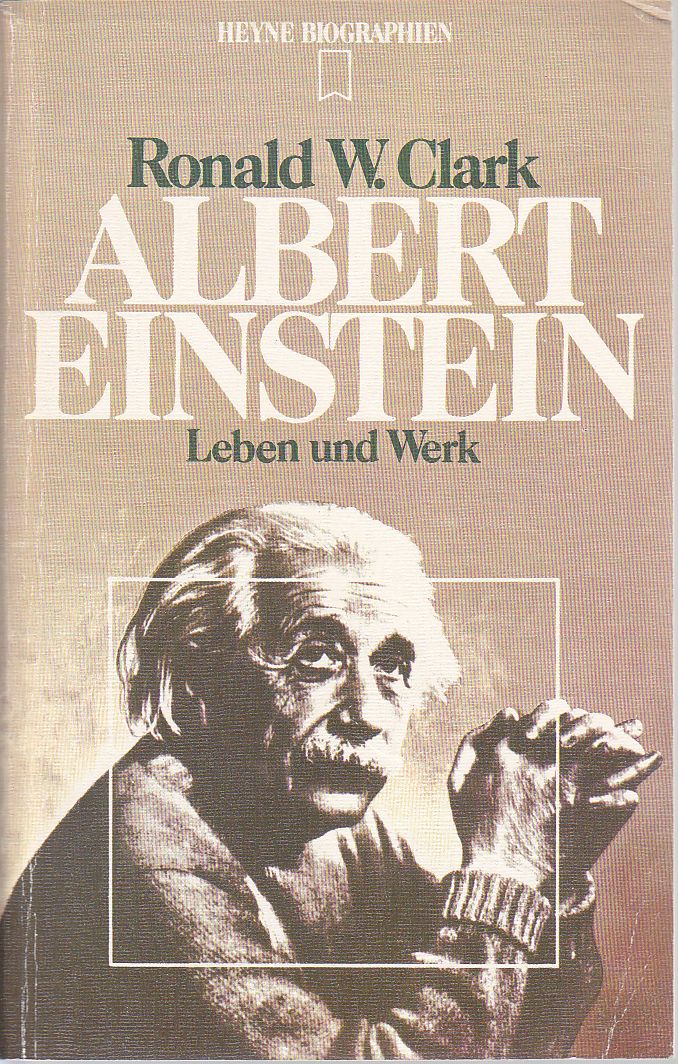
I read this more for the physics pieces than the biographical information, though I got into the latter more than I intended. It’s hard not to think of the book as the definitive biography on Einstein. Trying to put some of this together:
The speed of light, filled with implications for Einstein (1), seems to be the driving force behind the special and general theories of relativity. In contrast to Newtonian physics (fixed space, eternal time; a stage to move on, in “normal” time), Einstein described movement through space and time that approximated the speed of light, and he concluded that space and time were variable and relative concepts. As I understand it, for example, a fixed unit of time measuring motion (thus, distance) is one thing in the Newtonian world, but it is quite another at C, the speed of light, where the distance for, say, one second, is vastly greater. In the reverse, the time to cover a fixed distance (space) is vastly different for a Newtonian than it is for one who dwells in Einstein’s world. In the realm of C, space and time can only be flexible concepts. (2)
Einstein’s next looked at the effect of gravity on variable spacetime, looking for an alternative explanation for Newton's "action at a distance" that he, Newton, saw as gravity. That couldn't work for Einstein because light had a finite speed that could be measured. With that, he concluded that there could not be "simultaneity," as Newton's explanation implied.
Space, Einstein saw, is distinctly neither flat nor square (i.e. Euclidian). Rather, gravity curves it. Bodies, whose inertial mass has them going in a straight line, now follow curved lines toward the more massive bodies that have created “gravitational wells.” (3) As straight-line inertial motion is modified by spacetime curvature, and as spacetime is filled with massive bodies and energy, there is then perpetual and universal movement, always relative to other bodies, flowing along lines of the curvature. Seen this way, is gravity a force at all? Are Newtonian “pulling” and "gravitational attraction" artifact words? Isn't “gravity” just the effect of concentrated mass depressing spacetime (and is gravity, really, just another word for mass?), whereby straight-line inertial motion becomes curved motion?
But curvature (geometric) causation begs the question: Why does matter form in ways to depress spacetime if not for gravity? Is it that particles/objects move toward and into each other to form the heavy center of mass/energy that then builds upon itself to become “gravitational mass,” which deforms/depresses the plane of spacetime? If so, matter simply follows spacetime curvature into gravitational singularities that bring all movement, locally, to a halt, or bring objects back toward itself when they try to move counter to the gravitational center.
Clark says of Einstein that gravitational mass is congealed energy and that light, lying at energy’s opposite pole, is the pure energy of movement. (4) Thus, is it fair to say that cosmic reality consists of concentrated energy (gravitational mass) and free energy (massless [no rest mass] photons) and that these two poles of energy constitute Total Energy? And, isn’t energy’s essence movement, both in place (stable atoms and gravitational “rest” mass) and within or on the fabric of spacetime? Now, reality’s picture is that of a vast gravitational and energetic field of interacting energy and matter, moving on and across an eternally wavy spacetime.
Extending the logic of spacetime curvature and the place of gravitational mass and light within it, doesn’t matter and free energy move toward centers of mass and energy, with mass being degrees of energetic content, the most concentrated of which (5) are neutron stars, or pre-big bang scenarios, where all particle differentiation is squeezed into non-existence, leaving nothing behind but energy’s essence which is, of course, what? Compressed neutrons; cosmic foam; plasma; vibratory strings?
Is it reasonable to speculate that all curved cosmic movement returns back to itself under a big bang-like scenario of extreme curvature of concentrated energy-matter? But it is not really “contraction,” a reeling back in, but rather a continuance of straight-line motion through curved spacetime, and a return to itself, to form a new singularity of sorts and big bang scenarios repeat, forever and ever. (6)
Forever and ever is time; a singularity is space, or a lack thereof; and a released singularity is spacetime. But none of what Einstein came up with addresses the question of the beginning. What started this movement? Who or what was or is the prime mover? Is there a creator or not? Clark hints that Einstein was in the Deist camp – something got this deterministic ball rolling as the ultimate source of movement. But, as Spencer (more than anyone else) observed about the existence of God or prime mover, the answer is forever beyond our reach. This cannot be known.
1. Einstein according to Clark, said: ‘“For the rest of my life I want to reflect on what light is.’”
2. Poincare,, when looking at “all the dimensions of the universe,” stated that “the concept of space “is relative to the frame of reference within which its distances were measured.’” Regarding the frame of reference, it is one thing for an earth-bound observer and another thing for one moving close to the speed of light.
A news article, interpreting Einstein’s theory at the time it came out, stated: “The ideals of Aristotle and Euclid and Newton which are the basis of our present conceptions prove in fact not to correspond with what can be observed in the fabric of the universe….Space is merely a relation between two sets of data, and an infinite number of times may coexist. Here and there, past and present, are relative, not absolute, and change according to the ordinates and coordinates selected.”
Space - the distance between objects and their interactions, as measured by time (via C, given the vastness involved) – was also a real, autonomous entity for Einstein. Space was a field of energy of interacting particles, objects and energy waves (hence, the meaning of the “fabric” of spacetime terminology; Clark quotes Einstein’s reference to space as “cloth”).
3. If the combo of relative (size) and kinetic mass (speed) is sufficient, equilibrium is expressed through stabilized orbits. If not, the larger mass incorporates the lesser mass.
4. He writes that, for Einstein, “All mass was merely congealed energy; all energy merely liberated matter. Thus the photons, or light quanta,..were just particles which had shed their mass and were traveling with the speed of light in in the form of energy; while energy below the speed of light had been transformed by its slowing down, a transformation which had had the effect of congealing it into matter.” Again, later, Clark adds that matter for Einstein “was really congealed energy, while light quanta, or photons, consisted of particles which had changed their mass in the process of reaching the speed of light.”
Light is energy that is free of (rest) mass, thus “massless” in that sense, but it possesses the mass of kinetic energy, resulting in speed-of-light movement. For gravitational mass, is this the energy that is locked up via a strong force in the nucleus, or locked up in atoms via the electro-magnetic force? Seen this way, isn’t gravitational mass a bundle of such energies, concentrated by spacetime curvature, which itself, curvature, not gravity, acting on bundles of concentrated energy, is the causative force for movement?
Also, this is another way that illustrates non-fixed spacetime: The measure to time is space is longer when curved by gravitational mass than when there’s no curvature. On a global surface, the shortest flight path for an airline is not a straight line but a geodesic line.
5. By Rutherford, “showing that the atom consisted largely of empty space, [he] had thereby opened up the possibility of superdense stars in which subatomic particles were squeezed together in a concentration unknown on earth.”
6. “[I]n the ‘Einstein world,’ as it soon became known, the curvature produced by matter turned space back on itself so that a ray of light, moving in a straight line in terrestrial terms, would return to its starting point after circling the universe….”