

What do you think?

The Green Lake Is Awake
Winner, 1994 American Award for Belles Lettres. "[A] valuable contribution to American poetics."-- Publishers Weekly
- GenresPoetry
131 pages, Paperback
First published June 1, 1994
About the author
Joseph Ceravolo
12 books7 followersA poet sometimes associated with the New York School of poets, Joseph Ceravolo began writing poems in 1957 while completing his Army service in Germany. In 1959, Ceravolo earned a degree in civil engineering from the City College of New York and enrolled in Kenneth Koch’s poetry workshop at the New School for Social Research in Manhattan.
The New York–born son of Italian immigrants, Ceravolo died at age 54 after publishing several books, establishing a career as a hydraulics engineer, and raising a family in New Jersey. His 1968 collection, Spring in This World of Poor Mutts, was published by Columbia University Press and won the first Frank O’Hara Award for poetry—“intended to encourage the writing of good new experimental poetry.”
Ceravolo’s other publications include Fits of Dawn, published in 1965 by close friend Ted Berrigan’s C Press; The Green Lake Is Awake (1994), with poems selected by Larry Fagin, Kenneth Koch, Charles North, Ron Padgett, David Shapiro, and Paul Violi; INRI, (1979); Millennium Dust (1982), which includes poems later anthologized in The Poets of the New York School; Transmigration Solo (1979); and Wild Flowers Out of Gas (1967).
Ratings & Reviews
Friends & Following
Create a free account to discover what your friends think of this book!
Community Reviews
Displaying 1 - 14 of 14 reviews
![Profile Image for s.penkevich [hiatus-will return-miss you all].](https://i.gr-assets.com/images/S/compressed.photo.goodreads.com/users/1735525095i/6431467._UX200_CR0,11,200,200_.jpg)
August 16, 2013
‘Meet me wherever I am’
This is poetry that when reading you unhinge your mind the way you unlock your eyes to see the hidden picture in a Magic Eye poster, remember those? The poetry of Joseph Ceravolo, the first recipient of the Frank O’Hara award , is a disorienting, energetic burst of fresh air and vibrancy. The Green Lake is Awake, a collection of his poems published in 1994, is a fantastic introduction into the neglected poet, offering a broad perspective on his style that ranges from longer poems that read like a waterfall of energy breaking free from a dam, to his shorter poems characterized by a chaotic syntax and direct visceral imagery. Ceravolo manages to make his poems speak volumes beyond a surface reading, which seems distorted, incomplete and much like gibberish at first, yet take hold of the heart and deliver an abstract message of pure emotion that could never be contained within words; it is poetry that uses language more for its musicality than logical linguistic meaning and creates an experience of pure joy and energy that makes one glad to be alive and breathing in his smattering of words.
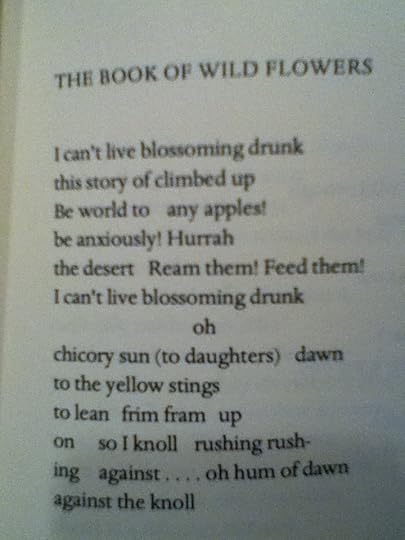
I was so infatuated with this poem that one drunken night I sent this out as a mass text to everyone in my phone. ‘I can’t live blossoming drunk/this story of climbed up’ is such beautiful nonsense that, yet, makes perfect sense in the heart and soul and has become my new favorite thing to interject into conversation. This is a perfect example of what I love so much about Ceravolo: it isn’t the ordering and comprehension of words, but the emotion that blossoms in your heart when you read them that matters.
While it is understandable that Ceravolo’s oddities may be a turn-off to many, this is a collection that I would urge you to take the time to sit back and let sink in. There is such a fun, free and dynamic energy to his poetry that is incredibly moving and inspiring. Like music, it is the sound and flow of his words that take hold and give the readers heart and soul wings, not the literal structure and meaning. It is a style that reinforces what I believe to be the beauty and power of poetry and Ceravolo continuously makes me believe that mere abstract words on a page have the power to move mountains and save lives. This is a immensely rewarding collection that offers rewards far beyond the cost of the effort that must be put into it.
4.5/5
White Fish in Reeds
Hold me
till only, these are my
clothes I sit
Give them more songs than
the flower
These are my clothes to a
boat Streets
have no feeling
Clouds move
Are people woman?
Who calls you
on a sun shirt sleeves down his ecstasy
The hair you are
becoming? Mmmm
That this temperate is where
I feed The sheep sorrel flower is
And I want to
be
among all things
that bloom
Although I do not
love flowers
Lighthouse
All this summer fun.
The big waves, and waiting
(the moon is broken)
for the moon to come out
and revive the water. You look
and you want to watch as
men feel the beer breaking
on their lips, and women seem like
the sun on your little back.
Where are you closer to everything?
in the plants?
on the photograph or
the little heart that's not
used to beating like the waves' foam?
A wasp is
looking for a hole in the screen.
No. There's no man in the lighthouse.
There's no woman there, but there is
a light there; it's a bulb.
And I think how complete you are
in its light. Flash......... Flash.....
....................................
And I think of how our own room
will smell; You lying on one bed
and we in the other, facing the... flash.....
.....................Flash
Fire of Myself
What I miss most is
that live
that subtle transformation
from inert to
trans-atomic structures
that leave my welded and supple body
that carries the imprint
of that body
into the land
of pure migration
Passion for the Sky
You are near me. The night
is rectilinear and light
in the new lipstick
on your mouth and on the colored
flowers. The irises are blue.
As far as I look we are across. A
boat crosses by. There is no monkey in me
left: sleep. There is something
sold, lemons. Corn is whizzing from the
ground. You are sleeping
and day starts its lipstick.
Where do we go from here?
Blue irises.
This is poetry that when reading you unhinge your mind the way you unlock your eyes to see the hidden picture in a Magic Eye poster, remember those? The poetry of Joseph Ceravolo, the first recipient of the Frank O’Hara award , is a disorienting, energetic burst of fresh air and vibrancy. The Green Lake is Awake, a collection of his poems published in 1994, is a fantastic introduction into the neglected poet, offering a broad perspective on his style that ranges from longer poems that read like a waterfall of energy breaking free from a dam, to his shorter poems characterized by a chaotic syntax and direct visceral imagery. Ceravolo manages to make his poems speak volumes beyond a surface reading, which seems distorted, incomplete and much like gibberish at first, yet take hold of the heart and deliver an abstract message of pure emotion that could never be contained within words; it is poetry that uses language more for its musicality than logical linguistic meaning and creates an experience of pure joy and energy that makes one glad to be alive and breathing in his smattering of words.
I was so infatuated with this poem that one drunken night I sent this out as a mass text to everyone in my phone. ‘I can’t live blossoming drunk/this story of climbed up’ is such beautiful nonsense that, yet, makes perfect sense in the heart and soul and has become my new favorite thing to interject into conversation. This is a perfect example of what I love so much about Ceravolo: it isn’t the ordering and comprehension of words, but the emotion that blossoms in your heart when you read them that matters.
WarmthCeravolo leaves thoughts and lines unfinished, jumps into new ideas, leaves odd spaces between words, and conducts his poetry like a chaotic orchestra that somehow manages to harmonize perfectly with the heart of the reader. It is often as if his words are too excited to finish, leaving the rest implied as they are eager to get on to the next idea and must take flight mid-thought. To read his more chaotic poems is what it must be like to be the cashier at a late-night fast food place on a Friday night in a college town trying to understand the mania and orders of an ever-morphing line of young, drunken students full of feverish energy and excitement. They come and go from line without warning, too excited vitality and ebullience to be extracted from the mayhem. Perhaps that is why I get a nostalgic feeling from his poetry, and why it recalls a statement a friend made on our first night of college, that anything is art if you look for the emotion behind it, and that our MSU dormitory’s stoop would be an artistic statement come morning when the yellow dawn touched the disorder of beer bottles and the overwhelming number of cigarettes butts strewn across the concrete that served as an echo of the unhindered joy the several of us had partaken in under that star-lit summer sky. Perhaps this nods to college days is some sad nostalgia, or perhaps it is because of the youthful energy ever-present in Ceravolo’s poetry. He has this utterly fantastic exuberance that soars to tremendous heights, crashing through the stratosphere of the reader’s consciousness and exploding like the most brilliant of fireworks display to rain down luminescent trails of glorious words.
There’s nothing to love in this
rice Spring.
Collected something warm like friends.
Sail glooms are none.
Your desire
rests like sailors in
their bunks. Have beaten you, lips.
Supply me
Man made keeping.
Supply it flowing out;
are brute bullets in your back
because there is
in this rice Spring
Cross FireNot all of Ceravolo’s poetry is a striking dismissal of linguistic form, and even without the oddities that bring such a vibrancy to his work, there is still a heartfelt message to behold and ponder within each poem. Ceravolo often speaks of love for existence, perfectly capturing the bittersweet pains of being alive, of feeling both the inevitable pains of life while simultaneous reflecting and appreciating the sweetness of life that can be easily overlooked. Sorrow and satisfaction are never far apart, and each poem reminds the reader why life is such a precious, fleeting thing. It is a plea for a soul-searching, to love all that you see before you, and it is as if Ceravolo is asking to take on the weight of the world just so his fellow man can be relieved of strife and suffering.
This is the second day without anyone.
I am chinning against a dark sky
to strengthen my arms.
A picture of everyone I love passes through me.
No clear light streams thru this cell.
There's no dawn.
What have I gained
by lying in this abyss,
waiting for the masonry
to show a little slit
for my soul to get through?
GrowThat just might be the best thing I have read all year. ‘Grow’ is a poem I return to again and again, always struck by the sheer beauty and intensity of it’s simplistic sytle and staggering statements.
I fight and fight.
I wake up.
The oasis is now dark.
I cannot hear anything.
The wind is felt
and the stars and the sand
so that no one
will be taken by pain.
I sit next to the bushes,
Hercules couldn’t move me,
and sleep and dream.
The sand, the stars are solid
in this sleeping oasis,
alone with the desert and
the metaphysical cigarette.
While it is understandable that Ceravolo’s oddities may be a turn-off to many, this is a collection that I would urge you to take the time to sit back and let sink in. There is such a fun, free and dynamic energy to his poetry that is incredibly moving and inspiring. Like music, it is the sound and flow of his words that take hold and give the readers heart and soul wings, not the literal structure and meaning. It is a style that reinforces what I believe to be the beauty and power of poetry and Ceravolo continuously makes me believe that mere abstract words on a page have the power to move mountains and save lives. This is a immensely rewarding collection that offers rewards far beyond the cost of the effort that must be put into it.
4.5/5
White Fish in Reeds
Hold me
till only, these are my
clothes I sit
Give them more songs than
the flower
These are my clothes to a
boat Streets
have no feeling
Clouds move
Are people woman?
Who calls you
on a sun shirt sleeves down his ecstasy
The hair you are
becoming? Mmmm
That this temperate is where
I feed The sheep sorrel flower is
And I want to
be
among all things
that bloom
Although I do not
love flowers
Lighthouse
All this summer fun.
The big waves, and waiting
(the moon is broken)
for the moon to come out
and revive the water. You look
and you want to watch as
men feel the beer breaking
on their lips, and women seem like
the sun on your little back.
Where are you closer to everything?
in the plants?
on the photograph or
the little heart that's not
used to beating like the waves' foam?
A wasp is
looking for a hole in the screen.
No. There's no man in the lighthouse.
There's no woman there, but there is
a light there; it's a bulb.
And I think how complete you are
in its light. Flash......... Flash.....
....................................
And I think of how our own room
will smell; You lying on one bed
and we in the other, facing the... flash.....
.....................Flash
Fire of Myself
What I miss most is
that live
that subtle transformation
from inert to
trans-atomic structures
that leave my welded and supple body
that carries the imprint
of that body
into the land
of pure migration
Passion for the Sky
You are near me. The night
is rectilinear and light
in the new lipstick
on your mouth and on the colored
flowers. The irises are blue.
As far as I look we are across. A
boat crosses by. There is no monkey in me
left: sleep. There is something
sold, lemons. Corn is whizzing from the
ground. You are sleeping
and day starts its lipstick.
Where do we go from here?
Blue irises.

May 12, 2008
Even though it doesn't contain ALL of my favorite Ceravolo poems, it's what we have, and it's MARVELOUS! We really do need a COLLECTED Ceravolo, no doubt about it. When the PDF of his chapbook FITS OF DAWN leaked out last year (and continued to leak until the poet's wife found out), it's clear JUST HOW MANY OF US ARE HUNGRY for this inimitable genius of Joseph Cervolo! Someone PLEASE HELP ME BEG his wife to publish ALL the poems?
Or get them from interlibrary loan and read them like I did.
CAConrad
http://CAConrad.blogspot.com
Or get them from interlibrary loan and read them like I did.
CAConrad
http://CAConrad.blogspot.com

February 13, 2008
The Green Lake Is Awake
Joseph Ceravolo
Coffee House Press
Minneapolis, MN 1994
“Wanting to understand is a peculiar obsession of mankind.” Jean Cocteau
Over the past week reading The Green Lake Is Awake, a retrospective of Ceravolo’s five books of poems and poems published variously in anthologies, I’ve had the distinct pleasure of inhabiting this occluded poet’s world. While this publication seems far from complete in encapsulating Ceravolo’s mind and poetic output, it stands as the only accessible work in which to view the activity of a mind clearly demonstrating how the inner music of language collects its images from the ordinary world. In this is a structuring that unfolds the testament to speak in excess, while eschewing the expressive lyric caught in its own epiphanic flash of self-confidence.
Images in Ceravolo’s poems are never the harbingers of stability wrestling down the moment to hold in some apotheosis of calm. In other words, the images don’t finally summon a fixed world. If language requires the neurons of mind to struggle, to be circumscribed by the daily particulars, which act upon us, then Ceravolo’s hyper-indirections are concealed worlds of transition. Transitioning between worlds (the private life of domesticity, nature in its purest form, and the cityscape), marked by associational leaps of emotional value, create moments of flux, fluidly tabulating their own blur of feeling and information. The quality of synesthesia in Ceravolo’s poems are a filmic montage, a constellation of resources where “To indicate is to / turn off in a world / away from ease.” What his poems indicate are emphatically not the croon of a mind in compliance with the logic of syntax, nor the passivity of the “I” charting its interior motions at the expense of a “manifold otherness”. Necessarily, Ceravolo’s singing is always in the plural. In the poem a “Note From St. Francis,” he writes:
In the world today
there is
no world so attached as I am
to worlds.
While Ceravolo can be as direct as the above passage seems, he also lives within a twilight zone of meaning, a place where aberrations of speech and logic, the shifting plains of verbal tectonics, gradually accumulate to produce fragments of near clarity, but often in transitory flashes of holding and being held by a word. The apparent difficulty of these movements, are in Ceravolo’s poetic, less aleatory in their wanderings, and more, courses in spontaneity. Ceravolo’s carefully sculptured poems, and their brilliant pacing, are built by an almost surreal simplicity of perception. His consciousness builds a poem through direct perception subverted by seemingly meaningless phrases such as in “Partly in skies in weak muzzles, fertile / communal dodging america.”
However, understanding in the usual sense, that language is encoded with a structure by which we can scrape some meaning off of a word or cluster of words, is complicated by the structure of the saying. Poet and critic, Peter Schjelddahl writes: “Ceravolo is a lyric poet of such oddness and purity that reading him all but makes me dizzy, like exercise at a very high altitude. I rarely know what he is talking about, but I can rarely gainsay a word he uses…there is a dominance of usages I want to call ‘off’ or ‘bent,’ like vamped notes in jazz.” Understanding and meaning in Ceravolo’s poems are not secondary to the text, but are part of the verbal performance of the poem. To read a serial poem such as “Water: How Weather Feels The Cotton Hotels,” is to be thrown mid-river into a procession of wildly divergent acts of viewing and sustained metaphysical inquiry. If the nature of the real is in question, Ceravolo remarkably understands the stakes:
Slope sun
declining
journeys trace about
the factory towers having
given up their form
to the atmosphere blue
and purplish a
faded banner of surface
passing through this
plain relief
Joseph Ceravolo
Coffee House Press
Minneapolis, MN 1994
“Wanting to understand is a peculiar obsession of mankind.” Jean Cocteau
Over the past week reading The Green Lake Is Awake, a retrospective of Ceravolo’s five books of poems and poems published variously in anthologies, I’ve had the distinct pleasure of inhabiting this occluded poet’s world. While this publication seems far from complete in encapsulating Ceravolo’s mind and poetic output, it stands as the only accessible work in which to view the activity of a mind clearly demonstrating how the inner music of language collects its images from the ordinary world. In this is a structuring that unfolds the testament to speak in excess, while eschewing the expressive lyric caught in its own epiphanic flash of self-confidence.
Images in Ceravolo’s poems are never the harbingers of stability wrestling down the moment to hold in some apotheosis of calm. In other words, the images don’t finally summon a fixed world. If language requires the neurons of mind to struggle, to be circumscribed by the daily particulars, which act upon us, then Ceravolo’s hyper-indirections are concealed worlds of transition. Transitioning between worlds (the private life of domesticity, nature in its purest form, and the cityscape), marked by associational leaps of emotional value, create moments of flux, fluidly tabulating their own blur of feeling and information. The quality of synesthesia in Ceravolo’s poems are a filmic montage, a constellation of resources where “To indicate is to / turn off in a world / away from ease.” What his poems indicate are emphatically not the croon of a mind in compliance with the logic of syntax, nor the passivity of the “I” charting its interior motions at the expense of a “manifold otherness”. Necessarily, Ceravolo’s singing is always in the plural. In the poem a “Note From St. Francis,” he writes:
In the world today
there is
no world so attached as I am
to worlds.
While Ceravolo can be as direct as the above passage seems, he also lives within a twilight zone of meaning, a place where aberrations of speech and logic, the shifting plains of verbal tectonics, gradually accumulate to produce fragments of near clarity, but often in transitory flashes of holding and being held by a word. The apparent difficulty of these movements, are in Ceravolo’s poetic, less aleatory in their wanderings, and more, courses in spontaneity. Ceravolo’s carefully sculptured poems, and their brilliant pacing, are built by an almost surreal simplicity of perception. His consciousness builds a poem through direct perception subverted by seemingly meaningless phrases such as in “Partly in skies in weak muzzles, fertile / communal dodging america.”
However, understanding in the usual sense, that language is encoded with a structure by which we can scrape some meaning off of a word or cluster of words, is complicated by the structure of the saying. Poet and critic, Peter Schjelddahl writes: “Ceravolo is a lyric poet of such oddness and purity that reading him all but makes me dizzy, like exercise at a very high altitude. I rarely know what he is talking about, but I can rarely gainsay a word he uses…there is a dominance of usages I want to call ‘off’ or ‘bent,’ like vamped notes in jazz.” Understanding and meaning in Ceravolo’s poems are not secondary to the text, but are part of the verbal performance of the poem. To read a serial poem such as “Water: How Weather Feels The Cotton Hotels,” is to be thrown mid-river into a procession of wildly divergent acts of viewing and sustained metaphysical inquiry. If the nature of the real is in question, Ceravolo remarkably understands the stakes:
Slope sun
declining
journeys trace about
the factory towers having
given up their form
to the atmosphere blue
and purplish a
faded banner of surface
passing through this
plain relief

May 8, 2008
What a natural! And also how strange. These poems really are in a class by themselves, a world by themselves.

March 6, 2009
This has just become one of my favourite books of poetry EVER!! Somewhere between NY school and Language poetry and yet neither. Entirely Mr. Ceravolo. It breaks my heart and fires my mind (which is rare). World sorrow wold gladness and what an eye and ear. I am now re-reading it. This is one of the books I would want on an island or in a forest or whatever. If I decide to travel the world again this one is coming with me!!!

January 1, 2021
The back cover includes a quote from Charles North that begins, “No one writes like Ceravolo.”
Things rings true to me; I found his poetry endlessly compelling. It is at once ephemeral and visceral. Ceravolo explores pointed moments in nature, city life, suffering, and love—often blending these together. At times technically incomprehensible, his enigmatic use of language more often than not gives way to a powerful clarity of emotions, and the rhythm moves the reader through the words breezily. Though as soon the poems come together in shapes and colors, they dissipate as well. Like a firefly in the night. It’s beautiful, intangible, painfully corporeal.
From “Contrast”: “Is it death trying to see and breathe?”
Things rings true to me; I found his poetry endlessly compelling. It is at once ephemeral and visceral. Ceravolo explores pointed moments in nature, city life, suffering, and love—often blending these together. At times technically incomprehensible, his enigmatic use of language more often than not gives way to a powerful clarity of emotions, and the rhythm moves the reader through the words breezily. Though as soon the poems come together in shapes and colors, they dissipate as well. Like a firefly in the night. It’s beautiful, intangible, painfully corporeal.
From “Contrast”: “Is it death trying to see and breathe?”
September 2, 2018
"I walk around this
leaf falling park
Will I meet
someone I know, so far away?
Am I a Part of this
wheel of matter? just
because I am made of matter?"
leaf falling park
Will I meet
someone I know, so far away?
Am I a Part of this
wheel of matter? just
because I am made of matter?"

October 19, 2024
Freaky genius
Everyone/ chews at a different rate and/ stars do not emit/ I am waiting for you at the/ north entrance (61)
Autumn is very sad/ though not like you. You/ hear autumn is/ coming O seasons/ Are you the crib? Can I/ understand what I / like? I am sitting/ in my house (60)
Everyone/ chews at a different rate and/ stars do not emit/ I am waiting for you at the/ north entrance (61)
Autumn is very sad/ though not like you. You/ hear autumn is/ coming O seasons/ Are you the crib? Can I/ understand what I / like? I am sitting/ in my house (60)
Read
August 6, 2015Its his defiance, a breaking away of comfy associative writing towards a choppy dissonance, not dreamlike at all, rather concoctions of words that reproduce images and meanings in our heads asexually.
A crazy one: "Toy for the raking gully
shame encore there,
sorry human posed working,
demeanor just helen as
garden comes, Music
o cotton unforgiving bargain,
chilly, gush, album in later manjun
embrace. Begs soon jamais
furious bungalow of
pour a boy. Scowl posess however
city trumped,
jumbles pity them, rum or
canto sleep in this eddy..."
A crazy one: "Toy for the raking gully
shame encore there,
sorry human posed working,
demeanor just helen as
garden comes, Music
o cotton unforgiving bargain,
chilly, gush, album in later manjun
embrace. Begs soon jamais
furious bungalow of
pour a boy. Scowl posess however
city trumped,
jumbles pity them, rum or
canto sleep in this eddy..."
July 23, 2008
There are some modernist artistic techniques that poetry doesn't seem very good at embodying. The concrete materials of painting are way better suited to abstraction expressionism, maybe, than are the concrete materials of poetry.
But this crazy bent sculptural creativity of Ceravolo's feels right!!! Here's a poem:
Oak oak! like like
it then
cold some wild paddle
so sky then;
flea you say
"geese geese" the boy
June of winter
of again
Oak sky
But this crazy bent sculptural creativity of Ceravolo's feels right!!! Here's a poem:
Oak oak! like like
it then
cold some wild paddle
so sky then;
flea you say
"geese geese" the boy
June of winter
of again
Oak sky

October 5, 2014
Disjointed and awkward usage is usually something to avoid in poetry, but Ceravolo swung both like samurai swords in his approach to the form. He was very brave to attempt to such a thing, and this collection is full of his successes at doing so. His imagery is strange and wondrous, and it's always refreshing to see someone invent new approaches, and thus reveal new levels of what's possible.

April 6, 2023
Amazing, mind-bending poems written in a fragmentary style that makes for a truly singular reading experience. Experimental, language-reinventing, unpredictable, and wonderful. Looking forward to reading the individual collections.

April 9, 2008
My favorite poem was the one about the lighthouse
(flash.....flash)
Some of these were really great, and some were okay.
(flash.....flash)
Some of these were really great, and some were okay.

November 18, 2016
He's Italian.
Displaying 1 - 14 of 14 reviews