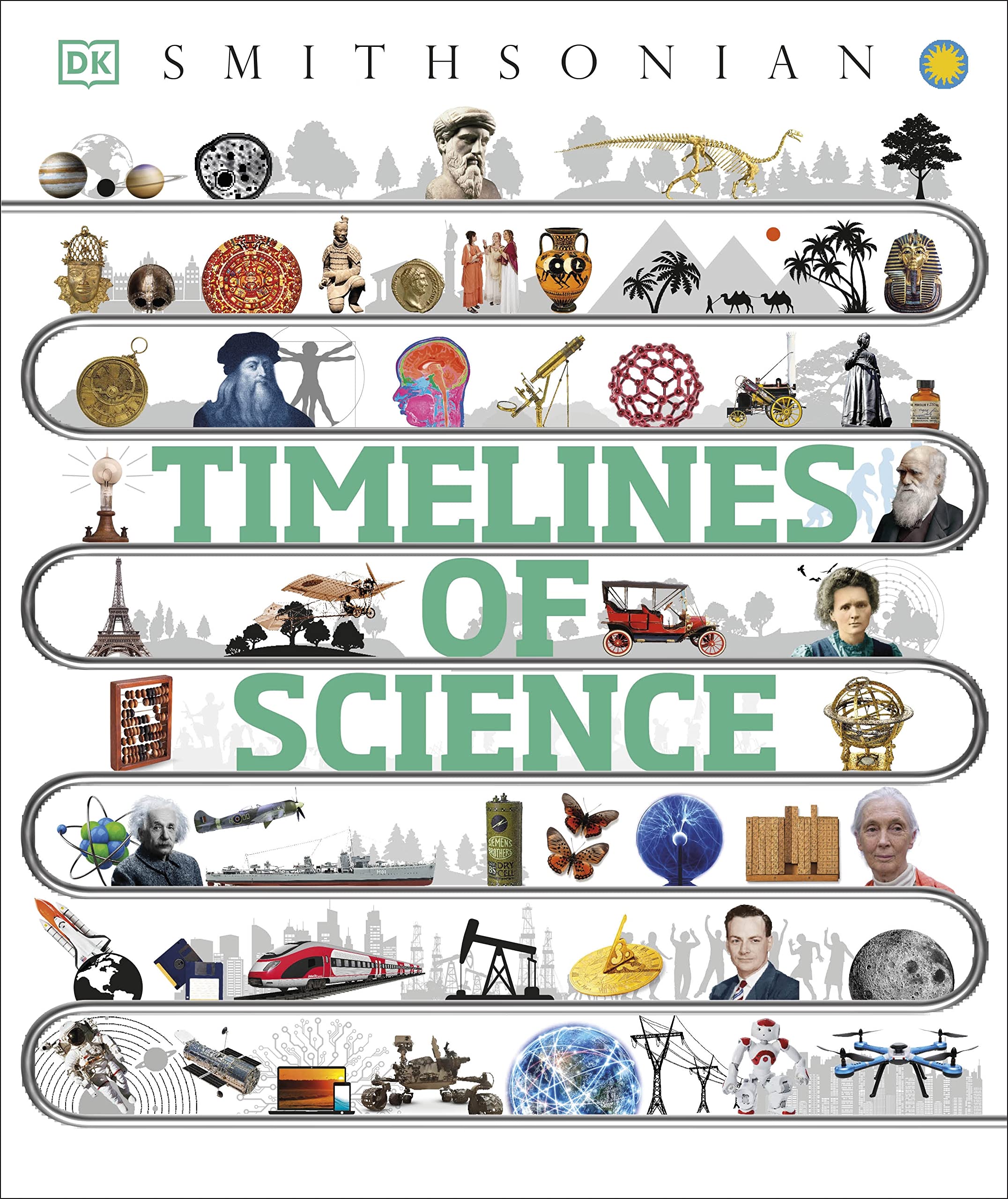
Explore spectacular visual timelines that tell the story of science, from fossils to quantum physics, and discover exactly how science has changed the world - one discovery at a time.
Timelines of Science takes you on an astonishing journey through history, showing how dedication, disasters, and eureka moments have brought us antibiotics, electricity, space exploration, and so much more!
Packed with fascinating facts, amazing images, and some seriously staggering science, this science history book shows how thousands of years of human endeavour have expanded our knowledge and shaped our lives. Find out why the fruitless search for a potion of eternal life led to the birth to chemistry. See how the invention of magnifying lenses opened new windows into the cosmos and micro-cosmos. And learn how happy accidents led to the discovery of X-rays, batteries, pulsars, and even the big bang.
Dive deep into the pages of this sublime science book to
- Timeline features show how scientific ideas developed over time - Easy-to-read explanations of general science topics, such as the life cycle of a star or the history of Earth's changing climate - Supporting boxes explain modern scientific concepts, adding educational value and aiding understanding - Feature spreads highlight specific breakthroughs, with the story presented as running text in a newspaper-style layout - Biographies showcase the lives of key men and women who reshaped scientific thought
Timelines of Science is not just about science - it's also a book about people! The stories of discovery are told through the lives of extraordinary men and women who often dared to challenge conventional wisdom in their trailblazing pursuit of scientific truth.
Filled with dazzling illustrations, spectacular photography, and easy-to-follow storytelling, Timelines of Science is guaranteed to capture the imagination of children and adults of all ages and abilities. A must-have volume for children 9+ interested in science, technology, and invention, doubling up as the perfect gift to for budding scientists, Timelines of Science is sure to delight.
Dorling Kindersley (DK) is a British multinational publishing company specializing in illustrated reference books for adults and children in 62 languages. It is part of Penguin Random House, a consumer publishing company jointly owned by Bertelsmann SE & Co. KGaA and Pearson PLC. Bertelsmann owns 53% of the company and Pearson owns 47%.
Established in 1974, DK publishes a range of titles in genres including travel (including Eyewitness Travel Guides), arts and crafts, business, history, cooking, gaming, gardening, health and fitness, natural history, parenting, science and reference. They also publish books for children, toddlers and babies, covering such topics as history, the human body, animals and activities, as well as licensed properties such as LEGO, Disney and DeLiSo, licensor of the toy Sophie la Girafe. DK has offices in New York, London, Munich, New Delhi, Toronto and Melbourne.
Skimming for an overview - what was happening where, at the same time? What else happened, elsewhere? What came first?
Note that everything I report below is, of course, "as far as we know" and that perhaps someone else did something like it much earlier and we just haven't found records of it yet (and may never).
Chinese medicine was being studies scientifically even before the Egyptian pyramids were being built. Which was before there was a (known to us at least) standardized calendar. But acupuncture wasn't developed until 90 BCE, afawk.
Babylonians were developing sophisticated mathematics by 1800 BCE, including the 'Pythagorean' theorem. [From elsewhere I have learned that zero was invented as both a placeholder and a number in ancient India around the 5th century CE.]
By about 1K years ago, an awful lot of science was happening... mostly in the rest of the world, not Europe yet.
Da Vinci and Columbus were contemporaries.
The first manned flight, the Montgolfier balloon, was in 1782. Right in between the American and French Revolutions.
The speed of light was calculated in 1676 by Ole Romer.
Charles Darwin owes at least inspiration to his grandfather Erasmus Darwin.
Elmer Verner McCollum "helped to discover a number of key dietary substances" including Vitamin D, which protects against rickets, in 1921.
Jocelyn Bell discovered the first pulsar in 1967.
We've known there are five kingdoms since 1969. I guess I had a pretty poor education in some ways because that should have been in plenty of time for mine. But I only learned three.
"Mary-Clare King is best known for her work on gene mutations in breast cancer. She also discovered that gene regulation is primarily responsible for the differences between humans and chimpanzees, which share around 99% of their genes."
"Early work [on CRISPR] in 2005 was developed by French biochemist Emmanuelle Charpentier and American biochemist Jennifer Doudna into a technique that has been used in a range of biological and medical applications."
In 2005 in Arctic Canada "the partial skeleton of a 375 million year old Devonian age fossil called Tiktaalik showed an evolutionary link between fish and touch upon animals that first moved on land."
Whew. So, I found a lot of interesting information, even on just a skim. But not much correlation. The modern era has almost nothing that is happening in the rest of the world from US and Europe. And it's tech-heavy... which seems about right but is less important. We need more science, not more advanced smartphones. Sheesh.
Anyway, next up is Timelines of Everything which, by definition, will have show what's going on in diverse fields at any given time, right?