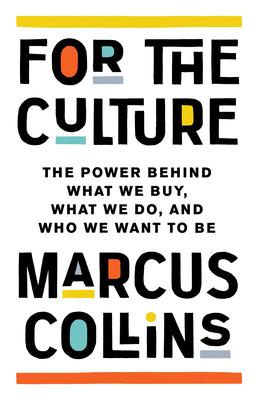
The architect of some of the most famous ad campaigns of the last decade argues that culture is the most powerful vehicle for influencing behavior, and shows readers how to harness culture to inspire other people to share their vision.
We all try to influence others in our daily lives. Whether you are a manager motivating your team, an employee making a big presentation, an activist staging a protest, or an artist promoting your music, you are in the business of getting people to take action. In For the Culture , Marcus Collins argues true cultural engagement is the most powerful vehicle for influencing behavior. If you want to get people to move, you must first understand the underlying cultural forces that make them tick.
Collins uses stories from his own work as an award-winning marketer—from spearheading digital strategy for Beyoncé, to working on Apple and Nike collaborations, to the successful launch of the Brooklyn Nets NBA team—to break down the ways in which culture influences behavior and how readers can do the same. With a deep perspective, and built on a century’s worth of data, For the Culture gives readers the tools they need to inspire collective change by leveraging the cheat codes used by some of the biggest brands in the world. This is the only book you’ll need if you want to influence people to take action.
First, let’s start with the good, because For the Culture is filled with it. Marcus Collins is the head of strategy at Wieden+Kennedy, and no wonder, the guy is dazzling. He’s also a professor of marketing at the University of Michigan, and it shows—his book is packed with information clearly and engagingly explained, and laid out almost like a course.
Collins starts by introducing concepts from social psychology, providing us with a solid foundation for what comes next. There are simply too many insights for me to do For the Culture justice, but this excerpt should give you a pretty good idea of what the book is about:
“… tribes are real. They’re made up of real people, and people use them to communicate who they are and demarcate how they fit in the world. Segments, on the other hand, are not real. They are a construct that marketers create where people are placed into homogeneous-like groups based on a loose proxy that helps us identify who they are and predict what they are likely to do. Segments are clean and neat. But real people are complex and messy.
Unfortunately, this delineation is often lost on marketers, who rely on demographics to describe people based on their age, race, gender, household income, geography, and education. Demographics provide discrete boxes to put people into and help us make the world neat. But here’s the thing: demographics, while factual, don’t accurately describe who people are.
Demographics never get close enough to capture the nuances that make me who I truly am. However, my tribes do, which makes tribes a better means of segmenting the market than demographics. Plus, people self-identify by their tribes and adhere to the cultural characteristics of the tribes, and of the congregation more broadly. Therefore, our behaviors are much more likely to be predictive of the behaviors of people like us than the fictional boxes that marketers construct. Through this lens, segmentation and targeting become very clear. We divide the market into two segments: those who believe and those who do not. We then target the believers, who are more inclined to move, and move on past the nonbelievers.”
Collins explains you can’t tell tribes how to feel about your product or service, you have to essentially join the tribe to see how they think, and then tailor your message so they can make their own meaning from it. He shares some brilliant examples of work he did for Brooklyn’s Barclays Center, McDonald’s, and other brands. I don’t call them brilliant lightly, either—they’re pretty much masterpieces of brand marketing.
Which leads me to the bad: Collins ends his book with an entreaty to use this knowledge for good. He writes, “It’s through stories that we preach the gospel to the congregation—the collection of people who see the world the way we do. For this reason alone, we bear a great responsibility when we use storytelling as a vessel to preach the gospel… Now that you have the skills, you have an implicit responsibility to use them ethically, realizing that the ramifications of our stories can have a long-lasting material effect on people.” Sounds great, right? But if we go back to the examples I mentioned above, you can’t help but notice a serious gap between what Collins does and what he asks us to do.
In the Barclays Center example, he describes that there was great opposition to the stadium being built in Brooklyn because of the potential environmental impact on the area and the displacement of long-standing businesses and homeowners. Collins’s solution? A campaign appealing to Brooklyn pride through which locals start identifying with their new team (the Brooklyn Nets, a middling New Jersey basketball team relocating to go with the stadium). Support for the new stadium surged. Did this help the businesses and homeowners from being displaced? Did it in any way lessen the environmental impact? Of course not, but Barclays got what it wanted.
And then there’s McDonald’s. Plagued by the fallout from Morgan Spurlock’s Super Size Me, lawsuits from obese customers, and the utter failure of their attempts at a healthier menu, the burger chain was in trouble. Collins came to the rescue with a heartwarming and very relatable campaign in which celebrities shared their usual orders at McDonald’s, helping consumers see themselves as part of a tribe that includes their idols. Obesity be damned, McDonald’s was back in business.
We don’t read marketing books for lessons in morality, and this is why—many marketers are blind, or at least very near-sighted, when it comes to the broad effects of our work, instead we take pride in doing a good job in reaching our clients' goals and lose sight of the big picture.
TL;DR A brilliant book on how to leverage subcultures to embrace and evangelize your brand, marred only by a feeble plea for ethics that the author himself doesn’t live up to.
Best professor and mentor I’ve had wrote a book with many of his wise teachings on marketing and the psychology behind why we do what we do. A book I’d invite all to check out!
I don’t think this is for me. While I’m sure this book is excellent to many, I can’t get past the frequent use of “tribe” to refer to “finding your tribe,” “tribal affirmations” or “tribal practices” etc when discussing culture. Full disclosure, I am a marketer and life-long learner and greatly anticipated this book. But I’m also aware that where I live, in a state that recognizes 39 Native American tribes, when we ask, “what’s your tribe?” that is met with a deeply unique history, sovereignty and identity that is personal to so many individuals.
I would expect this frequent use of “tribe” in reference to societal groups (and not Native Americans or Indigenous Peoples) to have come from a book written in the early 2000s. Not 2023. There are so many alternatives; the author even had a chapter titled “finding a congregation” yet would refer to tribes more frequently. Why the change?
For those who may not be informed of the issue, here’s a quick note from the group, We R Native: For Indigenous people, tribal identity is important. So when non-Native people say “find your tribe” or “tribe” to describe groups of shared interest, it is offensive because it erases the significance of Tribal sovereignty, identity, and people. Instead, we can use words like: group, crew, friends, or circle.
This book has been endorsed by the VP of Inclusive Marketing for Disney and the CMO of Google. With that kind of backing, and entire brand changes over cultural sensitivity issues in recent years (like the Washington Redskins in 2020 to Washington Commanders in 2022 and Kim Kardashian’s Kimono to Skims line in 2019), I am surprised that “tribe” was used at all.
Again, I’m sure the content of the book is sound and informative. But I cannot get past this issue to get to the main point of the author.
The content in the book is useful in real-world application of swaying consumers onto your company offering. What I loved about the book was that it elaborated on the psychological impact of marketing campaigns used by companies as well as the sociological reasoning behind the campaign.
This is absolutely a fantastic book explaining the power and method of advertising.
First of all - why do good advertising work? Yes - there will be products that are so superior in terms of product functionality, that they need no advertising. But the chance of that is slim given technological advances occur all the time. It’s only a matter of time that a newer and better product comes to the market. A good advertising and branding on the other hand, solves an issue of a product becoming a commodity: placing itself within the brain real estate of the consumer.
Why do we think Kleenex means tissue paper? Why do we think Chat-GPT means AI chatbots? Why do we “Google” something (when we can also “Bing” something)? And speaking of Microsoft - why did Zune flop when the iPod was clearly inferior to Zune HD and Zune Classic (I know because I was a Zune fan) in terms of hardware capabilities? Because - fundamentally, those brands captured consumer’s internal brain real estate. For consumers, iPod means portable music players, Google means online search and - Kleenex means tissue paper.
The fact of the matter is that we - as consumers - simply don’t have all the time in the world to do intrinsic calculation for every product we use. It’s much better to use mental shortcuts within our brain - we know we won’t get disappointed buying an iPod, a box of Kleenex or - use Google to search. The product is competent enough that we know we’d get rewarded using such shortcuts. Like the old saying: nobody gets fired for buying IBM.
Second of all - this shows the brilliance of the author - how can marketers really target their target audiences? The author points out numerous times throughout the book that demographic targeting is not the way to go (which I can attest to). The lazy way for marketers to target their customers is to think of an imaginary persona: Becky is white, 25 years old, has a BA from Cornell University in Economics. Becky drives a Toyota Prius and shops at Whole Foods: does that mean Becky is a liberal? Does that mean Becky supports environmental causes? Neither conclusion could be right other than the fact that I’m simply conjuring up imaginary details of Becky through stereotypes: it wouldn’t be a total shock to anyone if upon talking to Becky, one learns that Becky is actually a Trump supporter. She drives a Prius not for environmental causes but rather, during the COVID supply chain crunch, Prius was the only car available for her to purchase as all other cars were sold out.
(Oh - and I obviously made Becky up.)
What’s the solution? The author points out that rather than guess people through traits, marketers should know people through what they know. Instead of using demographics, marketers ought to use culture - or the author would better describe as, “tribes”.
What are tribes? Here are few examples we all know someone would be in: the Swifities who loves Taylor Swift, the Apple fanboys who swears by Apple, the B-Hives who calls Beyoncé “Queen B”, the Trump supporters who thinks Trump is the new Jesus, the Tesla fanboys (who recently got confused when Musk turned into a complete hard-core Trump supporter)… the list goes on and on.
The author painstakingly educated his readers that the tribes circle around a person, a company, or a cause because those entities are embodiments of something tribal members themselves believe in. By including themselves in the tribe, they feel like they’re a part of something bigger - a cause, or an identity that they fully embrace and so do their tribal members.
The author believes that the inferior way of doing businesses, where brands differentiate themselves from others solely from functionality and price, simply can’t compete with tribal differentiation. A brand themselves should have an identity. Marketers should first identify the core tribal identity of the brand first, then spread the word to existing tribal members. Apple, for instance, renewed itself with the “think differently” campaign that targets people who dare to think differently (and - the author wrote - first drew the creative types who see themselves just like Apple. Even though they could easily buy Apple competitor’s products). Nike, for instance, the author noted, sees itself as a brand celebrating everyday people as athletes. In fact, many of Nike's advertisements as well as Apple’s don’t even feature their products: fundamentally, they’re selling an image, an ideal and - branding themselves as the head of a tribe. A brand that has no tribal messaging is merely a commodity brand that will eventually see their profit margin shrink since they can’t differentiate themselves (the author used the Pizza industry as an example, with price wars the Pizza industry had, Pizza at this point is merely being seen as a fast, affordable meal).
Lastly - the author noted that tribal messaging works because tribes are so ingrained in people’s minds, tribal messaging moves people. This is especially true in political messaging. Political messaging often paints things as life and death, that if the opposition wins, the entire nation will collapse. And sometimes literally: political messaging selling wars by telling their constituents that if they don’t fight the war, they will all be slaves to their opponents.
Yet, I want to end this review by pointing out one more thing, which is the main idea from Robert Cialdini‘s classic, Influence that human brain capacity is rather limited. Instead of craving people to see your product as a product that solves everything, focus on only one thing - because that only one thing will be something people remember. It’s one thing or nothing. Think of Apple's Mac vs PC commercial: yes, by painting “Mac” as the cooler version of the two and “PC” being the more business-y like product, Apple could very easily box itself in by being not business enough. But you can only have one thing, or nothing. At least by labeling itself as the cool kids, they will garner orders from people who inspire, or already are, the “cook kids”.
Introduction: "For the Culture" by Marcus Collins is a thought-provoking and insightful exploration of the influence and impact of culture in our society. Through a captivating blend of personal anecdotes, research, and cultural analysis, Collins delves into the ways in which culture shapes our identities, behaviors, and the world around us.
Summary: The book takes readers on a journey that highlights the power and significance of culture in various realms, including art, music, fashion, and social media. Collins skillfully examines how cultural movements have the ability to shape and define generations, often becoming catalysts for change and progress.
One of the book's strengths lies in Collins' ability to seamlessly weave his personal experiences into the larger cultural narrative. He shares his own encounters with different cultures, shedding light on the impact they had on his own identity formation and worldview. This personal touch adds authenticity and relatability to the book, making it resonate with readers on a deeper level.
Collins also incorporates extensive research and analysis throughout the book. He explores case studies, historical events, and cultural phenomena to support his arguments and provide a comprehensive understanding of the subject matter. This blend of personal anecdotes and rigorous research creates a well-rounded and engaging reading experience.
The author explores how cultural movements can bring about positive change and challenge societal norms. He emphasizes the importance of cultural diversity and understanding, highlighting how it can lead to a more inclusive and harmonious society. Collins encourages readers to embrace their own cultural heritage while appreciating and respecting the cultures of others.
Pros: 1. Engaging and relatable personal anecdotes. 2. Thorough research and analysis to support arguments. 3. Thought-provoking exploration of the impact of culture. 4. Encourages cultural diversity and inclusivity. 5. Well-paced and accessible writing style.
Cons: 1. Some sections may delve deeper into certain cultural movements. 2. Could provide more specific examples of cultural impact.
Conclusion: "For the Culture" is a captivating and enlightening book that explores the profound influence of culture in our lives. Marcus Collins offers a unique perspective on the subject, blending personal experiences, research, and cultural analysis to create a compelling narrative. This book is highly recommended for anyone who wants to gain a deeper understanding of the power of culture and its impact on society.
The book provides general superficial analysis of about the current economic concerns that are influencing the Economy. Most especially. And. What people would consider. Most important. Nonetheless. The book, focuses of about factors that are prevalent concerns that are obvious and given. Not to just professionals. Degree holders. Obvious to everyone. To the extent. You don’t need to have a degree to know these things in this book. And. What is written in this book. Doesn’t default the person. The author. As leader. Or. Hero. For that. The theme of the authorship. The way the book is written. Presents as if the Author. Is a hero. For. Presenting. These ideas. That are given societal and environmental issues. And. Most aggravating. This person. Author. Completely. Ignores the human right factors. That. Are causing such failure in society, government, education, and economy. And. Continues to focus on the brainwashing methods and factors. That. Initially and is the reason. For. The great failure that the world is currently in. And. Is being hidden from the people.
As I read this book. I was completely. “TERRORIZED”. I was so shocked. That. Political scandal. And. The abuse and violation of government and law. Had. Accomplished this far in defiance of Society, Humanity, and Human Rights.
There is no way to read this book. And. Be enlightened. Meaning. As if the book. Enables the person. To feel. As if. Their, futures… are bright and prosperous. In of how the author themed his writing.
The Author. If the person wanted to be a good writer. Just, had to answer one of these questions to attain some level of trust, “What is the future going to be like? What are the opportunities of the future? What is going to be done about the lies that the government fabricated to hide their illegal activity and their continuous success of fraud and theft?”
Lastly. A book is considered a tool to inform and teach. To assure. That society. And. Those people, whom are chosen to be representatives of such information. To Learn the information. And. Contribute in of the development of what that information is for. To. Succeed at contributing to develop society in of a more perfect system.
This book. Is to contribute to the continuous success. Of. Lies that the government fabricated to hide their illegal activity and their continuous system that succeeds them in of their prideful lives of fraud and theft.
I heard him speak at a conference and I had a positive mindset and was excited to read it. Although, this book became painful to finish, but I pushed through it to gain perspective and hopefully learn/understand something new. I am all about learning and hearing all sides, but this book was political on one side. Most of the examples were not relatable to me, mostly about music, celebrities, shows that I’ve never watched, and opposing views. It was a simple concept that was over complicated, over analyzed, and over explained. I am a marketer myself, and most of the take always were just reminders said in a fancier way. The book could have been cut in half or more. I think the graph on page 233 sums up all you need to know that is beneficial or listening to him talk briefly at a conference.
This is the BEST marketing book out in the world, in part because it is a book about humans and how to better understand each other in order to create work in the world that has a bigger impact on the people we seek to serve with our messages in order to, as you put it - get them to move. I already want a second book!
For the Culture is a thought-provoking read for any modern marketer. Collins does a fantastic job of outlining anthropological concepts and explaining them with relevant case studies. What makes this book particularly powerful is its use of modern examples from the past 10 years, including ones that succeeded in tapping into culture and ones that didn’t.
If you’re a marketer, buy this book right now. I don’t usually love non-fiction but found this book so intriguing. It challenges the way you think about targeting and how to truly activate your brand in culture. I’ve recommended it to my whole team.
Marcus Collin’s is big brains and one of the best professors I had at the University of Michigan. His book is wonderful and I highly recommend it to everyone. It took me a while to get through because of all the information in it but I enjoyed every second of it.
Very unique perspective. Great examples and insight into how effective brands and organizations “move people” through an understanding of people and culture.
For The Culture by Marcus Collins it’s not a long book but is it very interesting one from Patagonia‘s moral stance on consuming more stuff than we need to AGIs wanting to turn black Friday into go outside Friday mini companies have taken a chance at a financial hit to stand up for what they believe in in this book talks about how that transfers to the social zeitgeist he not only talked about the things that worked socially but the things that didn’t work like Kendall Jenner‘s Pepsi commercial and Kim Kardashians corn rolls I found this book very interesting and it didn’t take me long to finish and wish there was more by the end hi to him a child of the 80s so totally got the whole thing with Eddie Murphy and the stand-up comedy from the 80s. Even though I don’t agree about cultural appropriation because if we divided everyone’s inventions and held them to that race we would spend more time looking up if we’re allowed to use ,wear or acknowledge something then we would actually interaction with the thing we want to use and as far as calling cornrows Bo Derrick‘s braids the only reason her hair was like that was because in the 70s and 80s when you went on a tropical vacation natives would be there wanting to braid your hair for five or $10 it’s not like both Derek went into a beauty salon and said give me cornrows a lot of vacationers in that era healthy hair like that I don’t know why people find it so convenient to forget that I guess because it doesn’t fit their narrative. Either way it doesn’t take away from the greatness of this book it is so interesting and a study in pop culture it’s a book I thoroughly enjoyed. as I said it isn’t a long book but has a lot to say and all interesting. I received this book from NetGalley and a publisher but I am leaving this review voluntarily please forgive any mistakes as I am blind and dictate my review.
I enjoyed reading the book. The diverse cases and examples brought me closer to the zeitgeist and the strategies (especially digital ones) that help us understand culture's impact on people.
Marcus's background in the Black community and his Christian perspective create a compelling narrative blend, with great analogies that make the book relatable to readers.
My favorite quote from the book was related to cultural appropriation as 'the act of curiosity, a desire to understand the history and context of a community's cultural work.' While this insight isn't entirely novel, it resonated deeply since we tend to forget that curiosity is an avenue to connect with people.
While I appreciate Marcus's inclusion of ethics in the conclusion, the topic deserves perhaps an entire chapter rather than just a few pages. This would allow for a more in-depth exploration of how our morality plays a role in the possible unintended consequences.
I think I haven't read about culture since college and I had completely forgotten how relevant it is for everyday life. Not only that, it had never occurred to me -at a conscious level- how important it is to understand culture to do great marketing.
Many will say: "of course it is! It's obvious! Duh!", which makes this book even better: the fact that it makes so much sense only heightens its relevance yesterday, today, and tomorrow.
I really appreciated the message in the Epilogue - everyone in the US should read this. Parts of the book seemed redundant and I was hoping for some more actionable takeaways, but overall it was an insightful read.
Marcus Collins is so gifted in breaking down how culture moves and why. A fascinating look into the effects of catalyzing social constructs, trends, and the power of influencing others with the right buy-in strategies. Understanding this work (especially in today’s world) is not only relevant and impactful, but very important for cooperations and individuals alike.
I feel a little bad about my rating because I don’t think this was a bad book. It just wasn’t a book for me. I saw the author at a conference and loved his talk so I decided to check this out even though I really have no interest in marketing or business. The blurb on the cover also said that this was a book that could “make you better at any job” which I thought was promising. It just didn’t click for me though. While there were some lessons that could be applied universally, it was primarily a collection of interesting stories from his work in high priced marketing firms. That just wasn’t what I was looking for.
If you read this book with RED marketing and Dan Ariely books on decision making, then you will have a blueprint that will allow you to tap into the zeitgeist and art to create a tribe and movement around a product or idea
A typical US american book: Lots of praise for his oown work, lots of examples from the US only, very lightweight content. There are a couple of interesting insights burried in between. But this could have been way shorter.
Here are some of the key takeaways from the book "For the Culture" by Marcus Collins:
Culture is a system of expectations and conventions that govern what people like us do it's rooted or anchored in identity and how we self-identify whether it's an abstract reference an individual reference a group reference.
It's about understanding how they make meaning based on their cultural subscription because the things that we see on the surface have greater meaning underneath. That's why for some a cow was leather, for others it's a deity and for some, it's dinner. For some a rug is decor for others it's a souvenir for some it's a place of worship. Well which one is it? it's all of them based on the cultural subscription of those people and how they make meaning if we don't understand how they make meaning then we run the risk of being out of sync with their daily system of living.
You don't know people until you know the system by which they move which is culture so how do we do that we have to situate ourselves in the cultural contexts of those people. We do ethnographies + netnographies + anthropology = to understand the meaning (beliefs, artifacts, behaviors and language). Identity anchors culture.
Obvious Principles, hard to grasp without the book:
We must redefine and deepen our sense of culture. The onus is on the communicator to “read the room” and signal meaning in such a way that it aligns with how meaning is made. Once you've identified your brand’s belief, make a list of all the different communities that probably share the same belief system. Resist the urge to rely on demographics. Instead, think about real collectives that already exist. These networked tribes will make up your congregation. Once you’ve found your congregation, it’s time to preach the gospel. The dollar has value only because we—collectively as a global society—have all “agreed” that it does. Slow culture is what causes us to behave the way we do—our shared beliefs and values. Fast culture is a reflection of a community’s beliefs displayed in how society functions. Understanding the observable cultural expressions that diffuse throughout a population, these trends tell us only “what” people do, whereas slow culture tells us “why” they do it. We mistake information for intimacy. To understand who people are, you have to get much closer. You have to get intimate.
10 Actions to Implement:
Deepen your understanding of culture. Understand the importance of reading the room and aligning your communication accordingly. Identify your brand's beliefs and find communities that share the same belief system. Move beyond demographics and focus on real collectives. Preach your brand's gospel to your identified congregation. Understand the value of the currency in a global society. Recognize the impact of slow culture on behavior. Understand the role of fast culture in reflecting community beliefs. Understand the difference between 'what' people do and 'why' they do it. Strive for intimacy, not just information, to truly understand people.
10 Amazing Real-Life Examples:
The book does not provide specific real-life examples in response to the query. However, it does mention various cultural phenomena and trends, such as the popularity of stand-up comedy in the '80s, the cultural impact of brands like Supreme and Yeezy, and the cultural shift that could occur if Bitcoin were to replace the US dollar.
10 Powerful Quotes:
"We must redefine and deepen our sense of culture." "The onus is on the communicator to “read the room” and signal meaning in such a way that it aligns with how meaning is made." "Once you’ve found your congregation, it’s time to preach the gospel." "The dollar has value only because we—collectively as a global society—have all “agreed” that it does." "Slow culture is what causes us to behave the way we do—our shared beliefs and values." "Fast culture is a reflection of a community’s beliefs displayed in how society functions." "Understanding the observable cultural expressions that diffuse throughout a population, these trends tell us only “what” people do, whereas slow culture tells us “why” they do it." "We mistake information for intimacy. To understand who people are, you have to get much closer. You have to get intimate." "I am a child of the ’80s. Michael Jackson, Beverly Hills Cop, Atari, Bart Simpson, Saturday-morning cartoons, and just about every other ’80s artifact that you can name bring back fond memories of my formative years."
What we wear, what we watch, who we marry, how we vote, what we support, and just about every aspect of daily living is informed by—and in many ways governed by—our cultural subscription. - Marcus Collins
References to culture abound. We read about company culture, family culture and organizational culture. Peter Drucker has written that “culture eats strategy for breakfast” and others have expanded that by saying that culture eats everything. In his book, For the Culture: The Power Behind What We Buy, What We Do, and Who We Want to Be, Marcus Collins taps into his experience creating some of the most powerful and captivating marketing campaigns with companies like Apple, Nike and the NBA’s Brooklyn Nets.
I think what makes this book so powerful and valuable is in its call to creating and adhering to authentic culture. In some cases, we create a company culture by identifying and adhering to the values that correspond to the type of organization we want to be. Other times, we successfully market and sell products to a community or organization because of shared values and the acknowledgement of a tribe or community. Collins provides a grounded approach to understanding how we can better understand culture, symbolism, and community membership - not just for sales and marketing but for real community.
There’s no force more influential than culture and that framework dictates almost all the decisions that we make, whether we’re conscious of them or not. And we as leaders, as marketers, as managers, activists, politicians, as clergy, even as parents, the more that we understand this, the more likely we are to harness its power to get people to adopt behavior. - Marcus Collins