

What do you think?

The Art of Colour: The History of Art in 39 Pigments
As featured on BBC Worldwide
A captivating new history of art told through the storied biographies of colors and pigments
In this refreshing approach to the history of color, Kelly Grovier takes readers on an exciting search for the intriguing and unusual. In Grovier’s telling, a color’s connotations are never fixed but are endlessly evolving. Knowledge of a pigment and its history can unlock meaning in the works that feature it. Grovier employs the term “artymology” to suggest that color is a linguistic device, where pigments stand in for syllables in art’s language. Color is the site of invigorating conflict—a battleground where past and present, influence and originality, and superstition and science merge into meanings that complicate and intensify our appreciation of a given work. How might it change our understanding of a well-known masterpiece like Vincent van Gogh’s Starry Night to know that the intense yellow moon in that painting was sculpted from clumps of dehydrated urine from cows that were fed nothing but mango leaves? Or that the cobalt blue pigment in Van Gogh’s sky shares a material bloodline with the glaze of Ming Dynasty porcelain? Consisting of ten chapters, each presenting a biography of a family of colors, this volume mines a rich vein of pigmentation from prehistoric cave painting to art of the present day. The book also includes beautifully designed features exploring important milestones in the history of color theory from the Enlightenment to the twentieth century.
A captivating new history of art told through the storied biographies of colors and pigments
In this refreshing approach to the history of color, Kelly Grovier takes readers on an exciting search for the intriguing and unusual. In Grovier’s telling, a color’s connotations are never fixed but are endlessly evolving. Knowledge of a pigment and its history can unlock meaning in the works that feature it. Grovier employs the term “artymology” to suggest that color is a linguistic device, where pigments stand in for syllables in art’s language. Color is the site of invigorating conflict—a battleground where past and present, influence and originality, and superstition and science merge into meanings that complicate and intensify our appreciation of a given work. How might it change our understanding of a well-known masterpiece like Vincent van Gogh’s Starry Night to know that the intense yellow moon in that painting was sculpted from clumps of dehydrated urine from cows that were fed nothing but mango leaves? Or that the cobalt blue pigment in Van Gogh’s sky shares a material bloodline with the glaze of Ming Dynasty porcelain? Consisting of ten chapters, each presenting a biography of a family of colors, this volume mines a rich vein of pigmentation from prehistoric cave painting to art of the present day. The book also includes beautifully designed features exploring important milestones in the history of color theory from the Enlightenment to the twentieth century.
256 pages, Hardcover
First published May 16, 2023
Ratings & Reviews
Friends & Following
Create a free account to discover what your friends think of this book!
Community Reviews
Displaying 1 - 17 of 17 reviews
November 14, 2023
This book contains some wonderful material and quite a bit of research. It tells the origins of the different colors found on an artist’s palette. I’ve read many similar books, but thought this one the most informative.
That said, there are some serious problems here.
The author sounds as if he swallowed a thesaurus. I’m not sure if he ever used the same word twice. His abundance of baroque adjectives makes you dizzy and he alliterates so much that you could use it as the basis of a drinking game (although you’d be on the floor in no time).
Grovier’s style distracts to the point of obliterating all sense of content. Which is a shame as this would be a great book if you didn’t need a shovel to get through it.
Here are some random sentences characteristic of the entire book. —
“Commercial commodification, however, is hardly the first thing that springs to mind when contemplating the transcendent shimmers of diaphanous lemon light that shudder from the surface of Claude Monet’s *Water Lillies* (1919). Seemingly at the furthest remove from the concerns of industrial efficiency, the lily pads that Monet masterfully sculpts from deftly dabbed dollops of cadmium yellow are paradoxically weightless in their gravity and become an evaporative substance that defies its own heft.”
“Although the smudgy music and evaporative vibrations of Monet’s *Water Lilies* may not immediately call to mind the angular geometry and pristine perpendiculars of the pioneering abstractionist Piet Mondrian’s late masterpiece *Broadway Boogie Woggie* (1942-43), the works’ mutual reliance on cadmium yellow ensures that their energy is powered by the same source.”
You’ll find the entire book just as pretentious. That’s not how people serious about art speak (or at least they shouldn’t). It scares away the customers.
In addition, Grovier includes some questionable personal interpretations. In his previous book, “The History of Art in 57 Works”, he did the same, but they were fun speculations. Here they just sound like flights of fancy.
I will give points for the numerous and well chosen color pictures. That’s done well.
That said, there are some serious problems here.
The author sounds as if he swallowed a thesaurus. I’m not sure if he ever used the same word twice. His abundance of baroque adjectives makes you dizzy and he alliterates so much that you could use it as the basis of a drinking game (although you’d be on the floor in no time).
Grovier’s style distracts to the point of obliterating all sense of content. Which is a shame as this would be a great book if you didn’t need a shovel to get through it.
Here are some random sentences characteristic of the entire book. —
“Commercial commodification, however, is hardly the first thing that springs to mind when contemplating the transcendent shimmers of diaphanous lemon light that shudder from the surface of Claude Monet’s *Water Lillies* (1919). Seemingly at the furthest remove from the concerns of industrial efficiency, the lily pads that Monet masterfully sculpts from deftly dabbed dollops of cadmium yellow are paradoxically weightless in their gravity and become an evaporative substance that defies its own heft.”
“Although the smudgy music and evaporative vibrations of Monet’s *Water Lilies* may not immediately call to mind the angular geometry and pristine perpendiculars of the pioneering abstractionist Piet Mondrian’s late masterpiece *Broadway Boogie Woggie* (1942-43), the works’ mutual reliance on cadmium yellow ensures that their energy is powered by the same source.”
You’ll find the entire book just as pretentious. That’s not how people serious about art speak (or at least they shouldn’t). It scares away the customers.
In addition, Grovier includes some questionable personal interpretations. In his previous book, “The History of Art in 57 Works”, he did the same, but they were fun speculations. Here they just sound like flights of fancy.
I will give points for the numerous and well chosen color pictures. That’s done well.

January 12, 2025
In many ways this book reminded me of The Great Courses lectures on music by Robert Greenberg, in how technology and artistic techniques go hand in hand. Beethoven's dynamic compositions for piano couldn't have been written for harpsichord. They sound the way they do because they take advantage of the expanded note range and volume control of the then new pianoforte. Similarly, many art works in this book would be different, or wouldn't have been created, without access to certain pigments and materials. It's a walk through art history, as seen through the colors used, and the mineral and biological sources used to create them. Some, like charcoal or red ochre, have been around forever...
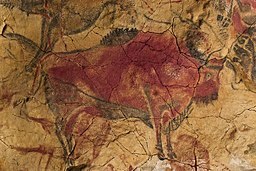
Red ochre used in bison cave painting,
Cave of Altamira, Spain, c. 13,000 BCE (source)...
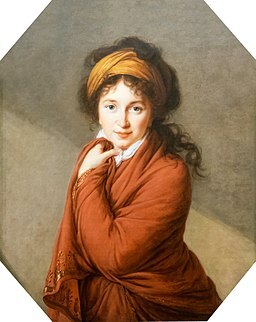
...and more recently. Portrait of Countess
Golovina, c. 1797-1800, Élisabeth Louis
Vigée Le Brun (source). All the images in this
review also appear in Grovier's book.
...and some, like cerulean blue are modern developments. Some original sources of these colors have fallen out of favor due to their great expense, like saffron orange, or their toxicity, like cadmium yellow. Synthetic dyes have often replaced them.
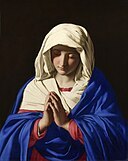
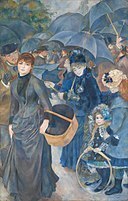
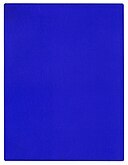
L to R: Sassoferrato, The Virgin in Prayer, 1640-50 (source); Pierre-Auguste Renoir, The Umbrellas, c. 1881-86 (source); Yves Klein, IKB 191, 1962 (source). All three use ultramarine blue, but Renoir and Klein's works use synthesized pigments. Pgs. 110-113 document the immense amount of labor needed to make the original from lapis lazuli.
Kelly Grovier's tour is written at a high level for a lay audience. This is neither an art history nor an art chemistry textbook. He will give you a bit of history of each pigment, some example works that used it, and quotes from artists' and manufactures' writings. In between his nine chapters on colors and the tenth on precious metals used in art, he has double-page spreads on various works of color theory through the ages, called "Colourful Minds." His prose can veer too much into the poetical, and downright purple, sometimes, as he tries to convey the emotional effect of color in visual art. The full-color pictures of the paintings, sculptures and other works mentioned do a lot of the heavy lifting. The paper quality is less than in many art books, probably to keep the price down, but one can certainly grasp the points Grovier makes about the works and specific colors used in them. I suspect that no reproduction can capture the full intensity of seeing these works up close, anyway. All in all, not a bad introduction to color in art.
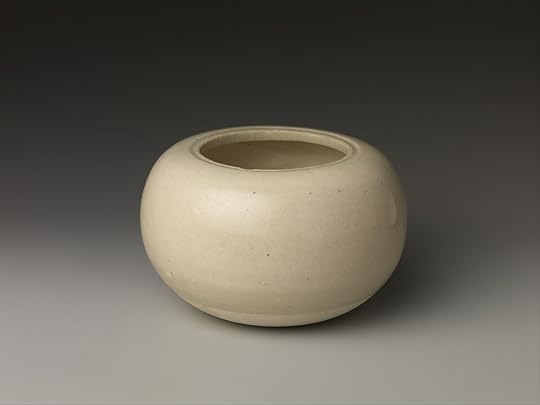
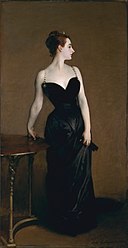
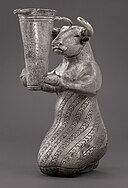
L to R: Kaolin glazed white porcelain bowl, 7th century Tang China (source); Madame X (Madame Pierre Gautreau), John Singer Sargent, 1884, using bone black for the gown (source); silver Kneeling Bull with Vessel, Proto-Elamite, 3100-2900 BCE (source).

Red ochre used in bison cave painting,
Cave of Altamira, Spain, c. 13,000 BCE (source)...

...and more recently. Portrait of Countess
Golovina, c. 1797-1800, Élisabeth Louis
Vigée Le Brun (source). All the images in this
review also appear in Grovier's book.
...and some, like cerulean blue are modern developments. Some original sources of these colors have fallen out of favor due to their great expense, like saffron orange, or their toxicity, like cadmium yellow. Synthetic dyes have often replaced them.


L to R: Sassoferrato, The Virgin in Prayer, 1640-50 (source); Pierre-Auguste Renoir, The Umbrellas, c. 1881-86 (source); Yves Klein, IKB 191, 1962 (source). All three use ultramarine blue, but Renoir and Klein's works use synthesized pigments. Pgs. 110-113 document the immense amount of labor needed to make the original from lapis lazuli.
Kelly Grovier's tour is written at a high level for a lay audience. This is neither an art history nor an art chemistry textbook. He will give you a bit of history of each pigment, some example works that used it, and quotes from artists' and manufactures' writings. In between his nine chapters on colors and the tenth on precious metals used in art, he has double-page spreads on various works of color theory through the ages, called "Colourful Minds." His prose can veer too much into the poetical, and downright purple, sometimes, as he tries to convey the emotional effect of color in visual art. The full-color pictures of the paintings, sculptures and other works mentioned do a lot of the heavy lifting. The paper quality is less than in many art books, probably to keep the price down, but one can certainly grasp the points Grovier makes about the works and specific colors used in them. I suspect that no reproduction can capture the full intensity of seeing these works up close, anyway. All in all, not a bad introduction to color in art.
,_John_Singer_Sargent,_1884_(unfree_frame_crop).jpg)

L to R: Kaolin glazed white porcelain bowl, 7th century Tang China (source); Madame X (Madame Pierre Gautreau), John Singer Sargent, 1884, using bone black for the gown (source); silver Kneeling Bull with Vessel, Proto-Elamite, 3100-2900 BCE (source).

April 7, 2025
Fascinating read!
I read this as research for a project I’m working on but any art lover interested in paint or color would enjoy. The book is divided by color and each color is further divided by pigment - each one rife with unique histories and full-color illustrations throughout. Loved this!
I read this as research for a project I’m working on but any art lover interested in paint or color would enjoy. The book is divided by color and each color is further divided by pigment - each one rife with unique histories and full-color illustrations throughout. Loved this!

February 9, 2024
A feast for your eyes and soul, whether you’re a painter or just one who appreciates art.
As an amateur watercolor painter, the book has been thought-provoking, helping me focus on the personalities of pigments, the subtle progression between shades of an individual color, and how a well chosen color scheme transforms the visual.
As an amateur watercolor painter, the book has been thought-provoking, helping me focus on the personalities of pigments, the subtle progression between shades of an individual color, and how a well chosen color scheme transforms the visual.

May 30, 2023
4/5; i read this to help me with school work and it was a bit different than i expected. i expected a textbook like feel with more technical knowledge over the formation of colour over the years and how artists formulated and adapted their painting techniques for the colours. while the book did give such information, it also went into depth about how painters at the time interpreted the colours in their own paintings and how we today view these paintings. very interesting especially for someone who really likes art as a whole and learning about colour theory / art analysis.
November 27, 2023
Although The Art of Colour ends rather abruptly after the discussion of silver, Kelly Grovier takes the reader an immersive journey into the history and meaning behind color as used in the art. The narrative is completely engrossing with enough vignettes and artistic analysis to satisfy both the curious history enthusiast and the art lover.
December 3, 2024
The language used really brings this book down. The author is a poet and from the way this is written I have to think not a very good one. His sentences often read like tongue twisters.
Example: "The connection between power and purple predates the periwinkle pampering....." and
"A process for procuring a prized and powerful purple dye had been perfected in ancient Phoenicia".
These two examples come from one paragraph alone.
Also the book is inconsistent in explaining how the different pigments were discovered, sourced, and turned into paint along with explaining the affect these discoveries had on working artists at the time on artists (which is when it's at its best IMO) vs. the author waxing inelegantly about the beauty of the specific color in which he tends to go on tangents that are hyperbolic, very subjective and just feel like a waste of time. In keeping with the author's annoying use of language I will say that he's guilty of saturating the book with purple prose which serves no purpose but distracts attention away from the pigments. There's some interesting facts here and there you just have to overlook the authors style of writing which detracts greatly from the enjoyment of the book.
Example: "The connection between power and purple predates the periwinkle pampering....." and
"A process for procuring a prized and powerful purple dye had been perfected in ancient Phoenicia".
These two examples come from one paragraph alone.
Also the book is inconsistent in explaining how the different pigments were discovered, sourced, and turned into paint along with explaining the affect these discoveries had on working artists at the time on artists (which is when it's at its best IMO) vs. the author waxing inelegantly about the beauty of the specific color in which he tends to go on tangents that are hyperbolic, very subjective and just feel like a waste of time. In keeping with the author's annoying use of language I will say that he's guilty of saturating the book with purple prose which serves no purpose but distracts attention away from the pigments. There's some interesting facts here and there you just have to overlook the authors style of writing which detracts greatly from the enjoyment of the book.

December 19, 2023
I enjoyed this book more than I thought I would and especially the tour of colors. I felt this was more of an art book because of the amount of famous paintings then it was about celebrating the colors. I liked reading about the different pigments for each color.
HOWEVER....
All the paintings throughout the book were very blurry. I did not really understand how this could be construed as colorful and vibrant. Maybe when the paintings were first created. For the name of the book, it was lackluster.
I DID ENJOY learning about blue, purple and white pigments. Overall, this was disappointing. GLad it was a library book.
HOWEVER....
All the paintings throughout the book were very blurry. I did not really understand how this could be construed as colorful and vibrant. Maybe when the paintings were first created. For the name of the book, it was lackluster.
I DID ENJOY learning about blue, purple and white pigments. Overall, this was disappointing. GLad it was a library book.

January 11, 2024
An excellent overview of the discovery or invention of many pigments used throughout art history. More springboard than textbook, The Art of Colour presents the stories behind each pigment with drama and tasteful, often clever, prose rather than a dry checklist of who's and when's and what's. My only gripe is the lack of a conclusion to sum up what we've read or where the future in pigment creation and use may lie. Highly recommended for art nerds.
January 26, 2024
Finally finished. Paced my self as non-fiction is not my favorite genre. Nice that it's written so that you can read a section, put it down, and come back to it later. I always love the history embedded into Mr. Grovier's works and the explanation of why pieces of art are noteworthy. Although I still don't get abstract art.

January 25, 2024
A beautiful and entertaining read marred slightly by its matte paper stock which doesn't do justice to the vibrant colors in the many painting examples throughout the book. (Look them up online, or better yet, see them in person, to get a better view of these pigments in all their glory).

January 30, 2024
Would have been five stars but for her compulsive need to make so many goofy alliterative sentences!
February 25, 2024
Quite poetically written book about colors backgrounds.
March 27, 2024
Really great way of accessing a millennia’s worth of art history

July 7, 2025
Very useful ressource for art students!
August 2, 2026
"The kindgdom of colours has within it multidimensional possibilities... each individual colour is a universe in itself"

July 17, 2026
I love this book. Great information about the history of color pigment sources and nearly poetic descriptions of how they illuminate some classic paintings. It gave me a new way to look at classic art because the beauty of some pigments are probably not exactly the same with modern pigment technology.
Displaying 1 - 17 of 17 reviews