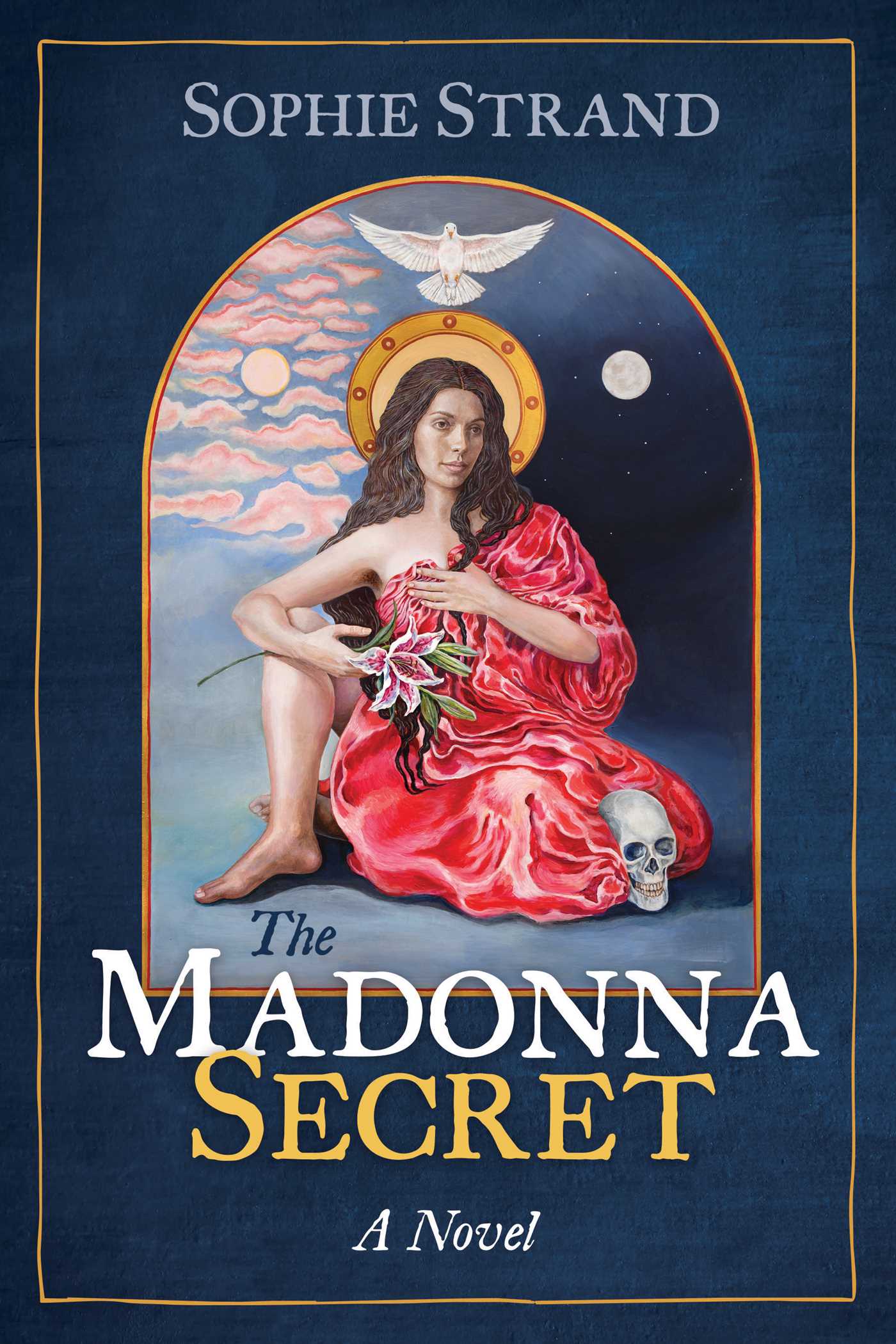
Mary Magdalene’s confessions reveal a sensual world of love and betrayal, magic and mystery, hidden within the Gospels
• Reroots Mary Magdalene and Jesus in the lush ecology and complex spiritual culture of Second Temple Period Judea and Galilee under Roman rule
• Rewilds the Gospels with the forgotten voices of defiant and oppressed women, the nature-based storytelling of oral communities, and the embodied eroticism of a lovable rabbi with appetites and desires, doubts and shame, and a playful sense of humor
• Retells a familiar narrative informed by extensive research in botany and ecology, scriptural analysis, feminist studies, and the mythic traditions of the Mediterranean
When Leukas, a Christian convert, ventures into the wilds of Gaul to receive the hidden teachings from Mary Magdalene before she dies, he discovers that hidden within the Gospels he thinks he knows is an epic love story—between an educated Jewish woman overwhelmed by her mysterious spiritual powers and a sensual magician devoted to the wisdom of the earth. The secrets she will reveal are both more shocking and more tragic than anything readers have encountered before.
Beginning with Miriam’s childhood as a member of a wealthy Jewish family living outside of Bethany, we see her struggles as a young woman with spiritual curiosity and intellectual aspirations that drive her to combat the violence of Empire and the sexism of her own culture. Propelled by mystic visions, Miriam is finally drawn into the wilds of Galilee, where her destiny collides with a mischievous rabbi who will change her and the world forever. Trapped in a mythic story unfolding in events around them, the lovers strive not to repeat a tragedy older than the pyramids.
In The Madonna Secret , Sophie Strand resurrects a richly textured world where complex characters reveal the lived reality of scripture and open familiar sayings to radical new meanings and possibilities.
Disclaimer: Not a Christian, just a feminist historian of Christianity and a big fan of sacred music. Don’t come at me as some kind of fundie hater.
Jesus said to her, “Woman, why are you weeping? Whom are you looking for?” Supposing him to be the gardener, she said to him, “Sir, if you have carried him away, tell me where you have laid him, and I will take him away.” Jesus said to her, “Mary!” She turned and said to him in Hebrew, “Rabbouni!” (which means Teacher). Jesus said to her, “Do not touch me, because I have not yet ascended to the Father. But go to my brothers and say to them, ‘I am ascending to my Father and your Father, to my God and your God.’ ” Mary Magdalene went and announced to the disciples, “I have seen the Lord,” and she told them that he had said these things to her.” - John 20:15-18
I knew I was going to hate this book. I hated The Flowering Wand and I hate Sophie Strand’s idiotic substack thoughts and instagram presence, but I am also a glutton for punishment when it comes to reading bad books dealing with things I know a lot about. It’s why I read Evangelical marriage manuals and Templar conspiracy nonsense. Both of which are things this book has a surprising amount in common with!
This is going to be a long one, so tl;dr: this is the most nonsensical, offensive, heteronormative, gender-essentialist, weirdly conservative, poorly paced, badly written, historically bizarre novel I’ve read in a really long time.
While I was reading this and talking about it with friends, one of them said that this novel is like “Christianity spitefic as written by someone whose only exposure to Christianity is arguments on internet forums”, and she was completely correct in how this book comes off. If you’re at all knowledgeable (properly knowledgeable. Conspiratorial cranks with Holy Blood Holy Grail nonsense up the wazoo don’t count), this book will have you screaming about all the things the author doesn’t actually understand.
A little background on my relationship to this topic: I work on the intersection between gender history, history of religion, and intellectual history with regards to medieval Christianity. Gendered eschatology is my beat. I also did a classics degree where I worked in a lot of early Christian studies, particularly with regards to Christianity’s relationship to other ancient religions. Considering my subfield interests, the Magdalene is near and dear to my heart. She figured prominently in my undergraduate thesis on self-fashioning and authorship in the lives of late medieval quasi-religious women (more on this later, I’m getting ahead of myself).
I love me a subversive retelling of a biblical story, although my tastes tend more towards reinterpretations of the Davidic narrative. But if you are looking for a subversive, feminist Magdalene, you will not find her here. In fact, you won’t find her here so hard that you’d probably be better off looking for her in the actual Bible.
Speaking of which, a note on names. Strand spells them according to Aramaic transliterations, and she is also allergic to any characters having the same names at all. For convenience’s sake, as I am going to largely be talking about the gender politics and implications, I will be referring to the mother of Jesus as the Virgin, and Miriam/Mary Magdalene as Mags when discussing the characters of The Madonna Secret. When I talk about “Mary”, I am talking about the mother of Jesus as she is portrayed in the gospels and extracanonical texts and traditions. When I talk about “the Magdalene”, I am discussing Mary Magdalene as she appears in the gospels and extracanonical texts and traditions.
The first thing about this novel that made me go “oh god no, no, stop it” is the opening, where Luke the Evangelist heads off to Roman Gaul to find Mags and quiz her on her relationship to Jesus/Yeshua. He finds her, after hanging out in an untamed wilderness populated by stereotypical D&D taverns and phonetic accents. This is, to put it bluntly, ridiculous. She’s in southern France, which was, even by this early date, getting pretty damn Romanised. Especially in the area where she’s traditionally supposed to have landed. But this all pales in comparison to the next thing that had me yelling. In here, Mary Magdalene is both Mary of Bethany and the sinful woman who anoints Jesus. This is an incredibly baffling choice for something purporting to be the “real secret history of the Magdalene”, because this is a late antique/medieval construction stemming from one of Gregory the Great’s sermons. It’s also baffling if you’re going primarily off Luke, which Sophie is, because just by reading Luke, it’s fairly hard to get the impression that they’re the same person.
Speaking of identifying people with each other, there’s a fun thing going on here where Mags isn’t just the best ever who has been lied about and excluded, but also she gets just about every trait and image that has ever been applied to other women of the Gospels. More on this later. There’s also a whole lot of comparative mythology going on, none of which should be surprising if you’ve had the misfortune of reading The Flowering Wand. Mags is heavily implied to have been Isis in a past life (Jesus was Osiris, Dionysus, and maybe Orpheus. Sophie also appears to think that Dionysus and Orpheus were primarily Roman figures. They super weren’t). Unfortunately this doesn’t get as weird as it really should have. It just makes her and Jesus super special soulmates who have transcendent world-shaking sex (no really. It summons animals. It is one of the cheesiest things I have ever read).
You may have noticed that I mentioned that Mags is Isis. “But Ella,” you say, “isn’t Isis often associated with the Virgin Mary, at least in a vague iconographical way?” Yes, she is, but this brings us to another fun aspect of this book-- everything cool about Mary gets applied to Mags here. This includes the Magnificat, the Woman of the Apocalypse imagery, the Mater Dolorosa imagery, the Queen of Heaven title, the Hail Mary and Hail Holy Queen, and even the fucking Nativity story and the Flight Into Egypt. Because here’s a big thing about this book: it talks big talk about the eternal timeless sisterhood of women and mothers and sisters, but it doesn’t follow through. No woman can be as special and cool as Mags, because she’s just the best. She’s even the subject of the Thunder, Perfect Mind! (The Thunder, Perfect Mind is a gnostic poem with an unnamed speaker who is almost certainly not Mary Magdalene. She’s probably Sophia or, more controversially, Norea, the female saviour figure in Sethian Gnosticism).
More than simply making Mags the most special and cool ever, Sophie actively degrades the roles of other gospel women to lift Mags up. Joanna, a wealthy woman who supported Jesus (and whom Bauckham contends is probably the same person as the apostle Junia) becomes Yohanna, an abused wife who has to be coaxed to run to Jesus by Mags. The Virgin has no special qualities whatsoever, save for being a Jewish mother stereotype who bears more than a passing resemblance to Life of Brian’s Mandy, especially when she starts yelling about how her son’s an idiot who can’t possibly be the Messiah. It’s very shades of “he’s not the Messiah, he’s a very naughty boy!” She also dies off-page in a Roman raid. Martha is beloved by her sister, but it’s a weird neggy sort of love where Mags is constantly talking about how she doesn’t need so much makeup or to dress up at all. Mary Salome floats around to describe how Women’s Lot In Life Really Sucks and to explain an anachronistic sort of modern New Age pagan syncretism (I’m always noticing that historical fiction set in the ancient world is totally down with ahistorical new age nonsense, but never wants to deal with pagan monotheism or with atheism, which are both belief systems attested to in the ancient world. Unlike ‘denizen of your local crystal store’).
You know how I keep mentioning that Mags gets all the traditional Virgin iconography? This is where I really start bitching about the (anti)feminist implications of the novel. Let’s start with the Bible. Mary Magdalene is introduced in this fashion in Luke: The twelve were with him, as well as some women who had been cured of evil spirits and infirmities: Mary, called Magdalene, from whom seven demons had gone out, and Joanna, the wife of Herod’s steward Chuza, and Susanna, and many others, who ministered to them out of their own resources. What does this passage tell us? That a group of women travelled with Jesus along with the twelve (male) apostles, and that these female arguable apostles were the ones financially supporting Jesus’s ministry. It tells us, about Mary, that she is called Magdalene, and that she had been exorcised of seven demons. It does not tell us her marital status, or whether she has children. It doesn’t tell us if she was a sex worker, as medieval tradition holds. She is Mary, called Magdalene, she had seven demons, and now she ministers to Jesus.
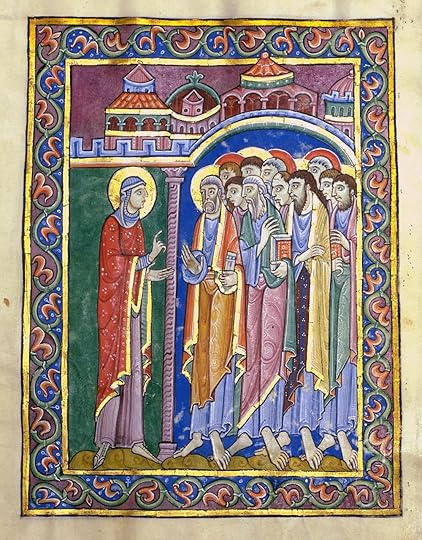
Later, as quoted at the start of the review, the Magdalene discovers the empty tomb, either as part of a group of women, or in John, alone. It is John that gives us the Magdalene’s star turn, where Jesus appears to her and her alone, tells her not to cling to him, and instead asks her to tell the rest of the disciples that he is ascending. It’s not a sexual moment (this becomes important in the context of the novel). It’s an intimate one though, and it is a beautiful one. This is the moment where the Magdalene gains the title under which she is venerated in a number of traditions as Apostolorum Apostola, apostle to the apostles. And as the apostle to the apostles, she became immensely popular, particularly among religious women of the medieval period. It’s how we get some of the unusual depictions of her in medieval art, like this one of her telling the apostles about the risen Christ from the St. Albans Psalter, which likely belonged to medieval English holy woman Christina of Markyate:
It’s also how we get to my personal favourite Magdalene tradition: the Magdalene as preacher. It’s unfortunately almost unknown among non-specialists these days, but it’s a tradition that artistically places images of a woman in the pulpit in an era where women were almost completely barred from public preaching (though there were loopholes and it’s more complica-- insert tangent here as I am dragged away with a vaudeville hook). All this serves to say that the Magdalene had, and continues to have, a place in Christian discourses as an icon and a woman who speaks and cannot be silent, and by her speech helps found and establish the Church. She is not defined by her wifehood or lack thereof, or by being a mother or not. She’s named more in the gospel texts than some of the male apostles. The Magdalene is central to the Christian narrative even without the Gnostic texts that further foreground her. She’s a disciple in her own right, and an apostle unto the twelve apostles. It’s pretty cool.
So if Mary Magdalene isn’t defined by her relation to childbearing or to men, but rather her relationship to Jesus and her role as a speaker of important news (I’ve heard her referred to by some priests in my acquaintance as ‘the first bearer of the gospel’), isn’t that already a pretty feminist starting point? Aren’t there so many places to go from there? If Sophie Strand is up on the medieval tradition of the Magdalene as Mary of Bethany and the sinful woman, surely she’s up on the Magdalene as preacher and apostle. Let’s go! Except we don’t, because this is an incredibly gender essentialist novel. It takes a woman who is defined by her speech and her active ministry and marginalises her speech, exiles her from her ministerial role, and defines her by her wifehood and her motherhood. To make the Magdalene special, she can’t just have a deep understanding of Jesus’s message. No. She has to be his wife and the mother of his children. This is apparently what makes her his “equal”. Not her role in spreading his message from the very first. Not her role in his ministry. Having sex with him and bearing his kids, and being hated for it.
The Magdalene as she appears in the Bible cannot be reduced to a womb on legs. She is a voice. She is a discoverer. She is a woman who enables the ministry of Jesus and a woman who spreads his good news. In the Middle Ages, when the Virgin represented the ideal states of woman, as either a virgin or a mother. The Magdalene, popularly understood as a penitent sex worker, was neither. But she represented a third path to those many women who saw themselves in her. The Magdalene’s example was proof that regardless of someone’s life experiences, she could still be saved, good, and holy. In the vita of Margaret of Cortona, a nobleman’s mistress turned Franciscan lay penitent and mystic, the Magdalene looms large. Worrying over her past sins, Margaret talks to Jesus about the choir of virgins, the ultimate spot for female saints in heaven, and worries that as a sinner, she won’t achieve anything at all. Jesus responds to Margaret that ‘except for the Virgin Mary and the martyr Catherine, there is no one greater than the Magdalene’. In other words, if the Magdalene can be the third greatest virgin in heaven, Margaret has a chance. She doesn’t need to be a consecrated virgin or a saintly married mother, both options off-limits to her. The Magdalene is a third and highly favoured model. For other women, she even represents an escape from the stifling roles of mother and wife, a role that allows women to define themselves as spiritual powerhouses and individuals, relations to Jesus and not to their families. It’s not a perfect tradition, as it’s a penitential, sex-negative one that doesn’t read so nicely to us modern feminist types, but it’s a way that women in a patriarchal society could carve a place for themselves as thinkers and people of import who answered to no men but Jesus (and maybe their confessors, although the ideal confessor-holy woman relationship was a lot more symbiotic than controlling).
Sophie Strand, on the other hand, doesn’t use any of this. Not only is the Magdalene important because she’s having procreative heterosexual sex with Jesus, but because her feminine energies match his masculine energies, and this male-female partnership is the key to the cosmos. Thus, by rejecting marriage and family, the disciples are being misogynists who need to return to their wives (who almost to a t, they beat. There’s no contemplation of the idea that maybe some of these women are happy that their husbands fucked off to join a cult and aren’t beating them anymore). Clearly marriage and parenthood is only something a man would reject, because women in this novel are entirely defined by their motherhood. Mags’s life and the latter sections of the plot revolve around her womb, and Magdalene not wanting to be a wife and a mother is ultimately dismissed as shallow attempts to learn the wisdom of man (intellectual pursuits and scriptural study) as opposed to women’s wisdom (herbs and childbearing and looms). Even if she’s Not Like Other Girls (and oh boy is Mags Not Like Other Girls), her learning to be Like Other Girls is this gender essentialist “women’s work is better because it’s not terrible and artificial like the things created by men, and therefore women should ignore the written word and the intellectual debates of men” thing. It’s supposed to be feminist, and I’ve encountered this idea before, but it always feels like a strange mirrorverse of evangelical complementarian theology. And in this novel, it feels even more like this than usual, because of how Sophie deals with Jesus.
Yeshua/Jesus (honestly, I deeply want to call him Josh. It’s a perfectly cromulent take on Jesus as a name, okay!?) is Manly. This is important because Sophie brings it up constantly. He is big and brawny and hairy and dirty and unkempt and he has serious pit stank that Mags is very into (and that possibly smells like spikenard). He literally rips Mags’ dress during one of their hot and heavy animal-summoning sex sessions where they are aligned with the cosmos and it’s the most Outlander-adjacent nonsense possible. He’s directly contrasted with Joseph of Arimathea (Yosseph), who smells like perfume and wears earrings and takes care of his appearance. It’s all very unsubtle, and it makes me feel a hell of a lot like I’m reading Mark Driscoll all over again. Long story short, if your Real Manly Man Jesus reads pretty similarly to Mark Driscoll’s “the disciples clearly had all dude camping trips where they played endless rounds of pull my finger” testosterone-poisoned, roided out warrior Jesus and the toxic masculinity of Mars Hill Church, you have a problem. Especially if your attitude towards male-female relationships glorifies procreative heterosexual sex at the expense of all else and feels a lot like evangelical complementarian theology. It makes your feminist credentials feel pretty suspect.
Clearly Jesus is supposed to be a happy, rollicking example of manly man masculinity, compared to the rendition of Orpheus in here as a gentle giant, but there’s toxic masculinity in here too, mostly represented by Simon Peter, who gets a pretty intense and baffling villain edit in here. Peter’s plenty flawed in the gospels, denying Jesus thrice and all that, but here he’s an outright woman-hating villain (presumably this is because of the papacy and the Gospel of Thomas, but the point in Thomas is that Peter is wrong, and he’s in the usual ‘socratic dialogue partner’ role that apostles often get put into in more sayingsy sections of scripture. The “making Mary [Magdalene] a man” thing is too complicated to get into in a goodreads review too. Sufficeth to say my Gnosticism 101 class spent like half a class period arguing about it. It goes without saying that Sophie doesn’t get it). Everything that goes wrong and leads to the crucifixion is Peter’s fault, somehow. Including Judas’s betrayal. And it’s his misinterpretation that creates the roots of eucharistic theology. This, more than anything, made me absolutely furious.
This book has haunted me since I started reading it. I've neglected my own loves and land and responsibilities in order to consume it's near 600 pages. I'm not sure our mother would approve of such decadent time squandering but I can't seem to let it go. These beings will stay with me and I will sing of the vulture, the panther, the owl and the river to all who will listen.
New twist on an ancient story. I’m not a biblical scholar and can’t speak to the accuracy of this book in relation to the classic biblical events and characters but readers shouldn’t try to take this book at face value and think of the story as a replacement of Jesus’s story. To me, this is obviously a work of fiction meant to spin the story of Jesus to recenter it on his wife and the divine feminine which has been blatantly missing from the origin stories of the majority of the dominant patriarchal religions. That was one of the main reasons why I loved this novel. As someone who grew up Catholic and now identifies as an agnostic, I appreciated how this novel offered a fresh and feminist perspective on some of the New Testament messages. It made me think of the classic idea of “God” not as an all powerful man surveying and judging you from the sky but as a nourishing mother providing life from beneath the Earth - which intuitively makes way more sense as a figure to worship and follow to live fulfilled and happy lives in harmony with all other living beings on Earth. Even if you aren’t a religious person, I still think this book has important themes and messages for our current times where a majority of humans see themselves as separate from other natural beings which has led to much of the continued ecological destruction and apathy for the violence that many communities and countries are facing all over the world. Will be reading more of Strand’s books in the future!
I don't know why Goodreads always marks the books I place on any shelf other than "to read" as "read". I haven't read this book and I never will, so please ignore Goodreads' absurd claim that I've "read" this.
Update: So I just finished reading Sophie Strand's new book "The Body is a Doorway" and it's actually helped me understand the author's perspective and intentions for this book much better - I actually wish I had read it first. And to be fair, whenever I read anything about Jesus and/or Mary Magdalene I have a specific point of view and I guess particular expectations I'm hoping the storyteller will fulfill. I may have to re-read " The Madonna Secret" with all of this in mind 🤔
Original review: 3.5 ⭐ It's challenging to write a review of this book. I appreciate Sophie Strand's talent as a storyteller. I felt very immersed in the world and experiences of the characters. Her narrative is very tactile and embodied - grounded in the natural world, the senses, and the body. The world she builds is lush and immersive. Mary’s visions are visceral, mythical, and impactful. I appreciated some of the perspectives on women's sacredness and suffering. I probably would have loved this book 25 years ago in my neo-pagan/divine feminine era.
All that being said, I really just can't get on board with her re-telling or re-imagining of the story of Mary Magdalene and Jesus. Another reviewer mentioned that if you have any love or affection or affinity for Jesus and his teachings (or, I'll add, the Gospel of Mary) that this book will land poorly. I agree. She paints Jesus as a man unsure of his teachings, overwhelmed and confused by his healing powers, and often drunk and under the heavy influence of his disciples, who have an axe to grind and revolt against Rome in their hearts. While he is a good storyteller and a compassionate man, he is also portrayed as muddling and misguided at best, and weak and delusional at worst.
The other biblical figures, particularly women, in this narrative aren't treated well either. Mother Mary is a nagging old hag of a woman and.... ugh. Other reviewers do a great job of flushing this out so I'll leave it at that.
Jesus and Mary have horrible visions of the pain and death they have "set in motion" through his ministry - meaning, primarily, the horrors perpetrated by the institution of the church - crusades, witch burnings, etc. The author really misses the point here. There was an opportunity to illuminate how Rome hijacked Jesus's teachings and bent them to the hierarchical structure of empire. It is empire that caused this destruction, along with the elimination of women from church leadership and the elimination of gospels (like the Gospel of Mary and the Acts of Paul and Thecla) that clearly showed women in leadership roles in Jesus' ministry and the early church, to support and perpetuate patriarchal hierarchy.
I don't know, it was a fine story but a frustrating retelling of the gospels (including the gospel of Mary).
Complicated feels about this one, especially reading it in the present moment of active genocide in Palestine. I really appreciated Ella’s review on here by someone with a much better understanding of theology and gnosticism grounded in something more than my own C&E catholic family upbringing n catholic school learnings, plus an enduring soft spot for the saints (cue my grandmother’s admonition that this tendency was “a bit pagan”). My school learning was Ursuline, so very much focussed on the kind of “third option” for women offered by the Magdalene, aka run away from reproductive obligations n get an education plus probs have lots of fun gay sex w other women theological scholars/nuns (I was particularly disappointed that this text had zero gay sex or gender bending).
My feeling, too, is that Strand essentialises not just gender but also Indigeneity (apparently the most natural thing is to sleep in the forest with no shelter, under the stars as god intended, probs naked too). The message of connection with Land, with Place, as the true meaning of “the kingdom,” to me felt facile and reductionist without any exploration of actually *tending* to that land (beyond crying about cities), working with it to produce food, to cultivate connection and reciprocity and relationality — not as some divine and spontaneous knowing, but rather as a learning that happens through time, work, dedication, tenderness, and intergenerational teachings (extended family is notably absent from Miriam/Mags’ childhood?). A connection like that of Palestinians to olive trees planted by their direct ancestors hundreds of years ago, tended lovingly through generations, rather than just a horror at killing any given tree that you have not previously formed a relationship with (feels a lot like white veganism tbh, especially given any kind of revolutionary uprising against the Romans is held as dangerous/foolhardy/not worth it).
Having said all this, I didn’t not enjoy reading this, perhaps as somewhat of a rebuttal to much of christian ethos that is weaponised against women (and queers, who don’t get a look in in this novel — again, disappointing), and even just a bit of the heretical delight in running roughshod over sanctified texts and the freedom to reimagine foundational stories. But ultimately I was left with discomfort and bafflement at the choices made, when it’s clear to me at least that there’s far better ones to be explored.
This was such a compelling read, drawing me into the Judea of the first century, its people, religion and ecology as if I were present. Told from a woman’s point of view, that of Miriam, wife of Yeshua, it is thought-provoking, challenging the present day assumptions about the foundations of Christianity. I highly recommend!
As someone who has been hurt by evangelical Christianity, I started reading this book with trepidation. From the first few pages, however, I realized this was a retelling of the Miriam of Magdala and Yeshua story that would feed my soul. I was transported to first century Palestine and became engrossed in the lives of characters that I'd read about but never really imagined fully.
Nowadays I read fiction very rarely but I’m glad I took time out to read Sophie Strand’s The Madonna Secret. It follows Miriam (Mary) who we suspect was the consort-companion of Yeshua (Jesus), placing her at the centre of the story we all think we know. But of course almost everything we know about Jesus is more about the icon, the symbol, the voice, or put more bluntly the sterile instrument of his lord. Sophie’s retelling rehumanizes Jesus as a man with convictions, doubts, sorrows, passions and flaws. Discovering this very flesh-and-blood avatar of Jesus alone is a good reason to pick up this book.
I’d also like to give special mention to Sophie’s style of writing - how might one describe it best? It is grounded in the senses but fecund in its descriptions. Every scene is layered with synesthetic adorations of the colours, aromas, textures, body languages from every season, temperatures, flavours, auras… It is a scented pool for an initiation of sorts - hear a woman’s words about the most womanly experiences around a man whose essential quality was his overflowing compassion. From the perspective of a maiden, a lady, and a crone too - subject to the (ancient) world’s unkindness in controlling the power of women, and yet remaining fiercely resistant and independent and wise.
And the reward for following this journey? Realising that Jesus’ greatest accomplishment wasn’t that he died for the world, but that he lived laughed and loved everything about it, even to the very end.
Thank you Sophie for taking my time and giving me in return an experimental gospel to deconstruct verse by verse. I’ve read the book once and loved the poetry of every page. I will soon read it again and meditate on the grace that is hidden further between the lines, so subtle it would be easy to assume it isn’t even there.
This is the story of Miriam, the woman we now call Mary Magdalene. This is the story of The Watchtower, the Magdal-Eder, the wife of Yeshua. Helen of Troy’s beauty may have launched a thousand ships, but Miriam of Bethany’s audacity to love and be loved by the magician from Galilea has launched an endless, crushing number of wars. The Inquisition itself sought to repress The Great Heresy, which was the persistent story of Yeshua’s wife and the child she carried in the holy grail of her womb. How dangerous is a woman in her own power, an equal to a god-declared man? The condescending tongues of men who tell Miriam’s story from pulpits and theological commentary will answer that question as many times as we ask it.
In The Madonna Secret Sophie weaves an intricate, vivid, poetic tapestry of life in Palestine during the Roman occupation. She effortlessly creates an overlapping sense of the lives Miriam and Yeshua had lived together before this one, breathing fresh air into what makes a story more powerful, not less: its capacity to exist throughout time, in different ecologies, and by different names. She gives the story of Yeshua back to the dirt, doing what the church has never been able to do. She lets it decompose back into a human and passionate story of tragedy, loss, despair, magic, love, midwifery, death, and rebirth.
I really wanted to like this book more than I did. I adore Strand’s prose and waited eagerly for about a year for this book to come out and bought it immediately when it did. It took me a long time to finish it, and despite it being a 600 page book, this is telling in and of itself.
Despite being fairly aligned with the main characters values, I found Miriam’s inner dialogue to be incredibly repetitive. What I found poetic and deeply resonant and the beginning of the book made me roll my eyes by the end. The characters also seemed to change personalities intermittently and without reason. One moment Miriam is wise, holding a fierce power and intelligence that is quiet and humble. The next, she’s throwing a temper tantrum and behaving as if she is clueless about what’s going on. I didn’t see much character development in any of them.
I also didn’t feel convinced of the love between Miriam and Yeshua. She didn’t even seem to share the same adoration for her baby/pregnancies as she did the birds, the river, etc., which she continually redirects the readers attention to. As a mother myself, I was extremely disappointed by the lack of description of this experience, and I could tell it was written by a woman who has not experienced the immense and overwhelming love between a mother and her child. There were things I liked about it, no doubt, but I can’t justify giving it more than 3 stars.
If you love the Jesus of the Bible, you will hate this book. Strand twists the biblical gospels into a woman hating cult.
That being said, I rather enjoyed it as fiction. In so many ways, it broke my heart. Partly because Christianity is still the boys club that she describes. Woman today are still put into the category of virgin or whore. Sexuality is demonized. Strand opens the door to what possibly could have gone wrong. 10/10 recommend. But be prepared.
Whenever Mary Magdalene's story gets told in fictional form, authors have to make choices about how to interpret the little that is known about Her. As a result, to some, a certain alignment or link to Truth will shimmer true, while for others, things just don't gel.
For me, this was a little of both at times. Mary here grows up in Bethany, and we follow her from childhood till just after her husband Yeshua's death. The whole thing is framed as a flashback storytelling from a time in her life where she's an old woman, presumably living in France, but we know very little about her life there.
The story reads easily and is well built up. I loved the many layers of Miriam's psyche and how different elements from various biblical stories are woven in. What I did not like was how certain characters were developed, like Yeshua and his disciples. They were both a bit flat and one side. And while it is certainly possible they might have done douchy things at some point, the idea of Yeshua being a dick and a party animal just didn't fit with me, nor did the idea of him having a shitty relationship with his parents and his mother being a feisty (plausible) hag and mostly absent (less plausible).
This book is dark, sweet water to all women who have loved the Mystery, and have broken in worlds that force the birdsong and fungi and women away from its beating heart. I have often mourned the christ and gods I felt flowing in me, living and glittering as water, but who were denied me in favor of something frozen and male and commanding. So, from a Mormon ecological mystic, thank you—thank you for this living story that threatens empire. To me, raised in an open patriarchy with hot metal walls for women, this is not just an expression.
I have already told other Mormon women I know to read this book, and I hope they will. May it root and flower cracks into the walls, opening windows to the cool fingers of the forest ~
This was ambitious of her to write and of me to read…adapting this source material into an engaging story is no joke. As a Jew, it was interesting to encounter so many traditions and concepts that I’m quite familiar with in the context of a story that is itself way more familiar to readers who were raised Christian. I loved the exploration of the relationship between the relatively young (at the time) Jewish monotheism and the older polytheistic religions that many Jews would still have been practicing at the time. I’m not an expert, but I’ve encountered the history of pre-written Judaism as a land-based, polytheistic religion in which women were priests and leaders, so this made me want to learn more. Along those lines, I wish there had been more examples of this besides the fetish Miriam’s mother gives her.
A few other things I wish: I wish the pacing had been better. A lot of space was dedicated to circular exegetical discussions that I honestly found boring and not especially relevant to the plot. It’s as if there are two stories being told: a story of spiritual development and interpersonal drama, which I found extremely interesting and engaging, and a thematic exploration of misogyny in the Abrahamic tradition, which I found unoriginal and disconnected from the central tension of the narrative.
The end got confusing for me, maybe because I’m less familiar with the source material. But I would say the sign of a successful adaptation is that the reader doesn’t need to be familiar with the source material to understand what’s happening and be immersed. It felt like a repetitive wash cycle of “this was the moment it all fell apart!!” And honey, it wasn’t just Miriam’s life that fell apart…it was the PLOT!! Multiple characters totally defy their characterization up to this point with no exposition or explanation as to why: we get an extended scene to catch us up on Yohanna’s evolution, but we know nothing about what’s going on with Yeshua that he suddenly loves attention and calling himself the Messiah, why Nicodemus lets these hooligans camp out in his house for weeks, what happened in Marta’s marriage, or—and this bothered me the most because it would have taken a single line of dialogue to resolve—why Yosseph is suddenly so down to forgive, forget, and be a stepdad!
FINALLY, Miriam makes a point of telling the entire story of her childhood, saying to Leukas that she’s not going to tell her husband’s story but her own. Preach girl!! So why does the story basically end with hubby dying? 70 years have passed and homegirl went from the Levant to Egypt to Gaul, and we hear none of it? What about Kemat? What about these tree worshippers she’s been living with? Nada. Lame. I say, cut all the exegetical dialogue and give me more story, more character development.
This was long lol…all my criticisms aside, I’m very impressed with this book. It obviously has prompted me to think about a lot of things, and I think it will ultimately end up alongside Circe by Madeline Miller as a formative work in my own spiritual journey.
This entire review has been hidden because of spoilers.
I so badly wanted to love this book more. The ending redeemed a lot of initial complaints, but still not a five. Not a four either. 3.5? I appreciate the author noting that this is not a nonfiction book, nor is it intended to be an interpretation of scripture. It still felt confusing to have a retelling of Jesus’s story, the disciples, Mary, Lazarus, Nicodemus and have (some of) it feel almost disrespectful to the story of Jesus.
There were some really beautiful and necessary disruptions to my idea of Jesus and his story. Also incredible celebration of the Divine Feminine. It was absolutely an interesting read/listen, but I’m not sure that I *liked* the book.
EDIT
Okay I just monologued about it and think I like it more. This idea that the three Marys in Jesus’s life are one and the same in some ways is beautiful. Because it isn’t just the Marys, it’s all women. Collectively, women brought forth Life, whether through the birth of the presumed Messiah, or through the love they felt for one another. The sacredness of femininity is binding. Women are simultaneously fierce, individual forces and a collective, holy force. Stunning.
This entire review has been hidden because of spoilers.
Oh what a slog. I thought this might be an interesting depiction of Mary Magdalene’s life, and indeed there were some moments of intrigue, but I got the uncanny feeling that I was being brainwashed - while the book presents as progressive and a counter-narrative, it is in fact steeped in deep misogyny and patriarchy. And frankly it’s not very well written. I finally gave up at 60% read. And for the record, I almost never give up on books… 👀 Don’t waste your time, there are many better books out there!
Beautifully written, if a tad bombastic at times, especially toward the end. Breathes humanity into stories I’ve struggled to relate to. I loved Miriam placed in familial context with Lazaros and Nicodemus. All the passages about nature, the senses, and blood were so enchanting. The ending 🤯 4.5
“Miriam, I am old enough now to know there is no one god or goddess. I pray to every blade of grass. Every flower. Every person I meet. Every person I hate. But most of all I pray to the women. All of us. For it is we who give birth to the world.”
“A name is everything. It is the music we respond to when we are lost. Someone goes down to the river and calls out our name and somehow, we hear it and return.”
“Here is my blood. My body. My seed. My womb is never empty. It carries the world.”
“Maybe I was queen of all things that sang. All things that spoke slowly, with green leaves and twisting trunks. Queen of nights with no center, when the moon hides behind a cloud and the dark penetrates even a shut eye.”
“Springtime— when the earth bleeds and we call it a bloom. Each flower pierces through to above from below, I thought. It is painful being born, I think.”
“Slowly it was arriving in great, invisible waves. The understanding that I understood nothing. That my human life was not as important as the life of all the land, the seasons of weather creating and erasing rivers and fields and hills and mountains. There would be other kingdoms we would never live to see.”
“Read between my fingers the love I have held and the love I have let go.”
“All cities burn. All cities crumble. We build them up again and again. And again someone comes and turned them to rubble. If your temple is the ocean, it cannot wash away. If your temple is the mountain, it cannot burn. If your temple lives within you, you need not travel to find it.”
“having stepped into so many different currents in my life, I now know an important secret: rivers disrupt time. Rounding a bend, the turbulence of the water confuses the solidarity of the landscape and causes events to occur differently on opposite banks.”
“To be hollow is to be vulnerable to fate! Our love, our pining and striving, our very desire keeps us filled with our own stories, our own needs. When we empty ourselves too throughly, the winds come to fill the void.”
“I think that when we grow very close to our fate, the world tightens around us like a skin. There will be no deviation. No escape. The shape of our lives finds us, fresh and unformed. When our fate arrives, we find that we are only able to walk in one direction.”
“We strive for union our whole lives: with God, with our purpose, with each other. But union is not a sport for children. It is not a game. It is the loss of a self. The rain does not just break against the ground— it becomes the ground. The river consumed by the ocean is the ocean… But union— the meeting of two equals in love and celebration— is one of the greatest mysteries. I keep it secret because the words for the telling do not yet exist.”
“I did not honor it back then. Now I know that uncertainty is the greatest miracle of all. When we hold ourselves open to the possibility of error, a blessing can arrive that we never imagined possible. The oceans can part and offer a way forward. A question blooms season after season, yielding new flowers, new ideas. But an answer is solid. It bears only one fruit. And very often, it is the wrong fruit.”
“Was not the earth the true healer? A nights sleep deep in the forest. A quiet day in the company of birds. River water. Bitter herbs. This was the slow medicine that healed us from the soles of our feet upward. I was only just beginning to understand: the cause of this suffering was the way we lived— on top of the land instead of inside of it.”
“I will look for you, Always. Our kingdom will come again. Someday. We will be simple people with small lives. We will walk softly, and fate will never hear our steps.”
This is far and away one of the most beautiful books I’ve ever read. The tone and descriptions painted not just a visual picture but an emotional one as well. One of those books that feels like it redefines how the light catches on the world is around you. 820 pages and I didn’t want it to be over.
I would say anything and it wouldnt picture the alchemichal world of Sophie Strand in this book. Its just Mary Magdalene gone feral, vivid dreaming a world where miracles, plants, people and otherness are possible. Just that, this book comes closest to the most difficult definition of love and humanity. i wouldnt dare speak more, just READ IT.
I am absolutely shook to my core after reading this. I went through the entire gamut of emotions. It’s the best book I’ve read in a long, long time. Cannot recommend enough.
I really wanted to like this book, but it fell flat somehow, short of its potential, like the author was afraid of offending if she ventured too far from mainstream conventions. Twentieth century neopagan romanticization of nature was borderline painful to read. Characters were either one dimensional or wildly inconsistent. Some of the poetic descriptions were pleasing to read, & I appreciated the inclusion of smell & texture, but overall it was hard to finish the book.
I don’t understand why this book is so well reviewed. I found it boring, this is a well known story and she didn’t add to the narrative in a creative way. I was simply waiting for it to play out, there were no moments of discovery within this well worn tale. The characters were flat and not endearing, so on top of already knowing how the story would end, I didn’t care what happened either. And her underlying philosophy is shallow new age nonsense with no depth at all.