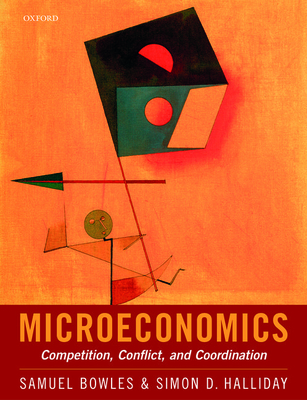
Bowles and Halliday capture the intellectual excitement, analytical precision, and policy relevance of the new microeconomics that has emerged over the past decades. Drawing on themes of the classical economists from Smith through Marx and 20th century writers - including Hayek, Coase, and Arrow - the authors use twenty-first century analytical methods to address enduring challenges in economics.
The subtitle of the work - Competition, conflict, and coordination - signals their focus on how the institutions of a modern capitalist economy work, introducing students to recent developments in the microeconomics of credit and labor markets with asymmetric information, a dynamic analysis of how firms compete going beyond price taking, as well as bargaining over the gains from exchange, social norms, and the exercise of power.
The new benchmark model proposed by Bowles and Halliday is based on an empirical approach to economic actors and problems. They start from the premise that contracts are incomplete, and that as a result market failures, rather than being a special case illustrated by environmental spillovers, are to be expected in markets for labor, credit, knowledge and throughout the economy. They explain how experiments show that human motivations include ethical as well as other-regarding preferences (rather than entirely self-interested) and explain why the technologies of knowledge-based economies are a source of winner-take-all rather than stable competition. The authors also consider the intrinsic limits of mechanism design and governmental interventions in the economy.
Teaching recent developments in microeconomic theory allows the authors to provide students with the tools to analyze and engage in informed debate on the issues that concern them climate change, inequality, innovation, and epidemic spread. Tradeoffs are highlighted by providing models in which capitalism can be seen as an "innovation machine" that raises material living standards on average, while at the same time sustaining levels of inequality that many find to be unfair.
Digital formats and resources This title is available for students and institutions to purchase in a variety of formats and is supported by online resources.
The e-book offers a mobile experience and convenient access to a variety of features that offer extra learning support. It allows students to engage in self-assessment activities, watch video material that further explains figures and mathematics, and offers the opportunity to work with interactive graphs to understand how the models work.
Drawing on the authors' decades of teaching the new microeconomics, this title is supported by a range of online resources for students and lecturers including multiple-choice-questions with instant feedback, further mathematical and discussion-based questions, a fully customizable test bank for lecturer use, PowerPoint slides to accompany each chapter, worksheets that can be assigned to the class, and answers to the problems set in the book.
Librarian Note: There is more than one author by this name in the Goodreads data base.
Samuel Bowles is Research Professor and Director of the Behavioral Sciences Program at the Santa Fe Institute and Professor of Economics at the University of Siena. He is coauthor of Notes and Problems in Microeconomic Theory (North Holland Texts in Mathematical Economics) and Schooling in Capitalist America (Basic Books), and has published articles, most recently, in the American Economic Review, Nature, the Quarterly Journal of Economics, the Economic Journal, and the Journal of Theoretical Biology.