

What do you think?
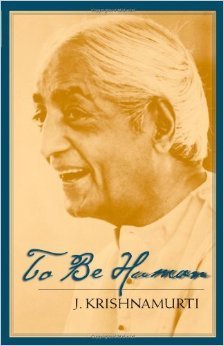
To Be Human
To Be Human presents Krishnamurti's radical vision of life in a new way. At the heart of this extraordinary collection are passages from the great teacher's talks that amplify and clarify the nature of truth and those obstacles that often prevent us from seeing it. Most of these core teachings have not been available in print until now.
Besides presenting the core of Krishnamurti's message, the book alerts the reader to his innovative use of language, the ways in which he would use "old words with new interpretations," then gives practical examples, showing that we can clarify our understanding of life itself—and act on this new understanding.
The splendid introduction by David Skitt discusses Krishnamurti's philosophy as a guide to knowledge and experience, the roles knowledge and experience should play in our lives, and the times when it is best to cast them aside and "look and act anew." The book's source notes will aid the inquisitive reader who wishes a deeper understanding of this great teacher's message.
Besides presenting the core of Krishnamurti's message, the book alerts the reader to his innovative use of language, the ways in which he would use "old words with new interpretations," then gives practical examples, showing that we can clarify our understanding of life itself—and act on this new understanding.
The splendid introduction by David Skitt discusses Krishnamurti's philosophy as a guide to knowledge and experience, the roles knowledge and experience should play in our lives, and the times when it is best to cast them aside and "look and act anew." The book's source notes will aid the inquisitive reader who wishes a deeper understanding of this great teacher's message.
240 pages, Paperback
First published January 1, 2000
About the author
J. Krishnamurti
1,338 books4,403 followersJiddu Krishnamurti was born on 11 May 1895 in Madanapalle, a small town in south India. He and his brother were adopted in their youth by Dr Annie Besant, then president of the Theosophical Society. Dr Besant and others proclaimed that Krishnamurti was to be a world teacher whose coming the Theosophists had predicted. To prepare the world for this coming, a world-wide organization called the Order of the Star in the East was formed and the young Krishnamurti was made its head.
In 1929, however, Krishnamurti renounced the role that he was expected to play, dissolved the Order with its huge following, and returned all the money and property that had been donated for this work.
From then, for nearly sixty years until his death on 17 February 1986, he travelled throughout the world talking to large audiences and to individuals about the need for a radical change in humankind.
Krishnamurti is regarded globally as one of the greatest thinkers and religious teachers of all time. He did not expound any philosophy or religion, but rather talked of the things that concern all of us in our everyday lives, of the problems of living in modern society with its violence and corruption, of the individual's search for security and happiness, and the need for humankind to free itself from inner burdens of fear, anger, hurt, and sorrow. He explained with great precision the subtle workings of the human mind, and pointed to the need for bringing to our daily life a deeply meditative and spiritual quality.
Krishnamurti belonged to no religious organization, sect or country, nor did he subscribe to any school of political or ideological thought. On the contrary, he maintained that these are the very factors that divide human beings and bring about conflict and war. He reminded his listeners again and again that we are all human beings first and not Hindus, Muslims or Christians, that we are like the rest of humanity and are not different from one another. He asked that we tread lightly on this earth without destroying ourselves or the environment. He communicated to his listeners a deep sense of respect for nature. His teachings transcend belief systems, nationalistic sentiment and sectarianism. At the same time, they give new meaning and direction to humankind's search for truth. His teaching, besides being relevant to the modern age, is timeless and universal.
Krishnamurti spoke not as a guru but as a friend, and his talks and discussions are based not on tradition-based knowledge but on his own insights into the human mind and his vision of the sacred, so he always communicates a sense of freshness and directness although the essence of his message remained unchanged over the years. When he addressed large audiences, people felt that Krishnamurti was talking to each of them personally, addressing his or her particular problem. In his private interviews, he was a compassionate teacher, listening attentively to the man or woman who came to him in sorrow, and encouraging them to heal themselves through their own understanding. Religious scholars found that his words threw new light on traditional concepts. Krishnamurti took on the challenge of modern scientists and psychologists and went with them step by step, discussed their theories and sometimes enabled them to discern the limitations of those theories. Krishnamurti left a large body of literature in the form of public talks, writings, discussions with teachers and students, with scientists and religious figures, conversations with individuals, television and radio interviews, and letters. Many of these have been published as books, and audio and video recordings.
This author also writes under: Jiddu Krishnamurti
In 1929, however, Krishnamurti renounced the role that he was expected to play, dissolved the Order with its huge following, and returned all the money and property that had been donated for this work.
From then, for nearly sixty years until his death on 17 February 1986, he travelled throughout the world talking to large audiences and to individuals about the need for a radical change in humankind.
Krishnamurti is regarded globally as one of the greatest thinkers and religious teachers of all time. He did not expound any philosophy or religion, but rather talked of the things that concern all of us in our everyday lives, of the problems of living in modern society with its violence and corruption, of the individual's search for security and happiness, and the need for humankind to free itself from inner burdens of fear, anger, hurt, and sorrow. He explained with great precision the subtle workings of the human mind, and pointed to the need for bringing to our daily life a deeply meditative and spiritual quality.
Krishnamurti belonged to no religious organization, sect or country, nor did he subscribe to any school of political or ideological thought. On the contrary, he maintained that these are the very factors that divide human beings and bring about conflict and war. He reminded his listeners again and again that we are all human beings first and not Hindus, Muslims or Christians, that we are like the rest of humanity and are not different from one another. He asked that we tread lightly on this earth without destroying ourselves or the environment. He communicated to his listeners a deep sense of respect for nature. His teachings transcend belief systems, nationalistic sentiment and sectarianism. At the same time, they give new meaning and direction to humankind's search for truth. His teaching, besides being relevant to the modern age, is timeless and universal.
Krishnamurti spoke not as a guru but as a friend, and his talks and discussions are based not on tradition-based knowledge but on his own insights into the human mind and his vision of the sacred, so he always communicates a sense of freshness and directness although the essence of his message remained unchanged over the years. When he addressed large audiences, people felt that Krishnamurti was talking to each of them personally, addressing his or her particular problem. In his private interviews, he was a compassionate teacher, listening attentively to the man or woman who came to him in sorrow, and encouraging them to heal themselves through their own understanding. Religious scholars found that his words threw new light on traditional concepts. Krishnamurti took on the challenge of modern scientists and psychologists and went with them step by step, discussed their theories and sometimes enabled them to discern the limitations of those theories. Krishnamurti left a large body of literature in the form of public talks, writings, discussions with teachers and students, with scientists and religious figures, conversations with individuals, television and radio interviews, and letters. Many of these have been published as books, and audio and video recordings.
This author also writes under: Jiddu Krishnamurti
Ratings & Reviews
Friends & Following
Create a free account to discover what your friends think of this book!
Community Reviews
Displaying 1 - 19 of 19 reviews

August 1, 2014
This book didn't do much for me until the last pages. That's probably my fault (if there is any fault or a blame at all). It just didn't penetrate me at all. The words were mostly just words and I couldn't get at and experience whatever Krishnarmurti was talking about. And wasn't even sure I agreed.with or liked him all that much.
Most of it seemed like stuff id already heard and in ways that I could better connect with. It didn't ignite my curiosity to dig deep into and meditate over the questions or words spoken. And it bothered me how Krishnarmurti kept demanding 'listen, listen, listen, not just to my words, investigate' me being all like, 'mister I'll damn right decide for myself when and how and to whom I'll listen. Just do your thing and let me do mine.'
So Krishnarmurti talked and talked for pages on and on about this or that and I was supposed to listen but didn't really care.
And then towards the end where it was broken up into shorter paragraphs, sometimes just a few lines, words began to sink in and ring true and I could connect with them.
I don't know (hahaha. You'll get it if you've read it) why this was so. It was just different.
I think I prefer Krishnarmurti in quotes and short, piercing lines, instead of the long monologues.
Most of it seemed like stuff id already heard and in ways that I could better connect with. It didn't ignite my curiosity to dig deep into and meditate over the questions or words spoken. And it bothered me how Krishnarmurti kept demanding 'listen, listen, listen, not just to my words, investigate' me being all like, 'mister I'll damn right decide for myself when and how and to whom I'll listen. Just do your thing and let me do mine.'
So Krishnarmurti talked and talked for pages on and on about this or that and I was supposed to listen but didn't really care.
And then towards the end where it was broken up into shorter paragraphs, sometimes just a few lines, words began to sink in and ring true and I could connect with them.
I don't know (hahaha. You'll get it if you've read it) why this was so. It was just different.
I think I prefer Krishnarmurti in quotes and short, piercing lines, instead of the long monologues.

July 18, 2020
This, by far has been the most difficult book I've ever read. I've had to go back and forth to truly understand what the author is saying. The difficulty, I must confess, is in no way attributed to the author's intent or craft but completely to my inability and lack of readiness to grasp the depth of the content.
A book I must, most certainly, reread for better understanding.
A book I must, most certainly, reread for better understanding.

January 20, 2024
The first book I’ve read about Krishnamurti. This is a collection of excerpts from lectures he gave, organized by topic. Most were about psychology. He describes all knowledge as memory of past experiences. These then constellate into images, or what could also be called complexes, which are the assumptions and past experiences we’ve had about anything but he focuses on relationships. We then really only interact with these images rather than the actual other person. The free association of images leads to a plurality of consciousnesses within us, which leads to internal disharmony and conflict. We need to instead have a unified consciousness, separate from memory, which leads to a Buddha-like state of curious serenity.
That at least is how I understood it. He speaks in a very technical way and has his own lexicon to describe his philosophy, so I’m sure I didn’t fully grasp what he was saying. What I found interesting about it was how different it was from what I’d read from Jung and Gurdjieff. For all three, a united consciousness is the goal but they go about it in different ways. Jung wants to pull the unconscious into the light, and Gurdjieff wants to realize our mechanistic nature and consolidate our multiple I’s through observation and remembering. One can see the parallels between them in theory of structure and approach. Krishnamurti, however, differs in method by advising one to not force, observe, or exert will over one’s psyche. He is frustratingly vague on what this would actually look like in practice.
That at least is how I understood it. He speaks in a very technical way and has his own lexicon to describe his philosophy, so I’m sure I didn’t fully grasp what he was saying. What I found interesting about it was how different it was from what I’d read from Jung and Gurdjieff. For all three, a united consciousness is the goal but they go about it in different ways. Jung wants to pull the unconscious into the light, and Gurdjieff wants to realize our mechanistic nature and consolidate our multiple I’s through observation and remembering. One can see the parallels between them in theory of structure and approach. Krishnamurti, however, differs in method by advising one to not force, observe, or exert will over one’s psyche. He is frustratingly vague on what this would actually look like in practice.

May 9, 2011
Definitely A Good read. It is evident that the author meditated deeply for each answer was precise,relevant and insightful.
October 18, 2020
This is a compilation of posthumously published transcripts of interviews, public speeches et cetera meant as an introduction to Jiddu Krishnamurti's teachings. The edition I read also contained several introductory chapters written by several different authors, placing Krishnamurti's ideas in a greater historical context and explaining why they are still relevant in the 21st century.
The interview format, often taking the shape of Q&A format addressing questions from audience members at Krishnamurti's public lectures, has certain strengths that I found this book to have over say "Freedom from the Known" in that he ends up expounding on more specific and particular practical problems than usual. As a result, "To Be Human" is somewhat less abstract and theoretical in content than his usual books. He did focus more on discussing people's nuts-and-bolts problems in life in the "Commentaries on Living" series, which I sometimes see mentioned as his best works.
Many of the texts in "To Be Human" focus intensely on pointing out how illusory our experience of time is - as well as how artificially constructed our sense of individual identity is. They also go in depth with de-programming our socially indoctrinated need to belong to social categories like nationalities, religious denominations, political ideologies etc. A central point is how all those things are created by the psychological structures of human perception, according to which the mind operates, as well as the resulting cognitive biases we should learn become more aware of and free from.
The latter half of the book focuses more on deconstructing and deprogramming how people make the fulfilment of their life and existence conditional on all kinds of artificial social and philosophical constructs and how to achieve spiritual independence from all this. As you can guess, the editors' focus on those themes results in "To Be Human" feeling much more like a traditional religiously flavoured self-help book than the other books by Krishnamurti I have read, all of which were published during the author's own lifetime.
Whether that is a plus or a minus probably depends on your own tastes, but this might make "To Be Human" more accessible for some audiences. After all, I consider it a huge problem in our society that it is difficult to find easily understandable self-help literature which does not water down all the useful advice with harmful pseudoscience, poorly substantiated conspiracy theories or conservative religious morality of a type that is not quite what people need today - and "To Be Human" is an excellent choice for a book fulfilling that purpose.
The interview format, often taking the shape of Q&A format addressing questions from audience members at Krishnamurti's public lectures, has certain strengths that I found this book to have over say "Freedom from the Known" in that he ends up expounding on more specific and particular practical problems than usual. As a result, "To Be Human" is somewhat less abstract and theoretical in content than his usual books. He did focus more on discussing people's nuts-and-bolts problems in life in the "Commentaries on Living" series, which I sometimes see mentioned as his best works.
Many of the texts in "To Be Human" focus intensely on pointing out how illusory our experience of time is - as well as how artificially constructed our sense of individual identity is. They also go in depth with de-programming our socially indoctrinated need to belong to social categories like nationalities, religious denominations, political ideologies etc. A central point is how all those things are created by the psychological structures of human perception, according to which the mind operates, as well as the resulting cognitive biases we should learn become more aware of and free from.
The latter half of the book focuses more on deconstructing and deprogramming how people make the fulfilment of their life and existence conditional on all kinds of artificial social and philosophical constructs and how to achieve spiritual independence from all this. As you can guess, the editors' focus on those themes results in "To Be Human" feeling much more like a traditional religiously flavoured self-help book than the other books by Krishnamurti I have read, all of which were published during the author's own lifetime.
Whether that is a plus or a minus probably depends on your own tastes, but this might make "To Be Human" more accessible for some audiences. After all, I consider it a huge problem in our society that it is difficult to find easily understandable self-help literature which does not water down all the useful advice with harmful pseudoscience, poorly substantiated conspiracy theories or conservative religious morality of a type that is not quite what people need today - and "To Be Human" is an excellent choice for a book fulfilling that purpose.

September 6, 2021
This book is a collection of his dialogues with his audience. At some point it looks to me as old wine in new wineskin. His teachings are only useful for those who are prepared/ing for a meditative, solitude life. For others (common people) i seriously think, might put them in some confusion about their own life and loosing way in-between. They may not even understand (lack of attention in JKs terms) what JK is saying.

December 4, 2021
Completely ambivalent although I don't know much about Krisnamurti I still fail to see the real and clear direction of any psychology or philosophy. Some very inspirational spiritual content, although I find the repetition saturated. It will poke thoughts about existence and what really is and what is real along with how we can truly perceive things. I'll have to read more to make a qualified assessment.

July 8, 2023
Ölmeden önce okunması gereken kitaplar vardır ya,bu kitap, ölmeden önce üç defa okunması gereken bir kitap ki anca anlayıp, uygulamaya geçebilelim. Krishnamurti ile ilk tanışmam oldu, onu hiç okumdan önceki ona dair imgemi mutedil bir şekilde değiştirdi, bilincimin altı üstüne geldi. İyi ki var(mış diyemiyorum, hala var..).

February 9, 2023
This book was not for me. I liked the thinking and rhetoric he used, but I did not like the execution and narrative. Too many questions directed to the reader or person he is talking to. It kind of feels patronizing at times due to that.

August 15, 2021
Just a few Buddhist insights wrapped in layers of condescension and sophism.

November 18, 2022
Too many words to explain simple things that could be said in shorter words??
Didn’t enjoy :( only made it to p47
Boring
Life too short to read this
Didn’t enjoy :( only made it to p47
Boring
Life too short to read this


March 5, 2024
My highest recommendation for anyone interested in reading Krishnamurti and wondering which of his books to begin with.... A perfect introduction to his "teaching."

June 17, 2020
The book is a compilation of lectures and tapes, and covers Krishnamurti's discourses on human consciousness - emotions, war, and other aspects of our and society's paradigms. He is a brilliant man, but practically all of these spiritual philosophers seem to go out of their way to make everything difficult to understand.
The book may be short, but it is extremely dense. There is not a paragraph that does not contain some complex esoteric perspective. Often I had to re-read them a few times to make sense of the concept. And sometimes, I still wasn't totally sure. The bottom line is to figure things out for yourself and don't give away your power to others.
On love, I think Swedenborg's explanation is superior and far easier to understand - it is our essence. As with the other emotions, Krishnamurti does a great job of explaining what they aren't, but grasping the concept of what they are was difficult for me.
One thing for sure, the book does make you see things differently by challenging the accepted paradigms, and any book that makes you question yourself as much as this one is definitely worth reading.
The book may be short, but it is extremely dense. There is not a paragraph that does not contain some complex esoteric perspective. Often I had to re-read them a few times to make sense of the concept. And sometimes, I still wasn't totally sure. The bottom line is to figure things out for yourself and don't give away your power to others.
On love, I think Swedenborg's explanation is superior and far easier to understand - it is our essence. As with the other emotions, Krishnamurti does a great job of explaining what they aren't, but grasping the concept of what they are was difficult for me.
One thing for sure, the book does make you see things differently by challenging the accepted paradigms, and any book that makes you question yourself as much as this one is definitely worth reading.
April 28, 2022
It feels more like you are reading someone talking than you are reading a novel. Jidda has interesting ideas, many of which intersect at the crossroads of psychology and eastern philosophy. His accounts are metaphysical and epistemological in nature. Good for thinking deeply and curiously about certain human tendencies and habits brought about because of society.

October 13, 2022
I've read a lot of K. This (like many other books) is a posthumous collection, but an especially good one.
Perhaps the best, if not the simplest/easiest introduction to K's core teachings.
To be read and reread.
Again. And again.
Perhaps the best, if not the simplest/easiest introduction to K's core teachings.
To be read and reread.
Again. And again.

October 16, 2007
Another failure on my part to "get religion." I had thought Krishnamurti was some guy from a long long time ago, but he's just another patronizing hypocritical soi-disant guru dick.
September 18, 2008
Powerful Book--Very Complexs

April 27, 2010
Metaphysical meanderings with Krishnamurti. How fun!
Displaying 1 - 19 of 19 reviews