

What do you think?

Collected Short Stories
Written at various dates before World War I, these 12 stories contain themes that were to re-emerge in E.M. Forster's later work. They demonstrate his belief in freedom, self realization and a spiritual honesty that may be used to defeat the lies of repression.
224 pages, Paperback
First published January 1, 1947
About the author
E.M. Forster
839 books4,513 followersEdward Morgan Forster, generally published as E.M. Forster, was an English novelist, essayist, and short story writer. He is known best for his ironic and well-plotted novels examining class difference and hypocrisy in early 20th-century British society. His humanistic impulse toward understanding and sympathy may be aptly summed up in the epigraph to his 1910 novel Howards End: "Only connect".
He had five novels published in his lifetime, achieving his greatest success with A Passage to India (1924) which takes as its subject the relationship between East and West, seen through the lens of India in the later days of the British Raj.
Forster's views as a secular humanist are at the heart of his work, which often depicts the pursuit of personal connections in spite of the restrictions of contemporary society. He is noted for his use of symbolism as a technique in his novels, and he has been criticised for his attachment to mysticism. His other works include Where Angels Fear to Tread (1905), The Longest Journey (1907), A Room with a View (1908) and Maurice (1971), his posthumously published novel which tells of the coming of age of an explicitly gay male character.
He had five novels published in his lifetime, achieving his greatest success with A Passage to India (1924) which takes as its subject the relationship between East and West, seen through the lens of India in the later days of the British Raj.
Forster's views as a secular humanist are at the heart of his work, which often depicts the pursuit of personal connections in spite of the restrictions of contemporary society. He is noted for his use of symbolism as a technique in his novels, and he has been criticised for his attachment to mysticism. His other works include Where Angels Fear to Tread (1905), The Longest Journey (1907), A Room with a View (1908) and Maurice (1971), his posthumously published novel which tells of the coming of age of an explicitly gay male character.
Ratings & Reviews
Friends & Following
Create a free account to discover what your friends think of this book!
Community Reviews
Displaying 1 - 30 of 62 reviews

September 2, 2011
This wonderful collection of stories really helped me to "get" E.M. Forster in a way that I was not able to access through his more famous longer works, and sealed him to me as a kindred spirit. This is a very coherent collection where we see Forster worrying away at the same bones he digs up in Howards End, A Room With a View andA Passage to India. He was essentially a romantic with a prophetic view of where the Victorian obsession with progress, novelty and mechanisation were leading. In most of these stories it is nature and the spirits who animate her who triumph. Especially notable is "The Machine Stops", a visionary piece of early science fiction in which he seems to foresee the deprivations of the Internet Age with disturbing accuracy. These tales are melancholic and magical and strangely accessible, a real delight.

June 5, 2016
I generally hate fantasy, which most of these stories are. Many are set in heaven or hell, making me feel like I was trapped in a book of New Yorker cartoons.
"The Eternal Moment", with an upper-class English tourist offering to take the youngest son of a poor Italian concierge back with her to be raised by wealthy people, has echoes of Where Angels Fear to Tread. Or vice versa; I'm not sure which one was written first.
2.279 stars, rounded up to 3.

March 27, 2010
Twelve fantasy stories written before the First World War, including The Machine Stops and a short introduction by the author. I've just read the first, The Story of a Panic which is very funny, scary and bitter tasting as well as a slice of the sheer nastiness of a certain English gentility relayed through the repressed utterances of the odious narrator.
The Machine Stops I read a few weeks ago, and was interested to see Forster say it was a response to an early H.G.Wells story. Earlier in the day, while reading around the political aspects of those strange cutting edge futurologies named extropy, transhumanism and post-human: Wells and science fantasy in general are relevant in part of this consideration. Whatever, it strikes me as remarkable that the genesis of the move towards what is called the Singularity is rooted back so far, and Forster's story of 1909 is prescient.
The Other Side of the Hedge is a sardonic diatribe against the myth of progress. It's brilliantly brief and worth getting off the treadmill for five minutes to read.
And while much of all these stories is somewhat akin to being trapped with G.K.Chesterton on LSD in a celestial elevator, the way in which Forster brings off satirical acuteness with a more generalised disdain for bourgeois small-indedness is remarkable. I'd recommend in particular,
Other Kingdom as representative. It's got all the elements of pandemonic forced lying just the other side of fragile systems, pathways, cultural matrices; some brilliant one-liners, explicit theatrical scenarios, marvellous uses of puns; and not a little on the nature of writing and reading themselves, and the sterilities of bookish fantasies.
The Machine Stops I read a few weeks ago, and was interested to see Forster say it was a response to an early H.G.Wells story. Earlier in the day, while reading around the political aspects of those strange cutting edge futurologies named extropy, transhumanism and post-human: Wells and science fantasy in general are relevant in part of this consideration. Whatever, it strikes me as remarkable that the genesis of the move towards what is called the Singularity is rooted back so far, and Forster's story of 1909 is prescient.
The Other Side of the Hedge is a sardonic diatribe against the myth of progress. It's brilliantly brief and worth getting off the treadmill for five minutes to read.
And while much of all these stories is somewhat akin to being trapped with G.K.Chesterton on LSD in a celestial elevator, the way in which Forster brings off satirical acuteness with a more generalised disdain for bourgeois small-indedness is remarkable. I'd recommend in particular,
Other Kingdom as representative. It's got all the elements of pandemonic forced lying just the other side of fragile systems, pathways, cultural matrices; some brilliant one-liners, explicit theatrical scenarios, marvellous uses of puns; and not a little on the nature of writing and reading themselves, and the sterilities of bookish fantasies.
July 2, 2026
A pleasant and interesting collection of Short Stories by E.M. Forster. I really enjoyed them all and they made me want to reread some of his other books. Not quite as good as some of his novels in my opinion but I enjoyed them nevertheless.
The book includes themes of a Supernatural and Sci-fi nature in which he seemed to take an interest.
The book includes themes of a Supernatural and Sci-fi nature in which he seemed to take an interest.

April 24, 2023
This collection of stories shares similar themes and the same brilliant prose as Forster’s novels, but the stories are often presented in the medium of science fiction or fantasy. Supernatural themes run throughout, and a couple of the stories also hint at the subject of homosexual love.
My favorites were The Machine Stops and Mr. Andrews, but these were all worth the time it to read them.
The Story of a Panic: the supernatural turn of events in a picturesque setting put me in mind of Picnic at Hanging Rock (though I have never read it). Peppered with classic Forster themes such as classism and British snobbery.
- “ I always make a point of behaving pleasantly to Italians, however little they may deserve it”
The Other Side of the Hedge: No words wasted in this metaphoric treatment of human progress.
The Celestial Omnibus: I wasn’t as enamored with this allegorical treatment of literary snobbery(?).
Other Kingdom: a diatribe against patriarchal norms of the time. Supernatural element: is our female heroine a wood sprite?
- “The arguments for the study of Latin are perfectly sound, but they are difficult to remember“
- “If it were my place to like people, I could have liked her very much“
The Curate’s Friend: another supernatural being of the woods, a faun plays a part in helping the narrator forgo conventions in the pursuit of true happiness. Perhaps the most overt allusions in the book to Forster’s own sexuality.
- “No man has the right to call himself a fool, but I may say that I then presented the perfect semblance of one.“
The Road from Colonus: a rather pessimistic tale on the obduracy of the elderly; I think I don’t want to get old now.
- “He had lost interest in other people’s affairs, and seldom attended when they spoke to him. He was fond of talking himself but often forgot what he was going to say, and even when he succeeded, it seldom seemed worth the effort. His phrases and gestures had become stiff and set, his anecdotes, once so successful, fell flat, his silence was as meaningless as his speech. …There was nothing and no one to blame: he was simply growing old.“
The Machine Stops: the true gem of this book. The prose doesn’t sparkle like we expect from Forster, but here we marvel at that classic (dystopian?) sci-fi theme: the dangers presented humanity by the progress of technology. Incredibly insightful; prophetic, even. There is a lot to remind one of HG Wells in this story, but I think Forster has out-Wellsed Wells here.
The Point of it: Really enjoyed the first 2/3 of this; a summary of a man’s life. Less enamored with the final third, a treatment of the afterlife.
Mr. Andrews: on its way to heaven, the soul of a beneficent Christian meets that of a Muslim man who has led a violent life. Hilarity does not ensue, but we are treated to a single short philosophical musing.
The Story of the Siren: yet another mythical creature, introduced by way of an anecdote told by that tried Forster medium, a lowly caste servant.
- “They loved each other, but love is not happiness. We can all get love. Love is nothing.”
The Eternal Moment: a tale of how tourism ruins a nice place, but once again it’s really a story of the irreconcilability of social classes. A touch cynical, and an appropriate way to finish this collection.

January 5, 2008
Reading Forster is always very relaxing, it's like a warm bath. Calm, sophisticated English which makes you feel good somehow. The stories in this collection are not so well known as novels like A passage to India or Howards end, but equally enjoyable in themselves. Forster desribes the stories truthfully as "fantasies" and thus we find Mediterranean fantasies, after-life fantasies, future fantasies and mythological fantasies. They can be strange and confusing or sometimes even a little brutal, but in the end they're always fun to read: they tickle your own fantasy. I especially recommend "The celestial omnibus", "The road from Colonus" and "The machine stops". Anyone who's enjoyed Forster's novels or even the movies about them can't go wrong with reading these stories.

May 19, 2012
This was my first date with E.M. Forster and I confess that I was a tad nervous. I was expecting this collection of short stories to consist of twelve rather dry character studies, what Eddie Izzard described as British men opening doors and stammering at one another.
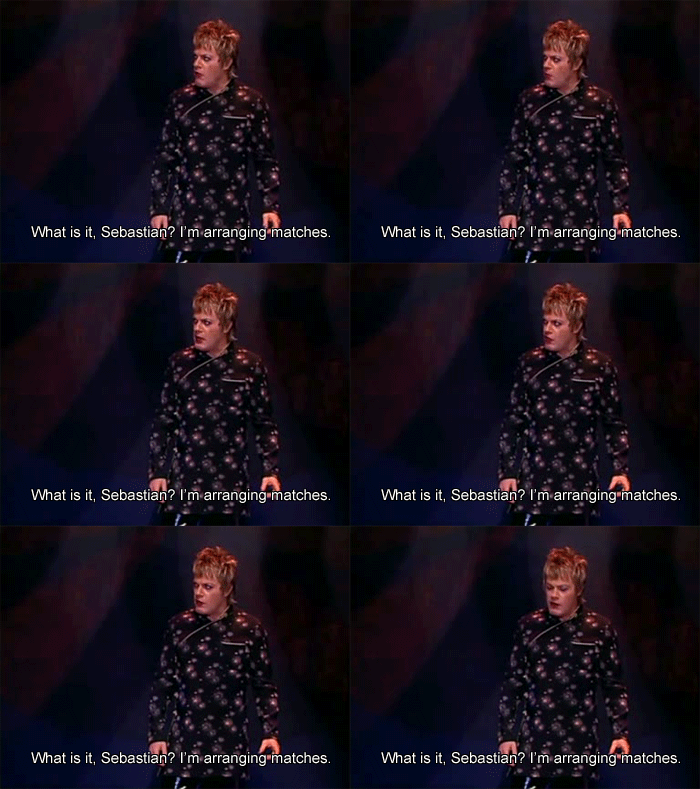
So I was pleased indeed when our little tête-à-tête opened not with twenty pages of matchstick arranging, but with a snappy supernatural tale. Except the supernatural trappings are really a vehicle for Forster to criticise British attitudes towards their more colourful European neighbours. In a few short pages Forster manages to make us understand that the story's narrator is what literary critics refer to as an arrogant tosspot with a stick up his posterior. E.M. also explores attitudes to nature in post-Industrial Revolution Europe, and there's even a subtle dig at Christianity—a goat's hoof-print leading a character to surmise that the Prince of Darkness was at hand, rather than the nature loving Pan. (Fauns are something of a recurring theme in the first half of the collection, as is their being mistaken for Satan.)
Thus, while the quality of the first story soothed my original fears, it did raise another concern. If Forster's début work could pile so many coherent themes atop one another in so short a space, then presumably his later, more developed works would achieve even more. I haven't really explored themes and allusions in written compositions since I did a GCSE in English Literature over ten years ago. I simply wasn't convinced that I'd be able to "get" the majority of his stories, especially given the apparent need for a classical education to even be aware of half of the allusions (the first three stories alone invoke Pan, Achilles, and the story of Daphne). Sure I read a lot, but I know there's a difference between reading fifty books in a year and being well read. Fortunately Forster helped me out. The quaint re-imagining of the legend of Daphne, Other Kingdom, for example, is narrated by the ignoble Mr Inksip, a teacher of Latin and Ancient Greek. The tale of Daphne escaping Apollo's advances by turning into a tree is never specifically mentioned, but enough Greek mythology is discussed to drag out a half-formed memory of the myth whence it had been laying dormant in some dark part of my mind.
All this talk of allusions and so on would be moot if the book had footnotes explaining everything, but by now I should probably be able to make many of the connections myself. And so I took it nice and slow, pausing to think about (but striving not to overthink) each story rather than rushing through the pages as is my custom. And Forster held my hand (on a first date too, what a floozy).
As if to remind the reader that stories and poems can (and should!) be read for enjoyment rather than dry academic interest, and that a twenty page story shouldn't warrant two hundred pages of commentary and analysis, Forster's second story, The Celestial Omnibus contrasts the two approaches. Its central characters are a young boy who enjoys reading, even if he can't comment on Homer's use of dactylic hexameter, and a "cultured" gentleman who owns a voluminous library but pours scorn on the boy's frivolous attitudes. One evening the boy finds a bus service to a Heaven populated not by angels but by all the great authors and poets and their creations. The incredulous gentleman accompanies the boy the next night in order to demonstrate that the bus was imagined, only to discover its reality and join the boy. In a nice touch it is Dante who drives the coach on this second night with the message "Abandon all audacity ye who enter here" (give or take) emblazoned within the vehicle in Latin, a slight variation on Dante's more famous line. En route the boy is chastised by the gentleman for "wasting time" the previous evening with Dickens' Mrs Gamp and Fielding's Tom Jones rather than asking profound questions of Shakespeare and Homer and Dante. And yet upon arriving at Heaven it is the boy who finds himself transported by joy, surrounded and adored by a plethora of characters. The gentleman meanwhile is solemnly told by Dante that poetry is a means not an end, that it is sustenance for the soul, not a replacement for one. It all ends on a bittersweet note with the gentleman's fall and the boy's ascendancy, and yet the reader is left to realise that the fallen gentleman held the boy's return ticket to the mortal world. Books may be a form of escapism from whatever ails us—in the boy's case his unkind parents—but if we could escape completely, would we really want to?
Another highlight in the collection is its centrepiece, the lovely novelette The Machine Stops. It's set in a future where globalisation and technologicalisation have reached their limits (or more accurately an impasse) and the human race has become totally homogeneous, living underground in identical cells only to experience virtual lectures and hear new ideas, and utterly dependent upon a vast global machine that serves their every need. In time people even come to worship the machine, willingly forgetting its human origins. While there's a hint of dystopia about the setting, it's interesting that Forster doesn't suggest there's some evil mastermind or cabal behind this desensualisation of the human race. There is a central committee that bans visits to the surface and that instigates the Church of the Machine, but as the omniscient narrator points out, they merely announce the measures, they are not responsible for them. Rather there is an invincible pressure among the people en masse towards these ideas. Forster, it is fair to say, had reservations about increasing dependence on machines. And reading the story here in 2012 and seeing the uncanny similarities between his Machine and the internet makes it all the more potent and unsettling.
Sadly the second half of the collection didn't live up to the promise of the first. Forster's interesting ideas on our attitudes towards nature are replaced by a triplet of rather directionless tales about the afterlife, all of which sound rather hollow given Forster's religious views. His secular humanist attitude almost works in his favour in Mr Andrews, a tiny story that ponders what would happen if all religions were both right and ultimately unfulfilling, and it was human contact and kindness rather than some idealised paradise that would provide us with total happiness. It's quaint and all that but easily forgotten. The other two stories in the trio are The Point of it, to which Forster's literary friend's apparently asked "What is the point of it?" I'm inclined to agree with them. And then there's Co-ordination, which feels like an eight page joke set in Heaven, Hell, and Earth, but it's one of those jokes where when the punchline comes I didn't laugh, just kept listening, and there was an awkward silence, and then Forster had to mumble something about that being the punchline and then I had to force a laugh, and it was all rather uncomfortable.
The collection ends with The Eternal Moment, a thought provoking little tale that can't quite seem to make its mind up what it is. It centres around an ageing author who returns to a small German village that she made famous through her début novel. She finds that her fears that the village's new-found fame will have spoiled it are all too justified, with the village itself become ugly in appearance and the inhabitants ugly in attitude. So it seems to be a tale about the problems of tourism, a mildly interesting story with mildly uninteresting characters, but perhaps ahead of its time (like The Machine Stops) for recognising the Googlewhack effect of tourism—if a remote town becomes famous for being quaint and untouched and off the beaten track and so on, then tourists will flock there, and it will be dull and knackered and accessible from the newly built airport next door. Half way through the story it switched focus to an Italian man that the author had a brief tryst with on her original visit to the area decades earlier. She finds her lithe, romantic, ingenuous lover has become a waddling, sanctimonious little turd who Forster isn't subtle about painting as an utter scoundrel. The story shuffles to a close with the author embracing her old age and pondering in a grimly happy fashion on her life while the other characters pretend nothing has happened.
Thus the date ended and I dropped Forster back at his bookshelf. Was it good? Mostly, yes. As the evening wore on I found my companion somewhat less charming that I did initially, which poses a problem, since Forster's later more famous works are apparently more like these later stories than the fresh, interesting ones at the beginning of the collection. So I probably won't be giving him a call anytime soon.
What's that? Was there a goodnight kiss? No, because this is a book I'm talking about and that would be peculiar. You strange, crazy person, you.
So I was pleased indeed when our little tête-à-tête opened not with twenty pages of matchstick arranging, but with a snappy supernatural tale. Except the supernatural trappings are really a vehicle for Forster to criticise British attitudes towards their more colourful European neighbours. In a few short pages Forster manages to make us understand that the story's narrator is what literary critics refer to as an arrogant tosspot with a stick up his posterior. E.M. also explores attitudes to nature in post-Industrial Revolution Europe, and there's even a subtle dig at Christianity—a goat's hoof-print leading a character to surmise that the Prince of Darkness was at hand, rather than the nature loving Pan. (Fauns are something of a recurring theme in the first half of the collection, as is their being mistaken for Satan.)
Thus, while the quality of the first story soothed my original fears, it did raise another concern. If Forster's début work could pile so many coherent themes atop one another in so short a space, then presumably his later, more developed works would achieve even more. I haven't really explored themes and allusions in written compositions since I did a GCSE in English Literature over ten years ago. I simply wasn't convinced that I'd be able to "get" the majority of his stories, especially given the apparent need for a classical education to even be aware of half of the allusions (the first three stories alone invoke Pan, Achilles, and the story of Daphne). Sure I read a lot, but I know there's a difference between reading fifty books in a year and being well read. Fortunately Forster helped me out. The quaint re-imagining of the legend of Daphne, Other Kingdom, for example, is narrated by the ignoble Mr Inksip, a teacher of Latin and Ancient Greek. The tale of Daphne escaping Apollo's advances by turning into a tree is never specifically mentioned, but enough Greek mythology is discussed to drag out a half-formed memory of the myth whence it had been laying dormant in some dark part of my mind.
All this talk of allusions and so on would be moot if the book had footnotes explaining everything, but by now I should probably be able to make many of the connections myself. And so I took it nice and slow, pausing to think about (but striving not to overthink) each story rather than rushing through the pages as is my custom. And Forster held my hand (on a first date too, what a floozy).
As if to remind the reader that stories and poems can (and should!) be read for enjoyment rather than dry academic interest, and that a twenty page story shouldn't warrant two hundred pages of commentary and analysis, Forster's second story, The Celestial Omnibus contrasts the two approaches. Its central characters are a young boy who enjoys reading, even if he can't comment on Homer's use of dactylic hexameter, and a "cultured" gentleman who owns a voluminous library but pours scorn on the boy's frivolous attitudes. One evening the boy finds a bus service to a Heaven populated not by angels but by all the great authors and poets and their creations. The incredulous gentleman accompanies the boy the next night in order to demonstrate that the bus was imagined, only to discover its reality and join the boy. In a nice touch it is Dante who drives the coach on this second night with the message "Abandon all audacity ye who enter here" (give or take) emblazoned within the vehicle in Latin, a slight variation on Dante's more famous line. En route the boy is chastised by the gentleman for "wasting time" the previous evening with Dickens' Mrs Gamp and Fielding's Tom Jones rather than asking profound questions of Shakespeare and Homer and Dante. And yet upon arriving at Heaven it is the boy who finds himself transported by joy, surrounded and adored by a plethora of characters. The gentleman meanwhile is solemnly told by Dante that poetry is a means not an end, that it is sustenance for the soul, not a replacement for one. It all ends on a bittersweet note with the gentleman's fall and the boy's ascendancy, and yet the reader is left to realise that the fallen gentleman held the boy's return ticket to the mortal world. Books may be a form of escapism from whatever ails us—in the boy's case his unkind parents—but if we could escape completely, would we really want to?
Another highlight in the collection is its centrepiece, the lovely novelette The Machine Stops. It's set in a future where globalisation and technologicalisation have reached their limits (or more accurately an impasse) and the human race has become totally homogeneous, living underground in identical cells only to experience virtual lectures and hear new ideas, and utterly dependent upon a vast global machine that serves their every need. In time people even come to worship the machine, willingly forgetting its human origins. While there's a hint of dystopia about the setting, it's interesting that Forster doesn't suggest there's some evil mastermind or cabal behind this desensualisation of the human race. There is a central committee that bans visits to the surface and that instigates the Church of the Machine, but as the omniscient narrator points out, they merely announce the measures, they are not responsible for them. Rather there is an invincible pressure among the people en masse towards these ideas. Forster, it is fair to say, had reservations about increasing dependence on machines. And reading the story here in 2012 and seeing the uncanny similarities between his Machine and the internet makes it all the more potent and unsettling.
Sadly the second half of the collection didn't live up to the promise of the first. Forster's interesting ideas on our attitudes towards nature are replaced by a triplet of rather directionless tales about the afterlife, all of which sound rather hollow given Forster's religious views. His secular humanist attitude almost works in his favour in Mr Andrews, a tiny story that ponders what would happen if all religions were both right and ultimately unfulfilling, and it was human contact and kindness rather than some idealised paradise that would provide us with total happiness. It's quaint and all that but easily forgotten. The other two stories in the trio are The Point of it, to which Forster's literary friend's apparently asked "What is the point of it?" I'm inclined to agree with them. And then there's Co-ordination, which feels like an eight page joke set in Heaven, Hell, and Earth, but it's one of those jokes where when the punchline comes I didn't laugh, just kept listening, and there was an awkward silence, and then Forster had to mumble something about that being the punchline and then I had to force a laugh, and it was all rather uncomfortable.
The collection ends with The Eternal Moment, a thought provoking little tale that can't quite seem to make its mind up what it is. It centres around an ageing author who returns to a small German village that she made famous through her début novel. She finds that her fears that the village's new-found fame will have spoiled it are all too justified, with the village itself become ugly in appearance and the inhabitants ugly in attitude. So it seems to be a tale about the problems of tourism, a mildly interesting story with mildly uninteresting characters, but perhaps ahead of its time (like The Machine Stops) for recognising the Googlewhack effect of tourism—if a remote town becomes famous for being quaint and untouched and off the beaten track and so on, then tourists will flock there, and it will be dull and knackered and accessible from the newly built airport next door. Half way through the story it switched focus to an Italian man that the author had a brief tryst with on her original visit to the area decades earlier. She finds her lithe, romantic, ingenuous lover has become a waddling, sanctimonious little turd who Forster isn't subtle about painting as an utter scoundrel. The story shuffles to a close with the author embracing her old age and pondering in a grimly happy fashion on her life while the other characters pretend nothing has happened.
Thus the date ended and I dropped Forster back at his bookshelf. Was it good? Mostly, yes. As the evening wore on I found my companion somewhat less charming that I did initially, which poses a problem, since Forster's later more famous works are apparently more like these later stories than the fresh, interesting ones at the beginning of the collection. So I probably won't be giving him a call anytime soon.
What's that? Was there a goodnight kiss? No, because this is a book I'm talking about and that would be peculiar. You strange, crazy person, you.

Read
May 16, 2019"Bay Andrews" baslikli oykunun Turkce cevirisi icin: https://wanderlustpress.net/2014/02/2...

January 27, 2026
This is not what I anticipated. Forster was an accomplished short story writer. The focus of many of these are the afterlife and the unexplained. There is even some science fiction. A nice surprise.

February 4, 2013
Short stories are not my first or even fifth choice, but when a favorite author writes some, I have to widen my narrow mind for a bit. And I was pleasantly surprised. This collection shows Forster's preoccupation with other worlds, whether of culture, mythology, religion or even time, and an individual's "crossing over" or straddling or awakening to these worlds - a fascinating theme. The best of the stories was "The Machine Stops" - which was amazingly relevant. I loved it. Would give that story 5*. If you're a Forster fan, these are worth the time.

April 6, 2010
The novelist best known for twentieth century classics including A Passage to India, A Room with a View and Maurice was also a prolific writer of short stories. In them he explored many of the themes central to his novels, including the morals of the middle classes in the early twentieth century, and his fascination with culture and mores of the beguiling South. The reader is Dan Stevens.
This entire review has been hidden because of spoilers.

Read
June 16, 2024I don’t have much to say on the book itself but I love the sassy little way he’s sat on the front cover… you go girl….

April 4, 2021
A collection of twelve stories published in 1947, in Forster’s lifetime. Forster called them ‘fantasies’, and their subject matter is certainly quite different to that of his novels, even if there is some thematic consistency. Like the novels they’re told in Forster’s distinctive hard-boiled, antique prose, so redolent of sunny climes that it feels more like it’s been hard-baked. Unlike the novels, however, many can be quite hard to follow, and I found myself getting both bored and irritated at times.
Many of the stories here have a strong classical flavour, being full of mythical creatures such as nereids, dryads, fauns and sirens; and Ovid-like human transformations.
‘The Story of a Panic’ is interesting. During a picnic in the woods, something mysterious happens which is never explained and which has a profound effect on the characters afterwards, especially one of the characters, for whom it has a transformative effect. The story’s mysterious and unexplained event in the woods strongly foreshadows the pivotal incident at the Marabar Caves in Forster’s novel, ‘A Passage to India’ (1924).
The three stories I liked best, and that’s mainly because they were the easiest to read, were ‘The Road to Colonus’, a tale with Oedipal overtones about an old man on a tour through Greece who suddenly decides to stop at a grove of plane trees which seems to offer him salvation; ‘Other Kingdom’ (1909), about an ethereal girl with an insufferable and domineering husband who escapes him by turning herself into a beech tree (she’s a dryad, you see); and, best of all, ‘The Eternal Moment’, about an ageing female novelist who returns to an Alpine village that she made famous twenty years earlier, and finds it corrupted by tourism, and the dashing young Porter who fell in love with her grown vulgar and fat. I actually liked this last story a lot.
The odd one out in the collection, however, and the story which drew me to it, is ‘The Machine Stops’ (1909). It seems Forster also wrote dystopian fiction. It describes a world in which each and every person lives in absolute isolation in their own standard room, where all physical and spiritual needs are taken care of by an all-pervasive global Machine; and in which all communication is virtual. When you want food, you press a button to order it; when you want your bed, you press a button to order it; when you want to talk to your friend, you have a video call. Greater Freedom, to do things like go outside and have real experiences, is permitted; but the Machine, a kind of internet and government and subject of spiritual worship all wrapped into one ghastly entity, successfully manipulates people so that freedom is unpopular. Why go out into the big bad world, where you are exposed to the elements, where your every need isn’t met at the touch of a button... where you could catch a virus? It’s scary out there. Scary and dirty and inconvenient. People have come to rely upon and love the comfort and safety of their lockdown.
‘The Machine Stops’ is relevant to our times and startlingly prophetic but, unfortunately, no more pleasure to read than most of the rest of this collection.
Many of the stories here have a strong classical flavour, being full of mythical creatures such as nereids, dryads, fauns and sirens; and Ovid-like human transformations.
‘The Story of a Panic’ is interesting. During a picnic in the woods, something mysterious happens which is never explained and which has a profound effect on the characters afterwards, especially one of the characters, for whom it has a transformative effect. The story’s mysterious and unexplained event in the woods strongly foreshadows the pivotal incident at the Marabar Caves in Forster’s novel, ‘A Passage to India’ (1924).
The three stories I liked best, and that’s mainly because they were the easiest to read, were ‘The Road to Colonus’, a tale with Oedipal overtones about an old man on a tour through Greece who suddenly decides to stop at a grove of plane trees which seems to offer him salvation; ‘Other Kingdom’ (1909), about an ethereal girl with an insufferable and domineering husband who escapes him by turning herself into a beech tree (she’s a dryad, you see); and, best of all, ‘The Eternal Moment’, about an ageing female novelist who returns to an Alpine village that she made famous twenty years earlier, and finds it corrupted by tourism, and the dashing young Porter who fell in love with her grown vulgar and fat. I actually liked this last story a lot.
The odd one out in the collection, however, and the story which drew me to it, is ‘The Machine Stops’ (1909). It seems Forster also wrote dystopian fiction. It describes a world in which each and every person lives in absolute isolation in their own standard room, where all physical and spiritual needs are taken care of by an all-pervasive global Machine; and in which all communication is virtual. When you want food, you press a button to order it; when you want your bed, you press a button to order it; when you want to talk to your friend, you have a video call. Greater Freedom, to do things like go outside and have real experiences, is permitted; but the Machine, a kind of internet and government and subject of spiritual worship all wrapped into one ghastly entity, successfully manipulates people so that freedom is unpopular. Why go out into the big bad world, where you are exposed to the elements, where your every need isn’t met at the touch of a button... where you could catch a virus? It’s scary out there. Scary and dirty and inconvenient. People have come to rely upon and love the comfort and safety of their lockdown.
‘The Machine Stops’ is relevant to our times and startlingly prophetic but, unfortunately, no more pleasure to read than most of the rest of this collection.
June 22, 2025
I only liked The Machine Stops, didn’t get the other ones, and skipped half of the last one.

July 19, 2020
These stories were written very early in Forster’s career and, predictably, are not as well-written as his later novels. His prose is not as tight or pertinent as it would become. It is fascinating, though, to watch his style develop through the course of the collection.
There is an excited naivety about ideas rather too bluntly expressed, but it’s kind of exciting to watch a young man being so passionate about what’s wrong with the world. Although he describes these as fantasy stories in the introduction, they are not what I would call Fantasy. Many are philosophical or theological in the most obvious way - two (or three) are actually set in the afterlife.
I got the collection in order to read The Machine Stops because it has had some attention recently due to the way it seems to predict our lives in Covid lockdown. While it’s impressive that about 110 years ago Forster was able to predict some of the advances in technology to come, I think it’s a rather pessimistic view of lockdown to see it as similar to that self-centred, individualistic, controlled society. The story is pretty good, though. Like many in this collection it is derivative (of HG Wells mostly) but also contains elements which would reappear in ‘golden age’ dystopias such as Brave New World.
The last story, The Eternal Moment, is not a fantasy of any sort, and is very like his Italian novels. This had the most accomplished writing and was probably my favourite. Several others feature well-off English (racist, snobbish) people in Southern Europe. He writes that well and one can see the seeds of what he will later write wonderfully.
Some of the stories are flat and dry. However, the other ones I enjoyed were: Other Kingdom, The Story of the Siren (includes a sensual description of a naked man), The Celestial Omnibus, and The Road From Colonus.
There is an excited naivety about ideas rather too bluntly expressed, but it’s kind of exciting to watch a young man being so passionate about what’s wrong with the world. Although he describes these as fantasy stories in the introduction, they are not what I would call Fantasy. Many are philosophical or theological in the most obvious way - two (or three) are actually set in the afterlife.
I got the collection in order to read The Machine Stops because it has had some attention recently due to the way it seems to predict our lives in Covid lockdown. While it’s impressive that about 110 years ago Forster was able to predict some of the advances in technology to come, I think it’s a rather pessimistic view of lockdown to see it as similar to that self-centred, individualistic, controlled society. The story is pretty good, though. Like many in this collection it is derivative (of HG Wells mostly) but also contains elements which would reappear in ‘golden age’ dystopias such as Brave New World.
The last story, The Eternal Moment, is not a fantasy of any sort, and is very like his Italian novels. This had the most accomplished writing and was probably my favourite. Several others feature well-off English (racist, snobbish) people in Southern Europe. He writes that well and one can see the seeds of what he will later write wonderfully.
Some of the stories are flat and dry. However, the other ones I enjoyed were: Other Kingdom, The Story of the Siren (includes a sensual description of a naked man), The Celestial Omnibus, and The Road From Colonus.
July 2, 2024
It is difficult to write a review on a collection of short stories. At least, it is for me. Some would opt for rating each story alone and isolated: after all, that seems to be the natural course of action for a book (and what is a short story but a sad, small book) and if the tales can be read in isolation, then why treat them as a part of some grand compendium when, in reality, they were likely written apart from one another?
However, I read these stories back-to-back. And, as things read back-to-back sometimes do, they intertwined and mixed; suddenly the distinguishable was now a muddled, thematic mess, without consistency of characters, but a thread, nonetheless.
The Machine Stops is planted in the middle of this garden of forking paths. It floored me. In a house without wifi, on vacation, I felt vulnerable, and the sci-fi novella was not just the future, but the present. Incredible, soul-searching science fiction.
Alongside this brilliance? There's a hedge, and it means everything and nothing. There's an omnibus which contains ... well, I won't spoil everything. There's something like heaven.
And there's a critical examination of what makes class and nature and thinking right or wrong or grey. Some things are human, and some things are societal constructions. The line is fine and almost invisible ... but it exists, doesn't it?
However, I read these stories back-to-back. And, as things read back-to-back sometimes do, they intertwined and mixed; suddenly the distinguishable was now a muddled, thematic mess, without consistency of characters, but a thread, nonetheless.
The Machine Stops is planted in the middle of this garden of forking paths. It floored me. In a house without wifi, on vacation, I felt vulnerable, and the sci-fi novella was not just the future, but the present. Incredible, soul-searching science fiction.
Alongside this brilliance? There's a hedge, and it means everything and nothing. There's an omnibus which contains ... well, I won't spoil everything. There's something like heaven.
And there's a critical examination of what makes class and nature and thinking right or wrong or grey. Some things are human, and some things are societal constructions. The line is fine and almost invisible ... but it exists, doesn't it?
August 11, 2022
Fantastical, whimsical. To see his most famous short story (the machine stops) the odd one out of fantasy entourage yet the most recognized is rather wicked trick of faith. Forster excels in capturing the lean and tender of human emotions to the point of exoticism and revel in its expression. In more than one occasion, and it ought to point out it is a recurrent theme really, his plots turn to critique on some sort to the modern society in expense of the story or the conclusion themselves making sense or not. His stories are full of unnecessary characterization which serves to lose oneself in the plot however this methodology runs the risk of getting irritating at times especially on parodying stories of Greek mythology like Story of Panic and Other kingdom to name a few.
The Celestial Omnibus
The Story of Panic 3/5
The Other Side of The Hedge 2/5
The Celestial Omnibus 4/5 (children)
Other Kingdom 3/5
The Curate's Friend 2/5
The Road to Colonus 4/5
The Eternal Moment
The Machine Stops 5/5
The Point of It 5/5
Mr Andrews 3/5
Co-ordination 3/5
The Story of the Siren 3/5
The Eternal Moment 4/5
Stories published Posthumously
Dr Woolacott 3/5
The Life to Come dnf
The Other Boat 5/5
The Celestial Omnibus
The Story of Panic 3/5
The Other Side of The Hedge 2/5
The Celestial Omnibus 4/5 (children)
Other Kingdom 3/5
The Curate's Friend 2/5
The Road to Colonus 4/5
The Eternal Moment
The Machine Stops 5/5
The Point of It 5/5
Mr Andrews 3/5
Co-ordination 3/5
The Story of the Siren 3/5
The Eternal Moment 4/5
Stories published Posthumously
Dr Woolacott 3/5
The Life to Come dnf
The Other Boat 5/5
June 1, 2024
A pleasant surprise. I had associated EM Forster with 80s costume dramas on the big and small screen - none of which I've seen (or read the novels they were adapted from). I'd also forgotten that he'd written The Machine Stops, which I didn't realise was in here when I picked up the book, and also forgotten I read. (You can tell it's an old edition because that's not the image used on the cover.)
Now I know better.
The fantastical elements aside, I also found something refreshingly modern in the mocking, ironic tone of many of these stories - a breath of Edwardian fresh air after stuffy Victoriana, I thought, with a healthy disdain for Empire and its accidental beneficiaries. No idea if Edwardian England or Forster was like this, but I couldn't shake the idea once it was in my head.
This seems like reportage, of a kind, from Forster's early life - the places he visited, and the people he met. He writes like something young or innocent enough to greet the world's foibles with laughter rather than despair, although again, no idea if that's how he really was.
Gets more serious towards the end though - perhaps these are printed in chronological order, potentially signalling some more heavyweight observations and critiques that will one day get turned into costume dramas? I'm looking forward to reading those more than ever.
Now I know better.
The fantastical elements aside, I also found something refreshingly modern in the mocking, ironic tone of many of these stories - a breath of Edwardian fresh air after stuffy Victoriana, I thought, with a healthy disdain for Empire and its accidental beneficiaries. No idea if Edwardian England or Forster was like this, but I couldn't shake the idea once it was in my head.
This seems like reportage, of a kind, from Forster's early life - the places he visited, and the people he met. He writes like something young or innocent enough to greet the world's foibles with laughter rather than despair, although again, no idea if that's how he really was.
Gets more serious towards the end though - perhaps these are printed in chronological order, potentially signalling some more heavyweight observations and critiques that will one day get turned into costume dramas? I'm looking forward to reading those more than ever.

March 12, 2020
Thank you, E.M. Forster, for reviving my long-dormant affection for short stories! I adored Forster's storytelling in A Room With a View, so when I saw this at Half-Price Books a few months ago, I knew I had to get it, both for more of Forster's writing and for the lovely Roger Fry painting on the cover. I'm glad I finally got around to reading it.
I love the potency of short stories, and these were particularly riveting. I think writing short stories might even be a finer craft than writing novels--parameters on the craft like length constraints often cause creativity to flourish. With a short story, there are so many elements to pack into a small container, so you have to be especially intentional.
Anyway, these were great. Some of my favorites were "The Celestial Omnibus," "The Machine Stops," and "Mr. Andrews." "The Celestial Omnibus" was particularly meaningful to me--I cried and laughed my way through that one. Lasciate ogni bandanza voi che entrate.
I love the potency of short stories, and these were particularly riveting. I think writing short stories might even be a finer craft than writing novels--parameters on the craft like length constraints often cause creativity to flourish. With a short story, there are so many elements to pack into a small container, so you have to be especially intentional.
Anyway, these were great. Some of my favorites were "The Celestial Omnibus," "The Machine Stops," and "Mr. Andrews." "The Celestial Omnibus" was particularly meaningful to me--I cried and laughed my way through that one. Lasciate ogni bandanza voi che entrate.

October 17, 2023
If the stories in this collection are organized exactly in the chronological order I would say it's a journey of disillusionment. Personal ranking: "Story of a Panic" the best, then "Other Kingdom", then "the Celestial Omnibus". "The Machine Stops" is moving but does not strike me particularly as great. References to longer novels, or some fun titles I would have called them: "the Eternal Moment" as "Miss Abbott, or what if Lilia did not marry Gino, or what Miss Abbott would do if she visited again much later"; "The Curate's Friend" as "What is working behind the marriage between George Emerson and Lucy Honeychurch". "Other Kingdom" recalls strongly Howards End, but more ephemeral, and filled with spirits from Antiquity.

February 25, 2020
For a fan of Forster's novels, these short stories are both more of the same, and something completely different. There are strong notes of fantasy in most, which is never seen elsewhere, and one is entirely dystopian science-fiction, which is completely unexpected and actually one of the strongest of the collection. Meanwhile, all the themes and many of the characters of the full novels are clearly to be seen here in zygote form, but in slightly different contexts. Not quite a five-star collection - I don't think Forster handles the short story format as deftly as Aldous Huxley, for instance - but of significant interest, with 'The Machine Stops' a particular highlight.
JM 25/02/20
JM 25/02/20

February 20, 2025
beetje kut. a room with a view is een van mijn favoriete boeken, en vaak vind ik short stories van een schrijver interessant omdat je de thema's ziet die hun interesseren, maar deze bundel is zo repetitief! de verhalen zijn ook op slechte volgorde gezet: eerst gaan ze allemaal over pan, en dryads en nimfen, daarna allemaal over de hemel en de hel, daarna over italië. en alles is maar een afgezwakte versie van a room with a view, onontwikkeld en nietszeggend. the machine stops was vast vroeger vrij revolutionair, sci-fi van voor de eerste wereldoorlog. die was iets beter, maar het taalgebruik paste slecht. later is het genre gewoon beter ontwikkeld. tja. dan maar weer een langer boek lezen!

April 26, 2026
it took me a very long time to find motivation to finish this bc i couldn't figure out how these stories connected but i'd say the second half is stronger and more rich in purpose and foresight. Overall, I find Forster's writing beautiful but missing so many teeth that what it ends us giving you as a reader is half-chewed meat that is hard to digest. And i also discovered that, for what it's worth, looking into what the story is about and then reading it really helps anchor you in the story if you happen to be a more finnicky reader like me.

May 5, 2018
The main point of fantasy writing is to escape the confines of realism. Which begs the question what is realism? Here Forster explores the consequences of believing in the supernatural worlds (Greek, Christian, Muslim) that influence our daily arrangements of thoughts. It's a curious look at the inner workings of Forster for, although he is a great author and able to limit content in short stories, this collection of stories does not leave me as entertained as do his novels.
June 20, 2019
These stories range from comically spiritual juvenilia (The Other Side of The Hedge, The Point if It) to quite mature stuff (The Eternal Moment). My favourites though are the fantasy ‘The Celestial Omnibus’, a fable about the appreciation of literature, and ‘The Machine Stops’, an HG Wells-inspired piece of science fiction which anticipates a world where social media determines human relationships. I would not have guessed that Forster had such an interest in fantasy and science fiction.

October 14, 2020
Early short fiction from Forster, very different for the most part from the novels he's best known for. The earliest stories are very fable-like, and there's a longish story that's an interesting take on dystopian science fiction ("The Machine Stops"). Several stories are about the afterlife in some way, and are again very fable-like. In the last story, "The Eternal Moment," he's moving recognisably in the direction of A Room with a View and Passage to India.

September 25, 2024
Fascinating pre-WW1 mostly fantasy stories (most a bit dated). But worth it for the Panic story, Forster's first published piece, about a teenager's spiritual awakening. And the amazing The Machine Stops, a prophetic story (written 1909!) in which Forster predicts the internet, humans isolated from each other, talking on screens, sharing second-hand ideas, divorced from Nature, and tech controlling the environment (The Machine is AI).

February 12, 2019
Several of these stay with you especially "Story of a Panic" and "The Machine Stops" but "Celestial Omnibus" is the stand-out for me with the incredible sense of wonder it elicits with barely any detail. Just read it again to calm down after my current book missed the mark totally, it is so beautifully put together.

June 8, 2020
I initially picked this up in order to read the eerily current The Machine Stops. I was consumed by the first five stories, all of which acted as fantastical adaptations of classical myths or ponderings on the nature of literature and poetry. Forster provides his usual spin of human connection to ancient themes.
Displaying 1 - 30 of 62 reviews