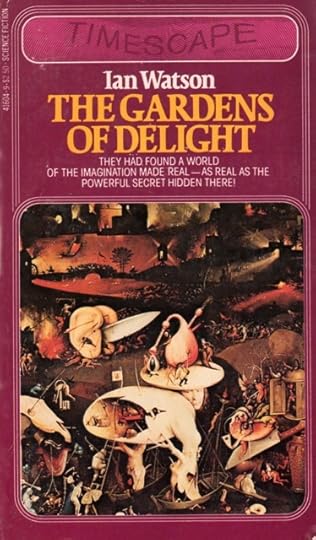
Searching a mysterious planet for the colony founded by an earlier spaceship, the crew of the Schiaparelli discover a strange society that resembles Breugel's apocalyptic paintings
(Cover of the 1982 Pocket Books/Timescape mass-market, with Bosch artwork.)
When the starship Schiaparelli lands on a distant planet to check up on a colony set up there a couple hundred years previous, the crew is shocked to discover a scene straight out of Bosch’s famous triptych painting, The Garden of Earthly Delights. People frolicking around naked, strange creatures and plants everywhere. It appears to be almost a utopia. But if the entire planet is based on the Bosch painting, that can only mean that Hell is not far away.
Much talking while being naked ensues. This may in fact be the talkiest book I’ve read, reminiscent of Z-grade “atomic age” science fiction films of the 50s. There are plenty of novels that, almost like plays, tell the story through dialogue, elegantly. But this has massive, endless dumps of info being exchanged through dialogue, which can go on for chapters at a time. Also, the characters are all basically devoid of any personality traits, which made differentiating between them a struggle.
And yet, there are some insanely far out concepts and ideas here, enough so that despite the fact that I’m basically 0 for 2 when it comes to Watson, I haven’t entirely given up on him. He seems to be more of an idea man than a plot man, so I’d be interested in checking out one of his collections as opposed to another novel.
Considering Kubrick chose him to write the initial 90-page story treatment for A.I., which I love, he can’t be all bad. Plus I already own several more of his books and need an excuse to give him another shot.
Ian Watson is clearly enjoying himself in this manic exploration of philosophy and psychology, employing the infinitely-more-manic tool of Hieronymus Bosch's most famous painting to do so.
A starship is sent out to learn to learn the progress of colonists on a far-flung world, only to discover said colonists inhabiting a different planet entirely, one that they somehow have somehow stopped rotating, divided into three distinct sections (I'm sure you can guess what they are), and populated and decorated and desecrated with one impossibility after another. The colonists themselves have forgotten Earth, concerned only with enlightenment: evolution through devolution (reincarnation is a feature), the endurance of extreme suffering, the endurance of extreme pleasure, and the understanding of true innocence. What is behind all this? Who? How? Why? But, most importantly, what is the starship crew going to do about it?
The imagery is suitably astounding, by turns beautiful, hilarious, disgusting, and horrific. For a painting that is wide open to interpretation (and, indeed, has been widely interpreted), Watson's take seems to be what to my mind the only logical one: that Bosch was probably taking the piss. And so, extrapolating from this, Watson seems, ultimately after much debate and introspection and transformation and being shat through the devil's anus, to be suggesting that life is a bit of a laugh... whether or not you actually want it to be funny.
Read like Ballard on speed. And that is a Good Thing.
Un libro que me a parecido muy novedoso en cuanto a la ciencia ficción, a pesar de que se publico en 1986. Aunque por momentos me pareció que si no estas bien concentrado en la lectura es dificil de comprender, generalmente te mantiene atrapado y que lo hace difícil de dejar, pues tiene su encantó. Y el autor combina ciencia ficción, religión y alquimia generando una lectura que por momento es agradable, con algo de belleza, con una pizca de de locura y oscura.
Gardens of Delight was an interesting book. A crew of space travelers are searching for a planet that was used as a former colony. When they get there, they find themselves in a world that is very similar to a medieval painting.
This touches on a lot of topics such as religion, culture, art, and science. Some of the ways they were presented could be dated and borderline offensive, but this wasn't a deal breaker. The out of the box thinking kept me entertained throughout the book.
Una nave de reconocimiento viaja a un planeta lejano para comprobar el estado de una colonia humana. Cuando llegan al lugar se encuentran atrapados en un mundo que recrea El jardín de las delicias pintado por El Bosco. Me ha recordado a Alicia en el país de las Maravillas pero con un enfoque a la cincia ficción. Los personajes recorren un mundo onírico con una lógica alocada donde se acaba especulando sobre temas filosóficos y la figura de Dios.
I would describe this as a crossover fanfic of Splendor Solis and a Hieronymus Bosch painting.
I'm giving this an extra star because I liked the ending, but the ending in no way made up for all of the navel-gazing in what was billed as a "novel".