Take a journey through some of our planets most spectacular wildlife events and learn how the world works, the origin of life and our place in nature.
"Reading this book may change your mind about almost everything. Important beyond compare, utterly engrossing, at once chilling and heartening." Dame Joanna Lumley
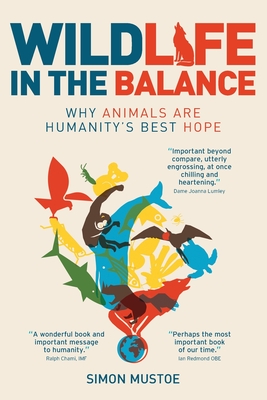
Why do you think animals exist? What purpose do they serve and why do we need them? Why will rewilding work? Wildlife in the Balance is the untold story of how animals are essential for a habitable planet.
Renowned field biologist, conservationist and film-maker Ian Redmond OBE describes Wildlife in the Balance as ‘perhaps the most important book of our time’. Charlie Moores (Unleashed Podcast) says it ‘pulls together a dizzying but utterly coherent narrative that explains how animals are critical to our survival’. Dr Charles Massy (best-selling author of Call of the Reed Warbler) calls Wildlife in the Balance ‘a rich primer and wondrous feast of information and conceptual clarity that will help people fall in love with nature’.
Read Wildlife in the Balance to learn why animals are humanity's best hope.
REVIEWS"Perhaps the most important book of our time." Ian Redmond OBE
"A wonderful book and important message to humanity." Ralph Chami, Assistant Director, International Monetary Fund
"The Me Too for wildlife." Ceri Levy, Gonzovationist
"Read the book, grasp the ideas and change our future." Dr David Hill CBE, Environment Bank
"A crucially important book." Carl Safina, author of Becoming Wild and Beyond Words
"You really need to read this book full-stop." Charlie Moores, Off the Leash Podcast
"An important book to read and act upon." Ian Dunn, CEO Plantlife International
"Visionary, insightful, and hugely important." Dr Charlie Gardner, Durrell Institute
"A remarkable new perspective on wildlife." David Casselman, Ecoflix Foundation
"Beautifully written and captivating from page one." Dr Anika Molesworth, author of Our Sunburnt Country
'Mustoe flips the script on how to save the planet. A symphony of science and stories that inspires and educates on every page' – Vicki Renner, Artshub
***
Simon Mustoe has worked all over the world as an ecologist, expeditioner and conservationist. He’s tumbled in boats amid frigid North Atlantic storms, trekked solo into Madagascar’s remote dry forests, discovered unknown species of seabird in Australia’s tropical ocean territories and recorded previously unseen whales in West Papua. His thirty years as a researcher, communicator, expert witness and consultant for industry, governments and conservation groups has offered many oblique views of our interaction with nature and candid examples of our failure to protect it and ourselves. Telling the story about our relationship with and dependence on wildlife is Simon’s passion. He co-produced Australia’s National Landscapes Nature Series, sends his online magazine Wildiaries to a quarter of a million Australians and illustrates his own blog, Animal Impact. Meanwhile, Simon continues to play an active role as adviser to important ecosystem restoration initiatives.
Look after the animals, perhaps even more so than trees. Monocultures are not ecosystems. Despite having a holiday to read this, the state of the planet presented in this book made it almost too depressing to get through. At times it was like watching malignant cancers multiplying - is it possible to reverse? Do I wish I had never asked the doctor for a diagnosis? In the end, I can just do my ecologically sound bits and not do some damaging bits. Good luck to us all, 'us' being all the animals in the ecosystem, not just the humans. The other animals are doing their bits, we are mostly undoing them at great speed. Hmm. See what I mean..
Wildlife in the Balance is an interesting read, which I found quite eye opening. As a species, humans need to learn to live alongside wildlife rather than see themselves as superior. We are no better or worse than any other species, just different. Wildlife in the Balance delves into the reasons humans need animals, and reminds us that we are, in fact, animals ourselves. Not only do we need to be environmentally friendly, we need to be environmentally responsible. If we are not more environmentally conscious, we know our future could be quite bleak. In Wildlife in the Balance, Simon Mustoe expands on the knowledge we currently have about human impacts on the natural environment by explaining how we are reliant on wildlife and their contribution to the ecosystems surrounding us. Congratulations on an eye opening book. I found myself at times devastated by your revelations, but equally uplifted and inspired. I.hope others enjoy your writing as much as I did.
This book is a ‘stand-alone’ truth that we must accept if we are to survive as a species. READ THIS BOOK.
If you read no other book in 2023 let it be this one.
When you’ve read it, buy copies for your best friends, you will be giving them a gift of enlightenment, a path to save humanity and something of the greatest importance - knowledge.
Once you know something, you cannot unknow it.
I have bought 5 copies so far for friends because I believe it to be crucial reading. I’ve never bought more than one copy of any book before.
Simon Mustoe has lifted the lid and it’s up to us to turn the heat down before we lose all that is precious about this blue-green planet we call home.
This is one of those books that helps to confirm ideas that you may have had but that you can't always explain. Basically I believe in protecting wildlife as it leads to a more balanced world and it makes logical sense to me. I also believe that nature is better at this balancing act than humans are. In short, this book supports these ideas and raises them. We are part of the animal kingdom, we need to be part of the balancing act and we are essentially destroying ourselves by destroying animal wildlife. We are on the wrong path and we need to change it - quickly. We need to pay more attention to animals, all animals but especially the big ones. The problem with our environment needs addressing and we need a preventative approach not a ' it's broken so let's fix it' approach. We are the problem - animals ( of which we are one) are the solution. There is brilliant thing throughout this book and it should be read by anyone who thinks we are on the wrong path or even on the edge of destruction. However, 1. It's not always well- written, it's disjointed, often repetitive and sometimes seems to be unedited. 2. It seems to have random pictures and random information that doesn't fit with the content 3. First 50 pages ( mainly because of 1 and 2) are hard going. 4. It is full of references and then sometimes makes claims that are completely unsubstantiated and unreferenced. It's a brilliant book though. Read it.
Most people like nature. They like to walk in the countryside and hear birds singing. They also worry about animal extinction. There is a sense of loss that the richness that David Attenborough told us all about as we grew up is rapidly disappearing. We despair that our grandchildren may not get to experience the same natural world that we have known. We worry about the Orangutans' losing their habitat and are upset by visions of wild animals struggling in the face of human exploitation. We worry about sea pollution, over fishing, plastics and forever chemicals.
But this book is the first I've read that provides a convincing explanation why the abundant diversity of animals exists in the first place and their holistic importance in sustaining a habitable planet. Reading it flicked a switch and created a "lightbulb moment" similar to when I originally read Dawkin's "The Selfish Gene".
Mustoe does a great job explaining the system of ecology with so many great examples.
I listened to the audiobook (read by the author) and enjoyed it.
The key point is that we can solve a lot of the coming crises by protecting wildlife - plants, animals, insects, etc. But that if we don't, the idea of technology solutions will only make the problem worse. The system is too complex to simply "change one thing and fix it."
I have not been heavily involved in biodiversity but this book makes a really compelling case for stopping everything that is killing wild animals: Stop using pesticides, herbicides. Stop killing wild animals. Stop destroying their habitats.
The conclusion at the end, like so many non-fiction books, makes a few conclusions that are quite a leap from the great material in the book. But that doesn't diminish the great content throughout.
This is a really interesting book that gives a new perspective on conservation and ecology. It’s not an easy read and I think a lot of the science went over my head but the stories used to aid understanding of complex scientific principles help it make sense. Cooperation and balance are things that I have a cognitive bias towards so I was pleased to read about them. The book itself gives a balance between teaching us where we’re going wrong but also giving us hope that things can repair. I’d definitely recommend reading this and also listening to any podcasts fearing Simon Mustoe. I love the link with philosophy and science he describes; how we often look at the ‘how’ first but if we can get the ‘why’ right it helps us understand the story, this makes a lot of sense to me.
The review is 5 stars and Wow, this is an amazing book, I learned so much about animals and interaction with the environment. True, this is not an easy read, there are big words and hard truths, but there are also fascinating insights and hope. Nuggets that will never leave me include ... the famine caused by the Chinese sparrow slaughter, organised to stop crops being eaten, which then led to a plague of locusts, because the larvae were not eaten by sparrows, ... that an ecosystem does not exist without animals ... that planting trees alone will not solve our environmental problems ... that we have the potential to be the first species to bring about our own extinction ... that the balance struck in nature to prevent chaos, depends on animals. Please read and reread this book.
This is a 'must read book', and a book that needs to be shared. For too long humans have upset the balance with the natural world. Simon Mustoe explains why this is a problem for the survival of humanity. Simon is an ecologist, expeditioner and conservationist and writes in a way that is easy for all to understand and backs it up with science . His passion for the subject is obvious. I really enjoyed reading the book and at the same time raised my concern for our survival This book is a great educational read and I think should be in all schools as the next generations may understand why we need balance in everything and treat the earth with more respect. Buy it - read it - share it!
"You have to remember only one thing. It doesn't matter whether it's climate change, decline in soil fertility, disease, clean water, healthy oceans, war or famine, the key to solving all our problems, saving our planet for humanity's sake... is to rebuild a world rich with a diversity of vibrant and abundant wildlife."
Read this if you want to learn more about conservation and the critical role wildlife plays in making our planet habitable; I am convinced after reading this that animals, and wildlife broadly, will be instrumental in solving the environmental crises that we face.
Captivating from page one. This is a story of our place on Earth, both the unfortunate truths in how we have hurt our fragile planet, and the important role we play in rebuilding a habitable world for all life. It is ultimately a book about our connection to nature, humanity and hope. Wildlife in the Balance is beautifully written and enlightens the reader with a powerful message – that Earth’s wildlife and wild places are essential for our survival and we must act urgently and ambitiously to look after them.
This is a remarkable book. Most of us are aware of changing climate and our destruction and pollution of the planet - particularly of wildlife habitat - but Simon has put into perspective the greatest danger of all which is the loss of wildlife. The book describes the essential relationship between animals and balanced ecosystems without which we cannot survive. It should be read by all. We need to stop the mass extinction which is occurring now.
This book is a must read for anyone interested in how this planets critical emergency status is to be reversed and solved. Wonderfully written, and a powerful account of why we must change the way we see ourselves in our interaction with animals, biodiversity and the ecosystem we live in. Dr Paul Collins BSc BVSc.
Loving this book so far! Captivated me right from the start and found a deep resonance in this important message; as if Simon has plucked them out from my heart through his. It’s my wish that everyone reads this and reconnects to their true nature; the wildlife needs us to see them through this light. Thank you for dedicating your life to such an important cause Simon!
I think this is one of the most important books of our time. The knowledge put forth in this volume is absolutely essential for the future of our world. It is true in every respect. It should be an essential read for all. Thank you Simon. You have a great talent and a remarkable perspective on wild life and how we humans fit in to the world balance of humanity.
Didn't know what to expect when I started reading. Was it going to be all doom and gloom? Yes, there are harsh realities underpinned by scientific research that the author brings to us. But we also learn why humans need wildlife to exist. Wildlife in the Balance shows us what we need to do to bring our planet back into alignment.
Loved this book. I alternated between "wow!"" and "oh dear, we are truly doomed as a species!". The descriptions of how animals make the planet habitable for humans are detailed but understandable. The Author has a great writing style and flawless proofreading. He concluded on an upbeat note, despite the statistics of just how many animals we have massacred over the years, animals we NEED!
This book is a must read for anyone concerned with our natural Environment. Wildlife in the Balance will change the way you think about plants and animals and their role in the survival of the human race.
This book is fascinating and so revealing, about what we need to do to save this planet and ourselves. Extremely informative and educational. Let’s just follow this lead and save the world.
I have given this book to lots of people. It is such a good explainer for why looking after animals is a synonym for looking after ourselves and the best explanation for why we must protect biodiversity. I don't have a background in ecology and found the explanation of animals and the critical role they (we) play in ecosystems very accessible. I love the analogy drawn between successful ecosystems and successful human systems. For instance, when animals operate collaboratively, they have a much better chance of sustaining their species. The author extends this analogy to political systems and there is no doubt, bi-partisanship can lead to fantastic policy outcomes. I feel the world will be a much better place if everyone reads this book!