

What do you think?
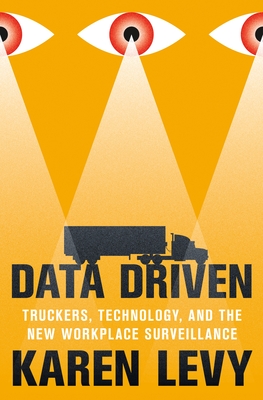
Data Driven: Truckers, Technology, and the New Workplace Surveillance
A behind-the-scenes look at how digital surveillance is affecting the trucking way of life
Long-haul truckers are the backbone of the American economy, transporting goods under grueling conditions and immense economic pressure. Truckers have long valued the day-to-day independence of their work, sharing a strong occupational identity rooted in a tradition of autonomy. Yet these workers increasingly find themselves under many watchful eyes. Data Driven examines how digital surveillance is upending life and work on the open road, and raises crucial questions about the role of data collection in broader systems of social control.
Karen Levy takes readers inside a world few ever see, painting a bracing portrait of one of the last great American frontiers. Federal regulations now require truckers to buy and install digital monitors that capture data about their locations and behaviors. Intended to address the pervasive problem of trucker fatigue by regulating the number of hours driven each day, these devices support additional surveillance by trucking firms and other companies. Traveling from industry trade shows to law offices and truck-stop bars, Levy reveals how these invasive technologies are reconfiguring industry relationships and providing new tools for managerial and legal control—and how truckers are challenging and resisting them.
Data Driven contributes to an emerging conversation about how technology affects our work, institutions, and personal lives, and helps to guide our thinking about how to protect public interests and safeguard human dignity in the digital age.
Long-haul truckers are the backbone of the American economy, transporting goods under grueling conditions and immense economic pressure. Truckers have long valued the day-to-day independence of their work, sharing a strong occupational identity rooted in a tradition of autonomy. Yet these workers increasingly find themselves under many watchful eyes. Data Driven examines how digital surveillance is upending life and work on the open road, and raises crucial questions about the role of data collection in broader systems of social control.
Karen Levy takes readers inside a world few ever see, painting a bracing portrait of one of the last great American frontiers. Federal regulations now require truckers to buy and install digital monitors that capture data about their locations and behaviors. Intended to address the pervasive problem of trucker fatigue by regulating the number of hours driven each day, these devices support additional surveillance by trucking firms and other companies. Traveling from industry trade shows to law offices and truck-stop bars, Levy reveals how these invasive technologies are reconfiguring industry relationships and providing new tools for managerial and legal control—and how truckers are challenging and resisting them.
Data Driven contributes to an emerging conversation about how technology affects our work, institutions, and personal lives, and helps to guide our thinking about how to protect public interests and safeguard human dignity in the digital age.
234 pages, Kindle Edition
Published December 6, 2022
About the author
Karen Levy
9 books7 followersKaren Levy is an associate professor in the Department of Information Science at Cornell University, associate member of the faculty at Cornell Law School, and field faculty in Sociology, Science and Technology Studies, Media Studies, and Data Science. Levy researches how law and technology interact to regulate social life, with particular focus on social and organizational aspects of surveillance.
Ratings & Reviews
Friends & Following
Create a free account to discover what your friends think of this book!
Community Reviews
Displaying 1 - 14 of 14 reviews

June 5, 2024
A book fit for a TO queen??!!!
One of my majors in college was Logistics, and I was there during the height of the ELD mandate implementation, so I heard a LOT about this. Every company that would come in for a class visit would talk to us about it - sometimes about how they weren’t personally concerned about the mandate because they were already following the rules and had nothing to worry about (probably not untrue, but realizing now there was a lot more to the story here outside of some of these larger trucking firms that could “afford” to be compliant). There were also narratives about how a lot of truck drivers were older and not wanting to learn new technology, instead choosing to retire because of this mandate (also not totally false, but again not the whole picture either).
Today I’m known as the TO Queen (Transportation Optimization) on my work team (only a partially self appointed title) so yes, I can recite the DOT hours of service regulations in my sleep, but I’m still very removed from the ins and outs of the truly tactical truck operations. I still find it all very interesting, and again have my “roots” in logistics so I was very excited when Karl (Rhiar’s fiancé) leant me this book and I cannot wait to book club it with him (and put poor Rhiar through even more talk of data and truckers than we both already have).
This book was extremely academic. I found it super interesting and still heard the author’s voice come through, but it was definitely a slower read. She was very thorough and I appreciated being taken through some of the history, background, and culture of the trucking industry in the time leading up to this mandate. This book obviously focused more on long haul trucking and did a good job showing the need for industry reform and more trucker safety protection, which this mandate was attempting to do by strictly enforcing driver hours. At the end of the day though, the ELD mandate was a bandaid/symptom fix rather than fixing the actual problems. The actual problems being the structure of driver pay as mileage based, too low of pay overall for truckers, and constant customer detention battles cutting into DOT hours. These issues ultimately led many truckers to falsify their paper logbooks and some to continue to falsify ELDs (although this is more challenging, it still is very much happening). I didn’t realize all the repercussions and moving pieces of this mandate and how it is still questionable if this does in fact increase safety as it aimed to do. In fact, the author explores some increased challenges in law enforcement checks that potentially put both officers and truckers into new dangerous situations and explores the possibility that rigidly restrictive time pressures can actually lead to more reckless driving.
At the end of the day, this was a book about workers’ rights that largely explored the intersection of workers and data/technology. It talked a lot about surveillance and worker autonomy as well as predictions for the evolution of autonomous vehicles/driving in the distant future.
I’m extremely glad I pushed myself to read this one and will continue to be a nerd about all things supply chain so stay tuned?!
One of my majors in college was Logistics, and I was there during the height of the ELD mandate implementation, so I heard a LOT about this. Every company that would come in for a class visit would talk to us about it - sometimes about how they weren’t personally concerned about the mandate because they were already following the rules and had nothing to worry about (probably not untrue, but realizing now there was a lot more to the story here outside of some of these larger trucking firms that could “afford” to be compliant). There were also narratives about how a lot of truck drivers were older and not wanting to learn new technology, instead choosing to retire because of this mandate (also not totally false, but again not the whole picture either).
Today I’m known as the TO Queen (Transportation Optimization) on my work team (only a partially self appointed title) so yes, I can recite the DOT hours of service regulations in my sleep, but I’m still very removed from the ins and outs of the truly tactical truck operations. I still find it all very interesting, and again have my “roots” in logistics so I was very excited when Karl (Rhiar’s fiancé) leant me this book and I cannot wait to book club it with him (and put poor Rhiar through even more talk of data and truckers than we both already have).
This book was extremely academic. I found it super interesting and still heard the author’s voice come through, but it was definitely a slower read. She was very thorough and I appreciated being taken through some of the history, background, and culture of the trucking industry in the time leading up to this mandate. This book obviously focused more on long haul trucking and did a good job showing the need for industry reform and more trucker safety protection, which this mandate was attempting to do by strictly enforcing driver hours. At the end of the day though, the ELD mandate was a bandaid/symptom fix rather than fixing the actual problems. The actual problems being the structure of driver pay as mileage based, too low of pay overall for truckers, and constant customer detention battles cutting into DOT hours. These issues ultimately led many truckers to falsify their paper logbooks and some to continue to falsify ELDs (although this is more challenging, it still is very much happening). I didn’t realize all the repercussions and moving pieces of this mandate and how it is still questionable if this does in fact increase safety as it aimed to do. In fact, the author explores some increased challenges in law enforcement checks that potentially put both officers and truckers into new dangerous situations and explores the possibility that rigidly restrictive time pressures can actually lead to more reckless driving.
At the end of the day, this was a book about workers’ rights that largely explored the intersection of workers and data/technology. It talked a lot about surveillance and worker autonomy as well as predictions for the evolution of autonomous vehicles/driving in the distant future.
I’m extremely glad I pushed myself to read this one and will continue to be a nerd about all things supply chain so stay tuned?!

January 9, 2023
The author makes critical and important points about the state of trucking and it’s unfair structure towards drivers, but using the ELD vs newer technologies such as driver monitoring systems as the source of digital surveillance makes the entire narrative seem outdated in 2022/2023.

August 15, 2024
A really interesting overview of some of the history of trucking, its regulations, current challenges and the attempts to fix them. While deep in its investigation, the book is sometimes shallow in its observations and conclusions. The introductory chapter basically is a summary of the entire book, and only uses examples to flesh out Levy’s initial framework. While understandable from an academic layout, it made reading the rest of the book somewhat less interesting. Overall, she makes a strong case against the current eld attempts and argues that changing trucker pay structure would be more
Impactful
Impactful

September 3, 2026
Book Review
Data Driven, by Karen Levy
3/5
"Information: some interesting, but a lot stale"
*******
Verdict: not recommended. The ratio of interesting factoids to stale information is way too low to be worth it.
Of the book:
-159 pages/8 chapters.≈20pps/chapter
-2 appendices (11 pps total)
-388 point citations (≈2.44/page). Well sourced.
-352 sources in the bibliography. -Overwhelming majority to journals and articles
-1.1 unique sources per page of the book (!)
-
*******
There was a great book here-- about 12 years ago.
I don't know why on Earth somebody would do all of this work and compile all of these sources only to let the information go stale because she could not get around to publishing it.
--The book was published in 2023
--Most of the field work was done between 2011 and 2014, and stopped at 2019 (p.160)
-She was giving presentations around 2018 - - for a book that was published 5 years later.
(Incidentally, that is the same flaw in the gold standard academic book on trucking written by, "Big Rig," by Steve Viscelli--publication *years* after collecting the data.)
-She did not ride with another trucker, or even touch the steering wheel of a truck.
Just to give a few examples:
1. (p.79) The author talks about the dynamics in law enforcement officers interactions with truckers, and how that is perturbed by the existence of ELDs.
In reality: inspection stations have been closing left and right both in the United States and Canada, and so this is less of an issue than it might seem.
That does make sense, because your safety department (for over the road truckers) will shut you down *way* before DOT catches you.
2. The technology on the two-way cameras has improved significantly.
It used to be that safety would watch you from the office, and it would be less regular because the ratio of drivers to inspectors cannot be 1:1. These days, cameras use artificial intelligence and record every single second of the drive. If you yawn or look at your phone, an immediate report is generated--That no human being ever saw.
3. The data for this book was collected before logs became mandatory; when they did become mandatory, the prices of freight went way up.
And after the rollout, the technology has only gotten more impervious to tampering, and more intrusive.
What other way could this have gone?
In reality: when a driver is on the road thousands of miles away from his dispatch, it is the quintessential example of the principal-agent problem. (The person who is driving the truck and the person who has the liability and equipment expenses is nowhere he can directly supervise the process.)
It's not hard to imagine that companies are going to *eventually* want to find some way to get control of their equipment in such a way as to take a bite out of the problem.
It should just be (and in fact has proven to be) a matter of time.
4. By the time she gets to the 8th chapter, she has lost touch with reality in only the way the sociologists can. (p.154: "But if we pay truckers for their work, rather than only for the miles they drive..... Drivers would be far less incentivized to drive on safely or when fatigued...... Could collective bargaining help turn the tables?")
a. Truckers have a doxastic commitment to making sure they get paid; if it could have been figured out, this would have happened long ago.
b. Unionization? Yellow truck had 12,000 units at one point, and they ceased operations on a dime because of Union disputes. In 2023. THE EXACT YEAR THAT THIS BOOK WAS PUBLISHED.
5. The surveilling character created by electronic logging devices can go both ways. So, for places with excessive detention time, it is possible to aggregate large amounts of information both for getting detention pay as well as for knowing where not to send your drivers.
The upshot is that:
1. People who need to stay in the industry making money will just have to learn to get used to the technology.
2. And those who cannot and have the ability to retire will do it and do something else.
3. But in reality, industry standards change all the time. Because the only constant is change. (Think about how many jobs used to be "30 and out" and how those jobs just no longer exist.)
Factoids
(17) In 2018, 37 million trucks are registered for business purposes, and together drove an estimated 305 billion miles in the United States. 8 million people work in the trucking industry, and about 3.6 million are truck drivers. 2 million of those are Long haul.
(20) In 1980, truckers made roughly $110,000 in today's dollars. As of today, median earnings have stagnated at about $47,000 per year--and that figure has been constant for 15 years.... One out of every six people killed on the job in the United States is a truck driver.
(23) 1 in 10 truckers holds a two or four year college degree.
(25) In the early 1970s, 80% of truckers were in unions.... These days, that number is less than 10%. (Michael Belzer)
(35) Sleep studies conducted among drivers consistently show the trucker's average only 5 to 6 hours of sleep in 24-hour period when they are working. Each year, truck crashes on America's highway is kill about 5,000 people and injure 150,000 more.
(43) Electronic logging devices made their first appearance back in 1988. The mandate took effect in December 2017.
(57) Structurally asymmetric impact on firms of different sizes in plain English means that ELD costs are higher per unit of capital for independent owner operators then for large carriers. And that works to the benefit of large carriers. "Smaller players tend to self-monitor and lack the principle agent problem that large companies can address through monitoring and analytics."
(Ch. 7, various) A LARGE number of technologies are available that can easily be used in automation. Technology is available to track the time between a driver taking his foot off the accelerator and pushing it onto the brake in order to determine fatigue. The SmartCap is a baseball cap that detects fatigue but monitoring a driver's brain waves. Optalert manufactures a pair of glasses that monitors the speed and duration of a trucker's blanks. Maven Machines detects head movement that suggests a driver is distracted. Actigraph systems both monitor and predict fatigue rates over time. Steer.... vibrates and flashes if it detects signs of fatigue and delivers a gentle electric shock to the driver if fatigue continues. Mercedes has prototyped a vest to monitor a trucker's heart rate; the system can stop the truck if it senses the trucker is having a heart attack.
Data Driven, by Karen Levy
3/5
"Information: some interesting, but a lot stale"
*******
Verdict: not recommended. The ratio of interesting factoids to stale information is way too low to be worth it.
Of the book:
-159 pages/8 chapters.≈20pps/chapter
-2 appendices (11 pps total)
-388 point citations (≈2.44/page). Well sourced.
-352 sources in the bibliography. -Overwhelming majority to journals and articles
-1.1 unique sources per page of the book (!)
-
*******
There was a great book here-- about 12 years ago.
I don't know why on Earth somebody would do all of this work and compile all of these sources only to let the information go stale because she could not get around to publishing it.
--The book was published in 2023
--Most of the field work was done between 2011 and 2014, and stopped at 2019 (p.160)
-She was giving presentations around 2018 - - for a book that was published 5 years later.
(Incidentally, that is the same flaw in the gold standard academic book on trucking written by, "Big Rig," by Steve Viscelli--publication *years* after collecting the data.)
-She did not ride with another trucker, or even touch the steering wheel of a truck.
Just to give a few examples:
1. (p.79) The author talks about the dynamics in law enforcement officers interactions with truckers, and how that is perturbed by the existence of ELDs.
In reality: inspection stations have been closing left and right both in the United States and Canada, and so this is less of an issue than it might seem.
That does make sense, because your safety department (for over the road truckers) will shut you down *way* before DOT catches you.
2. The technology on the two-way cameras has improved significantly.
It used to be that safety would watch you from the office, and it would be less regular because the ratio of drivers to inspectors cannot be 1:1. These days, cameras use artificial intelligence and record every single second of the drive. If you yawn or look at your phone, an immediate report is generated--That no human being ever saw.
3. The data for this book was collected before logs became mandatory; when they did become mandatory, the prices of freight went way up.
And after the rollout, the technology has only gotten more impervious to tampering, and more intrusive.
What other way could this have gone?
In reality: when a driver is on the road thousands of miles away from his dispatch, it is the quintessential example of the principal-agent problem. (The person who is driving the truck and the person who has the liability and equipment expenses is nowhere he can directly supervise the process.)
It's not hard to imagine that companies are going to *eventually* want to find some way to get control of their equipment in such a way as to take a bite out of the problem.
It should just be (and in fact has proven to be) a matter of time.
4. By the time she gets to the 8th chapter, she has lost touch with reality in only the way the sociologists can. (p.154: "But if we pay truckers for their work, rather than only for the miles they drive..... Drivers would be far less incentivized to drive on safely or when fatigued...... Could collective bargaining help turn the tables?")
a. Truckers have a doxastic commitment to making sure they get paid; if it could have been figured out, this would have happened long ago.
b. Unionization? Yellow truck had 12,000 units at one point, and they ceased operations on a dime because of Union disputes. In 2023. THE EXACT YEAR THAT THIS BOOK WAS PUBLISHED.
5. The surveilling character created by electronic logging devices can go both ways. So, for places with excessive detention time, it is possible to aggregate large amounts of information both for getting detention pay as well as for knowing where not to send your drivers.
The upshot is that:
1. People who need to stay in the industry making money will just have to learn to get used to the technology.
2. And those who cannot and have the ability to retire will do it and do something else.
3. But in reality, industry standards change all the time. Because the only constant is change. (Think about how many jobs used to be "30 and out" and how those jobs just no longer exist.)
Factoids
(17) In 2018, 37 million trucks are registered for business purposes, and together drove an estimated 305 billion miles in the United States. 8 million people work in the trucking industry, and about 3.6 million are truck drivers. 2 million of those are Long haul.
(20) In 1980, truckers made roughly $110,000 in today's dollars. As of today, median earnings have stagnated at about $47,000 per year--and that figure has been constant for 15 years.... One out of every six people killed on the job in the United States is a truck driver.
(23) 1 in 10 truckers holds a two or four year college degree.
(25) In the early 1970s, 80% of truckers were in unions.... These days, that number is less than 10%. (Michael Belzer)
(35) Sleep studies conducted among drivers consistently show the trucker's average only 5 to 6 hours of sleep in 24-hour period when they are working. Each year, truck crashes on America's highway is kill about 5,000 people and injure 150,000 more.
(43) Electronic logging devices made their first appearance back in 1988. The mandate took effect in December 2017.
(57) Structurally asymmetric impact on firms of different sizes in plain English means that ELD costs are higher per unit of capital for independent owner operators then for large carriers. And that works to the benefit of large carriers. "Smaller players tend to self-monitor and lack the principle agent problem that large companies can address through monitoring and analytics."
(Ch. 7, various) A LARGE number of technologies are available that can easily be used in automation. Technology is available to track the time between a driver taking his foot off the accelerator and pushing it onto the brake in order to determine fatigue. The SmartCap is a baseball cap that detects fatigue but monitoring a driver's brain waves. Optalert manufactures a pair of glasses that monitors the speed and duration of a trucker's blanks. Maven Machines detects head movement that suggests a driver is distracted. Actigraph systems both monitor and predict fatigue rates over time. Steer.... vibrates and flashes if it detects signs of fatigue and delivers a gentle electric shock to the driver if fatigue continues. Mercedes has prototyped a vest to monitor a trucker's heart rate; the system can stop the truck if it senses the trucker is having a heart attack.

May 18, 2023
I found out about this book from an ad in the Atlantic. It was amazing - the grasping storytelling and simultaneously the well-researched facts will give you a great overview of truck drivers‘ life in the USA (imho more similar than I had expected to the situation in Europe).
The author adapted her PhD thesis at Princeton for the general public through this book and she researched over the course of several years through 70+ interviews with different stakeholders, while putting the subject of the book in the spotlight: the truck drivers.
At the end, she talks extensively about her methodology, which I also found particularly interesting and taught me a lot.
Really recommandable for anyone in the industry and beyond!
The author adapted her PhD thesis at Princeton for the general public through this book and she researched over the course of several years through 70+ interviews with different stakeholders, while putting the subject of the book in the spotlight: the truck drivers.
At the end, she talks extensively about her methodology, which I also found particularly interesting and taught me a lot.
Really recommandable for anyone in the industry and beyond!
August 12, 2023
Majorly enjoyed the first chapters as a lay reader. Understanding the economics of trucking and the unintended consequences of workplace surveillance was illuminating -- it's such an important part of our economy that it seems like it's in the realm of 'things every informed citizen should know.' It absolutely caused me to helpfully reflect on information flows and controls in my workplace. But later chapters felt less valuable--introducing less new information, changing my perspective less--specially the robotruckers discussion where I felt I had more context to critically evaluate the claims.

November 20, 2023
A principle that I emphasize in books I have written on school reform is requirement on the part of leaders in every field to talk to individuals directly involved in delivering a service. Too often, strategies thought up in boardrooms ignore the day-to-day implementation problems that operators have solved. Ms. Levy's account of technology entrance into the world of trucking is an excellent description of the unintended consequences of how good ideas thought up in boardrooms translate poorly in the cabs of semis.
November 13, 2025
I never look forward to or enjoy required reading however this proved to be an exception. A interestingly present academic novel that has a captivating flow to it while also not being a hard/dense read. The novel introduced the reader to a profession not many know about with issues unique to it and manage to tie it to every workplace and how we are affected by surveillance and vice versa. A recommended read for people who want to learn about a little known but important industry or for those that are interested in how technology and surveillance is encroaching upon our livelihoods.

March 6, 2023
This book is a deep dive into the question of the whether mandated electronic monitoring of truck drivers in the US actually resulted in safer highways.
Along the way it takes a small detour into the issues attending autonomous driving systems and the likelihood that autonomous vehicles are going to replace professional drivers anytime soon.
The author amply proves that technological solutions to essentially human problems cannot hold water.
Along the way it takes a small detour into the issues attending autonomous driving systems and the likelihood that autonomous vehicles are going to replace professional drivers anytime soon.
The author amply proves that technological solutions to essentially human problems cannot hold water.

December 31, 2024
I thought the focus of this would be much more on the last section of autonomous trucks, but it was still interesting to learn about ELDs and the perspective of truckers. I empathize with the complaints, but I think the author forgot the issue (that long-haul trucking is dangerous for the truckers and everyone else on the highway) and didn't really engage with a suitable, realistic solution to it.
May 20, 2023
This was a very informative read; Levy brought up many issues regarding AI/surveillance especially in the trucking profession, which is something I had never considered. Lots to think about how to use technology in complement (vs. as a substitute) for human tasks, AND the need to critically examine where certain tech evasion/regulation resistance stems from (spoiler: mostly capitalism).

March 15, 2023
I love ethnographic accounts of technology!!!! So so good

May 25, 2024
Impressive focused and deep fieldwork, and not at all unaccessible, but was a bit of a tiring read because of my lack of personal interest in the trucking industry

May 29, 2023
Levy deftly weaves the practicalities of trucking with theories of workplace privacy, technological advancement, and the wheels of society more generally. Maybe the most interesting book I’ve read so far this year, if only because I keep looking for ELD decals on trucks nowadays. Levy’s on-the-ground research proves invaluable for illuminating the minutia existing in the complicated dynamics among truckers, trucking companies, law enforcement, and policymakers. Personally, chapters 6 & 7 were the most interesting to me, dealing with employment privacy and autonomous vehicles. Honestly has me considering delving further into that world in my professional life.
Displaying 1 - 14 of 14 reviews