

What do you think?
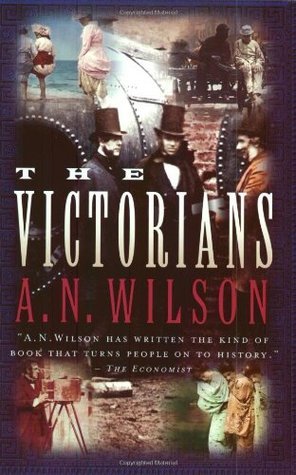
The Victorians
A dramatic, revisionist panorama of an age whose material triumphs and spiritual crises prefigure our own. The nineteenth century saw greater changes than any previous era: in the ways nations and societies were organized, in scientific knowledge, and in nonreligious intellectual development. The crucial players in this drama were the British, who invented both capitalism and imperialism and were incomparably the richest, most important investors in the developing world. In this sense, England's position has strong resemblances to America's in the late twentieth century.
As one of our most accomplished biographers and novelists, A. N. Wilson has a keen eye for a good story, and in this spectacular work he singles out those writers, statesmen, scientists, philosophers, and soldiers whose lives illuminate so grand and revolutionary a history: Darwin, Marx, Gladstone, Christina Rossetti, Gordon, Cardinal Newman, George Eliot, Kipling. Wilson's accomplishment in this book is to explain through these signature lives how Victorian England started a revolution that still hasn't ended. 65 illustrations
As one of our most accomplished biographers and novelists, A. N. Wilson has a keen eye for a good story, and in this spectacular work he singles out those writers, statesmen, scientists, philosophers, and soldiers whose lives illuminate so grand and revolutionary a history: Darwin, Marx, Gladstone, Christina Rossetti, Gordon, Cardinal Newman, George Eliot, Kipling. Wilson's accomplishment in this book is to explain through these signature lives how Victorian England started a revolution that still hasn't ended. 65 illustrations
738 pages, Paperback
First published January 1, 2002
About the author
A.N. Wilson
138 books251 followersAndrew Norman Wilson is an English writer and newspaper columnist, known for his critical biographies, novels, works of popular history and religious views. He is an occasional columnist for the Daily Mail and former columnist for the London Evening Standard, and has been an occasional contributor to the Times Literary Supplement, New Statesman, The Spectator and The Observer.
Ratings & Reviews
Friends & Following
Create a free account to discover what your friends think of this book!
Community Reviews
Displaying 1 - 30 of 118 reviews

December 17, 2014
It's quite difficult to know how to describe this book. It's non-fiction, it's history, of course it's history, but somehow...not quite history as one might expect it. And yet if you asked me to put my finger on why this isn't a typical history book I think I would struggle. It's about a particular time and place; it's written in a chronological fashion; the usual suspects of Victorian history make an appearance; it focuses on politics, the monarchy, war, culture, literature, fashion, commerce. And yet somehow there is definitely something about this book that differs from a 'normal' history book.
I think perhaps it's the author. This is very much A.N. Wilson's personal take on the Victorians, history from one individual's perspective. By and large, with most history books, the author is all but invisible. He (or she) presents their version of history without interfering in the narrative: their presence is only really visible in the elements they choose to focus on, the things they include and the things they omit. Whilst that is just as much the case here, the author's presence is that much more tangible. I think that, added to Wilson's occasionally whimsical tone and authorial asides, somehow makes this history book feel less like history and more like one individual's musings on history.
It's an unexpected approach, but not an entirely unsuccessful one. It makes this book very much a mixed bag, an often enjoyable but occasionally rambling read, one that almost feels like it's stuffed just that little bit too full with anecdotes and snapshots and asides and marginalia. One could argue a little bit more structure and rigidity, a tightening of the focus, a trimming of some of the fat, might have improved it, but then it would probably have been just like every other book on the Victorians out there, and there's definitely something to be said for a novel approach.
I think perhaps it's the author. This is very much A.N. Wilson's personal take on the Victorians, history from one individual's perspective. By and large, with most history books, the author is all but invisible. He (or she) presents their version of history without interfering in the narrative: their presence is only really visible in the elements they choose to focus on, the things they include and the things they omit. Whilst that is just as much the case here, the author's presence is that much more tangible. I think that, added to Wilson's occasionally whimsical tone and authorial asides, somehow makes this history book feel less like history and more like one individual's musings on history.
It's an unexpected approach, but not an entirely unsuccessful one. It makes this book very much a mixed bag, an often enjoyable but occasionally rambling read, one that almost feels like it's stuffed just that little bit too full with anecdotes and snapshots and asides and marginalia. One could argue a little bit more structure and rigidity, a tightening of the focus, a trimming of some of the fat, might have improved it, but then it would probably have been just like every other book on the Victorians out there, and there's definitely something to be said for a novel approach.

October 20, 2013
If you only ever read one book on the Victorians, this is the one to read. Wilson doesn't invent anything new; the categories are familiar. We start with the bad old England that Victoria inherited, work our way through the Chartists, Peel and the Corn Laws, the terrible 40s, the Italian influence, doubt, Mesmerism, Albert, the Great Exhibition, the Reform Bills, the Crimean War, Afghanistan, and on and on. Wilson is a wonderful storyteller, and he fills in the bare bones of history with lots of nice connections, curious biographies, and back stories. His history is people-based rather than movement-based or full of impersonal forces. And, of course, if you look at the Victorian era through that lens, there's plenty to amuse you, from Gladstone and his hypocrisy to Disraeli and his wit to the unwitting Freudianisms of Goblin Market to Charles Dodgson's creepy pictures of Alice Liddell, and so on virtually forever.
Wilson is an excellent writer with a novelist's eye for bringing history to life. Just don't look to this book for any fresh or systematic thinking about the Victorians. But there's plenty here to keep all but the most dedicated professional historian busy for a good long time. Read this in conjunction with Dickens or Thackeray or Eliot, and you'll soon have a rich, dense idea of the fabric and incident of Victorian life.
Wilson is an excellent writer with a novelist's eye for bringing history to life. Just don't look to this book for any fresh or systematic thinking about the Victorians. But there's plenty here to keep all but the most dedicated professional historian busy for a good long time. Read this in conjunction with Dickens or Thackeray or Eliot, and you'll soon have a rich, dense idea of the fabric and incident of Victorian life.

January 1, 2015
I didn’t finish this book although I did think it was decent. There is some really good information in here, but it was kind of slow going and I had a lot of other stuff going on. My main complaint is that Wilson assumes the reader already know a lot of the figures he’s talking about. This would probably be the case if I was raised and went to school in England, but as an ignorant US citizen, I kept going, “Who? What’s that??” And then I would have to consult Google and it was very disruptive to the reading experience. If he’d just inserted little dependent clauses, like “John Potatohands, the Queen’s royal potato planter, was a man of letters,” instead of just being like “John Potatohands was a man of letters,” it would have helped me out a lot. It was a library book that I put down a while back, but soon after I picked it up again and started reading a chapter a day I ran out of renewals. I get the feeling that it is quite informative—I learned a lot in just the bit I read—and I would like to come back to it when I have more time/patience for its format and style.

June 15, 2013
Where do you begin if you want to read a broad, deep, erudite overview of a large historical topic? Usually, it requires looking to older scholarship; “big” histories are rarely attempted by academics these days. Next stop is the unfairly maligned genre of “popular” history, which relies on the synthesis of secondary sources and is unburdened by the need for complete academic originality.
That was my dilemma when I first picked up A.N.Wilson’s epic “The Victorians,” almost at random. Wilson is a non-academic, but a reputable and excellent writer on a range of topics. On the surface, “The Victorians” relies on a straightforward framework, covering the era (one of the few with finite beginning and end dates) by decade from Victoria’s coronation in 1837 to her death in 1901. But it also offers a teeming, dense substructure of cultural, intellectual and social interconnections beneath the hood.
Wilson’s approach is both vertical and horizontal. He surveys the historical record but offers a continual stream of thematic cross-references over time, almost frenetically. “The Victorians” requires a great deal of attention to detail; as personages and ideas submerge and reappear, Wilson often makes minimal (or at best, oblique) reference to their original context. But that’s a minor complaint about a book that is a rare tour de force.
That was my dilemma when I first picked up A.N.Wilson’s epic “The Victorians,” almost at random. Wilson is a non-academic, but a reputable and excellent writer on a range of topics. On the surface, “The Victorians” relies on a straightforward framework, covering the era (one of the few with finite beginning and end dates) by decade from Victoria’s coronation in 1837 to her death in 1901. But it also offers a teeming, dense substructure of cultural, intellectual and social interconnections beneath the hood.
Wilson’s approach is both vertical and horizontal. He surveys the historical record but offers a continual stream of thematic cross-references over time, almost frenetically. “The Victorians” requires a great deal of attention to detail; as personages and ideas submerge and reappear, Wilson often makes minimal (or at best, oblique) reference to their original context. But that’s a minor complaint about a book that is a rare tour de force.

February 3, 2020
This is very clearly a book the author had inside him for a long time.
It’s everything A.N. Wilson knows about the Victorian era’s literature, politics, arts and historical events and the main actors in each of those fields, with a strong overlay of personal opinion, often viewed through the eye of religion. The royals do not really star, as the author seems to believe Queen Victoria was largely incidental to everything that happened during her reign, rather than instrumental.
It is unlikely you will actually learn the history or the politics of the period from this book, let alone the literature or the arts of the Victorians, because the reader here is very much left to drink from a hose. However, I found it to be a tremendously interesting and often entertaining read and an unbelievable source of background and gossip surrounding the (very) few bits I did happen to know about.
I have no means of knowing if the author’s love for Robert Peel, disdain for Lords Palmerston and Russel, grudging respect for Gladstone or guarded disrespect for Benjamin Disraeli are feelings shared by most historians the period, if the Corn Laws really ought to be understood as part of the same mentality that led to the Irish Famine, if the Crimean War or the Boer War were as unjustified as the author suggests they were or if one man, Charles Stuart Parnell, really stood a chance of delivering “Home Rule” for Ireland. And you’re presented with a portrait of Dickens, but not really with a proper tour of his London (or of a Manchester cotton mill, for that matter, either.) The plight of the countryside is presented here, but the industrial revolution 100% passes you by in this account.
The angle is very much that the author makes an enormous effort to tell you the story based on whatever stood a chance of reaching the eyes and ears of a privileged, privately educated member of the English upper class, with a side glance reserved for the sad fate of the smaller land owners.
A.N. Wilson being a columnist, you also get a peek into how journalism was born alongside still photography around the time of the Crimean War, how it took hold in the 1880’s, when it reported on the gallant death of General Charles George Gordon in Khartoum, and how quickly it devolved to sensationalism, with particular ire reserved for a proto Piers Morgan by the name of William Thomas Stead, editor of the Pall Mall Gazette: “Stead was not a bad man. He was that much more dangerous thing, a morally stupid man doing bad things which he believed to be brave because they made a stir.” (p. 476)
To summarize, if the question you have is “suppose I was a man born into privilege in Victorian times, what issues would concern me on a daily basis, whose company would I keep, what art would I experience, what books would I read, how would I experience school, what would be my relationship with the fair sex (or other men, for that matter) where might I be called to serve and under whom, who would take care of me if I were to get injured, how did I perceive the risk that the populace might rise in the UK as on the Continent, what would I think of Darwin and what would I make of the Catholic threat to the Empire?” then you’ve come to the right place. Or, at the very least, you’ll get A.N. Wilson’s well-informed angle.
Overall, and leaving out the bits about public school (and everything that happened there, yikes!) this was very enjoyable, much as I’m bound to forget most of it in a month’s time!
-----------------------------------------------
Appendix of trivia I picked up here, fun stuff I’ve already started forgetting.
They are a poor summary of the book and mainly reflect my interests:
-----------------------------------------------
The New Poor Laws of 1834, ushered in by the government of Lord Melbourne, centralized the provision of Poor Relief via poorhouses across the country, where conditions were kept abhorrent enough to make them at best a last resort for the poor.
Shortly thereafter, the House of Parliament burnt down, on 16 October 1834, with JWM Turner watching. The Czar attributed it to divine punishment for the Reform Act of 1832 which had broadened the franchise's property qualification in the counties, to include small landowners, tenant farmers, and shopkeepers and had disenfranchised some 56 “rotten boroughs.” (p.10)
“The reforms of 1832 perhaps extended suffrage to some propertied persons who had hitherto been excluded, but many of the old ways persisted. ‘Proprietary boroughs” still existed, for example.” (p. 39)
“In terms of actual votes cast, the Reform Act made no difference at all in many regions. In Harwich, which returned two members, the electorate was 214 people. Liverpool, with its 8,000 new voters, also returned two members.” (p. 40)
Poorhouses notwithstanding, the depression of 1837-44 led to a million Britons dying of famine and bequeathed us literature like Oliver Twist, serialized in 1837-39 (p.28)
Police is a nineteenth century phenomenon, it did not exit before. Robert Peel established a Metropolitan Police force of 3,000 men in 1829, in response to crime against property, which had sprung from the fact that English criminal law was moving from being the harshest anywhere, with some 200 capital offences, closer to the European norms, with only eight capital offences in 1841 (p. 38)
One man could contest as many seats as he pleased, as Gladstone did in 1880, winning both Leeds and Midlothian, and passed Leeds on to his son Herbert. (p. 401)
The Lancet was originally a muckracking publication that upset the medical establishment, because it foiled its attempt to cover up deaths from Cholera and flogging. Thomas Wakley, its founder, was a coroner, not a medical doctor (p. 35) and even became a member of parliament.
The Chartist movement was born in the famine and depression of 1837-44. The Chartists were basically asking for one-man-one-vote, but were split between a rebellious and a pacifist faction. They were violently quashed on April 10 1848, but their influence had been dwindling for a decade. (p. 118, but also pp. 34-47)
You could hear thick non-London accents in UK parliament until deep into the Victorian age. Robert Peel had a strong northern accent, mocked by Benjamin Disraeli, for example. (p. 59)
An Austrian quack, Anton Mesmer, invented mesmerism, a widely-practiced form of hypnotism, in the 1840’s. (pp. 103-107)
The British have been defeated before in Afghanistan: 16,000 men (British and Indian) were slaughtered in the 1842 retreat from Kabul to Jalalabad. One man, an army doctor, was spared, to deliver the news.
John Stuart Mill’s day job was that of an Examiner for the East India Company. (pp. 108 – 112)
The Great Exhibition of 1851 was the brainchild of Henry Cole (p. 128) and took place in Hyde Park in the glass and iron structure designed by Joseph Paxton.
Queen Victoria and Prince Albert did not much like Lord Palmerston. Between themselves, they used to call him Pilgerstein!
It was Marx who quipped that history repeats itself first as a tragedy and then as a farce, in reference to the fact that 18 Brumaire marked both the ascension of Napoelon to power in 1799 and Louis-Napoleon’s in 1851.
The menu served at the banquet of the warring officers (Russian and British) after the battle of Balaclava (p. 195) makes for some reading and lends credibility to the notion that war in the 19th century was a form of sport for the quarrelsome and incompetent landed gentry who could afford to pay for it. (p. 186)
Darwin descended from businessman Josiah Wedgwood, of fine china fame, and that’s how he could afford his travels, to say nothing of his scientific views.
The Enfield rifle caused great misery to loyal Sepoy officers, severely punished for refusing to bite off the cartridges before loading them into the gun: they were stuffed with tallow (an animal fat) and beeswax. (p. 201)
“Childhood as Americans or Europeans of the twenty-first century understand the term is really quite a new phenomenon in human history and began -roughly speaking- in the 1860s.” (p. 260)
“In 1814, there were 23,000 four-wheeled vehicles in the capital; by 1834, 49,000; by 1864, 102,000, with a further 170,000 two-wheelers. This represents a huge social class, as well as a huge congestion in the streets, and it is this class, this immensely privileged class, probably more comfortable than any human class who had ever existed on the planet, whose offspring were the first with the leisure and time to have a childhood.” (p. 262)
The James Bulger killing of 1993 was a repeat of an entirely similar incident in 1861, when the eight-year-old boys who perpetrated the murder were imprisoned for one month and sent for five years to a reformatory (p. 266)
The Contagious Diseases act of 1864 (and other such legislature that followed) were of disastrous consequences to women until it was repealed in 1886. (p. 308) Women had it pretty bad at the time, as the legal framework was no different from Saudi Arabia’s today.
Charles Lutwidge Dodgson, better known as Lewis Carroll, from our angle a pervert who took pictures of little girls and proposed to Alice Liddell when she was all of 11, actually was not all that abnormal for his day, when morals were rather different from ours (p. 324)
The last man to be hanged publicly in England was an Irishman (p. 338)
Marx, Metternich and Napoleon III all found refuge in England when things got hot for them on the Continent.
The Reform Act of 1867, ushered by Liberal Prime Minister, William Ewart Gladstone, granted the vote to all householders in the borrows, as well as lodgers who paid rent of 10 pounds a year or more, extending the franchise by 938,000 voters. (p. 338)
Further reform in 1884 extended the vote from 2,618,453 voters to 4,376,916 voters (p. 479) and also reduced all constituencies to one MP.
Gladstone was the son of a Liverpool merchant, had gone to Eton, had married into aristocracy and is quoted as considering himself “an out-and-out inequalitarian.” (p. 356) A devout Christian, he liked to spend time talking prostitutes out of their profession. (Some type of Reform Act was going to come about, basically.)
Benjamin Disraeli wrote several novels, commenting on all issues society was considering in his times, including the theory of evolution.
Public opinion in England in the late 19th century was rocked by a minor footnote in world history, the slaughter of fewer than five thousand Bulgarians by Ottoman mercenaries in the summer of 1876. These became known as “the Bulgarian Atrocities.” The main purpose of the publicity given to these atrocities, whose victims were Christians, was to undermine Disraeli’s turcophile stance. (p. 397)
The word “jingoism” comes from the following song, which Disraeli’s supporters sang, the main theme here being the containment of Russian expansionism (p. 399):
We don’t want to fight, but by Jingo if we do
We’ve got the ships, we’ve got the men, we’ve got the money too
We’ve fought the Bear before, and while Britons shall be true
The Russians will never have Constantinople
Cemeteries were “invented” in Victorian times. Until then, people had been buried around churches. The first one was established at Kensal Green in 1831, then Norwood in 1837, then Highgate in 1839. My local cemetery (Brompton) dates from 1840. (p. 543)
David Lloyd George was a compulsive womanizer (p. 594)
The concept of a concentration camp (its name included) was invented by the British during the Boer War (p. 612)
King George I of the Hellenes attended Queen Victoria’s funeral (p. 618)
It’s everything A.N. Wilson knows about the Victorian era’s literature, politics, arts and historical events and the main actors in each of those fields, with a strong overlay of personal opinion, often viewed through the eye of religion. The royals do not really star, as the author seems to believe Queen Victoria was largely incidental to everything that happened during her reign, rather than instrumental.
It is unlikely you will actually learn the history or the politics of the period from this book, let alone the literature or the arts of the Victorians, because the reader here is very much left to drink from a hose. However, I found it to be a tremendously interesting and often entertaining read and an unbelievable source of background and gossip surrounding the (very) few bits I did happen to know about.
I have no means of knowing if the author’s love for Robert Peel, disdain for Lords Palmerston and Russel, grudging respect for Gladstone or guarded disrespect for Benjamin Disraeli are feelings shared by most historians the period, if the Corn Laws really ought to be understood as part of the same mentality that led to the Irish Famine, if the Crimean War or the Boer War were as unjustified as the author suggests they were or if one man, Charles Stuart Parnell, really stood a chance of delivering “Home Rule” for Ireland. And you’re presented with a portrait of Dickens, but not really with a proper tour of his London (or of a Manchester cotton mill, for that matter, either.) The plight of the countryside is presented here, but the industrial revolution 100% passes you by in this account.
The angle is very much that the author makes an enormous effort to tell you the story based on whatever stood a chance of reaching the eyes and ears of a privileged, privately educated member of the English upper class, with a side glance reserved for the sad fate of the smaller land owners.
A.N. Wilson being a columnist, you also get a peek into how journalism was born alongside still photography around the time of the Crimean War, how it took hold in the 1880’s, when it reported on the gallant death of General Charles George Gordon in Khartoum, and how quickly it devolved to sensationalism, with particular ire reserved for a proto Piers Morgan by the name of William Thomas Stead, editor of the Pall Mall Gazette: “Stead was not a bad man. He was that much more dangerous thing, a morally stupid man doing bad things which he believed to be brave because they made a stir.” (p. 476)
To summarize, if the question you have is “suppose I was a man born into privilege in Victorian times, what issues would concern me on a daily basis, whose company would I keep, what art would I experience, what books would I read, how would I experience school, what would be my relationship with the fair sex (or other men, for that matter) where might I be called to serve and under whom, who would take care of me if I were to get injured, how did I perceive the risk that the populace might rise in the UK as on the Continent, what would I think of Darwin and what would I make of the Catholic threat to the Empire?” then you’ve come to the right place. Or, at the very least, you’ll get A.N. Wilson’s well-informed angle.
Overall, and leaving out the bits about public school (and everything that happened there, yikes!) this was very enjoyable, much as I’m bound to forget most of it in a month’s time!
-----------------------------------------------
Appendix of trivia I picked up here, fun stuff I’ve already started forgetting.
They are a poor summary of the book and mainly reflect my interests:
-----------------------------------------------
The New Poor Laws of 1834, ushered in by the government of Lord Melbourne, centralized the provision of Poor Relief via poorhouses across the country, where conditions were kept abhorrent enough to make them at best a last resort for the poor.
Shortly thereafter, the House of Parliament burnt down, on 16 October 1834, with JWM Turner watching. The Czar attributed it to divine punishment for the Reform Act of 1832 which had broadened the franchise's property qualification in the counties, to include small landowners, tenant farmers, and shopkeepers and had disenfranchised some 56 “rotten boroughs.” (p.10)
“The reforms of 1832 perhaps extended suffrage to some propertied persons who had hitherto been excluded, but many of the old ways persisted. ‘Proprietary boroughs” still existed, for example.” (p. 39)
“In terms of actual votes cast, the Reform Act made no difference at all in many regions. In Harwich, which returned two members, the electorate was 214 people. Liverpool, with its 8,000 new voters, also returned two members.” (p. 40)
Poorhouses notwithstanding, the depression of 1837-44 led to a million Britons dying of famine and bequeathed us literature like Oliver Twist, serialized in 1837-39 (p.28)
Police is a nineteenth century phenomenon, it did not exit before. Robert Peel established a Metropolitan Police force of 3,000 men in 1829, in response to crime against property, which had sprung from the fact that English criminal law was moving from being the harshest anywhere, with some 200 capital offences, closer to the European norms, with only eight capital offences in 1841 (p. 38)
One man could contest as many seats as he pleased, as Gladstone did in 1880, winning both Leeds and Midlothian, and passed Leeds on to his son Herbert. (p. 401)
The Lancet was originally a muckracking publication that upset the medical establishment, because it foiled its attempt to cover up deaths from Cholera and flogging. Thomas Wakley, its founder, was a coroner, not a medical doctor (p. 35) and even became a member of parliament.
The Chartist movement was born in the famine and depression of 1837-44. The Chartists were basically asking for one-man-one-vote, but were split between a rebellious and a pacifist faction. They were violently quashed on April 10 1848, but their influence had been dwindling for a decade. (p. 118, but also pp. 34-47)
You could hear thick non-London accents in UK parliament until deep into the Victorian age. Robert Peel had a strong northern accent, mocked by Benjamin Disraeli, for example. (p. 59)
An Austrian quack, Anton Mesmer, invented mesmerism, a widely-practiced form of hypnotism, in the 1840’s. (pp. 103-107)
The British have been defeated before in Afghanistan: 16,000 men (British and Indian) were slaughtered in the 1842 retreat from Kabul to Jalalabad. One man, an army doctor, was spared, to deliver the news.
John Stuart Mill’s day job was that of an Examiner for the East India Company. (pp. 108 – 112)
The Great Exhibition of 1851 was the brainchild of Henry Cole (p. 128) and took place in Hyde Park in the glass and iron structure designed by Joseph Paxton.
Queen Victoria and Prince Albert did not much like Lord Palmerston. Between themselves, they used to call him Pilgerstein!
It was Marx who quipped that history repeats itself first as a tragedy and then as a farce, in reference to the fact that 18 Brumaire marked both the ascension of Napoelon to power in 1799 and Louis-Napoleon’s in 1851.
The menu served at the banquet of the warring officers (Russian and British) after the battle of Balaclava (p. 195) makes for some reading and lends credibility to the notion that war in the 19th century was a form of sport for the quarrelsome and incompetent landed gentry who could afford to pay for it. (p. 186)
Darwin descended from businessman Josiah Wedgwood, of fine china fame, and that’s how he could afford his travels, to say nothing of his scientific views.
The Enfield rifle caused great misery to loyal Sepoy officers, severely punished for refusing to bite off the cartridges before loading them into the gun: they were stuffed with tallow (an animal fat) and beeswax. (p. 201)
“Childhood as Americans or Europeans of the twenty-first century understand the term is really quite a new phenomenon in human history and began -roughly speaking- in the 1860s.” (p. 260)
“In 1814, there were 23,000 four-wheeled vehicles in the capital; by 1834, 49,000; by 1864, 102,000, with a further 170,000 two-wheelers. This represents a huge social class, as well as a huge congestion in the streets, and it is this class, this immensely privileged class, probably more comfortable than any human class who had ever existed on the planet, whose offspring were the first with the leisure and time to have a childhood.” (p. 262)
The James Bulger killing of 1993 was a repeat of an entirely similar incident in 1861, when the eight-year-old boys who perpetrated the murder were imprisoned for one month and sent for five years to a reformatory (p. 266)
The Contagious Diseases act of 1864 (and other such legislature that followed) were of disastrous consequences to women until it was repealed in 1886. (p. 308) Women had it pretty bad at the time, as the legal framework was no different from Saudi Arabia’s today.
Charles Lutwidge Dodgson, better known as Lewis Carroll, from our angle a pervert who took pictures of little girls and proposed to Alice Liddell when she was all of 11, actually was not all that abnormal for his day, when morals were rather different from ours (p. 324)
The last man to be hanged publicly in England was an Irishman (p. 338)
Marx, Metternich and Napoleon III all found refuge in England when things got hot for them on the Continent.
The Reform Act of 1867, ushered by Liberal Prime Minister, William Ewart Gladstone, granted the vote to all householders in the borrows, as well as lodgers who paid rent of 10 pounds a year or more, extending the franchise by 938,000 voters. (p. 338)
Further reform in 1884 extended the vote from 2,618,453 voters to 4,376,916 voters (p. 479) and also reduced all constituencies to one MP.
Gladstone was the son of a Liverpool merchant, had gone to Eton, had married into aristocracy and is quoted as considering himself “an out-and-out inequalitarian.” (p. 356) A devout Christian, he liked to spend time talking prostitutes out of their profession. (Some type of Reform Act was going to come about, basically.)
Benjamin Disraeli wrote several novels, commenting on all issues society was considering in his times, including the theory of evolution.
Public opinion in England in the late 19th century was rocked by a minor footnote in world history, the slaughter of fewer than five thousand Bulgarians by Ottoman mercenaries in the summer of 1876. These became known as “the Bulgarian Atrocities.” The main purpose of the publicity given to these atrocities, whose victims were Christians, was to undermine Disraeli’s turcophile stance. (p. 397)
The word “jingoism” comes from the following song, which Disraeli’s supporters sang, the main theme here being the containment of Russian expansionism (p. 399):
We don’t want to fight, but by Jingo if we do
We’ve got the ships, we’ve got the men, we’ve got the money too
We’ve fought the Bear before, and while Britons shall be true
The Russians will never have Constantinople
Cemeteries were “invented” in Victorian times. Until then, people had been buried around churches. The first one was established at Kensal Green in 1831, then Norwood in 1837, then Highgate in 1839. My local cemetery (Brompton) dates from 1840. (p. 543)
David Lloyd George was a compulsive womanizer (p. 594)
The concept of a concentration camp (its name included) was invented by the British during the Boer War (p. 612)
King George I of the Hellenes attended Queen Victoria’s funeral (p. 618)

October 6, 2021
An excellent survey of England during the reign of Victoria -- except toward the end it becomes a bit scattered. A. N. Wilson's The Victorians attempts to cover the entire spectrum of the era -- political, literary, cultural, artistic, etc -- but it is an impossible task as the period was so rich. Most successful were the coverage of politics and culture, with some interesting sidelights on the arts and literature.
This is a book that will open doors for ou if you are interested in the era, as I am. And it explains some of the complexities of the British parliamentary system.
Curiously, Victoria had relatively little influence on what transpired. While Prince Albert was alive, the two did act in concert; though, after Albert's death, Victoria withdrew in every way except as a symbol. And that period of withdrawal lasted some forty years.
This is a book that will open doors for ou if you are interested in the era, as I am. And it explains some of the complexities of the British parliamentary system.
Curiously, Victoria had relatively little influence on what transpired. While Prince Albert was alive, the two did act in concert; though, after Albert's death, Victoria withdrew in every way except as a symbol. And that period of withdrawal lasted some forty years.

April 27, 2021
Done with the Victorians in every way for a while. This book again needed a lot of British Victorian and earlier political background to be read with any kind of ease. A good grounding in philosophical movements of the 19th century, as well as the religious landscape and history of Europe would help too. Not much of interest in the way of lives, or popular cultural phenomena, not even personality profiles. Figures other than church, royalty, and a few big politicians are glossed over - except for Ruskin for some reason, Wilson was a little obsessive over Ruskin. Deep dives into art movements are non-existent. It works only as a general political background resource, and not a very interesting one at that. The best things I took from it were wanting to read Disraeli, and finally getting a grasp on Parnell and Irish Home Rule. Wilson's voice is also annoying. He comes off as snobbish, and very very white-centric without being entertaining in his conceits. I think I will skip further books of his.

April 5, 2024
I loved this book, it is probably the best written history book I have ever had the chance to read.
Each chapter deals with a specific theme associated with that particular decade of the Victorian age, starting with her ascent all the way through to her death in 1901.
As a Brit, I have learnt about the Victorians and the Victorian age, throughout my schooling and into my adult years. You cannot ignore the Victorian age wandering through any city in the UK, that era really left its mark. And yet - I learned so much more from this book.
The nuances of the Victorian age right through to the horrendous wars (Boer War as an example) are included, and the attitudes to race, class, sexuality and gender are not ignored. Instead they are handled with care, with the pointing out of failings to the modern day reader, as well as surprisingly where the Victorians went well.
My only criticism and this really is minor is how meaty and heavy the book is to read - it took me 8 months to read. However, the topics this book covers could not have been delved into without the meat.
As the author himself writes - you cannot get the true meaning of the age in any form of simplicity.
I will be looking out for more books by this author in the future.
Each chapter deals with a specific theme associated with that particular decade of the Victorian age, starting with her ascent all the way through to her death in 1901.
As a Brit, I have learnt about the Victorians and the Victorian age, throughout my schooling and into my adult years. You cannot ignore the Victorian age wandering through any city in the UK, that era really left its mark. And yet - I learned so much more from this book.
The nuances of the Victorian age right through to the horrendous wars (Boer War as an example) are included, and the attitudes to race, class, sexuality and gender are not ignored. Instead they are handled with care, with the pointing out of failings to the modern day reader, as well as surprisingly where the Victorians went well.
My only criticism and this really is minor is how meaty and heavy the book is to read - it took me 8 months to read. However, the topics this book covers could not have been delved into without the meat.
As the author himself writes - you cannot get the true meaning of the age in any form of simplicity.
I will be looking out for more books by this author in the future.

May 19, 2020
I feel kind of bad rating so lowly because this really is a phenomenally researched book, but I just wasn't vibing with it. There were parts of it that were interesting, but I mean they were single paragraphs in whole chapters -- I found the rest of the book unbelievably dry and a little disorganised. There were chapters, and I know this because every so often there would be a number and a title, but it felt like the events within those chapters weren't adequately separated -- with the exception of a few solid events with beginnings and ends, like wars, the chapters themselves darted around and sometimes recalled things from decades ago. This wouldn't be so bad if it stuck with a theme (when writing the biography of an entire era, of course some jumping around will be necessary) but that didn't happen. There were chapters allegedly about something that would mention that thing for a paragraph and then go right back to something else that had been discussed before, and I really failed to see the link.
I was disappointed by how little social or cultural history there was. The book very much focused on names already well-known, and it was very heavy on the politics. Some chapters professed to be about cultural issues or beliefs or traditions, but there was very little of it -- for example, the chapter on funerals and the Victorian obsession with death had maybe three paragraphs about it and then went off on another analysis of Catholicism during the time (something the author kept coming back to time and time again, for some reason?), and I think the whole obsession with the mystical and mesmerism and stuff was mentioned vaguely a couple of times. There wasn't enough about day-to-day life and just how it was; I'm much more interested in social histories and this was just a dense book about war and politics most of the time, with several quite frankly uncomfortable tangents that bordered on justifying some of the atrocious acts committed. Sure, there were parts where these acts were condemned, but sometimes I felt that in trying to play devil's advocate the author accidentally (I hope) made some statements that perhaps shouldn't have been made. For example, on the colonisation of Africa to fuel Western greed (emphasis mine):
Like... does anyone else get some really bad vibes from this? I don't know what the author actually meant but the way this is written... I mean, if it's unintentional then the author needs a better editor at the very least, because this just has some implications and sympathies that I don't particularly like. This isn't the only example of this kind of thing, either, but I think it's the worst one. It certainly made me mutter to myself out loud.
The good points of the book? There are every so often some interesting anecdotes and facts, and the chapter entitled Appearance and Reality is pretty engaging. I should also say, to be completely fair, that my own personal taste has contributed to this rating -- indeed, the interesting sections and the fact that I realise that I personally don't like the writing style is what made me give two stars rather than one. I just happened to find it very dry, and while I recognise that this is a risk when reading large historical volumes I've read enough of them now to know what I like and what writing styles grate on me. This, unfortunately, was the latter. I was also hoping for a little more about the social history, but it seems that a danger of reading Victorian history is that politics will come into everything (even if the book is marketed as having less of that, I've found myself getting bogged down in the politics; to be quite frank, I am zero per cent interested in Victorian politics, and I'm starting to wonder if I'm in the minority here). As I said, I feel a little bad rating so low based mostly on the fact that it's a personal preference rather than any fault of the author's research, but the fact remained that I actually had to resort to skim-reading chunks of this, so I can't in good conscience rate it any higher.
I was disappointed by how little social or cultural history there was. The book very much focused on names already well-known, and it was very heavy on the politics. Some chapters professed to be about cultural issues or beliefs or traditions, but there was very little of it -- for example, the chapter on funerals and the Victorian obsession with death had maybe three paragraphs about it and then went off on another analysis of Catholicism during the time (something the author kept coming back to time and time again, for some reason?), and I think the whole obsession with the mystical and mesmerism and stuff was mentioned vaguely a couple of times. There wasn't enough about day-to-day life and just how it was; I'm much more interested in social histories and this was just a dense book about war and politics most of the time, with several quite frankly uncomfortable tangents that bordered on justifying some of the atrocious acts committed. Sure, there were parts where these acts were condemned, but sometimes I felt that in trying to play devil's advocate the author accidentally (I hope) made some statements that perhaps shouldn't have been made. For example, on the colonisation of Africa to fuel Western greed (emphasis mine):
No one can say that the post-colonial problems faced by Africans in the twenty-first century do not grow out of the preoccupations of the nineteenth-century conquerors. The artificial boundaries imposed on mapless tribal lands by analogy with European borders, the deliberate shattering of traditional sociopolitical structures among African peoples, and their exploitation by Western commerce continue to cause and to highlight the difficulty. But which Western observer confronted by child slavery in an Easy African cocoa plantation, or female circumcision, or rampant AIDS, does not feel the impulses of the benevolent Victorian missionaries to 'improve' and to 'civilise' the continent?
Like... does anyone else get some really bad vibes from this? I don't know what the author actually meant but the way this is written... I mean, if it's unintentional then the author needs a better editor at the very least, because this just has some implications and sympathies that I don't particularly like. This isn't the only example of this kind of thing, either, but I think it's the worst one. It certainly made me mutter to myself out loud.
The good points of the book? There are every so often some interesting anecdotes and facts, and the chapter entitled Appearance and Reality is pretty engaging. I should also say, to be completely fair, that my own personal taste has contributed to this rating -- indeed, the interesting sections and the fact that I realise that I personally don't like the writing style is what made me give two stars rather than one. I just happened to find it very dry, and while I recognise that this is a risk when reading large historical volumes I've read enough of them now to know what I like and what writing styles grate on me. This, unfortunately, was the latter. I was also hoping for a little more about the social history, but it seems that a danger of reading Victorian history is that politics will come into everything (even if the book is marketed as having less of that, I've found myself getting bogged down in the politics; to be quite frank, I am zero per cent interested in Victorian politics, and I'm starting to wonder if I'm in the minority here). As I said, I feel a little bad rating so low based mostly on the fact that it's a personal preference rather than any fault of the author's research, but the fact remained that I actually had to resort to skim-reading chunks of this, so I can't in good conscience rate it any higher.
September 28, 2015
I decided to read this only one chapter per day so that I could really enjoy the wonderful writing and the bits that are not normally included in books about the Victorians .Glad to see my friend Dizzy came out well he was always my favourite, unlike the patronizing, sermonizing Gladstone.Nice to see the ladies of the time getting kudos too....Maryanne Evans still remains one of my favourite authors along with Oscar Wilde.Well worth reading and just enjoying.
September 2, 2022
Enjoyed this readable history of the Victorians in all their glory and shame. He doesn't shy away from their paradoxes and contradictions, and also demonstrates a surprisingly 'woke' attentiveness to the experience of women and minorities. Some dense passages on philosophy, religion and politics but otherwise a good survey of the period.

January 1, 2016
A fascinating period of history. I like most of Wilson's work and this did not disappoint.

August 28, 2017
Well written and worth the time but I would have liked a little more about the lot of the common folk.

October 30, 2021
Overall this book was hard going due to some showing off in the overuse of archaic language and Latin phrases. However, the story telling was excellent and I learned a lot.
April 9, 2021
The Victorians are still very much with us, not least on the history shelves of bookshops, where they jostle with the Tudors as the period occupying most shelf space. What this tends to do is leave the reader wondering what about either can be said that has not been said before.
First published in 2002 this weighty volume by A.N. Wilson does not have much new to say, it just does so with a breadth of reference and concision that is both remarkable and refreshing.
He draws a picture of an age that must, to those who experienced it, have felt like passing through a tornado. In the space of sixty-four years Britain went from a shambolic nation with a discredited monarchy to an, almost, modern democracy with an empire that spanned the globe.
No mean feat and one that is hard to do justice to in a single volume, even one clocking in at seven hundred pages. It is one Wilson manages with the skill of a juggler throwing five balls up in the air and catching six on the way down.
He wrangles a tide of events from the potato famine in Ireland to the Indian Mutiny; the huge social changes brought about by industrialization to the development of an (almost) representative democracy that could easily have been overwhelming.
Wilson also manages to describe the artistic and intellectual ferment of the age, guiding his readers amongst other things through the antics of the Pre-Raphaelites, the earnest debates of the Oxford Movement and the, to modern sensibilities, shocking ideas of Malthus and his adherents. This gives a picture of the Victorian age as one that both embraced and recoiled from the new, delighting in the mechanical marvels unveiled at the Great Exhibition, yet also eager to retreat into a sanitized version of the Middle Ages.
For all their military muscle and economic might the Victorians Wilson presents us with are people shaped by deep doubts as well as frequently arrogant certainties. Doubt about whether the newly enfranchised masses can be trusted and whether the empire on which the sun never sets can be held together. Above these hangs the greatest doubt of them all ushered in by Darwin and his contention that human beings, even those ones who present as white Englishmen, might at the most basic level just be so many slightly smarter than average apes.
This is the first book in a trilogy, the second volume, the logically titled After the Victorians, is almost as good and covers the half century between the death of Queen Victoria and the accession of Elizabeth II. The final instalment Our Age is a disappointment, telling the story of the half century from 1952 to the Millennium through an extended denunciation of almost every political, intellectual, and cultural trend that has shaped our era.
The disappointments of later instalments aside this is a single volume history of the Victorian age that deserves a place on the shelves of anyone with an interest in modern Britain.
First published in 2002 this weighty volume by A.N. Wilson does not have much new to say, it just does so with a breadth of reference and concision that is both remarkable and refreshing.
He draws a picture of an age that must, to those who experienced it, have felt like passing through a tornado. In the space of sixty-four years Britain went from a shambolic nation with a discredited monarchy to an, almost, modern democracy with an empire that spanned the globe.
No mean feat and one that is hard to do justice to in a single volume, even one clocking in at seven hundred pages. It is one Wilson manages with the skill of a juggler throwing five balls up in the air and catching six on the way down.
He wrangles a tide of events from the potato famine in Ireland to the Indian Mutiny; the huge social changes brought about by industrialization to the development of an (almost) representative democracy that could easily have been overwhelming.
Wilson also manages to describe the artistic and intellectual ferment of the age, guiding his readers amongst other things through the antics of the Pre-Raphaelites, the earnest debates of the Oxford Movement and the, to modern sensibilities, shocking ideas of Malthus and his adherents. This gives a picture of the Victorian age as one that both embraced and recoiled from the new, delighting in the mechanical marvels unveiled at the Great Exhibition, yet also eager to retreat into a sanitized version of the Middle Ages.
For all their military muscle and economic might the Victorians Wilson presents us with are people shaped by deep doubts as well as frequently arrogant certainties. Doubt about whether the newly enfranchised masses can be trusted and whether the empire on which the sun never sets can be held together. Above these hangs the greatest doubt of them all ushered in by Darwin and his contention that human beings, even those ones who present as white Englishmen, might at the most basic level just be so many slightly smarter than average apes.
This is the first book in a trilogy, the second volume, the logically titled After the Victorians, is almost as good and covers the half century between the death of Queen Victoria and the accession of Elizabeth II. The final instalment Our Age is a disappointment, telling the story of the half century from 1952 to the Millennium through an extended denunciation of almost every political, intellectual, and cultural trend that has shaped our era.
The disappointments of later instalments aside this is a single volume history of the Victorian age that deserves a place on the shelves of anyone with an interest in modern Britain.
November 20, 2009
This is a very good read, is very well-researched, and provides a wealth of information on the Victorians and their social context. It was very hard to put down, despite its massive length. One of the problems Wilson has, though, is his annoying tendency to either misread or misunderstand Marx. This is due, I think, in large part because of his sympathy for more British forms of socialism (based in Robert Owens). It's clear Wilson has read Marx, and not just the _Communist Manifesto_. But despite his knowledge he continually mis-characterizes Marx's position, conflates Marxism with Leninism or, worse, says that certain things Marx could never have imagined when, in fact, those things form a fundamental part of Marxist theory. For example, Wilson claims that Marx could never have imagined that the aristocracy could have died out mainly because of the vast plethora of "suburban" citizens by the end of the nineteenth century. Actually, Marx himself predicted this: the aristocracy were a part of the feudal relations of production hanging on into the era of capitalist relations of production (that's who all those "suburbanites" were: petit-bourgeois or outright capitalists who would, according to Marx, eventually come to replace the remnants of the feudal aristocracy. Again, Wilson quite rightly castigatess Kitchener's cruelty in spreading the Empire, but refuses to acknowledge that contemporary culture still bears responsibility for such crimes because we continue to benefit from them: Wilson would not have his position as a writer or as an academic if Britain had not accumulated so much wealth through its imperial atrocities. Wilson should continue to decry what was done in the past, but also needs to step up to the plate and admit the continuing benefit we all reap from that horrible period of history. Despite such disingenousness, Wilson's book is a valuable reference work on the Victorians and their time.

December 14, 2009
I would of rated this higher, but the last third of the book was a chore to finish. It was like Wilson lost his focus (which, admittedly, is difficult given the broad subject), and started speculating more with various what-ifs. In a history book, a little bit of that can go a long way. In addition, the subject matter is so broad (the Victorians) that Wilson was obligated to cover areas I could care less about. As long as he was dealing with writers, artists, politicians, religion, military events, etc., I was ok. But when he got into philosophies (always a bore for me), economics (snooze), and other flotsam & jetsam, I could feel my eyes glazing over. There were also times Wilson would dutifully take up some subject like Jack the Ripper or Sherlock Holmes, and you would get a very surface level discussion. However, other times Wilson shines with discussions of Browning -- and his poetry, or Ruskin (and Pater), or Zola, or the back and forth between Newman and Charles Kingsley. (Refreshingly, he views Kingsley, who had a mildly kinky relationship with his wife, as the more straightforward Christian.) On the area of Christianity, and belief, you can't help but be aware of Wilson's own struggles. At the time of this book, Wilson apparently stopped believing, which, for all I know, may have been influenced by his up close research on those great minds who were swayed by the Age (and arguments) of Darwin. It doesn't mar the book, because he treats this subject with complete respect, according believers and non-believers equal time. But from what I hear, Wilson now believes again.

July 9, 2013
I can't quite decide about this book. There were sections that were fascinating and others that were dry as dust. Be warned......you had better know your British history because the author throws names around with no explanation as to who they are/were. Granted it is difficult to cover all issues and events that happened during the long reign of Queen Victoria but some of the chapters cover subjects that seemed incidental to the larger picture. So much happened in the Empire during those 60 years, that I thought I would find more about the colonial aspect of Britain which was the backbone of British history at that time.....instead I learned that Prime Minister Lord Palmerston sometimes drooled!! It's not that I didn't like this book....but when one skips some chapters altogether, it doesn't bode well for the book as a whole. Not a bad book but not necessarily a good one.

January 27, 2021
So I just went into this book because it was There from over a decade ago when I acquired it god knows how but actually, reading this now was the perfect time. It gives excellent insight into how the Victorians set up the British nation as it is today and into the psyche of both the political classes and regular people. Somewhat depressing in many ways but I think if you have interest in the issues effecting us today then this is a good grounding to how we got here.
At first I was skeptical of the author’s position but was surprised to see a level headed but critical view of those involved in Empire (and the monarchy).
My only issue with the book was that there are some people and concepts who the author predisposes you to already have familiarity with such as Hegel who, I personally did not and a small explanation would have been of use.
At first I was skeptical of the author’s position but was surprised to see a level headed but critical view of those involved in Empire (and the monarchy).
My only issue with the book was that there are some people and concepts who the author predisposes you to already have familiarity with such as Hegel who, I personally did not and a small explanation would have been of use.

November 8, 2016
Hmmmm....for the best book about the Victorians I've read, it's not the first I'd recommend or the highest I've rated. I'd start with The Suspicions of Mr Whicher, unless you're already big into history.
This book is erudite, so much so that I missed a lot of things that the author assumed I knew, and the chapters jumped around in a way that I sometimes couldn't follow. Nevertheless, I feel like I have a good sense of who the Victorians were and how they changed over time: It's complicated.
If you're looking for a focus on the late Victorians, you should also start elsewhere; this has a much stronger focus on, say, the 1840s to the 1870s. Lots of politics and philosophy, and how those things became so nobly and tragically realized.
NOT light reading. Very toothsome.
This book is erudite, so much so that I missed a lot of things that the author assumed I knew, and the chapters jumped around in a way that I sometimes couldn't follow. Nevertheless, I feel like I have a good sense of who the Victorians were and how they changed over time: It's complicated.
If you're looking for a focus on the late Victorians, you should also start elsewhere; this has a much stronger focus on, say, the 1840s to the 1870s. Lots of politics and philosophy, and how those things became so nobly and tragically realized.
NOT light reading. Very toothsome.

September 9, 2017
An astoundingly comprehensive audit of the era; sprawling, expansive and imperial, touching all bases, cause célèbre (Chartism) to celebrated cause (The Boer War), succès de scandale (On the Origin of Species, perhaps) to successful scandal (The Fall of Parnell, perhaps). Wilson, elsewhere biographer of Darwin and Queen Victoria, emphasises personalities, those individuals whose lives, words and works mediate their period. His pen-portraits of key figures read like rigorously-researched private memoirs; his portrayal of Dizzy is biased enough to entertain and balanced enough to forgive, his Lewis Carroll is gentle yet just. Less a primer, more a full-blown guide.
July 21, 2020
If you are looking for a broad overview of the Victorian age, then this is the book for you. If however, like me, you are mostly interested in how the ordinary people lived, and the arts and entertainment of the time, you may find much of the book to be heavy going. I admit that much of the politics, religion, and war sections, washed over me, and I'm not sure if I've actually retained much of what I read. However, other sections were fascinating and I've come away with a list of other books to read, and subjects/people to learn more about. On the whole, I'm glad I stuck with this book, and the sections I enjoyed I would happily rate as four stars.

September 13, 2020
A tour de force. Not everybody's cup of tea as it is, to a large extent, unstructured, although it manages nonetheless to proceed, somehow, chronologically. And there will be, for some, too much high politics, the history of ideas and a focus on the aristocracy. But to immerse oneself in this book is a sheer pleasure. Brilliantly written, displaying a sure command over a large range of sources, some extraordinary vignettes and stories that bring the period alive in a book which is panoramic in scope.

January 28, 2020
Impossibly charming for a mammoth history book, Wilson brings his biographical talent to the fore here. Ever focusing on people over movements or events, he brings out the unique character of the 19th Century; dashing some myths and leaping headlong into others. Readable, comprehensive, and one of the best history books I've ever read.

July 15, 2013
An excellent overview of a historical era I had much to learn about. Good foundation for steampunk lit. A bit too fragmented, though.

January 26, 2020
Dawn of history of western tradition do you recall that series of video’s that was done by UCLA professor Eugen Weber? I barely do but I do recall the PBS series. Sonorous and comprehensive, Professorial and pettifogging in nature that series is called to mind while I read A.N. Wilson “The Victorians” it seemed a similar presentation of difficult material with one important exception in that the author’s presentation often strays into a Robin Leach sort of journalism of the lifestyles of the Rich and Famous a who’s who of that bygone era. Sometimes that’s entertaining and helps to illuminate what would normally be bone-dry information of hundreds of individuals some known some seldom heard of or of a very minor footnote nature. While the forty three chapters sometimes feel stitched together different chapters that don’t necessary flow in a manner that indicate an overarching observation or theme you get an understanding that Mauthus and his observation about population (probably more apparent in today’s world since the planet is already two billion people over it’s primsoll line. ) sorry,..Mauthus was an important thinker and later, Darwin is the biggest high thinking contributor to the character of the Victorian age. By bringing about the Man is an Animal, no no Man is not an Animal, argument which encapsulates the Question relating to God, Man and the nature of under what values we organize ourselves in a society. Yeah that’s important Wilson when he writes about the English countryside I think he was trying to relate how this debate and the fundamental nature of religion at the time shook the society as it begins the transformation into modern capitalist urban society. You know the growing development of international capitalism. The book speaks about the dark side of this but passes over it for the most part it wasn’t very critical and it hardly mentions some big events and talks about the diaries of Beatrice Potter and how Labor and the production for profit differ from the organization of industry from the consumption end, like I said bone-dry stuff but given out in a condensed newsy gossipy style it does hold together although I did wonder about all that wasn’t there Shackleton’s expedition to the artic for example or E. D. Morel and his campaign to expose the abuses of King Leopold II in the Congo. In truth this is like a giant ‘survey of Victorian culture’ I expect this book is missing many important points such as the British in China and Hong Kong and the Opium War, stuff like that if your interested in that this book isn’t for you, but if you ever wondered about the beginning of the fourth estate and scandal or how many of these old imperialists were hot on boys (more than a few) if who might have been Queen Victoria’s father (Jewish?) or that her Grandson Kaiser Wilhelm II was by her bedside when she died well then maybe this book is for you.
For length and overall enjoyment three stars
Information presentation four stars
So overall it’s a three star book.
For length and overall enjoyment three stars
Information presentation four stars
So overall it’s a three star book.
December 21, 2021
This was a really well researched book with a wide scope of an Age. I, personally love this era in British History, it's contradictions, it's energy, the change both devastating and beneficial. I can look back detached but also reminisce that events started 200 years ago are still impacting our own age. The Modern World was born in this Age and whether we like it or not, thanks must be given for all that is good and understanding for all that was bad- or a perception of bad...
I drifted away from it a few times, not the books fault, hence why it took me so long to finish.
Why 3 Stars? Because although I commend it for being well researched and I cannot deny the passion Wilson has for this period there were sections that were just boring to read, when a roll-call of names is given, or the author goes around the houses to make a point. He tried to explain a whole decade looking into aspects of art, science, politics, poverty, Empire but chronology could have been better used. I feel that some decades became a jumble - do i know how to fix this, no. But when i was reading the decades, it was onto the next thing sometimes after a around the houses description from the author. The one way i would have solved this would be to separate the Decades into the areas i mentioned, Empire, Art, Science, Royalty, etc whist still keeping the narrative of the age. Because Wilson tries to keep it all as one big narrative but its hard to keep it all inline in your head when events earlier in the decade are discussed at the end of the chapter for that decade. Plus 60 years of events, people, art movements, critics are hard to maintain.
Once again, there was s much to commend. Those bit of information that would inform and change your opinion on events or a period.
i know i am most likely wrong with my assessment. I liked the book. It's got so many nuggets of interesting information that it's a great reference point for future research but finding those points is hard because of the long jumble all around them.
I drifted away from it a few times, not the books fault, hence why it took me so long to finish.
Why 3 Stars? Because although I commend it for being well researched and I cannot deny the passion Wilson has for this period there were sections that were just boring to read, when a roll-call of names is given, or the author goes around the houses to make a point. He tried to explain a whole decade looking into aspects of art, science, politics, poverty, Empire but chronology could have been better used. I feel that some decades became a jumble - do i know how to fix this, no. But when i was reading the decades, it was onto the next thing sometimes after a around the houses description from the author. The one way i would have solved this would be to separate the Decades into the areas i mentioned, Empire, Art, Science, Royalty, etc whist still keeping the narrative of the age. Because Wilson tries to keep it all as one big narrative but its hard to keep it all inline in your head when events earlier in the decade are discussed at the end of the chapter for that decade. Plus 60 years of events, people, art movements, critics are hard to maintain.
Once again, there was s much to commend. Those bit of information that would inform and change your opinion on events or a period.
i know i am most likely wrong with my assessment. I liked the book. It's got so many nuggets of interesting information that it's a great reference point for future research but finding those points is hard because of the long jumble all around them.

May 21, 2026
This took me about three weeks to read from cover to cover but I loved every minute of it. This is a great overview of the Victorian era and I took copious notes. This touches on everything from education to zoos to transportation various wars to politics. Every History book has a point of view and presents things a certain way so as to draw parallels and support different arguments. I did appreciate that the author’s own opinion was so clear throughout - he loves Robert Peel and Prince Albert, thinks Lord Melbourne was useless, and is great at explaining Victorians in all their complexities and paradoxes - how the vast majority supported the abolition of slavery abroad while failing to apply the same empathy at home. You may agree or disagree with all this but I personally like that the author was at least honest about his own conclusions, it made me pause and think about those events and people throughout. I also loved the extensive bibliography and jotted down about ten or so titles I’d love to read after this. So well done. Some chapters are overly detailed and depending on what interests you, some may be more riveting than others (in my case, I find reading about wars to be a lot) but this is an essential read if you’re obsessed with the Victorian era which I’ve been wild for since the BBC aired the masterpiece that is North and South in 2005.
January 18, 2020
Since a young age I’ve had a deep fascination with Victorian history, and after receiving this book for Christmas I was looking forward to learning so much more about the era. However I quickly realised that the best way to read this book is to let it passively wash over you. To try and absorb every detail is hard work. Though after completing the book I confess I would struggle to recall any specific facts, the book has given me a broader understanding of the context of the time.
I like the chronological ordering of chapters, however found the writing style unusual for a history book and hard to pin down. For example, I am used to history books stating clear facts and leaving their interpretation open to myself. Whereas, this author takes it upon himself to state some very personal opinions, which I’m not sure I liked.
Overall, it’s a good read if you want a one-stop-shop book on Victorian history (if you have the time for it). But there are definitely better books out there for individual topics. I think potentially the main downfall of this book is it tried to cover far too much, and therefore fails to do certain topics justice (though the author acknowledges this in the introduction).
I like the chronological ordering of chapters, however found the writing style unusual for a history book and hard to pin down. For example, I am used to history books stating clear facts and leaving their interpretation open to myself. Whereas, this author takes it upon himself to state some very personal opinions, which I’m not sure I liked.
Overall, it’s a good read if you want a one-stop-shop book on Victorian history (if you have the time for it). But there are definitely better books out there for individual topics. I think potentially the main downfall of this book is it tried to cover far too much, and therefore fails to do certain topics justice (though the author acknowledges this in the introduction).
Displaying 1 - 30 of 118 reviews